Blockchain networks are decentralized digital ledgers that record transactions across multiple computers, ensuring immutability and transparency without central control. They power cryptocurrencies like Bitcoin and Ethereum, and drive applications across supply chain, finance, and decentralized infrastructure.
Key Takeaways
- networks are decentralized, tamper-proof ledgers that enable secure, transparent peer-to-peer transactions without intermediaries.
- Four main types exist: public, private, consortium, and hybrid, each designed for different access levels and governance models.
- Top platforms in 2026 include Ethereum, Solana, Bitcoin, BNB Chain, and Layer-2 solutions like Arbitrum and Base.
- Consensus mechanisms such as Proof of Work (PoW) and Proof of Stake (PoS) ensure network integrity and agreement among participants.
- Industries from finance to government are adopting blockchain for traceability, efficiency, and trust, with the global market forecast to approach $1 trillion by 2032 (Statista).
- The scalability trilemma, decentralization vs. security vs. speed, remains the central design challenge across every major network.
What Is a Blockchain Network? Definition and Core Principles
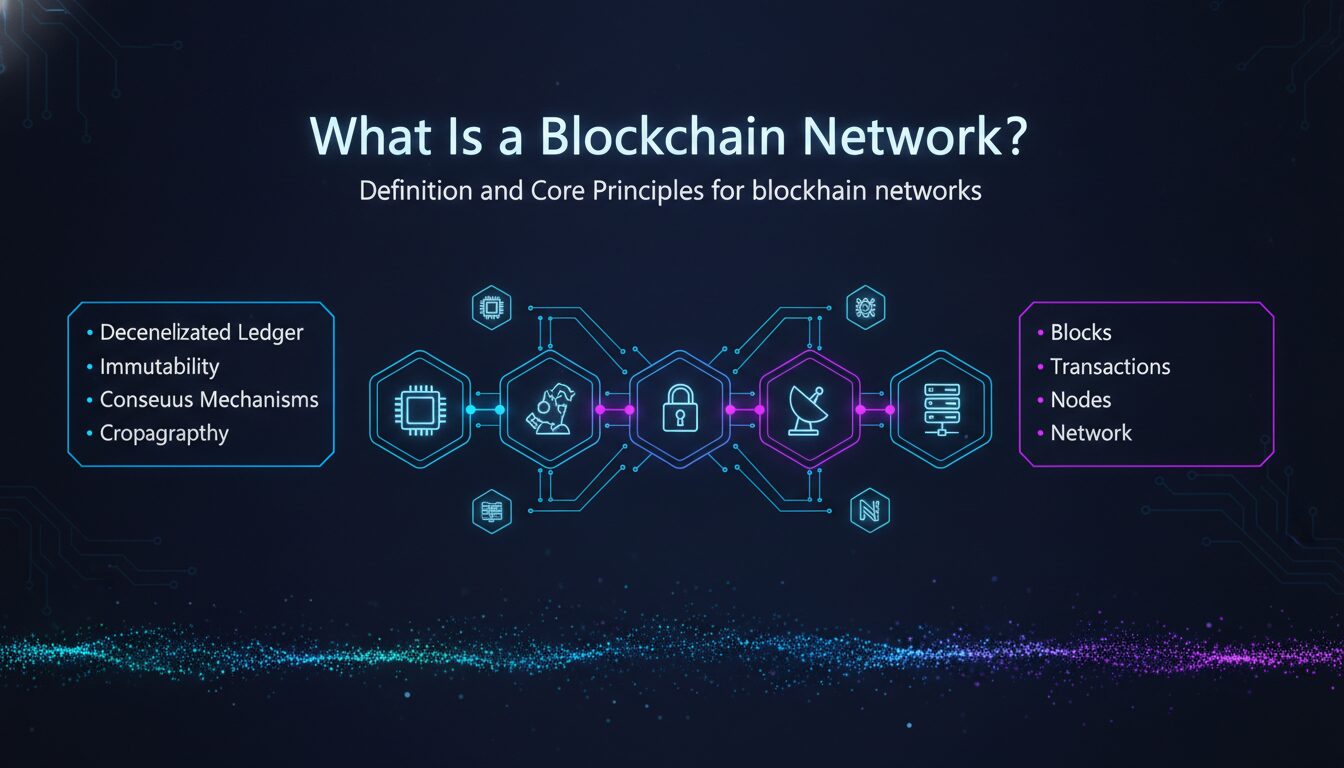
A blockchain network is a peer-to-peer system that maintains a distributed ledger of transactions, where data integrity is enforced through cryptography rather than trust in any single institution. Data is grouped into blocks, each containing a cryptographic hash of the previous block, a timestamp, and transaction data. This chaining of blocks creates an immutable record. Altering any block’s contents would require recomputing all subsequent hashes and overcoming the network’s consensus, making tampering computationally impractical.
“Blockchain is a shared, immutable digital ledger, enabling the recording of transactions and the tracking of assets within a business network and providing a single source of truth.” – IBM
According to IBM, blockchain operates as a decentralized distributed database where data resides on multiple nodes, enhancing security and resilience. That design is why practitioners often call it a “trust machine”: the protocol itself enforces honesty, not a counterparty.
The Building Blocks: How Networks Structure Data
Each block in a blockchain contains three core elements: a cryptographic hash of the previous block, a timestamp, and transaction data, typically organized as a Merkle tree. The Merkle tree structure, first incorporated by Stuart Haber, W. Scott Stornetta, and Dave Bayer in 1992, allows multiple transaction certificates to be collected into one block efficiently. That efficiency improvement was foundational. Without it, the data structures underlying modern this type of networks would be far less practical at scale.
As Wikipedia notes, blockchain records are resistant to alteration because changing data in any given block retroactively requires altering all subsequent blocks and obtaining network consensus. That’s not a policy rule. It’s a mathematical constraint baked into the protocol.
Decentralization and Consensus: The Heart of Trust
Traditional databases rely on a central authority to validate records. this kind of networks distribute control among all participants, called nodes. No single entity can unilaterally alter the ledger. Transactions must be verified through a consensus mechanism, a set of rules that nodes follow to agree on the state of the chain. This eliminates the need for intermediaries like banks, reducing costs and removing single points of failure.
Consensus ensures that every copy of the ledger across the network is identical. Popular mechanisms include Proof of Work (PoW), used by Bitcoin, where miners solve complex mathematical puzzles to validate blocks, and Proof of Stake (PoS), adopted by Ethereum in 2022, where validators lock up tokens as collateral to propose and attest blocks. Each mechanism balances security, speed, and energy efficiency differently.
Key Terminology: Nodes, Miners, and Validators
To understand blockchain, you need a firm grip on the vocabulary:
- Nodes: Computers that run the blockchain software and maintain a copy of the ledger. Full nodes store the entire history; light nodes store only block headers.
- Miners: In PoW networks, miners compete to solve cryptographic puzzles. The winner earns block rewards and transaction fees.
- Validators: In PoS networks, validators are chosen to propose blocks based on their stake, earning rewards for honest behavior and losing stake for misbehavior.
- Smart Contracts: Self-executing code stored on the blockchain that automatically enforces predefined rules when conditions are met.
- Fork: A split in the blockchain due to protocol changes or community disagreements, resulting in two diverging chains.
A Brief History: Before Bitcoin
The intellectual roots of networks predate Satoshi Nakamoto by decades. Cryptographer David Chaum first proposed a blockchain-like protocol in his 1982 dissertation. Stuart Haber and W. Scott Stornetta described a cryptographically secured chain of blocks in 1991, specifically to prevent document timestamp tampering. By 1992, they had incorporated Merkle trees to improve efficiency. Their company Surety has published document certificate hashes in The New York Times every week since 1995.
Satoshi Nakamoto built on all of that prior work in 2008, adding a difficulty parameter to stabilize block production rates and solving the double-spending problem without a trusted authority. Bitcoin launched in 2009 as the first practical implementation. Ethereum followed in 2015, extending the model to support smart contracts and broadening the design space for what blockchain networks could actually do.
Pros and Cons of Blockchain Networks
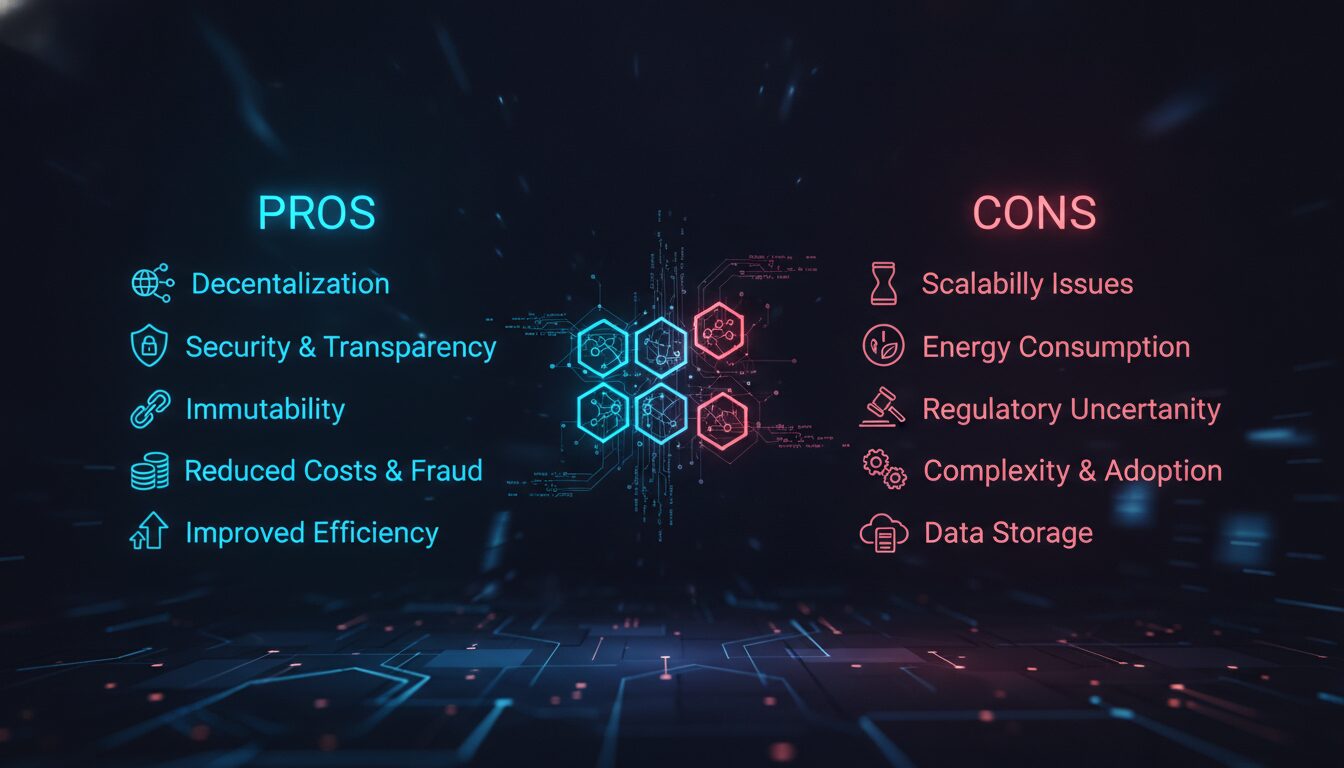
Pros
- Tamper-proof records: Cryptographic chaining makes historical data extremely difficult to alter without network consensus.
- Trustless operation: Participants transact directly without relying on banks, clearinghouses, or other intermediaries.
- Transparency and auditability: Public networks provide a complete, queryable transaction history accessible to anyone.
- Programmability: Smart contracts automate complex multi-party agreements, reducing manual overhead and error rates.
- Resilience: Distributed architecture means no single point of failure can take down the network.
Cons
- Scalability constraints: The scalability trilemma forces trade-offs between decentralization, security, and throughput that no network has fully resolved.
- Energy consumption: PoW networks, particularly Bitcoin, consume significant electricity, drawing ongoing environmental scrutiny.
- Interoperability gaps: Without standardized bridges, liquidity and data remain siloed across different chains.
- Regulatory uncertainty: Evolving rules across jurisdictions create compliance complexity for builders and operators.
- Irreversibility: Immutability is a feature, but it also means errors in transactions or smart contract code cannot be easily undone.
Four Main Types of Blockchain Networks
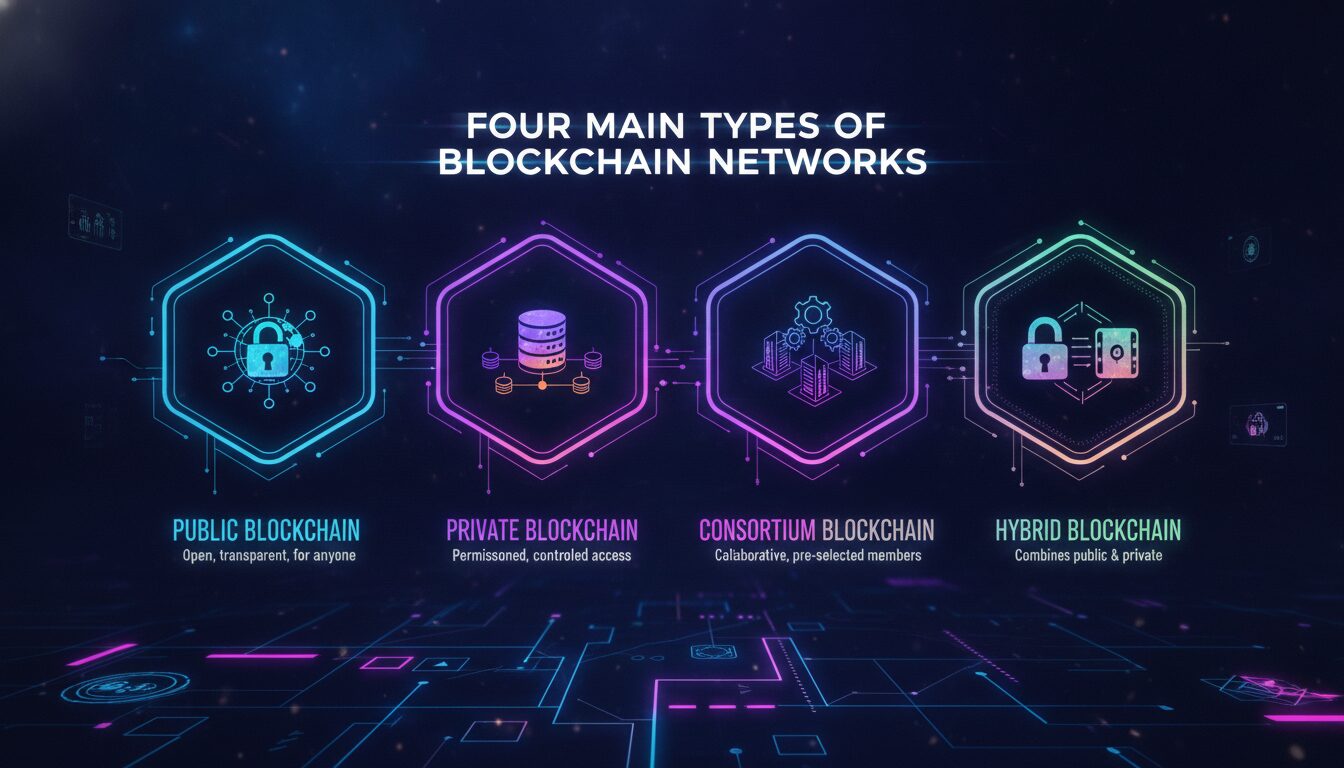
Public Blockchain Networks
Public blockchain networks are fully decentralized and open to anyone. Any node can join, read transactions, participate in consensus, and deploy smart contracts. Examples include Bitcoin, Ethereum, and Solana. These networks prioritize transparency and censorship resistance, though they often face scalability challenges due to their open, permissionless nature.
According to India’s National Informatics Centre, public blockchains are non-restrictive, permissionless distributed ledger systems where any node can verify transactions or mine. That openness makes them ideal for cryptocurrencies and decentralized applications where trustless interactions are essential.
Private Blockchain Networks
Private blockchain networks, also called permissioned blockchains, restrict participation to authorized entities. A single organization typically controls who can join, view data, and engage in consensus. This setup offers higher throughput and privacy, making it suitable for enterprise use cases like supply chain management or internal record-keeping.
Critics have a point worth taking seriously. As Wikipedia notes, Computerworld called the marketing of privatized blockchains without proper security models “snake oil.” That said, carefully designed permissioned blockchains can be more secure in practice than permissionless ones for specific business contexts, particularly where regulatory compliance demands strict access controls.
Consortium Blockchain Networks
Consortium blockchain networks are semi-decentralized and operate under a group of organizations rather than a single entity. Multiple pre-selected nodes share responsibility for consensus and governance. This structure balances the efficiency of private chains with partial decentralization, making it popular in industries where competitors must collaborate, such as banking consortia or trade finance platforms. Examples include R3 Corda and Hyperledger Fabric.
India’s National Informatics Centre defines consortium blockchains as those where “more than one organization manages the network,” each acting as a node to exchange information or mine. This collaborative model reduces single-point-of-failure risk while maintaining strict access controls.
Hybrid Blockchain Networks
Hybrid blockchain networks combine elements of both public and private chains. They allow organizations to keep certain data private while exposing other parts to a public network for transparency. A supply chain hybrid network might share shipment tracking publicly but restrict confidential contract terms to authorized parties.
According to Paxos, “a hybrid blockchain is a combination of the private and public blockchain,” enabling users to control which data stays confidential and which goes public. This type is increasingly relevant in real estate and healthcare, where selective transparency is a regulatory and operational requirement.
How Blockchain Networks Achieve Consensus
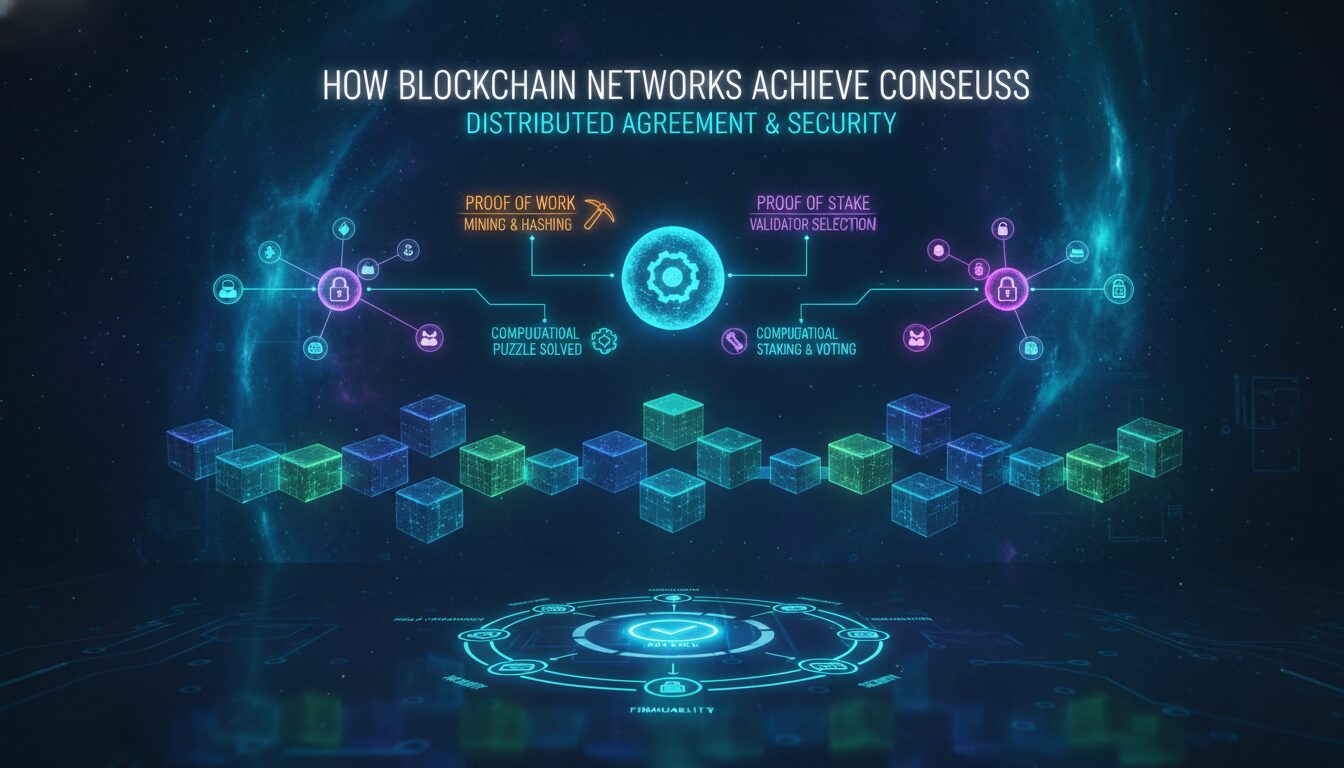
Consensus mechanisms are the protocols that allow distributed nodes to agree on a single version of truth without a central coordinator. Choosing the right one involves real trade-offs across security, speed, decentralization, and energy cost.
Proof of Work (PoW)
Proof of Work is the original consensus mechanism, first implemented by Bitcoin. Miners race to solve a cryptographic puzzle that requires significant computational resources. The first to solve it broadcasts the new block and receives a reward. PoW provides robust security but consumes substantial electricity, a criticism that has followed Bitcoin since its early years.
Despite that energy cost, PoW remains the benchmark for security. The Bitcoin network has never been successfully compromised at the protocol level since its launch in 2009. That track record matters when you’re talking about a network securing hundreds of billions in value.
Proof of Stake (PoS)
Proof of Stake eliminates energy-intensive mining by selecting validators based on the number of tokens they stake as collateral. Validators propose and vote on blocks, earning fees for honest participation and risking their stake for misbehavior. Ethereum’s transition to PoS in 2022, known as “The Merge,” dramatically reduced its energy footprint.
PoS networks like Solana, Cardano, and Polkadot achieve higher throughput and lower fees than PoW. The trade-off: large token holders may gain disproportionate influence over validation, a design tension that developers continue to debate actively.
Other Mechanisms: DPoS, PoH, and PoA
Beyond PoW and PoS, several specialized consensus algorithms have emerged. Delegated Proof of Stake (DPoS), used by TRON and EOS, allows token holders to vote for a small number of delegates who produce blocks. Proof of History (PoH), a Solana innovation, creates a cryptographic timestamp before consensus to accelerate transaction ordering. Proof of Authority (PoA) relies on pre-approved validators, often used in private or test networks. Each mechanism optimizes for specific goals: speed, decentralization, or compliance.
Top Blockchain Networks in 2026
The modern landscape features hundreds of active blockchain networks. Alchemy’s list of 162 blockchains illustrates the diversity, from established layer-1 giants to emerging layer-2 solutions. Below, we compare five of the most influential networks that QuickNode and other analysts rank among the top platforms for decentralized application development in 2026.
| Network | Consensus | Approx. TPS | Primary Use Case | Launch Year |
|---|---|---|---|---|
| Bitcoin | Proof of Work | 7 | Digital currency, store of value | 2009 |
| Ethereum | Proof of Stake | 15-30 (L1) | Smart contracts, DeFi, NFTs | 2015 |
| Solana | Proof of History + PoS | ~65,000 (theor.) | High-speed dApps, DePIN | 2020 |
| BNB Chain | Proof of Staked Authority | ~2,000 | DeFi, payments, trading | 2020 |
| Polygon PoS | Proof of Stake | ~7,000 | Ethereum scaling, dApps | 2020 |
Ethereum: The Smart Contract Pioneer
Ethereum remains the most widely used blockchain network for decentralized applications. Its native token, Ether (ETH), fuels transactions and smart contract execution. The introduction of Ethereum Improvement Proposals (EIPs) continuously refines the protocol. EIP-1559 in 2021 introduced a fee-burning mechanism, and EIP-4844 (proto-danksharding) delivers cheaper data availability for layer-2 rollups. With the Merge completed, Ethereum becomes deflationary during periods of high activity, reinforcing its position as the leading programmable blockchain.
Solana: High-Speed, Low-Cost Transactions
Solana has grown substantially, distinguishing itself with sub-second finality and minimal fees. Its unique Proof of History mechanism timestamps transactions before consensus, enabling theoretical throughput of around 65,000 TPS. That performance profile attracts DePIN (Decentralized Physical Infrastructure Networks) and high-frequency trading applications. Despite occasional network outages in its early years, Solana’s developer community and institutional adoption continue to expand.
Bitcoin: The Original Digital Currency Network
Bitcoin is primarily a monetary network rather than a general-purpose smart contract platform. Its capped supply of 21 million coins and battle-tested security make it the most decentralized and secure blockchain network in existence. According to Wikipedia, by 2024 the Bitcoin blockchain size exceeded 600 GB, reflecting over a decade of transactional history. Bitcoin L1 processes roughly 7 TPS, but layer-2 solutions like the Lightning Network enable faster, cheaper payments on top of that base layer.
Layer-2 Solutions: Scaling with Base, Arbitrum, and OP Mainnet
Ethereum’s high demand has produced a vibrant layer-2 ecosystem. Arbitrum and OP Mainnet use optimistic rollups to bundle transactions off-chain and submit proofs to Ethereum, reducing costs and increasing throughput. Base, launched by Coinbase, focuses on consumer applications and payments. These layer-2 networks collectively process far more transactions than Ethereum L1, with total value locked (TVL) across the top rollups reaching significant scale.
Emerging Networks: Sui, Aptos, and Avalanche
Newer layer-1 networks challenge incumbents with novel architectures. Sui and Aptos, both based on the Move programming language, feature object-centric storage and parallel execution for extreme scalability. Avalanche offers sub-second finality through its Snowman consensus protocol and supports custom subnets for institutional use cases. These networks are still building their developer ecosystems but are attracting serious attention from builders and capital allocators alike.
Blockchain Networks in Practice: Enterprise and Institutional Adoption
Finance and Supply Chain
Blockchain networks are reshaping financial services by enabling faster settlement, reduced counterparty risk, and automated compliance. Singapore Exchange Limited adopted blockchain to streamline interbank payments, solving batch processing inefficiencies that plagued traditional reconciliation workflows, as documented by AWS. In supply chain, companies use blockchain to track goods from origin to delivery, fighting counterfeiting and improving recall accuracy.
Sony Music Entertainment Japan has used blockchain services to make digital rights management more efficient, improving productivity and reducing costs in copyright processing, according to AWS. These aren’t proof-of-concept pilots. They’re production deployments solving real operational problems.
Government and Public Sector
Governments worldwide are piloting blockchain networks for land registries, identity management, and benefits distribution. India’s National Informatics Centre has developed property chain, certificate chain, and logistics chain products built on various blockchain types. According to Wikipedia, an Accenture analysis found that blockchains had reached a 13.5% adoption rate within financial services by 2016, enough to classify them as entering the early adopters phase. Gartner found in 2018 that only 1% of CIOs had implemented any blockchain, underscoring the gap between hype and actual deployment at that time.
Challenges: Scalability, Energy, and Interoperability
Despite real progress, blockchain networks still face significant hurdles. The scalability trilemma, balancing decentralization, security, and speed, remains unresolved across every major network. PoW networks draw criticism for their environmental footprint, though many mining operations are shifting toward renewable energy sources. Interoperability between disparate chains is another pressing issue. Without standardized bridges, liquidity and data remain siloed. Initiatives like Polkadot and Cosmos aim to solve this via relay chains and inter-blockchain communication protocols.
Blockchain vs. Traditional Databases
The comparison matters for any enterprise evaluating whether blockchain is the right tool. Traditional databases are faster, cheaper to operate, and easier to modify. They work well when a single trusted party controls the data. Blockchain networks earn their complexity premium only when multiple parties who don’t fully trust each other need to share a single source of truth without a central administrator. If you control all the data and all the participants, a traditional database is almost certainly the better choice. If you don’t, blockchain’s trust guarantees become genuinely valuable.
The Future of Blockchain Networks: Interoperability, AI, and Regulation
Cross-Chain Bridges and Protocols
The next wave of blockchain networks will prioritize interoperability. Cross-chain bridges enable asset and data transfers between different networks, though they’ve been frequent targets for exploits. Protocols like the Inter-Blockchain Communication (IBC) standard in the Cosmos ecosystem offer a more secure, standardized approach. As the Web3 space matures, expect tighter integration between layer-1s, layer-2s, and sidechains, with security audits becoming a baseline requirement rather than an afterthought.
Integration with AI and IoT
Blockchain networks are increasingly converging with artificial intelligence and the Internet of Things. AI agents can use smart contracts for automated payments and decision-making, while IoT devices can record sensor data directly onto a blockchain for tamper-proof logs. IBM notes that ongoing advancements are aimed at improving blockchain’s scalability and privacy for exactly these kinds of integrations. This convergence could underpin autonomous supply chains, smart cities, and verifiable AI training datasets.
Regulatory Landscape and Compliance
Governments are moving to regulate blockchain networks and digital assets. The European Union’s Markets in Crypto-Assets (MiCA) regulation and U.S. Securities and Exchange Commission enforcement actions are actively shaping how networks operate. Compliance tools, such as TRM Labs’ blockchain analytics platform, help businesses monitor transactions for anti-money laundering (AML) purposes. The regulatory backdrop will influence whether blockchain networks remain decentralized or evolve toward more permissioned, enterprise-friendly models over the next several years.
“Blockchains allow participants to verify and record transactions without relying on a central authority, enabling transparency, auditability, and trust in data integrity.” – TRM Labs
Conclusion
Blockchain networks have evolved from a niche cryptocurrency experiment into a foundational layer of a new decentralized internet. The four main types, public, private, consortium, and hybrid, cater to diverse needs from open-access DeFi to tightly controlled enterprise workflows. As the market races toward a projected $1 trillion valuation by 2032 (Statista), networks like Ethereum, Solana, and Bitcoin will continue to anchor the ecosystem, while layer-2s and interoperability protocols open new design space. The builders who understand these trade-offs at the protocol level are the ones who will ship the applications that matter.
If you’re serious about building on blockchain infrastructure, apply to the Genesis Cohort at Digital Blockchains. We work with founders and developers who want to go deep on protocol design, tokenomics, and decentralized systems.
Frequently Asked Questions
What is a blockchain network?
A blockchain network is a decentralized, distributed ledger that records transactions across multiple computers so that no single entity controls the data. Transactions are grouped into blocks, linked chronologically, and secured through cryptography, ensuring immutability and transparency.
What are the 4 types of blockchain networks?
The four main types are public (open, permissionless), private (controlled by one organization), consortium (governed by a group of organizations), and hybrid (combining public and private elements). Each offers different trade-offs in terms of security, transparency, and operational efficiency.
What are the top 5 blockchain networks in 2026?
According to QuickNode and Alchemy rankings, the top five include Ethereum, Solana, Bitcoin, BNB Chain, and Polygon PoS. Layer-2 networks like Arbitrum and Base are also rapidly gaining traction for scaling decentralized applications.
Are blockchain networks secure?
Blockchain networks are designed to be tamper-proof through cryptographic hashing and consensus mechanisms. Security depends heavily on network size and design: larger, more decentralized networks like Bitcoin are extremely difficult to compromise at the protocol level, while smaller or permissioned networks may carry different risk profiles.
What is the difference between public and private blockchain networks?
Public networks allow anyone to join and validate transactions, as with Bitcoin and Ethereum, prioritizing decentralization and transparency. Private networks restrict access to pre-approved participants, offering greater control, speed, and privacy for enterprise use cases where open participation isn’t appropriate.
How do blockchain networks make decisions without a central authority?
They use consensus mechanisms such as Proof of Work, where miners solve cryptographic puzzles, or Proof of Stake, where validators stake tokens as collateral. These rules ensure all nodes agree on the ledger’s state without any single party having final say.