Custom blockchain solutions are purpose-built distributed ledger systems engineered to meet an organization’s exact requirements for security, scalability, and governance. Unlike generic public networks, they give you complete control over consensus rules, data structures, and transaction logic.
Key Takeaways
- Custom blockchain solutions provide tailored architecture that matches specific business workflows rather than forcing workflows to fit a generic chain.
- Builders can design bespoke consensus mechanisms, tokenomics, and privacy safeguards from the ground up.
- Popular development frameworks include Hyperledger Fabric, Cosmos SDK, and Substrate.
- Finance, healthcare, and supply chain see the strongest ROI from custom chains because their compliance and privacy requirements exceed what public networks offer.
- Security audits and ongoing governance planning are non-negotiable, not optional line items.
- Network topology choices (public, private, consortium, hybrid) determine who reads, writes, and validates transactions.
What Are Custom Blockchain Solutions?
Definition and Core Concepts
A custom blockchain solution is a decentralized ledger technology (DLT) system engineered specifically for a particular use case or organization. Public networks like Ethereum or Bitcoin are general-purpose infrastructure; a custom blockchain is architected to align with the exact operational, security, and scalability demands of the business it serves. According to Code Driven Labs, custom blockchain development grants organizations “complete control over the architecture, data rules, tokenomics, and more” – ensuring the resulting network is a strategic asset, not a compromise.
At its core, a custom blockchain retains the foundational attributes of DLT: immutability, transparency, and decentralization. The designer can tune parameters such as block size, block time, node permissions, and consensus models. That configurability is what separates custom blockchain solutions from off-the-shelf platforms.
How Custom Blockchain Solutions Differ from Generic Platforms
Generic public blockchains impose pre-set rules on every participant. For an enterprise, that rigidity introduces friction: high transaction fees during network congestion, inability to satisfy data privacy regulations like GDPR, and throughput ceilings that choke business scaling. Custom blockchain solutions bypass those constraints by letting teams craft the protocol from scratch or modify an existing framework to suit shifting needs.
A custom solution can also operate across multiple network topologies: public, private, or permissioned consortium. That flexibility lets businesses dictate who can read, write, or validate transactions, which is critical for industries handling sensitive data where public visibility is undesirable.
“Custom blockchain development allows Web3 companies to design bespoke consensus algorithms for their unique use cases, achieve blazing-fast performance without depending on a congested network, and define exactly how tokens are minted, distributed, and used.” – Code Driven Labs
The Growing Need for Custom Blockchain Development
Limitations of Off-the-Shelf Blockchain Platforms
Many organizations start on existing chains like Ethereum or Solana because of their developer ecosystems and token liquidity. Over time, they hit walls. High gas fees and scalability bottlenecks are the most common pain points, as documented by multiple development firms. Shared infrastructure also presents security risks: a vulnerability in one dApp can affect others running on the same network.
Off-the-shelf platforms constrain governance models too. An enterprise that wants voting weighted by verified identity rather than token holdings cannot implement that on a typical public chain. Custom blockchain solutions fill this gap by letting teams define governance frameworks from the ground up.
Business Drivers for Customization
Three macro trends are accelerating adoption. First, the maturation of Web3 has pushed companies to demand decentralized applications that align precisely with their value propositions. Second, regulatory pressure in finance and healthcare requires transaction data handling that public chains cannot guarantee. Third, the evolution of development toolkits – Hyperledger, Cosmos, Substrate – has lowered the barrier to building bespoke chains, making custom blockchain solutions cost-effective for a broader range of organizations.
According to Fortune Business Insights, the global blockchain technology market is projected to reach significant scale by 2030, with custom enterprise deployments representing a growing share of that expansion. The ability to mint private tokens, streamline B2B settlements, or manage complex supply chains are key motivators driving that shift.
Key Components of Custom Blockchain Solutions
Consensus Mechanisms and Governance Models
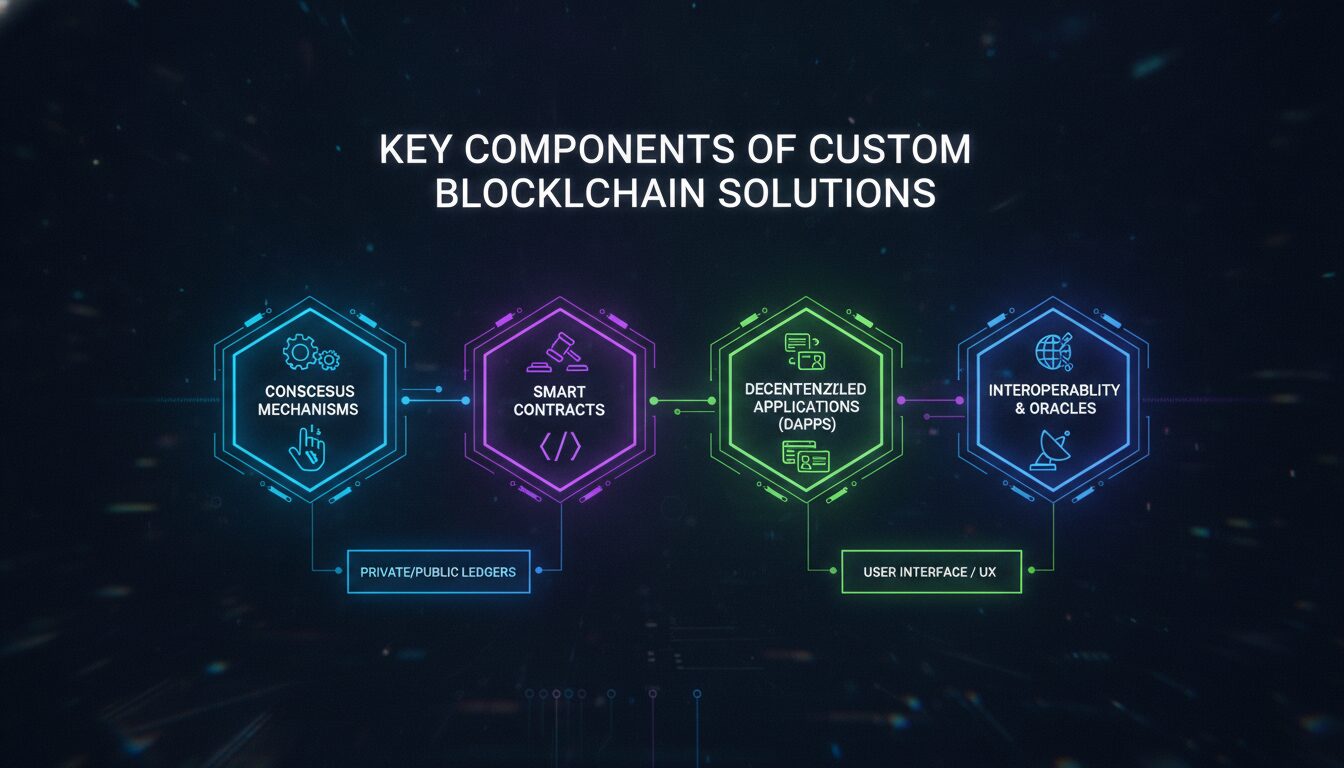
A consensus mechanism is the algorithmic heart of any blockchain, defining how participants agree on transaction validity. Bitcoin uses Proof of Work; Ethereum moved to Proof of Stake. Custom blockchain solutions can adopt Proof of Authority (PoA), Delegated Proof of Stake (DPoS), or hybrid models. A healthcare consortium, for instance, might use PoA where only licensed hospitals validate blocks, achieving both speed and regulatory compliance without exposing patient data to anonymous validators.
Governance models can be custom-coded as well. Instead of on-chain voting based on token holdings, a custom chain could incorporate multi-signature voting by known entities or integrate with existing legal frameworks. That degree of flexibility is impossible on most public platforms.
Smart Contracts and dApp Development
Smart contracts are self-executing code that automates business logic on the blockchain. According to Serokell, “smart contracts and dApps” are central components of blockchain development, with secure and optimized code being the critical differentiator between a functional system and a liability.
In a custom chain, the runtime for smart contracts can be tailored. Developers can use Solidity for EVM-compatible frameworks or Rust for Substrate-based chains. Here is a minimal Solidity example of a permissioned contract deployment guard:
// SPDX-License-Identifier: MIT
pragma solidity ^0.8.20;

contract PermissionedDeployer {
 address public admin;
 mapping(address => bool) public approvedDeployers;

 constructor() {
 admin = msg.sender;
 }

 modifier onlyAdmin() {
 require(msg.sender == admin, "Not admin");
 _;
 }

 function approveDeployer(address deployer) external onlyAdmin {
 approvedDeployers[deployer] = true;
 }

 function revokeDeployer(address deployer) external onlyAdmin {
 approvedDeployers[deployer] = false;
 }

 modifier onlyApproved() {
 require(approvedDeployers[msg.sender], "Not approved");
 _;
 }

 // Extend this pattern to gate contract factory calls
 function deployContract() external onlyApproved returns (bool) {
 // Factory logic here
 return true;
 }
}
An enterprise can extend this pattern to ensure only audited contracts reach the network, mitigating the risk of malicious code that plagues open public chains.
Tokenomics and Digital Assets
Tokenomics is the economic model of a blockchain and a critical component of any custom deployment. Businesses can design tokens for utility, governance, or asset representation. In a supply chain context, tokens might represent physical goods; in a DeFi platform, they might serve as a stablecoin or reward token. Customization allows precise control over inflation rates, distribution mechanisms, and staking rewards, aligning incentives with the network’s actual goals rather than inheriting defaults from a generic chain.
Token standards matter here too. EVM-compatible custom chains can adopt ERC-20 for fungible assets, ERC-721 for non-fungible tokens, or ERC-1155 for hybrid asset types. Substrate-based chains can define entirely custom asset pallets, bypassing Ethereum’s standards altogether when the use case demands it.
Types of Custom Blockchain Solutions: A Comparative Overview
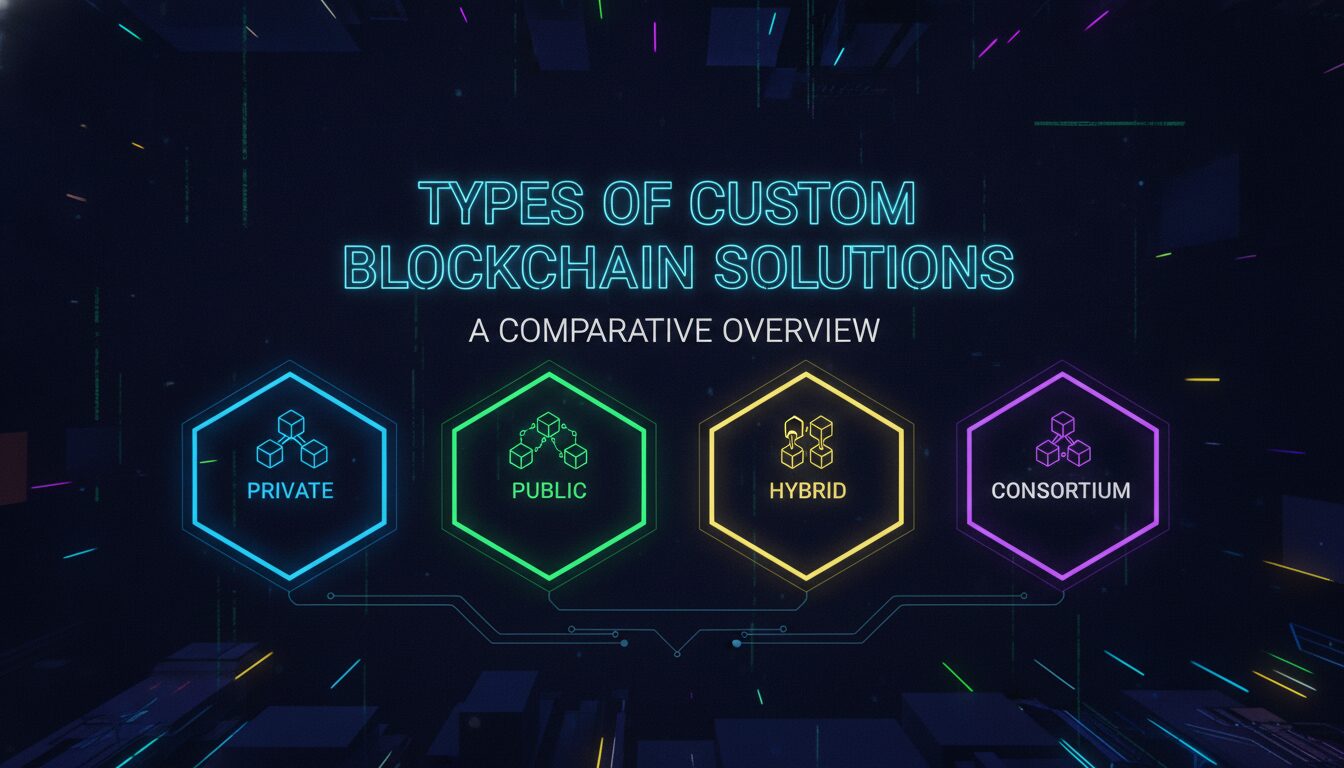
There are four primary architectures for custom blockchain solutions. The right choice depends on the desired balance between transparency, control, and performance.
| Type | Description | Best For | Key Advantage |
|---|---|---|---|
| Public Custom | Open, permissionless network with tailored features | Decentralized apps needing broad participation | Maximum transparency and immutability |
| Private Custom | Permissioned network controlled by a single organization | Internal enterprise processes, sensitive data management | High throughput, strict access control |
| Consortium | Governed by a group of trusted entities | Cross-organizational collaboration (e.g., banking consortium) | Shared control with collective trust |
| Hybrid | Combines public and private elements | Selective transparency, regulated industries | Balanced privacy and public verifiability |
Hyperledger Fabric is the go-to for private and consortium chains. Cosmos SDK enables interoperable public or hybrid chains. Substrate sits in the middle, supporting nearly any topology through its modular pallet system.
Pros and Cons of Custom Blockchain Solutions
Pros
- Full architectural control: Every parameter from block time to consensus algorithm is yours to define, not inherited from a third-party protocol.
- Regulatory fit: Private and consortium topologies can be designed to satisfy GDPR, HIPAA, KYC/AML, and other jurisdiction-specific requirements from day one.
- Performance optimization: Without shared infrastructure, throughput and latency targets are set by your architecture, not by network congestion from unrelated dApps.
- Custom tokenomics: Inflation schedules, staking rewards, and governance rights are designed to serve your network’s goals rather than a generic community.
- Reduced external dependency: No exposure to protocol upgrades, fee volatility, or governance decisions made by external token holders.
Cons
- Higher upfront cost: Building from scratch or heavily customizing a framework requires specialized expertise in cryptography, distributed systems, and smart contract security.
- Bootstrapping validator sets: A new chain needs a credible set of validators or nodes from launch; thin validator sets are a real attack surface.
- Ongoing maintenance burden: Protocol upgrades, security patches, and governance evolution fall entirely on your team rather than a large open-source community.
- Interoperability complexity: Connecting a custom chain to the broader ecosystem requires bridges or IBC-style protocols, each introducing additional attack surface.
- Audit requirements: Every custom component needs independent security review; skipping audits to save budget is how projects lose funds.
Steps to Develop a Custom Blockchain Solution
Developing a custom blockchain solution is a rigorous, multi-phase process. The following steps reflect best practices synthesized from multiple development firms and protocol teams.
Step 1: Discovery and Requirements Analysis
Start with deep business analysis. Teams must answer: What problem does the blockchain actually solve that a database cannot? What are the performance targets in transactions per second and latency? What compliance requirements apply? This phase produces a detailed requirements document and a feasibility study. Skipping it is how projects end up building infrastructure nobody uses.
Step 2: Architecture Design and Technology Stack Selection
Based on requirements, architects design the network topology, consensus mechanism, and data structures. The technology stack is chosen: Hyperledger Fabric, Corda, Cosmos SDK, Substrate, or a custom engine. A DeFi platform might prefer Cosmos SDK for its interoperability; a supply chain consortium might choose Fabric for its privacy channels. The design also covers node deployment, identity management, and off-chain integrations.
Step 3: Smart Contract and Runtime Development
Development covers smart contracts, client SDKs, API layers, and front-end interfaces. For EVM-compatible chains, Solidity is the standard. For Substrate, Rust pallets define the runtime logic. Code quality here is not negotiable: a single reentrancy bug or integer overflow can drain a treasury. Formal verification tools like Certora or Echidna should be part of the development pipeline, not an afterthought.
Step 4: Testing, Security Audit, and Testnet Launch
Rigorous testing includes unit tests, integration tests, and testnet simulations under realistic load. Security audits from independent firms are essential. As Serokell notes, third-party security reports build trust with users and investors and surface vulnerabilities that internal teams miss due to familiarity bias. After a stable testnet period, mainnet launch proceeds with a planned upgrade path.
Step 5: Mainnet Deployment and Ongoing Governance
Post-deployment, the work is not done. Ongoing maintenance, protocol upgrades, and governance evolution ensure the network adapts to business needs. This is where many projects underinvest: they treat launch as the finish line when it is actually the starting gun for operational blockchain management.
Industries Transformed by Custom Blockchain Solutions
Finance and Banking
Financial services were early adopters. Custom blockchain solutions power cross-border settlements, trade finance, and tokenized assets. According to Jupiter Research data cited by Itransition, adopting blockchain could allow financial services organizations and banks to save up to $27 billion on cross-border settlement transactions by the end of 2030, reducing costs by more than 11%. Through private or consortium chains, institutions achieve settlement finality in minutes rather than the 2-3 days standard clearing processes currently require, without exposing sensitive client data to public networks.
Supply Chain and Logistics
Transparency and traceability are the core value propositions here. Custom blockchains let participants track goods from origin to endpoint with an immutable record. Access controls mean suppliers see only their relevant data while retailers get cryptographic proof of authenticity. This architecture directly combats counterfeiting and eliminates the documentation friction that slows cross-border logistics.
Healthcare and Identity Management
Healthcare data management requires strict privacy. As Softeq documents, blockchain enables an immutable decentralized database for health data that addresses interoperability, immutability, and transmission security challenges across fragmented institutional systems. Custom blockchain solutions with zero-knowledge proofs can verify patient identities without revealing the underlying data. Electronic health records can be shared among providers under patient consent, with the entire permission trail recorded on-chain. Such systems must adhere to HIPAA, which is achievable through private, permissioned networks with advanced encryption.
“Blockchain technology allows creating an immutable decentralized database for health data to help cope with all the major problems: interoperability, immutability and transmission security.” – Softeq
Regulatory Considerations for Custom Blockchain Deployments
Jurisdiction-Specific Compliance
Regulatory requirements vary significantly by geography and sector. A custom chain handling financial assets in the EU must account for MiCA (Markets in Crypto-Assets Regulation). A healthcare chain in the US must satisfy HIPAA. A chain processing personal data of EU residents must address GDPR’s right-to-erasure requirements, which creates a genuine tension with blockchain immutability that architects must resolve through off-chain data storage patterns or cryptographic deletion techniques.
KYC and AML obligations apply to any custom chain that touches financial assets. Building identity verification into the protocol layer from day one is far cheaper than retrofitting it after launch. Engaging legal counsel with blockchain-specific expertise during the architecture phase is not optional for regulated industries.
Smart Contract Legal Status
Several jurisdictions now recognize smart contracts as legally binding agreements. Wyoming, for example, has enacted DAO LLC legislation. The EU’s eIDAS 2.0 framework creates pathways for blockchain-based identity. Builders of custom blockchain solutions should track these developments because the legal enforceability of on-chain logic directly affects product design decisions around dispute resolution and upgrade mechanisms.
Challenges in Custom Blockchain Development and How to Overcome Them
Security and Compliance Risks
Custom blockchains are not immune to attacks. Flaws in smart contract code cause real financial losses. Security best practices – formal verification, independent auditing, and bug bounties – are non-negotiable. Compliance varies by jurisdiction; a custom solution must accommodate KYC/AML regulations if it touches financial assets. Engaging legal experts during the design phase, not after deployment, is the only way to mitigate these risks without expensive rearchitecting.
Scalability and Interoperability Considerations
A custom chain might perform well at launch but struggle as transaction volume grows. Horizontal scaling via sharding or sidechains should be architected from the start, not bolted on later. Interoperability with other networks is equally critical. Using standards like IBC (Inter-Blockchain Communication) in Cosmos or native bridges ensures the custom chain doesn’t become an isolated silo. Projects like Polkadot and Cosmos provide robust frameworks for building interoperable custom blockchain solutions without sacrificing sovereignty.
How to Choose the Right Custom Blockchain Development Partner
In-House vs. Outsourcing
Building a blockchain in-house requires a rare combination of deep cryptography, distributed systems, and domain expertise. Most enterprises do not have that combination sitting idle. Outsourcing to specialized firms accelerates time-to-market and reduces the risk of architectural mistakes that are expensive to fix post-launch. Code Driven Labs describes their model as handling “the entire lifecycle, including blockchain architecture planning, consensus model design, smart contract development, chain implementation using frameworks like Substrate, Cosmos SDK, or Tendermint, node setup and testnet launch.”
Key Criteria for Evaluation
When evaluating a custom blockchain solutions provider, assess their experience with specific frameworks (Hyperledger, Cosmos, Substrate), their track record of delivered projects, security audit capabilities, and sector knowledge. A partner who understands your industry can propose governance models and compliance features that a generalist firm will miss. Also assess their approach to post-launch support: protocol governance does not stop at mainnet.
If you want to explore how Digital Blockchains approaches protocol infrastructure and tokenomics design, the studio page outlines our methodology. For a deeper look at token launch architecture specifically, see our article on token launch services and DAO creation.
Future Trends in Custom Blockchain Solutions
Integration with Web3 and DeFi
Custom blockchains are increasingly connected to the broader Web3 ecosystem. As of 2026, enterprises want their private chains to interact with public DeFi protocols for liquidity or to issue NFTs that trade on open markets. This drive for composability is producing more hybrid architectures and accelerating adoption of cross-chain communication standards. The line between “enterprise chain” and “public DeFi protocol” is blurring faster than most analysts predicted.
Layer 2 and Interoperability Advancements
Layer-2 scaling solutions – Optimistic Rollups, zk-Rollups – are no longer exclusively an Ethereum concern. Custom blockchains can incorporate L2 networks to boost throughput without compromising base-layer security. Interoperability protocols like Polkadot’s XCM and Cosmos’ IBC are making it easier to connect independent chains, turning custom solutions into modules of a larger decentralized ecosystem rather than isolated experiments.
Zero-Knowledge Proofs as a Standard Primitive
ZK proof systems are moving from research curiosity to production infrastructure. This year, multiple custom chain deployments are incorporating ZK-based identity verification and private transaction proofs as baseline features rather than optional add-ons. For regulated industries, ZK proofs solve the fundamental tension between blockchain transparency and data privacy requirements without sacrificing auditability.
Frequently Asked Questions
What is a custom blockchain?
A custom blockchain is a decentralized ledger built or modified specifically for an organization’s needs, offering control over consensus, data privacy, and transaction logic that generic blockchains do not provide. Unlike public networks with fixed rules, a custom chain is architected around the business requirements rather than the other way around.
How much does it cost to develop a custom blockchain solution?
Costs vary widely based on complexity, chosen framework, and development team. A simple private chain using Hyperledger Fabric costs significantly less than a fully custom public chain with novel consensus. Budgeting for security audits and long-term maintenance is essential and often underestimated in initial project scopes.
Is a custom blockchain more secure than a public one?
Not inherently. Security depends on design, implementation, and ongoing maintenance. Custom blockchains allow tailored security measures, but they also introduce the risk of unaudited smart contracts or insufficient validator distribution. A well-audited public chain often has more battle-tested security than a hastily built custom one.
What are the most popular frameworks for custom blockchain development?
Common frameworks include Hyperledger Fabric for enterprise permissioned chains, Cosmos SDK for interoperable sovereign chains, and Substrate for custom multi-purpose blockchains. Corda is also used for financial consortia where legal certainty and privacy are the primary requirements.
Can a custom blockchain interact with Ethereum?
Yes, through bridges or by making the custom chain EVM-compatible. Cosmos and Substrate both support cross-chain communication protocols that allow asset transfers and smart contract interactions with Ethereum. EVM compatibility also means existing Solidity tooling and developer knowledge transfers directly to the custom chain.
What industries benefit most from custom blockchain solutions?
Finance, supply chain, healthcare, and identity management see the strongest fit. Any domain requiring controlled data sharing, regulatory compliance, and robust governance is a prime candidate. These industries share a common need: they want the auditability of a public ledger with the access control of a private database.
Building a custom chain is a serious infrastructure commitment. If you’re at the architecture stage or evaluating whether a custom deployment is the right move, apply to the Genesis Cohort at digitalblockchains.com and work directly with our protocol team.