Blockchain testing services are quality assurance processes that verify the security, performance, and functionality of smart contracts, nodes, and decentralized applications before they touch real money. Because deployed code is immutable, testing is the only real safety net a team has.
Blockchain moved from side project to enterprise infrastructure fast, and the cost of skipping quality assurance has scaled right alongside it. On-chain data shows the crypto industry lost over $3.4 billion to theft between January 2025 and early December 2025, according to TestGrid’s research, with much of it traced back to unaudited code. DeFi protocols alone lost $1.7 billion in 2023 for largely the same reason, per ImpactQA’s analysis. This guide breaks down what testing services actually cover, what they cost, and how to pick a partner who won’t let your protocol become the next headline.
Key Takeaways
- Blockchain testing services exist because deployed code is permanent. You can’t patch your way out of a bad smart contract without a hard fork.
- Full coverage spans smart contracts, consensus mechanisms, node behavior, APIs, and performance under real load.
- Security testing (audits, penetration testing, formal verification) is the highest-priority category given the scale of DeFi losses to date.
- AI-augmented testing platforms are compressing test-case generation and defect detection cycles, but they don’t replace manual audit review.
- Picking a provider comes down to platform expertise, tooling maturity, compliance history, and engagement flexibility.
- Shift-left testing and CI/CD integration cut cost and rework by catching bugs before mainnet deployment.
What Are Blockchain Testing Services?
Blockchain testing services are a set of quality assurance disciplines that verify blockchains, smart contracts, dApps, and distributed ledger networks against functional, security, performance, and integration requirements. Because blockchain data and logic are immutable once recorded, defects become permanent unless the network forks, which makes rigorous pre-deployment testing a business requirement, not a nice-to-have.
The Immutable Nature of Blockchain Demands Rigorous Testing
Traditional software gets patched after release. Blockchain doesn’t work that way. A flawed smart contract managing millions in DeFi liquidity can’t be altered without a network-wide hard fork, and hard forks are messy, political, and often impossible to coordinate.
This immutability, cited by a1qa as a core driver of comprehensive testing, means business logic errors, access-control gaps, or math bugs become permanent attack surfaces the moment they’re deployed. Testing has to be exhaustive: every state, every edge case, every plausible malicious input.
Core Components Under Test: Smart Contracts, Nodes, and Consensus
Modern blockchain testing services target three layers that matter most:
- Smart contracts: the self-executing code governing asset transfer, voting, and automated workflows. Testing validates arithmetic accuracy, re-entrancy guards, and oracle feed integrity.
- Nodes and peer-to-peer networks: verifying synchronization, fork resolution, and data consistency across geographically distributed nodes.
- Consensus mechanisms: Proof-of-Work, Proof-of-Stake, and Byzantine Fault Tolerance algorithms get stress-tested under high transaction volumes and adverse network conditions to confirm finality and liveness.
Why Does Security Matter So Much in Blockchain Testing?
Security matters most because there’s no central authority in a decentralized system to reverse a fraudulent transaction once it settles. Providers like QASource, BugRaptors, and Canarys all treat security as the top priority in their service lineup, and for good reason.
DeFi Vulnerabilities and the Cost of Neglect
According to ImpactQA, faulty smart contracts and inadequate validation caused that $1.7 billion DeFi loss in 2023. Flash-loan exploits, oracle manipulation, and plain logic errors can drain a liquidity pool in a single transaction. Regular security audits and automated vulnerability scanning, both core parts of advanced blockchain testing services, catch these risks before they ever reach mainnet.
Penetration Testing and Smart Contract Audits
A solid security testing strategy combines automated tools like Manticore and Slither with manual expert review. Penetration testers simulate real-world attacks against the application and its supporting infrastructure. Smart contract auditors go line by line, checking compliance with standards like ERC-20 and ERC-721 and verifying the Checks-Effects-Interactions pattern is actually followed. A growing number of firms now offer formal verification to mathematically prove contract behavior rather than just testing for known bug classes.
“Every unaudited line of code is a potential multi-million-dollar vulnerability. In DeFi, testing is the only insurance policy that actually works.” – Security Research Team, ImpactQA
“Blockchain testing focuses on evaluating smart contracts, consensus mechanisms, and network reliability, ensuring seamless integration and operation.” – Canarys, Blockchain Testing Services
What Are the Key Types of Blockchain Testing Services?
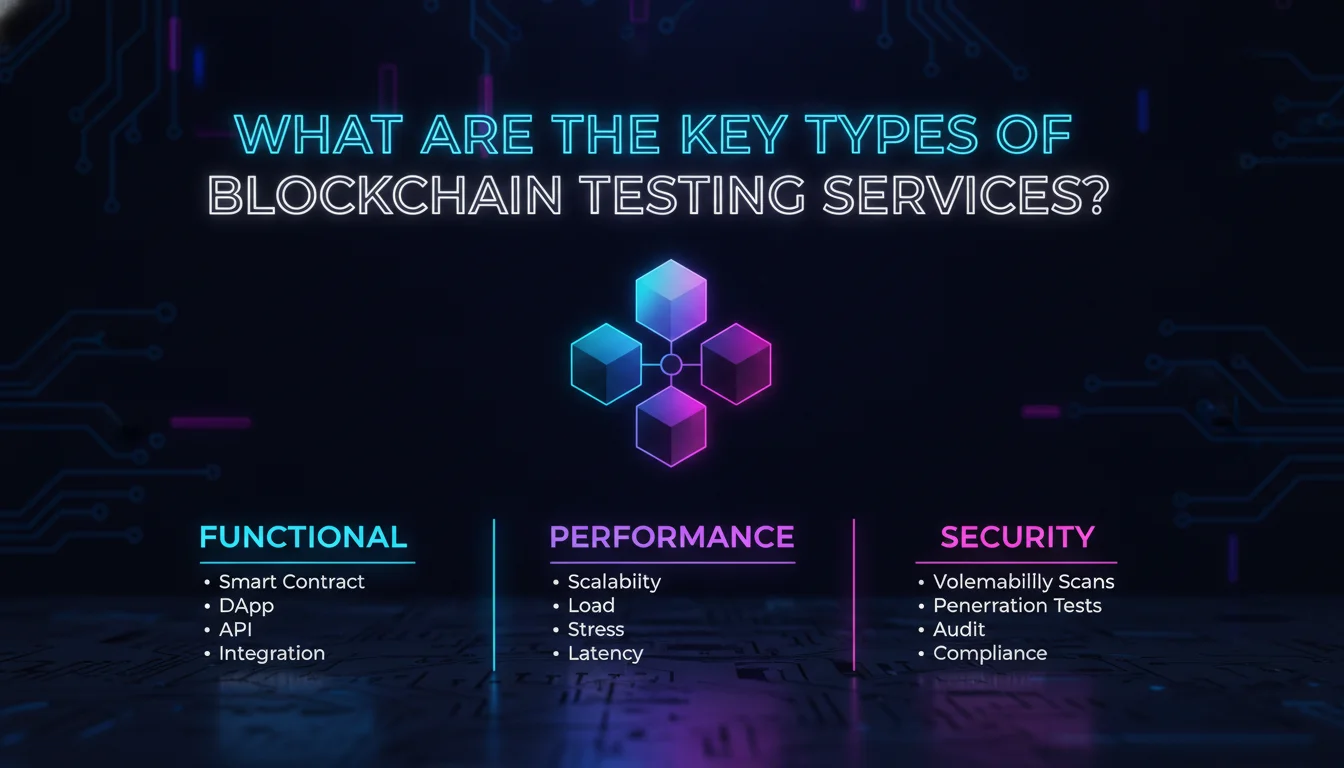
The key types of blockchain testing services are functional, performance, security, integration, node, API, and interoperability testing, each covering a distinct layer of the stack. Providers such as QualityAI and BugRaptors package these into structured offerings rather than one-size-fits-all audits.
Functional and Integration Testing
Functional testing confirms that smart contracts execute exactly as specified: token transfers, voting, staking, and every user-facing workflow. Integration testing checks that communication between blockchains, external APIs, oracles, and off-chain databases actually holds up. Because dApps often stitch together multiple component services, a failure at any single integration point can break the user experience or corrupt state entirely.
Performance and Scalability Testing
Performance testing measures transaction throughput (TPS), latency, and block time under realistic and peak loads. Tools like Hyperledger Caliper benchmark how a network behaves when transaction volumes spike unexpectedly. Scalability testing simulates node growth and rising data volume to confirm the network can expand without degrading, which matters a lot for any project planning to onboard large user bases.
Specialized Testing: Nodes, APIs, and Interoperability
Beyond the core categories, providers test node synchronization, fork handling, and data consistency across the network. API testing checks for uniform request-response formats across REST and WebSocket interfaces. In a multi-chain world, interoperability testing verifies that bridges, sidechains, and Layer-2 rollups maintain asset integrity and finality when assets move between environments.
Industry-Specific Testing Considerations
Blockchain testing needs shift depending on the vertical. Healthcare applications built on permissioned ledgers require heavier emphasis on data privacy and access-control validation, while supply chain platforms lean harder on integration testing across multiple external partner systems and IoT data feeds. Financial services deployments, unsurprisingly, demand the deepest security and compliance testing given the direct exposure to user funds.
How Do You Select a Blockchain Testing Service Provider?

Selecting a blockchain testing service provider comes down to matching your project’s technical scope against a vendor’s platform expertise, tooling, and engagement flexibility. With dozens of vendors claiming expertise, a structured evaluation process beats picking based on a sales pitch.
Step 1: Define Your Testing Scope
Decide whether you’re testing a single smart contract, a full dApp, or an entire protocol. Outline every component in play: wallets, DeFi pools, governance modules.
Step 2: Assess Technical Platform Expertise
Look for proven vendor experience with your target platforms (Ethereum, Hyperledger, R3 Corda) and your specific consensus model.
Step 3: Review Tooling and Automation Maturity
Check whether they use industry-standard frameworks like Truffle, Hardhat, and Caliper, and whether they’ve integrated AI-augmented testing into their workflow.
Step 4: Evaluate Engagement Models
Decide between offshore, nearshore, or dedicated teams, and between a short-term audit versus a continuous testing retainer.
Step 5: Check Compliance Certifications
Look for certifications like ISO 27001 and SOC 2, plus direct experience with regulatory frameworks relevant to your jurisdiction, such as MiCA in the EU.
Step 6: Request Reference Architectures and Case Studies
Evidence of past work in your specific industry lowers your risk considerably. Ask pointed questions about what broke and how it got fixed.
Comparing In-House vs. Outsourced Testing
Some enterprises build internal QA teams, but the pace of blockchain platform evolution makes it genuinely hard to keep specialist talent current. Outsourced blockchain testing services give you immediate access to domain experts, reusable test accelerators, and scalable capacity without a long hiring cycle. Many vendors offer flexible models: dedicated QA teams, managed services, or straight staff augmentation.
| Provider | Core Specialization | Notable Tools / Approach | Engagement Model | Key Differentiator |
|---|---|---|---|---|
| QualityAI | Domain-aligned testing for Ethereum, Corda, Hyperledger | Automated regression, COCO accelerator | Managed services | Blockchain-certified engineers |
| QASource | Security audits, smart contract validation, performance | AI-augmented test automation (QASource Intelligence) | Dedicated teams, staff aug | Tool-agnostic, 25+ years QA expertise |
| BugRaptors | Full-lifecycle testing, AI-powered tools | Functional, security, integration, smart contract testing | Offshore/nearshore flexible | Non-billable engineering leadership |
| Canarys | End-to-end blockchain testing | Penetration testing, node testing, consensus validation | Project-based | 95% customer satisfaction, 100% stability assurance |
| ImpactQA | DeFi security, automated testing | Automated pipeline testing, real-time monitoring | Managed, dedicated | Focus on DeFi protocol resilience |
What Do Blockchain Testing Tools and Frameworks Look Like in 2026?
The 2026 blockchain testing toolkit is a mix of open-source frameworks, commercial platforms, and AI-native testing assistants. The right tooling multiplies the effectiveness of any testing engagement, whether it’s handled in-house or through outsourced blockchain testing services.
Industry-Standard Tools: Truffle, Hardhat, and Manticore
For Ethereum-compatible chains, Truffle Suite and Hardhat remain the default development and testing environments. Both offer built-in test runners, network forking for simulations, and tight integration with JavaScript/TypeScript test libraries. For symbolic execution and vulnerability detection, Manticore explores all possible contract states and flags dangerous execution paths. Hyperledger Caliper remains the benchmark standard for permissioned ledgers, measuring throughput and latency under configurable loads.
AI-Augmented Testing Platforms and the Rise of CoTester
Generative AI is reshaping QA workflows, and platforms like TestGrid have introduced AI co-testers as a result. TestGrid launched CoTester 2.0 in 2026 as an always-available AI teammate that can generate test cases, simulate adversarial behavior, and flag likely failure modes. Providers integrating this kind of AI report faster defect detection and less manual scripting overhead. It’s shifting testing from a purely reactive gate into something closer to a proactive design-time assistant.
What Does a Blockchain Security Audit Cost?
Blockchain security audit costs typically range from a few thousand dollars for a simple token contract review up to six figures for a full DeFi protocol audit. The exact number depends on code complexity, the platform involved, and whether the firm relies on automated scanning, manual expert review, or both. A single ERC-20 token with standard OpenZeppelin libraries costs far less to audit than a novel AMM with custom liquidity math and multiple external integrations. Teams budgeting for testing should treat it as a fixed line item in the launch budget, not an afterthought squeezed in before mainnet.
What Is the Business Case for Blockchain Testing Services?
The business case for blockchain testing services is straightforward: the cost of an audit is a small fraction of the potential loss from a hack, an exploit, or a network stall. Beyond the technical necessity, this is a financial decision every serious team has to make early.
Mitigating Financial and Reputational Risks
The $3.4 billion in crypto theft during 2025 makes one thing clear: untested code is an existential risk, not a theoretical one. A single vulnerability can wipe out user confidence overnight and trigger regulatory scrutiny that outlasts the exploit itself. Testing helps stabilize token economies, prevent double-spend attacks, and confirm that minting and burning operate exactly as modeled, protecting both user funds and brand equity.
Ensuring Compliance and Regulatory Readiness
With the EU’s Markets in Crypto-Assets (MiCA) regulation fully in effect and comparable frameworks emerging elsewhere, blockchain applications increasingly need to demonstrate security, transaction integrity, and data privacy in a documented, auditable way. Testing services provide the validation trails regulators expect, which reduces legal exposure and can actually speed up time-to-market in compliant jurisdictions.
How Do You Integrate Blockchain Testing Into Your Development Lifecycle?
You integrate blockchain testing into your development lifecycle by embedding it from initial design through production monitoring, not treating it as a final gate before launch. Modern blockchain testing services plug directly into CI/CD pipelines, which lets teams iterate quickly without sacrificing quality.
Shift-Left Testing for Smart Contracts
Shift-left means testing as early as possible, during design and coding, not after deployment. Developers can run unit tests on virtual blockchain environments like Ganache or Hardhat Network before ever committing code to a shared branch. Automated static analysis tools catch common vulnerabilities like integer overflow and re-entrancy right at the pull-request stage. Catching defects this early avoids expensive late-stage rework down the line.
Continuous Testing in CI/CD Pipelines
In a decentralized context, continuous testing validates new builds against a matrix of network configurations and load profiles. Blockchains typically get deployed across multiple testnets before mainnet. Automated test suites run regression, security, and performance checks at every merge, and providers like QualityAI highlight reusable test accelerators such as their COCO framework as a way to cut regression suite execution time meaningfully.
What’s Next for Blockchain Testing in 2026 and Beyond?
The next phase of blockchain testing centers on agentic AI and multi-chain interoperability, both driven by how fast the underlying infrastructure keeps splintering across chains and rollups.
Agentic AI and Autonomous Testing
AI agents that generate test cases, self-heal flaky tests, and explain failures in plain language are becoming standard rather than experimental. Platforms like TestGrid’s CoTester 2.0 and QASource Intelligence embed this kind of agentic AI to simulate large numbers of transaction combinations, probing for emergent vulnerabilities that human testers might otherwise miss.
Testing for Multi-Chain and Layer-2 Ecosystems
As cross-chain bridges, app-chains, and Layer-2 rollups (both Optimistic and ZK) keep multiplying, testing services need to verify asset transfers, message passing, and finality across genuinely different network architectures. New test fixtures simulate mainnet forks, rollup fraud proofs, and bridge relayers end-to-end. The ability to test interoperability inside one unified framework is quickly becoming the real differentiator among advanced providers.
Pros and Cons of Outsourcing Blockchain Testing Services
Pros
- Immediate access to blockchain-specific domain expertise without a multi-month hiring cycle.
- Reusable test accelerators and frameworks that cut regression cycles compared to building everything from scratch.
- Flexible engagement models (dedicated teams, staff augmentation, project-based audits) that scale with project maturity.
- Exposure to AI-augmented tooling that smaller in-house teams often can’t justify building internally.
Cons
- Less day-to-day context on your specific codebase compared to an embedded in-house team.
- Ongoing dependency on external vendors for critical-path security decisions.
- Costs can scale quickly for continuous retainer models versus one-time audits.
- Coordination overhead across time zones for offshore or nearshore engagements.
Is Blockchain Still Relevant in 2026?
Yes, blockchain is still relevant in 2026, and its growth trajectory is accelerating rather than slowing. According to TestGrid’s research, the global blockchain technology market is projected to reach $1,431 billion by 2030, up from $31 billion in 2024. That kind of growth curve amplifies both the opportunity and the risk, which is exactly why blockchain testing services have shifted from optional add-on to baseline requirement for any team shipping real infrastructure.
From functional validation of smart contracts to AI-driven performance engineering, the right testing partner is often the difference between a protocol that survives its first year and one that becomes a case study in what went wrong. At Digital Blockchains, we think about testing rigor the same way we think about tokenomics design and smart contract architecture: as a discipline you build in from day one, not bolt on after the fact. If you’re building protocol infrastructure and want a studio partner who treats security testing as core to the build process, apply to the Genesis Cohort at digitalblockchains.com.
Frequently Asked Questions
What exactly do blockchain testing services cover?
They verify smart contracts, consensus mechanisms, node behavior, APIs, and overall dApp performance for security, functional correctness, and scalability. A complete engagement typically touches all of these layers rather than just one.
How much does a blockchain security audit cost?
Costs vary widely, from a few thousand dollars for a simple token audit to well into six figures for a full DeFi protocol review. Code complexity, platform choice, and whether the firm uses manual review, automated scanning, or both all factor into the final price.
Is blockchain testing only about security?
No. Security is critical, but testing also covers performance, functional accuracy, integration, user experience, and compliance. A well-rounded testing strategy addresses all of these areas rather than treating security audits as the whole job.
Can I use traditional QA tools for blockchain testing?
Partially. Standard tools work fine for APIs and front-ends, but blockchain-specific elements like smart contracts, gas usage, and consensus behavior require specialized frameworks like Truffle, Hardhat, and Manticore.
How do I choose between an in-house team and outsourced blockchain testing services?
It depends on your project’s maturity, budget, and timeline. Outsourced services give you immediate access to deep domain knowledge and mature tooling, while in-house teams offer tighter integration but require real investment in talent and infrastructure over time.
What is the role of AI in blockchain testing?
AI automates test case generation, detects anomaly patterns, and simulates complex attack scenarios faster than manual methods alone. This accelerates release cycles and generally improves test coverage, though it works best alongside manual audit review rather than replacing it.