Enterprise blockchain adoption is the integration of permissioned distributed ledger technology into business operations to automate trust, improve transparency, and reduce reconciliation overhead. As of 2026, the market has moved decisively from pilot projects to production deployments.
Key Takeaways
- blockchain adoption is the integration of permissioned distributed ledger technology into business processes to improve transparency, security, and efficiency.
- The blockchain technology market grew 86% from 2017 to 2019, according to Wipro’s research, with cloud-based solutions adding another 44-46% growth in 2020 alone.
- A major shift is underway from owning infrastructure to consuming blockchain as a service, with enterprises prioritizing business outcomes over operating the underlying technology.
- Success hinges on selecting high-value use cases, working with external partners, and building a clear ROI model rather than chasing technology trends.
- Regulatory clarity and interoperability between legacy systems and blockchain networks remain the two most critical hurdles to full-scale deployment.
What Is Enterprise Blockchain?
Definition and Core Principles
Enterprise blockchain is a distributed ledger technology (DLT) that enables multiple parties within a business ecosystem to share a synchronized, tamper-proof record of transactions or data. Unlike public, permissionless chains, enterprise blockchains are typically permissioned: participants are known, access is controlled, and governance is explicit. This design preserves the benefits of immutability and transparency while addressing corporate requirements for privacy, confidentiality, and compliance. As Visa’s comprehensive overview notes, blockchain is not an individual system but a protocol that allows different participants to transmit information by synchronizing various databases. Enterprise blockchain is not a product but a protocol that connects existing systems, allowing participants to validate a shared history without a central intermediary.
How It Differs from Public Blockchains
Public blockchains like Bitcoin or Ethereum are open to anyone, use consensus mechanisms like proof-of-work or proof-of-stake, and prioritize censorship resistance. Enterprise blockchains optimize for throughput, privacy, and governance instead. They employ pluggable consensus algorithms such as Raft or IBFT and support confidential transactions via channels or zero-knowledge proofs. This enables use cases like trade finance, supply chain tracking, and interbank settlement without exposing sensitive data publicly. The trade-off is a degree of centralization, but for businesses operating under regulatory mandates, that is an acceptable design choice rather than a flaw.
Why It Matters Now
After years of experimentation, this type of adoption is reaching a genuine inflection point. The technology has matured beyond its cryptocurrency associations, and platforms like Hyperledger Fabric, Corda, and Quorum have proven viable in production environments. According to MIT Sloan’s coverage of Northeastern University professor Ravi Sarathy, large-scale enterprise blockchain applications are expected to become commonplace by 2030, but the groundwork is being laid right now through strategic pilots and incremental integration.
The Current State of Enterprise Blockchain Adoption
Market Growth and Trends
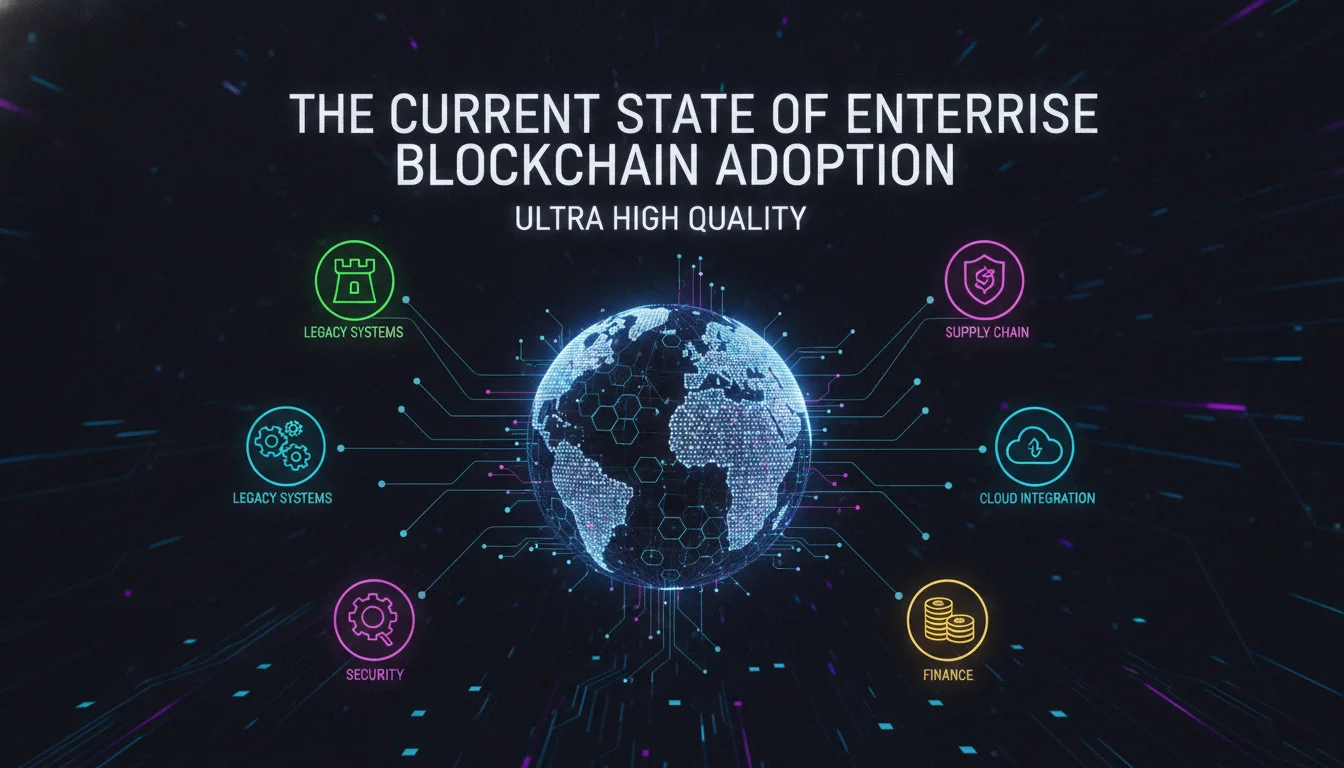
this kind of adoption has moved from hype to selective implementation. Wipro’s research indicates the blockchain technology market expanded by 86% between 2017 and 2019, with cloud-based solutions growing 44-46% in 2020 alone. That growth was driven by the pandemic, which forced enterprises to prioritize security and real-time data connectivity. Today, spending concentrates on solutions rather than pure technology, with Blockchain as a Service (BaaS) providers like Amazon Managed Blockchain and IBM Blockchain Platform capturing a significant share of enterprise budgets.
Leading Sectors and Regions
Financial services continue to lead enterprise blockchain, but supply chain, healthcare, and energy are closing the gap fast. In the U.S. and Europe, banks use DLT for settlement and asset tokenization, while Asian conglomerates are exploring hybrid models. a16z Crypto highlights how South Korea’s large firms, including Kakao, Naver, and WeMade, initially built their own L1 chains but are now shifting to existing networks or modular stacks like Avalanche subnets. This pattern underscores a global move toward pragmatic deployment over self-built infrastructure.
Adoption Maturity Model
Enterprises generally progress through three phases: experimentation (small pilots), deployment (production-grade use cases), and ecosystem expansion (network effects). Most are now transitioning from phase one to phase two, driven by clearer ROI metrics and maturing technology. Full cross-industry networks remain rare, though. The Deloitte blockchain and Web3 primer suggests that while interest is high, only a fraction of projects reach enterprise-wide scale, often because of integration and governance challenges rather than technical limitations.
Pros and Cons of Enterprise Blockchain Adoption
Pros
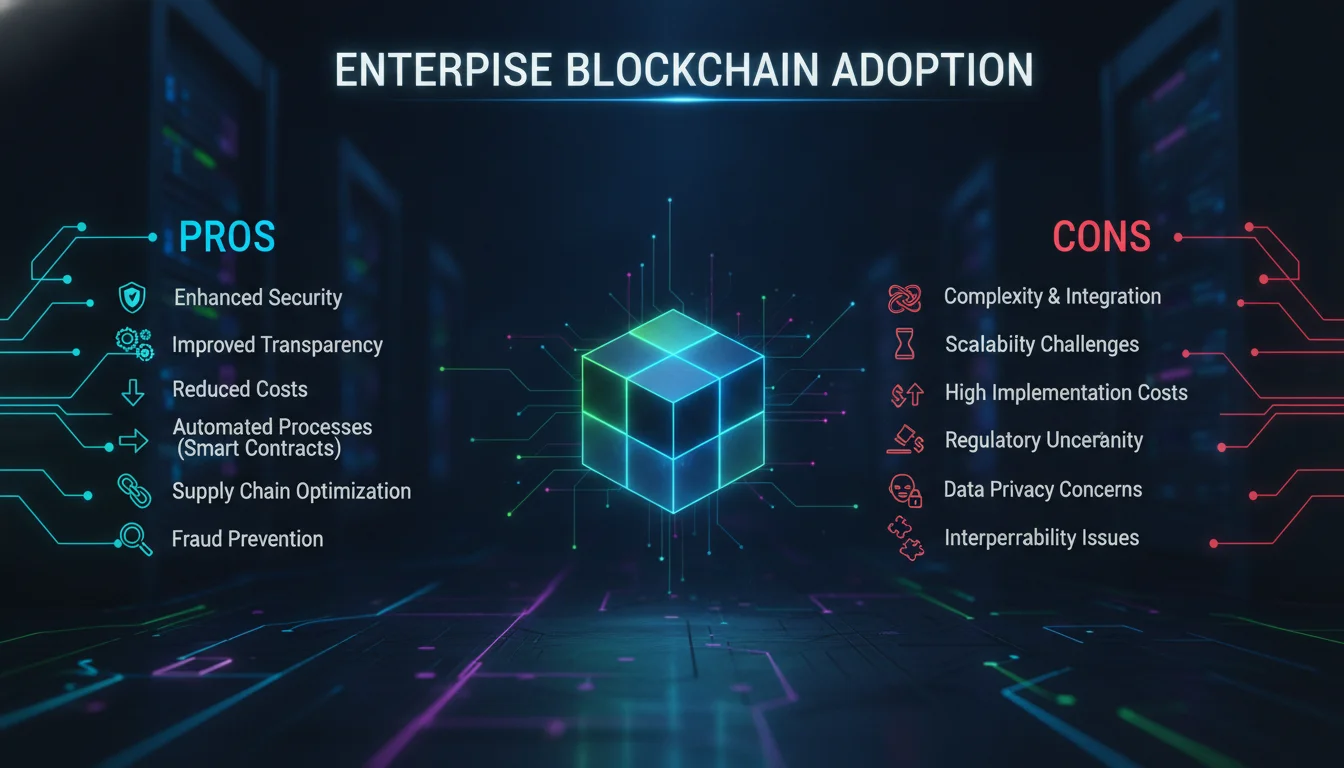
- Reduced reconciliation costs: A single shared ledger replaces multiple disjointed records, cutting settlement times from days to minutes in cross-border payment scenarios.
- Immutable audit trails: Every transaction is cryptographically linked and timestamped, making compliance reporting faster and fraud harder to conceal.
- Smart contract automation: Workflows trigger automatically on predefined conditions, reducing administrative lag and human error without requiring a trusted intermediary.
- New revenue models: Tokenization of real-world assets opens fractional ownership and secondary market liquidity for previously illiquid asset classes.
- Stronger supply chain visibility: End-to-end provenance tracking gives enterprises and regulators a verifiable record from raw material to end consumer.
Cons
- Legacy integration cost: Bridging SAP or Oracle databases with a blockchain network requires custom middleware and APIs, often costing more than the blockchain deployment itself.
- Governance complexity: Consortium models require competitors to agree on node operators, upgrade procedures, and cost-sharing, a political challenge as much as a technical one.
- Regulatory fragmentation: GDPR’s right to erasure conflicts directly with blockchain immutability, and divergent global frameworks create compliance uncertainty for cross-border deployments.
- Consortium sustainability risk: As TradeLens demonstrated, even well-funded consortia collapse when commercial incentives for all participants are not sufficiently strong.
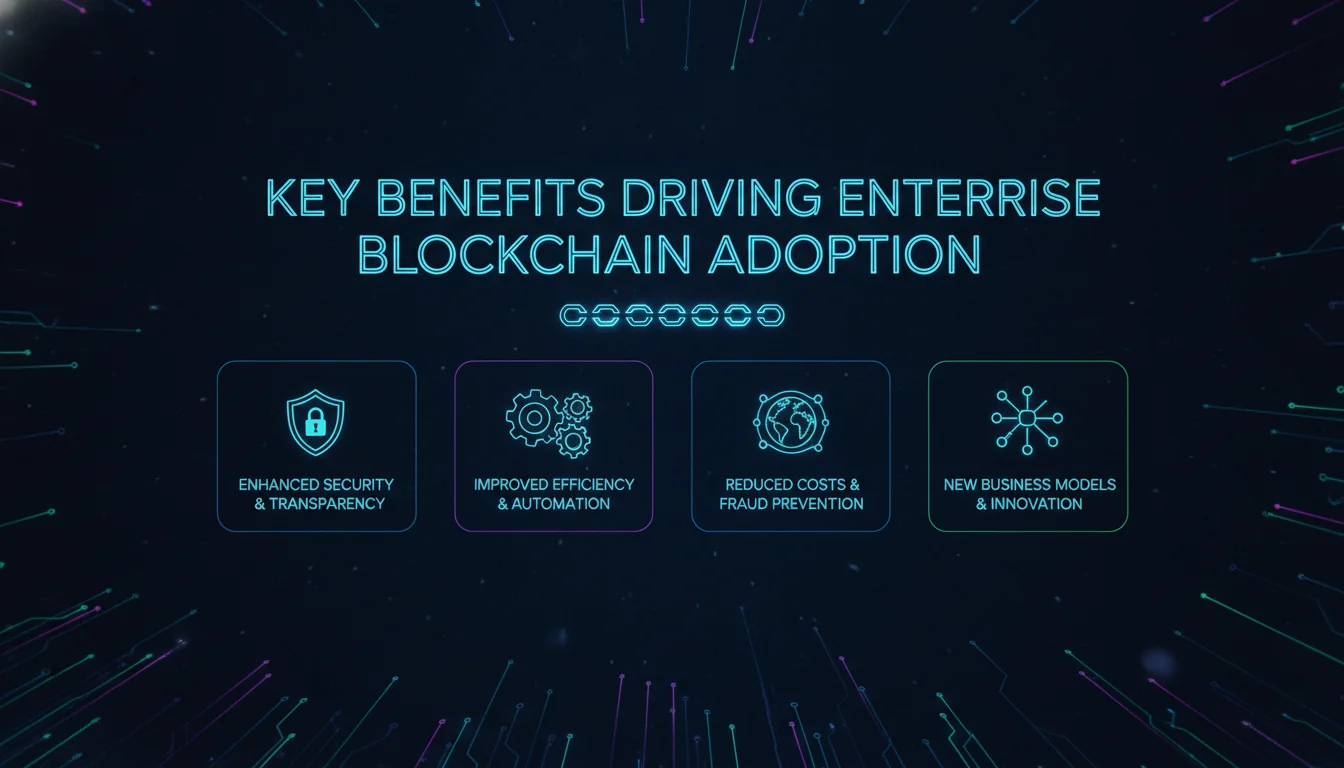
Key Benefits Driving Enterprise Blockchain Adoption
Operational Efficiency and Cost Savings
By eliminating reconciliation and manual data entry, blockchain reduces settlement times from days to minutes. In cross-border payments, removing correspondent banks from the chain can cut transaction costs substantially. blockchain adoption directly lowers operational overhead because a single shared ledger replaces multiple disjointed records maintained by each party independently. Smart contracts automate workflows, triggering payments upon delivery confirmation, which reduces administrative lag and human error without requiring a trusted intermediary.
Enhanced Transparency and Trust
In supply chains, enterprise blockchain provides an immutable audit trail from raw material to end consumer. Participants can verify provenance without relying on a central authority. This is especially powerful in food safety: Walmart used IBM Food Trust to trace mangoes in 2.2 seconds, compared to the previous process that took around 7 days. Such transparency meets regulatory demands and strengthens brand trust simultaneously. For consortiums, a shared source of truth eliminates disputes and builds a collaborative environment that benefits every participant.
New Revenue Opportunities
Beyond cost cutting, blockchain enables new business models. Tokenization of real-world assets, including real estate, art, and commodities, opens fractional ownership and liquidity for previously illiquid markets. this type of adoption can create revenue by enabling secondary markets for assets that were historically difficult to trade. Data monetization through auditable trails and self-sovereign identity solutions also offers enterprises new service lines, such as credential verification for educational institutions or digital identity for financial inclusion programs.
Major Challenges and Barriers to Adoption
Scalability and Performance
Public blockchains historically struggled with throughput. Bitcoin processes roughly 7 transactions per second, Ethereum around 15, far below enterprise demands. Private chains can reach thousands of TPS, but they often sacrifice decentralization to get there. London Blockchain notes that newer Layer 2 solutions and platforms like Hyperledger Fabric have addressed many of these limitations, but the perception of performance bottlenecks lingers and continues slowing this kind of adoption decisions. Customized consortia chains typically fit better for high-volume scenarios like trade finance.
Integration with Legacy Systems
Most enterprises operate on decades-old ERP and CRM systems not designed for DLT. Bridging SAP or Oracle databases with a blockchain network requires custom middleware and APIs. This integration work is often costlier than the blockchain deployment itself. According to NMS Consulting, without robust integration architecture, pilots fail to deliver ROI, reinforcing skepticism across the organization. Overcoming this requires a phased approach where blockchain complements, rather than replaces, existing infrastructure from day one.
Regulatory and Compliance Uncertainty
Divergent global regulations complicate enterprise blockchain adoption significantly. GDPR in Europe, HIPAA in the U.S., and various data residency laws each impose constraints that can conflict with blockchain’s core properties. Immutability conflicts with the right to erasure; pseudonymity challenges KYC and AML obligations. Many enterprises adopt a “wait and see” stance until clearer guardrails emerge. Progress is visible in jurisdictions like the EU’s MiCA framework and the UK’s digital securities sandbox, but regulatory fragmentation remains a drag on cross-border deployments.
Organizational and Cultural Resistance
Blockchain often requires competitors to collaborate, a behavioral shift that can be as daunting as the technology itself. Governance models covering who runs nodes, who bears costs, and how upgrades are managed must be negotiated across organizations with competing interests. MIT Sloan’s Ravi Sarathy points out that galvanizing people and aligning incentives is as critical as the technical build. Without executive sponsorship and a culture of data sharing, enterprise blockchain projects stall regardless of how good the underlying technology is.
Strategies for Successful Enterprise Blockchain Implementation
Identify the Right Use Case First
Enterprise blockchain adoption must begin with a clear business problem, not the technology itself. a16z Crypto makes this point directly: enterprises adopt because someone solves their pain point, whether that is faster settlement, lower reconciliation risk, or better liquidity. They want speed, transparency, and programmability, not ownership of the infrastructure. Start by auditing processes where multiple parties share data with low mutual trust. Multi-party workflow reconciliation, provenance tracking, and credential verification are ideal candidates. Avoid “blockchain for blockchain’s sake” pilots that lead to disillusionment and budget cuts.
Choose a Deployment Model That Matches Your Capabilities
Enterprises rarely want to manage blockchain infrastructure themselves. The three primary paths, as outlined by a16z, are: deploying onto an existing chain (someone else’s), having a partner deploy onto yours, or offering your stack as a service. Most firms opt for the first option, consuming blockchain services via BaaS or application-layer integrations. A bank might use a stablecoin settlement network built on Avalanche without ever operating the validators. Align the model with internal technical maturity and strategic goals before committing to infrastructure ownership.
Leverage External Expertise and Partners
Consultants play a significant role in enterprise blockchain adoption. They bridge the gap between business needs and technical implementation, helping select the right platform, design governance frameworks, and measure ROI. NMS Consulting argues that this translation function is the single most valuable intervention, ensuring adoption aligns with strategic goals from day one. System integrators like Accenture and Deloitte already provide end-to-end services, making adoption less risky for enterprises that lack in-house blockchain expertise.
Choosing the Right Blockchain Platform
Types of Enterprise Blockchains
Blockchain networks for business fall into three categories: public permissionless (e.g., Ethereum mainnet), private permissioned (e.g., Hyperledger Fabric), and consortium (e.g., Corda, Canton). The choice depends on trust assumptions, privacy needs, and governance requirements. The table below compares these options across key dimensions:
| Type | Access | Consensus | Privacy | Examples |
|---|---|---|---|---|
| Public Permissionless | Anyone can join | PoW/PoS (decentralized) | All data visible | Ethereum, Solana |
| Private Permissioned | Invitation only, single org | Pluggable (e.g., Raft, IBFT) | Channels, confidential Tx | Hyperledger Fabric, Quorum |
| Consortium Permissioned | Multiple known entities | Pool of approved validators | Selective disclosure | Corda, Canton |
Most enterprise blockchain adoption occurs on permissioned or consortium networks because they align with regulatory and data protection mandates that public chains cannot satisfy.
Consensus Algorithms: Raft, IBFT, and PoA Compared
The consensus algorithm is one of the most consequential technical choices in any enterprise blockchain deployment. Raft is a leader-based algorithm optimized for crash fault tolerance: one node leads, others follow, and the network recovers quickly from node failures without Byzantine fault tolerance. It suits internal deployments where all participants are trusted. IBFT (Istanbul Byzantine Fault Tolerant) adds protection against malicious nodes, making it appropriate for consortium settings where participants may not fully trust each other. Proof of Authority (PoA) assigns block-production rights to pre-approved validators, delivering high throughput and predictable finality at the cost of requiring known, accountable node operators. For most enterprise consortia, IBFT or PoA strikes the right balance between performance and trust assumptions.
Leading Frameworks and Their Use Cases
Hyperledger Fabric dominates supply chain and trade finance due to its modular architecture and channel-based privacy model. R3’s Corda is favored in financial services for its focus on bilateral transactions and regulatory simplicity. Quorum (GoQuorum) serves real estate and tokenization with Ethereum compatibility. As Visa’s paper highlights, open-source, community-driven development is essential to ensure longevity and interoperability. Enterprise Ethereum solutions like Besu are also gaining traction for organizations that want public network interoperability without sacrificing permissioning controls.
Emerging Trends: Modular Stacks and Interoperability
The rise of modular blockchain stacks, including Avalanche subnets, OP Stack, and Polygon Edge, is reshaping enterprise blockchain adoption. Companies can launch custom app-chains that inherit security or shared liquidity from a parent network, reducing development overhead substantially. a16z Crypto points to this as a key trend, alongside interoperability protocols like CCIP and IBC that let consortia exchange data and value across ecosystems. This modularity promises to lower barriers and unlock networked business models that were previously impractical to build.
Real-World Enterprise Blockchain Use Cases
Supply Chain Traceability
Supply chain traceability is one of the earliest and most validated applications of enterprise blockchain. IBM Food Trust proved the concept at scale: Walmart traced mangoes in 2.2 seconds using the platform. The TradeLens initiative, IBM and Maersk’s blockchain-based supply chain monitoring application, demonstrated the technology’s potential for global trade before being discontinued. MIT Sloan notes the TradeLens discontinuation as a critical lesson: consortia require strong commercial incentives for all participants. Technology alone cannot sustain a network if the business model does not distribute value fairly across members.
Financial Services: Settlement and Tokenization
Enterprise blockchain adoption is transforming capital markets infrastructure. J.P. Morgan’s Onyx uses a permissioned Ethereum network for intraday repo settlements, processing substantial notional value daily. Stablecoin settlement networks like USDC on Stellar enable near-instant cross-border payments. Central bank digital currencies (CBDCs) are essentially enterprise blockchains operated by sovereign entities, with pilots in China, Sweden, and Nigeria demonstrating feasible retail and wholesale models across very different regulatory environments.
Healthcare Data Management
Blockchain enables patient-centric health records where individuals control access permissions directly. Projects like MedRec use DLT to manage electronic medical records across providers, ensuring data integrity and auditability while complying with HIPAA requirements. Pharmaceutical supply chains also benefit: DHL and Accenture have trialed tracking systems to combat counterfeit drugs, with blockchain providing an immutable chain of custody from manufacturer to pharmacy.
Digital Identity and Credentials
Self-sovereign identity (SSI) built on blockchain allows enterprises to issue and verify credentials without a central authority. Educational institutions issue diplomas on-chain; employers verify them instantly without contacting the issuing institution. This reduces fraud and administrative costs simultaneously. Governments are exploring digital IDs on blockchain, with Estonia’s e-Residency program being a notable example of state-backed enterprise blockchain adoption at national scale.
The Role of Consultants in Accelerating Adoption
Bridging the Business-Technology Gap
Enterprise blockchain projects fail most often when business stakeholders cannot articulate requirements to technical teams. Consultants serve as translators, running design-thinking workshops to map use cases and select appropriate platforms. They bring cross-industry benchmarks and best practices, reducing trial-and-error cycles. According to NMS Consulting, this translation function is the single most valuable intervention, ensuring enterprise blockchain adoption aligns with strategic goals from day one rather than drifting into isolated technology experiments.
Developing the Business Case and ROI Model
Quantifying blockchain’s value goes beyond traditional ROI calculations. Consultants build cost-benefit analyses that account for intangible gains like trust, data quality, and ecosystem positioning. They frame the investment in terms of problem resolution: reducing settlement time by a measurable number of days, cutting manual reconciliation costs by a verifiable percentage tied to existing KPIs. By anchoring metrics to current operational baselines, they secure executive buy-in. Deloitte’s advisory approach often includes prototyping a minimal viable ecosystem (MVE) to demonstrate tangible outcomes quickly before committing to full deployment.
Managing Change and Governance
Organizational change management is critical for consortia. Consultants design governance frameworks covering who can join the network, how rules are amended, and how operating costs are shared across participants. They facilitate the legal agreements that underpin business commitments between parties who may otherwise be competitors. This is especially complex in sectors like healthcare or finance, where compliance is non-negotiable. A well-structured governance model reduces the risk of consortium collapse, which has plagued several high-profile early initiatives.
The Future of Enterprise Blockchain Adoption
From Niche to Mainstream by 2030
MIT Sloan’s Ravi Sarathy predicts that large-scale enterprise blockchain applications will be commonplace by 2030. This vision depends on continued improvements in scalability, interoperability, and regulatory clarity across major jurisdictions. The building blocks are already visible: zero-knowledge proofs for privacy-preserving computation, cross-chain bridges for data sharing, and progressive regulation in key markets. Enterprise blockchain adoption will increasingly resemble the adoption of cloud computing, starting with non-critical functions and moving to mission-critical systems as institutional trust grows.
“Even though blockchain has not been adopted by enterprises at scale, there’s significant promise and it’s only a matter of time. Advances are making it more and more feasible for enterprises to begin piloting and developing internal applications.” – Ravi Sarathy, Northeastern University professor, speaking at MIT Sloan Management Review
The Convergence with AI and IoT
Blockchain’s tamper-proof data layer is a natural complement to AI and IoT architectures. Supply chain sensors can record environmental conditions on a blockchain, then AI models audit compliance automatically without human review. In insurance, IoT data from connected devices can trigger smart contract payouts without manual claims processing. This convergence multiplies the value of each technology, but it also increases integration complexity. Enterprises must plan for a multi-layered architecture from the start rather than bolting these systems together after deployment.
“The majority of enterprises are not looking to build or manage blockchain infrastructure. They want to solve a specific business problem: faster settlement, better liquidity, lower reconciliation risk.” – a16z Crypto, Enterprise Blockchain Adoption Report, January 2026
Key Metrics to Watch
To gauge the pace of enterprise blockchain adoption, track the number of production-grade consortia, the volume of tokenized real-world assets on-chain, and the number of enterprises reporting a positive ROI from blockchain initiatives. Surveys from Deloitte and EY serve as useful indicators of sentiment shifts. Regulatory milestones matter equally: approval of blockchain-based securities issuance, clear tax guidance for tokenized assets, and formal recognition of DAOs as legal entities will each signal an environment ready for broader mainstream adoption.
If you’re building protocol infrastructure or designing tokenomics for an enterprise deployment, the Digital Blockchains studio works with founders and protocol teams at the architecture stage. You might also find our analysis of smart contract design patterns and tokenomics frameworks useful as you evaluate deployment options.
Frequently Asked Questions
What is enterprise blockchain adoption?
Enterprise blockchain adoption is the process by which private and public organizations integrate distributed ledger technology into core business operations to improve transparency, security, and efficiency. It typically involves permissioned networks with known participants and focuses on solving specific business problems like supply chain tracking or financial settlement.
Which industries are leading in enterprise blockchain adoption?
Financial services, supply chain and logistics, and healthcare are the frontrunners. Banks use blockchain for cross-border payments and tokenization, logistics firms for provenance tracking, and healthcare organizations for secure patient data exchange. These sectors share high inter-party transaction volumes and a strong need for trust automation across organizational boundaries.
What are the biggest barriers to enterprise blockchain adoption?
The main barriers include integration with legacy IT systems, scalability concerns relative to enterprise transaction volumes, regulatory uncertainty across jurisdictions, and the organizational challenge of getting competitors to collaborate on shared infrastructure. Lack of clear ROI frameworks and governance models also hinder adoption significantly.
How can consultants help with enterprise blockchain adoption?
Consultants assist by identifying high-value use cases, selecting the right platform such as Fabric or Corda, developing ROI models tied to existing KPIs, and designing governance for consortia. They bridge the gap between business needs and technical implementation, reducing the risk of failed pilots that set back broader organizational adoption.
What is the difference between public and enterprise blockchains?
Public blockchains are permissionless and open to anyone, prioritizing decentralization and censorship resistance. Enterprise blockchains are permissioned, meaning participants are vetted, and they optimize for privacy, performance, and regulatory compliance. They are tailored for business use cases where data confidentiality and governance accountability are essential requirements.
When will enterprise blockchain adoption become mainstream?
According to Northeastern University professor Ravi Sarathy, speaking at MIT Sloan, large-scale enterprise blockchain applications are expected to become commonplace by 2030. Selective mainstream adoption is already happening in financial settlement and supply chain, with broader uptake accelerating as technology matures and regulatory frameworks solidify.