- A blockchain based streamung service uses blockchain for metadata indexing, smart contracts for payments, and peer-to-peer networks for content distribution.
- Creators gain stronger copyright protection, direct monetization, and resistance to platform-level censorship compared with YouTube or Netflix.
- The global video streaming market reached $106.83 billion in 2023, according to Trembit, with live streaming holding 62% of the market.
- Streamr, an open-source decentralized network, reports 315 active nodes and supports live video, AI data, and DePIN use cases.
- Evaluating a blockchain based streamung service requires comparing latency, token incentives, DRM support, and blockchain network compatibility.
A blockchain based streamung service is a decentralized video or audio delivery platform that indexes metadata on-chain, executes payments through smart contracts, and distributes content across peer-to-peer networks like IPFS instead of centralized servers.
Key Takeaways
- Blockchain streaming separates metadata (on-chain) from media files (peer-to-peer storage), keeping the ledger lightweight.
- Smart contracts automate micropayments, royalty splits, and NFT-based content ownership without manual payout cycles.
- Streamr’s live network runs on 315 active nodes processing 262.29 GB per day, with node operators staking $DATA for yield.
- Piracy and royalty leakage remain massive problems in legacy media. Consensys cites $71 billion in annual US film/TV piracy losses.
- Adoption barriers include wallet friction, latency versus centralized CDNs, and multi-country licensing complexity.
- Buyers should pilot with a narrow use case (live events, education, niche communities) before full migration.
The commercial case for decentralized streaming is growing. Traditional platforms such as YouTube, Netflix, and Spotify remain centralized intermediaries that control content policies, pricing, and royalty distribution. A streamung service instead uses distributed ledgers to record ownership and automate payments, while content files sit on peer-to-peer networks like IPFS. This article breaks down how the architecture works, why creators are migrating, and what buyers and developers should evaluate as of 2026.
What Is a Blockchain Based Streamung Service?
Core Definition and Architecture
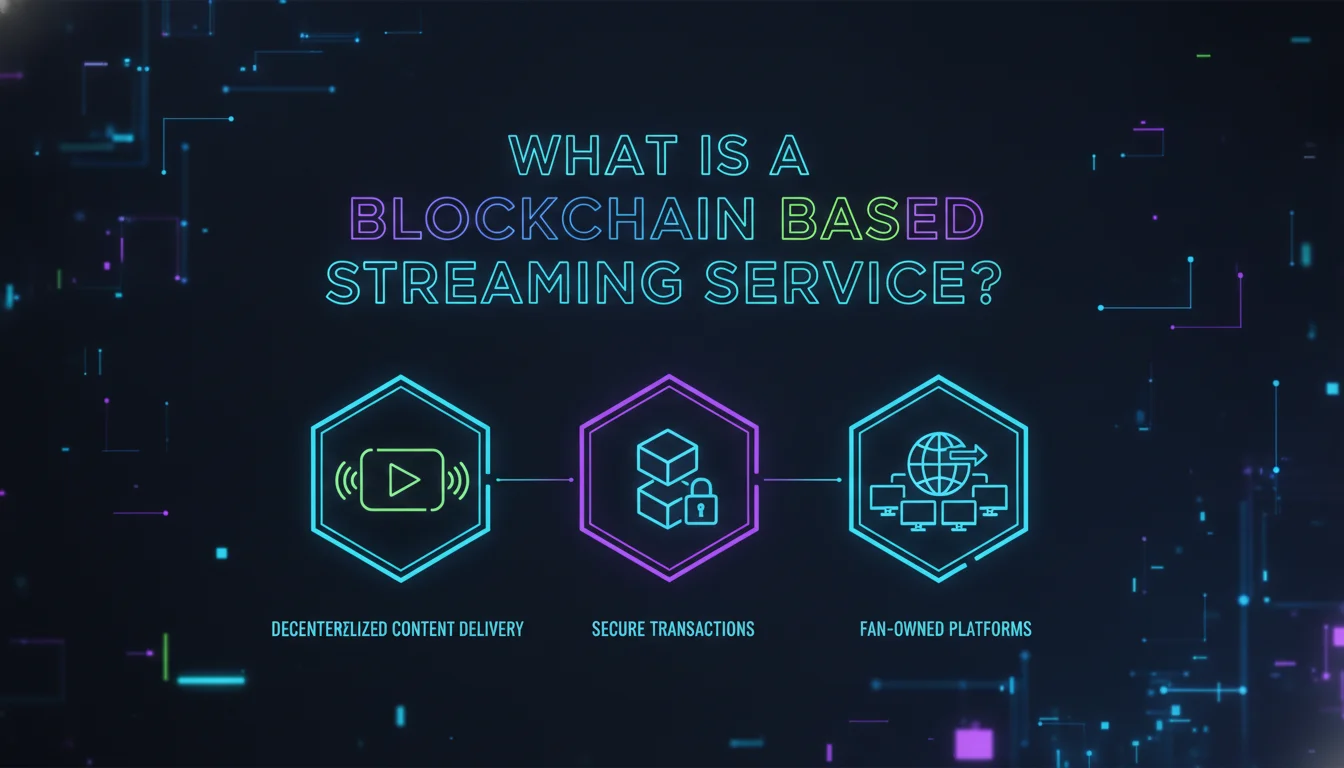
A this type of service is a decentralized video or audio delivery platform that uses blockchain for metadata indexing, smart contracts for payments, and peer-to-peer networks like IPFS for content distribution. Unlike centralized streaming, the platform doesn’t store full video files on company-owned servers. Instead, the blockchain records metadata, ownership rights, and access rules, while actual media chunks get distributed across multiple nodes.
The open-source GitHub project by MMagdys illustrates this architecture well: the blockchain indexes content metadata only, while a Distributed Hash Table (DHT) locates the stream chunks across the network. This separation reduces storage costs and makes content delivery more resilient to server failures or regional blocking. It’s a pattern we see repeated across most serious decentralized streaming builds.
How It Differs from Centralized Streaming
Centralized platforms like YouTube and Netflix route video through data centers controlled by a single company. That model produces consistent performance but also centralizes censorship, pricing, and revenue distribution. A this kind of streamung service removes that central point by letting peers share encrypted chunks directly.
According to Trembit, blockchain streaming encrypts and stores content across multiple locations using IPFS, then delivers it through relay nodes. Smart contracts automatically handle transactions and content access, so creators don’t wait for a platform’s manual payout cycle.
The Role of Smart Contracts and IPFS
Smart contracts are self-executing code on a blockchain that automatically handle transactions and access rules when predefined conditions are met. In streaming, a smart contract can release payment to a creator the moment a viewer consumes one minute of video, enabling metered billing at the protocol level rather than through a billing department.
IPFS, or InterPlanetary File System, is a distributed storage protocol that stores encrypted video chunks across multiple nodes rather than a single data center. This is the same peer-to-peer architecture described in the Trembit trends report and demonstrated in the MMagdys reference implementation on GitHub.
Why Content Creators Are Moving to Blockchain Streaming Platforms
Ownership, Copyright, and NFT Verification
Content creators are leaving YouTube because they want better monetization, stronger copyright protection, and higher streaming quality, according to Trembit’s 2025 trends report. On a blockchain platform, creators can mint videos as NFTs, creating a verifiable ownership record that’s hard to dispute after the fact.
Consensys notes that digital piracy and IP infringement cost the US film and TV industry an estimated $71 billion annually. A the based streamung service can digitize content metadata on a time-stamped, immutable ledger, making it easier for creators to enforce rights once infringement happens.
The append-only structure of a blockchain makes it easier for creators to legally enforce their rights once infringement occurs. – Consensys, Blockchain Use Cases in Media & Entertainment
Transparent Monetization and Micropayments
Consensys cites CitiGroup data showing the US music industry generates $43 billion a year, but artists take home only about $5 billion, or 12 percent. Smart contracts enable automatic micropayments between consumers and creators, cutting out multiple layers of intermediaries.
Oodles highlights that blockchain-powered micropayment models can replace all-you-can-watch subscriptions with per-use pricing. This matters for commercial buyers: a service can offer flexible distribution and monetization where users pay only for what they actually consume.
Netflix could save $138 million per month through the applications of blockchain-based identities in the streaming space. – Oodles, citing Forbes
Reduced Censorship and Platform Risk
Centralized platforms can demonetize or remove content based on shifting policies. Antier’s 2025 guide states that creators are turning to blockchain video platforms for decentralized governance, community-led decision-making, and reduced censorship risk.
PerfectionGeeks notes that traditional live streaming stores all information in one place, which makes it an easier target for attackers. Blockchain-based video streaming spreads information across multiple locations, improving resilience against both attacks and content takedowns.
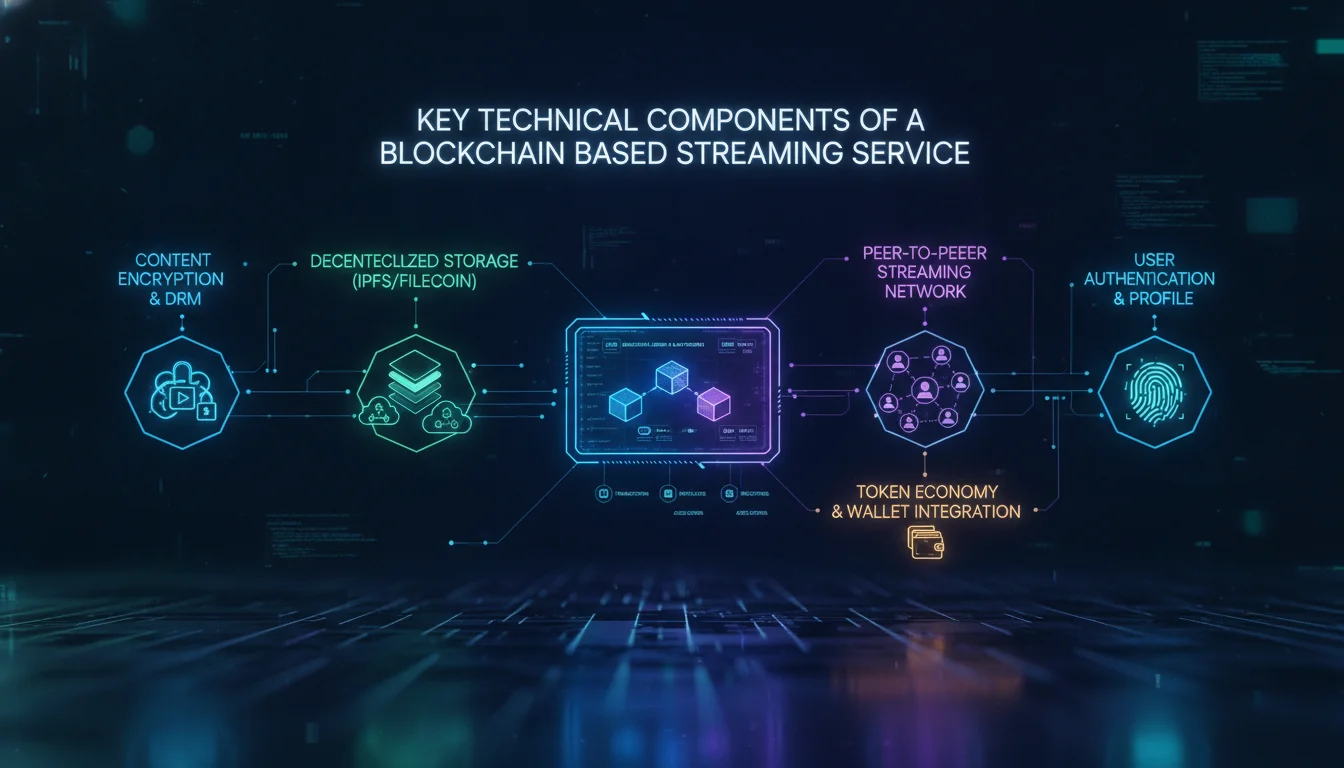
Key Technical Components of a Blockchain Based Streamung Service
Blockchain Metadata Indexing and DHT
A Distributed Hash Table (DHT) is a lookup system that maps content identifiers to the network locations of stream chunks. The GitHub implementation from MMagdys uses blockchain purely for content metadata and DHT for locating chunks. This design keeps the blockchain lightweight and avoids storing large media files on-chain, a decision every serious streaming architecture eventually converges on.
Peer-to-Peer Content Delivery with IPFS and RTMP
Trembit describes the technical flow this way: video content is first delivered to a media server via RTMP (Real-Time Messaging Protocol), then transcoded, encrypted, and securely delivered to viewers using protocols like IPFS and HLS (HTTP Live Streaming). Relay nodes eliminate the need for expensive server infrastructure.
Enterprises building a blockchain based should evaluate whether the network supports RTMP ingestion and IPFS pinning, since those two components largely determine live latency and content durability.
Tokenized Incentives and Node Operators
Streamr, a real-world decentralized data network, reports 315 active nodes and processes 262.29 GB per day. Node runners stake the $DATA token to secure the network and earn yield, with Streamr reporting 68.03% APY at the time of capture. This incentive layer is what makes permissionless content delivery scale without a central operator footing the infrastructure bill.
In a commercial streamung service, token incentives can compensate nodes for bandwidth and storage, while smart contracts distribute subscription revenue to creators without intermediary fees eating into the split.
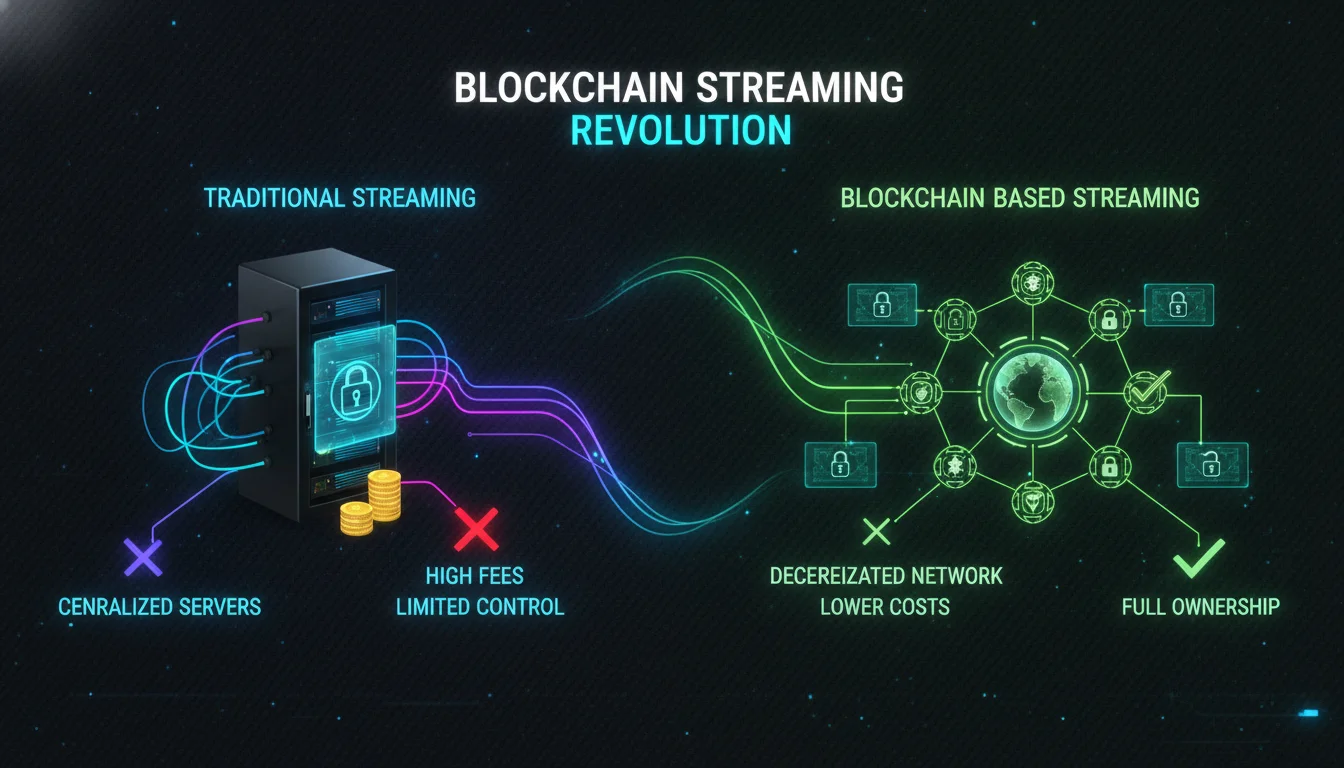
Comparing Traditional Streaming and a Blockchain Based Streaming Model
Cost Structure and Revenue Models
Oodles cites a Forbes estimate that Netflix could save $138 million per month through blockchain-based identities. These savings come from reduced fraud, automated payments, and lower intermediary overhead, not from cutting content budgets.
A this type of service can support pay-per-use consumption, tipping, NFT sales, and token rewards, whereas centralized subscriptions lock users into fixed monthly fees regardless of how much they actually watch.
Security, Piracy, and IP Protection
PerfectionGeeks argues that decentralized storage across multiple nodes resists server attacks better than a single centralized repository. Consensys adds that an append-only ledger makes it easier for creators to legally enforce rights after infringement occurs.
Scalability and Infrastructure Trade-offs
Blockchain streaming reduces reliance on expensive data centers, but it introduces real challenges around latency, peer availability, and delivery consistency. The comparison table below summarizes the key differences.
| Dimension | Traditional Centralized Streaming | this kind of streamung service |
|---|---|---|
| Content storage | Company-owned data centers, e.g., Netflix, YouTube | Peer-to-peer nodes, IPFS, and DHT-based chunk locations |
| Payment model | All-you-can-watch subscriptions or ad-supported | Smart contract micropayments, pay-per-use, token rewards |
| Royalty distribution | Manual, intermediary-heavy; artists receive only about 12% of US music spend | Programmable smart contracts distribute payments upon verified usage |
| IP protection | DMCA takedowns, platform-enforced, estimated $71B annual piracy loss | Time-stamped metadata, NFT ownership proofs, immutable ledger |
| Censorship risk | High; platform policy changes can remove content | Lower; decentralized governance and community-led policies |
| Infrastructure | Centralized CDN, high server costs | Relay nodes and token-incentivized peers; example: Streamr’s 315 nodes |
Real-World Blockchain Streaming Networks and Projects
Streamr: Decentralized Real-Time Data and Video
Streamr is a cryptographically secure, open-source, decentralized network capable of streaming live media and real-time data at scale. It supports live video, AI data delivery, DePIN hardware data, secure communications, metaverse experiences, and data monetization. Streamr works with companion blockchains including Ethereum, Gnosis, and Polygon for identity, security, and payments.
For commercial adopters, Streamr’s $DATA token and node operator model show how a the based streamung service can align network incentives without relying on a corporate CDN. It’s a useful blueprint for anyone modeling their own token economy.
Open-Source P2P Streaming Prototypes
The GitHub repository by MMagdys provides a working peer-to-peer blockchain-based video streaming service under an MIT license. It uses JavaScript, CSS, and HTML, with Node.js and npm as prerequisites. Developers can clone the repo, run npm install, and start the service locally to test video listing, streaming, and offline like/subscribe functionality.
Enterprise Blockchain Streaming Development
Development firms such as Oodles build end-to-end blockchain video streaming applications with features like blockchain-based profiles, search and geolocation, multiple crypto payment gateways, multi-lingual access, user ratings, and NFT content ownership. These enterprise builds target live platforms, Web3 media, and streaming dApps rather than consumer-facing brands.
How to Evaluate or Launch a Blockchain Based Streamung Service
Step 1: Define Content Ownership and Royalty Rules
Start by determining whether creators need NFT minting, usage-based payouts, or automated licensing. This decision shapes everything downstream, from smart contract design to wallet onboarding flows.
Step 2: Choose Blockchain and Storage Layers
Evaluate Ethereum, Polygon, or Gnosis for identity and payments, and IPFS or DHT for content distribution. Most production networks, Streamr included, don’t build their own L1, they lean on companion chains instead.
Step 3: Select Monetization Models
Decide between micropayments, subscriptions, token rewards, or NFT-gated access. A service can mix these models, unlike a traditional platform locked into one pricing structure.
Step 4: Assess DRM and Geolocation Requirements
Multi-country licensing may require digital rights management and regional billing systems. Oodles points out that subscribers often can’t access content in another country due to country-specific license restrictions, and blockchain doesn’t eliminate that legal reality on its own.
Step 5: Test Latency and Node Reliability
Run pilot streams through relay nodes and measure delivery consistency before full launch. This is where most projects discover their real bottlenecks, not in the smart contract layer but in peer availability.
Development Cost and Technical Considerations
Antier’s 2025 guide outlines several cost factors: blockchain network choice, IPFS integration, smart contract complexity, token economy design, and UI/UX workflows. Development teams building a blockchain based also need to plan for transcoding overhead, wallet onboarding, and node incentives, all of which add engineering time beyond a typical CRUD app.
Choosing the Right Blockchain Network
Streamr’s compatibility with Ethereum, Gnosis, and Polygon shows that a production streaming network doesn’t need its own L1. Instead, it can use companion chains for identity, security, and payments while running data transport on a separate peer-to-peer layer. That’s a more capital-efficient path than launching a dedicated chain just to move video chunks.
Challenges and Open Issues in Decentralized Streaming
Latency, Scalability, and Network Reliability
Latency is the single biggest barrier for blockchain streaming, because peer-to-peer delivery must maintain stable relay nodes to avoid buffering. Trembit notes that live streaming dominates 62% of the market, which raises the stakes on this problem. A blockchain based streamung service must optimize node discovery, chunk delivery, and fallback CDN support to compete with centralized latency.
Regulatory and Licensing Complexity
Multi-country licensing remains genuinely difficult. Oodles points out that subscribers often can’t access content in another country due to country-specific license restrictions. Blockchain can support DRM and billing systems with multi-country access, but legal compliance still requires negotiation with rights holders, token or no token.
Adoption Barriers for Mainstream Users
Wallet management, token volatility, and unfamiliar interfaces can deter mainstream viewers. Antier notes that future growth will depend on integrating social and gaming experiences, community-funded content, and onboarding paths that hide blockchain complexity from end users entirely.
Pros and Cons of a Blockchain Based Streamung Service
Pros
- Direct creator monetization through smart contract micropayments, without a platform taking a large cut first
- Stronger IP protection via time-stamped metadata and NFT ownership proofs
- Lower censorship risk through decentralized governance rather than a single company’s content policy
- Resilience against server-level attacks since content is spread across multiple nodes instead of one data center
- Flexible pricing models: pay-per-use, tipping, token rewards, and subscriptions can coexist
Cons
- Latency and buffering risk when relay nodes are unreliable or thin on the network
- Wallet setup and token volatility create friction for mainstream, non-crypto-native users
- Multi-country licensing and DRM compliance still require legal negotiation, blockchain doesn’t remove that step
- Smaller networks may have fewer active nodes than established CDNs, affecting delivery consistency
- Token-based incentive models add tokenomics design risk on top of normal product risk
The Future of Blockchain Based Streamung Services
From Niche Experiments to Mainstream Infrastructure
The direction is clear from Trembit, Consensys, Streamr, and Oodles: decentralized streaming is moving from experimental open-source projects toward commercial infrastructure. A blockchain based streamung service can lower payment friction, help enforce IP rights, and give creators a larger share of revenue than traditional aggregators typically allow.
What to Watch Through 2026
Watch for wider IPFS pinning services, NFT-gated content, and token-incentivized node networks expanding beyond early movers like Streamr. Commercial buyers should pilot a blockchain based streamung service against a specific use case, live events, educational content, or a niche creator community, before committing to a full migration.
If this trend holds, the next generation of streaming won’t be owned by a single platform. It will be operated by a network of peers, governed by smart contracts, and paid through transparent micropayments. That’s the thesis we’re building around at Digital Blockchains, and it’s why we work with teams designing tokenomics and protocol architecture for exactly this kind of infrastructure. If you’re building in this space, apply to the Genesis Cohort at digitalblockchains.com and let’s talk architecture before you write a line of Solidity.
Frequently Asked Questions
What is a blockchain based streamung service?
A blockchain based streamung service is a decentralized platform that uses blockchain for metadata, smart contracts for payments, and peer-to-peer networks for content delivery. It removes the centralized intermediary that traditional platforms like YouTube or Netflix rely on.
How does blockchain streaming differ from YouTube or Netflix?
YouTube and Netflix store content on centralized servers and control payouts directly. Blockchain streaming stores content across peer-to-peer nodes and automates payments with smart contracts, cutting out the manual payout cycle.
Can blockchain streaming prevent piracy?
It can’t eliminate piracy completely, but time-stamped metadata, NFT ownership proofs, and immutable ledgers make infringement easier to detect and enforce. Consensys notes this append-only structure gives creators stronger legal footing after the fact.
What is IPFS in blockchain streaming?
IPFS, or InterPlanetary File System, is a distributed storage protocol that stores encrypted video chunks across multiple nodes instead of a single data center. It’s the storage layer most blockchain streaming architectures rely on for actual media files.
How do creators earn money on blockchain streaming platforms?
Creators earn through smart contract micropayments, NFT sales, token rewards, and pay-per-use models that bypass traditional intermediaries. This structure lets a much larger share of revenue reach the creator directly compared with legacy royalty chains.
Which blockchain networks support video streaming?
Ethereum, Polygon, and Gnosis are commonly used for identity and payments, while data transport runs on peer-to-peer layers like Streamr or IPFS. Streamr specifically uses these three as companion chains rather than building its own base layer.