Protocol ai crypto is a category of blockchain networks that embed artificial intelligence directly into their architecture for AI computation, data exchange, and autonomous services. These systems aim to decentralize AI while keeping trust and transparency on-chain.
Key Takeaways
- ai crypto integrates AI models, marketplaces, and agents into decentralized ecosystems, moving well past simple token transfers.
- Projects like Lightchain Protocol AI, Ocean Protocol, and the meme-inspired AI Protocol (AI) token show just how wide this category has become.
- AI improves blockchain security through anomaly detection, smart contract auditing, and AI-powered oracles that strengthen data integrity.
- The biggest open problems are scalability, off-chain dependencies, and what researchers call the “illusion of decentralization.”
- The next phase points toward verifiable on-chain AI, federated learning, and broader enterprise adoption of decentralized AI infrastructure.
What Is Protocol AI Crypto?
Defining the Intersection of AI and Blockchain
this type of crypto refers to a set of smart contracts and off-chain components that let AI tasks, such as model training, inference, or data provisioning, run in a decentralized way on a blockchain network. Unlike traditional chains built purely for asset transfers, these protocols bake machine learning capabilities directly into their design. A comprehensive review published on Medium describes these systems as production-grade integrations spanning automated trading, oracle networks, and autonomous agent frameworks.
Core Components of AI Protocols
Most this kind of crypto systems share three layers: a blockchain substrate for consensus and immutability, an AI computation layer for running models, and a tokenomic incentive layer that pays participants for contributing data, compute, or models. Lightchain’s Proof of Intelligence (PoI) is one example, a consensus mechanism where miners perform useful AI work instead of solving arbitrary hash puzzles. This design ties network security to productive AI output, a concept examined in the arXiv paper “AI-Based Crypto Tokens: The Illusion of Decentralized AI?” by researcher Rischan Mafrur.
Why Builders Are Betting On Protocol AI Crypto

Decentralization of AI Services
Centralized AI services concentrate power, data, and revenue inside a handful of firms. protocol ai disrupts that model by enabling permissionless AI marketplaces where anyone can offer or consume AI services. Ocean Protocol, for instance, lets users tokenize data as Data NFTs and sell access through Datatokens, according to the project’s own documentation. That structure turns raw data into a tradeable asset while preserving privacy through Compute-to-Data.
Incentivizing Data and Model Sharing
Acquiring quality training data is one of the hardest problems in AI, and ai crypto systems tackle it by rewarding contributors with tokens. Lightchain uses its $LCAI token to compensate workers who provide computational resources for AI tasks. According to Lightchain’s own site, the network has processed over 300,000 transactions and built a live ecosystem that includes an AI chat product, a developer IDE, and DAO governance, showing how a well-designed incentive layer can bootstrap real network effects.
“While emerging innovations offer pathways to strengthen decentralized AI ecosystems, significant gaps remain between the promises and the realities of current AI-token implementations.” Rischan Mafrur, “AI-Based Crypto Tokens: The Illusion of Decentralized AI?”, arXiv, 2025
Leading Protocol AI Crypto Projects in 2026
Lightchain Protocol AI: Proof of Intelligence and AIVM
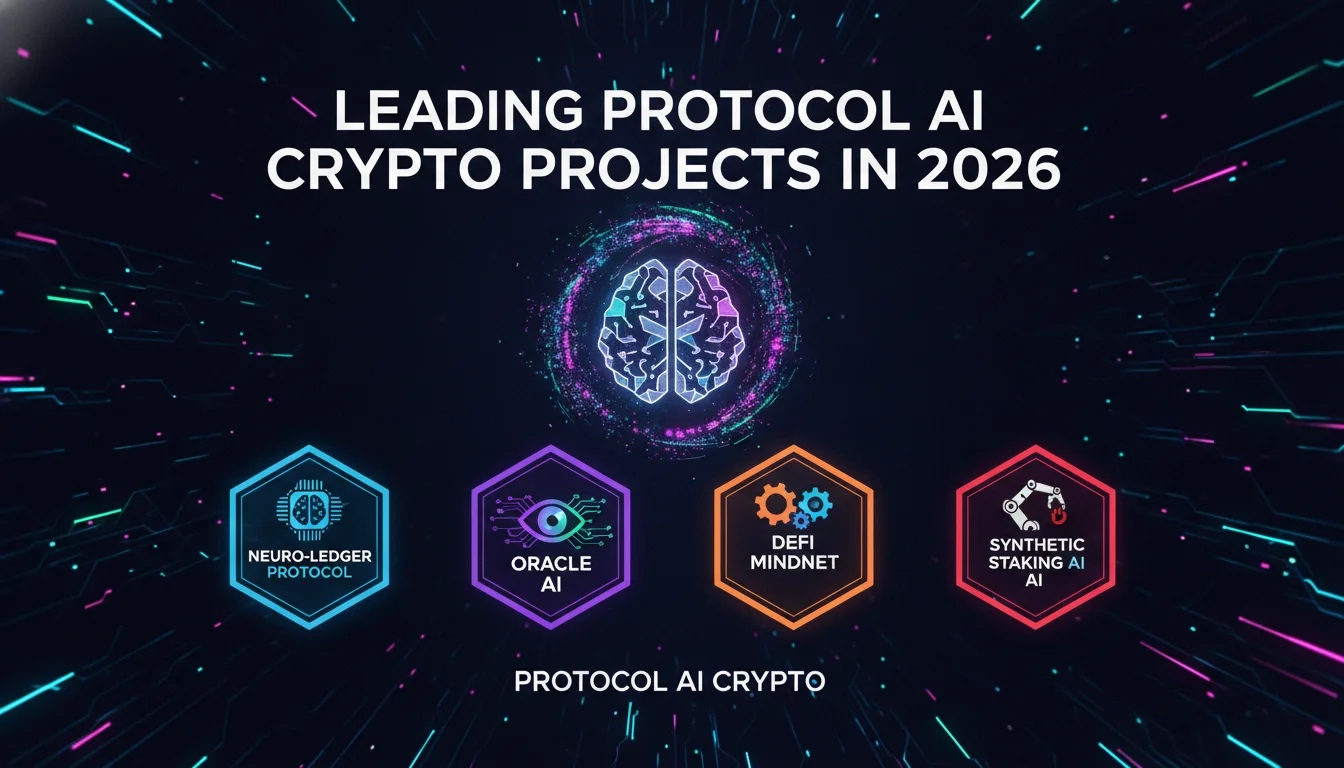
Lightchain AI is a Layer-1 blockchain combining Proof of Intelligence with an Artificial Intelligence Virtual Machine (AIVM). PoI rewards node operators for performing valuable AI computations, such as model training or inference, rather than burning energy on arbitrary hash puzzles. The AIVM extends the execution environment to natively support AI-driven smart contracts, so developers can build dApps that reason, predict, and automate tasks. With a total supply of 10 billion LCAI and a full toolkit including a bridge, faucet, and explorer, Lightchain has assembled one of the more complete this type of crypto stacks on the market.
Ocean Protocol: Tokenizing AI Data Assets
Ocean Protocol runs a decentralized data exchange built specifically for AI use cases. Its Compute-to-Data feature lets algorithms run against private data without ever moving the raw information off the owner’s infrastructure, solving a real privacy problem for enterprises. Data assets get wrapped as ERC-721 Data NFTs, and access is governed through ERC-20 Datatokens, per Ocean’s protocol documentation. Ocean’s Predictoor product also lets users run AI-powered prediction bots against crypto price feeds, a practical example of how these networks turn raw data into usable signal.
AI Protocol (AI Token): A Meme-Driven Micro-Cap
The AI Protocol token, ticker AI, trades on the Base chain and sits at the speculative end of this category. On-chain data from CoinMarketCap shows a maximum supply of 500 million and a market rank of #7883, with Crypto.com pricing the token at roughly $0.0000000000000000002382 and negligible trading volume. CoinMarketCap tags it under “Memes,” which puts it in sharp contrast with utility-focused projects like Ocean or Lightchain. Its existence is a useful reminder that the label “AI crypto” gets applied to everything from serious infrastructure to community tokens riding a trend, so investors need to check for actual AI functionality before assuming any exists.
Side-by-Side Comparison of Leading AI Protocols
| Project | Blockchain | AI Functionality | Token Utility | Key Innovation |
|---|---|---|---|---|
| Lightchain Protocol AI | Ethereum (L1) | PoI consensus, AIVM for AI dApps | Access, staking, governance | Proof of Intelligence consensus |
| Ocean Protocol | Ethereum | Data tokenization, Compute-to-Data | Data access, curation, governance | Compute-to-Data privacy |
| AI Protocol (AI Token) | Base | None (meme token) | Community, speculation | Brand association with “AI” |
| SingularityNET | Ethereum, Cardano | Decentralized AI service marketplace | Payments for AI services, governance | Open AI agent framework |
| Fetch.ai | Cosmos | Autonomous AI agents for DeFi, travel | Agent operation, transactions | Multi-agent system for real-world automation |
How AI Enhances Blockchain Security and Efficiency
AI-Powered Smart Contract Auditing
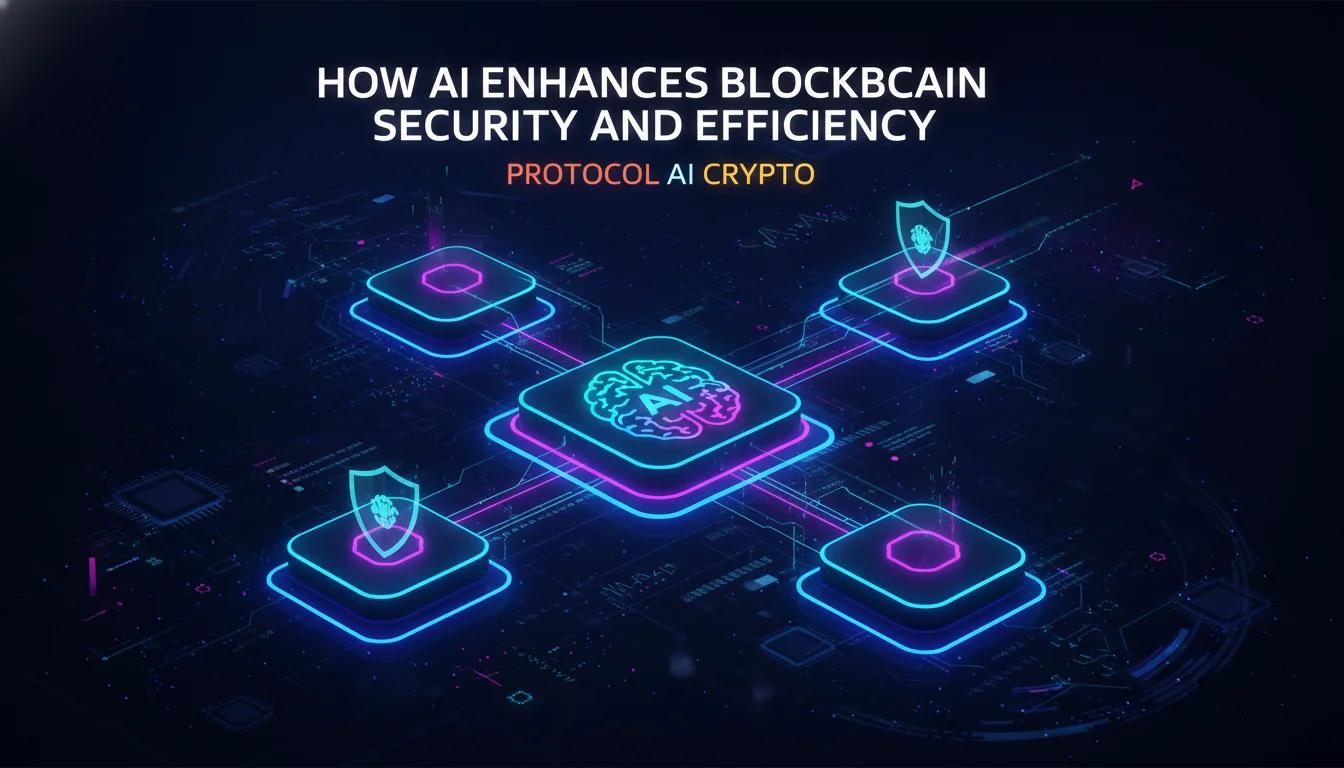
AI enhances blockchain security by applying machine learning models trained on historical exploit data to flag suspicious patterns in contract code before deployment. Smart contract vulnerabilities have cost the industry serious money over the years, and manual audits alone can’t keep pace with the volume of new deployments. Projects like Cortex and Oraichain, cited in the Medium review of production AI-crypto integrations, are building on-chain infrastructure that scores contract risk in near real time, adding a proactive layer on top of traditional audits.
Anomaly Detection in Network Transactions
AI algorithms are well-suited to spotting deviations from normal network behavior, which in a blockchain context means catching flash-loan attacks, wash trading, or Sybil attacks before they cause real damage. By folding AI-based monitoring into relay networks, protocol ai crypto platforms can build more resilient consensus layers. This matters most for cross-chain bridges, where large value transfers demand continuous anomaly scanning rather than periodic checks.
Technical Architectures of AI-Crypto Protocols
On-Chain vs. Off-Chain AI Computation
Most AI-crypto protocols run on hybrid architectures because the computational demands of AI models clash directly with blockchain scalability. Heavy model training happens off-chain, while cryptographic proofs of the work, or the model outputs themselves, get anchored on-chain for verification. The arXiv paper referenced above points out that this off-chain dependency creates a centralization risk: if a small number of parties control the off-chain compute, the system isn’t actually decentralized no matter what the token says. Newer approaches like zero-knowledge proofs for machine learning aim to keep computation verifiable while staying off-chain, balancing efficiency against trust.
Consensus Mechanisms Tailored for AI Tasks
Traditional Proof-of-Work and Proof-of-Stake are agnostic to what kind of computation secures the network. AI-focused protocols flip that script. Lightchain’s Proof of Intelligence repurposes consensus for useful work, selecting validators based on the quality and relevance of the AI tasks they complete. That approach cuts waste and, in theory, creates a marketplace where AI developers can monetize their skills directly through protocol-level rewards instead of relying on a separate platform.
Challenges and Limitations of Protocol AI Crypto
Scalability and Latency Constraints
Training a large language model fully on-chain is not possible right now given current block times and gas limits. Even inference, which is far lighter than training, still runs into latency issues on most chains. As a result, many protocol ai crypto projects lean on centralized cloud providers for the heavy lifting, which cuts against the decentralization pitch these networks are built on. Layer-2 solutions and dedicated AI execution environments like Lightchain’s AIVM are trying to close that gap, but mass-scale on-chain AI remains, honestly, a research-level challenge rather than a solved problem.
Centralization Risks and the “Illusion of Decentralization”
Mafrur’s arXiv paper argues that many AI-token projects simply wrap a token layer around an otherwise centralized AI service. A project might sell tokens for API access that runs entirely on AWS behind the scenes. That model is crypto-native in how it handles payment, but it fails to deliver actual decentralized AI when the underlying infrastructure still sits under one company’s control. True protocol ai crypto has to push custody of both data and execution out to the edge, using tools like trusted execution environments (TEEs) or decentralized physical infrastructure networks (DePIN).
“Many platforms depend extensively on off-chain computation, exhibit limited capabilities for on-chain intelligence, and encounter significant scalability challenges,” notes the arXiv review of AI-token architectures, a finding that should temper expectations for near-term “fully on-chain” AI claims.
Regulatory and Ethical Hurdles
AI protocols handling personal data have to navigate GDPR, CCPA, and a growing patchwork of regional privacy rules. On top of that, autonomous AI agents executing financial transactions raise real accountability questions. If an agent running on a network like Fetch.ai executes a bad trade, who’s actually liable, the developer, the DAO, or the user who deployed it? These unresolved questions could slow institutional adoption of protocol ai crypto until clearer legal frameworks emerge across major jurisdictions.
The Future of Protocol AI Crypto: 2026 and Beyond
Innovations on the Horizon: Federated Learning and ZK-Proofs
Federated learning, which trains models across decentralized devices without ever sharing raw data, and zk-SNARKs for machine learning are two techniques that could make protocol ai crypto systems more private and scalable at the same time. Ocean Protocol’s Compute-to-Data is an early version of this idea in production. Next-generation protocols may eventually run entire model pipelines verifiably on-chain, which would finally satisfy both the performance demands of AI and the trustlessness that blockchain is supposed to guarantee.
As of 2026, we’re watching this space closely at Digital Blockchains because the tokenomic design choices being made right now, how validators get rewarded, how data contributors get paid, will determine which networks actually scale versus which ones stay niche. If you’re building in this space and want a second set of eyes on your token model or protocol architecture, apply to the Genesis Cohort at digitalblockchains.com.
Pros and Cons
Pros
- Opens AI infrastructure and data markets to permissionless participation instead of a handful of big tech firms
- Token incentives can bootstrap data and compute contribution faster than traditional procurement models
- On-chain anomaly detection and contract auditing add a real security layer beyond manual review
- Privacy-preserving techniques like Compute-to-Data let algorithms use sensitive data without exposing it
Cons
- Heavy reliance on off-chain compute undercuts the decentralization pitch for many projects
- Full on-chain training or inference for large models remains technically out of reach today
- Regulatory and liability questions around autonomous AI agents are largely unresolved
- The category includes meme tokens with zero AI functionality riding the same narrative as serious infrastructure
Frequently Asked Questions
What is protocol AI crypto?
Protocol AI crypto refers to blockchain protocols that build artificial intelligence capabilities directly into their architecture, enabling decentralized AI services, data marketplaces, and autonomous agents through a mix of on-chain and off-chain components.
Which is the best protocol AI crypto project?
It depends on the use case. Ocean Protocol excels at data tokenization, Lightchain AI offers a fuller AI-native blockchain stack with PoI and AIVM, and Fetch.ai focuses on autonomous agents, so each serves a different corner of the AI-crypto space.
Is AI Protocol (AI token) a good investment?
AI Protocol is a micro-cap meme token with no evident AI utility, and its extremely low price and thin trading volume make it highly speculative. Anyone seeking real AI-crypto exposure should evaluate projects with actual technology and active ecosystems instead.
How does Proof of Intelligence work?
Proof of Intelligence is a consensus mechanism where network validators perform meaningful AI tasks, like training or inference, instead of burning energy on arbitrary puzzles. It rewards useful computation while still securing the network against attacks.
What is the most promising AI crypto right now?
There’s no single answer, since “promising” depends on whether you’re evaluating infrastructure depth, token liquidity, or ecosystem activity. Projects with working products and real usage, like Ocean Protocol’s Compute-to-Data or Lightchain’s live AI chat and IDE tools, tend to offer more substance than tokens riding pure narrative.
Can AI and blockchain be combined securely?
Yes, though real challenges remain around scalability and centralization. Hybrid architectures that keep sensitive data off-chain while verifying results on-chain, paired with privacy tech like zero-knowledge proofs, are making secure AI-blockchain combinations more practical each year.