Enterprise blockchain development services are consulting, design, and deployment engagements that build permissioned distributed ledger systems integrated with existing infrastructure. These services span smart contracts, private networks, and regulatory compliance work.
Key Takeaways
- development services deliver customized, permissioned networks built to strict security and compliance standards.
- A structured process, discovery, architecture design, development, deployment, and maintenance, determines whether the integration actually works.
- Platform selection (Hyperledger Fabric, Ethereum Enterprise, Corda) depends entirely on the use case, not on trend-chasing.
- Leading providers bundle smart contracts, audits, tokenization, and legacy system integration into one engagement.
- Interoperability and AI-assisted development are reshaping how fast these projects can ship.
Understanding Enterprise Blockchain Development Services
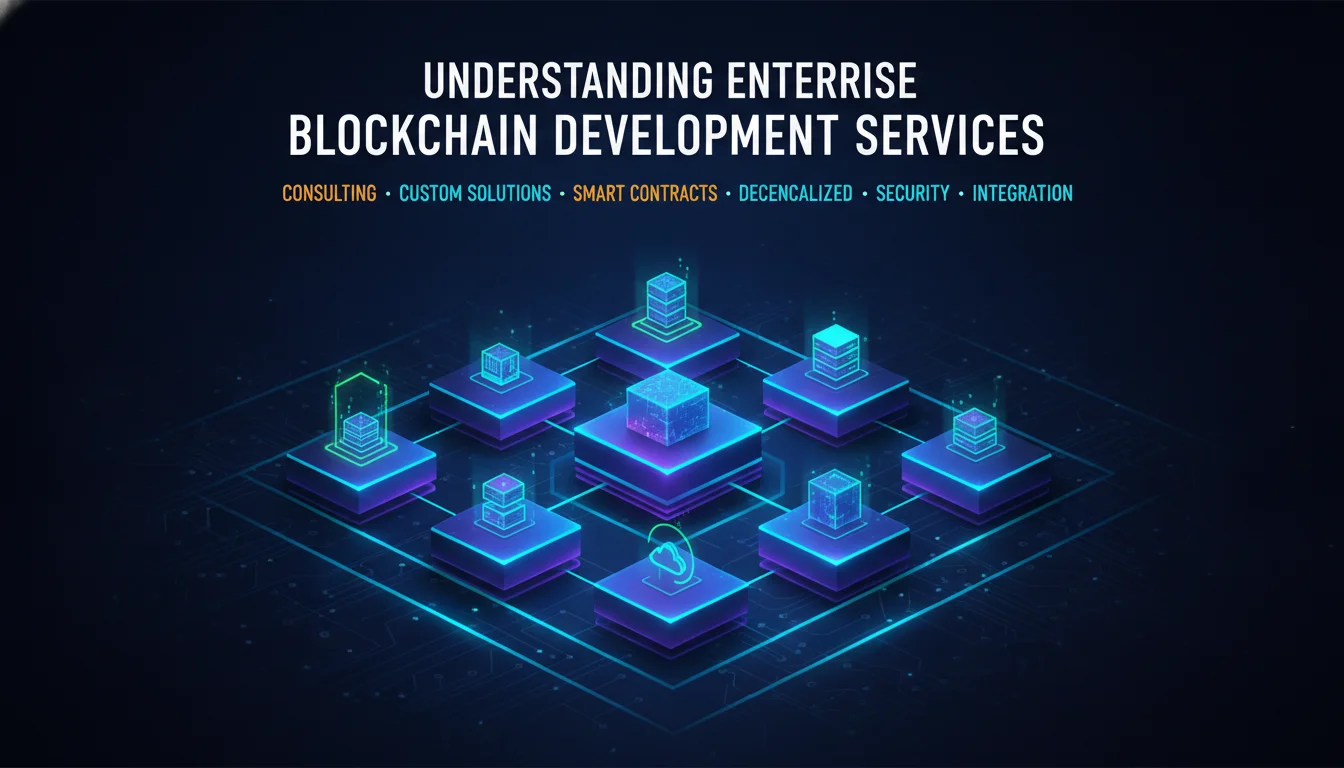
this type of services cover the strategic consulting, technical design, and implementation of blockchain networks built for organizational use, not public speculation. Unlike public chains open to anyone, enterprise blockchains are permissioned: access is restricted to authorized participants, and governance stays controlled. This structure supports confidentiality, scalability, and alignment with frameworks like ISO/IEC 27001 and GDPR.
“A permissioned ledger only earns its keep when it reduces reconciliation errors and gives every stakeholder the same source of truth in real time. Anything less is just an expensive database.” – a principle echoed across enterprise DLT implementation guides.
What Is Enterprise Blockchain?
An enterprise blockchain is a distributed ledger technology (DLT) network built for business applications rather than open speculation. It runs on a predefined consensus mechanism, often Practical Byzantine Fault Tolerance (PBFT) or Raft, that validates transactions faster among known, vetted nodes. According to Ideas2Goal, enterprise blockchains provide a single source of truth, cut reconciliation errors, and enable real-time data sharing across departments and partners.
Core Features of Enterprise Blockchain
Enterprise blockchain solutions typically include role-based access control, high transaction throughput, data privacy through channels or private data collections, and pluggable consensus. Hyperledger Fabric, for instance, lets organizations create separate channels for confidential transactions visible only to specific network members. These features are why this kind of development services matter most in industries handling sensitive data.
How Enterprise Blockchain Differs from Public Blockchains
Public blockchains prioritize decentralization and censorship resistance; enterprise blockchains prioritize efficiency, privacy, and regulatory fit. Per Ideas2Goal’s comparison, public blockchains run slower and stay fully transparent, while enterprise blockchains offer controlled visibility, faster consensus, and scalability through permissioned participation. That distinction shapes the entire enterprise blockchain landscape, from platform choice to who gets to validate a transaction.
Key Benefits of Enterprise Blockchain Development Services
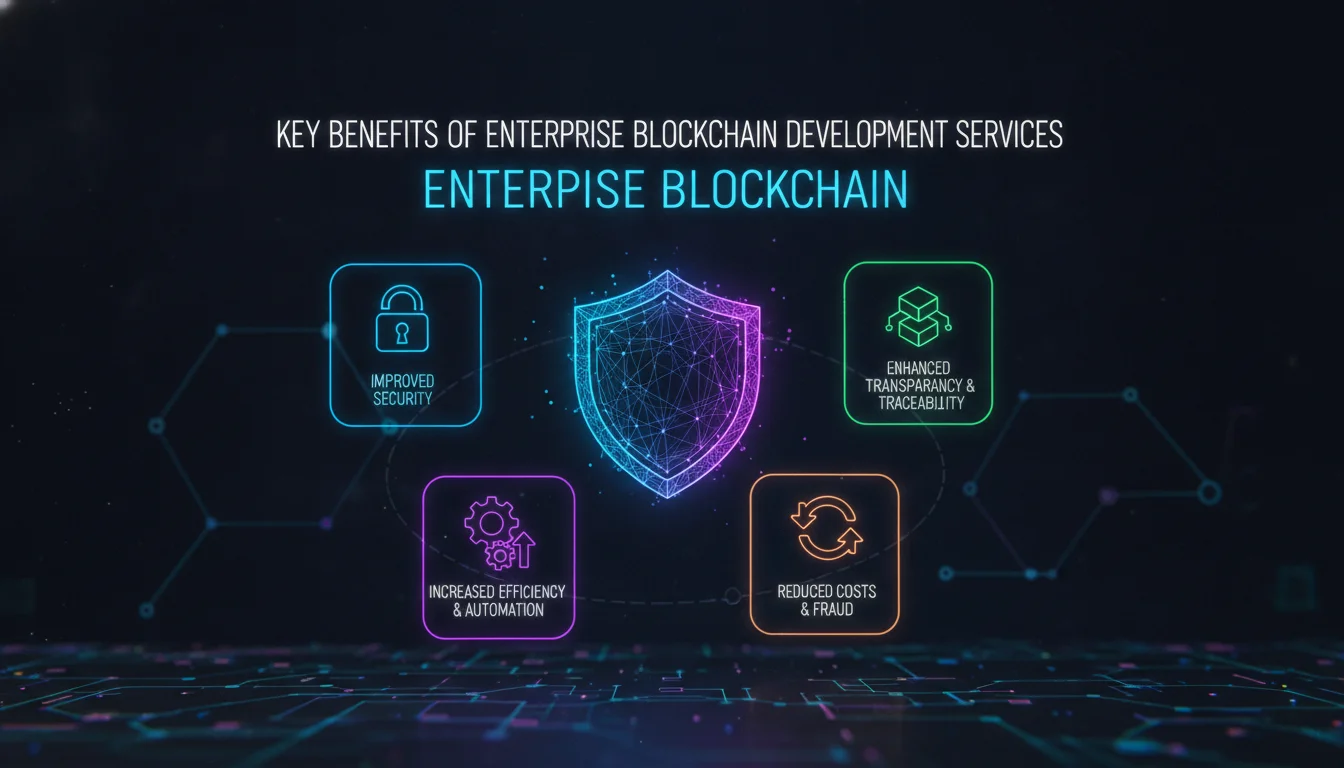
Organizations that adopt enterprise blockchain development services gain measurable advantages in security, operational efficiency, and stakeholder trust. These benefits come from the technology’s core properties: immutability, decentralization, and automation, but they only compound when tailored to specific business workflows.
Enhanced Security and Data Integrity
Enterprise blockchains use cryptographic hashing and consensus to make data tampering practically impossible. Every transaction gets digitally signed and linked to previous blocks, forming an audit trail by design. PixelPlex, a blockchain development firm with dozens of delivered projects, reports zero critical exploits across seven years for its smart contracts, crediting dual-audit flows and continuous fuzz testing. That kind of security discipline is the baseline promise of any serious enterprise blockchain provider.
Operational Efficiency and Cost Reduction
Automating business logic through smart contracts removes manual reconciliation and cuts out intermediaries. A supply chain platform, for example, can auto-trigger payments once IoT-confirmed delivery conditions are met. PixelPlex notes its DAO-based governance and automated workflow projects can reduce operational overhead by up to 40% in some engagements. Enterprise blockchain development services translate that automation into faster settlements and lower ongoing costs.
Regulatory Compliance and Trust
Permissioned networks make it easier to embed compliance controls like Know Your Customer (KYC) and Anti-Money Laundering (AML) directly at the protocol level. Appinventiv states its blockchain products are built to meet ST-20, AML, GDPR, PCI DSS, and PSD2 standards. By baking in identity management and audit-ready logging, these services help businesses satisfy strict regulatory requirements without giving up transparency.
Core Services Offered by Enterprise Blockchain Development Companies
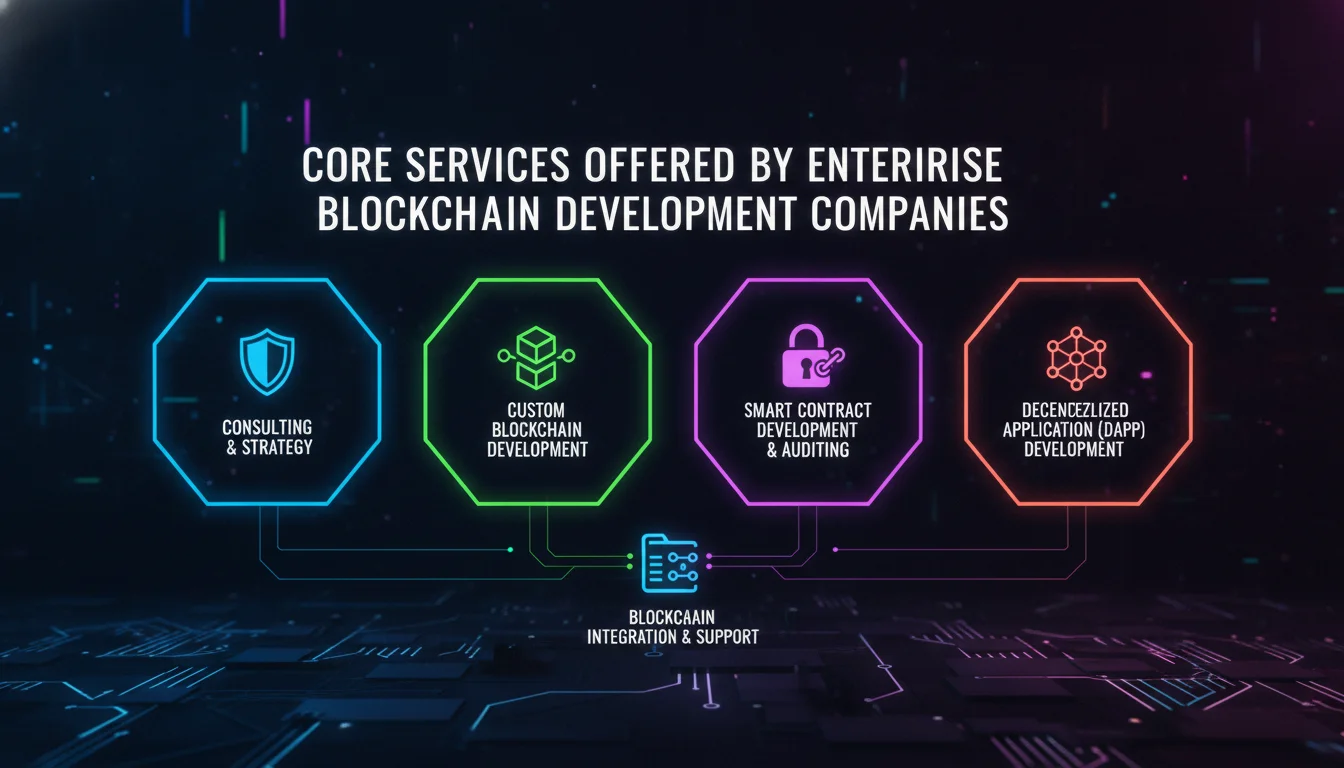
A full-stack provider delivers a suite spanning the entire project lifecycle, from ideation through post-launch support. Here’s what that typically includes.
Smart Contract Development and Audits
Smart contracts are self-executing code that governs transactions on a blockchain. Development means writing gas-optimized, secure code in languages like Solidity or Go, followed by rigorous audits. Here’s a simplified example of a gas-conscious access-control pattern in Solidity:
pragma solidity ^0.8.20;

contract EnterpriseAccessRegistry {
 address public admin;
 mapping(address => bool) public authorizedNodes;

 event NodeAuthorized(address indexed node);

 modifier onlyAdmin() {
 require(msg.sender == admin, "Not admin");
 _;
 }

 constructor() {
 admin = msg.sender;
 }

 function authorizeNode(address node) external onlyAdmin {
 authorizedNodes[node] = true;
 emit NodeAuthorized(node);
 }
}
PixelPlex emphasizes a dual-audit flow combining automated testing with formal verification to catch vulnerabilities before mainnet. Third-party audits are standard practice among reputable providers, and skipping them is a red flag in any proposal.
Private and Permissioned Network Development
Many enterprises need a private blockchain running on a restricted network of known nodes. Development covers the consensus model, membership services, and certificate authorities. TechAhead builds private networks that integrate with existing IT systems, offering role-based access and high-availability SLAs. Enterprise blockchain development services frequently lean on frameworks like Hyperledger Fabric, Corda, or Quorum for this layer.
Blockchain Integration and Consulting
Before any code gets written, a consulting phase maps the use case to a feasible architecture: technical feasibility studies, ROI analysis, and stack selection. Webkul pairs its consulting with an AI-assisted development approach to compress time-to-market. Integration work then connects the blockchain to legacy databases, ERP systems, and external APIs, keeping data synchronized in real time.
The Development Process for Enterprise Blockchain Solutions
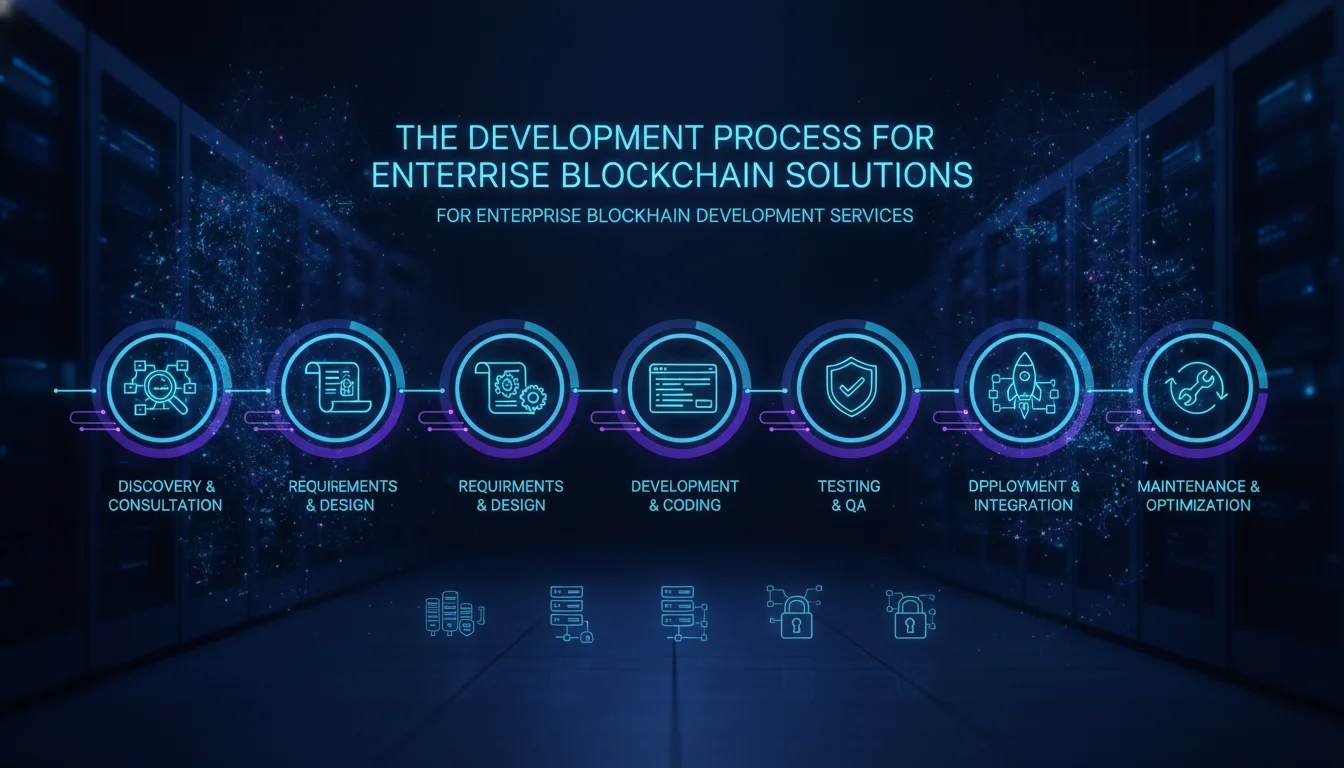
Step 1: Run Discovery and Requirements Analysis
Discovery starts with stakeholder interviews, existing system audits, and a regulatory review to confirm blockchain is actually the right tool for the problem. Appinventiv notes this phase also clarifies data privacy needs, transaction volume expectations, and integration points before anyone touches an architecture diagram.
Step 2: Design the Architecture and Select a Platform
Architects design the network topology, consensus mechanism, and smart contract interfaces once requirements are locked. Platform choice matters enormously here: Hyperledger Fabric for consortium networks, Ethereum Enterprise for EVM-compatible private chains, or Corda for financial services. The design has to account for scalability, throughput, and future interoperability, because retrofitting these later is expensive.
Step 3: Build and Test in Agile Sprints
Development happens in agile sprints that incrementally deliver smart contracts, APIs, and interfaces, backed by unit tests, integration tests, and security audits. PixelPlex reports maintaining budget accuracy within roughly 2% of forecast using fixed-scope road-mapping and public sprint burn-down charts. Testnets simulate real-world load to catch bottlenecks before anything touches mainnet.
Step 4: Deploy and Integrate with Existing Systems
Once testing clears, the network deploys on-premises, hybrid cloud, or fully cloud-based, depending on the compliance profile. Providers like Digis operate across six time zones to keep go-live coordination smooth for multinational clients. After deployment, the blockchain gets wired into existing ERP, CRM, and other business systems.
Step 5: Maintain and Evolve the Network
Blockchain networks need ongoing care: node management, smart contract upgrades, performance monitoring, and security patches. Many enterprise blockchain development services bundle 24/7 support and periodic growth reviews to keep the platform aligned with changing business needs.
Comparing Blockchain Platforms for Enterprise Use
Selecting the underlying platform is one of the most consequential decisions in any enterprise blockchain project. The table below compares four frameworks commonly used by providers in this space.
| Platform | Consensus | Privacy Features | Smart Contract Language | Best For |
|---|---|---|---|---|
| Hyperledger Fabric | PBFT / Raft | Channels, private data collections | Go, Java, JavaScript | Supply chain, consortium governance |
| Ethereum Enterprise (Quorum / Besu) | QBFT, IBFT | Private transactions, permissioning | Solidity | Finance, tokenization, DeFi |
| Corda | Notary-based | Point-to-point data sharing | Kotlin, Java | Financial services, insurance |
| Multichain | Round-robin validator | Stream-level permissions | JavaScript | Rapid prototyping, light enterprise needs |
Hyperledger Fabric
Maintained by the Linux Foundation, Hyperledger Fabric is a modular, permissioned framework supporting pluggable consensus and identity management through a membership service provider. Its channel architecture keeps transactions visible only to designated participants, making it a common pick for logistics and healthcare deployments.
Ethereum Enterprise
Ethereum Enterprise refers to private, permissioned implementations of the Ethereum protocol, like Hyperledger Besu and Quorum. They support Solidity smart contracts plus features like private transactions and permissioned validators. Appinventiv lists Ethereum development among its core services, pointing to the ecosystem’s maturity and developer depth.
Corda
Designed by R3 for regulated industries, Corda uses a notary service for consensus and focuses on point-to-point communication rather than global broadcast. It processes transactions individually instead of batching them into blocks, which suits complex financial instruments and trade finance workflows.
How to Choose an Enterprise Blockchain Service Provider
Choosing among dozens of vendors offering enterprise blockchain development services requires a structured look at technical capability, industry experience, and post-launch support, not just a glossy homepage.
Expertise and Track Record
Look for a provider with verifiable experience in your industry. PixelPlex has delivered dozens of blockchain projects across multiple networks, and Toptal states it vets only the top 3% of blockchain talent it evaluates. The number of successful deployments, published case studies, and client references are the real signal, not marketing copy.
Security and Compliance Standards
A trustworthy partner should hold internationally recognized certifications. Firms in this space commonly display credentials like ISO/IEC 27001, SOC 2 Type II, and CMMI Level 3. Webkul, for example, holds ISO/IEC 27001 certification, while TechAhead carries SOC 2 Type II and ISO 27001 certifications. These aren’t vanity badges: they signal an actual audit trail behind the provider’s security claims.
According to Digis, roughly 70% of its clients continue on for long-term support after launch, a useful proxy for how well a platform holds up once the initial deployment excitement fades.
Post-Launch Support and Scalability
Blockchain networks aren’t fire-and-forget systems. Ask about the provider’s SLA terms, monitoring tooling, and how the architecture scales, since adding nodes or increasing throughput later is far harder if it wasn’t designed in from the start. Digis reports a 98% client satisfaction rate across its enterprise engagements, which at minimum suggests a functioning feedback loop between delivery teams and clients.
Cloud vs. On-Premise Deployment
Which deployment model is right depends on your compliance obligations and existing infrastructure. On-premise deployments give regulated industries, banking, healthcare, government, full control over data residency and physical security, but they cost more to maintain and scale slower. Cloud and hybrid deployments cut infrastructure overhead and speed up node provisioning, though they require careful vetting of the cloud provider’s own security posture and data jurisdiction. Most enterprise blockchain development services now default to hybrid architectures: sensitive data and validating nodes stay on-premise, while less sensitive workloads run in the cloud.
Real-World Applications and Industry Use Cases
Enterprise blockchain development services get applied across sectors with distinct requirements and regulatory environments.
Supply Chain and Logistics
Blockchain enables end-to-end traceability, from raw material sourcing to consumer delivery. By recording every custody transfer on an immutable ledger, companies can verify authenticity, reduce counterfeiting, and automate supplier payments. Webkul’s work with Jomlah, a Saudi Arabian wholesale marketplace, improved transaction transparency across a complex, multi-party supply chain.
Finance and Banking
Financial institutions use enterprise blockchain for cross-border payments, trade finance, and asset tokenization. The technology compresses settlement times and provides a single, auditable source of truth across counterparties. Appinventiv’s portfolio includes blockchain payment platforms and cryptocurrency exchange development, matching demand in a sector that increasingly treats blockchain infrastructure as table stakes.
Healthcare and Identity Management
In healthcare, permissioned blockchains protect sensitive patient data while enabling secure sharing among providers. Decentralized identity (DID) solutions give patients direct control over their own medical records. TechAhead highlights DID integration work, and PixelPlex lists DID as a core offering within its blockchain integration services.
What Enterprise Blockchain Development Costs
Enterprise blockchain development costs vary widely because pricing depends on network complexity, platform choice, and how many legacy systems need integration. A basic private network proof-of-concept runs far less than a multi-party consortium chain with custom compliance tooling and dozens of integration points. Providers using fixed-scope roadmapping, as PixelPlex describes, can hold budgets within a tight variance of the original forecast, which matters more to finance teams than the headline number itself. Rather than quoting a single price, most serious vendors will scope discovery first, then return a fixed-bid or time-and-materials estimate tied to defined milestones.
Emerging Trends in Enterprise Blockchain
The enterprise blockchain space is moving fast, pushed by technical advances and shifting compliance demands. As of 2026, three trends stand out.
Interoperability and Cross-Chain Solutions
Future enterprise networks won’t exist in isolation. Cross-chain protocols and bridges are being built so permissioned blockchains can communicate with public networks, enabling hybrid scenarios, like a private supply chain ledger publishing proof of authenticity on a public chain. PixelPlex already offers cross-chain interoperability as part of its Web3 service line.
Blockchain and AI Convergence
Integrating artificial intelligence with blockchain is one of the bigger shifts happening right now. AI can optimize consensus tuning, flag fraud patterns, and strengthen smart contract logic during development. Webkul’s AI-assisted approach, which uses LLMs to help generate code, points toward a future where enterprise blockchain development services get delivered faster and at lower cost without cutting corners on audits.
Regulatory Evolution and CBDCs
Central Bank Digital Currencies (CBDCs) and clearer digital asset regulation are opening new enterprise use cases. The growth of compliant tokenization platforms and stablecoins is increasing demand for secure, audit-ready blockchain back-ends. Appinventiv notes that AML- and KYC-ready solutions are already a standard requirement for enterprise clients, not an optional add-on.
Pros and Cons of Enterprise Blockchain Development
Pros
- Tamper-resistant audit trails that simplify compliance reporting and dispute resolution.
- Faster settlement and reconciliation compared to legacy batch-processing systems.
- Granular access control through channels or private data collections, protecting sensitive business data.
- Automation of multi-party workflows via smart contracts, reducing manual intermediary steps.
Cons
- Upfront integration costs can be significant, especially connecting to older ERP or legacy databases.
- Platform lock-in risk: migrating from Hyperledger Fabric to Corda mid-project is costly and disruptive.
- Requires ongoing node management and security patching, which demands dedicated internal or vendor resources.
- Regulatory uncertainty around tokenized assets and CBDCs can shift compliance requirements mid-build.
Frequently Asked Questions
What are enterprise blockchain development services?
Enterprise blockchain development services are the consulting, design, and implementation work behind permissioned blockchain networks for business use, including smart contract development, integration, and ongoing maintenance. They differ from public blockchain projects because access, governance, and consensus are all controlled by known participants.
How do private enterprise blockchains differ from public ones?
Private blockchains restrict access to known participants, use faster consensus methods like PBFT, and offer data privacy controls, while public blockchains stay open, fully transparent, and often slower due to decentralized validation. That tradeoff is exactly why regulated industries default to permissioned architectures.
Which industries benefit most from enterprise blockchain?
Supply chain, finance, healthcare, and identity management are among the top adopters because they need traceability, regulatory compliance, and secure data sharing across multiple parties. Each sector applies the same underlying DLT properties, immutability and shared state, to a different compliance problem.
What is the typical cost of enterprise blockchain development?
Costs vary widely based on complexity, platform choice, and integration needs, so there’s no single reliable number to quote. Providers using fixed-scope roadmapping can hold delivery close to the original forecast, which is often more valuable to finance teams than a low headline quote.
How long does it take to deploy an enterprise blockchain solution?
Private blockchains can go live in as little as eight weeks for a basic network, while complex, multi-party integrations can take several months. Agile development and pre-built modules can meaningfully compress that timeline.
What security measures are essential for enterprise blockchain?
Essential practices include formal verification of smart contracts, dual-audit flows, continuous penetration testing, and adherence to standards such as ISO/IEC 27001 and SOC 2 Type II. Skipping any of these is a warning sign regardless of how polished a vendor’s pitch deck looks.
Building With a Long-Term Partner
Picking an enterprise blockchain development partner is closer to picking a co-founder than hiring a vendor. The architecture decisions made in week one, consensus mechanism, platform, data privacy model, will constrain what your organization can build for years. At Digital Blockchains, we approach every engagement as protocol infrastructure work first and application work second, because the tokenomics and governance layer underneath a system determines whether it survives contact with real transaction volume. If you’re evaluating a serious build, explore our studio approach or review our development process before scoping anything. Apply to the Genesis Cohort at digitalblockchains.com if you’re ready to build with a team that treats security audits and tokenomics design as inseparable from the smart contract code itself.