Enterprise blockchain development is the design and deployment of permissioned distributed ledger systems built for business environments, enabling secure data sharing, smart contract automation, and multi-party transparency without a central authority.
Key Takeaways
- blockchain development targets permissioned networks with verified identities, privacy controls, and high-throughput consensus.
- According to Statista, the global blockchain market is projected to reach $943 billion by 2032, growing at a CAGR of 56.1%.
- Leading platforms include Hyperledger Fabric, Quorum, and R3 Corda, each with distinct trade-offs for business use cases.
- A paperless letter of credit on blockchain cut processing time from 10 days to under 4 hours, per industry data cited by XenonStack.
- A structured six-stage process, from strategy through post-launch support, is the difference between a successful deployment and an expensive pilot that never scales.
- Future vectors include AI integration, real-world asset tokenization, and CBDC infrastructure readiness.
What Is Enterprise Blockchain Development?
this type of development is the practice of building and maintaining blockchain networks tailored specifically to organizational needs, distinct from open public chains in every meaningful architectural dimension. Unlike Bitcoin or Ethereum mainnet, enterprise blockchains are permissioned systems: every participant is known, authorized, and accountable. That single design decision cascades into better privacy, faster consensus, and a governance model that regulated industries can actually work with.
At its core, an enterprise blockchain is a shared, immutable ledger that records transactions across multiple parties. Each block contains a cryptographic hash of the previous block, making retroactive tampering computationally infeasible. This architecture is ideal for multi-company workflows where a single source of truth is non-negotiable. In supply chain management, for example, a distributed ledger can track goods from origin to delivery with every participant reading the same verified data in real time.
According to McKinsey, distributed ledger technologies create new opportunities by decreasing risk, reducing compliance costs, and enabling more cost-efficient transactions. That framing matters: this kind of development is not a technology bet, it is an operational efficiency play with measurable returns.
How Enterprise Blockchain Differs from Public Blockchains
Enterprise blockchain networks differ from public chains in three structural ways. First, identity: all participants are known and authorized, which tightens security and creates clear accountability. Second, consensus: enterprise chains use crash-tolerant or Byzantine-fault-tolerant algorithms like Raft or Istanbul BFT rather than energy-intensive proof-of-work, which means higher throughput and lower latency. Third, privacy: data-sharing controls are built in, so organizations can share selectively with specific counterparties rather than broadcasting to the world.
Governance is the fourth differentiator, and it is often underestimated. Public blockchains are community-governed and decentralized by design. Enterprise blockchains have a defined governance structure, either a consortium of members or a single administrator. That structure is what makes them viable in regulated industries like finance and healthcare, where audit trails and compliance are requirements, not nice-to-haves.
The Role of Distributed Ledger Technology
Distributed ledger technology (DLT) is the technical foundation beneath every enterprise blockchain project. It acts as a secure, decentralized database that stores, shares, and synchronizes transaction records across a network of nodes. DLT removes the need for matching records between separate databases, which cuts reconciliation costs and eliminates a whole category of errors. In an enterprise context, each participant retains control over their own node, preserving data sovereignty while still enabling real-time sharing across organizational boundaries.
Key Features of Enterprise Blockchain
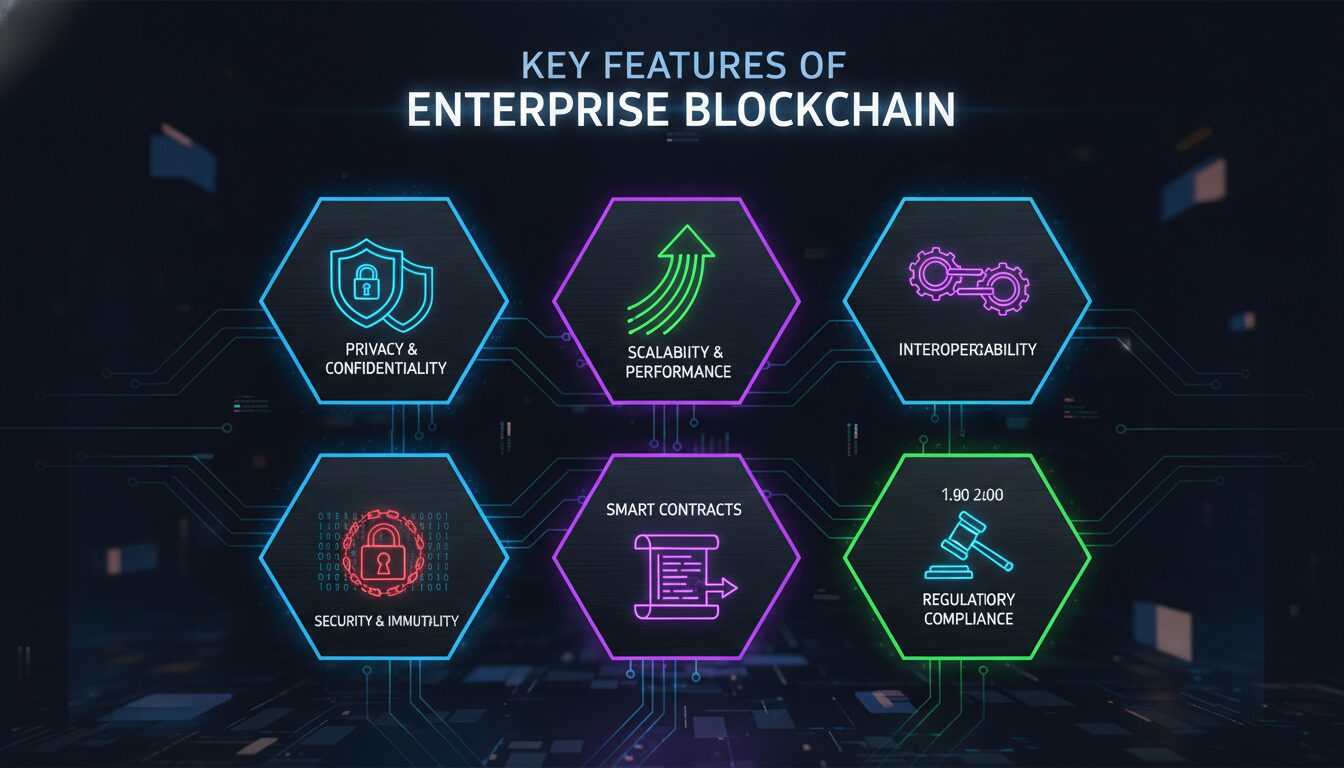
enterprise blockchain produces systems with three defining technical properties: decentralization, immutability, and consensus. Understanding each one is prerequisite knowledge before you evaluate platforms or write a single line of smart contract code.
Decentralization and Distributed Control
Decentralization in enterprise blockchain shifts control from a single authority to a distributed network of nodes. This eliminates single points of failure and prevents any one participant from exerting undue influence over the ledger. For cross-border trade or multi-party supply chains, that trust-neutral architecture is often the only way to get competing organizations to share a common data layer.
Immutability and Data Integrity
Immutability means that once a transaction is committed to the chain, it cannot be altered. Corrections require a new reversing transaction, so both the original entry and the correction remain visible to all authorized participants. The result is a tamper-proof audit trail that is invaluable for compliance and dispute resolution. In blockchain development, immutability is paired with permissioned access to ensure only valid, authorized data reaches the ledger in the first place.
Consensus Mechanisms for Business Use
Consensus mechanisms are the rules by which network participants agree on the current state of the ledger. Enterprise blockchains favor crash-tolerant or Byzantine-fault-tolerant algorithms: Raft, Istanbul BFT, and Kafka-based ordering are common choices. These run fast and consume minimal energy compared to proof-of-work. The consensus selection directly determines scalability, latency, and trust assumptions, making it one of the most consequential decisions in any this type of development project.
Types of Enterprise Blockchain Networks
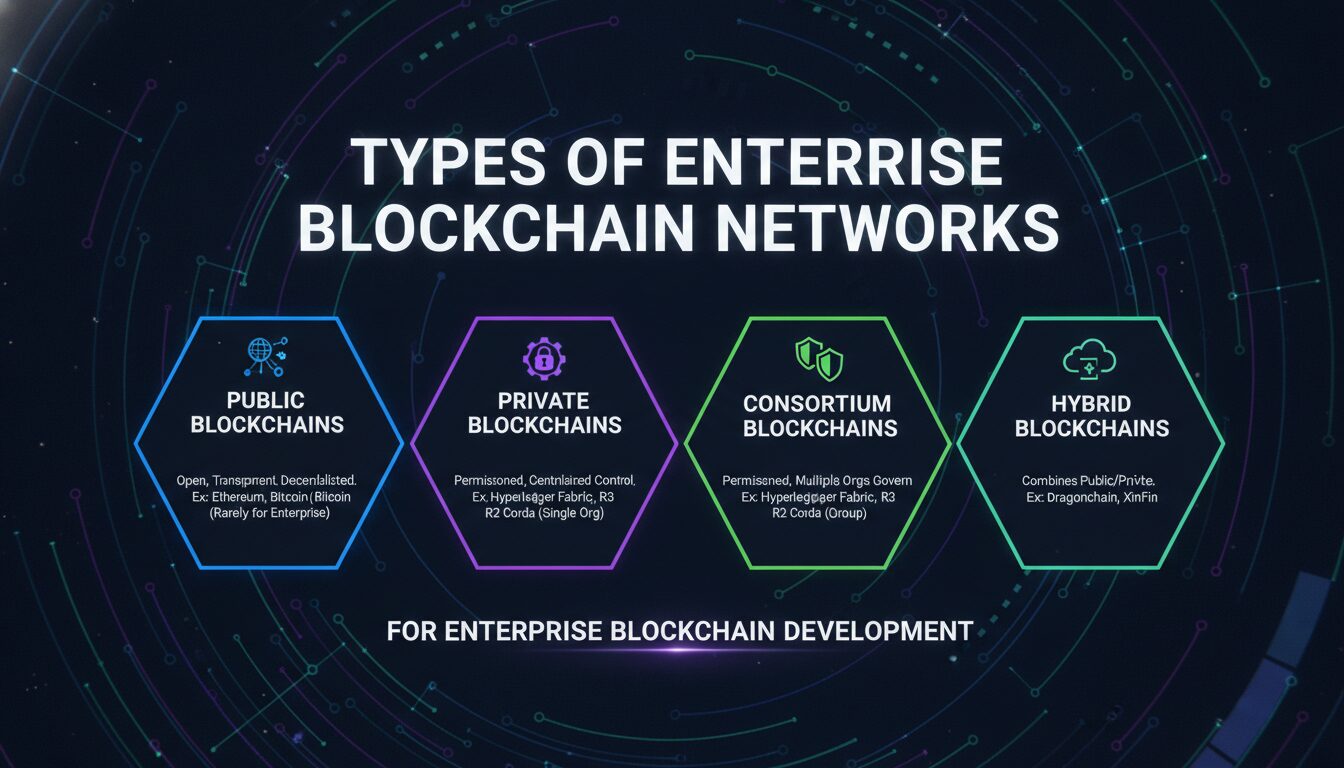
this kind of development produces three distinct network architectures. Choosing the right one depends on your governance requirements, the number of participants, and how much you need to expose versus protect.
Private Blockchains
A private blockchain is managed by a single organization and used for internal processes: auditing, data management, tax reporting, and accounting. Access is strictly controlled, and only designated nodes participate in consensus. This model delivers the highest privacy and performance, but it concentrates trust in the central operator, which is a trade-off worth examining carefully before committing.
Permissioned and Consortium Blockchains
In a consortium blockchain, a group of pre-selected organizations jointly govern the network. This model is popular for industry-wide collaborations: banks, manufacturers, and retailers sharing a supply chain ecosystem, for instance. Consortium blockchains balance decentralization and control, ensuring no single entity holds absolute power while still limiting access to vetted participants. They are the standard foundation for trade finance platforms and multi-party logistics solutions.
Hybrid Models
Hybrid blockchains combine public and private architectures. Some data is publicly verifiable while sensitive information stays private. An enterprise might use a hybrid model to publicly verify certificates of authenticity without exposing proprietary details. This flexibility is accelerating adoption in sectors that need both transparency and confidentiality simultaneously.
Pros and Cons of Enterprise Blockchain Development
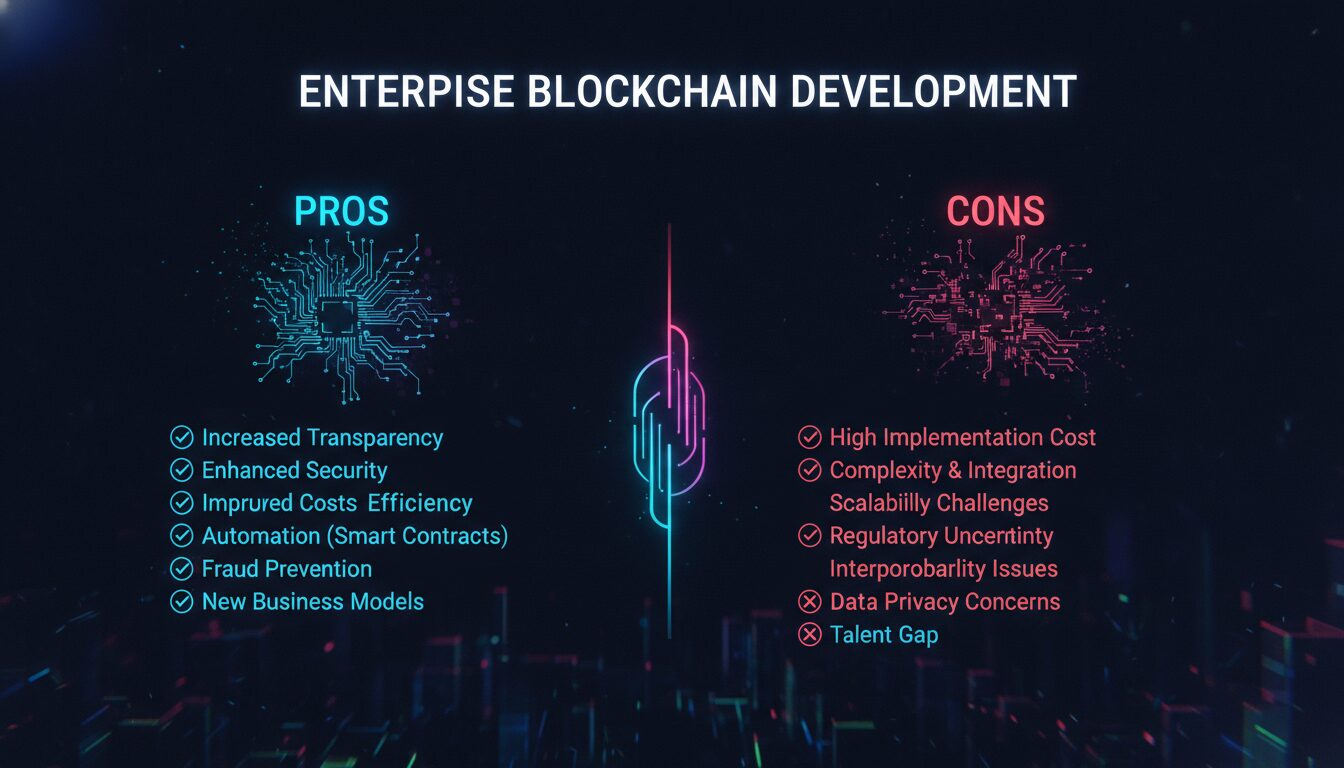
Enterprise blockchain development delivers real operational advantages, but it also introduces complexity that organizations need to plan for honestly.
Pros
- Reduced fraud risk: Immutable records and cryptographic verification make data manipulation computationally infeasible across the network.
- Lower compliance costs: A single DLT-based KYC verification can serve multiple institutions, cutting duplication and improving the customer experience.
- Process automation: Smart contracts execute automatically when predefined conditions are met, removing manual overhead from insurance claims, royalties, and supply chain payments.
- Faster settlement: A paperless letter of credit on blockchain cut processing time from 10 days to under 4 hours, according to industry data cited by XenonStack.
- Auditability: Every transaction is timestamped and traceable, which simplifies regulatory reporting and dispute resolution.
Cons
- Legacy integration complexity: Bridging a blockchain layer to existing ERP systems like SAP or Oracle requires middleware, custom APIs, and careful change management.
- Regulatory uncertainty: Legal frameworks for smart contracts and tokenized assets are still evolving across jurisdictions, creating compliance risk.
- Throughput limits: Even enterprise chains face bottlenecks at high transaction volumes; consensus protocol selection and off-chain storage strategies are required to address this.
- Governance overhead: Consortium models require ongoing coordination among participants, which adds organizational cost beyond the technical build.
Benefits of Enterprise Blockchain for Businesses
Enterprise blockchain development offers tangible benefits that show up directly in operational metrics. According to PricewaterhouseCoopers (PwC), 80% of surveyed asset and wealth managers acknowledge that disruptive technologies, including blockchain, fuel revenue growth. The mechanism behind that number is worth unpacking.
Enhanced Security and Reduced Risk
Enterprise blockchains encrypt data and distribute it across multiple nodes, making unauthorized access far more difficult than attacking a centralized database. Immutability ensures records cannot be tampered with after the fact, reducing fraud exposure. Smart contracts automate compliance checks like KYC, and because a single DLT-based verification can serve multiple institutions, the cost savings compound across the network.
Cost Efficiency and Automation
Removing intermediaries and automating manual processes cuts transaction costs at every layer. The letter of credit example is instructive: blockchain reduced processing from 10 days to under 4 hours, per data cited by XenonStack. Smart contracts execute automatically when conditions are met, eliminating disputes and administrative overhead in insurance claims, royalty distributions, and supply chain payments.
Transparency and Trust
A shared, real-time ledger gives all authorized participants the same view of every transaction. That transparency simplifies reconciliation and builds trust between parties that might otherwise require expensive intermediaries. In food safety, platforms like IBM Food Trust connect growers, processors, distributors, and retailers, cutting the time to trace produce from days to seconds. The operational and reputational benefits are both measurable.
“Blockchain and distributed ledger technologies can create new opportunities by decreasing risk, reducing compliance costs, creating more cost-efficient transactions, driving automated and secure contract fulfillment, and increasing network transparency.” – McKinsey
Challenges and Risks in Enterprise Blockchain Development
Enterprise blockchain development is not without real obstacles. Organizations must navigate technical, regulatory, and organizational challenges to reach a successful production deployment, and underestimating any one of them is how projects stall.
Integration with Legacy Systems
Most enterprises run on legacy ERP systems. Integrating a blockchain layer without disrupting day-to-day operations requires careful planning and middleware. APIs must bridge on-chain and off-chain data, and interoperability with existing databases remains a significant technical barrier. Without that integration work done properly, blockchain projects become isolated silos that never deliver ROI.
Regulatory and Compliance Hurdles
Enterprise blockchains often process sensitive data across jurisdictions, raising concerns about data privacy laws including GDPR and HIPAA. The immutability of blockchain can conflict with the right to erasure or with data localization requirements. Legal frameworks for smart contracts and tokenized assets are still maturing, creating uncertainty that needs legal expertise at the design stage, not as an afterthought.
Scalability and Performance
Enterprise chains are more scalable than public ones, but throughput bottlenecks still emerge under heavy load. Selecting the right consensus protocol and using off-chain databases for large files are standard mitigation strategies. As adoption grows, interoperability between different enterprise blockchain networks will intensify as a requirement, and the standards to support it are still being finalized.
The Enterprise Blockchain Development Process: Step by Step
A methodical approach is what separates a successful enterprise blockchain development initiative from an expensive proof-of-concept that never ships. The six stages below represent the standard workflow, adapted from methodologies used by leading development firms including Protokol and Agilie.
Step 1: Strategy Assessment and Requirements Gathering
Start by evaluating your business mission, pain points, and the specific problems blockchain can solve: cross-border reconciliation, supply chain traceability, or multi-party data sharing. Define network participants, governance rules, and access rights. This phase typically involves stakeholder workshops to align expectations and prioritize use cases before any code is written.
Step 2: Rapid Prototyping and Proof of Concept
Build a proof of concept (PoC) to validate technical feasibility and business value on a narrow use case. A PoC demonstrates core functionality like asset issuance, transfer, or smart contract execution. It surfaces integration issues early and gives stakeholders a tangible artifact to evaluate. This stage is where many organizations discover whether their chosen platform actually fits their requirements.
Step 3: Architecture Design
Once the PoC is validated, design the full system architecture. Choose the blockchain platform, consensus mechanism, and network topology. Design APIs that connect the chain to existing CRM or ERP systems. Run security audits and privacy design reviews covering zero-knowledge proofs and channel configurations to meet compliance requirements before a single production node is spun up.
Step 4: Smart Contract Development
With architecture approved, the development team codes smart contracts, configures nodes, and sets up the network. Smart contracts in enterprise blockchain development are typically written in Go (Hyperledger Fabric), Solidity (Quorum), or Java and Kotlin (Corda). Rigorous unit testing and static analysis are non-negotiable here: smart contract bugs are expensive to fix post-deployment and can be exploited before a patch ships.
A minimal Fabric chaincode example illustrates the pattern:
// Fabric chaincode: record asset transfer
func (s *SmartContract) TransferAsset(ctx contractapi.TransactionContextInterface,
 assetID string, newOwner string) error {
 asset, err := s.ReadAsset(ctx, assetID)
 if err != nil {
 return err
 }
 asset.Owner = newOwner
 assetJSON, err := json.Marshal(asset)
 if err != nil {
 return err
 }
 return ctx.GetStub().PutState(assetID, assetJSON)
}
Step 5: Comprehensive Testing
Testing goes well beyond smart contracts. Performance testing under realistic load, security penetration testing, and disaster recovery drills are all required before production. The system is exercised against real business scenarios to confirm it handles edge cases and meets throughput targets. This stage regularly surfaces the need for optimizations that were not visible during architecture design.
Step 6: Launch and Ongoing Support
Deployment starts with a pilot network of trusted partners before scaling to the full consortium. Post-launch, continuous monitoring, regular upgrades, and governance coordination are essential to maintain network health. Long-term support contracts ensure the solution evolves with the business and stays secure against emerging threats. As Protokol notes, enterprise blockchain solutions tend to evolve and require scaling and maintenance to continue delivering value.
Top Enterprise Blockchain Platforms and Technologies
Selecting the right platform is a foundational decision in enterprise blockchain development. Each framework offers distinct trade-offs in performance, security, and developer experience. The table below compares four widely used options.
| Platform | Governing Body | Consensus | Smart Contract Language | Key Use Cases |
|---|---|---|---|---|
| Hyperledger Fabric | Linux Foundation | Pluggable (Raft, Kafka) | Go, Java, JavaScript | Supply chain, trade finance |
| Quorum | ConsenSys (Ethereum-based) | Raft, Istanbul BFT | Solidity | Digital assets, data privacy |
| R3 Corda | R3 consortium | Notary-based | Java, Kotlin | Financial services, insurance |
| Ethereum Enterprise | Ethereum Foundation | Proof of Authority (Clique) | Solidity, Vyper | DeFi, tokenization |
Hyperledger Fabric dominates many enterprise deployments because of its modular architecture and channel-based privacy model. Quorum suits organizations already invested in the Ethereum ecosystem. Corda excels in finance with its point-to-point messaging design. Enterprise Ethereum is gaining traction for tokenization and DeFi applications in permissive setups.
Hyperledger Fabric in Depth
Fabric supports channels that allow subsets of participants to share confidential transactions. Its pluggable consensus lets businesses choose the algorithm that fits their trust model. The membership service provider (MSP) handles identity management, making Fabric the default choice for regulated industries that need fine-grained access control baked into the protocol layer.
Quorum and Its Ethereum Roots
Quorum extends Ethereum with private transactions and a voting-based consensus, giving organizations the benefits of the largest smart contract ecosystem while meeting enterprise requirements for confidentiality. Solidity support means a large developer pool and a library of reusable, audited contracts to build from.
Self-Custody Infrastructure: io.finnet
Solutions like io.finnet provide secure self-custody for digital assets, complementing traditional enterprise blockchain platforms by giving organizations full control over their cryptographic keys. As enterprises manage tokenized assets and interact with DeFi protocols, key custody becomes a critical infrastructure layer, not an afterthought.
Use Cases Across Industries
Enterprise blockchain development has moved well past the pilot stage in several sectors. The applications below represent live production deployments, not theoretical use cases.
Supply Chain Management
Blockchain enables end-to-end traceability from raw materials to the consumer. Every transfer of ownership is recorded on an immutable ledger, reducing counterfeiting and improving recall efficiency. IBM Food Trust, referenced by XenonStack, connects growers, processors, distributors, and retailers, cutting the time to trace produce from days to seconds.
Financial Services and Trade Finance
Banks and trading partners use enterprise blockchain to digitize letters of credit, cutting processing time from weeks to hours and eliminating paper-based errors. Smart contracts automate interest payments and collateral management. According to the Visa enterprise blockchain overview, the technology is gaining traction in capital markets for post-trade settlement and asset servicing.
Healthcare and Identity Management
Healthcare providers are using enterprise blockchain to share patient data securely across institutions while giving patients control over their records. Immutable audit logs help meet regulatory requirements. Digital identity solutions built on blockchain allow users to prove identity without revealing excessive personal information, reducing fraud in online banking, insurance, and travel verification.
Future Trends in Enterprise Blockchain Development
Several converging trends are set to reshape enterprise blockchain development through 2026 and beyond. According to Next Move Strategy Consulting, the enterprise blockchain segment is anticipated to reach $145.9 billion by 2030, with a CAGR of 47.4% from 2024 to 2030.
AI and Blockchain Convergence
Artificial intelligence is being integrated with enterprise blockchain to deliver smarter analytics, automated fraud detection, and predictive maintenance of smart contracts. AI models stored on-chain gain transparency and auditability. Trusted, tamper-proof data from the blockchain also provides a higher-quality training signal for AI systems. This combination is expected to unlock efficiency gains in logistics and financial risk management that neither technology achieves alone.
“Future trends of enterprise blockchain adoption will evolve through extensive integration with AI, enhanced interoperability between isolated platforms, and support for Real-World Assets and Central Bank Digital Currencies.” – Agilie CTO Sergey Melashych
Interoperability and Real-World Asset Tokenization
Cross-chain protocols will allow different enterprise blockchain networks to communicate, enabling asset and data transfers across consortium boundaries. Tokenization of real-world assets (RWAs), from commodities to real estate, is moving toward mainstream adoption. McKinsey estimates the tokenized market capitalization across asset classes could reach around $2 trillion by 2030, with tokenized money market funds already surpassing $1 billion in assets under management as of early 2024. Enterprise blockchains will provide the regulated infrastructure for that tokenization wave.
CBDCs and Regulatory Maturation
Many central banks are actively exploring central bank digital currencies (CBDCs), which rely on permissioned blockchain architectures. Organizations building enterprise blockchain development expertise today will be positioned to integrate with these future digital fiat systems. As regulatory frameworks mature, particularly in the EU and across Asia, compliance-first blockchain designs will shift from a differentiator to a baseline requirement.
Development Cost Considerations
Cost is a practical question that every enterprise blockchain development project must answer early. The range is wide because scope varies enormously: a focused PoC on a single use case costs a fraction of a full consortium network with custom smart contracts, middleware integrations, and ongoing governance infrastructure.
Key cost drivers include platform selection (open-source Fabric versus licensed enterprise solutions), the number of smart contracts required, the complexity of legacy system integration, security audit scope, and post-launch support commitments. Organizations that skip the PoC stage and jump straight to production builds consistently overspend. A disciplined stage-gate process, PoC first, architecture second, full build third, is the most reliable cost control mechanism available.
For teams evaluating build versus partner decisions, the Digital Blockchains studio model offers a structured engagement that covers strategy through deployment without the overhead of assembling an in-house blockchain team from scratch.
Frequently Asked Questions
What is enterprise blockchain development?
Enterprise blockchain development is the design, build, and maintenance of permissioned distributed ledger systems for business use. It focuses on verified identities, privacy controls, and high-throughput consensus to support multi-party workflows in regulated industries.
How does enterprise blockchain differ from public blockchain?
Enterprise blockchains are permissioned: only approved participants can join and transact. They use efficient consensus mechanisms, offer privacy tools like channels or zero-knowledge proofs, and are governed by a consortium or single organization rather than an open, decentralized community.
What are the main benefits of enterprise blockchain for businesses?
Key benefits include enhanced security through immutability, lower costs by automating processes with smart contracts, improved transparency among stakeholders, and better regulatory compliance through auditable ledgers. McKinsey identifies reduced risk and compliance costs as the primary operational drivers.
Which platforms are most popular for enterprise blockchain development?
Hyperledger Fabric, Quorum, R3 Corda, and Enterprise Ethereum are the most widely deployed. Fabric is known for modularity and channel-based privacy, Quorum for Ethereum compatibility, Corda for financial services, and Enterprise Ethereum for tokenization use cases.
What are the typical steps in an enterprise blockchain project?
A standard workflow covers six stages: strategy assessment, proof of concept, architecture design, smart contract development, comprehensive testing, and launch with ongoing support. Close stakeholder collaboration and post-launch governance are critical to long-term success in any enterprise blockchain development engagement.
How big is the enterprise blockchain market?
Statista projects the global blockchain market to reach $943 billion by 2032, growing at a CAGR of 56.1%. Next Move Strategy Consulting separately forecasts the enterprise blockchain segment will reach $145.9 billion by 2030, driven by supply chain, finance, and healthcare deployments.
If you’re evaluating enterprise blockchain development for a real production use case, the Genesis Cohort at Digital Blockchains is built for exactly that. Apply to build with us and get protocol-level expertise from day one.