Key Takeaways
- Decentralized finance platforms use blockchain technology to enable peer-to-peer financial transactions without traditional intermediaries.
- They provide global accessibility, lower fees, transparency, and programmability, but carry risks like smart contract vulnerabilities and regulatory uncertainty.
- Popular use cases include lending, borrowing, trading on decentralized exchanges, earning yield through staking, and stablecoin minting.
- When choosing a platform, evaluate security audits, total value locked (TVL), liquidity, and user experience.
- DeFi is evolving with Layer 2 scaling, cross-chain interoperability, and growing institutional interest.
Decentralized finance platforms are blockchain-based applications that enable peer-to-peer financial services such as lending, borrowing, and trading without banks or brokerages sitting in the middle.
What Are Decentralized Finance Platforms?
finance platforms are applications built on public blockchains that replace bank intermediaries with self-executing smart contracts. Instead of a loan officer approving your application, code checks your collateral and issues funds automatically. This model reduces costs and opens access to anyone with an internet connection. According to Investopedia, DeFi “uses security protocols, connectivity, software, and hardware advancements to create peer-to-peer financial networks.” The goal is a permissionless, transparent system where participation doesn’t depend on where you live or who you know.
The Evolution from Traditional Finance
Traditional finance runs on banks, brokerages, and clearinghouses that verify transactions, hold custody, and enforce compliance. In the United States, the Federal Reserve and the Securities and Exchange Commission (SEC) oversee those entities. this type of platforms replace institutional trust with cryptographic proof. Blockchain records are immutable and publicly verifiable, so two parties can transact directly without a middleman standing between them. As the World Economic Forum puts it, decentralized finance “has the potential to transform the global financial system, offering various benefits: transparency, accessibility, lower transaction costs and near-instant settlement.”
The shift started with Bitcoin’s peer-to-peer electronic cash model, but DeFi accelerated once Ethereum introduced programmable smart contracts. Today, this kind of platforms cover a wide range of services once exclusive to banks: lending, borrowing, insurance, derivatives, and asset management.
Core Components: Blockchain and Smart Contracts
Every DeFi platform sits on top of a blockchain, a distributed ledger that records transactions in blocks linked cryptographically. Ethereum remains the most widely used base layer for DeFi, though Solana, Avalanche, and Binance Smart Chain also host active ecosystems. Smart contracts define the platform’s logic. A lending protocol, for instance, uses a smart contract to pool funds from lenders and automatically issue loans once borrowers post sufficient collateral. These contracts are open-source, so anyone can audit the code, a sharp contrast to the closed, proprietary systems banks run on.
Because smart contracts execute autonomously, they enable trustless interactions. No single entity can freeze funds or reverse a transaction as long as the code holds up. That same autonomy cuts both ways: a bug in the code can be catastrophic, because there’s no intermediary standing by to intervene.
How Do Decentralized Finance Platforms Work?
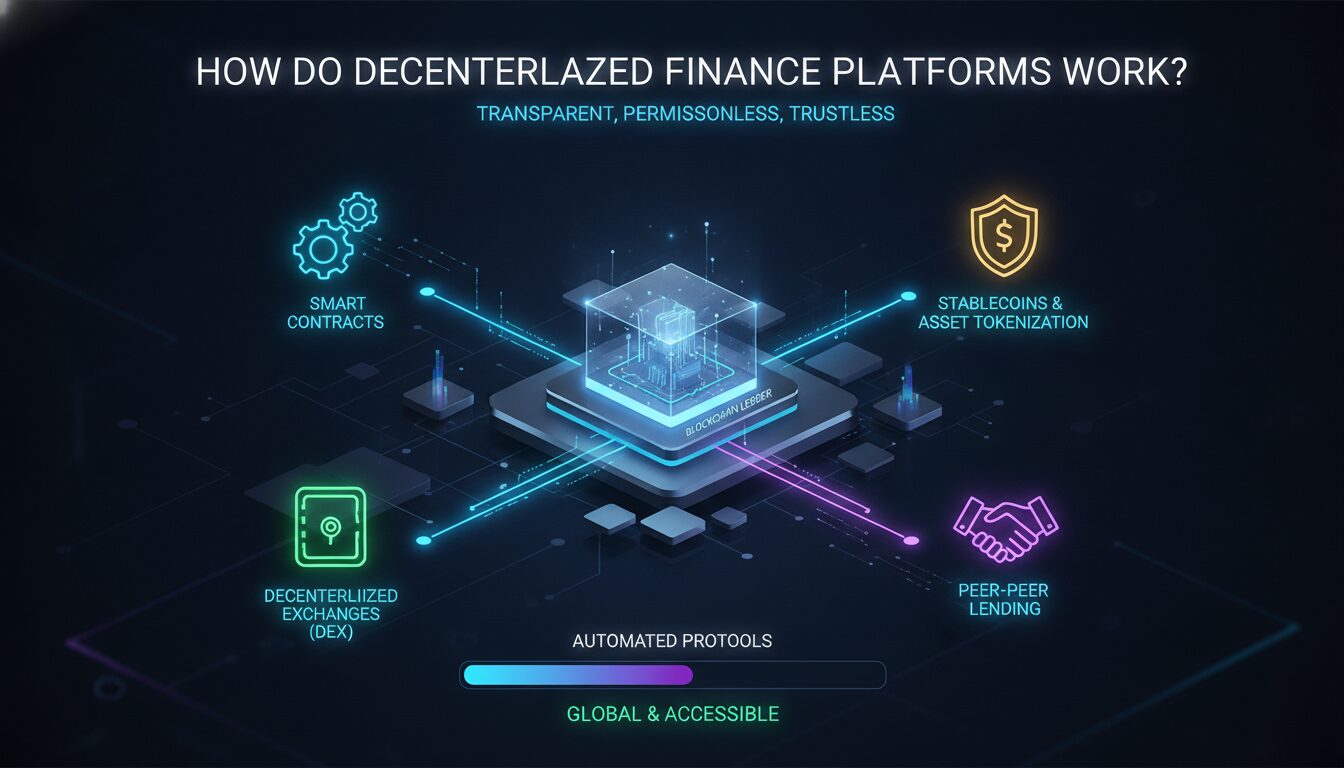
decentralized finance work by combining wallets, decentralized applications (dApps), and smart contracts to execute financial transactions directly on-chain. Users keep full custody of their assets through private keys, which function as digital signatures. When someone supplies liquidity or takes out a loan, they sign a transaction through their wallet, and the smart contract executes the action once predefined conditions are met.
Set Up and Start Using a DeFi Platform
- Set up a cryptocurrency wallet. Choose a non-custodial wallet like MetaMask, Trust Wallet, or Ledger. This generates a private key that only you control.
- Acquire cryptocurrency. Purchase ETH (for Ethereum-based platforms) or the native token of whichever chain you plan to use. Exchanges like Coinbase or Binance handle this step.
- Connect your wallet to a DeFi platform. Visit the dApp interface and authorize the connection so the platform can read your balance and propose transactions.
- Select a service. Decide whether you want to lend, borrow, swap tokens, or stake. Enter the amount and review the terms the smart contract displays.
- Confirm the transaction. Check the gas fee (network transaction cost) and confirm in your wallet. The blockchain processes the operation, typically within seconds to minutes.
The Role of Decentralized Applications (dApps)
dApps are the user-facing layer that makes finance platforms usable by non-developers. They provide an interface that hides the complexity of raw blockchain interaction. Uniswap’s swap page, for example, lets users exchange tokens without needing to understand the automated market maker (AMM) math running underneath. dApps also plug into multiple protocols at once, enabling composability, the idea that different DeFi services snap together like “money Legos.” As Stripe explains, “A decentralized finance platform lets people lend, borrow, trade, and earn yield directly through smart contracts instead of traditional banking.”
Liquidity Pools and Automated Market Makers
Centralized exchanges match buyers and sellers with order books. Decentralized exchanges (DEXs) typically use AMMs instead, which rely on liquidity pools: crowd-sourced pools of tokens locked in a smart contract. Liquidity providers deposit an equal value of two tokens and earn a cut of trading fees in return. A pricing formula (commonly x*y=k) sets the exchange rate for each asset and adjusts automatically as trades happen. This design keeps trading continuous and permissionless without a central order-matching engine.
Key Benefits of Decentralized Finance Platforms
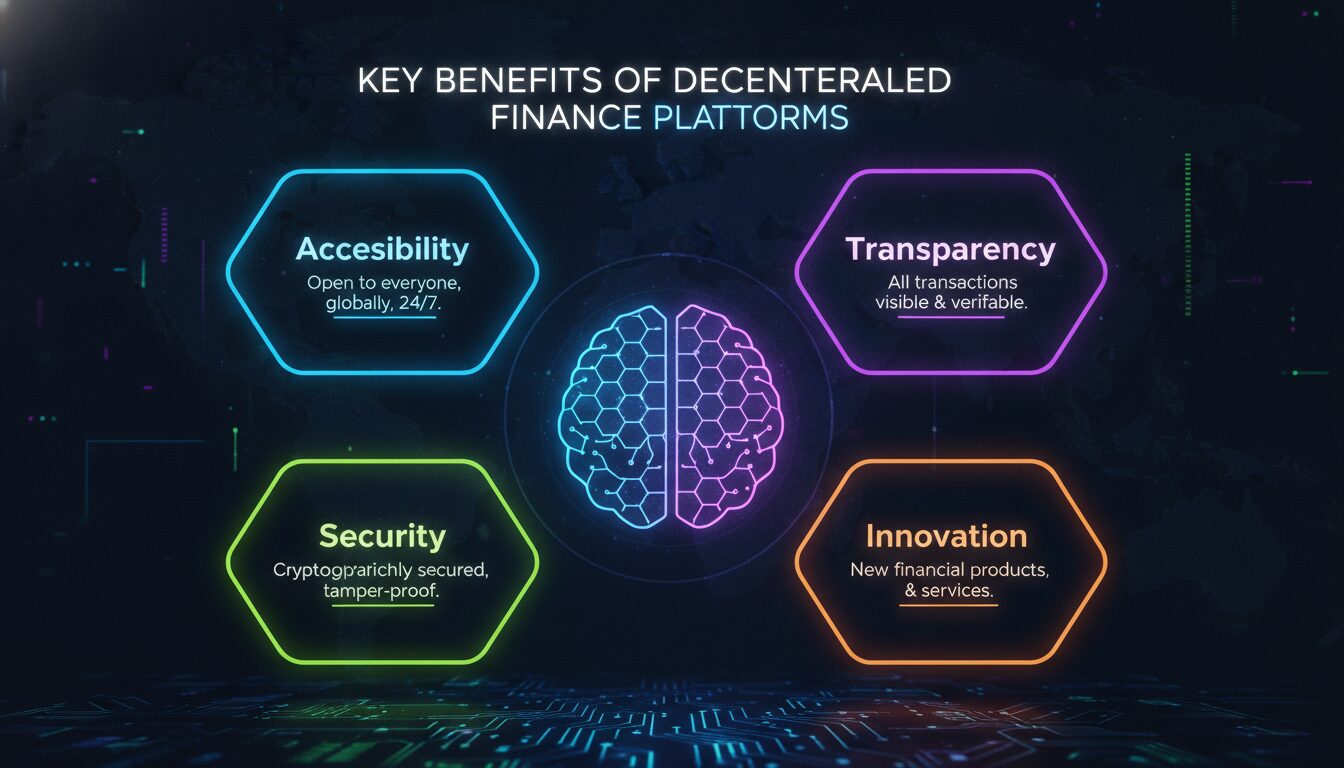
Global Accessibility and Financial Inclusion
this type of platforms break down geographic barriers to financial services. Anyone with an internet connection and a smartphone can access them, regardless of local banking infrastructure. According to the World Economic Forum, this matters most for the roughly 1.1 billion unbanked adults worldwide. There’s no credit history check, no government ID requirement, and no minimum balance. It’s worth being precise here though: transactions aren’t fully anonymous. As Investopedia notes, wallet activity doesn’t include a name but remains traceable by anyone with the tools to follow it, including regulators and law enforcement.
Transparency and Immutability
Every transaction on a public blockchain lands on a ledger anyone can inspect. For this kind of platforms, that means loan terms, liquidation thresholds, and fee structures are all open to verification. Code is auditable, and governance decisions, often made by token holders, are visible on-chain. Once a transaction confirms, it can’t be altered, which cuts down the risk of fraud or after-the-fact manipulation by a central party.
Programmability and Composability
Smart contracts let developers build financial products that run automatically once conditions are met. A yield aggregator, for example, can shift deposited funds between lending protocols to chase better returns, all governed by code rather than a portfolio manager. Composability means new platforms can build on existing ones without asking permission. A DEX can plug into a lending protocol to offer margin trading, or a stablecoin can serve as collateral across a dozen different dApps. This open, permissionless innovation has produced a range of services that traditional finance struggles to replicate at the same pace.
Popular Types of Decentralized Finance Platforms
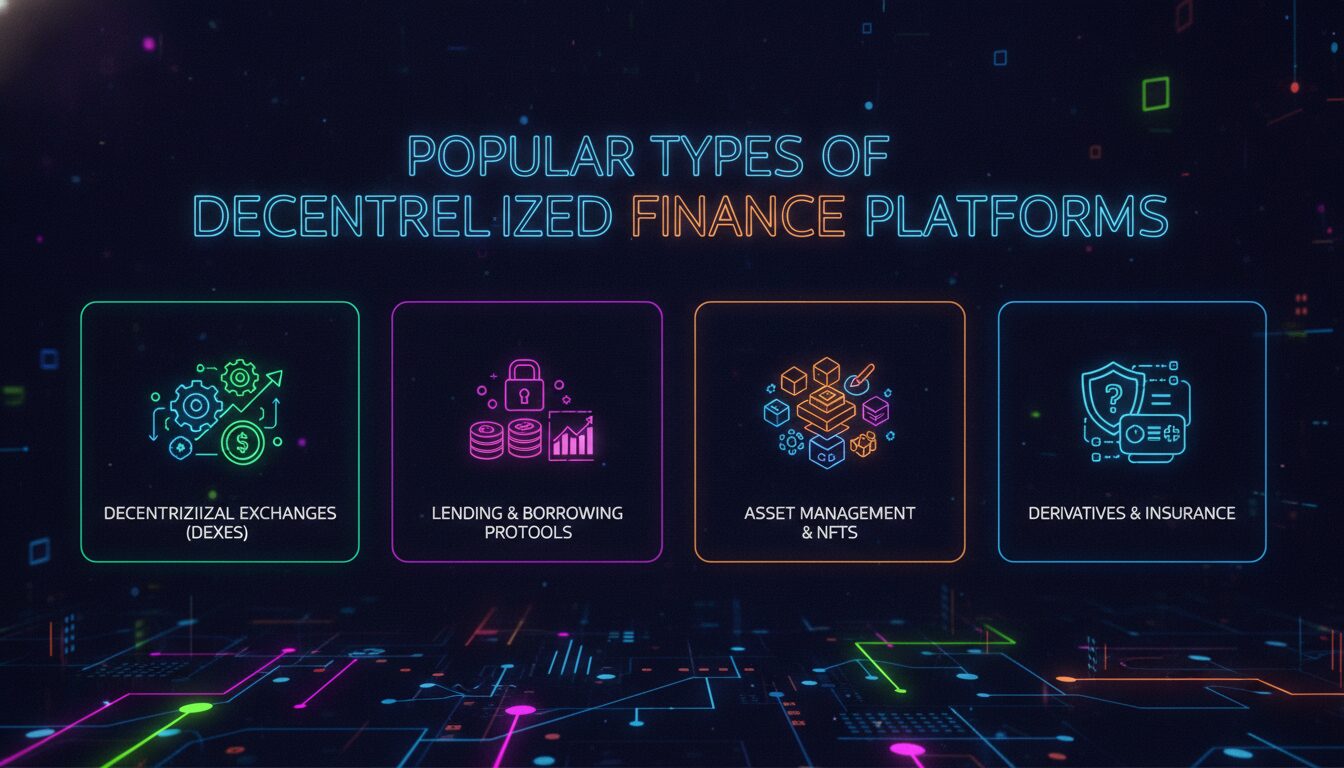
Lending and Borrowing Protocols
Platforms like Aave and Compound let users lend crypto to earn interest or borrow against posted collateral. Interest rates adjust algorithmically based on supply and demand. Aave pioneered flash loans, uncollateralized loans that must be borrowed and repaid within a single transaction, commonly used for arbitrage and refinancing. MakerDAO, established in 2017, lets users deposit collateral (initially ETH) and mint DAI, a stablecoin pegged to the US dollar. Per Wikipedia, “MakerDAO aimed to maintain the stable value of DAI in a decentralized and autonomous manner.”
Decentralized Exchanges (DEXs)
DEXs like Uniswap, SushiSwap, and Curve handle token swaps without a central intermediary. Uniswap’s v3 introduced concentrated liquidity, letting providers earmark funds to specific price ranges for better capital efficiency. Volume on leading DEXs regularly rivals centralized exchanges. They also open access to a much wider range of tokens, including newer projects that haven’t been listed on centralized platforms yet.
Stablecoins and Payment Systems
Stablecoins are cryptocurrencies designed to hold a stable value, usually pegged to a fiat currency like the USD. They’re essential infrastructure for decentralized finance because they cut down on volatility. Alongside MakerDAO’s DAI, popular stablecoins include USDC (issued by Circle) and USDT (Tether). These get used for payments, remittances, and as a safe haven during market downturns. Some platforms even offer interest-bearing stablecoin savings products, with yields that sometimes beat traditional bank savings rates.
Yield Farming and Staking Platforms
Yield farming means providing liquidity to a protocol in exchange for rewards, often paid in the platform’s native token. Staking is related but usually involves locking up tokens to secure a proof-of-stake network or to vote in governance. Yearn Finance automates yield farming by rotating strategies across multiple protocols to chase the best available return. Yields can swing hard though, and high advertised returns almost always carry higher risk underneath.
“We are a stone’s throw away from the global financial industry running on a common software infrastructure.” – Lex Sokolin, Global Fintech Co-Head of Consensys
Prediction Markets and Insurance Protocols
Beyond lending and trading, finance platforms extend into prediction markets and on-chain insurance. Prediction markets let users stake capital on the outcome of real-world events, with smart contracts settling payouts automatically once results are confirmed. Insurance protocols like Nexus Mutual let users pool capital to cover smart contract failure or exchange hacks, functioning as a mutual fund governed by its members rather than an underwriter. Neither category has the transaction volume of lending or DEXs yet, but both fill gaps that traditional finance handles through entirely different mechanisms.
Risks and Challenges of Decentralized Finance Platforms
Smart Contract Vulnerabilities and Hacks
Code is law in DeFi, and flawed code means funds can be stolen or frozen with no recourse. Per Consensys, coding errors and hacks remain a common challenge across the sector. Even audited contracts can hide undiscovered bugs. Because on-chain transactions are irreversible, victims typically have little recourse once an exploit executes. Anyone evaluating decentralized finance platforms should check audit history closely and consider insurance protocols like Nexus Mutual as a backstop.
Regulatory and Compliance Uncertainty
Regulators are still working out how DeFi fits into existing legal frameworks. In the U.S., the SEC and the Commodity Futures Trading Commission (CFTC) have brought enforcement actions against DeFi projects over unregistered securities and derivatives offerings. The Financial Action Task Force (FATF) has flagged concerns about DeFi’s exposure to money laundering, since many platforms skip Know Your Customer (KYC) checks entirely. Future rules could impose compliance requirements that reshape the permissionless model DeFi was built on.
Market Volatility and Scam Projects
Crypto markets are volatile by nature. Collateralized loans can get liquidated in minutes if prices move sharply. The open, permissionless nature of decentralized finance platforms has also attracted scam projects, including rug pulls where developers drain a liquidity pool and vanish. There’s often no safety net for victims. Fidelity warns that “there have been instances of scams that may make people skeptical” of the space as a whole. Due diligence isn’t optional here, it’s the entry fee.
Pros and Cons of Decentralized Finance Platforms
Pros
- No intermediaries required, which lowers fees and speeds up settlement
- Open, auditable code that anyone can review before depositing funds
- Global access for anyone with an internet connection and a wallet
- Composability lets protocols combine into new financial products
Cons
- Smart contract bugs can lead to irreversible loss of funds
- Regulatory uncertainty could reshape how platforms operate
- Volatile collateral values can trigger fast, painful liquidations
- Scam projects and rug pulls remain common in less-audited corners of the market
How to Choose the Right Decentralized Finance Platform
Security Audits and Track Record
Choosing the right platform starts with verifying it has undergone security audits by reputable firms like Trail of Bits, Consensys Diligence, or CertiK. Check the protocol’s age and total value locked (TVL). Older, battle-tested platforms like Uniswap and Aave have withstood years of attacks. Newer projects might dangle higher yields, but they carry more risk by definition. Read community discussions for any undisclosed incidents before committing capital.
Liquidity and Total Value Locked
Liquidity determines how easily you can enter or exit a position without slippage eating your returns. A platform with deep liquidity pools will have tighter spreads and lower trading costs. TVL, which measures total assets deposited in a protocol, is a common benchmark for comparing decentralized finance platforms. According to Consensys, the DeFi ecosystem has held over $13 billion in value locked in Ethereum smart contracts, a figure that fluctuates with market conditions. Higher TVL often correlates with trust, but it’s not a guarantee against failure.
User Experience and Community Support
A well-designed interface and clear documentation lower the learning curve substantially. Platforms like Uniswap and Aave offer simple, intuitive dApps that don’t require a computer science degree to use. Community governance through decentralized autonomous organizations (DAOs) also signals a genuine commitment to decentralization rather than just marketing language. Look for active Discord or Telegram channels where developers and users actually help each other. Governance tokens can give you a direct say in a platform’s future direction.
| Platform | Type | Key Feature | Notable Audit |
|---|---|---|---|
| Uniswap | DEX | Concentrated liquidity AMM | Trail of Bits |
| Aave | Lending | Flash loans | Trail of Bits, Consensys Diligence |
| MakerDAO | Stablecoin/Lending | DAI stablecoin, overcollateralized vaults | Trail of Bits, others |
| Compound | Lending | Algorithmic interest rates, COMP governance | Trail of Bits, OpenZeppelin |
| SushiSwap | DEX | AMM with yield farming and staking | Quantstamp, others |
| Curve | DEX | Stablecoin-focused AMM, low slippage | Trail of Bits |
The Future of Decentralized Finance Platforms
Decentralized finance platforms are headed toward greater scale, interoperability, and closer integration with mainstream finance. As of 2026, several trends are converging to push this forward faster than most people expected even two years ago.
Integration with Traditional Financial Systems
Banks and fintech firms are actively exploring DeFi infrastructure rather than dismissing it. Tokenized real-world assets (RWAs) like bonds and real estate are being brought on-chain, enabling fractional ownership and faster settlement than legacy custodians can offer. This convergence is starting to blur the line between traditional finance and decentralized finance platforms, and that trend looks set to continue this year and beyond.
Layer 2 Scaling and Cross-Chain Interoperability
High gas fees and network congestion on Ethereum mainnet drove adoption of Layer 2 solutions like Arbitrum, Optimism, and zkSync. These rollups batch transactions off-chain and submit compressed proofs on-chain, cutting costs significantly. Cross-chain bridges and interoperability protocols, including Chainlink CCIP and LayerZero, now make it possible to move assets and data between different blockchains without relying on a single custodian. TVL is no longer concentrated on one chain either: Ethereum, Solana, Arbitrum, and Base each host meaningful DeFi activity today, and comparing TVL across chains has become a standard part of due diligence for serious allocators.
Institutional Adoption and Regulation
Institutional investors are allocating more capital toward decentralized finance platforms, drawn by yield opportunities and portfolio diversification. Custodial solutions from firms like Fireblocks and Anchorage make institutional participation safer and more compliant. Clearer regulation will likely accelerate this trend, even if it also brings KYC/AML requirements to DeFi front-ends that didn’t previously require them. The EU’s Markets in Crypto-Assets (MiCA) regulation offers a template for harmonized oversight elsewhere. As the World Economic Forum notes, establishing global standards is critical for DeFi’s long-term success.
Interoperability between chains, not just scaling any single chain, will decide which decentralized finance platforms retain liquidity over the next cycle. Protocols that treat cross-chain messaging as an afterthought tend to bleed users to whichever ecosystem makes bridging frictionless.
Getting Started as a Builder
If you’re building rather than just using decentralized finance platforms, the technical bar has risen. Auditors expect formal verification on core financial logic, not just a Slither scan before mainnet deployment. A basic lending pool skeleton in Solidity looks something like this:
function deposit(uint256 amount) external {
 require(amount > 0, "Amount must be positive");
 token.transferFrom(msg.sender, address(this), amount);
 balances[msg.sender] += amount;
 totalSupplied += amount;
 emit Deposit(msg.sender, amount);
}
That’s the easy part. Liquidation logic, oracle price feeds, and interest rate models are where most protocols get exploited. Teams serious about launching need a tokenomics model that aligns incentives between liquidity providers, borrowers, and governance token holders from day one, not bolted on after a hack forces a redesign.
Conclusion
Decentralized finance platforms represent a real shift in how financial services get built and accessed. By removing intermediaries, they offer more transparency, efficiency, and inclusivity than legacy rails typically deliver. That said, they’re not risk-free: smart contract vulnerabilities, regulatory ambiguity, and market volatility all demand cautious participation. As the technology matures and integrates with legacy systems, decentralized finance platforms are likely to become a permanent layer of the global economy rather than a niche experiment. Builders and allocators who do the homework now will be better positioned as the space professionalizes.
If you’re building a protocol, launching a token, or structuring a DAO around any of these mechanics, apply to the Genesis Cohort at digitalblockchains.com. We work with serious teams on protocol architecture and tokenomics from the ground up.
Frequently Asked Questions
Is decentralized finance legit?
Yes, decentralized finance is a legitimate technological and financial innovation built on blockchain. That said, the space includes both well-audited protocols and outright scams, so users should verify a platform’s security, audits, and community reputation before depositing funds.
Is XRP a DeFi platform?
No, XRP is a cryptocurrency and the native asset of the XRP Ledger, which is a decentralized blockchain. XRP itself isn’t a DeFi platform, though it can be used within certain DeFi applications for payments and liquidity.
What is the best DeFi platform?
“Best” depends on what you need. For lending and borrowing, Aave and Compound are widely used. For trading, Uniswap remains a leading DEX. For stablecoin minting, MakerDAO’s DAI is one of the most established options. Always compare security, liquidity, and user experience before choosing.
What are the top decentralized exchanges?
Rankings shift over time, but top DEXs by volume typically include Uniswap, SushiSwap, Curve, PancakeSwap, dYdX, Balancer, and 1inch, among others. Volumes vary considerably by chain and market conditions, so it’s worth checking current data rather than relying on a fixed list.
How do I stay safe when using DeFi?
Use hardware wallets, research protocol audits, never share your private keys, and watch for phishing sites. Start with small amounts, consider insurance protocols, and avoid platforms with unaudited code or anonymous teams with no track record.
Can I earn passive income with DeFi?
Yes, by lending, providing liquidity, or staking, you can earn yield through decentralized finance platforms. Rates vary with market conditions and platform risk, and it’s worth remembering that unusually high yields almost always signal higher underlying risk.