Advantages of Blockchain Technology for Business in 2026
The advantages of blockchain technology are security, decentralization, transparency, and automation: a distributed ledger where transactions are permanently recorded and verified by network consensus, with no central authority required.
Key Takeaways
- The advantages of blockchain technology start with security: encryption and immutability prevent fraud and unauthorized changes at the protocol level.
- Decentralization eliminates single points of failure and removes reliance on intermediaries, building trust through code rather than institutions.
- Transparency and traceability give all authorized participants a real-time, auditable history that reduces fraud and boosts accountability.
- Smart contracts automate complex workflows, cutting administrative overhead and compressing settlement times from days to seconds.
- Scalability and energy consumption remain real constraints, but layer-2 protocols and Proof of Stake networks are closing the gap fast.
- Public, private, consortium, and hybrid blockchain types each suit different use cases – choosing the right one is as important as choosing blockchain at all.
Understanding Blockchain Technology
What is Blockchain?
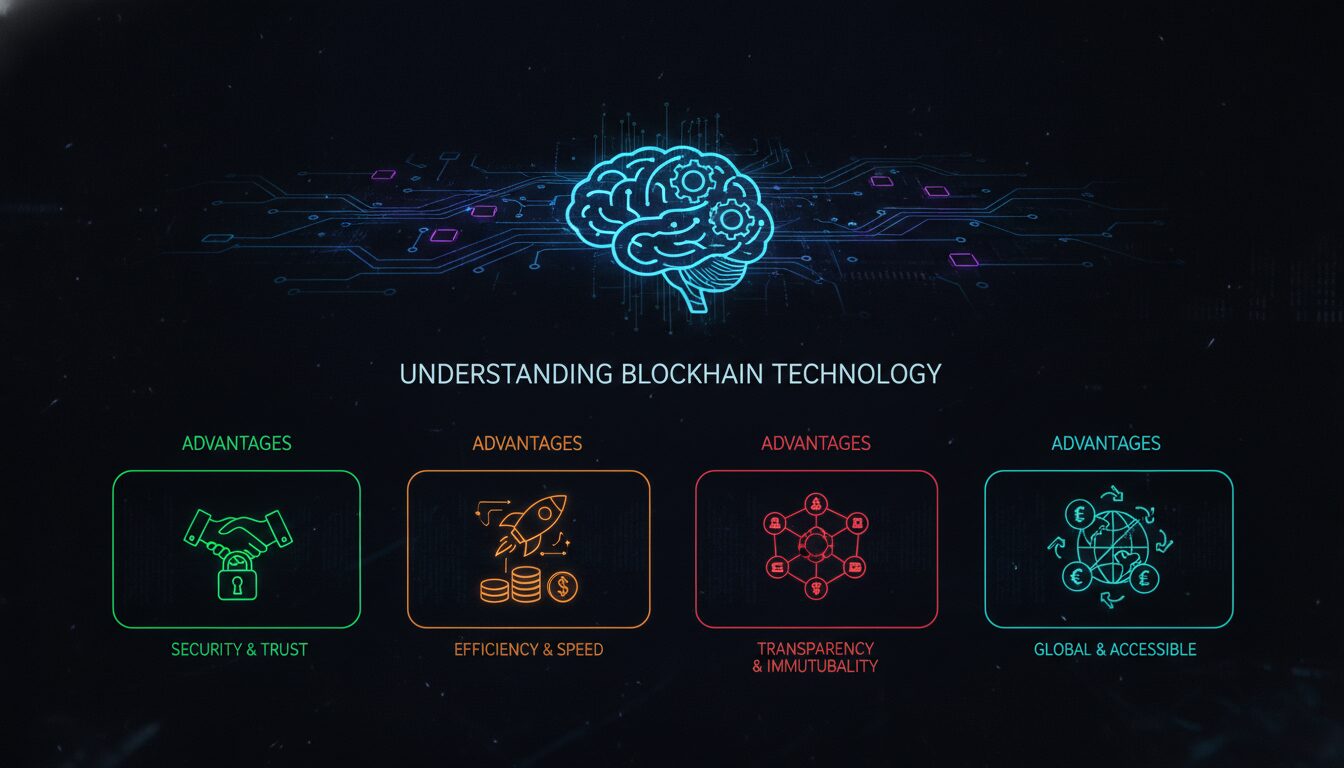
Blockchain technology is a decentralized, distributed ledger that records transactions across a network of computers called nodes. According to Amazon Web Services, it is an advanced database mechanism that allows transparent information sharing within a business network. Each block of data is cryptographically linked to the one before it, and the full ledger is replicated across every node, eliminating single points of failure and the need for a trusted intermediary. Once data is recorded, altering it requires consensus from the entire network – a property that sits at the heart of every advantage the technology offers.
How Does Blockchain Work? A Step-by-Step Process
The operational flow of a blockchain transaction breaks down into five clear steps:
- Transaction Initiation: A user requests a transaction – transferring cryptocurrency, recording a contract, or logging an asset transfer. That request broadcasts to the peer-to-peer network.
- Block Creation: Pending transactions are grouped into a new block. The block includes a cryptographic hash of the previous block, linking them securely in sequence.
- Consensus Validation: Network nodes validate the block using a predefined consensus mechanism. In Proof of Work (PoW), miners compete to solve a computational puzzle. In Proof of Stake (PoS), validators are selected based on their staked holdings.
- Block Addition: Once a sufficient majority of nodes agree on validity, the block is appended to the chain. Every node updates its copy of the ledger simultaneously.
- Ledger Update: The revised blockchain distributes across all nodes. Each node independently verifies the full chain, locking in data integrity. The transaction is now permanent and visible to all participants with appropriate permissions.
Core Components of Blockchain
Blockchain’s functionality rests on a few interlocking components. The distributed ledger ensures no single entity controls the data. Cryptographic hashing – SHA-256 is the most widely deployed standard – secures each block and maintains chain integrity. Consensus mechanisms like PoW and PoS ensure agreement among nodes without a central coordinator. Smart contracts, self-executing code with predefined rules, automate processes and reduce human intervention. As IBM puts it, these features combine to create a system where trust is inherent, not imposed, enabling new levels of business collaboration.
The Key Advantages of Blockchain Technology
Enhanced Security and Immutability
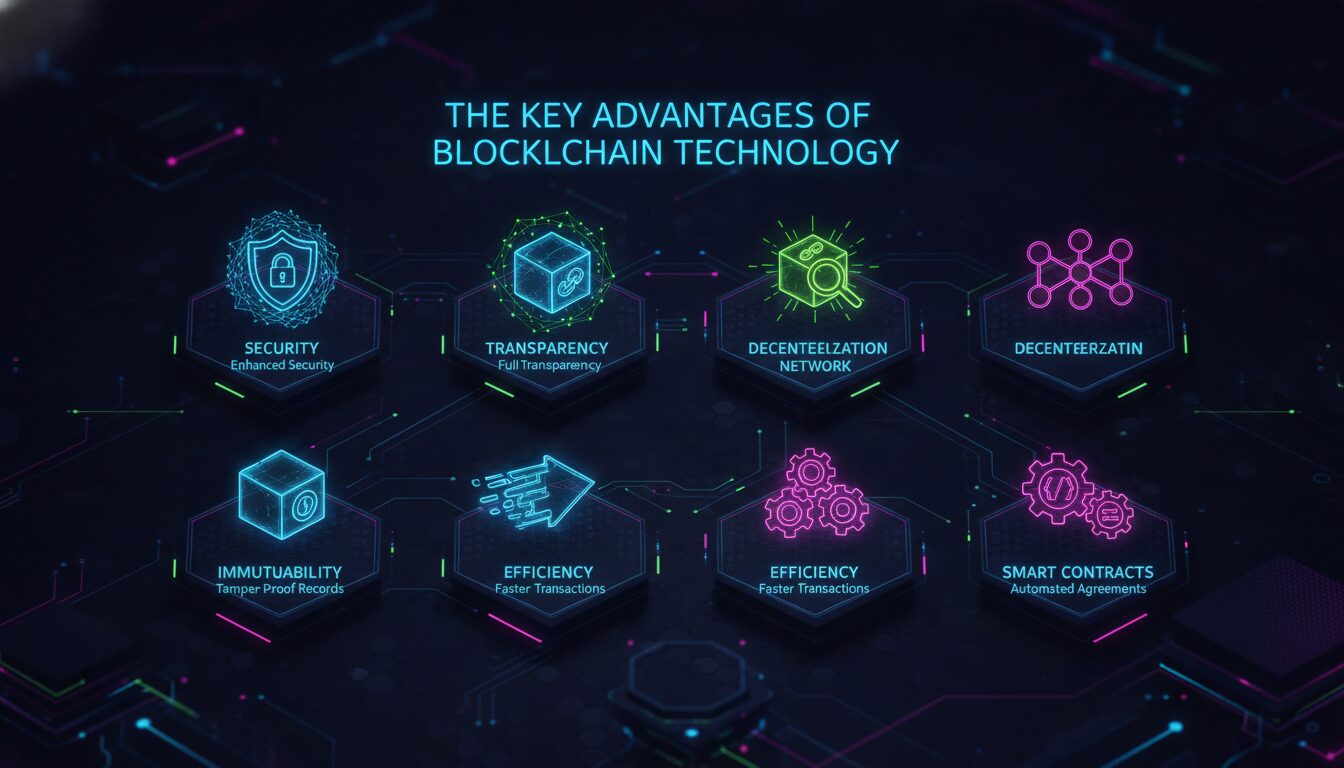
Enhanced security is one of the primary advantages of blockchain technology, and it operates at multiple layers simultaneously. Data is encrypted end-to-end, and each block contains a unique cryptographic hash of its contents. Any attempt to alter a past transaction requires recalculating all subsequent hashes across a distributed network – computationally infeasible at scale. IBM notes that blockchain creates a record that cannot be altered, directly preventing fraud and unauthorized activity. The decentralized architecture removes the central server that attackers typically target. Instead, data lives across thousands of independent nodes, and consensus mechanisms ensure any invalid block gets rejected before it can propagate.
Decentralization and Trust
Decentralization is a foundational advantage of blockchain technology, and its implications run deeper than most people initially realize. Control distributes across a network of independent nodes, each holding an identical copy of the ledger. No single party can unilaterally alter data or shut the system down. According to Grant Thornton, a blockchain network is resistant to disruption because its nodes operate independently and are equally authoritative – if one node goes offline, the blockchain still functions. GeeksforGeeks highlights that blockchain is free from censorship because it relies on trustworthy nodes and consensus protocols rather than a central authority. Trust shifts from institutional reputation to mathematical proof.
Transparency and Traceability
Transparency is among the most operationally valuable advantages of blockchain technology for multi-party business networks. Every transaction records on a shared ledger visible to all authorized participants, time-stamped and permanently linked to the previous entry. Delubac describes this precisely: all data is stored chronologically and linked by cryptographic evidence, enabling complete traceability of assets. In supply chains, that capability lets companies verify the provenance of goods at every step, confirming authenticity and ethical sourcing. IBM emphasizes that traceability data can expose weaknesses in supply chains – delays, bottlenecks, and gaps that would otherwise stay hidden. Any participant can independently verify transaction histories, which removes the information asymmetry that fraud depends on.
“Building trust between trading partners, providing end-to-end visibility, streamlining processes and resolving issues faster with blockchain all add up to stronger, more resilient supply chains and better business relationships.” – IBM, Benefits of Blockchain
Operational Efficiency and Cost Reduction
Streamlining Processes
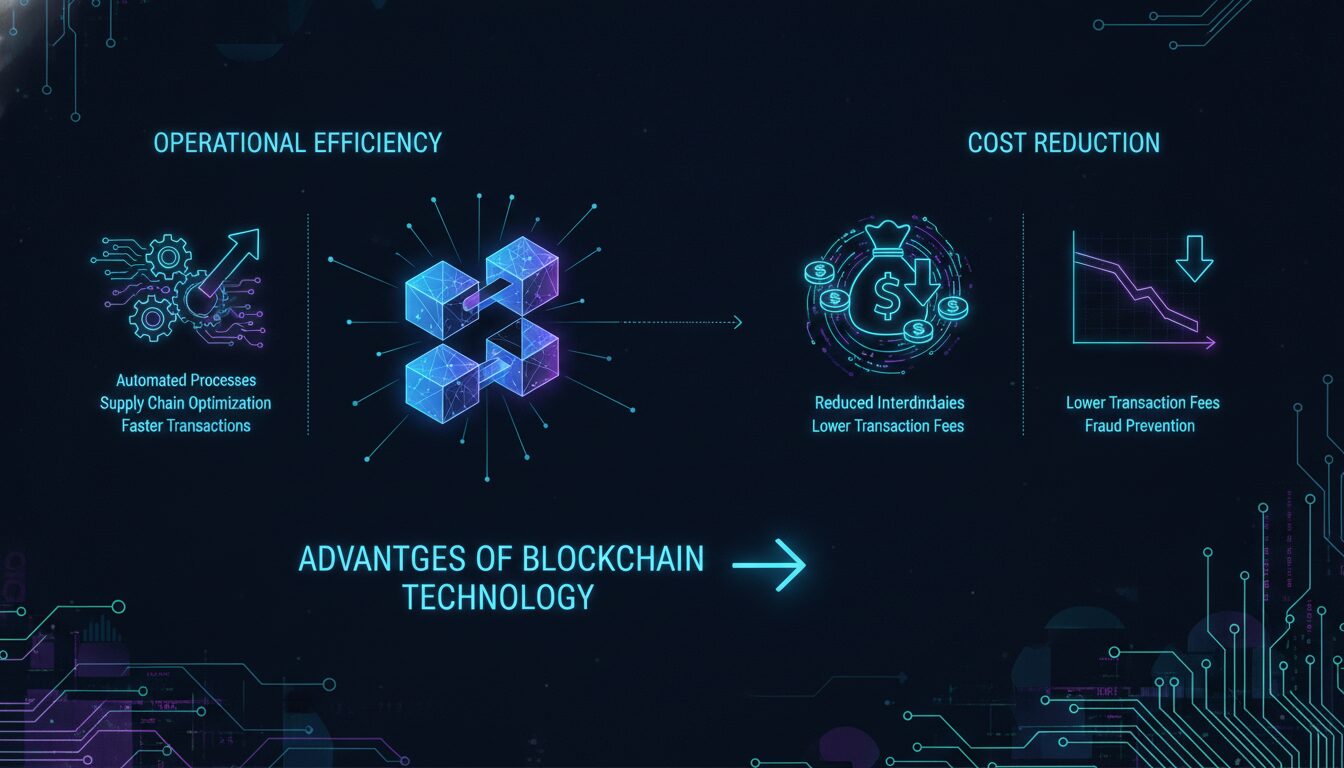
Traditional business processes are slow because they depend on paperwork, manual verification, and chains of intermediaries. The advantages of blockchain technology address this directly by digitizing and automating the entire flow. All transaction details and supporting documentation can live on-chain, eliminating physical records and manual reconciliation. IBM points out that by streamlining these processes, transactions complete faster and more efficiently. The removal of intermediaries – brokers, correspondent banks, legal agents – cuts fees and administrative overhead in one move. Cross-border payments that once required 2-5 days of clearing can settle in near-real-time on a blockchain network, according to Grant Thornton’s analysis of payment processing.
Reducing Intermediaries
Disintermediation is a structural advantage, not just a cost-saving tactic. In most industries, third parties charge fees specifically to provide trust and verification services. Blockchain replaces those intermediaries with code. The AWS documentation illustrates this with a property sale: traditionally, a trusted third party supervises the transaction because neither buyer nor seller can be fully trusted independently. With blockchain, each party holds a synchronized ledger that updates in real time, eliminating the need for escrow services entirely. In finance, payment processing on a blockchain bypasses correspondent banks. GeeksforGeeks notes that blockchain reduces costs by removing the third party and enabling direct, trustworthy transactions between partners.
Automation with Smart Contracts
Smart contracts are self-executing programs stored on the blockchain that enforce and execute agreements automatically when predefined conditions are met. They compress complex workflows into code, removing human intervention and the risk of non-compliance. IBM’s documentation highlights how in insurance, a smart contract can automatically settle a claim once a customer submits the required documentation – no adjuster review, no manual payment processing. Grant Thornton’s Sean Roberts frames it well:
“There’s really a shift in the way that some technologists are thinking about this, in regards to how we can use smart contracts and how we can use the technology of blockchain, which especially is helpful for things like immutability – the ability to lock something in and say that ‘this cannot be changed from here on out.'” – Sean Roberts, Advisory Manager, Grant Thornton
This automation extends to royalty payments in media, fund releases in escrow scenarios, and complex financial instruments – reducing cycle times from weeks to seconds.
Smart Contracts and Lease Accounting Compliance
One underappreciated application of smart contracts involves regulatory compliance for lease accounting. The Financial Accounting Standards Board (FASB) and International Accounting Standards Board (IASB) now require companies to record nearly all leases on the balance sheet. Many enterprises manage a sprawling network of contracts and leases created by different teams, in different locations, with divergent terms. Smart contracts on a blockchain can standardize and automate this tracking, ensuring that lease obligations are recorded accurately and consistently. Grant Thornton’s Malcolm Silberman captures the design philosophy: “If you design this appropriately, you shouldn’t even know that you’re on a blockchain.” The compliance benefit is real; the complexity is invisible to end users.
Blockchain’s Impact Across Industries

Supply Chain and Logistics
Supply chain is where the advantages of blockchain technology translate most visibly into operational outcomes. End-to-end visibility and accountability let companies track a product from raw material to consumer, verifying each step. According to a study published on PubMed Central, during COVID-19, blockchain was used to monitor the distribution, storage, and administration of vaccines, ensuring cold-chain integrity and preventing counterfeit doses. IBM notes that provenance data stored on a blockchain can help consumers make informed choices about sustainable or ethically sourced products. Eliminating paper-based records and manual checks also speeds up customs clearance and reduces disputes between trading partners.
Finance and Banking
The financial sector adopted blockchain early, and for good reason. Cross-border payments that traditionally take 2-5 days can settle in near-real-time using blockchain networks. According to Grant Thornton, systems can use blockchain to process payments securely and faster without third parties, lowering both cost and risk. Smart contracts facilitate complex financial instruments like derivatives, automating clearing, settlement, and reporting in a single flow. The ledger’s transparency aids auditors and regulators, reducing fraud and money laundering risk. Tokenization of real-world assets – representing real estate or equities as digital tokens on a blockchain – opens up liquidity and fractional ownership that traditional markets cannot easily provide.
Healthcare and Data Integrity
Healthcare records are sensitive, fragmented, and frequently siloed across providers. The advantages of blockchain technology in this sector center on unifying patient data in a secure, interoperable format where patients control access permissions and every change is auditable. The immutability of blockchain ensures medical records cannot be tampered with, which matters for legal compliance and patient safety. The PMC supply chain study confirms that blockchain’s traceability extends to pharmaceutical supply chains, preventing counterfeit drugs from entering distribution. Clinical trial data stored on-chain can also enhance transparency and trust in research outcomes. Adoption is still early, but the structural fit between blockchain’s properties and healthcare’s data integrity requirements is strong.
How Blockchain Ensures Data Integrity
Immutable Ledgers
Immutability is the mechanism that makes every other data integrity claim credible. Once a transaction appends to the blockchain and receives consensus confirmation, it cannot be modified or deleted. Each block contains a hash pointer to the previous block; altering any transaction changes that block’s hash, breaks the chain, and alerts the entire network instantly. GeeksforGeeks emphasizes that data cannot be tampered with because any change reflects across all nodes, preventing fraud. This property is invaluable for audit trails, legal evidence, and regulatory compliance. As Grant Thornton’s Malcolm Silberman noted, the integrity blockchain provides is absolute – even when users have no idea they’re interacting with a distributed ledger.
Cryptographic Verification
Blockchain uses layered cryptographic techniques to secure data at every stage. Public-key cryptography ensures only the owner of a private key can authorize transactions. Digital signatures verify the authenticity of each transaction without exposing the private key. As Coursera explains, a digital signature from the original owner of a transaction authenticates the information and protects it from tampering. Hash functions like SHA-256 create a unique fingerprint for each block; any minor change produces a completely different hash, immediately exposing tampering. AWS and IBM both confirm that these signatures are verified by all nodes before acceptance, making the verification process distributed rather than dependent on any single authority.
Consensus Mechanisms
Consensus mechanisms are the protocols that ensure all nodes agree on the valid state of the ledger without a central arbiter. They prevent double-spending and unauthorized modifications at the network level. Common mechanisms include Proof of Work (PoW), used by Bitcoin, which requires computational work to validate blocks; Proof of Stake (PoS), where validators are chosen based on their token holdings; and Practical Byzantine Fault Tolerance (PBFT), common in permissioned enterprise networks. According to IBM, if one node submits an invalid block, the other nodes reject it, ensuring only legitimate updates are recorded. This architectural feature is what makes the advantages of blockchain technology durable rather than theoretical – the ledger stays trustworthy even in a trustless environment.
Comparing Blockchain with Traditional Systems
Centralization vs. Decentralization
Traditional databases managed by a corporation or government rely on a central authority for maintenance and security. That creates a single point of failure: compromise the central server and all data is at risk. Blockchain distributes data across a peer-to-peer network, making it resilient and censorship-resistant. Pass4sure’s analysis notes that when one entity controls the flow and storage of data, there’s always a risk of fraud and single points of failure – blockchain mitigates these risks through distribution. This decentralized structure not only improves security but also democratizes data access, allowing equal participation across all authorized nodes.
Trust Models
Centralized systems vest trust in the organization operating the database. Users must believe that organization will secure the data, act honestly, and not manipulate records. Blockchain shifts trust from an institutional level to a technological level, where cryptographic proof and consensus replace human discretion. IBM’s description of blockchain as a “trustless” network captures this precisely: business partners don’t have to trust each other because the system enforces integrity automatically. This model is particularly valuable in multi-party environments where participants have conflicting interests – the protocol is the referee, not a human intermediary.
Performance and Scalability
Traditional SQL-based databases can process thousands of transactions per second and scale vertically with relative ease. Public blockchains face a different set of constraints. Bitcoin handles around 7 transactions per second, and Ethereum’s pre-merge throughput sat at roughly 15-30 transactions per second, due to block size limits and consensus overhead. GeeksforGeeks points out that Bitcoin’s 1 MB block size limits the number of transactions per block, creating scalability issues during peak demand. Layer-2 solutions like Lightning Network and rollups are actively addressing these bottlenecks. For enterprise use, permissioned blockchains offer higher throughput by relaxing decentralization requirements. The comparison below summarizes the key differences:
| Feature | Traditional Database | Blockchain |
|---|---|---|
| Architecture | Centralized | Decentralized / Distributed |
| Data Modification | CRUD operations (Create, Read, Update, Delete) | Append-only; no update or delete |
| Trust Model | Central authority | Consensus and cryptography |
| Transparency | Limited to select roles | Full (or permissioned) transparency among participants |
| Speed | High (thousands of tps) | Lower (typically <100 tps for public chains) |
| Cost per Transaction | Low | Varies; can be high in public networks |
| Fault Tolerance | Single point of failure | No single point; node failure does not halt network |
| Use Cases | Everyday applications, high-speed needs | Multi-party trust, audit trails, asset transfers |
Pros and Cons of Blockchain Technology
Pros
- Immutable security: Cryptographic hashing and distributed storage make unauthorized data modification computationally infeasible.
- Trustless transparency: All authorized participants see the same ledger in real time, eliminating information asymmetry.
- Disintermediation: Removing third-party intermediaries cuts transaction costs and speeds up settlement significantly.
- Smart contract automation: Self-executing code enforces agreements without human intervention, reducing errors and cycle times.
- High availability: No single node controls the network; one node going offline does not disrupt operations.
- Auditability: Every transaction carries a permanent, time-stamped record that satisfies regulatory and compliance requirements.
Cons
- Scalability limits: Public blockchains process far fewer transactions per second than centralized databases, creating bottlenecks at scale.
- Energy consumption: Proof of Work consensus is computationally intensive. According to GeeksforGeeks, blockchain transaction verification consumed roughly 0.3% of global electricity by 2018.
- Irreversibility: The same immutability that prevents fraud also means errors cannot be corrected without a new transaction – and lost private keys mean permanent loss of access.
- Regulatory uncertainty: Decentralized systems often conflict with legal frameworks that assume a central authority, slowing enterprise adoption.
- Complexity and cost: Specialized blockchain engineers are scarce, making development and maintenance expensive, as Delubac notes.
Challenges and Considerations
Scalability and Speed
Scalability is the most frequently cited constraint on the advantages of blockchain technology reaching their full potential. Public blockchains face a trade-off between decentralization and transaction throughput. Bitcoin’s 1 MB block size restricts it to a handful of transactions per second, leading to network congestion and higher fees during peak usage. According to GeeksforGeeks, this fixed block size is one of the biggest drawbacks, as it cannot accommodate high transaction volumes. Sharding, sidechains, and layer-2 protocols are actively addressing these bottlenecks. For enterprise implementations, permissioned blockchains achieve higher performance by relaxing decentralization requirements – a practical trade-off for many business use cases.
Energy Consumption
Energy-intensive consensus mechanisms like Proof of Work have drawn legitimate criticism. A survey cited by GeeksforGeeks noted that by 2018, roughly 0.3% of the world’s electricity was used for blockchain transaction verification, driven largely by Bitcoin mining. This concern has accelerated adoption of more efficient mechanisms: Proof of Stake (Ethereum completed its move to PoS in 2022) and Practical Byzantine Fault Tolerance in permissioned networks. As Delubac notes, some blockchains require substantial computing power, leading to high energy costs. Newer networks are being designed with sustainability as a first-order constraint, and the industry trend is clearly toward greener consensus models.
Regulatory and Adoption Hurdles
Blockchain’s decentralized architecture often conflicts with legal frameworks that assume a central authority exists. Regulatory uncertainty around cryptocurrencies, smart contract enforceability, and data privacy requirements – including GDPR’s right to erasure, which sits in direct tension with immutability – can slow enterprise adoption. GeeksforGeeks highlights that blockchain is still maturing and needs broader confidence for complete utilization. The irreversible nature of transactions, while an advantage for trust, becomes a liability when errors occur or private keys are lost. As Delubac points out, there is no “forgot password” option on a blockchain. Overcoming these challenges requires industry collaboration, clearer regulations, and interfaces that abstract away the underlying complexity.
Maximizing the Advantages of Blockchain Technology
Best Practices for Implementation
To fully realize the advantages of blockchain technology, organizations should start by identifying processes that involve multiple parties, require a shared immutable record, or suffer from persistent trust issues. Starting with a permissioned blockchain in a consortium delivers high performance while providing transparency and cost savings. Choosing the right consensus algorithm, designing smart contracts with thorough security audits, and ensuring regulatory compliance are non-negotiable steps. IBM’s experience suggests blockchain is most effective when it enhances existing business networks by building trust and automating workflows – not when it replaces all infrastructure wholesale. The goal is invisible infrastructure, not visible complexity.
Choosing the Right Blockchain Type
There are four main blockchain network types, and picking the wrong one undermines every other advantage. Public blockchains like Bitcoin offer maximum decentralization and security but limited transaction speed. Private blockchains, controlled by a single organization, offer faster performance with less decentralization. Consortium blockchains, governed by a group of entities, strike a practical balance for business use cases. Hybrid blockchains combine public and private elements for flexible data sharing. A supply chain consortium might use a private or consortium blockchain to protect sensitive commercial data while sharing provenance information with partners. A DeFi protocol needs a public blockchain for censorship resistance. The use case drives the architecture – not the other way around.
If you’re evaluating which blockchain architecture fits your protocol or product, the Digital Blockchains studio works through exactly these decisions with founding teams. You can also explore our build process to understand how we approach protocol design from first principles.
Future Trends in Blockchain
As of 2026, the advantages of blockchain technology are becoming more pronounced with the maturation of interoperability protocols, decentralized identity (DID), and zero-knowledge proofs (ZKP) that enhance privacy while maintaining verifiability. The integration of blockchain with AI and IoT is creating autonomous, self-sovereign systems that operate without human intermediaries at any layer. Standards bodies like the International Organization for Standardization (ISO) are developing frameworks to guide adoption, and major cloud providers including AWS and IBM offer Blockchain-as-a-Service (BaaS) to lower the entry barrier for enterprises. Quantum-resistant cryptography is on the horizon as a necessary upgrade for long-lived blockchain deployments. These converging trends will make blockchain an invisible but indispensable layer of the digital economy.
Frequently Asked Questions
What is blockchain and its advantages and disadvantages?
Blockchain is a decentralized, distributed ledger that records transactions across a network of nodes using cryptographic hashing and consensus mechanisms. Its advantages include enhanced security, transparency, immutability, disintermediation, and smart contract automation. Its disadvantages include scalability limits, high energy consumption for Proof of Work systems, regulatory uncertainty, and the irreversible loss of access when private keys are lost.
What is the downside to blockchain?
The primary downsides are scalability constraints on public networks, energy-intensive consensus mechanisms like Proof of Work, regulatory uncertainty in most jurisdictions, and the irreversibility of transactions. Lost private keys result in permanent loss of access to funds or data, with no recovery mechanism available.
Is blockchain 100% safe?
No distributed system is unconditionally safe. Blockchain is highly resistant to tampering because altering historical data requires enormous computational resources and network collusion. However, a 51% attack – where a single entity controls a majority of the network’s mining or staking power – could theoretically allow chain reorganization. Such attacks are highly impractical on large, well-distributed networks like Bitcoin or Ethereum, but smaller chains remain more vulnerable.
What are the 4 types of blockchain technology?
The four types are public (permissionless) blockchains, where anyone can participate; private (permissioned) blockchains, controlled by a single organization; consortium blockchains, governed by a group of entities; and hybrid blockchains, which combine public and private elements. Each type involves a different trade-off between decentralization, performance, and access control.
Can blockchain be used outside of cryptocurrency?
Yes. Blockchain has proven applications in supply chain traceability, healthcare record management, digital identity, voting systems, real estate title transfers, lease accounting compliance, and automated contractual agreements through smart contracts. The advantages of blockchain technology apply wherever multiple parties need a shared, tamper-resistant record without relying on a central authority.
How does blockchain achieve transparency while maintaining privacy?
Blockchain broadcasts transactions to all network nodes, but privacy is maintained through address pseudonymity and advanced techniques like zero-knowledge proofs, which allow one party to prove the correctness of data to another without revealing the underlying data itself. Private and consortium blockchains also restrict ledger visibility to authorized participants only.