Key Takeaways
- The Algorand blockchain delivers 10,000+ transactions per second with sub-4 second finality, powered by Pure Proof-of-Stake.
- Founded by Turing Award winner Silvio Micali, it is designed for institutional-grade DeFi and agentic commerce.
- Algorand leads in quantum resilience, already implementing Falcon signatures and targeting broad quantum security by 2027.
- Real-world applications like HesabPay, Lofty, and Folks Finance prove the network’s readiness today.
- ALGO token has a max supply of 10 billion and gained regulatory clarity as a digital commodity in the U.S. in March 2026.
Algorand blockchain is a high-performance, proof-of-stake Layer-1 network built for real-world applications, offering 10,000+ transactions per second, instant finality, and a clear roadmap to quantum resilience. Built by cryptographer Silvio Micali, it solves the blockchain trilemma without compromise.
1. What Is the Algorand Blockchain?
Algorand is a decentralized, open-source proof-of-stake blockchain launched in June 2019, founded in 2017 by Silvio Micali, a computer science professor at MIT and recipient of the 2012 Turing Award. The Algorand blockchain was built to solve the blockchain trilemma: achieving scalability, security, and decentralization simultaneously without sacrificing any single dimension. Its native cryptocurrency, ALGO, pays transaction fees, secures the network through staking, and enables governance participation.
According to Algorand’s official site, the protocol now operates under unified leadership after the Algorand Foundation and Algorand Technologies merged to accelerate ecosystem growth. Unlike many blockchains that have suffered downtime or contentious forks, the Algorand blockchain has never forked or halted, reinforcing its reputation as a production-ready network.
1.1 The Vision: Agentic Commerce and Institutional DeFi
Algorand positions itself as the infrastructure for agentic commerce, where AI agents transact autonomously without human intervention. Its x402 standard, an open payments protocol built on HTTP 402, lets machines pay for services directly. As the Algorand Foundation noted in a July 2026 post: AI agents can now pay for things on their own, no human, no checkout, no API key. This forward-looking approach aligns with the network’s emphasis on low costs and high throughput.
1.2 Key Design Principles
The platform’s architecture rests on three pillars: Pure Proof-of-Stake (PPoS), the Algorand Virtual Machine (AVM), and a layered consensus that ensures immediate transaction finality. These components work together to support use cases ranging from simple payments to complex smart contracts and tokenized assets.
2. How the Algorand Blockchain Works
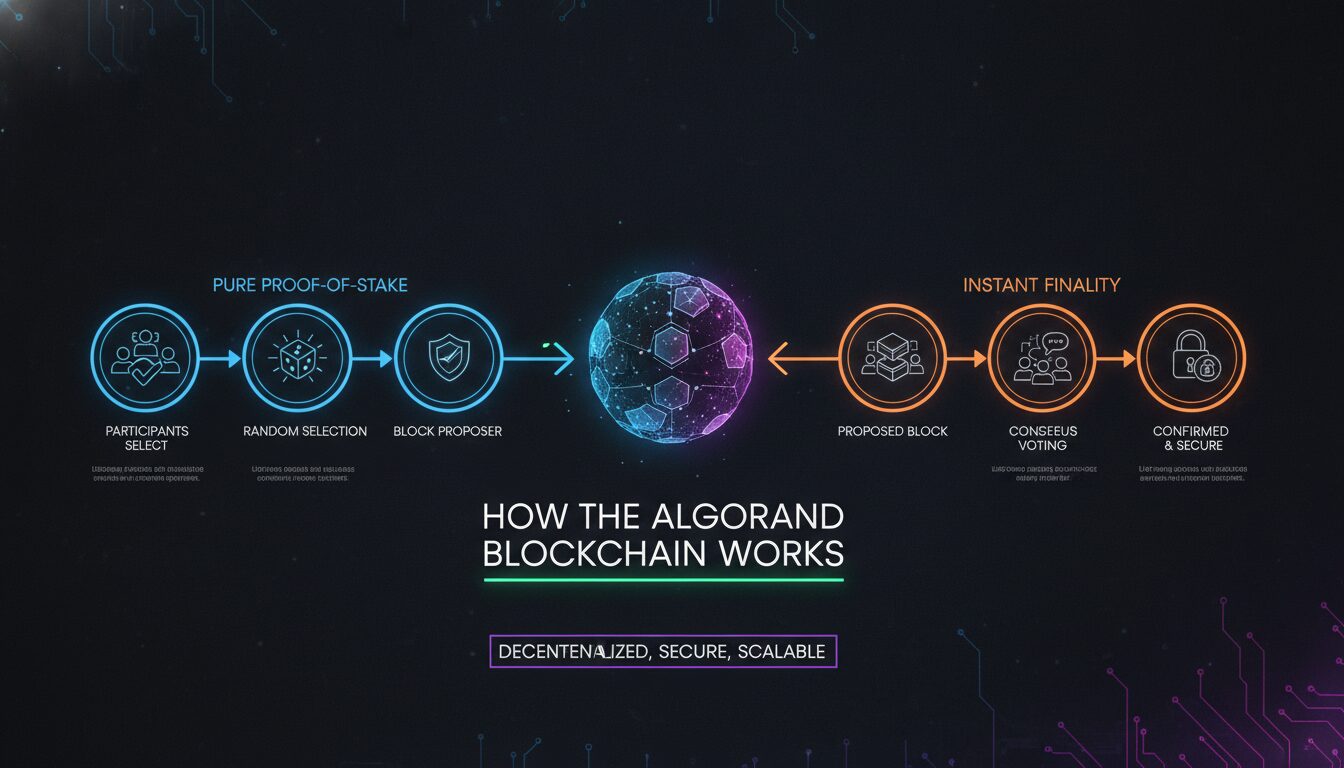
The Algorand blockchain operates on a consensus mechanism that eliminates the competition and energy waste typical of proof-of-work systems, relying instead on random validator selection through cryptographic sortition.
2.1 Pure Proof-of-Stake Consensus
In Pure Proof-of-Stake, every ALGO holder can participate in consensus with a probability proportional to their stake. Unlike delegated proof-of-stake systems, there are no elected super-delegates. The network randomly and secretly selects committee members for each block, preventing centralization and reducing the attack surface. The consensus protocol is a Byzantine Agreement variant that guarantees safety and liveness even with a fraction of malicious actors present.
2.2 Cryptographic Sortition
Sortition is the core of Algorand’s secret leader election. Each node locally runs a Verifiable Random Function (VRF) to determine if it is chosen to propose or vote on a block. The process stays private until the node reveals its proof, making it impossible for an adversary to know in advance which nodes to target. This randomness is critical for security and decentralization, as documented in the foundational papers by Micali and Jing Chen of Stony Brook University.
2.3 Block Proposal, Filtering, and Certification
Consensus proceeds in three steps. First, a proposal committee assembles and gossips proposed blocks, with a statistical expectation of roughly 20 proposals per round. Second, a soft vote filters the proposals, selecting the one with the lowest VRF hash priority. Third, a separate committee certifies the block as final. Once certified, a block cannot be reverted. This gives the Algorand blockchain its immediate finality, typically within 4 seconds.
3. Scalability and Performance
Scalability is a key strength of the Algorand blockchain. As of 2026, the network has demonstrated a capacity of 10,000+ transactions per second without compromising decentralization, according to Algorand’s official materials. That places it among the fastest Layer-1 blockchains, rivaling traditional payment processors.
3.1 Throughput and Finality Metrics
Algorand’s own benchmarks claim 10,000+ TPS with sub-4 second finality. In contrast, Ethereum’s base layer handles roughly 15-30 TPS, and Bitcoin processes around 7 TPS. The gap is not incremental; it’s structural. PPoS relies on randomness rather than competitive mining, which removes the throughput ceiling that plagues proof-of-work chains.
3.2 Low Transaction Fees and Energy Efficiency
Transaction fees on Algorand are fixed at 0.001 ALGO, a fraction of a cent, making it economical for microtransactions and high-frequency applications. Because PPoS requires no energy-intensive mining, the network runs carbon-negative, aligning with sustainable finance goals. This efficiency attracts projects like Enel, the world’s largest private electricity distributor, which uses the Algorand blockchain for fractional ownership of renewable energy assets.
4. The Algorand Virtual Machine and Smart Contracts
The Algorand Virtual Machine (AVM) is the execution environment for smart contracts on Algorand, supporting both stateless and stateful contract logic directly on Layer-1. Developers write contracts in TEAL (Transaction Execution Approval Language) or Python via the PyTeal and Beaker frameworks, lowering the barrier for teams already working in mainstream languages. This is a meaningful advantage over ecosystems that require learning Solidity or Rust from scratch.
Smart contracts on Algorand are formally structured as either Algorand Smart Contracts (ASC1s) for stateless logic or Algorand Smart Signatures for delegated signing. The AVM supports atomic transactions, meaning a group of up to 16 transactions either all succeed or all fail. That atomicity is native at the protocol level, not bolted on through a wrapper contract, which reduces complexity and attack surface for DeFi protocols building on the chain.
“Algorand’s AVM enables atomic transaction groups natively at the protocol layer, removing an entire class of reentrancy and ordering vulnerabilities that plague EVM-based DeFi.” – Algorand developer documentation, Algorand Foundation
5. Algorand Governance: The xGov Model
Algorand’s on-chain governance gives ALGO holders direct influence over protocol decisions through the xGov (Expert Governance) model. Participants lock ALGO for a governance period, vote on proposals, and earn rewards for active participation. The xGov layer extends this further by creating a pool of vetted community experts who can propose and evaluate technical changes, adding a layer of informed deliberation beyond simple token-weighted voting.
This model matters for institutional participants who need predictable, auditable governance before committing capital. It also matters for developers: protocol upgrades go through a transparent process rather than being pushed by a single entity. According to the Algorand Foundation, the unified organization now manages both protocol development and governance under one roof, streamlining the path from proposal to deployment.
6. Real-World Applications on the Algorand Blockchain
The Algorand blockchain is not theoretical infrastructure. It hosts production-grade applications across finance, supply chain, and identity. Here are the most instructive examples.
6.1 Lofty: Democratizing Real Estate Investment
Lofty is a Y Combinator-backed startup that tokenizes rental properties on Algorand, allowing anyone to invest with as little as $50. Property shares are represented as tokens, and owners receive rental income proportional to their holdings. This use case shows how the Algorand blockchain can fractionalize illiquid assets and lower barriers to entry for retail investors.
6.2 HesabPay: Transparent Humanitarian Aid
HesabPay uses Algorand to deliver stablecoin-based aid in Afghanistan, partnering with the World Food Programme and Mercy Corps. According to a World Bank CGAP study cited by BSCN, a pilot reached 840 people across 100 farming households, cutting delivery costs by 29%. A parallel pilot in Syria cut payment delivery times from 28 days to under one day, enabling offline payments via physical cards. This highlights the network’s utility in crisis zones where banking infrastructure is absent or unreliable.
6.3 Folks Finance: Next-Gen DeFi
Folks Finance is a comprehensive DeFi platform built on the Algorand blockchain, offering lending, borrowing, swaps, and liquid staking. Its non-custodial protocol benefits from the chain’s high throughput and low fees. The platform’s growth signals the maturation of DeFi on non-Ethereum networks and demonstrates that Algorand’s technical properties translate into real product advantages.
6.4 Mann Deshi: Tokenized Credit for Rural India
Mann Deshi, a cooperative bank, uses Algorand to issue tokenized credit scorecards to women in rural India. By putting informal transaction records on-chain, it enables previously unbanked individuals to access formal credit. This initiative shows how the Algorand blockchain can bridge traditional finance and decentralized technology in markets where legacy systems have failed.
6.5 Enel: Sustainable Energy Fractional Ownership
Enel, the Italian multinational energy company, partnered with Algorand to fractionalize ownership of solar and wind infrastructure. The project expands access to sustainable energy investments, demonstrating Algorand’s appeal to large enterprises pursuing ESG objectives.
Other applications include World Chess’s on-chain loyalty program, Midas’ tokenized treasury products, Labtrace’s data authentication, and Wholechain’s supply chain tracking, as listed on Algorand’s official site.
7. Algorand’s Quantum Resilience Roadmap
As quantum computing advances, many blockchains face existential threats from algorithms capable of breaking traditional cryptographic primitives. The Algorand blockchain has been proactively addressing this since 2022, making it the most quantum-ready major public blockchain by a significant margin.
7.1 Falcon Signatures and Post-Quantum Security
Algorand was among the first to implement NIST-selected Falcon post-quantum signature algorithms. In 2025, it executed the first quantum-resistant transactions on a public mainnet, proving that assets could be moved with post-quantum security on a live network. These Falcon signatures protect the chain’s entire history against future quantum attacks, as detailed on Algorand’s official site.
7.2 Roadmap to 2027 and Beyond
The Algorand Foundation unveiled a roadmap in June 2026, as reported by CoinDesk, targeting broad quantum resistance by the end of 2027. Key milestones include:
- Q3 2026: First native post-quantum accounts and SDK support for developers.
- 2027: Quantum-resistant multisignature wallets for institutions, treasuries, and high-value operations.
- Ongoing research into PQ-resilient Verifiable Random Functions (VRFs) for consensus messaging.
This roadmap cements Algorand’s position as the most quantum-ready major blockchain. No other Layer-1 has executed live quantum-resistant transactions on mainnet at this stage.
“Algorand’s roadmap targets broad quantum resilience by the end of 2027, including native PQ accounts, multisignature wallets, and research into PQ-resilient VRF and signatures for consensus messaging.” – CoinDesk, June 18, 2026
8. ALGO Token Economics and Market Position
Understanding the tokenomics is essential for evaluating the Algorand blockchain‘s long-term viability.
8.1 Supply, Distribution, and Staking
ALGO has a maximum supply of 10 billion tokens, with approximately 8.96 billion in circulating supply as of mid-2026, according to CoinMarketCap. The genesis block allocated tokens to early backers, the foundation, and a community rewards pool. Holders stake ALGO to participate in consensus and earn rewards, incentivizing network security. As of 2026, the price sits around $0.08, with an all-time high of $3.28 recorded in June 2019 and an all-time low of $0.07577 recorded on July 29, 2026, per CoinMarketCap data.
8.2 Regulatory Clarity: SEC and CFTC Classification
A landmark development came on March 17, 2026, when the SEC and CFTC jointly issued an interpretive release identifying ALGO as a digital commodity, not a security. This removed a significant overhang that had suppressed institutional interest. Previously, ALGO had been named in lawsuits against exchanges like Coinbase and Binance, creating uncertainty. The classification underscores the Algorand blockchain‘s compliance-friendly design and is likely to accelerate adoption by regulated entities.
9. Pros and Cons
Pros
- Immediate finality: Transactions confirm in roughly 4 seconds with no possibility of rollback, making it suitable for financial settlement.
- Quantum resilience: The only major Layer-1 with live post-quantum transactions on mainnet and a concrete 2027 roadmap.
- Regulatory clarity: ALGO’s digital commodity classification removes a major barrier for institutional adoption.
- Low, predictable fees: Fixed at 0.001 ALGO, enabling microtransaction use cases that are economically impossible on Ethereum.
- Python smart contracts: Lowers the developer onboarding curve significantly compared to Solidity or Rust.
- No forks, no downtime: A clean operational record since mainnet launch in June 2019.
Cons
- Smaller developer ecosystem: Ethereum and Solana have substantially larger developer communities, more tooling, and deeper liquidity.
- Token price performance: ALGO trades far below its 2019 all-time high, which affects developer and investor sentiment.
- DeFi TVL gap: Total value locked on Algorand remains modest compared to Ethereum, Solana, and even newer chains like Base.
- Limited Layer-2 ecosystem: Unlike Ethereum, Algorand’s scaling strategy is entirely Layer-1, which may limit future composability options.
10. How to Start Using the Algorand Blockchain
Getting started on the Algorand blockchain is straightforward. Follow these steps:
Step 1: Choose an Algorand Wallet
Download a non-custodial wallet that supports ALGO and Algorand Standard Assets (ASAs). Popular options include Pera Algo Wallet (mobile) and Defly (mobile with trading tools). For desktop, MyAlgo (web) is commonly used. Back up your seed phrase securely before doing anything else.
Step 2: Acquire ALGO Tokens
Purchase ALGO on a major exchange like Kraken, Coinbase, or Binance where available. Transfer the tokens to your wallet address. Transaction fees are minimal, so moving funds between addresses costs almost nothing.
Step 3: Explore dApps and Staking
Connect your wallet to Algorand dApps via the WalletConnect protocol. You can stake ALGO through platforms like Folks Finance or native staking options to earn rewards. Explore DeFi, NFTs, or tokenized real estate on Lofty. The ecosystem is accessible and expanding across multiple verticals.
11. Algorand vs. Competitors: A Detailed Comparison
The Algorand blockchain competes with other smart contract platforms. Below is a comparison of key features:
| Feature | Algorand | Ethereum | Solana | Hedera (HBAR) |
|---|---|---|---|---|
| Consensus Mechanism | Pure Proof-of-Stake | Proof-of-Stake (since Merge) | Proof-of-History + PoS | Hashgraph |
| Transaction Speed | 10,000+ TPS (official) | Roughly 15-30 TPS base layer | High | High |
| Finality | ~4 seconds | Variable (minutes in some cases) | Fast | Fast |
| Quantum Readiness | Yes (Falcon implemented, 2027 roadmap) | Not ready | Not ready | Not ready |
| Smart Contract Language | TEAL, Python | Solidity | Rust, C | Solidity |
| Regulatory Status (US) | Digital commodity (March 2026) | Commodity (ETH) | Unclear | N/A |
Algorand matches or exceeds competitors in finality and quantum readiness while offering unique regulatory clarity. Its trade-off is a smaller developer ecosystem compared to Ethereum or Solana, though Python support meaningfully lowers the barrier to entry for new builders.
Build on Algorand with Digital Blockchains
If you’re evaluating Algorand as infrastructure for a token launch, DeFi protocol, or real-world asset platform, the technical case is strong. The regulatory clarity, quantum roadmap, and production-grade performance metrics make it a serious option for builders who care about long-term viability, not just current TVL rankings. At Digital Blockchains, we work with founders building at the protocol layer. If you’re serious about deploying on Algorand or designing tokenomics for an Algorand-based project, apply to the Genesis Cohort at digitalblockchains.com.
Frequently Asked Questions
Is Algorand a dead coin?
No, Algorand is actively developed with a growing ecosystem. It recently unified its development and foundation arms, announced a quantum resistance roadmap targeting 2027, and continues to onboard real-world partners like Enel and HesabPay. The network has never forked or experienced downtime since its June 2019 mainnet launch.
Is Algorand like XRP?
Algorand and XRP serve different purposes. Algorand is a general-purpose smart contract platform supporting DeFi, NFTs, and tokenized assets, while XRP focuses on cross-border payments for financial institutions. Both use efficient consensus mechanisms, but Algorand’s PPoS is more permissionless and decentralized than XRP Ledger’s validator model.
Can Algorand reach $10?
Price predictions are speculative and outside our scope here. ALGO’s all-time high was $3.28 in June 2019, per CoinMarketCap. The current focus from the Algorand Foundation is on utility, adoption, and quantum resilience rather than price targets.
Is Algorand better than HBAR?
Both have genuine strengths. Algorand offers quantum-ready security, pure proof-of-stake, and a permissionless network. Hedera uses a patented hashgraph with high throughput and a governing council of major enterprises. The right choice depends on your use case and whether you need a permissionless or council-governed network.
How secure is the Algorand blockchain?
Algorand uses a Byzantine fault-tolerant consensus with cryptographic sortition, making it resistant to targeted attacks since validators are selected privately and revealed only after the fact. It has never forked or halted, and its quantum-resistant upgrades add a layer of future-proof security that no other major Layer-1 currently matches.
What is the purpose of the ALGO token?
ALGO pays transaction fees, enables participation in consensus and governance, and incentivizes network security through staking. It also serves as the settlement asset for the x402 payment standard, which enables machine-to-machine payments for the emerging agentic economy.