Key Takeaways
- The benefits of blockchain center on cryptographic security, immutable ledgers, and removing single points of failure from data infrastructure.
- Transparency and traceability create auditable, real-time records that build trust between counterparties who don’t inherently trust each other.
- Decentralization cuts reliance on intermediaries, reducing settlement friction and administrative overhead.
- Smart contracts automate multi-step processes, shrinking the gap between agreement and execution.
- Supply chain, financial services, and healthcare are the three sectors seeing the clearest benefits of blockchain in production today.
- The advantages come with real tradeoffs: throughput limits, key management risk, and regulatory ambiguity still matter.
The benefits of blockchain are improved security, transparency, and operational efficiency delivered through decentralized, tamper-resistant ledgers. These advantages lower costs, reduce fraud exposure, and let businesses automate processes that once required manual verification.
Understanding Blockchain Technology
What Is Blockchain?
A blockchain is a distributed digital ledger that records transactions across a network of computers rather than a single server. According to Investopedia, it’s “a decentralized digital database or ledger that securely stores records across a network of computers in a way that is transparent, immutable, and resistant to tampering.” Each block holds transaction data linked chronologically through cryptographic hashes. That structure is the foundation for nearly every benefit of blockchain that businesses and institutions are putting to work today.
How Blockchain Works
Transactions get grouped into blocks, validated by network nodes through consensus mechanisms like Proof of Work or Proof of Stake, then appended to the chain and distributed across every participant. This makes the record extremely hard to alter after the fact. The architecture removes the need for a central authority. As Grant Thornton puts it: “If one node submits an unauthorized or invalid block, the other nodes in the network will reject it.”
Core Principles Behind the Benefits
Four principles drive most of the of blockchain: decentralization, immutability, transparency, and cryptographic security. Decentralization removes single points of failure. Immutability means recorded data can’t be quietly changed. Transparency lets every participant view the same ledger. Security gets enforced through math rather than institutional promises. Put together, these features shift trust from intermediaries into the protocol itself.
Blockchain vs Traditional Databases: A Comparison
Comparing blockchain to conventional systems makes the benefits of blockchain easier to see in concrete terms. The table below contrasts key attributes.
| Feature | Blockchain | Traditional Database |
|---|---|---|
| Architecture | Decentralized, distributed ledger | Centralized server-client model |
| Data Integrity | Immutable via cryptographic linking | Data can be updated or deleted by administrators |
| Transparency | All participants see the same data | Access restricted to authorized users |
| Security | Consensus mechanism and encryption | Firewalls and access controls |
| Performance | Slower transaction throughput | Higher speed and scalability |
| Cost | Lower operational costs by removing middlemen | Requires infrastructure and administration |
Enhanced Security and Data Integrity
How Does Blockchain Improve Security?
Blockchain improves security by combining cryptographic hashing, decentralized storage, and consensus validation so no single actor can quietly rewrite history. IBM notes that blockchain creates “a record that can’t be altered and is encrypted end-to-end,” which helps prevent fraud and unauthorized access. Each transaction gets digitally signed and linked to the one before it, forming a chain that’s computationally impractical to tamper with. Cryptographic hashing converts input data into a fixed-size string, and any change to the original data produces a completely different hash, exposing tampering instantly.
Immutable Records
Once a transaction lands on the blockchain, it becomes part of a permanent history that isn’t easily rewritten. This immutability is one of the clearest benefits of blockchain because it prevents double-spending and preserves data integrity over time. In healthcare and legal documentation, immutable records provide a reliable audit trail that reduces the risk of manipulation. GeeksforGeeks notes that blockchain “maintains accurate historical data” and “enhances trust in digital records,” both critical for patient safety.
Reduced Fraud and Cyberattacks
Distributing data across a network instead of storing it in one location shrinks the attack surface available to hackers. The consensus mechanism means altering a record would require overwhelming computational power, which makes fraud attempts easy to spot. GeeksforGeeks highlights that blockchain “reduces risks of cyberattacks and fraud” precisely because there’s no single database to breach.
“There’s really a shift in the way that some technologists are thinking about this, in regards to how we can use smart contracts and how we can use the technology of blockchain, which especially is helpful for things like immutability, the ability to lock something in and say that ‘this cannot be changed from here on out.'” – Sean Roberts, Advisory Manager, Grant Thornton
Transparency and Traceability
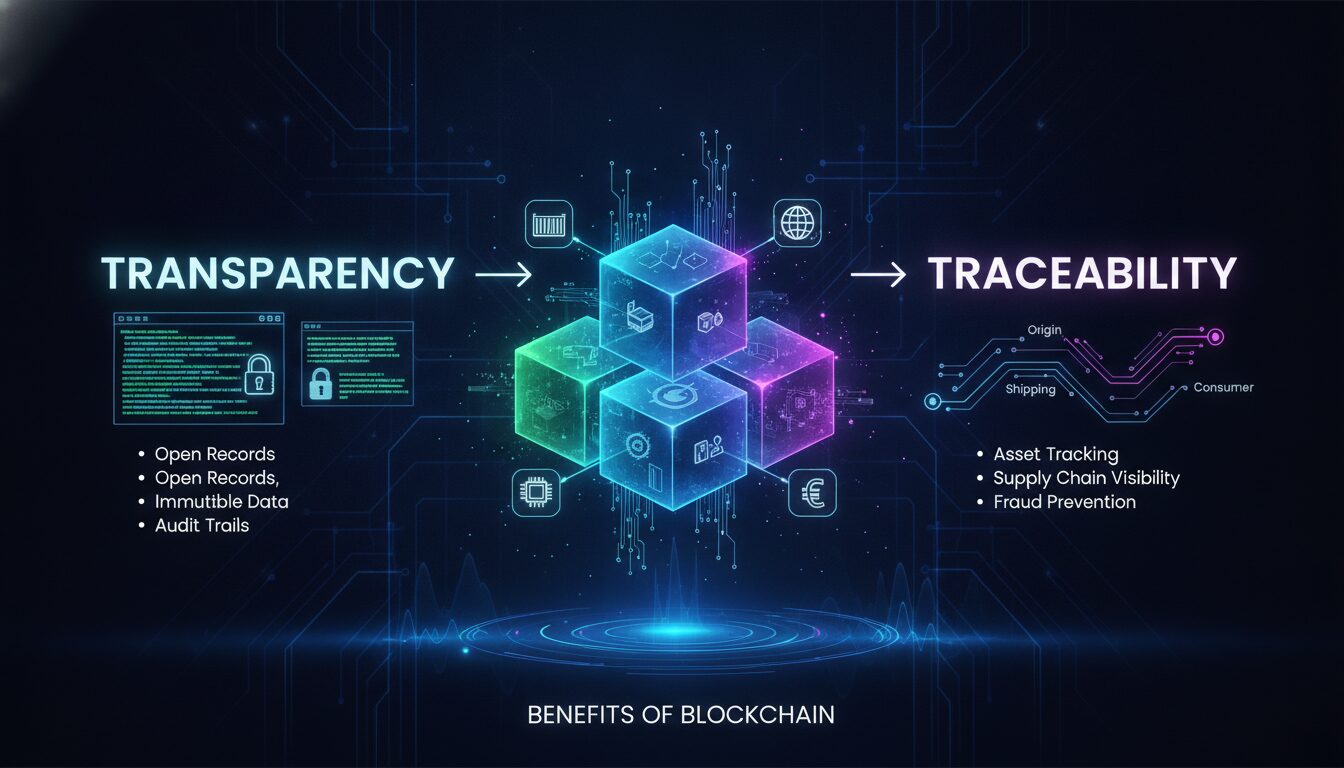
What Makes Blockchain Transparent?
Blockchain is transparent because every authorized participant sees the same ledger updated in real time, rather than relying on separate databases that need reconciliation. IBM points out that “all network participants with permissioned access see the same information at the same time, providing full transparency.” This shared view reduces disputes and speeds up reconciliation since there’s one source of truth instead of several conflicting records. Transactions remain publicly verifiable on the ledger, even though participant identities may stay pseudonymous.
Complete Audit Trails and Provenance Tracking
Blockchain builds an auditable history of every asset movement, which matters most in supply chains tracing a product’s journey from origin to consumer. IBM states that food contamination can be traced “back to its source in seconds” using blockchain, compared with days or weeks under traditional methods. This capability matters for verifying authenticity and meeting regulatory requirements. As Delubac explains, “all data is stored, organized chronologically and linked by cryptographic evidence,” giving an unbroken chain of custody.
Building Trust Among Business Partners
Transparency builds trust by giving every party verifiable proof of a transaction instead of a promise. Delubac notes that “all transactions are recorded and visible to all users,” which removes the information asymmetry that usually demands third-party verification. When partners can independently confirm data, business relationships move faster and cost less to maintain. This is one of the more overlooked benefits of blockchain: it substitutes cryptographic proof for mutual trust.
Decentralization and Trust
How Does Decentralization Reduce Risk?
Decentralization reduces risk by removing the single point of failure that centralized systems depend on. Instead of one institution controlling the ledger, a distributed group of nodes maintains it collectively, which limits how much power any one entity can exert. GeeksforGeeks points out that decentralization “eliminates single points of failure” and “improves system reliability.” No single party controls the entire network, which is the core definition of decentralization in this context.
Increased Network Resilience
Because every node holds a full copy of the ledger, the network keeps running even if several nodes go offline. Delubac notes that “when a node fails, the network and its operation remain unaffected.” This resilience is why blockchain gets considered for critical applications where uptime matters, though enterprises still need to design around real-world constraints rather than assume perfection.
User Empowerment and Censorship Resistance
Decentralized networks give users more control over their own data and more resistance to arbitrary censorship. No central authority can unilaterally block a transaction or rewrite a record after the fact. This matters most for people in regions with unstable financial systems, since blockchain-based services don’t require a traditional gatekeeper. PrideStaff Financial notes that a distributed ledger “provides cover and accountability for both client and accountant.”
Efficiency and Cost Savings
Faster Transaction Processing and Settlement
Traditional financial transactions often take days to settle because of layered intermediary processes. Blockchain enables near real-time settlement instead. According to PrideStaff Financial, “a blockchain enables the near real-time settlement of transactions, which reduces the risk of someone not paying.” IBM adds that because there’s “no need to reconcile multiple ledgers, clearing and settlement can be faster.” These benefits of blockchain flow directly into better liquidity and cash flow for businesses that move money across borders regularly.
Reduced Costs Through Disintermediation
Removing middlemen such as banks, brokers, and escrow agents cuts transaction fees and administrative overhead significantly. GeeksforGeeks lists “lower transaction fees” and “reduced administrative costs” among the top benefits of blockchain for businesses. In cross-border payments, blockchain can reduce costs by skipping currency conversion layers and correspondent banking charges that stack up in traditional wires.
Streamlined Processes and Automation
Blockchain strips out much of the paperwork and manual steps buried in everyday business processes. IBM notes that “by greatly minimizing paperwork and errors, blockchain significantly lowers administrative burdens and transaction costs.” Smart contracts push this further by triggering actions automatically once conditions are met, cutting delays and human error out of the loop. The combined effect is a leaner operation with fewer places for things to go wrong.
Smart Contract Automation
How Do Smart Contracts Work?
Smart contracts work by encoding an agreement’s terms directly into executable code that lives on the blockchain and enforces itself once conditions are met. IBM defines them as programs that “automate transactions, further increasing your efficiency.” This removes the need for manual verification and reduces reliance on intermediaries to confirm that both sides held up their end. In practice, a smart contract is a protocol that facilitates, verifies, or enforces a negotiation without a middleman.
Here’s a simplified Solidity pattern for a conditional payment release, the kind of logic underlying many of the automation benefits described above:
function releasePayment(uint orderId) external {
 require(deliveryConfirmed[orderId], "Delivery not confirmed");
 require(!paid[orderId], "Already paid");
 paid[orderId] = true;
 payable(seller[orderId]).transfer(amountDue[orderId]);
}
Transforming Business Operations
Smart contracts streamline complex processes like insurance claims, royalty payments, and lease agreements. As Grant Thornton’s Sean Roberts explains, technologists are increasingly focused on immutability, “the ability to lock something in and say that ‘this cannot be changed from here on out.'” That reliability cuts down on disputes and speeds up execution across multi-party agreements.
Automating a Transaction: Step by Step
Step 1: Define Conditions. Parties agree on terms and encode them into a smart contract deployed on the blockchain.
Step 2: Monitor Events. The contract listens for predefined triggers, such as a delivery confirmation from an IoT sensor or a payment received.
Step 3: Validate the Trigger. Once the condition is met, the blockchain’s consensus mechanism confirms the event.
Step 4: Execute Automatically. The contract self-executes, releasing funds, transferring ownership, or updating records without human intervention.
Step 5: Record Immutably. The execution gets logged permanently, creating a tamper-proof audit trail.
This automation is one of the more powerful benefits of blockchain, enabling trustless transactions that don’t depend on third-party enforcement to work as agreed.
Industry-Specific Benefits of Blockchain
Supply Chain and Logistics
Blockchain gives supply chains end-to-end visibility, enabling real-time tracking of goods from origin to destination. IBM notes that participants can “respond more quickly when disruptions arise” and that food contamination can be traced back to its source in seconds rather than days. This traceability reduces waste, limits fraud, and confirms product authenticity for buyers who care about origin. Retailers increasingly use blockchain-based systems to verify ethical sourcing, giving consumers provenance data they can check themselves.
Financial Services and Cross-Border Payments
The benefits of blockchain in finance show up as faster settlement, lower fees, and stronger security guarantees. Grant Thornton notes that blockchain can “process payments securely and faster without third parties,” which lowers both cost and risk in cross-border transactions. Banks and fintech firms use blockchain rails to streamline remittances and trade finance, a shift Investopedia’s broader coverage of the technology also tracks. Settlement windows that used to take days can compress to minutes when intermediaries get cut out of the path.
Healthcare and Life Sciences
In healthcare, blockchain secures patient data, manages consent records, and tracks pharmaceuticals through the supply chain to help prevent counterfeit drugs from entering circulation. Immutable records support data integrity for clinical trials and regulatory audits. GeeksforGeeks notes that blockchain “maintains accurate historical data,” which matters directly for patient safety when multiple providers touch the same record. As of 2026, hospital networks are piloting shared ledger systems to unify records across institutions and cut down on duplicate testing.
“Blockchain for business uses a shared and immutable ledger that only members with permission can access… this trust is built on blockchain’s enhanced security, greater transparency and instant traceability.” – IBM, Benefits of Blockchain
Environmental Considerations
Proof-of-Work blockchains like Bitcoin consume meaningfully more energy than Proof-of-Stake alternatives, and that tradeoff is part of any honest accounting of blockchain’s advantages. Ethereum’s move to Proof-of-Stake was specifically designed to cut energy consumption compared with its prior mining-based model. When evaluating the benefits of blockchain for a given use case, it’s worth matching the consensus mechanism to the actual need. A permissioned Proof-of-Stake or Proof-of-Authority network for supply chain tracking carries a very different energy profile than a public Proof-of-Work chain securing a monetary network.
Pros and Cons of Blockchain Technology
The benefits of blockchain are real, but they come with limitations worth weighing before deployment. The table below summarizes both sides.
Pros
- Enhanced security through cryptography and decentralized storage
- Transparent, immutable audit trails that reduce disputes
- Efficiency gains from automation and disintermediation
- Lower long-term costs by removing intermediaries
- Decentralization reduces single points of failure
Cons
- Complexity can hinder adoption and user experience
- Immutability means errors or illegal content can’t be easily removed
- Scalability limits can slow transaction throughput, and Proof-of-Work chains use significant energy
- Regulatory uncertainty persists across jurisdictions
- Private key management risk: lost keys mean permanently lost access
- Smart contract bugs can be exploited, and legal enforceability still varies by jurisdiction
| Benefit | Limitation |
|---|---|
| Enhanced security through cryptography and decentralization | Complexity can hinder adoption and user experience |
| Transparency and immutable audit trails | Immutability means errors or illegal content cannot be easily removed |
| Efficiency gains from automation and disintermediation | Scalability issues can lead to slow transaction throughput and high energy use |
| Lower costs by removing intermediaries | Regulatory uncertainty and lack of standards across jurisdictions |
| Decentralization reduces single points of failure | Private key management risks; lost keys mean lost access |
| Smart contracts enable trustless automation | Smart contract bugs can be exploited, and legal enforceability varies |
Understanding both columns helps teams decide where blockchain genuinely solves a problem versus where a traditional database still wins on speed and simplicity.
Is Blockchain 100% Safe?
No, blockchain is not 100% safe, even though it’s highly resistant to tampering compared with centralized systems. Risks include 51% attacks on smaller networks, private key theft, and smart contract vulnerabilities that get exploited despite the underlying ledger being secure. A well-designed blockchain with a robust consensus mechanism is extremely hard to compromise at the protocol level, but the applications built on top of it still carry normal software risk. This is why security audits matter as much as the choice of chain itself.
At Digital Blockchains, we treat this distinction as foundational to how we approach every build: the ledger’s security guarantees don’t automatically extend to the smart contracts and interfaces layered on top of it. Teams serious about shipping production systems need audits, formal verification where it matters, and realistic threat modeling from day one.
Frequently Asked Questions
What are the main benefits of blockchain?
The main benefits of blockchain include stronger security, transparency, decentralization, immutability, cost reduction, and automation through smart contracts. Together these features enable more efficient and trustworthy systems that don’t rely on a central authority to function.
What is the downside to blockchain?
The main downsides are scalability limits, energy consumption on Proof-of-Work networks, regulatory uncertainty, and the risk of losing access permanently if a private key is lost. Immutability, while a benefit for data integrity, also means mistakes and fraudulent entries can’t be simply erased.
Is blockchain 100% safe?
No system is 100% safe, and blockchain is no exception despite its strong security properties. Risks include 51% attacks, private key theft, and smart contract bugs, though well-designed networks with robust consensus mechanisms remain extremely resistant to attack.
What is blockchain actually useful for?
Blockchain is useful for any situation requiring a shared, tamper-resistant record among parties that don’t fully trust each other, including supply chain tracking, cross-border payments, healthcare records, and automated contract execution. It replaces manual reconciliation and third-party verification with a shared source of truth.
What industries benefit most from blockchain?
Supply chain, financial services, and healthcare see some of the clearest benefits of blockchain today. It improves traceability in logistics, speeds up cross-border payments in finance, and secures patient data and drug provenance in healthcare.
Building With Blockchain in 2026
Understanding the benefits of blockchain is one thing. Deploying them correctly, with the right consensus mechanism, tokenomics, and security posture, is a different challenge entirely. This year, more teams are moving past proof-of-concept and into production infrastructure, which raises the stakes on getting the architecture right the first time.
If you’re building a protocol, launching a token, or architecting a DAO and want a technical partner who’s spent time in the weeds of consensus design and smart contract security, apply to the Genesis Cohort at digitalblockchains.com. We work with serious builders who want infrastructure that holds up under real usage, not just a whitepaper.