Key Takeaways
- A blockchain auditor evaluates blockchain systems, smart contracts, and DApps for security risks, compliance gaps, and code vulnerabilities.
- Certifications such as the Certified Cryptocurrency Auditor (CCA) and Solidity Smart Contract Auditor Certification (SSCAC) validate specialized auditing skills.
- Leading audit firms like CertiK, Trail of Bits, and Hacken combine manual code review with automated tools and formal verification.
- The blockchain audit process typically includes scoping, automated scanning, manual analysis, and a detailed remediation report.
- Job listings on Indeed show blockchain auditor salaries in the $145,000 to $200,000 range, reflecting strong demand in Web3.
A blockchain auditor is a security professional who reviews blockchain systems, smart contracts, and decentralized applications to find vulnerabilities, confirm regulatory compliance, and validate code integrity.
As DeFi and Web3 systems multiply, the auditor’s job has grown past simple code review into formal verification, real-time monitoring, and enterprise-grade assurance. I’ll walk through the responsibilities, core skills, certification paths, leading firms, and career outlook for anyone entering this field, based on how we evaluate security partners in our own studio work at Digital Blockchains.
What Is a Blockchain Auditor?

The Core Role and Responsibilities
A this type of auditor examines the security, functionality, and compliance of blockchain-based applications. Unlike traditional IT auditors focused on centralized systems, a blockchain auditor has to understand decentralized architectures, consensus algorithms, and smart contract logic. Key tasks include reviewing source code for vulnerabilities, testing on-chain transaction flows, verifying adherence to standards like ERC-20 or ERC-721, and confirming that governance mechanisms function as intended. The Certified Cryptocurrency Auditor program from Blockchain Council notes that these professionals specialize in blockchain forensics and tracking the exchange-of-hands of digital assets.
Why Blockchain Auditing Matters in Web3
Blockchain auditing matters in Web3 because transactions are irreversible, so security failures become permanent losses rather than recoverable errors. CertiK reports that crypto hacks exceeded $1.3 billion in 2026, and its research indicates North Korean-linked actors were responsible for 60% of hacked cryptocurrency in 2025. A thorough review by a qualified blockchain auditor can catch reentrancy attacks, integer overflows, oracle manipulation, and logic errors before an exploit happens. Beyond protecting funds, audits build trust among users and regulators, which matters for institutional adoption.
“With blockchain, the underlying foundations of auditing and internal control can be embedded into each transaction. This means that the internal audit design itself can be shifted from a retroactive, point-in-time examination to an ongoing, real-time monitoring process.” – Deloitte, Auditing Blockchain Environments
Key Skills Required for Blockchain Auditors
Technical Skills: Smart Contracts and Consensus Mechanisms
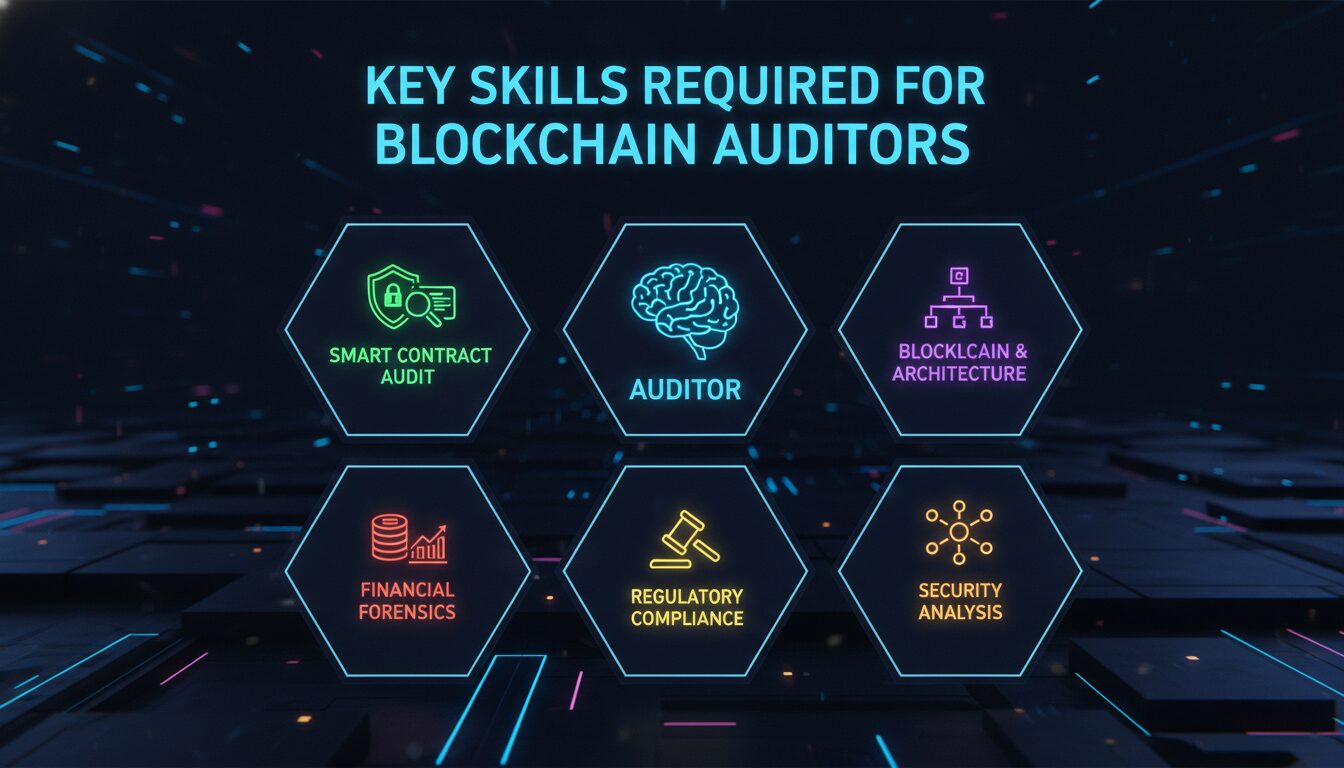
A capable blockchain auditor needs deep proficiency in smart contract languages like Solidity, Rust, or Vyper. They need to understand the Ethereum Virtual Machine, storage patterns, gas optimization, and common vulnerability classes such as reentrancy, front-running, and flash loan attacks. Knowledge of consensus protocols, including Proof of Work, Proof of Stake, and Byzantine Fault Tolerance variants, is critical because weaknesses at the protocol layer can undermine everything built on top. Hashlock’s Solidity Smart Contract Auditor Certification (SSCAC) tests hands-on skills in attack surface mapping, fuzz testing, and static and dynamic analysis.
Analytical and Forensic Skills
Blockchain forensics is a core competency for any auditor. This means tracing illicit fund flows, analyzing transaction graphs, and de-anonymizing pseudonymous addresses. Tools like Chainalysis, TRM Labs, and block explorers such as Etherscan and Solscan are standard in the toolkit. The Certified Cryptocurrency Auditor (CCA) from Blockchain Council targets exactly this skill set, teaching candidates to identify scams, fraud, and money laundering patterns through on-chain data analysis. Strong mathematical reasoning and a methodical approach to evidence gathering matter here as much as coding ability.
Soft Skills and Industry Knowledge
Technical skill alone won’t cut it. A blockchain auditor also needs strong communication skills to explain complex findings to non-technical stakeholders. Report writing, diagramming attack paths, and proposing practical fixes are part of the daily grind. Staying current with regulatory frameworks, including the EU’s MiCA rules, Dubai’s VARA guidelines, and U.S. SEC enforcement trends, keeps audits compliance-ready. Continuous learning through platforms like the Blockchain Council Academy or participation in bug bounty programs, such as CertiK’s Skynet, keeps skills sharp.
Top Blockchain Auditor Certifications
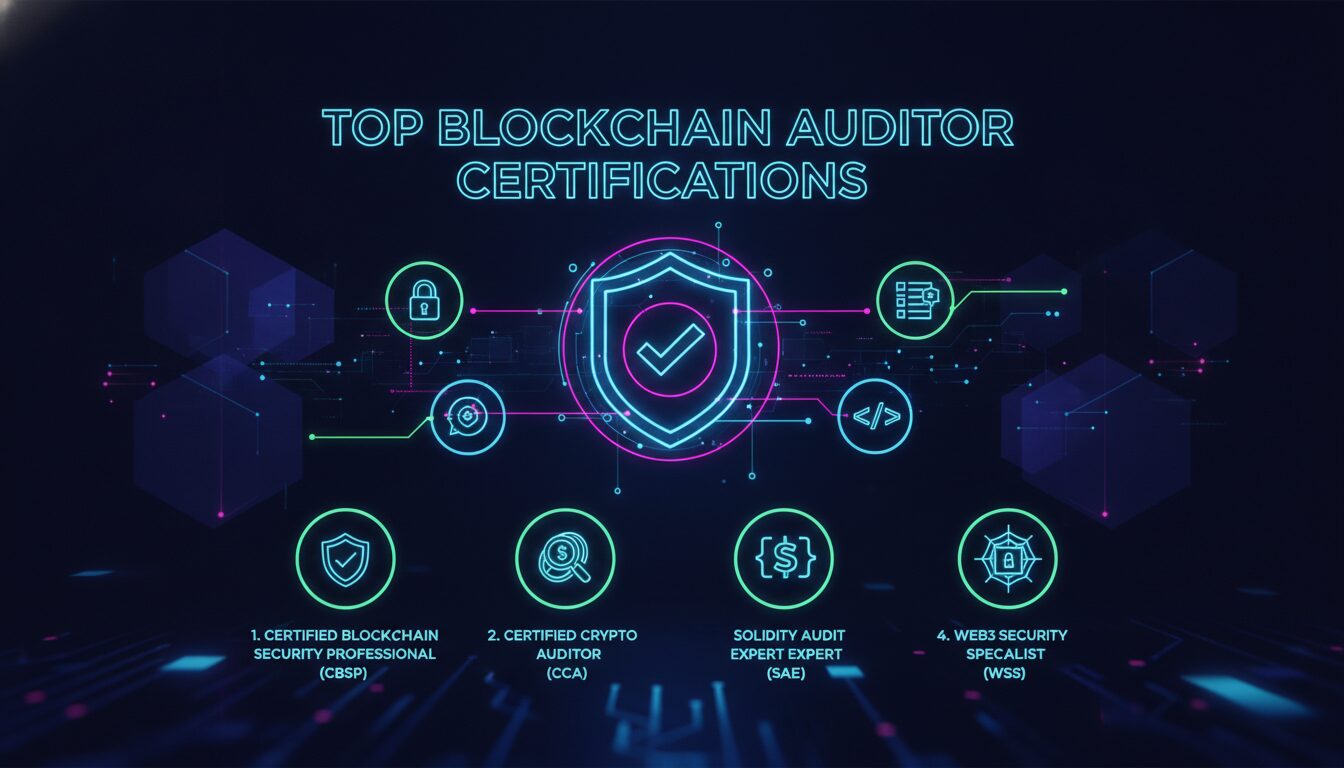
Formal credentials give newcomers a structured path into the field and signal competence to employers and clients. Here’s a comparison of the most recognized certifications for aspiring auditors.
| Certification | Issuer | Cost | Format | Key Focus |
|---|---|---|---|---|
| Certified Cryptocurrency Auditor (CCA) | Blockchain Council | $349 | Online self-paced training (6 hrs) + 100-mark MCQ exam (60% pass) | Cryptocurrency forensics, fraud detection, audit methodology |
| Solidity Smart Contract Auditor Certification (SSCAC) | Hashlock | $220 | 120-minute practical exam, no coursework | Solidity attack mapping, fuzz testing, static/dynamic analysis, gas optimization |
| Rust Security Auditor Certification (RSAC) | Hashlock | $220 | 120-minute practical exam | Rust-based contracts (Solana, Cosmos), ownership model, CosmWasm internals |
| Certified Blockchain Security Professional (CBSP) | Various providers | Varies | Course + exam | Full-stack blockchain security: architecture, cryptography, consensus, smart contracts |
| Certified Ethereum Professional (CEP) | Ethereum Foundation / community | Varies | Proctored online exam | Ethereum-specific knowledge: EVM, gas, tokens, dApp development |
Certified Cryptocurrency Auditor (CCA) by Blockchain Council
The CCA certification targets people who want to specialize in auditing blockchain-based cryptocurrencies. It covers transaction lifecycles, wallet types, exchange infrastructure, and common attack vectors like phishing, SIM-swapping, and dusting. The program runs entirely online, self-paced, with six hours of training followed by a 100-question multiple-choice exam. A score of 60% or higher is required to pass, and candidates can retake it up to three times. At $349, it’s a reasonably priced entry point for anyone stepping into the blockchain auditor role.
Solidity Smart Contract Auditor Certification (SSCAC) by Hashlock
Unlike CCA, the SSCAC focuses narrowly on smart contract auditing for Ethereum and EVM-compatible chains. Issued by security firm Hashlock, this certification skips training entirely and goes straight to assessment. The 120-minute exam throws real-world auditing scenarios at candidates, including vulnerability identification, gas optimization, and fix recommendations. Priced at $220, it’s a rigorous test built for experienced Solidity developers proving their credentials.
Other Certifications (RSAC, CBSP, and CEP)
As multi-chain ecosystems expand, auditors fluent in Rust are increasingly valuable. Hashlock’s Rust Security Auditor Certification (RSAC) evaluates expertise in securing Solana, Cosmos, and NEAR protocols. The Certified Blockchain Security Professional (CBSP) offers a broader curriculum spanning cryptographic primitives, network security, and regulatory compliance, well suited for consulting or enterprise roles. The Certified Ethereum Professional (CEP) validates deep Ethereum knowledge and often gets paired with more specialized auditing credentials.
Leading Blockchain Audit Firms and Their Approaches
CertiK: Formal Verification and AI-Powered Audits
CertiK is widely recognized as the largest blockchain security auditor, having assessed over $360 billion in market cap across thousands of clients. The firm distinguishes itself through formal verification: mathematically proving smart contract logic against defined specifications. Its Skynet platform provides real-time security scores and continuous monitoring. CertiK’s researchers have surfaced critical vulnerabilities in projects ranging from Apple’s iOS 17 kernel to the Sui network, for which the firm received a $600,000 bug bounty. CertiK also holds SOC 2 Type II compliance and ISO 27001 certification, and CB Insights has named it to its Top 50 Blockchain Companies list, underscoring its enterprise readiness.
Trail of Bits, Quantstamp, and Other Top Players
According to Alchemy’s Dapp Store, there are 104 blockchain auditing companies spanning multiple ecosystems. Trail of Bits is known for deep security research and has secured many of the world’s most targeted Web3 organizations. Quantstamp focuses on smart contract audit automation with tools built to scan for known vulnerability patterns. Hacken provides end-to-end security and compliance services, including penetration testing and bug bounty management. Sherlock runs a coverage model where auditors stake on their findings, tying incentives directly to protocol safety. Other notable firms include OpenZeppelin (which also maintains the widely used open-source contract library), BlockSec, Zellic, and OtterSec, each bringing specialized expertise to a different layer of the stack.
How to Choose the Right Audit Partner
Choosing the right audit partner means weighing track record, methodology depth, turnaround time, and post-audit support. Project teams should look at the auditor’s experience with similar protocols (DeFi lending versus NFT marketplaces), whether the approach mixes manual review, automated scanning, and formal verification, and how the firm handles support after issues surface. Checking public audit reports on platforms like CertiK’s Skynet or Hashlock’s audit portal reveals the typical issues found and the quality of the reporting. Engaging multiple auditors for high-value protocols, sometimes called a security review panel, is becoming standard practice to reduce blind spots.
The Blockchain Audit Process: Step-by-Step
A blockchain audit follows a structured workflow that moves from scoping to remediation. The exact steps vary between firms, but the core process looks similar across the industry.
Step 1: Scope the Engagement and Run Preliminary Analysis
The engagement starts with a detailed scope definition. The blockchain auditor works with the development team to identify which contracts, modules, and external dependencies need review, and clarifies intended functionality, trust assumptions, and the threat model. Preliminary analysis includes a high-level architecture review, reading documentation, and running automated scanners like Slither or MythX to catch trivial issues early. This stage sets the boundaries and pricing for the whole engagement.
Step 2: Run Manual Code Review Alongside Automated Testing
This is the most intensive phase of the process. The auditor manually inspects source code line by line, hunting for logic errors, access control flaws, rounding errors, reentrancy, denial-of-service vectors, and integration risks with oracles or other protocols. At the same time, they deploy fuzz testing tools like Foundry or Echidna to generate random inputs and stress-test invariants. Formal verification tools may get applied to mathematically prove critical properties. Every finding gets documented with proof-of-concept scripts where applicable.
Step 3: Deliver the Report and Track Remediation
After the review wraps, the auditor produces a detailed report classifying vulnerabilities by severity: critical, high, medium, low, and informational. Each issue includes a description, potential impact, and recommended fix. The development team addresses the findings, and the auditor re-reviews the changes to confirm the fix actually works. A final public audit report often gets published to boost transparency and user confidence. Some firms, like CertiK, layer on continuous monitoring post-deployment, updating a live security score through Skynet.
How Much Does a Blockchain Audit Cost?
Factors Influencing Audit Pricing
Audit costs swing widely depending on codebase size, complexity, the auditor’s reputation, and urgency. A simple ERC-20 token contract might cost a few thousand dollars, while a complex DeFi protocol with custom math and cross-chain bridges can run into six figures. Add-ons like formal verification, penetration testing, or compliance assessments for MiCA or VARA readiness push the total higher. Market cycles matter too: during bull runs, auditor availability shrinks and prices climb.
Typical Cost Ranges and Budgeting
Specific dollar figures aren’t published by most firms, but a mid-sized DeFi project engaging a professional blockchain auditor should generally expect costs somewhere between the low tens of thousands and roughly $80,000, based on the scope of comparable engagements in the industry. Startups with tighter budgets can turn to audit contests on platforms like Code4rena or Sherlock, where multiple independent auditors compete to find bugs for a shared prize pool. As a general rule, allocating roughly 3-5% of total development budget to security audits is a sound risk management practice.
Blockchain Auditor Career Path and Salary Trends
Entry Paths: From Developer to Auditor
Most blockchain auditors start out as software engineers with two to three years of smart contract development experience. Moving into auditing means shifting from a builder’s mindset to an attacker’s mindset: thinking adversarially and understanding how every line of code could get misused. Practicing through Capture-the-Flag challenges, bug bounties, and contributing to open-source audit platforms like Code4rena speeds up skill acquisition. Earning a recognized certification, like the CCA or SSCAC, adds credibility when applying for junior blockchain auditor roles.
Job Market Demand and Salary Insights
Demand for qualified blockchain auditor professionals has grown alongside DeFi, NFTs, and real-world asset tokenization. Job listings on Indeed show salary ranges between $145,000 and $200,000 annually for blockchain auditor roles, often bundled with incentives like 401(k) matching and remote flexibility. Experienced lead auditors and managing partners at top firms can earn considerably more. Location and niche expertise, such as zero-knowledge proofs, further shape compensation. As of 2026, the outlook remains strong as institutional capital enters the space and regulators increasingly require security attestations.
Internal Auditing and Blockchain: Insights from Deloitte
Shifting from Point-in-Time to Real-Time Auditing
Blockchain shifts internal auditing from a retrospective, sample-based exercise into continuous, real-time monitoring. Deloitte’s internal auditing guide describes this shift directly: because blockchain records are immutable and chronologically ordered, a blockchain auditor can build continuous, automated monitoring instead of periodic sampling. Smart contracts can emit logs that feed straight into audit dashboards, enabling real-time assurance of transaction integrity, fund flows, and compliance with predefined business rules. This shrinks the gap between an event and its verification, turning internal audit from a detective function into a preventive one.
Risk Considerations in Blockchain Implementations
Deloitte’s series also catalogs the risks internal auditors need to evaluate when an organization adopts blockchain. These include governance risk (who controls node operation?), operational risk (how are private keys managed?), data privacy risk (what sensitive information lives on-chain?), and regulatory risk (how does the system handle something like GDPR’s right to erasure?). A blockchain auditor working in an enterprise context has to assess these dimensions alongside the technical vulnerabilities to give the board and management a complete picture.
The Future of Blockchain Auditing
AI and Automation in Auditing
Artificial intelligence is starting to augment the blockchain auditor’s workflow rather than replace it. Tools like CertiK’s Skynet use machine learning to flag anomalous on-chain behavior and anticipate emerging threats. Large language models help draft audit report language and explain vulnerability patterns. Human judgment still matters most for contextual reasoning and spotting novel attack vectors nobody has coded a rule for yet. The likely future is a hybrid model: AI handles repetitive scanning and anomaly detection, freeing auditors to focus on architecture-level and business logic flaws.
Regulatory Evolution and Standardization
As jurisdictions from Dubai (VARA) to the European Union (MiCA) formalize crypto-asset rules, demand for standardized audit frameworks keeps growing. Groups like the AICPA are exploring SOC-for-Blockchain attestation standards. CertiK’s VARA Compliance Solutions and its DORA/MiCA advisory work show how audit firms are proactively building service lines around regulatory adherence. In the coming years, a blockchain auditor will likely need cross-border legal literacy and standardized reporting skills on top of technical depth, not unlike a certified public accountant in traditional finance.
“Mass deployment of AI agents is a disaster waiting to happen,” CertiK’s CEO has warned, underscoring why human-led review still anchors serious blockchain security work even as automated tooling expands.
Pros and Cons of Working with a Blockchain Auditor
Pros
- Catches critical vulnerabilities like reentrancy and oracle manipulation before deployment, when fixes are cheap.
- Builds user and investor trust through published, verifiable audit reports.
- Supports regulatory readiness for frameworks like MiCA and VARA ahead of enforcement.
- Formal verification firms can mathematically prove contract correctness, not just pattern-match known bugs.
Cons
- Costs can run into six figures for complex DeFi protocols with custom logic.
- An audit is a point-in-time review; it doesn’t guarantee safety against novel exploits discovered later.
- Demand spikes during bull markets can extend turnaround times and shrink availability of top-tier firms.
- Even audited protocols have been exploited, so an audit reduces risk rather than eliminating it.
Frequently Asked Questions
How to become a blockchain auditor?
Start by building proficiency in a smart contract language like Solidity or Rust, contributing to open-source Web3 projects, and earning a certification such as the CCA or SSCAC. Practical experience through bug bounties and audit contests like Code4rena builds the hands-on judgment that certifications alone can’t teach.
How much does a crypto audit cost?
Costs range from a few thousand dollars for simple token audits to six figures for complex DeFi protocols with custom math or cross-chain bridges. Working with a reputable blockchain auditor firm ensures thorough coverage and can prevent losses far larger than the audit fee itself.
What is the best blockchain auditing company?
There’s no single “best” firm since it depends on project needs. CertiK is the largest by market coverage and offers formal verification, Trail of Bits excels in deep security research, and Hacken provides end-to-end compliance services, which is why many serious projects engage multiple firms for layered assurance.
Is blockchain certification worth it?
Yes, certifications validate specific skills, help candidates stand out in a competitive job market, and are increasingly expected by employers hiring for blockchain auditor roles. The CCA and SSCAC are among the most recognized credentials in the industry right now.
What is the difference between a blockchain auditor and a smart contract auditor?
A smart contract auditor focuses narrowly on application-layer code, while a blockchain auditor examines the full system, including protocol layers, node infrastructure, governance, and off-chain components, for a more complete risk picture.
Security review is one of the areas we take seriously at Digital Blockchains when scoping new protocol builds. If you’re a developer, security researcher, or founder who wants to build with a team that treats audits as infrastructure rather than an afterthought, apply to the Genesis Cohort at digitalblockchains.com. We’re looking for serious builders, not spectators.