A blockchain audit is a systematic evaluation of a blockchain network’s architecture, smart contracts, and consensus mechanisms to assess security, compliance, and proper functionality. Get this wrong and you’re handing attackers a blueprint.
Key Takeaways
- A audit verifies the security and integrity of decentralized systems, smart contracts, and nodes.
- The process combines automated scanning with manual code review to identify vulnerabilities before exploitation.
- Audits are critical for preventing financial losses, ensuring regulatory compliance, and building user trust.
- Continuous, real-time auditing is replacing traditional point-in-time reviews, enabled by blockchain’s transparent ledger.
- Costs range from roughly $5,000 for a simple smart contract audit to over $100,000 for a full consensus mechanism review.
What Is a Blockchain Audit?
 What Is a Blockchain Audit? – blockchain audit | Digital Blockchains” class=”wp-image-1094″ loading=”lazy” width=”1792″ height=”1024″ />
Definition and Scope
A this type of audit is a comprehensive review of a blockchain-based system’s design, code, and operational processes. It covers everything from the foundational consensus algorithm to the smart contracts that automate transactions. The goal is to identify security flaws, logic errors, and compliance gaps before malicious actors can exploit them. Unlike a traditional financial audit, a this kind of audit focuses on the technical soundness of decentralized protocols and their resistance to attacks such as reentrancy, overflow, or oracle manipulation.
Why It Matters in 2026
With decentralized finance (DeFi) surpassing $80 billion in total value locked and enterprise blockchain adoption accelerating, the stakes have never been higher. According to CertiK, a single smart contract vulnerability can lead to multimillion-dollar exploits. A blockchain serves as a critical line of defense, transforming code from a potential liability into a trust-minimized asset. It’s the primary method for proving to users, regulators, and investors that a protocol is secure.
Why Are Blockchain Audits Critical?

Preventing Multi-Million-Dollar Exploits
DeFi hacks have resulted in substantial losses across the industry, with smart contract bugs consistently ranking as the leading cause. A thorough audit can reveal the exact flaws that hackers exploit, flaws that automated testing alone often misses. A professional review would flag the infamous read-only reentrancy vulnerability before it drains a liquidity pool. By preemptively hardening code, audits directly safeguard protocol treasury and user funds.
Ensuring Regulatory Compliance
Regulatory frameworks like the EU’s Markets in Crypto-Assets (MiCA) and emerging US stablecoin legislation mandate security assessments for blockchain-based financial services. A this type of audit provides documented evidence that a protocol meets required standards, enabling projects to obtain licenses and list on compliant exchanges. Without an audit, projects risk fines, delisting, or outright shutdown by authorities.
Building User Trust
Transparency is the hallmark of blockchain, yet users cannot manually verify every line of code. An independent audit report reassures depositors and partners that the system operates exactly as advertised. Platforms that prominently display audit badges see measurably increased adoption, as trust becomes a competitive advantage in a space still scarred by rug pulls and exploits.
The Internal Auditor’s Role
As Deloitte’s internal auditing guide highlights, internal audit teams play a distinct role from external security firms. Internal auditors evaluate governance structures, access controls, and change management processes before a blockchain system goes live. Pre-implementation reviews, where internal teams assess a protocol’s design against organizational risk appetite, catch architectural problems that external code auditors may never see. This two-layer approach, internal governance review plus external technical audit, is the standard for enterprise deployments.
Types of Blockchain Audits
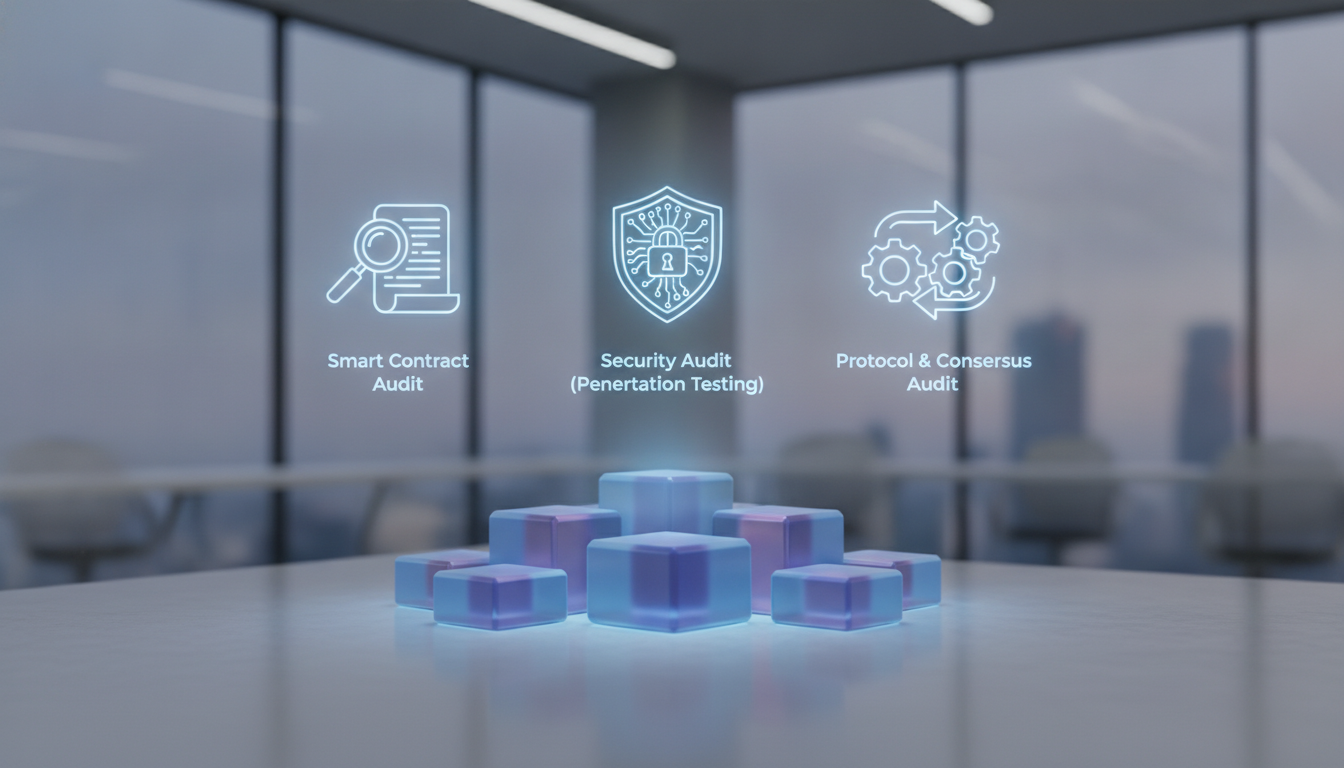
Smart Contract Audits
This is the most common form of blockchain audit. It scrutinizes the on-chain logic governing token transfers, staking, lending, and other automated operations. Auditors review codebases written in Solidity, Rust, or Move, checking for known vulnerability patterns from the SWC registry and logical flaws. Tests include fuzzing, formal verification, and scenario-based simulation.
Consensus Mechanism Audits
A blockchain audit of the consensus layer examines the protocol rules that maintain network agreement. For Proof-of-Stake chains, this includes validator selection, slashing conditions, and finality gadgets. Auditors simulate network partitions and Byzantine behavior to ensure the chain cannot be halted or rewritten by a minority adversary.
Compliance and Security Audits
Beyond code, a blockchain audit may cover operational practices: key management, node infrastructure, access controls, and Know-Your-Transaction (KYT) processes. This type of review is often required for exchanges and custody providers. It aligns blockchain operations with standards such as ISO 27001 and SOC 2.
Blockchain Forensics and Transaction Tracing
A growing subset of blockchain auditing involves forensic analysis of on-chain activity. Using tools like Chainalysis and TRM Labs, forensic auditors trace transaction flows across wallets, identify mixer usage, and reconstruct exploit sequences after an incident. This discipline is increasingly required by regulators and is a core component of AML compliance programs for exchanges and custody providers. For protocols that have already suffered an exploit, forensic auditing is often the first step toward recovery and legal action.
Comparison of Audit Types
| Audit Type | Primary Focus | Common Tools | Estimated Cost Range* | When Needed |
|---|---|---|---|---|
| Smart Contract Audit | Code vulnerabilities, logic errors | Slither, Mythril, Echidna | $5,000 – $50,000+ | Pre-deployment, post-upgrade |
| Consensus Mechanism Audit | Protocol rules, fork resistance | Custom simulations, fuzzing | $20,000 – $100,000+ | New chain launch, major update |
| Node Security Audit | Infrastructure, access controls | Nmap, penetration tests | $3,000 – $15,000 | Regular maintenance |
| Compliance Audit | Regulatory alignment (KYC/AML) | Blockchain explorers, analytics | $10,000 – $30,000 | Licensing, exchange listing |
| Forensic Audit | Transaction tracing, exploit reconstruction | Chainalysis, TRM Labs | $5,000 – $40,000+ | Post-exploit, AML compliance |
*Costs are estimates based on industry averages; actual quotes vary by project complexity and auditor reputation.
Pros and Cons of Blockchain Audits
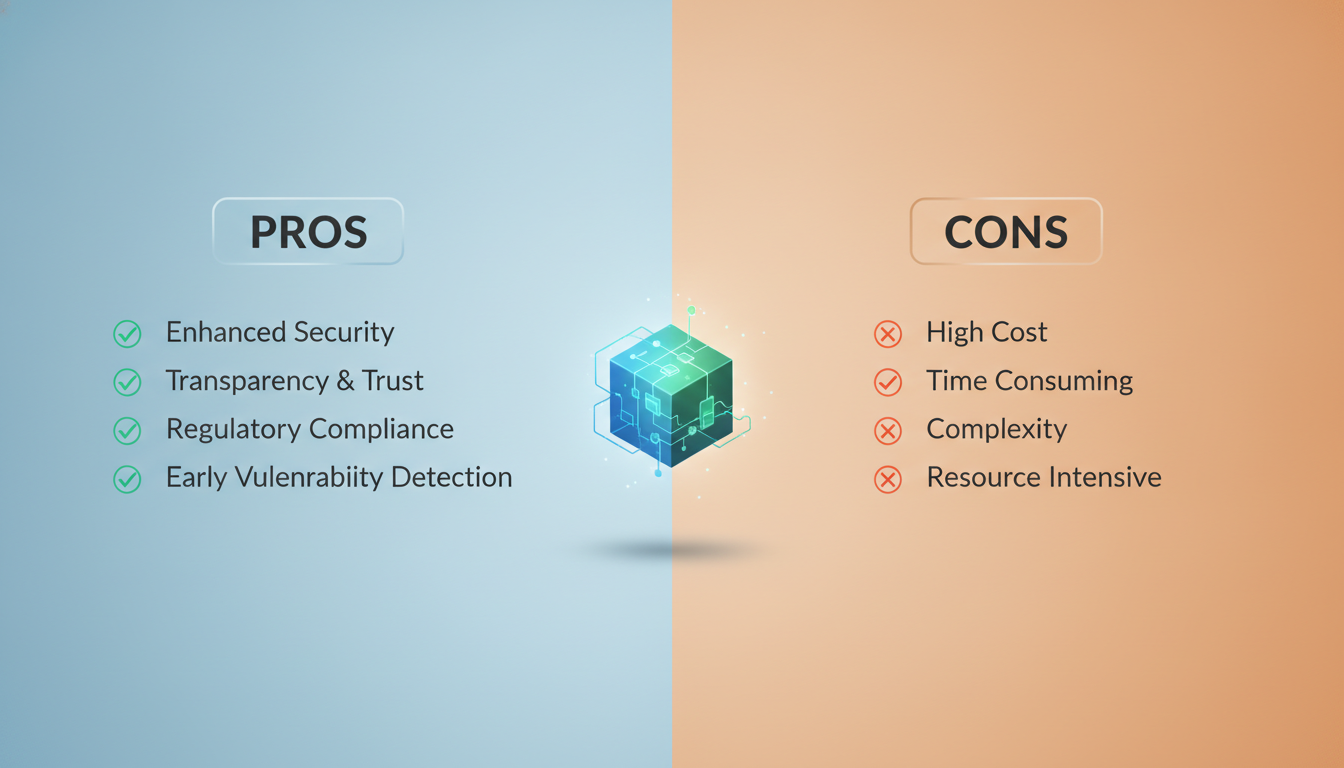
Pros
- Exploit prevention: Catches critical vulnerabilities before deployment, protecting user funds and protocol treasury.
- Regulatory readiness: Provides documented evidence of compliance with MiCA, SOC 2, and ISO 27001 requirements.
- User and investor confidence: Published audit reports from reputable firms signal protocol maturity and reduce perceived risk.
- Continuous improvement: The remediation cycle forces development teams to write cleaner, more maintainable code over time.
- Insurance eligibility: Several DeFi insurance protocols require a completed audit as a prerequisite for coverage.
Cons
- Cost and time: A thorough audit of a complex protocol can take 4-8 weeks and cost $50,000 or more, which strains early-stage teams.
- Not a guarantee: Even audited protocols get exploited. An audit is a point-in-time assessment, not a permanent security certificate.
- Scope limitations: Auditors can only review what’s in scope. New integrations or upgrades post-audit create fresh attack surfaces.
- Quality variance: The audit market has low barriers to entry. Not all firms deliver the same depth of review, and a low-cost audit can create false confidence.
The Blockchain Audit Process Step by Step
A reputable blockchain audit follows a structured methodology that blends automation with deep human expertise. Below are the typical stages.
Step 1: Scoping and Requirements
Before any code is touched, the audit team defines the scope alongside the client. This includes specifying which smart contracts, network layers, and external dependencies are in scope. A threat model is developed, identifying potential attack vectors based on the protocol’s economic design. Clear timelines and deliverables are agreed upon, usually spanning 2-6 weeks for a medium-sized project.
Step 2: Automated Static Analysis
Advanced tools such as Slither, MythX, and Echidna automatically scan the codebase for common vulnerabilities. This step quickly flags reentrancy, unchecked external calls, and integer overflows. Automated analysis can produce false positives and cannot detect complex business logic errors, which is exactly why a manual review follows.
Step 3: Manual Code Review and Penetration Testing
Senior auditors, often holding certifications like the Certified Cryptocurrency Auditor®, meticulously examine each function’s logic. They perform white-box testing, simulating edge conditions and creating proof-of-concept exploits. Concurrently, gray-box penetration testing probes the live testnet, evaluating node synchronization, transaction throughput, and resistance to denial-of-service attacks.
Step 4: Reporting and Remediation
Findings are compiled into a structured report, classifying issues by severity: critical, high, medium, and low. Each vulnerability includes a description, reproduction steps, a risk rating, and a suggested fix. The development team implements patches, and auditors conduct a retest to confirm resolution. Only after all critical issues are closed does the final audit report get published.
“The audit report is not the finish line. It’s the starting gun for remediation. A finding that sits unpatched is worse than no audit at all, because now the vulnerability is documented.” – Security principle widely cited across CertiK and Trail of Bits post-audit guidance.
Key Components Examined in a Blockchain Audit
Smart Contracts and Business Logic
The heart of most decentralized applications, smart contracts are scrutinized for arithmetic errors, access control problems, and token-related vulnerabilities. Auditors verify that functions like minting, burning, and governance execute exactly as intended and cannot be manipulated by flash loans or price oracle deviations. A single misconfigured access modifier on a privileged function is enough to hand an attacker full control.
Here’s a minimal example of a reentrancy-vulnerable withdrawal function in Solidity, the kind of pattern auditors flag immediately:
// VULNERABLE: state update happens AFTER external call
}

}
Node Infrastructure and Network Security
A blockchain audit also inspects the physical and virtual infrastructure running nodes. This covers firewall rules, API security, encrypted key storage, and the ability to withstand DDoS attacks. For validators in Proof-of-Stake systems, the audit checks that slashing protection and MEV (Maximal Extractable Value) mitigation strategies are in place.
Cryptographic Implementations
Blockchain relies on cryptographic primitives: hashing, digital signatures, and zero-knowledge proofs. An audit verifies that these are properly implemented and that no side-channel leaks compromise private keys. For protocols using newer primitives like BLS signatures or STARKs, this phase is especially rigorous and often requires PhD-level cryptography expertise.
Blockchain Audit Tools and Techniques
Static and Dynamic Analysis
Static analyzers review code without executing it, while dynamic analysis involves running the code in a controlled environment to observe behavior. Together, they provide a baseline security assessment. Popular static tools for Ethereum projects include Slither and Mythril. For Rust-based chains, tools like Rust-analyzer and Miri serve the same function.
Formal Verification
For high-value protocols, formal verification mathematically proves that the smart contract code satisfies its specification. This technique, used by firms like Runtime Verification and ConsenSys Diligence, provides the highest assurance level available. It’s time-consuming and expensive, often costing $100,000 or more, but for a bridge securing $500 million in cross-chain liquidity, that cost is trivial.
AI-Assisted Auditing
As of 2026, artificial intelligence is augmenting auditors by learning patterns from thousands of past exploits. Platforms like Forta and OpenZeppelin Defender use anomaly detection models to flag suspicious on-chain activity in real time. AI cannot replace human judgment on novel attack vectors, but it dramatically compresses the initial triage phase of a blockchain audit from days to hours.
“Blockchain’s immutable ledger gives auditors something traditional financial systems never could: a complete, tamper-proof record of every transaction, queryable in real time. The audit evidence doesn’t need to be collected. It already exists.” – Adapted from ISACA’s analysis of blockchain’s impact on audit and control in information systems.
Blockchain Audit Cost and How to Choose an Auditor
Cost Factors and Benchmarks
The price of a blockchain audit depends on codebase size, complexity, and novelty. A simple ERC-20 token audit may start at $5,000, while a cross-chain bridge or a new Layer-1 chain can exceed $200,000. For individual professionals entering the field, certifications like the Blockchain Council’s Certified Cryptocurrency Auditor® (CCA) are available at $399, offering 11 hours of training and a lifetime credential. The cost of an audit is negligible compared to the average losses seen in major DeFi exploits.
Certifications and Auditor Qualifications
Reputable auditors typically hold credentials such as Certified Bitcoin Professional (CBP), Certified Cryptocurrency Auditor® (CCA), or have completed specialized courses from ConsenSys Academy. They usually have backgrounds in cybersecurity, cryptography, or smart contract development. Firms like CertiK and Trail of Bits employ PhD-level researchers and have audited projects collectively securing over $100 billion in value.
Top Audit Firms in 2026
Leading providers include CertiK, Quantstamp, OpenZeppelin, and the auditing arms of Big Four firms like Deloitte and KPMG. These firms offer differentiated services, from low-cost automated scans to full-stack protocol reviews. Smart contract security competitions run by Code4rena and Sherlock provide crowd-sourced audit alternatives at a fraction of traditional firm costs, often surfacing critical bugs that internal reviews missed.
The Future of Blockchain Auditing
Continuous Real-Time Auditing
Blockchain’s inherent transparency enables a shift from periodic audits to continuous monitoring. As ISACA notes, auditors can now pull evidence directly from the ledger in real time, transforming blockchain audit into an ongoing process rather than a periodic snap-check. This reduces reconciliation costs and allows anomalies to be detected within seconds. The Walmart-IBM Food Trust traceability system is a concrete example: product origin queries that previously took 7 days now resolve in 2.2 seconds, demonstrating the operational power of real-time ledger access.
Supply Chain Traceability as an Audit Model
Beyond food safety, blockchain-based traceability is being applied to pharmaceutical supply chains, luxury goods authentication, and carbon credit verification. According to ISACA’s analysis of blockchain in information systems, the same immutability that makes blockchain useful for financial audits makes it equally powerful for tracking physical goods across multi-party supply chains. Each node in the chain becomes an auditable checkpoint, and the ledger provides a complete, tamper-resistant history without requiring trust in any single participant.
Privacy-Enhanced Audits with Zero-Knowledge Proofs
As privacy chains gain traction, new audit techniques use zero-knowledge succinct non-interactive arguments of knowledge (zk-SNARKs) to verify transactions without exposing underlying data. This allows an auditor to confirm that a private transfer complies with regulations without ever seeing the sender or receiver identity, marrying confidentiality with compliance. For regulated institutions exploring private blockchain deployments, this capability is not optional: it’s the only viable path forward.
Cross-Chain and Layer 2 Auditing
The proliferation of rollups, sidechains, and interoperability bridges introduces new attack surfaces that single-chain audit frameworks weren’t built to handle. Future blockchain audit frameworks will need to validate the security of cross-chain message protocols, sequencer decentralization, and fraud-proof mechanisms. Auditing the entire ecosystem, not just a single chain, will become mandatory for systemic stability as TVL migrates to multi-chain architectures.
Frequently Asked Questions
What exactly does a blockchain audit check?
A blockchain audit checks the security and functionality of a blockchain system, including its smart contract code, consensus rules, and node configuration. It verifies that transactions are processed correctly, access controls are enforced, and there are no vulnerabilities that could lead to loss of funds or data.
How much does a blockchain security audit cost?
Costs vary widely: a basic smart contract audit may cost $5,000 to $15,000, while a full Layer-1 protocol audit can exceed $100,000. Factors include code complexity, the reputation of the audit firm, and the scope of testing required.
What are the 4 types of blockchain?
The four main types of blockchain networks are public (permissionless), private (permissioned), consortium, and hybrid. Each has different trust models and accessibility, and a blockchain audit must be tailored to the specific governance rules of each type.
How to become a blockchain auditor?
Start with a strong foundation in computer science or cybersecurity, then gain hands-on experience with smart contract languages and security tools. Earning certifications like the Certified Cryptocurrency Auditor® and participating in audit contests on Code4rena or Sherlock can build credibility quickly.
Is a blockchain audit the same as a code review?
While code review is a core component, a blockchain audit is broader: it includes economic analysis, network penetration testing, and compliance checks. A proper audit uses formal methods and threat modeling, going far beyond a simple peer code review.
Why do DeFi projects need continuous auditing?
DeFi protocols are frequently upgraded and interact with many external contracts. A one-time audit cannot cover new integrations or emergent economic risks. Continuous auditing, enabled by real-time monitoring tools like Forta and OpenZeppelin Defender, catches exploits as they develop and reduces the window of vulnerability to minutes rather than weeks.
If you’re building a protocol that needs to survive contact with adversarial capital, the audit process starts long before deployment. Apply to the Genesis Cohort at digitalblockchains.com and build with a team that treats security as architecture, not an afterthought.