Aptos blockchain is a Layer 1 Proof-of-Stake network built on the Move programming language, designed for scalability, safety, and upgradeability. Created by Aptos Labs, it launched mainnet in October 2022 as the first Move-based blockchain.
Key Takeaways
- blockchain is a Layer 1 Proof-of-Stake network using the Move programming language, launched in October 2022.
- Founded by former Meta Diem engineers Avery Ching and Mo Shaikh, backed by $400 million in funding from Andreessen Horowitz, Apollo, and Franklin Templeton.
- The network uses a pipelined, modular design for parallel transaction execution, fully utilizing available hardware resources.
- Core ecosystem tools include Petra Wallet, Aptos Explorer, Aptos Connect, Aptos Names, and Geomi.
- Enterprise partnerships with Microsoft, Google Cloud, and NBCUniversal reflect growing institutional adoption.
- The Move Prover enables formal verification of smart contracts before deployment, a security capability rare among Layer 1 networks.
This article examines the technical architecture, ecosystem products, partnerships, and how to get started with the this type of blockchain, drawing from the official white paper, company announcements, and public repository data.
What Is the Aptos Blockchain and Who Created It?
The Origins from Meta’s Diem Project
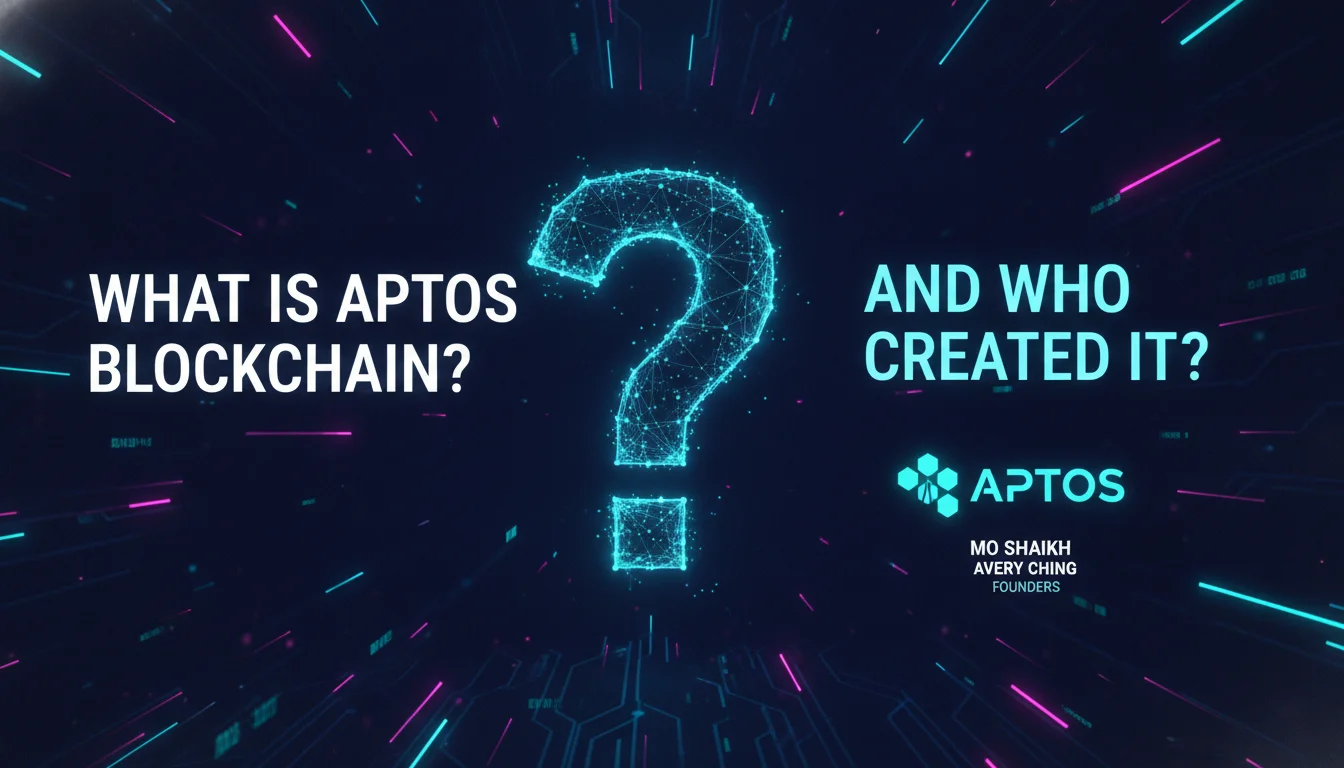
this kind of blockchain traces its roots directly to Meta’s failed Diem stablecoin project. Aptos Labs was founded in 2021 following Diem’s dissolution, according to Wikipedia. Avery Ching and Mo Shaikh, both former Facebook employees who worked on Diem, led the founding team. Many other former Libra employees later joined Aptos Labs. The team raised $400 million: $200 million in seed funding and $200 million in a Series A, with backing from Andreessen Horowitz, Apollo Global Management, and Franklin Templeton. That capital provided the runway to build a production-ready Layer 1 from scratch.
Aptos Labs and Leadership
Based in Palo Alto, California, Aptos Labs describes itself as a team of visionaries, researchers, strategists, designers, and builders committed to bringing decentralization to the masses. On December 19, 2024, co-founder Mo Shaikh stepped down as CEO, and Avery Ching became CEO, according to Aptos Labs. The company has since expanded into Japan through the acquisition of HashPalette Inc., developer of Palette Chain, and led a $10 million funding round for the decentralized gaming network KGeN, bringing KGeN’s valuation to $500 million.
Core Design Principles
The aptos was designed with scalability, safety, reliability, and upgradeability as key principles, according to the official Aptos White Paper. These principles directly respond to what the paper identifies as barriers to Web3 adoption: frequent outages, high costs, low throughput limits, and numerous security concerns. Aptos aims to bring blockchain infrastructure closer to the trust and efficiency of cloud computing.
Pros and Cons of the Aptos Blockchain
Pros
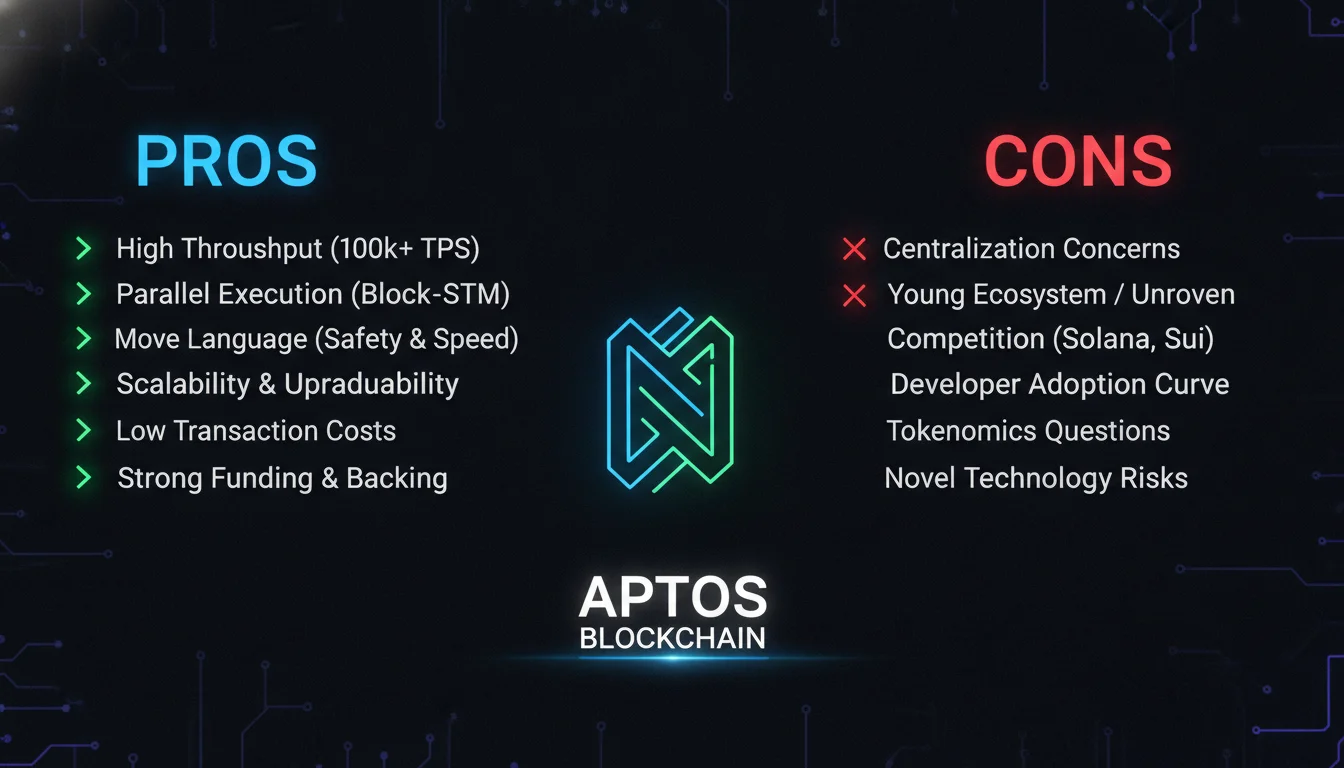
- Move language security: Assets are first-class resources that cannot be accidentally copied or dropped, eliminating a common class of smart contract vulnerabilities.
- Formal verification: The Move Prover lets developers mathematically prove contract properties before deployment, a capability most Layer 1 networks lack.
- Parallel execution: The pipelined, modular architecture runs dissemination, ordering, execution, storage, and certification concurrently, avoiding sequential bottlenecks.
- Institutional backing: Partnerships with Microsoft, Google Cloud, and NBCUniversal, plus participation in Hong Kong’s e-HKD pilot, signal serious enterprise credibility.
- Developer tooling: Petra Wallet, Aptos Connect, Geomi, and the aptos-core repository give builders a complete production stack.
- Flexible key management: Hybrid custodial options, key rotation, and multi-signature schemes reduce the blind-signing risks common in other wallets.
Cons
- Young ecosystem: blockchain mainnet only launched in October 2022. DeFi TVL and developer activity remain smaller than Ethereum or Solana.
- Move learning curve: Move is not widely taught, and developers coming from Solidity or Rust face a meaningful ramp-up period.
- Token emission opacity: Detailed staking yield and token emission schedules are not publicly documented in accessible formats, making tokenomics analysis harder.
- Concentration risk: A significant portion of early APT supply went to insiders and investors, a common criticism of newer Layer 1 launches.
Technical Architecture of the Aptos Blockchain
Pipelined Transaction Processing
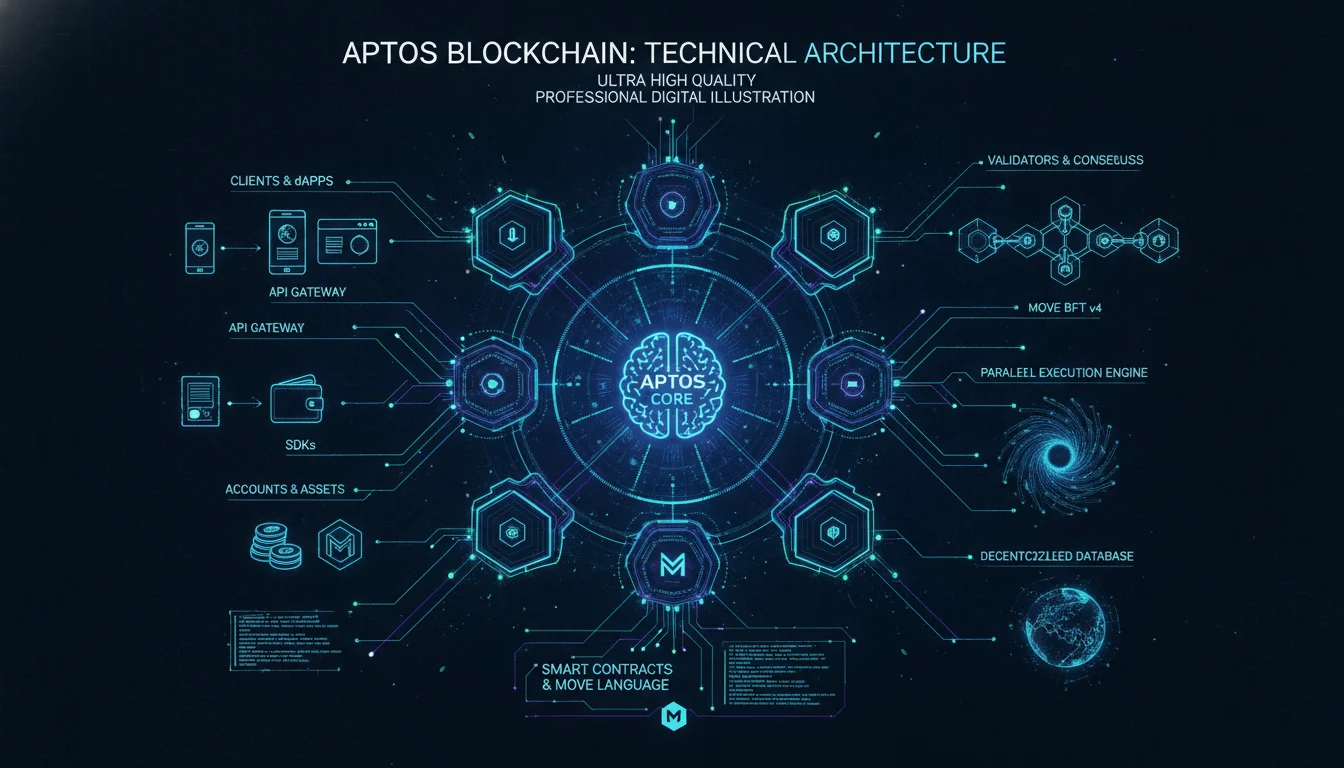
The this type of blockchain uses a pipelined and modular approach for transaction processing, as described in the Aptos White Paper. Transaction dissemination, block metadata ordering, parallel transaction execution, batch storage, and ledger certification all operate concurrently. This design fully utilizes available physical resources, improves hardware efficiency, and enables highly parallel execution. Unlike sequential blockchains where each stage waits for the previous one, Aptos overlaps these stages to reduce latency.
Parallel Execution and Modular Stages
At the core of the pipeline is the separation of consensus from execution. Block metadata is ordered first, then transactions execute in parallel across available cores. The this kind of blockchain data model enables this because transactions are organized around accounts and resources rather than a global state that must be locked. This modularity also means different stages, such as storage and certification, can be scaled independently without redesigning the entire system.
Data Model and Key Management
Aptos uses a resource-oriented data model inherited from Move. According to the white paper, this model enables flexible key management and hybrid custodial options. Users can rotate keys, delegate permissions, and use multi-signature schemes. Transaction transparency prior to signing and practical light client protocols provide a safer user experience, reducing the blind-signing risks common in wallet interactions.
| Design Feature | aptos Implementation | What It Solves |
|---|---|---|
| Consensus | Proof-of-Stake with block metadata ordering | BFT safety with high throughput |
| Execution | Parallel transaction execution | Sequential execution bottlenecks |
| Smart contracts | Move language + Move Prover | Formal verification of contract invariants |
| Key management | Flexible and hybrid custodial options | Rigid single-key accounts |
| Upgradeability | Modular pipeline stages | System-level upgrades without halting |
The real breakthrough is not one metric, but the combination: Move’s formal verification with parallel execution means Aptos can increase throughput without sacrificing the safety guarantees developers rely on.
The Move Language and Formal Verification
Why Move Matters for Security
Move is a smart contract programming language originally developed at Meta for the Diem project and adopted by the blockchain as its native execution layer. Move integrates directly with the execution engine for fast and secure transaction processing. Assets in Move are first-class resources, meaning they cannot be accidentally copied or dropped. That property alone eliminates a common class of vulnerabilities that have cost DeFi protocols hundreds of millions of dollars on other chains.
The Move Prover and Contract Invariants
According to the Aptos White Paper, the Move Prover is a formal verifier for smart contracts written in the Move language. It provides additional safeguards for contract invariants and behavior, allowing developers to mathematically prove certain properties about their code before deployment. This focus on security helps protect software from malicious entities. The white paper notes this is a native integration, not an aftermarket add-on.
“The Aptos blockchain natively integrates and internally uses the Move language for fast and secure transaction execution. The Move Prover, a formal verifier for smart contracts written in the Move language, provides additional safeguards for contract invariants and behavior.” – Aptos White Paper
Upgradeability and Developer Experience
Move modules on the aptos blockchain support upgradeability through explicit policy controls. Developers can publish modules and later upgrade them under conditions defined by the module owner. The white paper notes that over 350 developers across the globe contributed to building the aptos blockchain. The aptos-core repository on GitHub reflects this active development, showing 6.4k stars, 3.9k forks, and 24,902 commits as of the latest snapshot.
Consensus, Throughput, and On-Chain Performance
Proof-of-Stake Consensus
Aptos uses a Proof-of-Stake consensus mechanism with Byzantine fault tolerance. Validators stake APT tokens to participate in block production and earn rewards. The network’s block metadata ordering is decoupled from execution, allowing validators to agree on ordering while execution happens in parallel. This design reduces consensus overhead and supports high transaction throughput without requiring validators to serialize every operation.
Achieving High Throughput through Concurrency
The Aptos White Paper explicitly identifies low throughput limits as a barrier to blockchain adoption. By making dissemination, ordering, execution, storage, and certification concurrent, the aptos blockchain avoids idle hardware time. The modular approach means that if execution becomes a bottleneck, it can be scaled without redesigning consensus. This is a structural difference from blockchains that process transactions sequentially and hit hard throughput ceilings as usage grows.
Validator and Light Client Infrastructure
Google Cloud has collaborated with Aptos Labs to provide infrastructure support and run a validator on the aptos blockchain, according to Wikipedia. Light client protocols allow resource-constrained devices to verify state without running a full node. Combined with validator analytics in the Aptos Explorer, this infrastructure supports both enterprise and consumer use cases across different hardware environments.
On-Chain Randomness API
In February 2024, Aptos Labs launched what it describes as the first secure and instant on-chain randomness API for Proof-of-Stake blockchains. This is a meaningful primitive for gaming, lotteries, and any application requiring verifiable randomness without relying on off-chain oracles. It extends the aptos blockchain’s utility well beyond simple token transfers.
Aptos Labs Products and Ecosystem Tools
Petra Wallet for Self-Custody
Petra Wallet is the official self-custodial wallet for the aptos blockchain. According to Aptos Labs, it allows users to safely store and manage all assets. The wallet supports token transfers, NFT viewing, staking, and dApp interactions. Because the aptos blockchain supports flexible key management, Petra can offer features like account recovery and hardware wallet integration that are harder to implement on rigid single-key architectures.
Aptos Explorer and On-Chain Analytics
The Aptos Explorer is the primary block explorer for mainnet. It lets users search by account address, transaction hash, block height, coin type, or Aptos Name. The explorer also provides analytics, validator dashboards, and release tracking. Developers and analysts use it to inspect on-chain activity, verify transactions, and monitor network health in real time.
Aptos Connect, Aptos Names, and Geomi
Aptos Connect is a Web3 login and transaction experience that supports OAuth and social login through Google, Twitter, or Facebook. Aptos Names lets users register a human-readable identity for their Aptos address, simplifying payments and interactions. Geomi is a developer tool suite designed for API access, NFT integration, and secure Web3 logins. Together, these products lower the barrier to entry for non-technical users while giving developers production-ready building blocks for the aptos blockchain.
Partnerships, Enterprise Adoption, and Institutional Backing
Microsoft, Google Cloud, and AI Integration
Aptos Labs has partnered with Microsoft to explore the integration of blockchain technology with AI and data services. In August 2023, the two companies announced a collaboration to usher in a new age of AI x Blockchain. Google Cloud has also collaborated with Aptos Labs to provide infrastructure support and run a validator, and in March 2024 the two teamed up to elevate Web3 gaming. These partnerships place the aptos blockchain at the intersection of cloud infrastructure, AI, and decentralized applications.
NBCUniversal and Fan Experiences
In June 2024, Aptos Labs and NBCUniversal announced a long-term partnership to create blockchain-based digital experiences for fans. This demonstrates how a Layer 1 can serve mainstream media and entertainment at scale. Aptos Labs also launched Graffio, a decentralized social application, in October 2023, which the company describes as Web3’s overnight sensation.
Financial Institutions and Global Expansion
Aptos Labs is one of 11 firms selected to participate in the second phase of Hong Kong’s e-HKD pilot program, led by the Hong Kong Monetary Authority (HKMA). Along with Boston Consulting Group and Hang Seng Bank, Aptos Labs will test the commercial value of settling a tokenized fund using digital money on a public blockchain. The company also launched Aptos Ascend in April 2024 in partnership with Microsoft, Brevan Howard, and SK Telecom. In September 2024, Libre launched Brevan Howard, BlackRock, and Hamilton Lane funds on the aptos blockchain. In October 2024, Aptos Labs expanded into Japan through the acquisition of HashPalette Inc.
Tokenomics, Staking, and the APT Token
The Role of APT in the Network
APT is the native token of the aptos blockchain, used for transaction fees, staking, governance, and validator incentives. Unlike many networks that separate fee and staking tokens, APT serves both roles. The token is traded on major exchanges, and live price and market cap data are available on platforms like CoinMarketCap and CoinGecko. This article does not provide a specific price because market data changes constantly; readers should consult current listings directly.
Staking and Validator Participation
Validators must stake APT to secure the aptos blockchain and participate in consensus. Delegators can also stake APT to earn a share of rewards. The exact staking yield and token emission schedule are not detailed in publicly available excerpts from the white paper, but the Proof-of-Stake architecture is central to the network’s security model. The Aptos Explorer includes a validators dashboard for monitoring active validators and their performance metrics.
What We Know and What Remains Opaque
One honest limitation of the aptos blockchain’s public documentation is that detailed token emission schedules and precise staking reward rates are not prominently published in accessible formats. This makes independent tokenomics modeling harder than on networks like Ethereum, where EIP-1559 and the merge economics are fully documented. Builders and investors evaluating APT should factor this opacity into their due diligence.
How to Get Started with the Aptos Blockchain
Step-by-Step Guide for New Users
- Choose a wallet: Download the Petra Wallet browser extension or mobile app from the official Aptos Labs site.
- Acquire APT: Purchase APT on a centralized exchange or swap from another asset and withdraw to your Petra address.
- Register an Aptos Name: Use Aptos Names to claim a human-readable identity for easier transactions.
- Explore the chain: Visit Aptos Explorer to verify your transactions, view blocks, and monitor validators.
- Interact with dApps: Use Aptos Connect for social login to supported applications on the aptos blockchain.
Building and Exploring as a Developer
Developers can start by exploring the aptos-core repository on GitHub, which contains the node software, Move language tooling, SDKs, and documentation. The Aptos White Paper and developer docs provide guides for writing and testing Move modules. Geomi streamlines API access and NFT integration, while the Move Prover helps developers verify contract correctness before deployment. If you’re coming from Solidity, expect a meaningful mental shift: Move’s resource model requires rethinking how you represent ownership and state.
For teams building token infrastructure or DAO tooling on the aptos blockchain, our studio has documented the architectural decisions that matter most at the protocol level. The process we follow for smart contract audits and tokenomics design applies directly to Move-based deployments.
Joining the Community and Governance
The aptos blockchain ecosystem includes a global community of builders, validators, and users. Aptos Labs and the Aptos Foundation hosted their inaugural Summit in January 2024, bringing together 30+ ecosystem projects. Governance participation and staking allow token holders to influence network parameters. New users should follow official channels to avoid scams and verify contracts through the explorer before interacting.
From its origins in Meta’s Diem project to enterprise partnerships with Microsoft, Google Cloud, and NBCUniversal, the aptos blockchain has moved from whitepaper to production in a few short years. Its combination of Move-based security, parallel execution, and modular architecture offers a credible path to scaling Web3 without sacrificing safety. The technical foundation and institutional support suggest Aptos will continue to play a significant role in the Layer 1 landscape as the space matures through 2026 and beyond.
If you’re building on the aptos blockchain or evaluating it for a protocol deployment, apply to the Genesis Cohort at digitalblockchains.com to work with a team that reads whitepapers before making architecture decisions.
Frequently Asked Questions
Is Aptos a good blockchain?
Aptos blockchain is considered technically strong due to its Move language, parallel execution engine, and formal verification via the Move Prover. It has high-profile enterprise partnerships and a growing ecosystem, but whether it fits your needs depends on your specific use case, risk tolerance, and familiarity with the Move programming model.
Who is behind Aptos?
Aptos Labs, headquartered in Palo Alto, California, was founded by Avery Ching and Mo Shaikh, both former Meta Diem engineers. As of December 2024, Avery Ching serves as CEO after Mo Shaikh stepped down to pursue a new chapter while remaining a strategic adviser.
What is the Move language?
Move is a resource-oriented smart contract language originally developed for Meta’s Diem project and adopted natively by the aptos blockchain. It treats assets as first-class resources, preventing accidental duplication, and supports formal verification through the Move Prover before contract deployment.
What are Aptos payments?
Aptos payments refer to transactions using the APT token or other tokens issued on the aptos blockchain. The network supports fast, low-cost transfers, flexible key management, and social login via Aptos Connect to simplify the payment experience for non-technical users.
How does Aptos achieve high throughput?
Aptos uses a pipelined and modular design where transaction dissemination, block metadata ordering, parallel execution, batch storage, and ledger certification operate concurrently. This fully utilizes available hardware and avoids the sequential bottlenecks that cap throughput on older blockchain architectures.
What is the Aptos Explorer?
Aptos Explorer is the official block explorer for the aptos blockchain mainnet, allowing users to search transactions, blocks, validators, coins, and Aptos Names. It also provides analytics dashboards and validator performance data for network monitoring.