A certified blockchain professional is an individual who has passed a recognized exam confirming expertise in distributed ledger technology, smart contracts, and consensus mechanisms. These credentials prepare you for high-demand roles across finance, supply chain, and Web3 infrastructure.
Key Takeaways
- Certifications validate blockchain expertise and open doors to high-growth roles across technical and non-technical tracks.
- Leading programs include CBE, CBP, CBCP, and C4 credentials from recognized bodies.
- According to Coursera, the blockchain market was estimated at $31.28 billion in 2024 with a 90.1% CAGR projected through 2030.
- Salaries for blockchain roles consistently command premium compensation above general software engineering averages.
- Choosing the right certification depends on career goals, cost, technical depth, and whether you need vendor-neutral or protocol-specific coverage.
What Is a Certified Blockchain Professional?

Defining the Credential
A blockchain professional is someone who has completed a formal certification program and passed an exam testing knowledge of blockchain fundamentals, enterprise applications, and implementation strategy. Unlike a course completion badge, a professional certification often requires continuing education or periodic renewal, signaling a commitment to staying current. According to the Blockchain Council, their Certified Blockchain Expert designation equips holders with both technical knowledge and strategic insight, making them valuable to companies integrating blockchain into operations.
Why It Matters in 2026
As blockchain adoption accelerates across finance, supply chain, healthcare, and government, organizations struggle to find qualified talent. A certification provides an objective benchmark of skills, reducing hiring risk. Coursera’s 2026 guide notes that roles ranging from developer to project manager increasingly list blockchain credentials as a differentiator. The CryptoCurrency Certification Consortium (C4) emphasizes that standardizing knowledge through certifications builds trust among employers, investors, and clients.
Pros and Cons of Becoming a Certified Blockchain Professional
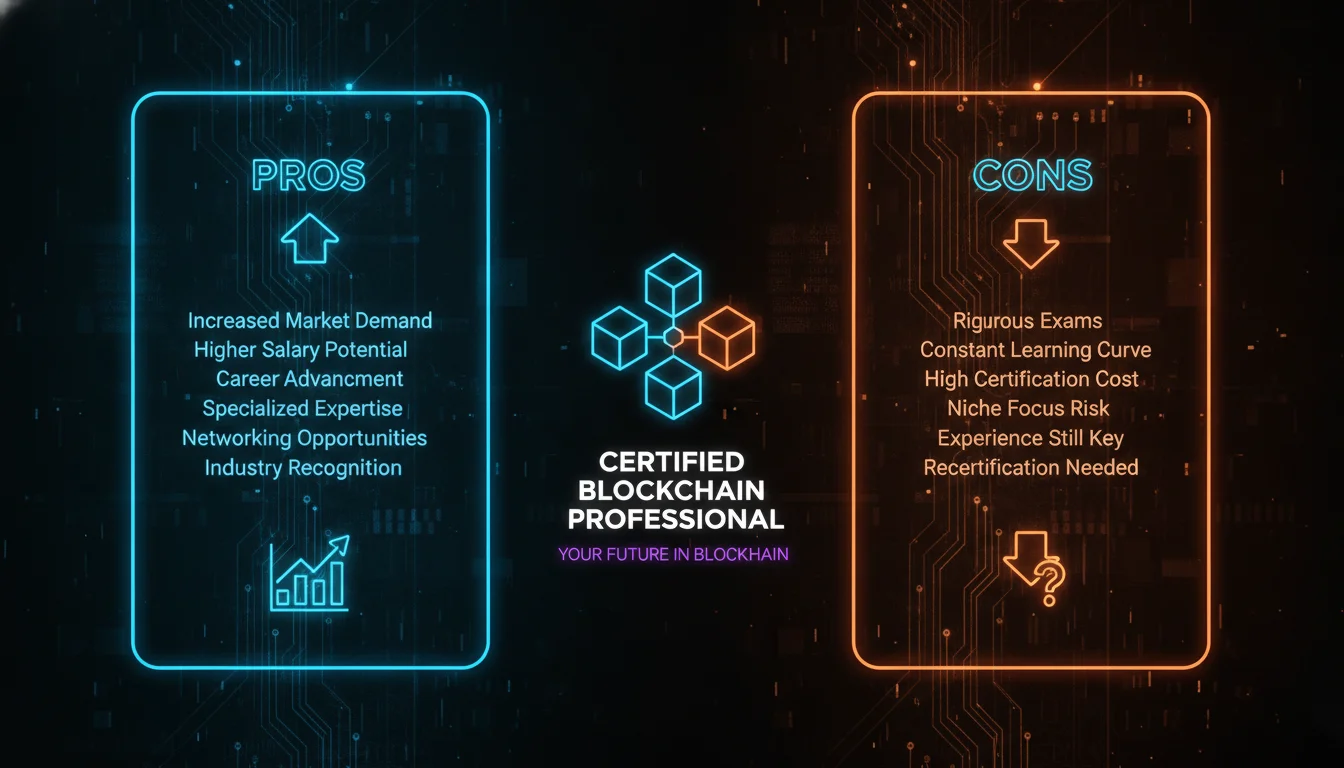
Pros
- Employer signal: A credential gives hiring managers an objective benchmark, especially useful when your resume lacks direct on-chain project history.
- Structured learning: Certification curricula force you through consensus mechanisms, cryptography, and enterprise frameworks you might otherwise skip.
- Career flexibility: Credentials apply across technical roles (developer, architect) and non-technical ones (product manager, legal advisor, marketing specialist).
- Salary premium: Industry data consistently shows certified professionals command higher compensation than non-certified peers in equivalent roles.
- Global recognition: Programs like the CBE are trusted across 145+ countries, making credentials portable across markets.
Cons
- Variable rigor: Not all certifications are equal. Some programs are exam-light and primarily revenue-driven, offering limited practical depth.
- Rapid obsolescence: Blockchain moves fast. A credential earned today may not reflect current protocol standards within 18-24 months without self-directed upskilling.
- No substitute for deployment experience: Employers building real infrastructure weight demonstrated on-chain work heavily. A certificate alone rarely closes that gap.
- Cost and time: Quality programs range from $150 to $499 or more, plus study time. ROI depends heavily on your current role and target market.
Top Certified Blockchain Professional Programs in 2026
The market offers several reputable paths to becoming a this type of professional. Each program has a distinct focus, price, and structure. Below is a comparison of four widely recognized options.
Certified Blockchain Expert (CBE) by Blockchain Council
The Certified Blockchain Expert from Blockchain Council is one of the most widely adopted choices, with over 10,000 enrollees across 145+ countries. It offers a self-paced plan at $349 and a live instructor-led plan at $499. The curriculum spans 14 modules covering tokenization, mining, consensus, and enterprise use cases. The online exam requires a minimum score of 60% to pass and allows up to three attempts. Certification validity is lifetime.
Certified Blockchain Professional (CBP) by EC-Council
EC-Council’s Certified Blockchain Professional course is vendor-agnostic and emphasizes technical foundations including cryptography, Ethereum, and Hyperledger. It introduces a Secure-Scalable-Sustainable framework for blockchain deployment. The program comprises 17 lessons covering DApps, AI integration, industry use cases, and blockchain as a service. Pricing is not publicly listed; contact EC-Council directly for current rates. The syllabus is among the most comprehensive for those targeting deep technical mastery.
Certified BlockChain Professional (CBCP) by GAQM
GAQM’s CBCP certification focuses on Ethereum and Hyperledger application development. The exam voucher costs $150 and covers two attempts; a premium e-book package is $180. Study modules cover cryptocurrency fundamentals, mining, consensus, and smart contracts. The certification targets supply chain managers, logistics professionals, and ERP consultants, making it a practical fit for operations professionals integrating blockchain into existing enterprise systems.
C4 Certified Blockchain Professional (CBP)
The CryptoCurrency Certification Consortium offers the CBP designation as part of its vendor-neutral, non-profit mission. Trusted by over 10,000 certified professionals, C4’s CBP covers Bitcoin, cryptocurrency standards, and secure private key management. C4 also provides the Certified Ethereum Professional (CEP) and the CryptoCurrency Security Standard Auditor (CCSSA) designations for those pursuing specialized tracks. The community-driven approach and open standards make C4 credentials particularly credible in crypto-native environments.
| Certification | Provider | Price (USD) | Format | Validity | Key Focus |
|---|---|---|---|---|---|
| CBE | Blockchain Council | $349 (self-paced) $499 (live) |
10-hour self-paced or 6-hour live | Lifetime | Enterprise blockchain, use cases |
| CBP | EC-Council | Not publicly listed | Self-paced (17 lessons) | Not specified | Technical foundations, Ethereum, Hyperledger |
| CBCP | GAQM | $150 (exam voucher) $180 (premium) |
Self-study with e-book | Not specified | Ethereum, Hyperledger, supply chain |
| C4 CBP | CryptoCurrency Certification Consortium | Not publicly listed | Exam-based, study resources available | Not specified | Bitcoin, cryptocurrency standards |
How to Become a Certified Blockchain Professional: Step-by-Step

Step 1: Build the Fundamentals First
Before enrolling in any program, build a solid grasp of blockchain basics: distributed ledgers, cryptographic hashing, consensus mechanisms (PoW, PoS), and smart contract logic. Free resources like the Blockchain Revolution Specialization on Coursera provide a strong starting point. You don’t need to be a developer, but basic computer science literacy accelerates your progress significantly.
Steps 2 to 4: Choose, Enroll, and Study
Research certification options using the comparison table above, aligned with your career goals. Enroll in your chosen program and commit to a realistic study schedule. Most self-paced courses offer lifetime access to materials, which helps if you’re balancing work. Dedicate consistent weekly hours to cover the syllabus, complete labs, and participate in discussion forums where available. Consider pairing your study with a mentor who has already passed the exam. According to MentorCruise’s 2026 blockchain certification guide, mentorship-paired candidates report faster results and better retention of applied skills.
Steps 5 to 7: Pass the Exam and Apply Your Skills
Schedule the online exam, which typically consists of multiple-choice questions. The CBE exam, for example, requires a minimum score of 60% and permits three attempts. Upon passing, you receive a digital badge and certificate shareable on LinkedIn and your resume. The credential is the starting line, not the finish. Apply your knowledge immediately by contributing to open-source blockchain projects, building on testnets, or taking on consulting work. Employers weight demonstrated experience alongside certification.
Key Skills Gained from a Blockchain Certification
Technical Competencies
A certified blockchain professional typically masters core technical areas: cryptographic hashing, block structure, UTXO versus account models, mining, and consensus algorithms. Many programs include hands-on development on Ethereum using Solidity to write and deploy smart contracts. Exposure to Hyperledger Fabric and other enterprise frameworks is standard, as is coverage of interoperability and scalability solutions. For those targeting security roles, C4’s CCSS training covers key management best practices and operational security guidelines for custodial systems.
Business and Strategic Skills
Beyond code, certification courses teach how to evaluate whether blockchain is the right solution for a given business problem. Learners explore tokenomics, regulatory considerations, and industry-specific use cases in healthcare, supply chain, and finance. This blend of technical and strategic insight enables professionals to bridge the gap between developers and executives. As the MIT Professional Education blog notes, that translator role is in high demand as enterprises move from blockchain pilots to production deployments.
Who Should Get Certified: Beyond Developers
Blockchain certifications aren’t exclusively for engineers. Coursera’s 2026 guide explicitly notes that credentials prepare professionals for roles including UX designer, project manager, accountant, and marketing specialist. If your job involves evaluating blockchain vendors, advising on token structures, or communicating technical decisions to boards, a certification gives you the vocabulary and framework to do that credibly. Non-technical professionals often find that a single certification course changes how they read whitepapers and evaluate protocol risk.
Career Opportunities for Certified Blockchain Professionals
In-Demand Job Roles
Common job titles for a certified blockchain professional include Blockchain Developer, Blockchain Solution Architect, Smart Contract Engineer, and Blockchain Consultant. Non-technical roles like Product Manager, Legal Advisor, and Marketing Specialist also benefit from certification, since those professionals need to understand the technology to make informed decisions and communicate effectively with engineering teams.
Industries Hiring Blockchain Certified Pros
Finance and banking remain the largest employers, but supply chain, pharmaceutical, food safety, and government sectors are rapidly adopting blockchain. Per ISACA, enterprise blockchain market value is expected to reach $19.9 billion by 2025, driving demand across IoT, identity management, and digital assets. That growth trajectory means the window for early credentialing is still open.
Is a Blockchain Certification Worth It? Salary and ROI
Market Demand and Growth
The global blockchain market was estimated at $31.28 billion in 2024 and is projected to grow at a 90.1% CAGR through 2030, according to data cited by Coursera. That kind of sustained growth signals a durable need for skilled professionals, not a speculative spike. Employers are increasingly willing to pay a premium for verified expertise, and a certification is the fastest way to signal that expertise before you have years of on-chain deployment history behind you.
Return on Investment
Consider the cost of certification against the potential salary impact. The CBE self-paced plan at $349 is a modest investment relative to blockchain developer compensation in the U.S. market. Industry data consistently shows certified blockchain professionals earn above general software engineering averages, with experienced architects commanding significantly more. Even a modest salary increase from a new role or promotion can recover certification costs within weeks. For career changers, the credential also reduces the credibility gap that comes with transitioning from a non-blockchain background.
“A Certified Blockchain Expert is equipped with both technical knowledge and strategic insight, making them a valuable asset for companies looking to integrate blockchain into their operations.” – Blockchain Council, CBE Program Overview
“Demand for IT professionals skilled in blockchain is rising due to its enterprise market value’s growth expected to reach $19.9 Billion by 2025. Blockchain is considered the most significant technological innovation since the internet.” – ISACA, Blockchain Fundamentals Certificate
Choosing the Right Certified Blockchain Professional Program
Factors to Consider
When selecting a certification, evaluate the curriculum’s alignment with your target job, the credibility of the issuing body, and whether the credential is recognized by your target industry. Price, study format (self-paced versus live), and renewal requirements are practical constraints. For enterprise roles, a program heavy on Hyperledger and use-case analysis makes sense. For crypto-native careers, C4’s certifications offer specialized paths into Bitcoin security, Ethereum protocol work, and custodial standards.
Accreditation and Industry Recognition
Look for certifications that are vendor-neutral and backed by established organizations. EC-Council’s CBP and C4’s CBP are both non-profit, global standards-driven options. The Blockchain Council’s CBE has the widest worldwide reach among the paid certifications, with presence across 145+ countries since 2016. Checking LinkedIn for professionals who hold a particular certification reveals its real-world hiring traction better than any marketing page will.
University-Backed Programs
For professionals who want institutional credibility alongside technical depth, university-backed options are worth evaluating. MIT Professional Education offers a Blockchain: Disruptive Technology course as part of its online catalog, covering how blockchain integrates with enterprise architecture and digital transformation strategy. These programs typically cost more than vendor certifications but carry significant brand weight in enterprise hiring contexts. They complement rather than replace practitioner credentials like the CBE or C4 CBP.
Future of Blockchain Certifications
Emerging Trends
As Web3, DeFi, and tokenized assets mature, certifications are expanding to cover new domains: decentralized identity, zero-knowledge proofs, and DAO governance. Micro-credentials and stackable certifications are rising, letting professionals tailor their learning path without committing to a full program upfront. C4 continuously updates its exams to reflect current technological shifts, including its CCSS training schedule across EMEA, APAC, and AMER regions. That kind of ongoing curriculum maintenance is a signal worth weighing when choosing a provider.
Continuous Learning
Blockchain technology moves fast. Even lifetime certifications require self-directed learning to stay relevant. Most certified professionals complement their initial credential with advanced courses, hackathons, and contributions to open-source projects. As of 2026, being a certified blockchain professional is a strong foundation, but demonstrated practical experience is what separates candidates in competitive hiring processes. Build on testnets. Audit contracts. Ship something.
If you’re serious about building in this space, consider applying to the Digital Blockchains Genesis Cohort. We work with protocol builders, tokenomics architects, and smart contract engineers who want to move from certified to deployed.
Frequently Asked Questions
What is a blockchain certified professional?
A blockchain certified professional is an individual who has passed a rigorous exam from a recognized body and holds a credential confirming their knowledge of blockchain technology, smart contracts, and enterprise applications. The certification is often vendor-neutral and may require periodic renewal to reflect current protocol standards.
Is blockchain certification worth it?
For most tech and business professionals, yes. Certifications validate your skills to employers, often leading to better job opportunities and higher compensation. The ROI is strongest for career changers and professionals moving into blockchain-adjacent roles who need a credible signal before they have extensive on-chain project history.
What is the average salary for a certified blockchain expert in the USA?
Specific salaries depend on role, seniority, and location. Industry data consistently shows that certified blockchain professionals earn above general software engineering averages in the U.S., with experienced architects and solution designers commanding the highest compensation. Certification alone doesn’t set the salary floor; demonstrated deployment experience does.
Is CBE worth it?
The Certified Blockchain Expert from Blockchain Council is worth it for those seeking a broad, enterprise-focused credential with global recognition. Its $349 price point, lifetime validity, and practical curriculum covering 14 modules make it a strong entry point for career changers, consultants, and business professionals who need structured blockchain fluency.
How do I choose the right blockchain certification?
Align the certification with your career goals: developer-focused programs suit engineers, while business-oriented ones help managers and consultants. Compare costs, topics covered, and the provider’s reputation and update cadence. Talking to mentors or certified peers who are already working in your target role is the fastest way to validate your choice before spending money.
Do blockchain certifications expire?
Some certifications, like the CBE from Blockchain Council, offer lifetime validity with no expiry date. Others, particularly those from non-profit consortia, may require renewal every few years to ensure your knowledge reflects current standards. Always check the provider’s renewal policy before enrolling, especially if you’re in a regulated industry where credential currency matters.