Key Takeaways
- An ai and blockchain recruitment company bridges the gap between AI and blockchain talent pools, helping startups and enterprises hire engineers who understand both domains.
- In 2026, roles like zkML engineers and decentralized AI architects are in high demand, yet generalist recruiters struggle to evaluate such niche skill sets.
- Agencies like Plexus, Blockchain Headhunter, and The Blockchain Recruiter run proprietary vetting processes, deep industry networks, and placement guarantees that generalist firms can’t match.
- According to Axiom’s 2026 hiring guide, a bad executive hire in crypto can cost more than 2.5 times their annual salary, which makes picking the right ai and blockchain recruitment company a strategic decision, not an afterthought.
- Average crypto salaries reached $182,000 in 2025, with AI specialists commanding a premium, according to Plexus’s State of Crypto Hiring 2026 report.
An ai and blockchain recruitment company is a specialist talent acquisition firm that sources and places candidates for roles requiring expertise in both artificial intelligence and blockchain systems. These firms exist because generalist recruiters can’t properly screen for this convergence.
What Is an AI and Blockchain Recruitment Company?
The Convergence of Two Disruptive Technologies
An recruitment company is a firm built specifically to source, screen, and place talent at the intersection of AI and Web3. As blockchain protocols increasingly integrate AI capabilities, from on-chain machine learning inference to decentralized GPU marketplaces, demand for professionals fluent in both domains has grown fast. This kind of recruitment company understands the technical nuances that separate a generalist software engineer from one who can optimize zero-knowledge proofs for AI model verification or design decentralized training pipelines. Unlike traditional tech recruiters, these agencies maintain networks within both the AI and Web3 communities, giving them access to candidates that generalist platforms like LinkedIn often miss entirely.
Why Generalist Recruiters Fall Short
Generalist recruiters fall short because the AI-blockchain intersection demands fluency in consensus mechanisms, tokenomics, and smart contract security alongside transformer architectures, GPU orchestration, and MLOps. Few individual recruiters carry both skill sets, and fewer firms build hiring pipelines around them. According to a 2025 Web3 Talent Report cited by Axiom’s 2026 blockchain recruitment guide, 64% of companies in the decentralized sector lost their top-choice candidate because their recruitment process took longer than 14 days, a timeline generalist agencies often can’t beat given their lack of domain-specific pipelines. A dedicated this type of company shortens this delay through pre-vetted talent communities and technical screening built for roles like Rust-based protocol engineers or Solidity developers with AI integration experience.
The Growing Demand for AI-Blockchain Hybrid Roles
Decentralized AI Networks and On-Chain ML
Demand for hybrid AI-blockchain roles is growing because projects building decentralized AI infrastructure, like Bittensor, Render Network, and Akash, need engineers who understand both smart contracts and distributed training workloads. These platforms require people who can write protocol-level code and also reason about inference pipelines running across distributed GPU networks. A capable this kind of recruitment company recognizes that a strong candidate’s GitHub history might need to show contributions to both Cosmos SDK and PyTorch repositories, a filter that broad-spectrum recruiters rarely think to apply.
Zero-Knowledge Machine Learning (zkML)
zkML is a fast-growing subfield that lets developers prove AI computations happened correctly without exposing the underlying data or model weights. Screening for it requires recruiters to tell the difference between candidates who’ve read about ZK-SNARKs, Groth16, or Plonk protocols and candidates who’ve actually shipped code using them. Plexus has built a dedicated “Blockchain x AI” practice, and Blockchain Headhunter runs an explicit “AI, LLMs & Machine Learning” category, both leaning on years of specialized sourcing experience. The Tech Recruiters takes a related approach with what it calls a Distributed Systems Filter, applying the same technical screen whether the open role is a COO or a consensus engineer.
“The strongest candidates rarely apply through job postings.” This is how Plexus describes its sourcing philosophy in its own FAQ, and it captures why passive-candidate reach matters more in Web3 hiring than in almost any other technical field.
How AI Enhances Blockchain Recruitment Itself
AI-Powered Sourcing and Screening
AI enhances blockchain recruitment by automating the sourcing work that would otherwise take a human recruiter weeks. Many leading ai and blockchain recruitment companies use AI tools internally to scan decentralized communities, GitHub repositories, and Discord channels for passive candidates who never post a resume anywhere. Adapt Talent reports that over 40% of top blockchain candidates aren’t on LinkedIn, which makes conventional sourcing close to useless for this audience. AI-driven tools parse commit histories, DAO governance participation, and on-chain activity to surface talent that keyword searches would never catch.
Bias Reduction and Skills Matching
Natural language processing models can anonymize candidate profiles and match them to open roles based on demonstrated skills instead of pedigree or brand-name employers. This matters more in Web3 than in traditional tech, where pseudonymous contributions and global, permissionless participation make resume-based screening unreliable at best. A reputable the and blockchain recruitment company uses these techniques to build diverse, high-quality shortlists, cutting down the risk of the homogenous founding teams that plague a lot of early-stage crypto startups.
Key Services Offered by Leading AI and Blockchain Recruitment Companies
Executive Search and C-Level Hiring
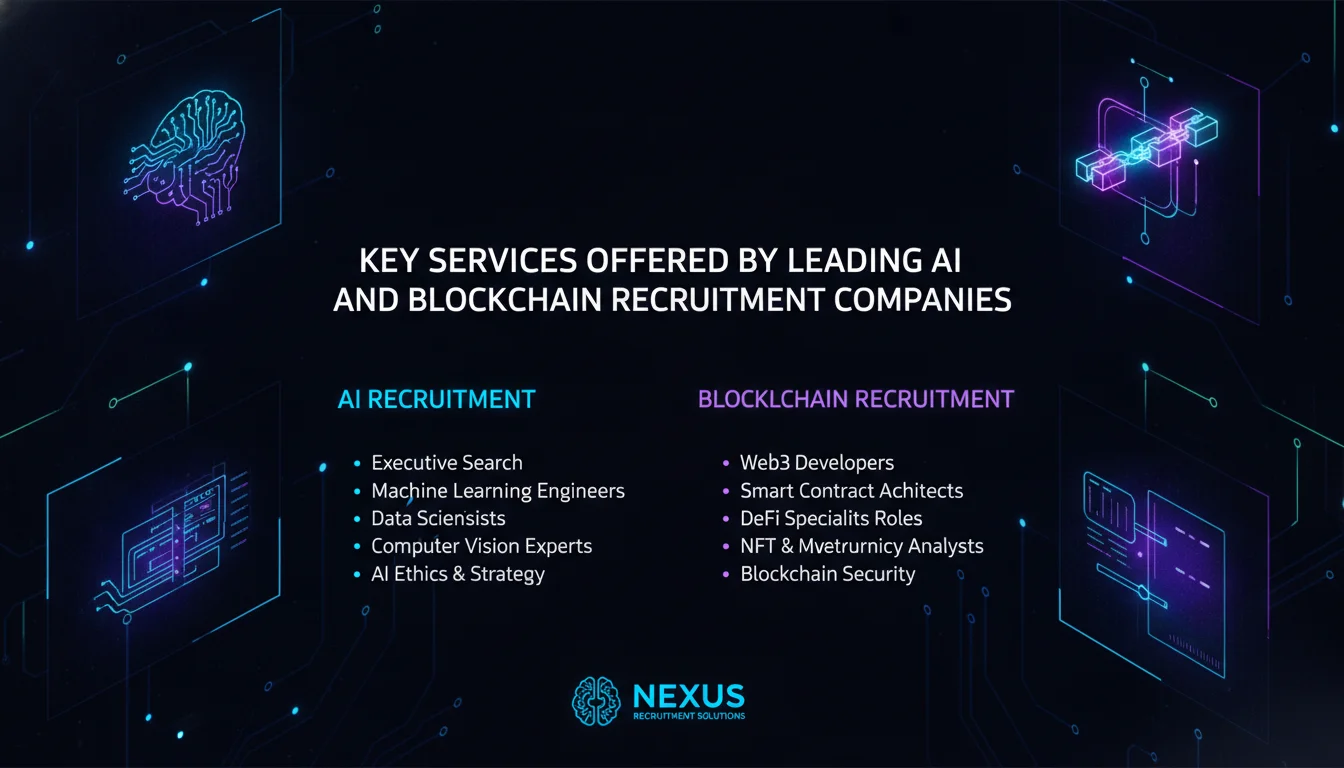
Executive search for CFOs, CTOs, and CEOs at decentralized AI networks requires more than a strong Rolodex. Cowen Partners, retained by model (described on Cowen’s site as the world’s largest crypto-focused venture capital firm), pairs traditional C-suite assessment with digital asset expertise. Firms operating in this space benchmark compensation against token package trends and liquidity cliffs, so offers stay competitive inside equity-heavy comp models where a chunk of pay sits in vesting tokens rather than cash.
Technical Vetting and Distributed Systems Filtering
The strongest agencies go well past resume review. The Blockchain Recruiter reports a 2.16:1 interview-to-hire ratio, meaning only the most relevant candidates ever reach a client interview. The Tech Recruiters runs a mandatory Distributed Systems Filter, a technical screen that checks whether a candidate actually understands consensus, state replication, and fault tolerance rather than just name-dropping them. Per the firm’s own published numbers, this pulls time-to-hire down from an industry range of 60 to 90 days to roughly 14 to 21 days.
Salary Benchmarking and Token Compensation Advisory
With average crypto salaries at $182,000 in 2025, an 11% premium over broader tech according to Plexus’s State of Crypto Hiring 2026 report, and token allocations often making up a meaningful share of total compensation, benchmarking pay requires niche expertise most generalist recruiters simply don’t have. Agencies like Plexus publish annual State of Crypto Hiring reports tracking shifts in token vesting structures, cash-to-token ratios, and regional pay gaps, giving clients the data to build offers that actually close.
Comparison of Top AI and Blockchain Recruitment Firms
| Agency | Specialization | AI/Blockchain Focus | Key Metrics | Global Reach |
|---|---|---|---|---|
| Plexus | DeFi, quant trading, infrastructure, blockchain x AI | Dedicated “Blockchain x AI” practice | 300+ placements/year, 650K+ talent database, ranked #30 on Recruiter Hot100 2026 | London, Miami, global candidate pool |
| Blockchain Headhunter | C-level, engineering, marketing, AI/ML roles | Explicit “AI, LLMs & Machine Learning” category | 300+ placements, 250K+ followers across LinkedIn/Telegram, active since 2017 | Remote-first, global network |
| CryptoRecruit | All roles: dev, exec, marketing, compliance | Job listings for decentralized AI networks | Coverage across dozens of countries, active job board | US, Australia, UK, Asia, Europe |
| The Blockchain Recruiter | Engineering managers, Rust/Go engineers, DeFi leadership | Case studies with zero-knowledge proof and DePIN projects | 100% success rate, 2.16:1 interview-to-hire, 97% offer acceptance, 1-year guarantee | Niche boutique, remote engagements |
| The Tech Recruiters | Blockchain protocol engineers, AI systems ML engineers, fintech | Mandatory Distributed Systems Filter across blockchain, AI, fintech, SaaS | 400+ placements, 98% retention, 3-5 days to first candidate intro | Global, focused on EMEA and North America |
| CryptoJobsList | Senior crypto talent: engineers, BD, execs | Success-based model, no retainer, large crypto-native pipeline | 100+ placements, shortlist in about a week, zero-risk model | Global, web-based platform |
How to Choose the Right AI and Blockchain Recruitment Company
Step 1: Verify Niche Expertise and Track Record
Start by asking for case studies that match your vertical. If you’re building a decentralized AI network, look for a firm that has placed daemon engineers or zkML researchers, not just generic smart contract developers. The Blockchain Recruiter publishes detailed case studies for clients including Grove (formerly Pocket Network), Irreducible, and the Badger Association, showing real familiarity with Cosmos SDK engineering, zero-knowledge hardware, and DeFi infrastructure hiring.
Step 2: Assess Talent Network and Passive Candidate Reach
The strongest candidates rarely apply through job postings, so an effective company needs direct access to the Telegram groups, Discord servers, and GitHub repositories where crypto-native talent actually spends time. Check the size of their social following and ask directly what percentage of placements come from passive candidates versus inbound applicants. Adapt Talent states plainly that over 40% of top blockchain candidates aren’t on LinkedIn, so a real alternative sourcing strategy isn’t optional, it’s the whole job.
Step 3: Evaluate Speed-to-Hire and Retention Metrics
In crypto, every week without a key hire burns runway and pushes back roadmap milestones. Look for a firm that delivers screened candidates in days rather than weeks. The Tech Recruiters guarantees initial intros within 3 to 5 days, compared to a 14 to 21 day industry standard cited across multiple agencies. Retention rates above roughly 95%, like the 98% The Tech Recruiters reports, suggest the matchmaking is going beyond raw skills into cultural and mission fit.
According to Axiom’s 2026 blockchain recruitment guide, “the cost of a bad executive hire can exceed 2.5 times their annual salary, especially when tokenomics and roadmap stability are at stake.” A specialized recruitment partner isn’t a nice-to-have here, it’s risk management.
2026 Salary Trends and Compensation Insights
Average Salaries and Token Packages
Salary data for 2026 shows crypto compensation climbing faster than the broader tech market. Plexus’s State of Crypto Hiring 2026 report shows average crypto salaries hit $182,000 in 2025, with AI-specialized roles like decentralized AI architects commanding an additional premium on top of that base. Rust has also overtaken Solidity as the leading smart-contract language among new hires, according to Plexus’s data, reflecting how much hiring momentum has shifted toward Solana and other high-throughput chains.
Geographic Hotspots and Remote Work
Hubs like London, Miami, and Singapore still matter, but remote work is now the default rather than the exception. Web3 companies increasingly hire across borders, which makes a recruitment partner with real global reach and local compliance knowledge genuinely valuable rather than a nice extra. CryptoRecruit lists openings across dozens of countries, and a growing number of ai and blockchain recruitment companies now offer Employer of Record services to simplify international payroll and legal compliance for distributed teams.
Pros and Cons of Using a Specialized Recruitment Partner
Pros
- Faster access to pre-vetted, passive candidates who never appear on generalist job boards.
- Technical screening built for niche roles like zkML engineers, Rust protocol developers, and MLOps specialists.
- Compensation benchmarking that accounts for token vesting, liquidity cliffs, and equity-heavy pay structures.
- Lower risk of a costly mis-hire in roles where mistakes are expensive to unwind.
Cons
- Fees typically run higher than generalist staffing agencies, especially for executive search.
- Smaller boutique firms may have limited coverage outside their core specialty (say, DeFi versus zkML).
- Retainer-based models require upfront commitment before any candidate is delivered.
- Quality varies widely between firms, so due diligence on track record is still on you.
Frequently Asked Questions
What is an ai and blockchain recruitment company?
An ai and is a specialized talent acquisition firm that focuses exclusively on sourcing, vetting, and placing professionals whose expertise spans both artificial intelligence and blockchain technologies. These firms fill roles like zkML engineers, decentralized AI product managers, and Rust developers with GPU programming experience.
How much does it cost to hire a blockchain developer through such a company?
Fees typically run 20-30% of the candidate’s first-year base salary, though some agencies, like CryptoJobsList, use success-based models with no upfront retainer. Given that average crypto salaries were around $182,000 in 2025, total recruitment fees for a single hire can add up quickly, but that cost is usually far smaller than the cost of a bad hire.
What are the top blockchain recruiting firms?
Leading specialist firms include Plexus (London/Miami), Blockchain Headhunter, CryptoRecruit, The Blockchain Recruiter, and The Tech Recruiters. Each has a different edge: Plexus for scale and its data-driven State of Crypto Hiring reports, Blockchain Headhunter for community reach built since 2017, and The Tech Recruiters for its technical screening rigor.
Is AI replacing human recruiters in the blockchain space?
No, AI is augmenting the process rather than replacing recruiters. It automates initial sourcing and screening, but human recruiters still handle relationship-driven work like closing passive candidates, assessing cultural fit, and understanding nuanced technical requirements that a model can’t fully judge. A well-run ai and blockchain recruitment company treats AI as a tool inside the process, not a substitute for it.
What does blockchain developer compensation look like in 2026?
According to Plexus’s 2026 report, average crypto salaries were $182,000 in 2025, with senior roles often exceeding that once token incentives are factored in. AI-adjacent skills, like on-chain ML or zkML experience, tend to push compensation even higher.
How do I verify a recruitment agency’s technical vetting process?
Ask directly for a mock assessment or a written breakdown of their screening methodology. Firms like The Tech Recruiters will walk you through their Distributed Systems Filter, while others share sample coding challenges used to test candidates on consensus mechanisms, smart contract security, or AI/ML integration knowledge.
Where This Fits Into Your Broader Hiring Strategy
Picking the right ai and blockchain recruitment company is really a build-versus-buy decision applied to talent. At Digital Blockchains, we think about hiring the same way we think about protocol architecture: get the foundational layer right or everything built on top of it inherits the flaw. If you’re assembling a team to launch a token, stand up a DAO, or ship a Web3 product and want a studio partner that understands both the technical and organizational side of this, apply to the Genesis Cohort at digitalblockchains.com. We work with serious builders who want infrastructure-grade thinking applied to team-building, not just headcount.
As blockchain and artificial intelligence continue converging through 2026, the need for a dedicated ai and blockchain recruitment company keeps growing. These specialist firms understand the technical and cultural nuances of the Web3 ecosystem, and they bring the speed, rigorous vetting, and compensation intelligence that generalist recruiters can’t match. Whether you’re a Layer 1 team using zero-knowledge proofs, a DAO integrating on-chain governance with AI agents, or a VC-backed startup building decentralized GPU infrastructure, the right talent partner can be the difference between scaling on schedule and stalling out. Evaluate agencies by their track record, check their passive candidate reach, and always ask for a transparent technical screening process. Your next mission-critical hire depends on it.