Blockchain training is a structured educational process that builds skills in distributed ledgers, smart contracts, and consensus mechanisms, preparing professionals for careers in Web3, DeFi, and enterprise blockchain.
Key Takeaways
- training combines technical depth (smart contracts, consensus algorithms) with strategic knowledge (use cases, governance, tokenomics).
- Certifications from ISACA, Blockchain Council, and university-backed courses on Coursera validate expertise with employers across 150+ countries.
- The global blockchain market is projected to reach $94 billion by 2027, fueling demand for millions of skilled professionals.
- Hands-on labs with testnets and wallets are critical for any this type of training program to build practical competence.
- Options range from free self-paced courses like Cyfrin Updraft to paid professional certificates from MIT Professional Education (~$2,500).
What Is Blockchain Training?

this kind of training is a structured educational process that teaches the fundamentals, development, and applications of distributed ledger technology. It covers topics from cryptographic hashing and consensus algorithms to smart contract programming and decentralized governance. Formal training can range from a few hours of video instruction to multi-month specializations with capstone projects.
Core Concepts Covered
At its foundation, blockchain introduces the immutable, append-only nature of blockchains, the role of nodes in maintaining a shared state, and how transactions are validated. Learners explore Proof of Work (PoW), Proof of Stake (PoS), and other consensus mechanisms, as well as the differences between public, private, and consortium chains. These aren’t abstract concepts: understanding them is what separates engineers who can deploy production-grade systems from those who can only follow tutorials.
Beyond the Basics
Advanced training covers Layer 2 scaling solutions like ZK-Rollups and Optimistic Rollups, account abstraction via EIP-4337, and the oracle problem. Programs also examine real-world architectures such as Ethereum, Hyperledger Fabric, and Polkadot, so professionals can evaluate which protocol fits a given enterprise need. The goal isn’t to memorize specs. It’s to develop the judgment to make architectural trade-offs under real constraints.
“Effective blockchain training goes beyond theory. It requires learners to send testnet transactions, deploy smart contracts, and understand L2 scaling solutions to be truly prepared for the industry,” notes an instructor at Cyfrin Updraft.
Why Invest in Blockchain Training?

The business case for blockchain training is straightforward: the market is growing faster than the talent supply. According to the Blockchain Council, the global blockchain market is growing at a CAGR of 66.2% and will reach $94 billion by 2027. With 3.5 million blockchain jobs forecast by 2028, formal training is becoming a non-negotiable for career advancement.
High Salaries and Demand
Certified blockchain developers command an average salary of $185,000 in the United States. Blockchain training positions professionals to capture these roles by validating hands-on experience with decentralized applications, token standards (ERC-20, ERC-721), and DeFi protocols. Even adjacent roles like smart contract auditor or DeFi analyst regularly exceed $150,000 in total compensation.
Industry-Wide Adoption
Deloitte’s 2020 Global Blockchain Survey found that 77% of executives believe they will lose competitive advantage without blockchain adoption. Blockchain training helps organizations upskill teams for supply-chain traceability, digital identity, and cross-border payments: areas where the technology is moving from pilot to production. ISACA has also noted that enterprise blockchain market value was expected to reach $19.9 billion by 2025, signaling that corporate demand for trained professionals is structural, not cyclical.
“The shortage of blockchain talent is one of the most acute skill gaps in enterprise technology right now. Organizations that invest in training today will have a measurable advantage in deployment speed and security posture,” according to ISACA’s blockchain credentialing program documentation.
Types of Blockchain Training Programs
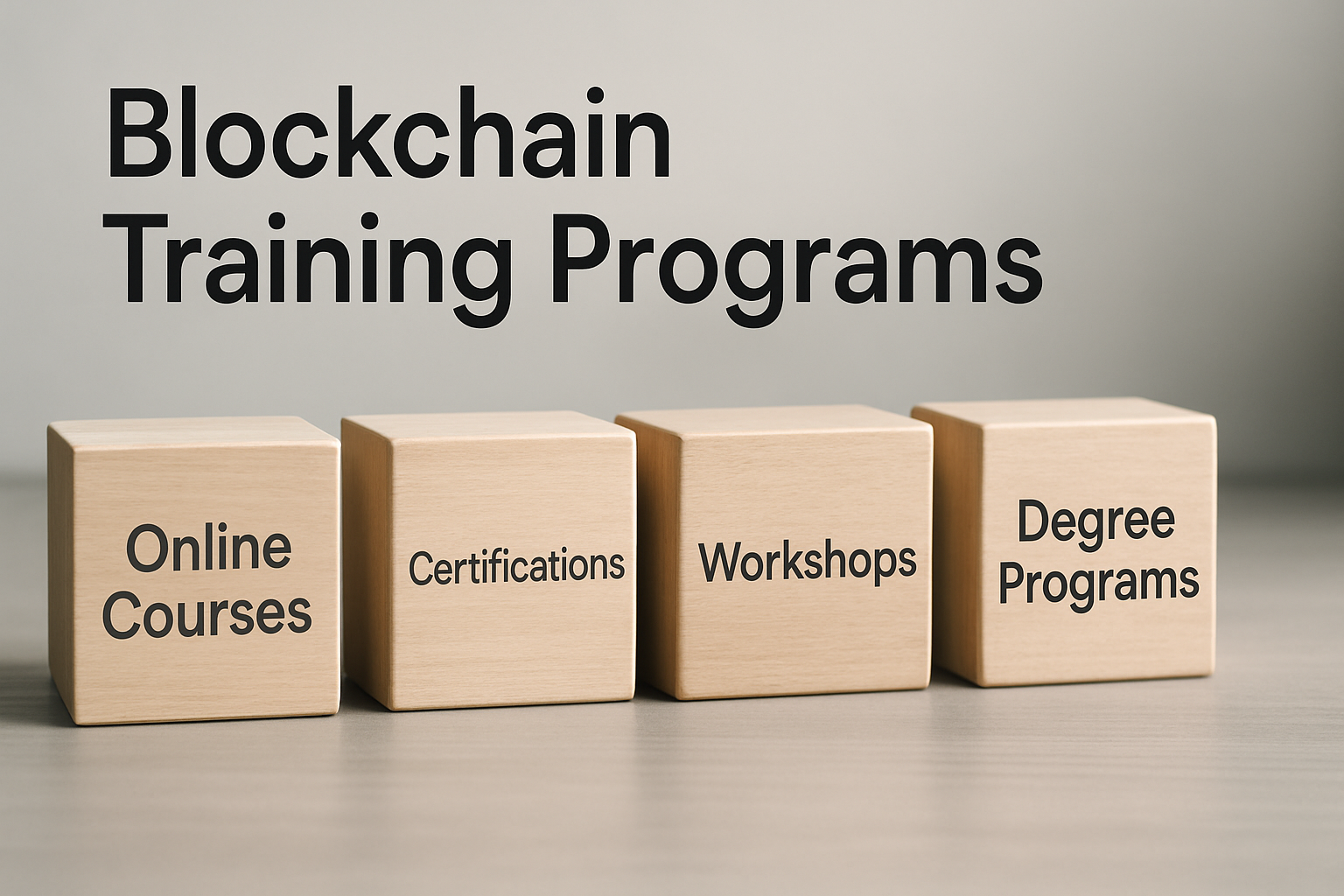
Programs vary widely in format, depth, and cost. The right choice depends on your current skill set, career goals, and preferred learning style.
Self-Paced Online Courses
Platforms like Coursera offer university-backed specializations in blockchain, often with a free audit track. These courses allow learners to progress asynchronously, with video lectures, quizzes, and peer-reviewed assignments. Typical durations range from one to six months, and the Coursera subscription runs $49 per month after the free trial period ends.
Live Instructor-Led Bootcamps
Intensive, cohort-based bootcamps, both online and in-person, provide real-time mentorship and networking. They often culminate in a portfolio project such as deploying a full-stack dApp, and are favored by career-switchers seeking rapid immersion. Most structured bootcamps run 8 to 12 weeks of full-time study.
Professional Certifications
Vendor-neutral certifications like the ISACA Blockchain Fundamentals Certificate and the Blockchain Council’s Certified Blockchain Expert validate expertise through proctored exams. Many require continuing professional education (CPE) credits, ensuring that certified individuals stay current with evolving standards. These credentials carry real weight: employers at firms like ConsenSys, Binance, and Coinbase actively look for them on candidate profiles.
Bootcamps vs. University Degrees
This is a question worth addressing directly. Bootcamps optimize for speed and practical output: you’ll deploy contracts and build dApps within weeks. University degrees and formal specializations optimize for depth and credential prestige, which matters more in enterprise and research contexts. For most developers targeting Web3 roles in 2026, a combination works best: a rigorous self-paced specialization for foundational theory, paired with a bootcamp or open-source project for portfolio evidence. A four-year computer science degree with blockchain electives remains the strongest signal for senior engineering roles at protocol-layer companies.
Key Skills You’ll Develop Through Blockchain Training
Comprehensive blockchain training blends theory with hands-on labs, producing professionals who can design, audit, and govern decentralized systems.
Smart Contract Development
Learners write, test, and deploy smart contracts using Solidity or Rust. Training covers gas optimization, security patterns (re-entrancy guards, integer overflow checks), and integration with frameworks like Hardhat and Foundry. A basic Solidity contract structure looks like this:
// SPDX-License-Identifier: MIT

    }

    }
}
This pattern, emit events on state changes, use external over public for gas savings, and avoid unbounded storage writes, is the kind of discipline that separates auditable production code from tutorial-grade examples.
Decentralized Finance (DeFi) and Tokenization
DeFi modules teach liquidity pools, automated market makers, yield farming, and stablecoin mechanics. Tokenization sections explain how real-world assets (real estate, art, commodities) are represented on-chain and the regulatory implications under MiCA or SEC rules. Understanding ERC-20 and ERC-721 token standards is table stakes. The more advanced skill is modeling tokenomics: emission schedules, vesting curves, and governance weight distributions that hold up under adversarial conditions.
Enterprise Blockchain Architecture
For those targeting corporate roles, training covers Hyperledger Fabric channels, private data collections, and identity management via Membership Service Providers. Participants learn to map business workflows to chaincode and evaluate consensus plug-ins like Raft. This is where the blockchain trilemma becomes a practical constraint rather than a theoretical concept: you’re making real trade-offs between decentralization, security, and throughput for a specific business context.
Regulatory Compliance and Legal Frameworks
Increasingly, blockchain training programs include modules on GDPR data handling (particularly the tension between immutability and the right to erasure), KYC/AML obligations for token issuers, and MiCA compliance for projects operating in the EU. For healthcare applications, HIPAA-compliant chain architectures require specific design choices around data residency and access control. These aren’t optional topics for enterprise practitioners. Regulators in the US, EU, and UK are actively enforcing, and ignorance is not a defense.
How to Choose the Right Blockchain Training
With dozens of options available, selecting the best blockchain training requires a clear assessment of your objectives and constraints.
Define Your Career Path
A developer track demands deep programming and protocol knowledge, while a product-manager track emphasizes use-case analysis and tokenomics. Align the curriculum with roles posted on Web3 job boards to ensure relevance. If you’re targeting protocol-layer engineering, prioritize programs that cover EIP standards and cryptographic primitives. If you’re targeting DeFi strategy or DAO operations, prioritize governance frameworks and financial modeling.
Evaluate Hands-On Components
The most effective programs include testnet interactions, wallet creation, and contract deployment. Look for courses that offer sandbox environments where you can experiment without risking real funds. Cyfrin Updraft and the Blockchain Council both provide such labs. If a course has no hands-on component, it’s producing knowledge, not skill.
Check Accreditation and Industry Recognition
Credentials from CPD-accredited bodies or established universities carry weight with employers. Verify whether the certificate appears on LinkedIn profiles of professionals at firms like ConsenSys, Binance, or Coinbase. A certificate that no hiring manager recognizes is a line item on your resume, not a credential.
Top Blockchain Training Providers in 2026
The following table compares leading programs based on cost, duration, and certification value. Updated for 2026 based on current program offerings.
| Program | Provider | Format | Duration | Cost | Certification | Hands-On Labs |
|---|---|---|---|---|---|---|
| Blockchain Basics | Cyfrin Updraft | Self-paced video | 6 hours | Free | Optional certificate | Testnet wallets, transactions |
| Blockchain Specialization | Coursera / Univ. at Buffalo | Self-paced with deadlines | 3-6 months | Free trial; $49/month | Professional certificate | Yes (assignments and projects) |
| Blockchain Fundamentals Certificate | ISACA | Self-paced + exam | 2-month access | Paid (member discount) | ISACA certificate + CPE | Performance-based labs |
| Blockchain: Disruptive Technology | MIT Professional Education | Online, cohort-based | 6 weeks | ~$2,500 | MIT certificate | Case studies |
| Blockchain Certification Programs | Blockchain Council | Self-paced | 8-10 hours each | Starts at $149 | CPD-accredited certificate | Yes (24+ courses) |
Pros and Cons of Blockchain Training
Blockchain training delivers real career value, but it’s not without trade-offs. Here’s an honest assessment before you commit time and money.
Pros
- High salary ceiling: Certified blockchain developers average $185,000 in the US, with senior architects and auditors commanding more.
- Transferable skills: Cryptography, distributed systems design, and smart contract security apply across multiple protocol ecosystems.
- Flexible entry points: Free options like Cyfrin Updraft lower the barrier to entry, while paid certifications from ISACA and MIT signal verified expertise to employers.
- Growing market: With 3.5 million jobs forecast by 2028 and a market projected at $94 billion by 2027, demand is structural.
- Remote-friendly roles: Most Web3 and DeFi positions are fully remote, expanding the geographic opportunity set.
Cons
- Rapid protocol churn: What’s current today (EIP-4337, Dencun upgrade) may be superseded within 18-24 months, requiring continuous learning.
- Quality variance: Not all certifications carry equal weight. Some low-cost certificates from unrecognized providers add little to a resume.
- Steep learning curve: Solidity security, ZK-proof systems, and cryptographic primitives require genuine mathematical and programming depth.
- Market volatility risk: Hiring in Web3 correlates with market cycles. Job openings contracted significantly during the 2022-2023 bear market.
Career Opportunities After Blockchain Training
Completing a reputable blockchain training program opens doors to roles that barely existed five years ago.
Blockchain Developer
Developers build and audit smart contracts, integrate wallets, and optimize gas usage. A strong foundation in Solidity, Vyper, or Move, combined with knowledge of EIP standards, is essential. Salaries often exceed $150,000, with senior roles at protocol companies reaching well above that.
Blockchain Architect
Architects design the system topology: choosing the appropriate chain, consensus mechanism, and off-chain storage. They must understand trade-offs between decentralization, security, and scalability. This is the blockchain trilemma applied in practice, not in theory.
DeFi Strategist and Token Economist
These roles require deep knowledge of liquidity incentives, governance token distribution, and risk parameters. Training in tokenomics and financial modeling is key, along with familiarity with protocols like Aave and Uniswap. If you want to go deeper on tokenomics design, our tokenomics framework guide covers emission modeling and governance structures in detail.
Smart Contract Auditor
Auditors review protocol code for re-entrancy vulnerabilities, access control flaws, and economic exploits before deployment. This is one of the highest-value roles in the ecosystem. A single critical vulnerability in a DeFi protocol can result in losses of tens of millions of dollars, which is why auditors with verifiable track records command premium rates. For context on how smart contract security fits into broader Web3 development, see our smart contract development guide.
Frequently Asked Questions
What is the best way to learn blockchain?
The most effective approach combines structured coursework with hands-on practice. Start with a free foundational course like Cyfrin Updraft’s Blockchain Basics to build conceptual clarity, then move to a specialization on Coursera or a bootcamp that requires you to deploy real contracts on a testnet. Reading protocol documentation (Ethereum’s EIPs, Hyperledger Fabric docs) alongside coursework accelerates the learning curve significantly.
Are there free blockchain training courses with certificates?
Yes. Cyfrin Updraft’s Blockchain Basics course is completely free and includes testnet transaction simulations. Coursera offers a free audit track for most blockchain specializations, though the shareable certificate requires a paid subscription at $49 per month. Some Blockchain Council introductory modules are also available at no cost.
How long does a typical blockchain training program take?
Duration varies widely. A focused fundamentals course can be completed in 6 to 10 hours, while a full specialization may take 3 to 6 months. Bootcamps typically run 8 to 12 weeks of full-time study. MIT Professional Education’s cohort-based program is 6 weeks.
What jobs can I get after blockchain training?
Graduates commonly move into roles as blockchain developers, smart contract auditors, DeFi analysts, token economists, or product managers at Web3 companies. With additional experience, roles like blockchain architect or protocol researcher are attainable. Demand spans over 150 countries, with the strongest hiring concentrated in the US, EU, and Southeast Asia.
Is blockchain certification worth it?
Certification from recognized bodies like ISACA or MIT Professional Education signals employer-verified skills and can meaningfully improve salary outcomes. It’s especially valuable for consultants and professionals pivoting into Web3 from traditional finance or enterprise IT. The key is choosing a credential that hiring managers at your target companies actually recognize.
What skills are taught in blockchain training?
Core skills include distributed ledger fundamentals, cryptographic hashing, smart contract programming in Solidity or Rust, DeFi protocol mechanics, Layer 2 scaling, and governance frameworks. Regulatory topics like GDPR compliance, KYC/AML obligations, and MiCA requirements are increasingly included in enterprise-focused programs. Hands-on labs reinforce these with testnet deployments and wallet interactions.
Ready to move from training to building? Apply to the Genesis Cohort at Digital Blockchains and work alongside protocol engineers on real infrastructure.