What is blockchain is a decentralized, distributed digital ledger that records transactions across a network of computers, enforcing immutability and transparency through cryptographic proofs. It powers Bitcoin, Ethereum, and hundreds of enterprise systems across finance, healthcare, and supply chain.
Key Takeaways
- What is blockchain at its core: a tamper-proof, shared ledger distributed across thousands of nodes with no single point of control.
- Consensus mechanisms like proof of work and proof of stake replace trusted intermediaries with cryptographic agreement.
- Smart contracts, introduced by Ethereum in 2015, extend blockchain beyond simple value transfer into programmable logic.
- Public, private, and consortium networks each serve distinct use cases, from open DeFi protocols to enterprise supply chains.
- According to Statista data cited by IBM, the blockchain market is forecast to reach nearly $1 trillion by 2032, growing at a CAGR of 56.1% since 2021.
- As of 2026, layer-2 scaling, zero-knowledge proofs, and cross-chain interoperability are the three most active research fronts.
What Is Blockchain? A Technical Overview

The Core Definition
What is blockchain at a protocol level: a linked sequence of cryptographically sealed data structures, where each block contains a batch of validated transactions, a timestamp, and the SHA-256 hash of the preceding block. Once a block is appended, altering it requires recomputing every subsequent block’s hash and outpacing the rest of the network simultaneously. The Wikipedia entry on blockchain, available in over 90 languages, captures this precisely: the hash linkage makes retroactive alteration computationally infeasible rather than merely difficult.
Key Components of a Blockchain
Four components define every blockchain implementation. Nodes are the computers that store and propagate the ledger. Blocks hold transaction data, a nonce, and two hashes. Chains link blocks in strict chronological order. Consensus algorithms, whether proof of work (PoW) or proof of stake (PoS), govern which node earns the right to append the next block. On top of this foundation, smart contracts add programmable logic. Ethereum popularized them: self-executing code that enforces agreement terms automatically when predefined conditions are satisfied, with no human intermediary required.
Why It Differs from Traditional Databases
A traditional relational database is a centralized system controlled by a single administrator. That administrator can update, delete, or corrupt records. Blockchain distributes control across thousands of independent nodes, eliminating that single point of failure. According to IBM, blockchain provides “a single source of truth” that trusted third parties traditionally maintained. In a conventional banking database, a rogue insider could theoretically alter balances. On a major public blockchain, doing the same requires controlling more than 50% of the network’s total computational power, which is economically infeasible at scale.
How Blockchain Works: Step-by-Step
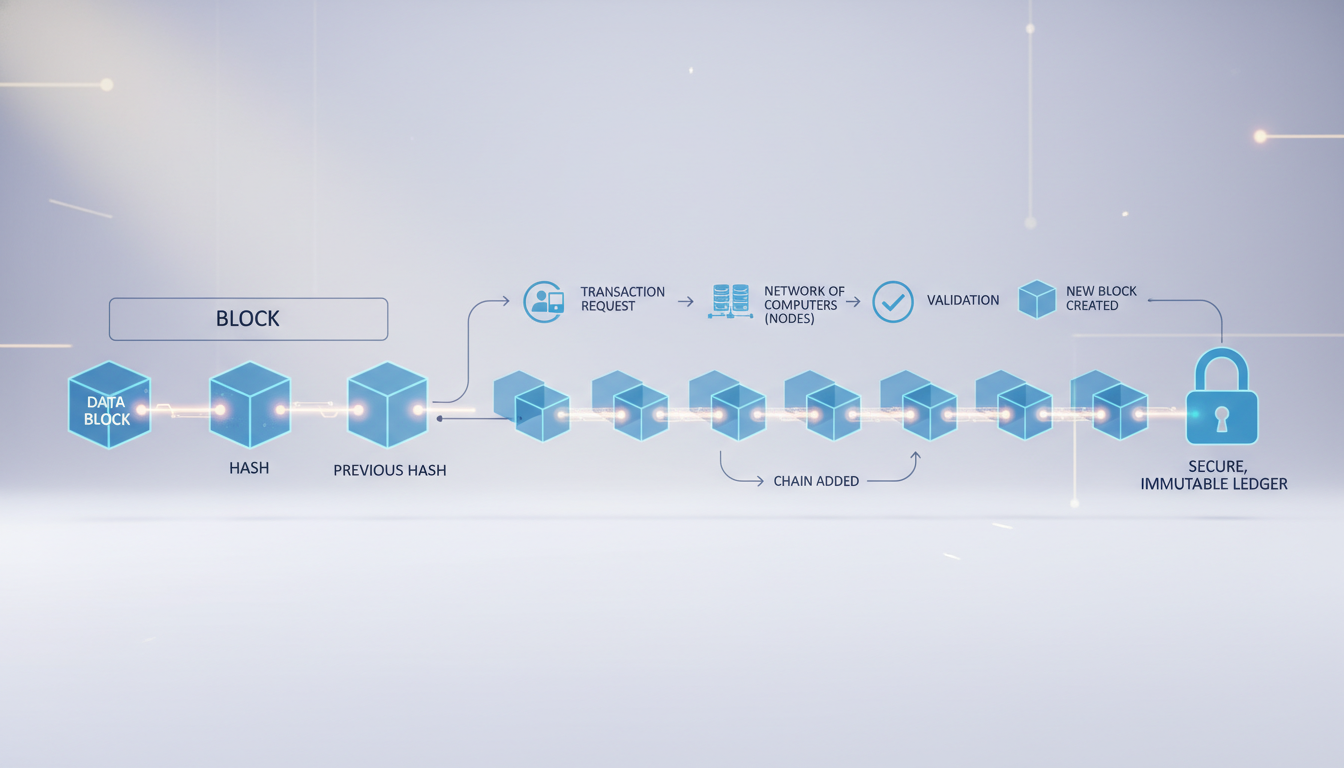
Understanding what is blockchain in practice means tracing a transaction from initiation to finality. The process breaks into three stages.
Step 1: A Transaction Is Initiated
A user broadcasts a request to the peer-to-peer network. This could be a cryptocurrency transfer, a supply chain event, or a smart contract execution. Every node receives the request and begins validating it against predefined rules: checking digital signatures, confirming the sender holds sufficient funds, and verifying the transaction format conforms to the protocol specification.
Step 2: Verification and Consensus
Nodes validate the transaction collectively. On Bitcoin, they compete to solve a SHA-256 proof-of-work puzzle, expending real computational energy to earn the right to propose the next block. On Ethereum post-2022, validators are selected based on staked ETH under proof of stake, which reduced the network’s energy consumption by roughly 99% according to the Ethereum Foundation. Stanford Online notes that consensus algorithms are the “backbone of blockchain security,” preventing double-spending without any central authority. This shift from PoW to PoS is the most significant protocol-level change in blockchain history to date.
Step 3: A New Block Is Created and Appended
Validated transactions are grouped into a new block, assigned a unique hash, and linked to the previous block’s hash. The updated chain propagates across all nodes within seconds. Each new block added after a transaction increases the computational cost of reversing that transaction, creating what practitioners call “confirmations.” Bitcoin’s 6-confirmation standard, for instance, makes reversal statistically negligible for all practical purposes.
The Evolution of Blockchain Technology
From Bitcoin to Smart Contracts
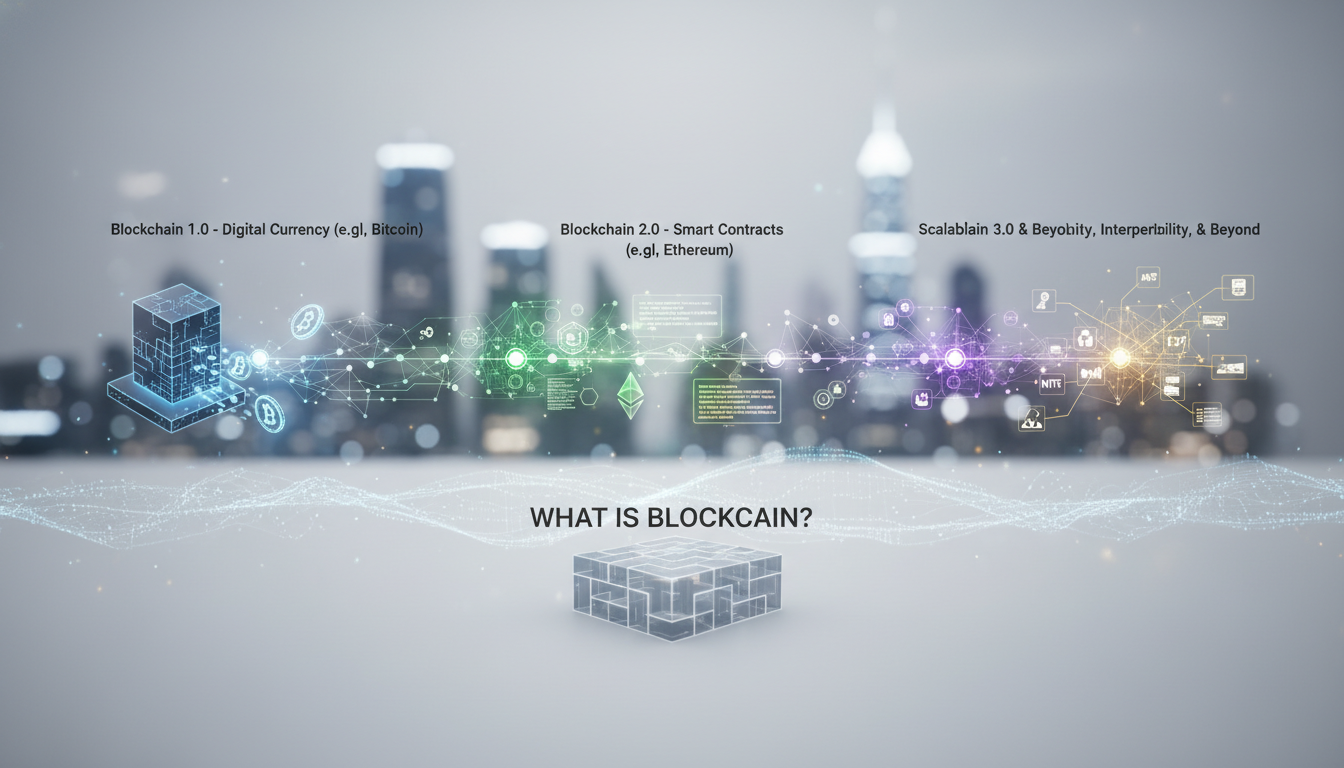
The first blockchain was conceptualized in 2008 by the pseudonymous Satoshi Nakamoto and launched as Bitcoin in January 2009. It solved the double-spending problem for digital currency without requiring a central bank or clearinghouse. Six years later, in 2015, Ethereum introduced programmable smart contracts: self-executing agreements with terms written directly in Solidity code. That single innovation expanded what is blockchain from a payment rail into a general-purpose computation layer, enabling decentralized applications (dApps) and complex financial instruments that run autonomously on-chain.
The Rise of DeFi and NFTs
By 2020, decentralized finance protocols like Uniswap and Aave were offering lending, borrowing, and automated market-making without intermediaries. Non-fungible tokens (NFTs) followed, enabling provable digital ownership of unique assets. DeFiLlama data shows that total value locked across DeFi protocols peaked above $100 billion during the 2021 cycle, demonstrating real capital commitment to on-chain financial infrastructure. According to Statista data cited by IBM Think, the blockchain market is projected to reach nearly $1 trillion by 2032, with a CAGR of 56.1% since 2021.
“Blockchain technology is forecast to grow to nearly 1 trillion US dollars by 2032, with a compound annual growth rate (CAGR) of 56.1% since 2021.” — Statista, cited by IBM Think
Types of Blockchain Networks

Choosing the right network architecture is the first real decision any builder faces. What is blockchain in enterprise context often means a private or consortium chain, not the open public networks most people picture.
Public Blockchains
Public blockchains like Bitcoin and Ethereum are permissionless: anyone can join, validate transactions, and read the full ledger. They are maximally decentralized and rely on economic incentives to secure the network. The tradeoff is throughput. Bitcoin’s base layer processes roughly 7 transactions per second by design, prioritizing security and decentralization over raw speed. Ethereum’s base layer handles 15-30 TPS, though layer-2 rollups push effective throughput into the thousands.
Private and Consortium Blockchains
Private blockchains restrict participation to invited nodes. They run faster consensus protocols like PBFT or Raft, achieving thousands of transactions per second, but they sacrifice the trust guarantees that come from open participation. Consortium blockchains, such as Hyperledger Fabric, are governed by a defined group of organizations rather than a single owner. As Fidelity Learn explains, private networks suit enterprise use cases where confidentiality matters: a pharmaceutical supply chain tracking drug provenance, for instance, has no reason to expose commercial pricing data to competitors on a public ledger.
| Feature | Public Blockchain | Private Blockchain |
|---|---|---|
| Access | Permissionless; anyone can join | Permissioned; invitation required |
| Decentralization | High | Low to moderate |
| Consensus | Proof of Work, Proof of Stake | PBFT, Raft, etc. |
| Transaction Speed | 7-30 TPS base layer | Thousands TPS possible |
| Use Cases | Cryptocurrencies, DeFi, NFTs | Enterprise supply chains, healthcare |
Pros and Cons of Blockchain
Pros
- Tamper-proof records: Cryptographic hashing makes historical data practically immutable once confirmed, ideal for audit trails and compliance.
- Eliminated intermediaries: Smart contracts automate trust, removing brokers, clearinghouses, and reconciliation teams from many workflows.
- Transparency on demand: Public blockchains give every participant read access to the full transaction history, reducing information asymmetry.
- Resilience: No single server to take down. The Bitcoin network has maintained over 99.9% uptime since 2009 according to on-chain data.
- Programmable money: DeFi protocols built on Ethereum demonstrate that financial logic can run autonomously, 24/7, without business hours or bank holidays.
Cons
- Throughput limits: Public blockchains sacrifice speed for security. Base-layer Bitcoin and Ethereum cannot match the thousands of TPS a centralized payment processor handles.
- Energy consumption: Proof-of-work chains like Bitcoin consume significant electricity. This is a genuine environmental tradeoff, not a minor footnote.
- Irreversibility: Immutability cuts both ways. Sending funds to a wrong address or a buggy smart contract is often permanent, with no customer support to call.
- Complexity and cost: Deploying and auditing smart contracts requires specialized expertise. A single audit from a reputable firm can cost $20,000 to $150,000 depending on contract complexity.
- Regulatory uncertainty: As of 2026, regulatory frameworks across jurisdictions remain inconsistent, creating compliance risk for builders and enterprises alike.
Key Benefits of Blockchain in Practice
Trust and Transparency
All authorized participants share a single source of truth. Disputes shrink because no party can present a different version of the ledger. Walmart’s food traceability program, built on Hyperledger Fabric, reduced the time to trace a food item from farm to shelf from days to seconds. That speed matters enormously during a contamination recall, where hours translate directly into public health outcomes.
Security and Immutability
Cryptographic hashing and distribution make records tamper-proof at the protocol level. Even if one node is compromised, thousands of others maintain the correct ledger state. Amazon Web Services highlights that blockchain “creates an unalterable ledger” ideal for financial reconciliations. The Bitcoin blockchain has never been successfully attacked at the protocol level since its 2009 launch, a 15-plus-year track record no centralized database can match.
“All transactions must be approved by both parties and are automatically updated in both of their ledgers in real time.” — AWS Blockchain
Efficiency and Automation via Smart Contracts
Smart contracts eliminate manual processing steps. Insurance claims can be auto-verified against policy terms and settled in minutes rather than weeks. In trade finance, payment release triggers automatically when IoT sensors confirm delivery. The Singapore Exchange Limited used blockchain to automate interbank payment reconciliation, eliminating manual errors from thousands of daily transactions. That kind of operational gain is why enterprises are willing to absorb the complexity cost of blockchain adoption.
What Is Blockchain Used For? Real-World Applications
Finance and Banking
Beyond cryptocurrency, what is blockchain doing in traditional finance? Quite a lot. J.P. Morgan’s Onyx platform moves billions in wholesale payments using blockchain rails, compressing settlement from T+2 days to near-instant finality. Cross-border remittances, which traditionally lose 5-7% to fees and conversion costs, are being rebuilt on public and consortium chains. Securities settlement, trade finance, and syndicated loans are all active deployment areas as of 2026.
Supply Chain Management
Carrefour uses blockchain to trace chicken through its supply chain, giving consumers verifiable organic certification via a QR code scan. Each participant inputs data at each custody transfer, creating an unbroken, auditable chain. This accelerates product recalls from days to hours and shifts the burden of proof from paper documents to cryptographically signed on-chain records. For a deeper look at how tokenization intersects with supply chain, see our analysis of asset tokenization on Digital Blockchains.
Healthcare and Energy
Patient records stored on a private blockchain can be shared securely between hospitals, reducing redundant diagnostic tests and protecting sensitive data. In energy, peer-to-peer trading platforms like Brooklyn Microgrid let solar panel owners sell excess power to neighbors via blockchain-settled transactions, bypassing the utility as intermediary. Sony Music uses blockchain for copyright management, ensuring artists receive royalty payments automatically through smart contracts rather than waiting on quarterly reporting cycles.
Blockchain vs. Traditional Databases
Structure and Control
Traditional SQL and NoSQL databases are centrally managed, making them efficient but vulnerable to insider manipulation and single-point failures. Blockchain distributes control so no single party can corrupt the record. The tradeoff is real: a centralized database can execute complex queries in milliseconds, while a blockchain write requires network-wide consensus. For mission-critical business logic requiring speed, a centralized database often wins. For trust-critical record-keeping where multiple parties need to agree on a shared history, blockchain is the stronger architecture.
Performance and Scalability
A centralized database handles thousands to millions of transactions per second. Public blockchains prioritize security over throughput at the base layer. Layer-2 solutions are closing this gap fast: Lightning Network enables Bitcoin micropayments at scale, while Ethereum’s optimistic and ZK rollups achieve 1,000-plus TPS while inheriting base-layer security. As of 2026, many enterprises opt for consortium blockchains that balance speed with decentralized trust, running PBFT consensus at thousands of TPS while keeping the auditability guarantees that make blockchain worth deploying. For more on how smart contracts power these systems, read our smart contracts deep-dive on Digital Blockchains.
The Future of Blockchain Technology
Scalability and Interoperability
The next phase of blockchain development centers on connecting isolated networks. Projects like Polkadot and Cosmos are building cross-chain messaging protocols that allow assets and data to move between blockchains without centralized bridges. Zero-knowledge proofs, particularly ZK-SNARKs and ZK-STARKs, are enabling private, verifiable computation at scale. Sharding, implemented in various forms across Ethereum and other chains, partitions the network into parallel processing lanes. These three vectors, cross-chain interoperability, ZK cryptography, and sharding, will define blockchain’s technical trajectory through 2030 and beyond.
Integration with AI and IoT
Blockchain’s role in AI is emerging as a data provenance layer. Training data authenticated on-chain can be traced to its source, which matters enormously for combating synthetic media and ensuring model integrity. In IoT, devices can transact autonomously: a smart meter settling energy consumption in real time, or a logistics sensor triggering payment release on delivery. The combination of blockchain’s trust layer with AI’s inference capabilities and IoT’s sensor data creates infrastructure for autonomous economic agents operating without human oversight at each step.
What is blockchain in 2026? It’s the trust infrastructure layer of the internet. Its ability to provide secure, transparent, and programmable record-keeping has already restructured finance, and its integration into AI, IoT, and cross-chain systems is accelerating. With a market trajectory toward $1 trillion by 2032, the builders who understand the protocol deeply today are the ones who will architect what comes next.
If you’re building on blockchain infrastructure or designing a token system, apply to the Genesis Cohort at Digital Blockchains and work with a team that reads the whitepapers and deploys the contracts.
Frequently Asked Questions
What is blockchain in simple words?
Blockchain is a digital ledger shared across a network of computers, where each record is cryptographically linked to the one before it, making the history tamper-proof without requiring a central authority. Think of it as a shared notebook that thousands of people hold simultaneously: everyone can read it, but no one can secretly erase or alter a past entry.
How does blockchain ensure security?
Security comes from three layers working together: cryptographic hashing links each block to the previous one, decentralization means there is no single server to attack, and consensus mechanisms require network-wide agreement before any new data is accepted. Altering a past record would require recomputing every subsequent block’s hash while simultaneously outpacing the rest of the network, which is computationally infeasible on any major public chain.
What is the difference between blockchain and Bitcoin?
Bitcoin is a cryptocurrency application built on top of blockchain technology. Blockchain is the underlying distributed ledger protocol; Bitcoin is one specific implementation of it. The relationship is similar to the internet and email: email is one application that runs on internet infrastructure, not the infrastructure itself.
Can blockchain be hacked?
The protocol layer of major public blockchains has proven extremely resilient. Attacking Bitcoin’s base layer would require controlling more than 50% of the global hash rate, which represents billions of dollars in hardware and energy costs. Most successful attacks target smart contract vulnerabilities, exchange custodians, or bridge protocols, not the underlying blockchain consensus itself.
What are smart contracts and how do they work?
Smart contracts are programs deployed on a blockchain that execute automatically when predefined conditions are met, with no intermediary required. Written in languages like Solidity for Ethereum, they encode agreement logic directly on-chain: an insurance payout triggers when verified weather data confirms a flood, or a token transfer releases when a delivery is confirmed. Once deployed, the code runs exactly as written, which makes auditing the code before deployment critical.
What industries benefit most from blockchain?
Finance sees the clearest near-term returns through faster settlement and automated compliance. Supply chain management benefits from end-to-end traceability and fraud reduction. Healthcare gains from secure, interoperable patient data. Energy markets are being restructured by peer-to-peer trading platforms. As of 2026, financial services and logistics remain the two sectors with the deepest enterprise blockchain deployments by transaction volume.