Key Takeaways
- Blockchain development involves creating decentralized, immutable ledgers that power cryptocurrencies, DeFi applications, and enterprise solutions.
- Median U.S. salary for blockchain developers reached $136,000 in 2026, with demand outpacing supply.
- A structured roadmap can take beginners from zero to job-ready in 10 months, focusing on core programming, Solidity/Rust, and dApp deployment.
- Step-by-step development requires use case validation, consensus selection, and rigorous security auditing.
- Key languages include Go, Rust, Solidity, and JavaScript, while platforms like Ethereum, Hyperledger Fabric, and Solana dominate the ecosystem.
- Smart contract vulnerabilities like reentrancy and integer overflow remain the leading cause of on-chain exploits, making security-first development non-negotiable.
Develop blockchain is the process of designing, coding, and launching a distributed digital ledger that records transactions securely across a peer-to-peer network. It merges cryptography, economic incentives, and consensus algorithms to create tamper-resistant systems.
What Is Blockchain Development?

Defining the Core Concept
Blockchain development is building the infrastructure and applications that run on a distributed ledger. A blockchain is a continuously growing list of records, called blocks, linked using cryptography. Each block contains a hash of the previous block, a timestamp, and transaction data. This structure makes the chain immutable: once data is recorded, it cannot be altered retroactively without changing all subsequent blocks, which requires consensus from the majority of the network. Developers who build blockchain solutions must understand these fundamentals to ensure data integrity and security.
The Anatomy of a Blockchain Network
A typical blockchain network includes nodes (computers that maintain a copy of the ledger) and a consensus mechanism that validates transactions. The two most common node types are full nodes, which store the entire chain, and light nodes, which keep only block headers for efficiency. In public blockchains like Bitcoin and Ethereum, anyone can participate, while private blockchains restrict access to authorized entities. When you set out to develop blockchain applications, choosing between public, private, or consortium architectures is a critical early decision that affects scalability, governance, and compliance.
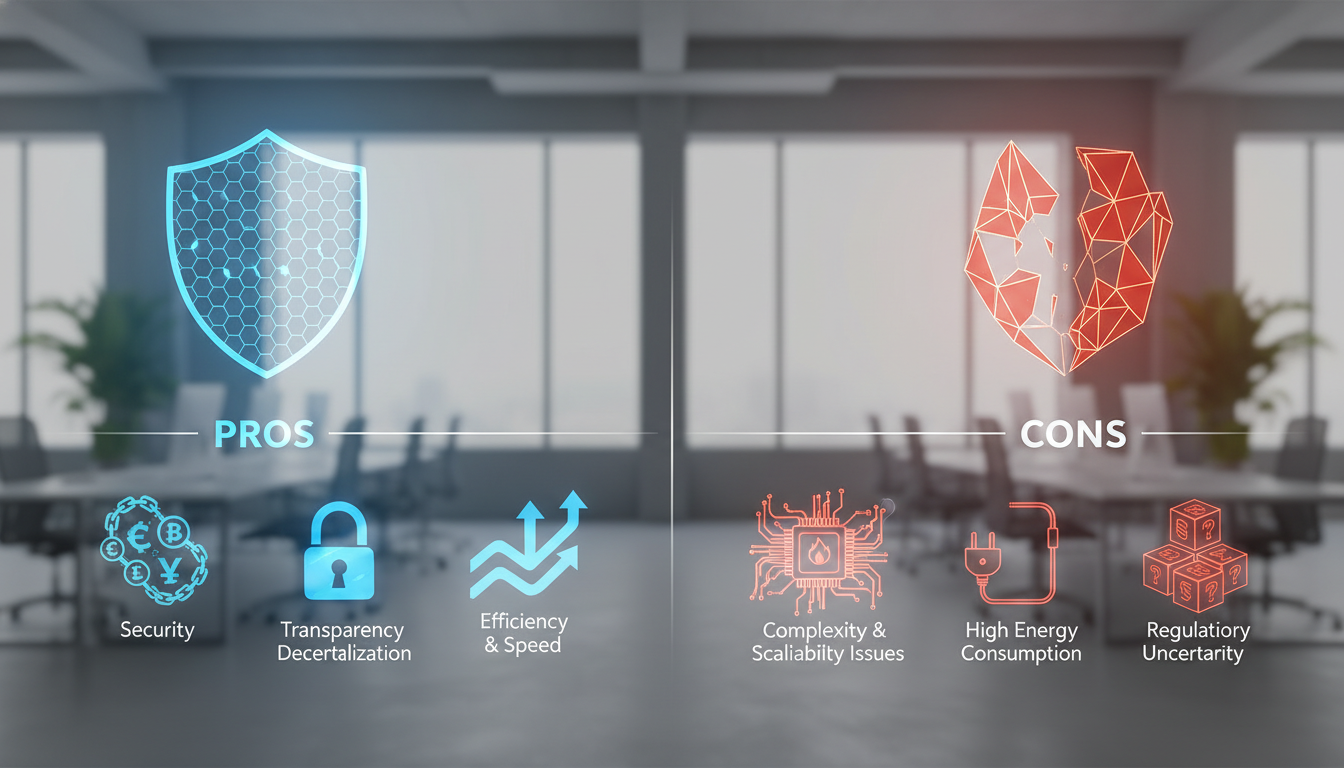
Pros and Cons of Blockchain Development
Pros
- Tamper-resistant records: Cryptographic linking of blocks makes retroactive data manipulation computationally infeasible without network consensus.
- Reduced intermediaries: Smart contracts automate trust, cutting transaction costs in cross-border payments and multi-party workflows.
- High availability: Distributed node architecture means no single point of failure; the network keeps running even when individual nodes go offline.
- Transparent audit trails: Every state change is permanently recorded and publicly verifiable, which is invaluable for supply chain and compliance use cases.
- Thriving ecosystem: Mature tooling (Hardhat, Foundry, OpenZeppelin), active developer communities, and Layer 2 scaling solutions accelerate time-to-production.
Cons
- Scalability constraints: Base-layer throughput on networks like Ethereum is measured in tens of transactions per second, far below traditional database benchmarks.
- Complexity overhead: Consensus design, gas optimization, and key management add significant engineering complexity compared to centralized stacks.
- Irreversibility risk: Bugs deployed to mainnet are permanent. A single reentrancy vulnerability can drain millions before a fix is possible.
- Regulatory uncertainty: Evolving frameworks like the EU’s MiCA and the U.S. SEC’s stance on digital assets create compliance risk that requires ongoing legal review.
- Energy and cost trade-offs: Proof of Work chains carry real energy costs; even Proof of Stake networks charge gas fees that can spike under load.
Why Develop a Blockchain Solution?

Business Advantages Over Traditional Databases
Traditional databases rely on a central authority, creating single points of failure and bottlenecks. Blockchain technology distributes data across a network, enhancing fault tolerance and transparency. Systems built on blockchain reduce the need for intermediaries, cutting transaction costs significantly in cross-border payments, according to industry research. The immutability feature provides an audit trail that is invaluable for supply chain and healthcare records. When organizations develop blockchain networks, they gain a secure, shared source of truth that streamlines reconciliation and minimizes disputes.
The decentralized nature also improves resilience. Even if some nodes go offline, the network continues functioning. This makes blockchain an attractive infrastructure for applications requiring high availability, such as decentralized finance (DeFi) platforms running 24/7.
Real-World Industry Applications
From finance to logistics, industries use blockchain to solve trust and traceability problems. In supply chain, IBM’s Food Trust network uses blockchain to track produce from farm to shelf, reducing contamination response times from weeks to seconds. In healthcare, hospitals build blockchain systems to securely share patient data while maintaining HIPAA compliance. The energy sector is experimenting with peer-to-peer energy trading, where households buy and sell solar power via blockchain-based microgrids. Entertainment companies use non-fungible tokens (NFTs) to authenticate digital art and collectibles.
When Blockchain Is the Right Choice
Not every project needs a blockchain. The decision to develop blockchain infrastructure should be justified by specific needs: multiple untrusted parties sharing a database, the absence of a central trusted intermediary, or a hard requirement for tamper-proof audit trails. If the application can be built with a traditional database and a trusted third party, blockchain adds unnecessary complexity. Experts recommend starting with a feasibility study that weighs the costs of network maintenance, latency, and energy consumption against the concrete benefits.
Prerequisites for Blockchain Development

Essential Programming Skills
To develop blockchain systems effectively, proficiency in one or more programming languages is mandatory. The most widely used languages include Go (Hyperledger Fabric, Ethereum clients), Rust (Solana, Polkadot), and C++ (Bitcoin Core). For smart contract development, Solidity dominates the Ethereum ecosystem, while Vyper offers a simpler Python-like alternative. Front-end and middleware developers often use JavaScript, Python, and TypeScript, with frameworks like React and Vue for dApp interfaces. According to the Coursera blockchain developer guide, a solid foundation in object-oriented programming and version control (Git) is the essential first step.
Understanding Cryptography and Decentralized Systems
Cryptographic hashing (SHA-256, Keccak-256) and public-key cryptography are the security foundation of every blockchain. Developers must grasp how digital signatures verify transactions and how Merkle trees efficiently prove data integrity. Decentralized systems design involves peer-to-peer networking, fault tolerance, and Byzantine fault tolerance algorithms. A course like the Blockchain Revolution Specialization on Coursera covers these concepts in as little as two months, giving learners hands-on experience with consensus mechanisms and digital assets.
“A focused two-month period can be enough to grasp the essentials of blockchain, smart contracts, and decentralized applications, especially when guided by structured coursework.” — Coursera’s Blockchain Revolution Specialization.
Learning Data Structures and Algorithms
Linked lists, hash maps, and trees are core data structures used in blockchains. Since a blockchain is essentially a linked list of blocks, understanding pointers and hashing is crucial. Time complexity knowledge helps when designing efficient smart contracts that minimize gas fees. Many developers who build blockchain solutions recommend practicing on platforms like LeetCode or HackerRank to sharpen algorithmic thinking before tackling consensus protocol design.
A Step-by-Step Guide to Develop Blockchain Solutions
Most projects that develop blockchain networks follow a structured lifecycle. Here is a proven 5-stage process that enterprise teams use to go from ideation to production.
- Identify the use case and feasibility study: Define the problem, the stakeholders, and why blockchain is the best solution. Conduct cost-benefit analysis and risk assessment.
- Design the architecture and protocol: Choose the blockchain type (public, private, consortium), select a consensus mechanism (PoW, PoS, PoA), and plan node distribution, storage, and network topology.
- Develop smart contracts and chaincode: Code the business logic in Solidity, Rust, or Go. Use frameworks like Hardhat or Truffle for testing and debugging.
- Integrate and test: Connect frontend and backend via APIs (Alchemy, Infura), perform unit testing, integration testing, and security audits using tools like Slither and Echidna.
- Deploy and maintain: Launch on mainnet or a private network, monitor performance, and plan for upgrades and governance.
Step 1: Identify a Valid Use Case
Before writing a single line of code, document the problem statement and expected ROI. Ask whether the solution requires multi-party consensus, immutable audit trails, or automated enforcement via smart contracts. During this phase, many teams realize that a traditional database suffices, saving significant resources. For those who decide to develop blockchain applications, this clarity prevents scope creep and keeps the architecture honest.
Step 2: Choose a Consensus Protocol
Consensus algorithms determine how nodes agree on the ledger’s state. Proof of Work (PoW) provides high security but consumes massive energy. Proof of Stake (PoS) is more efficient and used by Ethereum, Solana, and Cardano. Solana’s Proof of History (PoH) is worth special attention: it creates a cryptographic timestamp sequence that allows validators to agree on event ordering without communicating in real time, enabling the network’s sub-second finality of roughly 0.4 seconds. For private blockchains, Practical Byzantine Fault Tolerance (PBFT) or Raft are common choices. When you develop blockchain systems, always match the consensus mechanism to the non-functional requirements: performance, energy footprint, and trust model.
Step 3: Design the Blockchain Architecture and Nodes
Decide on on-chain vs. off-chain storage, the type of database (LevelDB, MongoDB), and the node configuration. Full nodes provide maximum security but demand more storage; light nodes improve scalability. If interoperability is key, consider sidechains, bridges, or a Layer 2 solution like Optimistic Rollups or zk-Rollups. This stage also involves token design (native currency, utility tokens, NFTs) and defining the governance model. Tokenomics decisions made here, including supply caps, emission schedules, and staking incentives, directly affect long-term network health and miner or validator participation.
Smart Contract Security: Vulnerabilities You Must Know
Smart contract security is the most consequential skill gap in blockchain development. A single bug deployed to mainnet is permanent and exploitable. The 2022 Axie Infinity Ronin bridge hack and the Wormhole exploit together resulted in losses exceeding $1 billion, according to on-chain data from Chainalysis. Understanding the attack vectors is non-negotiable before you develop blockchain applications for production.
Reentrancy Attacks
Reentrancy is the most notorious Solidity vulnerability. It occurs when an external contract call is made before the internal state is updated, allowing the callee to re-enter the function and drain funds. The 2016 DAO hack exploited exactly this pattern, draining roughly 3.6 million ETH. The fix is simple in principle: follow the Checks-Effects-Interactions pattern and use OpenZeppelin’s ReentrancyGuard modifier.
// Vulnerable pattern
}

}
Integer Overflow and Underflow
Before Solidity 0.8.0, arithmetic operations could silently wrap around. An attacker could cause an unsigned integer to underflow from 0 to 2^256-1, effectively granting unlimited token balances. Solidity 0.8.x introduced built-in overflow checks, but developers using older contracts or assembly blocks must still apply SafeMath or equivalent guards manually.
Access Control Failures
Missing or misconfigured access modifiers are responsible for a large share of DeFi exploits. Functions that should be restricted to contract owners or governance multisigs are accidentally left public. Always use OpenZeppelin’s Ownable or AccessControl modules, and audit every external and public function for unintended exposure.
“The majority of smart contract vulnerabilities we see in audits are not exotic zero-days. They are well-documented patterns like reentrancy and access control failures that developers simply did not check for.” — Trail of Bits, Smart Contract Security Audit Findings.
Choosing the Right Tech Stack for Blockchain Development
Core Programming Languages
Go, Rust, and C++ lead the back-end development of blockchain clients, while Vyper and Solidity are essential for EVM-compatible smart contracts. Python and JavaScript are widely used for testing, scripting, and dApp frontends. The table below summarizes the most popular languages and their primary use cases.
| Language | Primary Use | Example Platforms |
|---|---|---|
| Go | Blockchain clients, chaincode | Hyperledger Fabric, Ethereum (Geth) |
| Rust | High-performance runtime, smart contracts | Solana, Polkadot, Near |
| C++ | Core protocol implementation | Bitcoin Core, EOS |
| Solidity | Smart contracts (EVM) | Ethereum, BNB Chain, Avalanche |
| JavaScript | dApp frontend, testing | Web3.js, Ethers.js, Hardhat |
Smart Contract Development Frameworks
Frameworks streamline the workflow to develop blockchain logic. Hardhat, a JavaScript-based environment, offers built-in testing and Solidity debugging. Truffle provides an integrated asset pipeline and a local blockchain simulator called Ganache. Foundry (Rust-based) is gaining traction for its speed and fuzzing capabilities. These tools handle compilation, deployment, and automated testing, accelerating development cycles significantly.
Blockchain Platforms and Ecosystems
The choice of platform shapes the project’s scalability, cost, and ecosystem support. The table below compares leading blockchain platforms for general development.
| Platform | Consensus | Transaction Finality | Best For |
|---|---|---|---|
| Ethereum | PoS (Casper) | ~12 seconds | DeFi, NFTs, general dApps |
| Hyperledger Fabric | PBFT | Sub-second | Enterprise, supply chain |
| Solana | PoH + PoS | ~0.4 seconds | High-frequency trading, gaming |
| Polygon | PoS + Plasma | ~2 seconds | Scalable Ethereum sidechain |
| BNB Chain | PoSA | ~3 seconds | Low-fee dApps, token launches |
When you develop blockchain applications, the platform’s transaction fees (gas) and throughput must align with user expectations. A DeFi protocol expecting high-frequency micro-transactions will have very different platform requirements than an enterprise supply chain tracker.
Best Practices for Secure and Efficient Blockchain Development
Security Auditing and Testing
Blockchain exploits can result in significant financial losses, as demonstrated by the 2022 hacks of the Axie Infinity Ronin bridge and Wormhole token bridge. To mitigate risks, developers must integrate automated tools like Slither for static analysis, Echidna for fuzzing, and formal verification for critical contracts. Third-party security audits from firms like OpenZeppelin or Trail of Bits are mandatory before mainnet deployment. A rigorous process to develop blockchain software includes writing comprehensive unit tests and using testnets like Sepolia to simulate attacks before any real value is at stake.
Gas Optimization and Performance
Every opcode in a smart contract costs gas, and inefficient code drives up transaction fees for every user. Developers should batch operations, minimize storage writes, and use libraries like OpenZeppelin’s optimized contracts. Using uint256 instead of smaller integer types can sometimes save gas due to how the EVM packs data. Performance tuning also involves choosing the right data structures off-chain: MongoDB’s document model is often paired with blockchain indexing services like The Graph to provide fast querying without burdening the chain.
Sustainable Development and Energy Efficiency
As environmental concerns grow, the pressure to develop blockchain solutions with low carbon footprints intensifies. Proof of Stake networks like Ethereum and Solana consume a fraction of the energy compared to Proof of Work equivalents. Many enterprise clients now mandate sustainability criteria in RFPs. Layer 2 solutions and sidechains reduce mainnet load, further decreasing energy use per transaction. Green blockchain initiatives are becoming a genuine differentiator for public and private chains competing for institutional adoption.
Career Path: How to Become a Blockchain Developer in 2026
Learning Roadmaps and Educational Resources
Aspiring developers can follow the blockchain developer roadmap on roadmap.sh, which has been starred over 355,000 times on GitHub and used by 2.8 million developers. The roadmap covers topics from blockchain basics and cryptography to advanced scaling solutions like zk-Rollups. Complementing this with hands-on projects, such as building a simple token on Ethereum, accelerates skill acquisition. A well-structured path can take a motivated beginner from zero to job-ready in approximately 10 months, as outlined by educators like Programming with Mosh. For a deeper look at how protocol-level architecture decisions shape career specializations, see our guide on blockchain protocol fundamentals.
Certifications, Degrees, and Online Courses
A bachelor’s degree in computer science remains the traditional route, but certifications like the Certified Blockchain Developer (CBD) from EC-Council or the ConsenSys Academy programs provide targeted credentials. Platforms like Coursera offer specializations in blockchain, completing in roughly two months on a part-time schedule. Many developers supplement formal education with open-source contributions to demonstrate expertise when they develop blockchain projects publicly. A strong GitHub portfolio of deployed contracts often carries more weight with hiring teams than a certificate alone.
Salary Insights and Job Market Trends
“The median annual salary for blockchain developers in the United States reached $136,000 in 2026, reflecting the premium placed on decentralized technology skills.” — Data from Coursera’s 2026 blockchain developer report.
Job postings continue to rise across DeFi startups, traditional finance, and cloud providers like AWS and Microsoft, which now offer managed blockchain services. Remote work options have widened the talent pool, with many developers based in Eastern Europe, India, and Southeast Asia commanding competitive rates. To stay competitive, experts recommend learning Rust for high-performance chains and mastering zero-knowledge proofs. For teams looking to build production-ready systems, our blockchain studio works with serious builders at every stage.
Overcoming Challenges in Blockchain Development
Scalability and Interoperability
The blockchain trilemma, balancing decentralization, security, and scalability, remains a core engineering challenge. Layer 2 rollups, sharding, and state channels offer solutions, but they add meaningful complexity. Inter-blockchain communication protocols like IBC and cross-chain bridges enable asset transfers, but early implementations suffered from significant hacks. When teams develop blockchain solutions, thorough testing of these integrations is critical to avoid security gaps that attackers will find before you do.
Regulatory and Compliance Hurdles
Unclear regulations around digital assets and smart contracts create legal risks that cannot be ignored. The European Union’s MiCA framework and the U.S. SEC’s evolving stance require developers to build with compliance in mind, such as implementing identity verification layers on permissioned chains. Some enterprises opt for hybrid models that combine public verification with private data storage to meet GDPR requirements. As of 2026, legal review is no longer optional for any protocol handling user funds.
User Adoption and UX Design
Mainstream users often struggle with seed phrases, gas fees, and complex wallet setups. To develop blockchain apps with mass appeal, UX designers focus on abstracting these details through account abstraction (EIP-4337), gasless transactions, and fiat on-ramps. Platforms like Biconomy and OpenZeppelin Defender help developers improve user experience while maintaining security. The gap between crypto-native UX and consumer-grade UX is still measured in years of friction, and closing it is one of the most valuable skills in the ecosystem right now.
Future Trends in Blockchain Development
AI and Machine Learning Integration
The convergence of AI and blockchain is creating autonomous smart contracts that adjust parameters in real time based on data oracles. AI-powered auditing tools can detect vulnerabilities faster than manual reviews, catching classes of bugs that static analyzers miss. As more organizations develop blockchain systems, embedding AI modules for fraud detection and credit scoring within DeFi protocols will become standard practice rather than a differentiator.
Low-Code and No-Code Development Platforms
Platforms like Moralis, thirdweb, and Alchemy’s latest suite enable developers to build blockchain applications with minimal boilerplate. Drag-and-drop smart contract builders and pre-configured templates are lowering the barrier to entry, allowing non-technical teams to launch tokens, DAOs, and NFT marketplaces. These tools accelerate prototyping, but complex custom logic still requires traditional coding. They are a complement to skilled developers, not a replacement.
Enterprise Adoption and Tokenized Real-World Assets
Fortune 500 companies continue integrating blockchain into supply chain, identity, and finance workflows. Private and consortium blockchains provide the controlled environments needed for regulatory compliance. Updated for 2026, the most significant trend is the tokenization of real-world assets (RWA): bonds, real estate, and commodities being represented on-chain. Some analysts project this market could reach multi-trillion-dollar scale within the decade, though precise timelines remain speculative. What is clear from on-chain data is that institutional wallet activity on permissioned chains has grown substantially year-over-year.
Frequently Asked Questions
What exactly does a blockchain developer do?
A blockchain developer writes, tests, and deploys software that runs on distributed ledger technology. This includes core protocol development, smart contract coding, and building decentralized applications (dApps) that interact with the blockchain. Some specialize in protocol-layer work (consensus, networking), while others focus on application-layer smart contracts and user interfaces.
How long does it take to learn blockchain development?
With a focused learning path, motivated beginners can acquire the fundamentals in as little as two months. A complete roadmap to become job-ready typically spans 10 months, covering programming foundations, smart contracts, security, and project work. Consistent daily practice and building real projects compress that timeline considerably.
Which programming language is best for blockchain development?
Solidity is the standard for Ethereum smart contracts, while Rust and Go are preferred for high-performance blockchain protocol development. JavaScript and Python are essential for front-end interfaces and testing scripts. Most professional blockchain developers are proficient in at least two of these languages.
Is blockchain development a good career in 2026?
Yes, blockchain development remains a high-demand field with strong salary growth. The median U.S. salary of $136,000 and expanding enterprise adoption make it a financially rewarding career path. Specializations in zero-knowledge proofs and cross-chain protocol design command even higher rates.
Do I need a degree to become a blockchain developer?
A computer science degree is beneficial but not mandatory. Many successful developers are self-taught, backed by certifications, bootcamps, and a strong portfolio of open-source blockchain projects. Hiring teams consistently prioritize demonstrated on-chain work over academic credentials.
How much does it cost to develop a blockchain application?
Costs vary widely. A simple dApp may cost $15,000 to $50,000, while a custom enterprise blockchain platform can exceed $200,000. Key factors include complexity, platform choice, security audit scope, and ongoing maintenance requirements.