The development of blockchain is the systematic engineering of decentralized ledger systems that enable trustless, transparent transactions without intermediaries. This process encompasses protocol architecture, consensus implementation, smart contract deployment, and network security, transforming how we build financial systems, supply chains, and digital identity platforms.
Key Takeaways
- The of blockchain extends far beyond cryptocurrencies, it powers smart contracts, DeFi protocols, supply chain tracking, and decentralized identity systems.
- Core blockchain developers build protocol-level infrastructure, while application developers create user-facing dApps and smart contracts on existing networks.
- A typical development lifecycle includes ideation, feasibility analysis, prototyping, coding, security auditing, deployment, and ongoing maintenance cycles.
- Modern blockchain platforms like Ethereum, Solana, and Polkadot support different consensus mechanisms, programming languages, and throughput capabilities.
- Interoperability between blockchains drives the these blockchain bridges and cross-chain protocols in 2026.
What Is the Development of Blockchain?

The such blockchain refers to the engineering discipline that creates and maintains distributed ledger systems. A blockchain is a shared, immutable digital ledger that records transactions and tracks assets across a business network. Developers use cryptographic hashing, consensus algorithms, and peer-to-peer networking to guarantee data integrity and trust without central authorities.
Core vs. Application Development
Two primary roles exist in the development of systems. A core blockchain developer designs the underlying protocol, consensus rules, and security patterns. An application blockchain developer builds smart contracts, decentralized applications (dApps), and user interfaces that interact with existing blockchains. Together they form the complete stack for working decentralized systems.
Key Components of a Blockchain System
- Distributed ledger – A database replicated across multiple nodes, ensuring no single point of failure.
- Consensus mechanism – The rule set that nodes follow to agree on the valid state (e.g., Proof of Work, Proof of Stake).
- Cryptographic hashing – Functions like SHA-256 link blocks together and secure transaction data.
- Smart contracts – Self-executing programs stored on the blockchain that automate agreements when conditions are met.
The History and Evolution of the Development of Blockchain

The Genesis: Bitcoin and the First Blockchain
The of blockchain began with the release of the Bitcoin whitepaper in 2008 by Satoshi Nakamoto. Bitcoin introduced a public, permissionless ledger that solved the double-spending problem without a central bank. The first block, the Genesis Block, was mined in January 2009, marking the operational start of this technology.
According to Statista research, blockchain technology is forecast to grow by nearly 1 trillion US dollars by 2032, with a compound annual growth rate (CAGR) of 56.1% since 2021.
Ethereum and the Rise of Smart Contracts
In 2015, the launch of Ethereum introduced smart contracts, turing-complete programs that run exactly as programmed without downtime, censorship, or fraud. This innovation transformed the these blockchain from a simple value-transfer system into a platform for decentralized applications. Ethereum’s ERC-20 token standard later fueled the ICO boom of 2017 and the growth of decentralized finance (DeFi).
The Modern Era: DeFi, NFTs, and Beyond
By 2020–2021, the development of blockchain had expanded into DeFi protocols (lending, trading, stablecoins), non-fungible tokens (NFTs), and decentralized autonomous organizations (DAOs). Newer platforms like Solana, Polkadot, and Avalanche introduced high throughput and cross-chain communication, pushing these systems into enterprise supply chains, identity verification, and gaming applications.
Key Stages in the Development of Blockchain
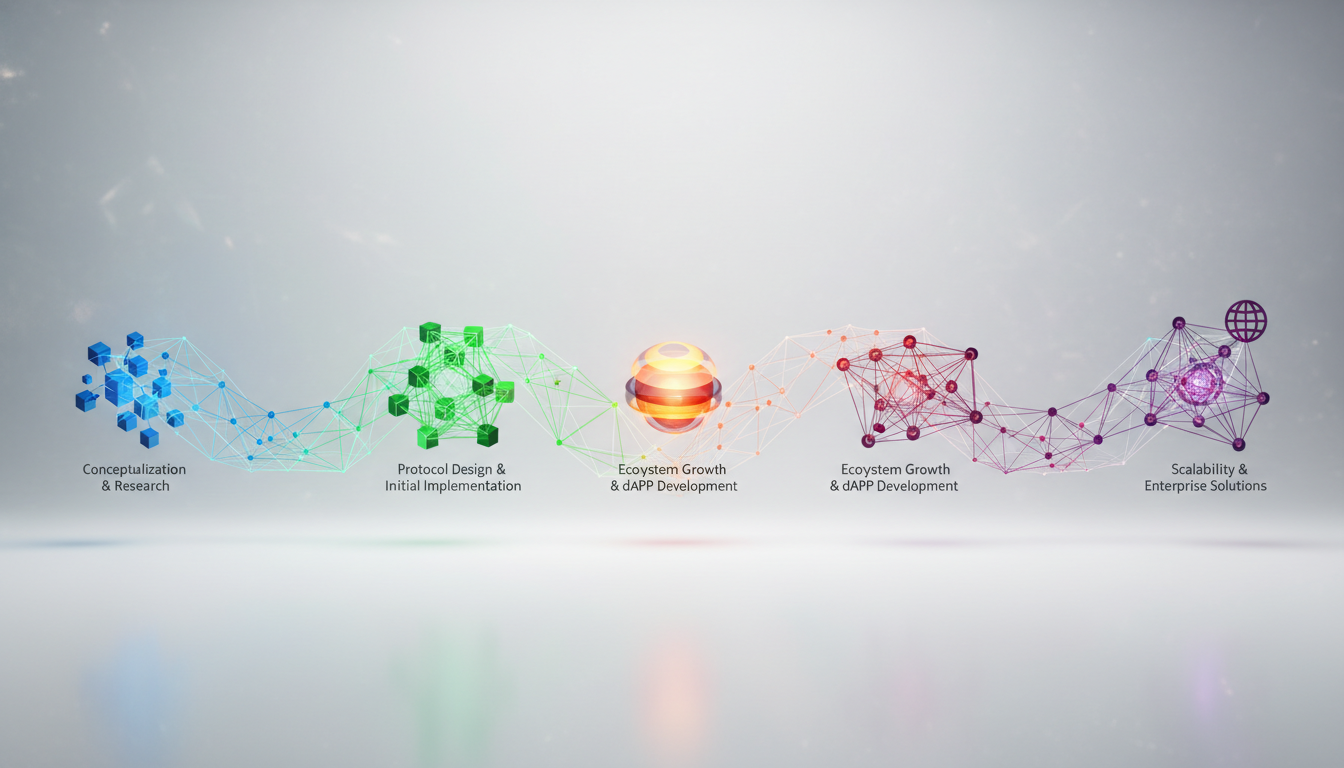
A structured development process reduces risk and ensures reliable products. The following seven stages are widely adopted across the industry for the development of blockchain systems:
Ideation and Feasibility Analysis
Every project starts with a clear problem statement. Developers evaluate whether a blockchain solution is actually needed, if a central database or existing ledger system can solve the problem, distributed ledgers may add unnecessary complexity. Feasibility includes assessing regulatory constraints and market demand for the proposed system.
Design, Prototyping, and Development
During design, architects choose the consensus algorithm (e.g., Proof of Stake, Delegated PoS), the programming language (Solidity, Rust, Vyper), and the network type (public, private, or consortium). A testnet prototype is built first, allowing developers to simulate transactions, stress-test the system, and refine tokenomics before going live on mainnet.
Deployment, Testing, and Maintenance
The mainnet launch follows a final security audit. Smart contracts are verified and often published on Etherscan or similar explorers. Post-deployment, developers monitor performance, deploy patches, and, if necessary, upgrade contracts through proxy patterns. Continuous maintenance ensures networks stay resilient against evolving threats.
Understanding Blockchain Architecture

Blocks, Chains, and Cryptographic Hashing
Data is grouped into blocks. Each block contains a cryptographic hash of the previous block, a timestamp, and transaction data (typically organized as a Merkle tree). Changing any block’s data would require recalculating all subsequent hashes and gaining network consensus, making the chain tamper-evident.
Decentralization and Node Networks
These systems run on peer-to-peer networks where each full node stores a copy of the ledger. Nodes validate and relay transactions. Decentralization eliminates single points of control and failure, which is why public blockchains can achieve high Byzantine fault tolerance.
Public, Private, and Consortium Blockchains
| Type | Access | Consensus | Use Cases | Example |
|---|---|---|---|---|
| Public (Permissionless) | Anyone can join and participate | PoW, PoS | Cryptocurrencies, DeFi | Bitcoin, Ethereum |
| Private (Permissioned) | Invitation-only, controlled by an organization | PBFT, Raft | Supply chain, internal audit | Hyperledger Fabric |
| Consortium | Multiple organizations share control | PBFT, Raft | Banking consortia, trade finance | R3 Corda |
Consensus Mechanisms Driving Modern Blockchains
Proof of Work (PoW) and Proof of Stake (PoS)
Proof of Work requires miners to solve computationally intensive puzzles; the first to solve gets to add the next block and receives a reward. Bitcoin uses PoW, but its high energy consumption has spurred alternatives. Proof of Stake selects validators based on the amount of cryptocurrency they hold and are willing to “stake.” According to the Ethereum Foundation, Ethereum’s shift to PoS in 2022 reduced its energy consumption significantly.
Byzantine Fault Tolerance (BFT) and Variants
BFT algorithms allow networks to reach consensus even if some nodes act maliciously. Practical Byzantine Fault Tolerance (PBFT) is used in permissioned networks like Hyperledger. Variants like Tendermint power fast-finality chains such as Cosmos.
Emerging Consensus Protocols
Newer platforms experiment with unique mechanisms. Proof of History (PoH), used by Solana, timestamps transactions before consensus, enabling sub-second finality. Delegated Proof of Stake (DPoS) elects a small set of validators to improve throughput (e.g., EOS, Tron). These innovations continue driving the development of blockchain scalability solutions.
Security Audits and Formal Verification in Blockchain Development
The Importance of Security Audits
Smart contract vulnerabilities have led to significant losses in the DeFi ecosystem. A mandatory security audit identifies re-entrancy, overflow, and front-running risks. Audits from firms like OpenZeppelin, Trail of Bits, and Quantstamp are standard before mainnet deployment in the development of blockchain applications.
Tools for Automated Analysis
Developers rely on static analysis tools such as Slither and Mythril to scan Solidity code for known bug patterns. Fuzzing frameworks like Echidna generate random transactions to test contract behavior under stress. These tools catch many low-hanging vulnerabilities before human auditors conduct deeper analysis.
Formal Verification Methods
Formal verification mathematically proves that a smart contract’s code matches its specification. Tools like Certora Prover and Coq allow teams to guarantee invariants (e.g., “total supply never exceeds a fixed cap”). In critical financial protocols, formal verification is becoming as essential as third-party auditing.
Interoperability: Building Bridges Between Blockchains
The Need for Cross-Chain Communication
Hundreds of blockchains now exist, but most operate in silos. The development of blockchain has reached a stage where interoperability, the ability to transfer assets and data between networks, is vital. Without it, users face fragmented liquidity and poor user experiences.
Protocols Enabling Interoperability
Polkadot uses a relay chain and parachains to share security and messages. Cosmos connects sovereign blockchains through its Inter-Blockchain Communication (IBC) protocol. Chainlink’s Cross-Chain Interoperability Protocol (CCIP) enables secure token transfers and arbitrary messaging across any public or private chain.
Challenges and Solutions
Bridges have been prime targets for exploits, including major incidents affecting cross-chain protocols. To mitigate risk, developers are adopting native cross-chain protocols that rely on the underlying chain’s security rather than central validator sets. The 2026 landscape favors hubs-and-spokes models over point-to-point bridges.
The Future of Blockchain Development
Scalability Solutions: Layer 2 and Sharding
Transaction throughput remains a bottleneck in the development of blockchain systems. Layer-2 rollups (Optimistic and ZK-Rollups) process transactions off-chain and submit validity proofs to the main chain. Ethereum’s ongoing sharding research aims to split the network into multiple data shards, potentially increasing throughput significantly.
Integration with AI and IoT
The convergence of these distributed systems with AI and IoT is creating tamper-proof data pipelines. Smart contracts can execute when an IoT sensor reports a shipment’s arrival, verified and immutably recorded on-chain. AI models can analyze on-chain data for fraud detection, while the development of blockchain provides audit trails for AI decisions.
Regulatory and Environmental Considerations
Governments worldwide are introducing digital asset frameworks. The EU’s MiCA regulation and proposed US legislation are shaping how developers handle KYC, privacy, and token classification. Environmental concerns have driven almost all new projects to adopt low-energy consensus, with PoS becoming the standard for public chains.
According to Coursera, the median total salary for blockchain developers in the United States is $136,000 per year.
Pros and Cons
Pros
- Decentralization – Eliminates single points of failure and central control, increasing system resilience.
- Transparency – All transactions are publicly verifiable, creating trust without intermediaries.
- Immutability – Once data is confirmed, it cannot be altered, providing strong audit trails.
- Programmability – Smart contracts automate complex agreements and reduce manual intervention.
- Global accessibility – Anyone with internet access can participate without traditional gatekeepers.
Cons
- Scalability limitations – Most networks handle far fewer transactions per second than traditional databases.
- Energy consumption – Proof of Work consensus requires significant computational resources.
- Regulatory uncertainty – Evolving legal frameworks create compliance challenges for developers.
- Technical complexity – The development of blockchain requires specialized knowledge and careful security considerations.
- Irreversibility – Mistakes in smart contracts or lost private keys can result in permanent asset loss.
Frequently Asked Questions
What is blockchain development in simple words?
The development of blockchain is the creation of computer programs that run on a distributed ledger, a decentralized, shared database that records information in a way that makes it extremely difficult to change or hack.
How do I become a blockchain developer?
Start by learning computer science fundamentals and a language like Python or JavaScript. Then study blockchain-specific skills: cryptography, smart contract programming (Solidity, Rust), and tools like Hardhat or Remix. Hands-on projects and testnet deployments build real expertise in the development of blockchain applications.
Which blockchain platform should I develop on?
Ethereum remains the largest ecosystem, but Solana offers higher speed and lower costs. For enterprise use, Hyperledger Fabric or Corda are common choices. Polkadot and Cosmos are ideal if you need cross-chain communication capabilities.
What programming languages are used in blockchain development?
Solidity is the dominant language for EVM-compatible chains. Rust is used on Solana, NEAR, and Polkadot. Vyper and Cairo serve niche ecosystems. Backend components often use Go, JavaScript, or Python for the development of blockchain infrastructure.
How much does it cost to develop a blockchain application?
Costs vary widely. A simple NFT marketplace might cost $30,000–$80,000, while a custom DeFi protocol with security audits can exceed $150,000. Team location, complexity, and the chosen platform all influence the final price.
What is the difference between a blockchain and a traditional database?
A traditional database is centrally controlled, mutable, and optimized for read-write speed. The development of blockchain creates decentralized, append-only, and immutable systems, data, once written and confirmed, cannot be altered. These systems trade performance for trust and transparency.
Ready to build the next generation of decentralized applications? Apply to the Genesis Cohort at digitalblockchains.com and join a community of serious builders pushing the boundaries of what’s possible with distributed ledger technology.