Key Takeaways
- Blockchain game development combines distributed ledgers, smart contracts, and NFTs to give players verifiable ownership of in-game assets.
- Capital flowing into the sector has grown substantially in recent years, with on-chain data showing billions in cumulative funding across studios and infrastructure providers.
- Established studios now field large, specialized teams building cross-chain titles across more than a dozen active networks.
- Play-to-earn models and interoperable assets are changing how players engage and how revenue actually flows.
- Scalability and regulatory friction remain the two biggest blockers, and both are being addressed through Layer-2 rollups and clearer compliance frameworks.
Blockchain game development is the practice of building video games that use distributed ledger technology for asset ownership, transparent transactions, and player-driven economies. It gives players verifiable scarcity, tradable NFTs, and tokenized rewards inside persistent digital worlds.
What Is Blockchain Game Development?
The Core Concepts of Blockchain Gaming
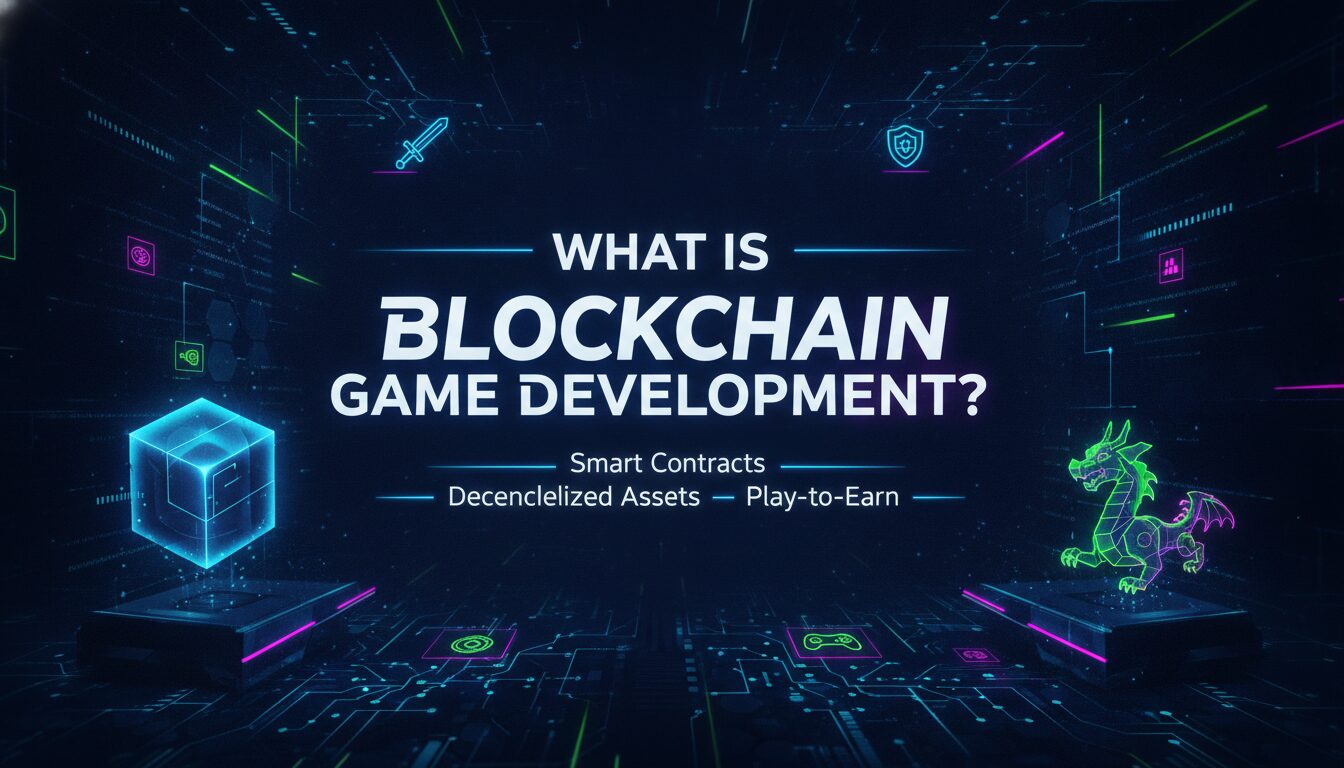
Blockchain game development is the discipline of building games where asset ownership, currencies, and player progress live on a public ledger instead of a company’s private database. A blockchain game uses this infrastructure to decentralize ownership and enable trustless interactions between players and the game world. Unlike traditional titles where items sit locked in proprietary servers, these games give players actual ownership through non-fungible tokens (NFTs) and fungible tokens. Smart contracts, self-executing programs that run the game’s core logic, make this possible without a central authority pulling the strings.
Three pillars hold this model together: decentralization (no single entity controls the game), immutability (records can’t be quietly altered), and tokenization (items become tradeable digital assets). Together, these produce transparent economies that outlive any single studio’s decision to shut down a server.
How Blockchain Transforms Traditional Gaming
Traditional gaming ecosystems are closed loops. Players sink time and money in, but if the servers go dark, that value disappears with them. Anchoring assets on public ledgers changes that math entirely. Players can sell, trade, or rent NFTs on decentralized marketplaces, preserving value beyond any single game’s lifecycle. Cross-game interoperability, where an asset minted in one title works in another, is starting to build a genuinely connected metaverse rather than isolated silos. Governance is shifting too: many projects now hand rule-making to a decentralized autonomous organization (DAO), where token holders vote directly on updates and treasury spend.
The Rise and Market Growth of Blockchain Games
Investment Surge and Industry Adoption
Has investment in blockchain gaming actually grown, or is that just marketing spin? The data backs it up. According to research published by BidBits, capital flowing into blockchain gaming has increased dramatically year over year, with cumulative investment now measured in the billions. That growth reflects a broader recognition that decentralized infrastructure can reshape a global gaming industry worth well over $200 billion annually. As documented by Wikipedia, several AAA publishers had already announced blockchain integration plans by 2021. As of 2026, that early interest has turned into dedicated Web3 divisions at legacy studios and steady venture funding into game development startups building on decentralized rails.
From Niche to Mainstream: Key Milestones
Blockchain games date back to 2017, when titles like CryptoKitties first showed the appeal of provably scarce digital collectibles. The 2021 play-to-earn wave, led by Axie Infinity, proved this model could sustain real user bases and generate meaningful revenue, not just novelty interest. The category has matured a lot since then. Today it spans everything from casual mobile titles to full-scale MMORPGs, backed by a growing stack of wallets, marketplaces, and Layer-2 scaling tools. More than 16 active networks, including Ethereum, Polygon, Solana, and Avalanche, now give developers real technical choice instead of a one-size-fits-all deployment.
Benefits of Blockchain Integration in Gaming
True Asset Ownership and Interoperability
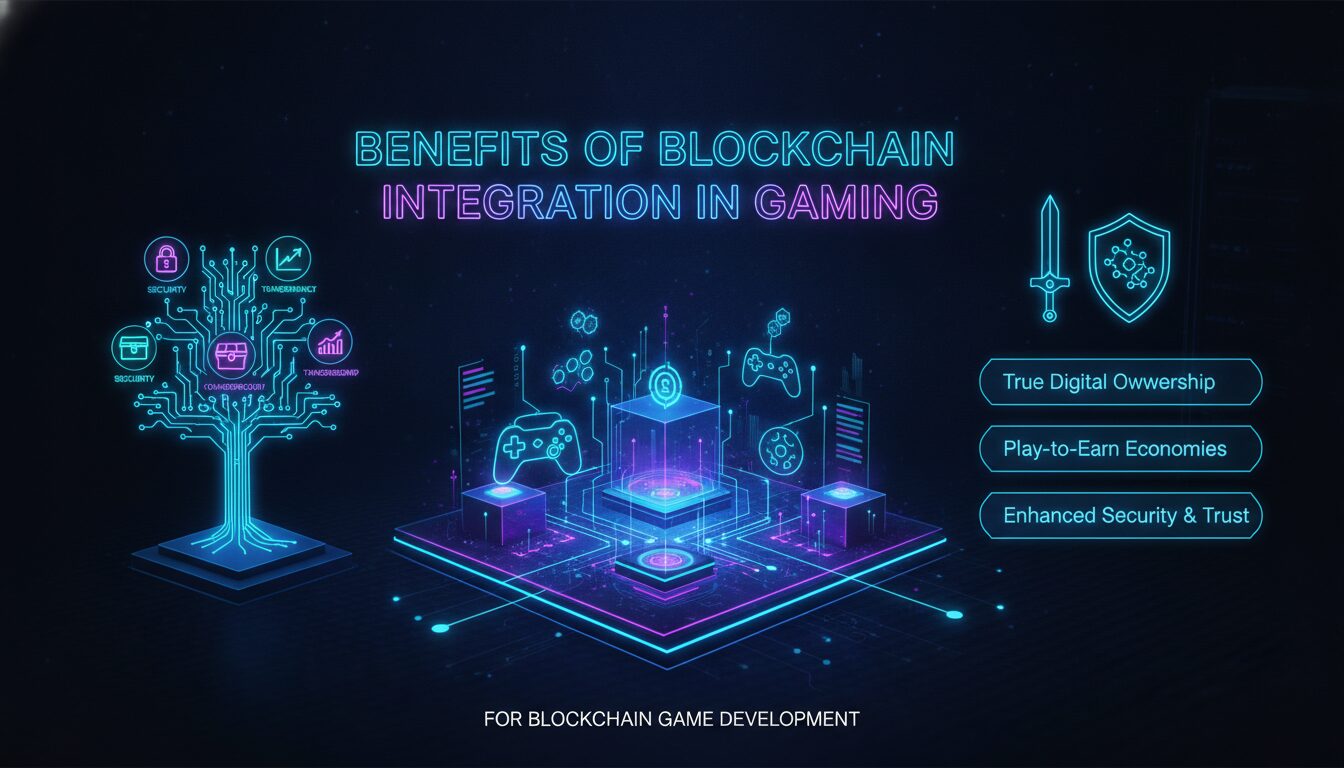
The most compelling outcome of building games this way is genuine digital ownership. In-game items like weapons, skins, or virtual land exist as NFTs on a public chain, verifiable by anyone who bothers to check. Players can move assets to a non-custodial wallet, trade them on open exchanges, or in some cases use them across multiple titles. A spaceship earned in one game could theoretically port into another, provided both share compatible token standards. That kind of interoperability breaks down the walled gardens that have defined gaming for three decades.
Play-to-Earn and Player-Driven Economies
This space pioneered the play-to-earn model, where players receive tokens or NFTs as rewards for time invested and milestones hit. Those assets carry real-world value and can be exchanged for stablecoins or fiat currency. The model opened economic opportunity in regions with limited formal employment, which is part of why Axie Infinity found such traction in Southeast Asia. Beyond earning, some platforms now let users create and monetize their own content, skins, levels, mods, and collect royalties automatically through smart contracts. That flywheel is what keeps communities engaged well past the initial hype cycle.
Enhanced Security and Transparency
Smart contracts automate game-world logic and transactions, cutting down on the manual manipulation that plagued earlier virtual economies. Every trade, reward, and rule change is publicly auditable on-chain. That transparency builds trust between studios and players in a way closed servers never could. The decentralized structure also removes single points of failure, making it far harder for a bad actor to quietly tamper with game state or drain a treasury.
“The real shift here isn’t the technology itself, it’s how it reshapes the relationship between players and creators. For the first time, digital economies can mirror real-world property rights, giving players an actual stake in the games they play.” Alex Chen, Lead Blockchain Game Architect at a Web3 studio
Key Components of Blockchain Game Development
Smart Contracts and Game Logic
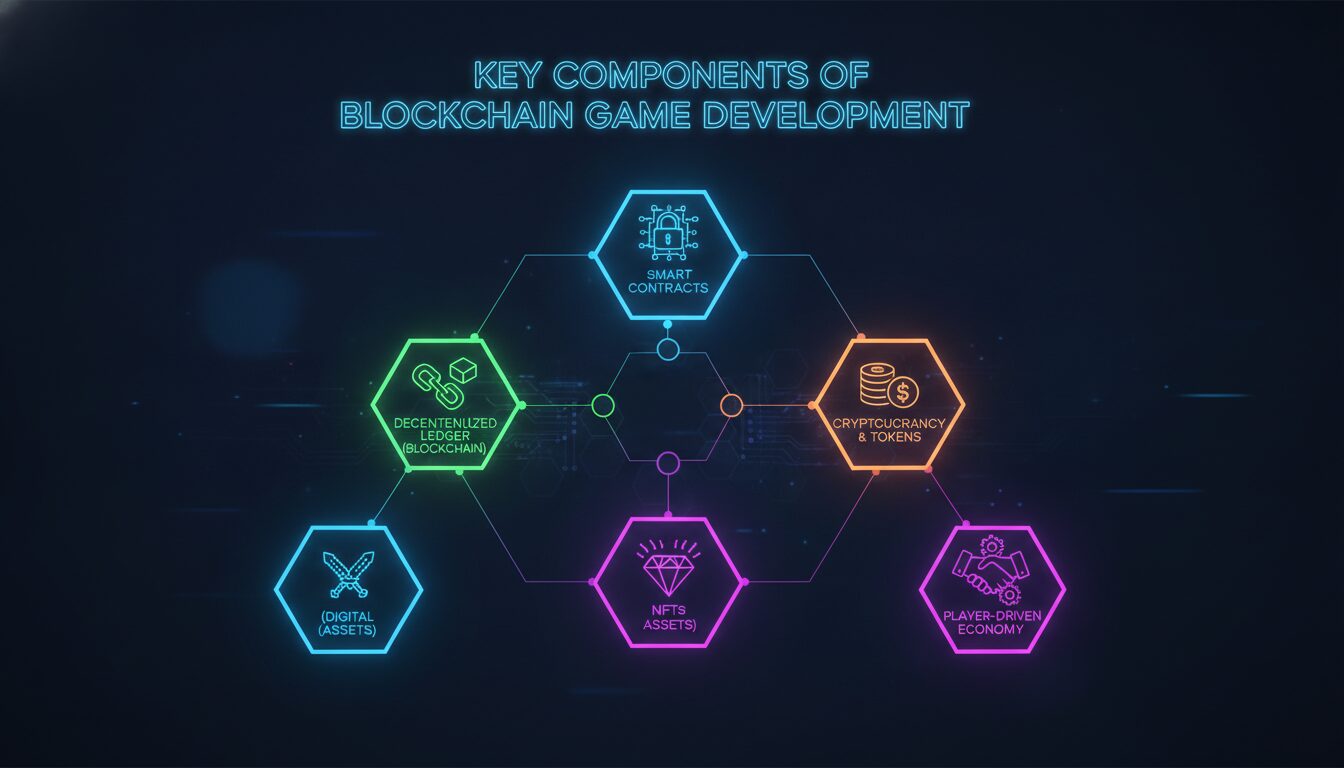
A smart contract is a self-executing program on a blockchain that automatically enforces rules and processes transactions. In practice, these contracts handle minting NFTs, distributing rewards, and managing the in-game economy without a centralized server calling the shots. They need rigorous testing and auditing, since a single flawed function can lead to exploits that drain millions before anyone notices. Solidity remains the standard for Ethereum-compatible chains, while Rust dominates on Solana. Here’s a simplified example of a minting function in Solidity:
function mintItem(address player, uint256 itemId) public onlyGameContract {
    require(itemSupply[itemId] < maxSupply[itemId], "Supply exhausted");
    _mint(player, itemId, 1, "");
    itemSupply[itemId]++;
    emit ItemMinted(player, itemId, block.timestamp);
}
This kind of function, paired with an audited base like OpenZeppelin’s ERC-1155 implementation, keeps minting logic transparent and tamper-resistant.
NFTs and In-Game Asset Management
NFTs are the backbone of asset ownership in this model. Each token is unique and represents a specific item, whether that’s a character, a weapon, or a plot of virtual land. Unlike traditional virtual goods, these tokens live independently of the game client, sitting in the player’s own wallet. Most platforms lean on established standards like ERC-721 and ERC-1155 to handle minting, upgrading, and trading without reinventing the wheel each time. That’s the difference between an ephemeral rental model and an actual capital market for digital goods.
Tokenomics and Economic Design
Tokenomics is the economic blueprint behind the game, defining how tokens get created, distributed, and consumed. A well-built model balances supply and demand carefully enough to avoid the hyperinflation or speculative collapse that sank many early play-to-earn projects. Most teams issue a governance token for voting rights alongside a separate utility token for in-game transactions, distributing both through gameplay, staking, or liquidity pools. Getting this balance right is arguably the hardest, and most rewarding, part of the entire process.
Choosing the Right Blockchain for Your Game: A Comparative Analysis
Popular Blockchain Networks for Gaming
Which blockchain should you actually build on? It depends on your game’s transaction volume, target audience, and tolerance for gas fees. Each network trades off differently between security, speed, and existing community size. The table below summarizes the leading options, based on capabilities highlighted by platforms like BidBits and other industry sources. Developers should also weigh whether the game needs interoperability with other dApps in the same ecosystem.
Comparison Table: Blockchain Platforms at a Glance
| Blockchain | Key Features | Best For |
|---|---|---|
| Ethereum | Deep liquidity for digital asset transactions; large developer community; Proof-of-Stake security | High-value assets, complex DeFi integrations |
| Polygon | Ethereum-aligned sidechain with minimal network fees | Mass-market games needing low-cost transactions |
| Solana | High throughput via Proof-of-History; very low fees | Real-time multiplayer, action-heavy games |
| Avalanche | Fast finality with customizable subnets | Games requiring dedicated, isolated chains |
| BNB Chain | Wide recognition and a large existing user base | Play-to-earn games targeting mainstream adoption |
The Development Process: From Concept to Launch
1. Define Game Mechanics and Tokenomics
Start by deciding on the core gameplay loop, asset types, and exactly how tokens will flow through the economy before writing a line of code. Getting this wrong early is expensive to fix later.
2. Select a Blockchain Platform
Evaluate networks using the comparison above, and seriously consider a Layer-2 solution if you expect high transaction volume from day one.
3. Develop and Audit Smart Contracts
Code contracts for minting, trading, and rewards using established frameworks like OpenZeppelin, then get them independently audited before mainnet deployment.
4. Integrate Wallets and a Marketplace
Let players connect wallets like MetaMask or Phantom, and either build a native marketplace or integrate with an existing one.
5. Build the Front End
Develop the game client in Unity or Unreal Engine, then connect it to the chain through an SDK layer that abstracts away most of the blockchain complexity from players.
6. Conduct Rigorous Testing
Test extensively on testnets, simulate peak loads, and run a full security audit before any real assets touch mainnet.
7. Launch and Manage the Community
Deploy on mainnet, distribute initial assets, and keep players engaged through DAO governance and active social channels.
Overcoming Technical Challenges
High gas fees on Ethereum mainnet can wreck the player experience fast, which is why most teams adopt sidechains or rollups that cut transaction costs by roughly 90-99%. Scalability gets addressed through sharding and app-specific chains like Avalanche subnets. The Web2-to-Web3 education gap, teaching players about wallets and private keys, remains a real barrier that studios tackle with simplified UX and optional custodial onboarding.
Unique Challenges and Solutions in Blockchain Game Development
Scalability and High Gas Fees
Early titles in this space were hampered by network congestion and transaction costs that made routine gameplay uneconomical. Layer-2 solutions like Immutable X, Arbitrum, and zk-sync rollups now offer near-instant finality at a fraction of the previous cost. Emerging standards like ERC-4337 (account abstraction) are also enabling gas-free transactions for players, which lowers the entry barrier considerably. These technical improvements are what’s making mass-market adoption realistic rather than theoretical.
User Experience and Onboarding Barriers
Wallets and seed phrases still scare off casual gamers, full stop. Studios building for broader audiences are increasingly using social logins and custodial wallets that hide the underlying complexity entirely. Progressive web apps and mobile-first design are also smoothing onboarding for players who’ve never touched crypto before. Reduce the friction enough, and this technology stops being a niche interest and starts being infrastructure nobody thinks about.
Regulatory and Legal Considerations
As the industry matures, regulatory scrutiny is increasing right alongside it. Laws governing digital assets, securities classification, and anti-money laundering requirements vary widely by jurisdiction. Developers need to ensure in-game tokens don’t inadvertently qualify as unregistered securities, and implement KYC/AML procedures where local law demands it. Leading studios now work directly with legal counsel to navigate this terrain without stalling product development.
DeFi metrics and on-chain data consistently show that projects with transparent tokenomics and audited contracts retain players longer than those that skip formal security review, a pattern that’s shaped how serious studios now approach launch timelines.
The Future of Blockchain Game Development in 2026 and Beyond
Emerging Trends: AI Integration, Metaverse, and Cross-Chain Play
The next wave will be defined largely by artificial intelligence layered on top of on-chain ownership. AI-generated content, dynamic NPCs, and personalized quests are starting to merge with token-based ownership to create worlds that actually evolve. Cross-chain protocols like Polkadot and Cosmos are letting assets move between networks instead of staying locked to one chain, while the broader metaverse concept depends on this kind of infrastructure for its underlying economy. The line between gaming, social platforms, and commerce keeps getting blurrier every year.
Predictions for the Next Five Years
Industry watchers expect this sector to produce the first genuine AAA-quality Web3 titles that compete with traditional blockbusters on production value, not just novelty. As the technical stack matures, expect better frame rates, more realistic graphics, and larger concurrent user bases running on decentralized infrastructure without players noticing the plumbing underneath. Tokenomics models are also evolving past boom-and-bust cycles toward sustainable, utility-driven designs. This approach is on track to become standard architecture for online games, the way the internet became the default medium for distribution decades ago.
Pros and Cons
Pros
- Players get verifiable, transferable ownership of in-game assets instead of licensed access that can vanish overnight.
- Play-to-earn mechanics create real income opportunities, particularly valuable in regions with limited formal job markets.
- Transparent, auditable smart contracts reduce fraud risk compared to closed, centrally-controlled game economies.
- Interoperable assets and Layer-2 scaling are making cross-game and cross-chain experiences increasingly practical.
Cons
- Gas fees and network congestion can still degrade user experience on unoptimized chains.
- Wallet setup and private key management remain real onboarding barriers for non-crypto-native players.
- Poorly designed tokenomics can lead to inflationary collapse, as seen in several early play-to-earn projects.
- Regulatory uncertainty around token classification varies by jurisdiction and can slow launch timelines.
Frequently Asked Questions
What is blockchain game development?
Blockchain game development is the process of building video games that use distributed ledger technology to manage in-game assets, currencies, and player data in a decentralized way. It enables true digital ownership, transparent economies, and new monetization models unavailable in traditional titles.
How do blockchain games benefit players?
Players get real ownership of in-game items as NFTs, letting them sell, trade, or in some cases use assets across multiple games. Play-to-earn rewards also let players earn cryptocurrency or tokens for genuine participation and skill.
What are the most popular blockchains for game development?
Ethereum, Polygon, Solana, Avalanche, and BNB Chain are among the most widely used networks for building Web3 games. Each offers a different balance of security, transaction speed, and existing community size.
How do play-to-earn models work?
Play-to-earn models reward players with tokens or NFTs for hitting in-game milestones or completing tasks. Those assets can then be traded on exchanges for other cryptocurrencies or fiat, creating a real income stream tied to gameplay.
What skills are needed for blockchain game development?
Developers need working knowledge of smart contract languages like Solidity and Rust, plus experience with game engines like Unity or Unreal Engine. Understanding tokenomics, wallet integration, and security auditing is just as important as the coding itself.
Is blockchain gaming secure?
It can be, when implemented properly with audited smart contracts and decentralized ledgers that reduce fraud and hacking risk. Players still need to follow basic wallet safety practices, since most asset theft happens through phishing rather than protocol-level exploits.
Building a Web3 game that actually ships takes more than a whitepaper and a token contract. If you’re a serious builder working on tokenomics, smart contract architecture, or a full game economy, apply to the Genesis Cohort at digitalblockchains.com and build with a team that’s spent real time in this space.