Key Takeaways
- Blockchain games give players verifiable ownership of in-game assets through NFTs, recorded on a public ledger no developer can erase.
- The sector processes over 20 million daily gaming transactions across all chains, with top titles like Axie Infinity holding 195,000+ active players in any 30-day window.
- Major publishers including Ubisoft and Square Enix have moved from skepticism to active exploration, while Steam still bans these titles and Epic Games Store welcomes them.
- The $600 million Ronin bridge exploit in 2022 remains the clearest argument for audited smart contracts, multi-sig wallets, and validator decentralization.
- Ethereum’s move to proof-of-stake cut energy use by over 99.95%, removing the environmental objection that slowed enterprise adoption for years.
- Venture capital poured roughly $2.5 billion into GameFi in Q1 2025 alone, signaling that institutional money still sees long-term upside despite market cycles.
Blockchain games are video games that use distributed ledger technology to give players verifiable ownership of in-game assets as NFTs and enable play-to-earn models where participants earn spendable cryptocurrency. They differ from traditional games in transparency, asset portability, and economic structure.
What Are Blockchain Games?
Definition and Core Concepts
A blockchain game is a video game that uses decentralized ledger technology to manage in-game assets, rules, and economies. Unlike conventional games where all data lives on centralized servers controlled by developers, games store asset ownership and transaction records on-chain. Players truly own their digital items, represented as NFTs, and can freely trade, sell, or transfer them outside the game environment. The category covers crypto games, NFT games, Web3 games, and play-to-earn titles, depending on the specific mechanics involved.
According to Konvoy VC, the defining shift is from developer-controlled economies to player-owned ecosystems, made possible by smart contracts and tokenization. That single architectural change has downstream effects on monetization, governance, and player incentives that traditional game studios are still working through.
A Brief History of Blockchain Gaming
The first mainstream blockchain game, CryptoKitties, launched in November 2017 and let users collect and breed virtual cats as NFTs on Ethereum. One virtual pet sold for over $100,000 in December 2017. The game also exposed a real scalability problem: at its peak, CryptoKitties accounted for roughly 30% of all Ethereum transactions, causing significant network congestion. That event accelerated development of sidechains and Layer 2 protocols that later became standard infrastructure for this type of games.
In 2018, Axie Infinity popularized the play-to-earn model, enabling players in countries like the Philippines to earn meaningful income through gameplay. The game’s native tokens, AXS and SLP, could be exchanged for fiat currency, blurring the line between entertainment and employment. By 2021, major publishers including Ubisoft, Electronic Arts, and Square Enix had announced intentions to explore blockchain integration, marking a significant moment for the industry.
Key Features of Blockchain Games
True Asset Ownership
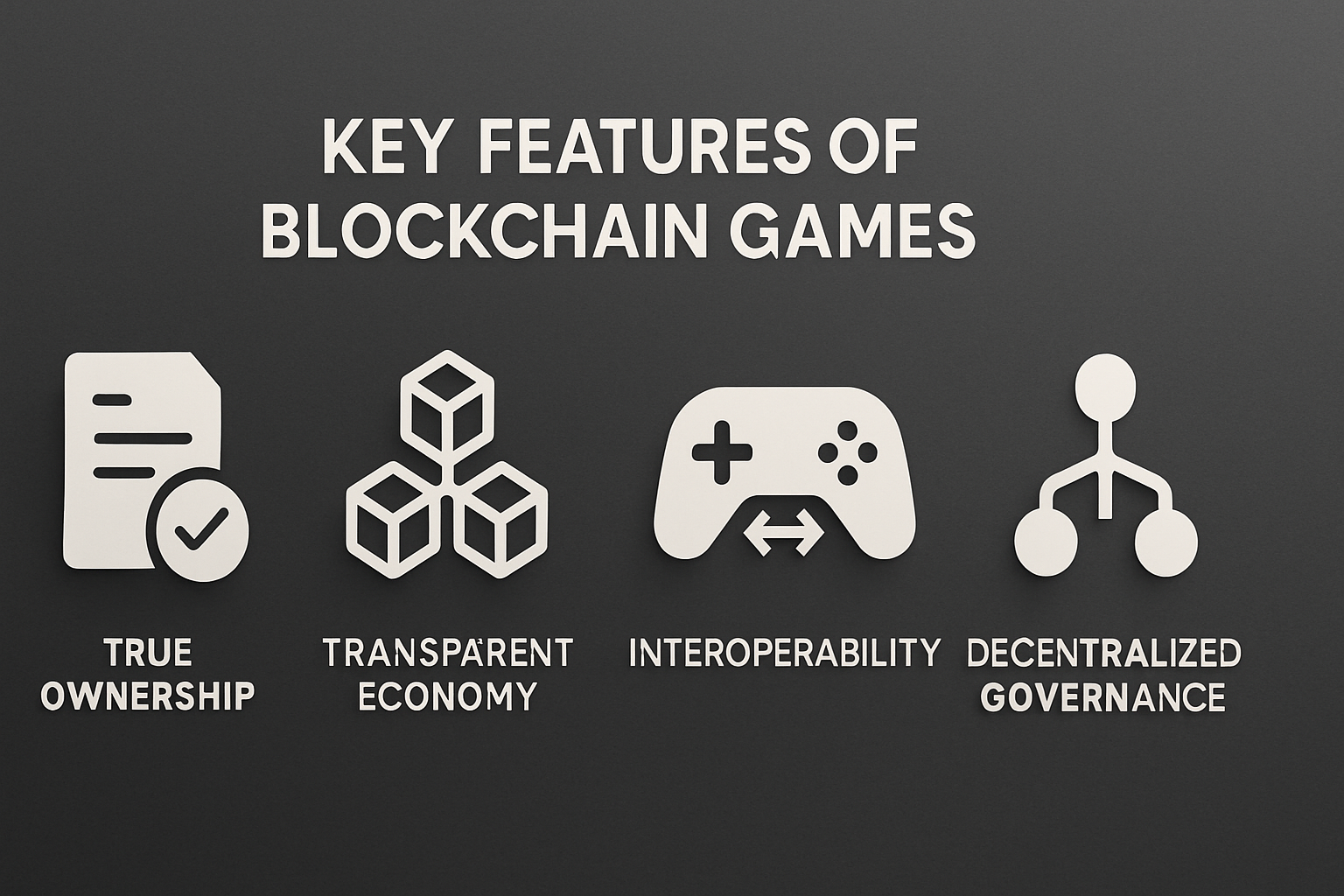
True asset ownership is the feature that most clearly separates this kind of games from every title that came before them. In traditional games, in-game purchases like skins, weapons, or characters are licensed to the player and disappear if the game shuts down. In blockchain games, assets are stored on-chain as NFTs, granting verifiable ownership. You can sell, trade, or potentially use these assets across different compatible games. A sword earned in one NFT-based RPG could theoretically be used in another title supporting the same token standards, though full cross-game interoperability is still in active development across most ecosystems.
Play-to-Earn Mechanics
Play-to-earn (P2E) is a model where players earn cryptocurrency or NFTs by participating in the game. Rewards come from completing quests, winning battles, or staking tokens, and those assets can be sold on decentralized markets for real money. Games like Axie Infinity and The Sandbox have demonstrated that P2E can generate meaningful income, particularly in lower-income regions. The model also faces legitimate criticism for creating pyramid-like economies when new player growth stalls, which is exactly why many developers have shifted toward a “play-and-earn” framing that puts fun before financial return.
Decentralization and Transparency
Decentralization reduces reliance on a single company’s servers, cutting the risk of censorship or sudden shutdowns. All in-game transactions and asset histories are recorded on a public ledger, making scams like fake rare items or rigged loot boxes structurally difficult. Smart contracts automate payouts and enforce rules without intermediaries, creating a trust layer that centralized games simply cannot replicate. That transparency is increasingly attractive to players who have been burned by developer decisions to sunset games and wipe account balances overnight.
How Blockchain Technology Powers Games
The Role of Smart Contracts and NFTs
Smart contracts are self-executing agreements with terms written directly into code, and they handle everything from asset creation to reward distribution in blockchain games. When a player breeds two NFT creatures, a smart contract automatically generates a new NFT with combined traits and processes any required fees, with no human intermediary involved. NFTs represent in-game items, characters, or virtual land as unique on-chain tokens. Their scarcity and provenance are verifiable at any time, preventing duplication or fraud at the protocol level rather than relying on a developer’s database integrity.
The ERC-721 standard on Ethereum defined the original NFT specification, while ERC-1155 introduced multi-token contracts that handle both fungible and non-fungible assets in a single contract, reducing gas costs for games with large item catalogs. Most modern blockchain games build on one of these two standards or their equivalents on other chains.
Scaling Solutions: From Ethereum to Layer 2
Early blockchain games like CryptoKitties struggled with high gas fees and slow transactions on Ethereum’s mainnet. Developers now deploy on more efficient blockchains or use Layer 2 solutions to solve this. Ronin, a sidechain built specifically for Axie Infinity, processes transactions faster and at a fraction of mainnet cost. Immutable X offers zero-gas NFT trading through ZK-rollups, making it attractive for high-frequency trading card games. Polygon, Solana, and BNB Smart Chain have also become popular for their low costs and high throughput. Ethereum’s move to proof-of-stake consensus in 2022 reduced energy consumption by over 99.95%, addressing the environmental criticism that had been a genuine barrier to enterprise adoption.
How to Get Started with Blockchain Games
Getting into blockchain gaming requires a few deliberate steps, and skipping any of them is how people lose money before they play a single match.
- Set up a crypto wallet: Download a non-custodial wallet like MetaMask or Phantom to store your NFTs and tokens. Never share your seed phrase.
- Acquire cryptocurrency: Purchase ETH, SOL, or other required tokens from a reputable exchange and transfer them to your wallet.
- Choose a game: Select a blockchain game that matches your interest. Check its active player base, tokenomics, and whether the smart contracts have been audited.
- Connect your wallet: Visit the game’s official website and link your wallet to interact with the decentralized application. Bookmark the URL to avoid phishing clones.
- Start playing: Begin with free-to-play options where available, or invest in starter assets to access earning mechanics. Treat early spending as tuition, not investment.
Top Blockchain Games to Play in 2026
Hundreds of blockchain games now exist, spanning genres from RPGs to trading card games. Data from DappRadar shows over 20 million daily gaming transactions across all chains, with some titles attracting massive user bases. The games below stand out based on active players, technical innovation, and demonstrated staying power through multiple market cycles.
Axie Infinity: The P2E Pioneer
Axie Infinity remains the most iconic blockchain game. Players collect, breed, and battle creatures called Axies, each one a distinct NFT. Despite a $600 million bridge exploit in 2022, the game rebounded with infrastructure upgrades to its Ronin sidechain and now holds over 195,000 active players in any 30-day period, according to Cryptonews. Its AXS governance token continues to rank among the top gaming cryptocurrencies by market cap.
Pixels and Virtual World Builders
Pixels is a social simulation and farming game on the Ronin network with 45,000+ active players. Users cultivate land, craft items, and interact with others, with all tradable assets represented as NFTs. The Sandbox and Decentraland offer larger metaverse environments where users build, monetize, and explore virtual real estate. Decentraland reports over 600,000 monthly active users, which reflects the mainstream pull of open-world blockchain games even among audiences who would not describe themselves as crypto-native.
Competitive Card Games: Gods Unchained and Splinterlands
For strategy fans, Gods Unchained is a trading card game comparable to Hearthstone but with NFT-based cards. It runs on Immutable X and maintains a consistent active player base drawn to its zero-gas trading model. Splinterlands is another established card battler that has processed tens of millions of battles on the WAX and Hive blockchains. Both games show how blockchain mechanics can enhance competitive genres without requiring players to understand the underlying infrastructure.
Comparing Popular Blockchain Games
The table below provides a snapshot of leading blockchain games across different genres and chains. Active user data is sourced from DappRadar and Cryptonews as of mid-2026.
| Game | Genre | Blockchain Platform | Native Token | Active Users (30D) | Key Feature |
|---|---|---|---|---|---|
| Axie Infinity | Metaverse, RPG | Ronin | AXS | 195,000+ | Play-to-earn creature battles |
| Pixels | Social Simulation | Ronin | PIXEL | 45,000+ | Farming and social interaction |
| Gods Unchained | Trading Card Game | Immutable X | GODS | 1,200+ | NFT cards with zero-gas trading |
| The Sandbox | Virtual World | Ethereum, Polygon | SAND | 1,000+ | User-generated content monetization |
| Decentraland | Metaverse, Social | Ethereum, Polygon | MANA | 600,000+ | Virtual land ownership and events |
| Alien Worlds | DeFi, Mining | WAX, BSC | TLM | N/A | Planet exploration and resource mining |
Note: Active user counts fluctuate with market cycles. Alien Worlds’ 30-day figures are not available from the same sources, but it consistently ranks among the top dApps by raw transaction volume.
Play-to-Earn: Earning Crypto Through Gaming
How the P2E Economy Works
Play-to-earn in blockchain games is not just grinding for digital loot. It involves a real digital economy where player activity generates tradable value. Players earn native tokens or NFTs by completing tasks, then sell them on exchanges or decentralized markets. Some games layer in staking, where holding certain assets yields additional token rewards over time. The model proved so effective that during the COVID-19 pandemic, many players in the Philippines supported their families entirely through Axie Infinity earnings.
Sustainability is the hard problem. P2E economies depend on a constant influx of new players or external capital to maintain token prices. When Axie’s user growth stalled in early 2022, the SLP token price collapsed, wiping out the income of players who had treated it as a salary. That lesson drove the industry toward “play-and-earn” design, where fun comes first and financial return is a secondary benefit rather than the primary pitch.
Real-World Earning Examples
Earnings vary enormously by game, skill level, and market conditions. Active players in competitive P2E titles can earn anywhere from a few dollars to several hundred dollars per month, according to data tracked by Cryptonews. In Gods Unchained, rare card sales have reached thousands of dollars for top-tier assets. Virtual land parcels in The Sandbox have sold for as much as $500,000 at peak market prices. These numbers are real, but they represent the top of the distribution. Most players earn far less, and treating any blockchain game as a reliable income source carries significant financial risk.
Pros and Cons of Blockchain Games
Pros
- True digital ownership: Assets exist on-chain and cannot be deleted by a developer decision or server shutdown.
- Earning potential: Players can convert in-game effort into real economic value through token and NFT markets.
- Transparency: All transactions and asset histories are publicly verifiable, eliminating rigged loot boxes and fake scarcity.
- Interoperability potential: Standards like ERC-1155 lay the groundwork for assets that move across multiple games and platforms.
- Decentralized governance: Many games give token holders a vote on development decisions, aligning player and developer incentives.
Cons
- Security risks: Smart contract bugs and bridge exploits have resulted in losses exceeding $600 million in a single incident.
- Economic fragility: P2E token economies can collapse quickly when new player growth slows, as Axie’s SLP demonstrated in 2022.
- High entry barriers: Many games require purchasing NFTs upfront, which can cost hundreds of dollars before a player earns anything back.
- Regulatory uncertainty: Token sales may be classified as securities in some jurisdictions, creating legal exposure for both developers and players.
- Platform resistance: Steam’s 2021 ban on blockchain games limits distribution reach, forcing developers to rely on their own channels or alternative stores.
Security and Risks in Blockchain Games
The Axie Infinity Hack and Lessons Learned
Security is the issue that separates serious blockchain game projects from speculative experiments. In March 2022, the Ronin bridge connecting Axie Infinity to Ethereum was exploited for over $600 million, making it one of the largest crypto hacks on record. The attack succeeded through compromised private keys and insufficient validator decentralization. A system marketed as trustless had a centralized failure point, and attackers found it.
Since then, the industry has raised its baseline. Multi-signature wallets, formal verification of smart contracts, and public bug bounty programs are now standard practice among credible projects. Players should use hardware wallets, avoid clicking unsolicited links, and verify smart contract addresses directly from official documentation before approving any transaction.
Scams and Regulatory Risks
Beyond technical exploits, the blockchain gaming space has a rug pull problem. Projects launch a token, generate hype, and disappear with investor funds before the game ships anything playable. Any project promising guaranteed returns should be treated as fraudulent by default. Regulators in multiple jurisdictions are examining whether P2E token sales constitute securities offerings, which could require licenses and disclosures that most small studios cannot easily obtain. Valve’s October 2021 decision to ban blockchain games from Steam underscored the reputational risk, though Epic Games Store moved in the opposite direction and now hosts several NFT titles.
Tokenomics in Blockchain Games: What Actually Matters
Tokenomics is the architecture that determines whether a blockchain game’s economy survives beyond its launch window. Most failed P2E projects share a common flaw: inflationary token emission with no meaningful sink. Players earn tokens faster than the game can absorb them, supply overwhelms demand, and prices collapse.
Sustainable designs typically include at least three elements. First, a dual-token model separating governance tokens (like AXS) from utility or reward tokens (like SLP), so that speculative pressure on one does not immediately destroy the other. Second, token sinks built into core gameplay, such as breeding fees, upgrade costs, or land development expenses, that permanently remove tokens from circulation. Third, a treasury or DAO structure that can adjust emission rates in response to on-chain economic data rather than waiting for a developer patch cycle.
“The games that will survive the next five years are the ones that treat tokenomics as a core game mechanic, not an afterthought bolted onto a finished product.” – Konvoy VC, GameFi Investment Thesis, 2024
For a deeper look at how token supply mechanics affect protocol health, see our analysis of tokenomics design principles and our overview of smart contract architecture for Web3 applications.
The Future of Blockchain Games
Mainstream Adoption and AAA Integration
The boundary between traditional and blockchain games is narrowing. Ubisoft’s Quartz platform, launched on Tezos in December 2021, marked the first time a major publisher shipped playable NFTs despite significant community pushback. Square Enix has sold legacy IPs to fund blockchain development. Epic Games hosts multiple NFT titles on its store. Venture capital investment in GameFi reached approximately $2.5 billion in Q1 2025 alone, a figure that reflects institutional conviction even after the broader crypto market correction of 2022 to 2023.
“Blockchain-based gaming infrastructure is attracting capital at a pace that suggests investors view it as foundational to the next generation of interactive entertainment, not as a speculative side bet.” – Messari, GameFi Sector Report, 2025
Interoperability and the Metaverse
True interoperability, using a single avatar or item across multiple games, remains the most technically ambitious goal in the space. Projects like the Oasys blockchain and standards like ERC-1155 are meaningful steps toward that vision. As metaverse concepts mature, we may see interconnected virtual worlds where assets move across titles, powered by decentralized identity protocols and audited cross-chain bridges. That future requires solving hard problems in key management, asset valuation across different game economies, and governance of shared standards. None of those problems are unsolvable, but none are solved yet either.
Environmental Sustainability
Early blockchain games were rightly criticized for their carbon footprint. Ethereum’s shift to proof-of-stake reduced energy consumption by over 99.95%, and most gaming-focused chains now use eco-friendly consensus mechanisms. Tezos, a proof-of-stake chain, was specifically chosen by Ubisoft for its low energy profile. The industry’s alignment with ESG goals is not just optics. It removes a concrete objection that enterprise partners and institutional investors had been citing as a reason to stay on the sidelines.
Frequently Asked Questions
What are blockchain games?
Blockchain games are video games that use distributed ledger technology to give players verifiable ownership of in-game assets through NFTs, often combined with play-to-earn mechanics where players earn spendable cryptocurrency. The key difference from traditional games is that asset ownership is recorded on a public blockchain rather than a developer’s private database.
Can you earn real money from blockchain games?
Yes, many blockchain games allow players to earn cryptocurrencies or NFTs that can be sold on exchanges for real money. Earnings vary widely based on game, skill level, and market conditions, and most players should treat income as a bonus rather than a reliable salary.
Are blockchain games safe?
They carry real risks including smart contract bugs, bridge exploits, and outright scams. Always check whether a game’s contracts have been audited by a reputable firm, use a hardware wallet for significant holdings, and never approve transactions from unverified sources.
What do you need to play a blockchain game?
You need a non-custodial cryptocurrency wallet like MetaMask or Phantom, some crypto to cover gas fees, and an account on the game’s platform. Many games also require purchasing starter NFTs before you can access earning mechanics.
Why did Steam ban blockchain games?
Valve banned blockchain games in October 2021 because their policy prohibits items with real-world monetary value being exchanged on the platform. The company also cited concerns about fraud and scams targeting players through fake token schemes.
What is the most popular blockchain game right now?
As of mid-2026, Axie Infinity remains one of the most active titles with over 195,000 players in any 30-day window, followed by Pixels on Ronin and Decentraland on Ethereum and Polygon. Rankings shift frequently as new titles launch and market cycles affect token-driven engagement.
Ready to build the next generation of on-chain gaming infrastructure? Apply to the Genesis Cohort at Digital Blockchains and work with a team that deploys smart contracts, designs token economies, and builds Web3 products from the protocol layer up.