The tron blockchain is a decentralized, high-throughput smart contract platform launched in 2018 by Justin Sun, designed to support dApps, DeFi protocols, and content monetization without intermediaries. It processes roughly 2,000 transactions per second at near-zero cost.
Key Takeaways
- TRON is a decentralized blockchain platform that supports smart contracts and decentralized applications (dApps).
- It operates on a delegated proof-of-stake consensus mechanism, offering high throughput and low transaction fees.
- TRON hosts a significant share of the USDT stablecoin supply, making it a major player in the DeFi ecosystem.
- The TRON ecosystem spans gaming, social media, and decentralized finance applications.
- TRON transitioned to a DAO governance model in December 2021, giving TRX holders direct voting power.
- TRON has faced regulatory scrutiny over illicit transaction flows, but developer adoption remains strong heading into 2026.
Introduction to the TRON Blockchain
The tron blockchain is a decentralized platform designed to facilitate the creation and deployment of decentralized applications (dApps) and smart contracts. Launched in 2018 by Justin Sun, TRON aims to create a free and decentralized internet, allowing content creators to monetize their work without intermediaries. With its high transaction throughput and low fees, TRON has emerged as a significant player in the blockchain ecosystem.
TRON started life as an ERC-20 token on Ethereum before migrating to its own independent mainnet in June 2018. That migration was a defining moment: it gave the project full control over its consensus rules, fee structure, and governance model. Since then, the network has grown into one of the most actively used public blockchains by raw transaction volume, driven largely by stablecoin transfers and DeFi activity.
As of 2026, TRON continues to attract developers who prioritize throughput and cost efficiency over the brand recognition of Ethereum or the developer tooling of Solana. It occupies a specific niche: high-frequency, low-value transactions at scale, particularly USDT movement across exchanges and wallets.
A Historical Timeline of TRON’s Development
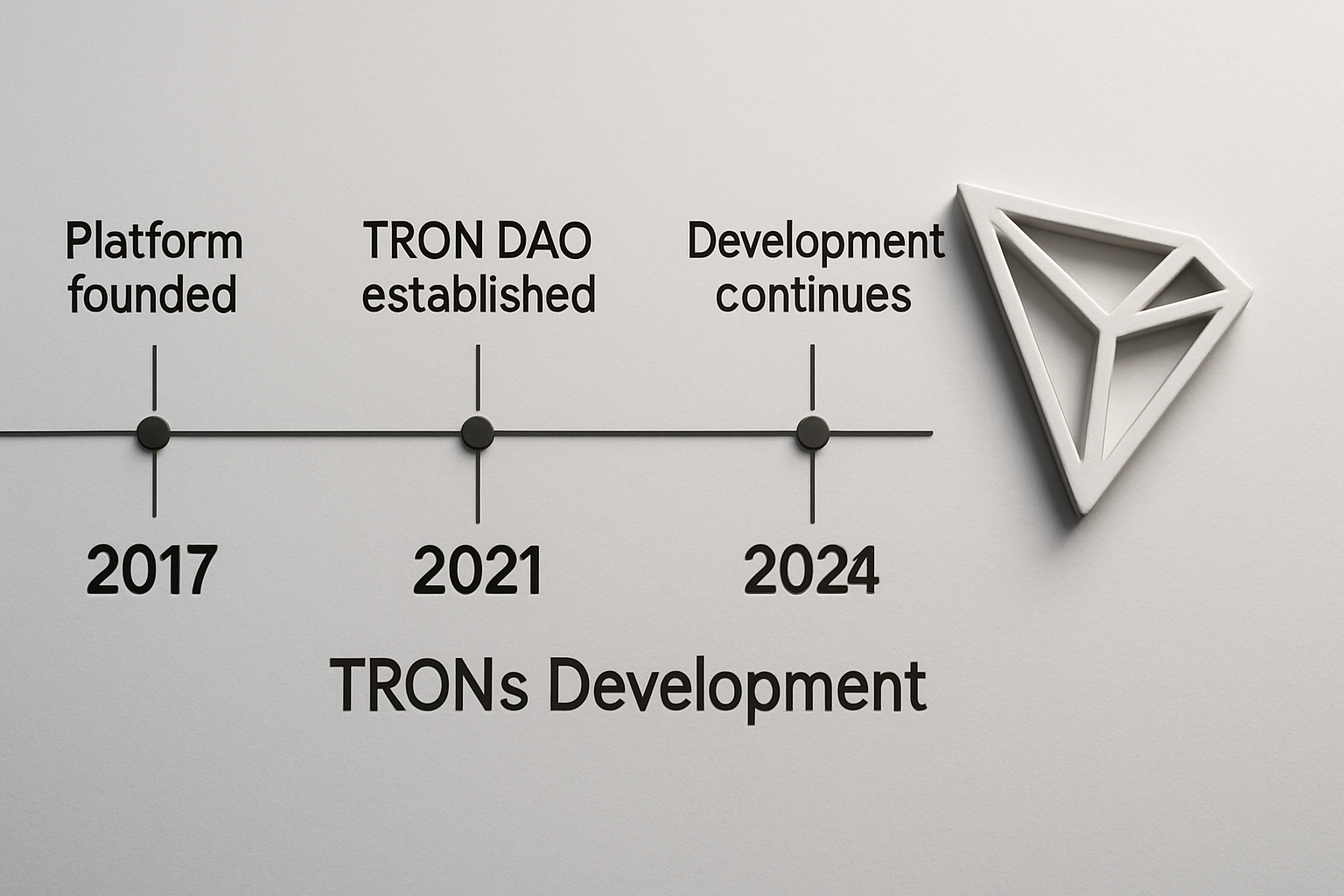
TRON’s evolution from a whitepaper to a global infrastructure layer spans less than a decade, but the milestones are dense.
- 2017: Justin Sun founds the TRON Foundation and publishes the original whitepaper. The project raises funds via an ICO, issuing TRX as an ERC-20 token on Ethereum.
- June 2018: TRON launches its independent mainnet, completing the migration from Ethereum. TRX holders swap their ERC-20 tokens for native TRX.
- July 2018: TRON acquires BitTorrent, one of the largest peer-to-peer file-sharing networks in the world, with over 100 million users at the time of acquisition. This move signals TRON’s intent to bridge legacy internet infrastructure with blockchain incentives.
- 2019: The BitTorrent Token (BTT) launches on the TRON network, becoming one of the first large-scale token distributions on the platform. The TRON Virtual Machine (TVM) reaches full compatibility with the Ethereum Virtual Machine (EVM), making it straightforward for Solidity developers to port existing contracts.
- 2020: TRON’s DeFi ecosystem expands rapidly. JustSwap (later rebranded to SunSwap) launches as the network’s primary automated market maker, and USDT on TRON surpasses Ethereum in daily transfer volume for the first time.
- December 2021: TRON officially transitions to a decentralized autonomous organization structure, dissolving the TRON Foundation and transferring governance to TRX holders.
- 2022-2023: The TRON DAO Reserve launches with a mandate to maintain stablecoin stability on the network. TRON also introduces USDD, an algorithmic stablecoin backed by a reserve of TRX and other assets.
- 2024-2026: TRON positions itself as infrastructure for agentic AI payments, with Justin Sun publicly framing the network’s low-fee, high-throughput architecture as suited for machine-to-machine micropayments at scale.
Architecture of the TRON Blockchain
The tron blockchain is built on a three-layer architecture that separates storage, execution, and application concerns cleanly.
Three-Layer Structure
- Storage Layer: Responsible for data storage and management, ensuring that all transactions and smart contracts are securely recorded.
- Core Layer: This layer handles the execution of smart contracts and transaction processing, utilizing a decentralized virtual machine.
- Application Layer: The top layer where developers can build and deploy dApps, providing a user-friendly interface for end-users.
Consensus Mechanism
TRON operates on a delegated proof-of-stake (DPoS) consensus mechanism, which allows TRX holders to participate in the network’s governance and transaction validation. Under DPoS, token holders vote for 27 Super Representatives who produce blocks in rotation. This mechanism enhances the network’s scalability, enabling it to process approximately 2,000 transactions per second, significantly higher than Bitcoin and Ethereum’s base layer throughput.
The DPoS model is worth understanding precisely because it differs from both pure proof-of-work and pure proof-of-stake. Block producers are elected, not randomly selected. That creates a more predictable block time (currently 3 seconds per block) but also concentrates validation power among a relatively small set of known entities. Critics argue this reduces censorship resistance. Proponents argue it enables the throughput numbers that make TRON viable for high-frequency use cases.
The TRON Virtual Machine (TVM)
The TVM is EVM-compatible, which means Solidity smart contracts written for Ethereum can be deployed on TRON with minimal modification. This compatibility was a deliberate design choice to reduce the friction of developer migration. A contract that looks like this on Ethereum:
// SPDX-License-Identifier: MIT

    }

    }
}
…deploys identically on TRON using the same Solidity compiler. The primary differences show up in fee handling (TRON uses an energy and bandwidth resource model rather than gas denominated in ETH) and in address encoding (TRON uses Base58Check addresses starting with “T” rather than hex addresses starting with “0x”).
TRC Token Standards
TRON has its own token standards that mirror Ethereum’s ERC standards:
- TRC-10: A basic token standard built directly into the protocol layer, not requiring smart contract execution. Lower cost to issue, but limited programmability.
- TRC-20: The smart contract-based fungible token standard, equivalent to ERC-20. USDT on TRON runs as a TRC-20 token. This is the standard most developers use for DeFi applications.
- TRC-721: The non-fungible token standard, equivalent to ERC-721. Used for NFTs and unique digital assets on the TRON network.
Key Features of the TRON Blockchain
TRON’s technical design prioritizes three things above all else: speed, cost, and compatibility. Each feature below flows directly from those priorities.
High Throughput and Scalability
One of the standout features of the tron blockchain is its high throughput, which allows for rapid transaction confirmations. Processing around 2,000 transactions per second with 3-second block finality makes TRON practical for applications requiring real-time interactions, such as gaming and social media platforms. For context, Bitcoin processes roughly 7 transactions per second and Ethereum’s base layer handles 15-30 transactions per second without Layer 2 scaling solutions.
Low Transaction Fees
TRON offers low or even zero transaction fees for users who hold sufficient TRX to stake for bandwidth and energy resources. This cost structure is particularly advantageous for microtransactions and dApps that require frequent interactions. A typical TRC-20 USDT transfer costs a fraction of a cent in energy fees, compared to Ethereum mainnet transfers that can cost several dollars during periods of network congestion.
Decentralized Finance (DeFi) Ecosystem
TRON has established a robust DeFi ecosystem, hosting a variety of applications that facilitate lending, borrowing, and trading. Notably, TRON is the largest host of the USDT stablecoin, with over 50% of its circulating supply on the TRON network. According to Tether’s own transparency reports, TRON-based USDT consistently leads all chains in daily transfer volume. This position enhances TRON’s liquidity and usability in decentralized finance.
TRON vs. Competing Blockchains: A Direct Comparison
Understanding where TRON fits requires comparing it directly against the chains it competes with for developer and user attention.
| Feature | TRON | Ethereum | Solana | BNB Chain |
|---|---|---|---|---|
| Consensus | DPoS (27 SRs) | PoS (validators) | PoH + PoS | DPoS (21 validators) |
| TPS (theoretical) | ~2,000 | ~15-30 (base layer) | ~65,000 | ~2,000 |
| Block Time | 3 seconds | ~12 seconds | ~0.4 seconds | ~3 seconds |
| Smart Contract Language | Solidity (TVM) | Solidity (EVM) | Rust (SVM) | Solidity (EVM) |
| Avg. Transfer Fee | Near-zero (staked TRX) | Variable (can exceed $5) | ~$0.00025 | ~$0.05-0.20 |
| USDT Dominance | Largest host (>50% supply) | Second largest | Growing | Moderate |
| EVM Compatible | Yes (TVM) | Native | No | Yes |
| DAO Governance | Yes (since Dec 2021) | Partial (protocol governance) | Partial | Partial |
The comparison above makes TRON’s positioning clear. It is not trying to out-innovate Ethereum on smart contract expressiveness or match Solana on raw speed. Its advantage is a specific combination: EVM compatibility, near-zero fees, and dominant USDT liquidity. For stablecoin transfers and DeFi applications where cost per transaction matters more than absolute throughput, TRON is a rational choice.
Applications Built on the TRON Blockchain
The tron blockchain supports a wide range of production applications, not just proofs of concept.
Decentralized Applications (dApps)
TRON supports a wide range of dApps across various sectors, including gaming, social media, and finance. These applications leverage TRON’s high throughput and low fees to provide smooth user experiences. According to DappRadar data, TRON consistently ranks among the top 3 chains by daily active dApp users, driven primarily by DeFi and gaming activity.
Gaming and Entertainment
The gaming industry has seen significant adoption of the tron blockchain, with platforms like WINk and TRONBet allowing users to engage in blockchain-based gaming experiences. These platforms utilize TRON’s capabilities to offer fast transactions and a decentralized environment. The 3-second block time is particularly relevant here: gaming interactions that require near-instant confirmation are feasible on TRON in a way they are not on Ethereum’s base layer.
Social Media Platforms
TRON also powers social media applications that enable content creators to monetize their work directly. Platforms like Steemit and BitTorrent utilize TRON’s infrastructure to reward users for their contributions without relying on traditional advertising models. BitTorrent, acquired by TRON in 2018, remains one of the most concrete examples of a legacy internet application being retrofitted with blockchain-based incentive layers.
DeFi Protocols
SunSwap (formerly JustSwap) is TRON’s primary decentralized exchange, operating as an automated market maker similar to Uniswap on Ethereum. JustLend serves as the network’s main lending protocol, allowing users to supply and borrow TRC-20 assets. The TRON DAO Reserve also manages USDD, the network’s native algorithmic stablecoin, which is backed by a reserve of TRX and other major crypto assets.
Partnerships and Ecosystem Collaborations
TRON’s growth has been supported by a series of strategic partnerships that extend its reach beyond pure blockchain infrastructure.
The BitTorrent acquisition in 2018 remains the most significant. Bringing over 100 million existing users into the TRON ecosystem in a single transaction gave the network a scale advantage that most blockchain projects spend years trying to build organically. The BTT token, launched in 2019, created a direct economic incentive for BitTorrent users to seed files and participate in the network.
Tether’s decision to issue USDT on TRON (as a TRC-20 token) is arguably the most consequential partnership in the network’s history. Tether chose TRON specifically because of its low fees and high throughput, and the resulting liquidity has made TRON-based USDT the dominant form of USDT by transfer volume globally, according to Tether’s transparency data.
TRON has also pursued integrations with major centralized exchanges. Most top-tier exchanges support TRC-20 USDT withdrawals natively, which means every exchange user who moves USDT off-platform is, knowingly or not, interacting with the tron blockchain. This embedded distribution is a structural advantage that is difficult for competing chains to replicate quickly.
As of 2026, TRON is actively pursuing partnerships in the AI payments space, positioning TRX and TRC-20 stablecoins as the settlement layer for autonomous agent transactions. Whether this materializes into meaningful adoption remains to be seen, but the technical fit is genuine: machine-to-machine payments require exactly the low-fee, high-frequency characteristics TRON already delivers.
Governance and Community Involvement
TRON’s governance model gives TRX holders direct influence over protocol decisions, though the concentration of voting power among large holders is a known limitation.
TRON DAO
In December 2021, TRON transitioned to a decentralized autonomous organization (DAO), allowing TRX holders to participate in governance decisions. This shift empowers the community to influence the development and direction of the TRON ecosystem. The dissolution of the TRON Foundation was a meaningful signal: it removed a central legal entity that could have been a regulatory target and distributed formal authority across the token holder base.
Voting and Super Representatives
TRX holders can freeze their tokens to gain TRON Power, which can be used to vote for Super Representatives (SRs). These 27 SRs are responsible for validating transactions and producing blocks, ensuring a decentralized governance model. An additional 127 Super Representative candidates receive partial rewards, creating a broader set of network participants with economic skin in the game. Voters receive a share of block rewards proportional to their staked TRX, creating a direct financial incentive for governance participation.
Pros and Cons of the TRON Blockchain
No blockchain is right for every use case. Here is an honest assessment of where TRON excels and where it falls short.
Pros
- Near-zero transaction fees: Staking TRX for bandwidth and energy resources effectively eliminates transfer costs for regular users, making TRON the most cost-efficient chain for high-frequency USDT transfers.
- EVM compatibility: Solidity developers can deploy existing contracts on TRON with minimal changes, reducing the barrier to entry for teams already building on Ethereum.
- Dominant USDT liquidity: Hosting over 50% of USDT’s circulating supply means TRON has deeper stablecoin liquidity than any competing chain, which is a structural advantage for DeFi protocols.
- High throughput at 3-second finality: Around 2,000 TPS with 3-second block times makes TRON practical for gaming, micropayments, and real-time applications.
- Established dApp ecosystem: A mature set of DeFi protocols (SunSwap, JustLend), gaming platforms, and social applications gives developers a working ecosystem to build on top of.
- DAO governance: The December 2021 transition to a DAO structure gives TRX holders formal governance rights, including the ability to vote on protocol upgrades and parameter changes.
Cons
- Centralization concerns: With only 27 active Super Representatives producing blocks, TRON’s validator set is small compared to Ethereum or Solana. This concentration is a legitimate censorship-resistance concern.
- Regulatory and reputational risk: Reports from blockchain analytics firms indicate that TRON has been disproportionately used for illicit transactions relative to its market share. This creates ongoing regulatory exposure.
- Originality questions: Early versions of TRON’s codebase were found to contain code copied from other open-source blockchain projects without proper attribution, which damaged the project’s credibility in developer communities.
- Justin Sun’s influence: Despite the DAO transition, Justin Sun remains the most prominent voice associated with TRON. His personal controversies have created reputational overhang for the project.
- Limited developer mindshare: Outside of DeFi and stablecoin use cases, TRON attracts fewer developers than Ethereum, Solana, or even newer chains like Aptos and Sui.
Challenges and Criticisms
TRON’s challenges are real and worth examining without dismissal.
Association with Illicit Activities
Despite its technological advancements, TRON has faced criticism for its association with illicit activities. Reports from blockchain analytics firms suggest that a significant portion of illegal crypto transactions passes through the TRON network, raising concerns about its reputation and regulatory scrutiny. The low fees and high throughput that make TRON attractive for legitimate use cases also make it attractive for high-volume illicit transfers.
Technical Criticisms
Critics have pointed out that TRON’s claims of high transaction throughput may not always reflect real-world performance under adversarial conditions. Additionally, some have accused TRON of copying code from other blockchain projects, leading to questions about its originality and innovation. The EVM compatibility that TRON markets as a feature is, in part, a consequence of building on top of existing open-source work rather than developing novel execution environments.
What to Expect When Building on TRON
If you are evaluating TRON as a deployment target, here is a practical picture of the developer experience in 2026.
Development Tooling
TRON’s primary development tools are TronWeb (the JavaScript SDK, analogous to Web3.js or Ethers.js on Ethereum), TronBox (a Truffle-based development framework), and TronIDE (a browser-based Solidity IDE). The tooling is functional but lags behind Ethereum’s ecosystem in terms of community support, third-party integrations, and documentation quality. Developers coming from Ethereum will find the concepts familiar but the tooling less polished.
TRONSCAN is the network’s primary block explorer, equivalent to Etherscan. It supports contract verification, token tracking, and transaction history. For developers building TRC-20 tokens or DeFi contracts, TRONSCAN is the primary debugging and monitoring interface.
Resource Model vs. Gas
TRON’s fee model differs from Ethereum’s gas system in a way that trips up many developers on first contact. Instead of paying gas per transaction, TRON uses two resources:
- Bandwidth: Consumed by every transaction. Users receive a free daily bandwidth allocation. Additional bandwidth can be obtained by staking TRX.
- Energy: Consumed by smart contract execution. Energy must be staked for or purchased. This is where most of the cost in complex DeFi interactions comes from.
The practical implication: simple TRC-20 transfers are often free for users who hold and stake TRX. Complex contract interactions cost energy, which can be estimated using TRON’s energy estimation APIs before submitting a transaction.
Security Considerations
Smart contracts on TRON face the same vulnerability classes as on Ethereum: reentrancy attacks, integer overflow, access control failures, and oracle manipulation. The EVM compatibility means that Ethereum security tooling (Slither, MythX, Echidna) can be adapted for TRON contract auditing. However, TRON-specific risks exist around the resource model: contracts that consume more energy than expected can fail mid-execution, and the bandwidth/energy staking mechanics introduce edge cases that pure Ethereum developers may not anticipate.
Any production contract on TRON should go through a formal audit. The network’s history of high-value DeFi exploits mirrors Ethereum’s, and the lower fees that attract users also lower the cost of attack for adversaries probing contracts at scale.
Future Prospects of the TRON Blockchain
TRON’s roadmap for 2026 and beyond focuses on three vectors: AI payment infrastructure, cross-chain interoperability, and continued stablecoin dominance.
Continued Development and Innovation
As the blockchain landscape evolves, TRON is likely to continue enhancing its platform to support new use cases and applications. Ongoing development efforts focus on improving scalability, security, and user experience. The network’s protocol upgrade cadence has accelerated since the DAO transition, with governance votes now driving parameter changes that previously required foundation approval.
Integration with Emerging Technologies
TRON is exploring integrations with emerging technologies such as artificial intelligence (AI) and the Internet of Things (IoT). These integrations could open new avenues for decentralized applications and services, further solidifying TRON’s position in the blockchain ecosystem. The AI payments narrative is particularly relevant: autonomous agents executing thousands of micropayments per hour need a settlement layer with sub-cent fees and fast finality. TRON’s existing infrastructure fits that requirement without modification.
“TRON’s architecture was built for exactly the kind of high-frequency, low-value settlement that AI agent networks will require. The question is whether the ecosystem can attract the developer talent to build the application layer on top of it.” – Analysis from Messari’s 2025 TRON Network Report
“The dominance of TRC-20 USDT in global stablecoin transfer volume is not accidental. It reflects a deliberate infrastructure choice by Tether to prioritize the chain with the lowest transfer costs and highest throughput for retail settlement.” – Per Tether’s public transparency documentation and on-chain data from TRONSCAN
Frequently Asked Questions
What is TRON?
TRON is a decentralized blockchain platform that enables the creation and deployment of smart contracts and decentralized applications (dApps). It was designed specifically to support high-frequency, low-cost transactions at scale, with a particular focus on content monetization and DeFi.
Who created TRON?
TRON was founded by Justin Sun in 2017 and launched its mainnet in June 2018. Sun previously worked at Ripple and founded the project after leaving to build a blockchain platform focused on entertainment and content distribution.
What is the native token of TRON?
The native cryptocurrency of the tron blockchain is called Tronix (TRX). TRX is used to pay for network resources, participate in governance by voting for Super Representatives, and stake for bandwidth and energy allocations.
How does TRON achieve high transaction speeds?
TRON achieves high transaction speeds through its delegated proof-of-stake consensus mechanism, where 27 elected Super Representatives produce blocks every 3 seconds. This structure, combined with a three-layer architecture that separates storage, execution, and application concerns, enables approximately 2,000 transactions per second.
Is TRON based on Ethereum?
TRON started as an ERC-20 token on Ethereum before launching its own independent mainnet in June 2018. The TRON Virtual Machine (TVM) is EVM-compatible, meaning Solidity contracts written for Ethereum can be deployed on TRON with minimal changes. However, TRON is an independent blockchain with its own consensus mechanism, fee model, and governance structure.
What are the main use cases for TRON?
TRON’s primary use cases are USDT stablecoin transfers, DeFi protocols (via SunSwap and JustLend), blockchain gaming, and content monetization through platforms like BitTorrent. As of 2026, the network is also positioning itself for AI agent micropayment infrastructure, leveraging its near-zero fee structure and 3-second block finality.
Is TRON decentralized?
TRON operates as a decentralized autonomous organization (DAO) since December 2021, allowing TRX holders to vote on governance decisions. However, with only 27 active Super Representatives producing blocks, the validator set is more concentrated than networks like Ethereum, which is a legitimate decentralization concern that developers and users should weigh.