AI and blockchain are two distinct technologies that, when combined, produce tamper-proof, intelligent systems: blockchain supplies the transparency and immutability layer while AI delivers automated decision-making. Together, they address each other’s core weaknesses, enabling secure data sharing, verifiable AI models, and autonomous smart contracts across industries.
Key Takeaways
- and blockchain integration solves trust and transparency issues in AI models by providing an immutable audit trail.
- Blockchain offers a governance layer for AI systems, ensuring data integrity and regulatory compliance.
- AI enhances blockchain scalability, smart contract security, and consensus mechanisms.
- Financial services, healthcare, and supply chain are being reshaped by the combined effect of these two technologies.
- Major enterprises like IBM, KPMG, and AWS are actively investing in this convergence.
- Challenges include performance bottlenecks, regulatory gaps, and integration complexity, but decentralized AI marketplaces are emerging as a promising next frontier.
The Fundamentals: What Are AI and Blockchain?
Defining Blockchain
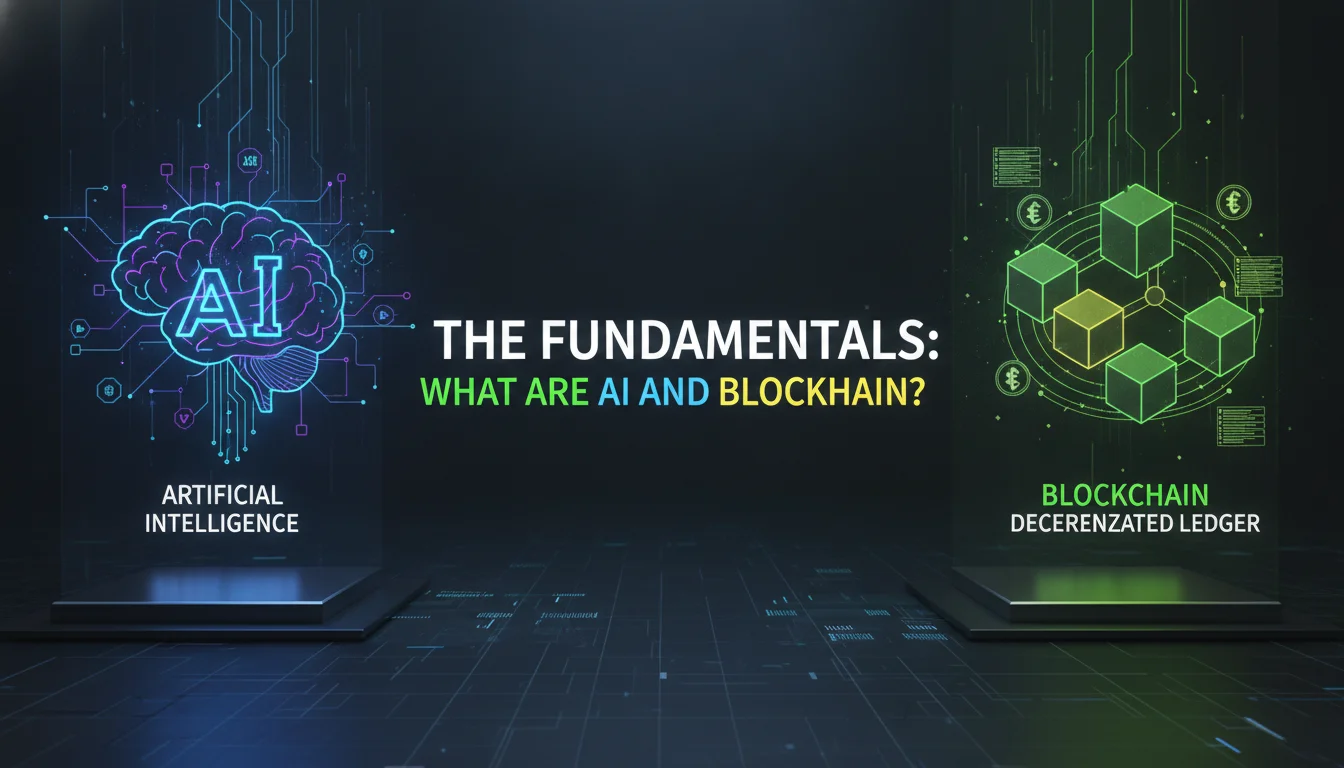
Blockchain is a shared, immutable digital ledger that records transactions across a network of computers in a transparent and tamper-proof manner. According to IBM Think, it provides an immediate, shared exchange of encrypted data to multiple parties simultaneously. Each transaction is grouped into a block, cryptographically linked to the previous one, forming a chain. This decentralized architecture ensures that no single entity controls the data, boosting trust and eliminating intermediaries. Blockchain’s core attributes, decentralization, immutability, and consensus-based validation, make it ideal for applications requiring verifiable records, such as supply chain traceability or identity management.
Defining Artificial Intelligence
Artificial intelligence (AI) refers to the simulation of human intelligence in machines, enabling them to learn, reason, and make decisions. It encompasses subfields like machine learning and deep learning, where algorithms are trained on data to predict outcomes or generate insights. AI excels at pattern recognition, natural language processing, and automation of complex tasks. Its ability to process vast datasets and produce actionable recommendations has made it indispensable in finance, healthcare, and beyond. However, AI models often suffer from a lack of transparency, the so-called black box problem, which blockchain can help address.
How AI and Blockchain Complement Each Other
Solving AI’s Black Box Problem with Blockchain
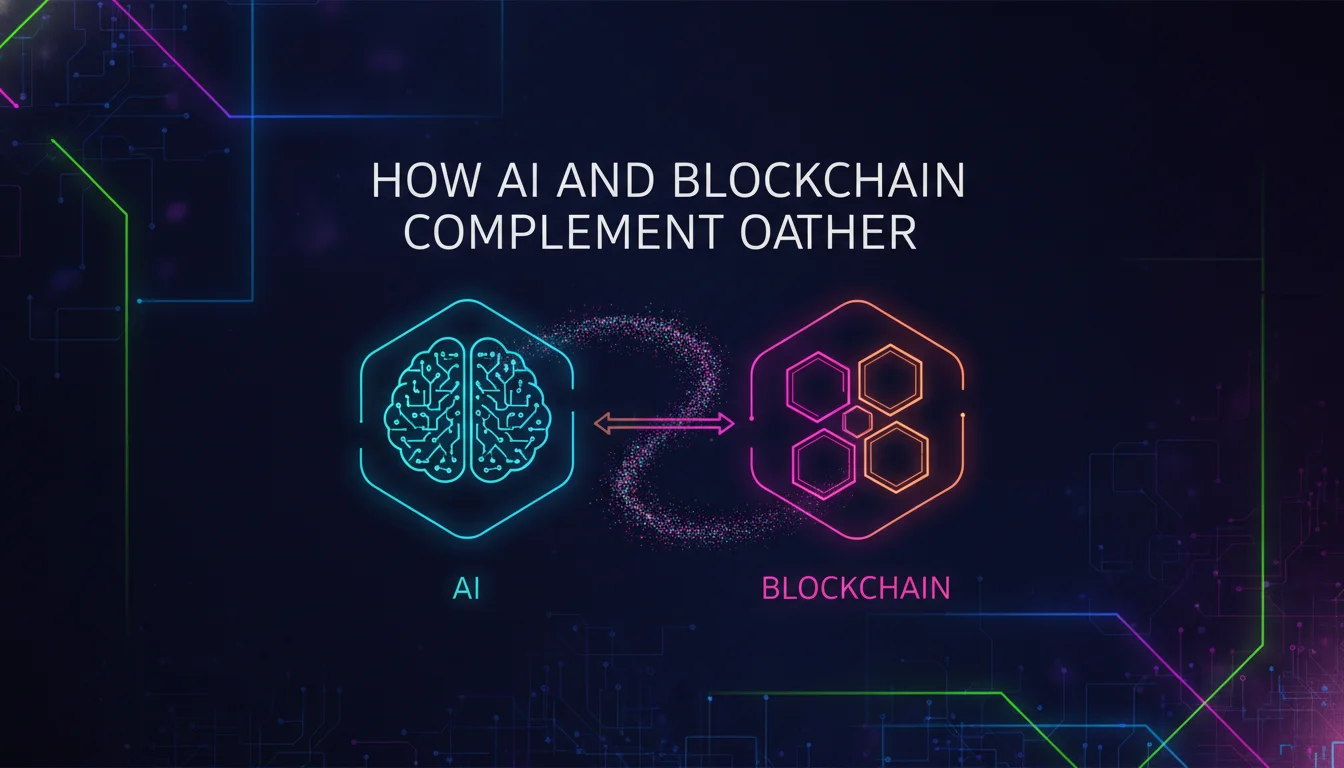
One of AI’s biggest criticisms is its opacity, and blockchain directly fixes that by creating an immutable audit trail from data ingestion through model training to decision output. The rationale behind decisions made by complex neural networks can be hard to trace, raising ethical and compliance concerns. As noted by KPMG, blockchain can act as a bouncer for generative AI, guarding intellectual property and validating the provenance of data. This means stakeholders can verify the integrity of AI models and the datasets they were trained on, building trust in automated systems. The combination of this type of blockchain thus creates an environment where AI decisions are explainable and auditable.
Enhancing Blockchain Efficiency with AI
While blockchain ensures data integrity, it faces real challenges in scalability and transaction speed. AI can optimize consensus algorithms by predicting network congestion and dynamically adjusting parameters. Machine learning models can forecast transaction volumes and suggest optimal block sizes, reducing latency. AI also enhances smart contract execution by analyzing external data sources, oracles, in real time, enabling contracts to adapt to changing conditions. This intelligence transforms static contracts into dynamic, autonomous agents capable of complex logic. Through this kind of blockchain integration, networks become not only more secure but also more efficient and responsive.
Shared Benefits in Data Integrity and Automation
When ai and work together, they create a virtuous cycle of data integrity. Blockchain ensures that the data fed into AI models is accurate and tamper-free, while AI helps blockchain networks manage large-scale data flows with greater efficiency. AI can detect anomalies in transaction patterns that might indicate fraud, and blockchain can permanently record the AI’s findings. This dual layer of verification is critical for regulated industries. Automation through AI-augmented smart contracts can also streamline processes like insurance claims, where conditions and payouts execute automatically once verified data triggers the contract.
| Challenge | AI Alone | Blockchain Alone | AI + Blockchain |
|---|---|---|---|
| Trust & Transparency | Black-box decisions; hard to audit | Immutable records but no decision intelligence | Auditable AI decisions with provenance tracking |
| Data Security | Vulnerable to data poisoning and unauthorized access | Cryptographic security but limited real-time threat detection | AI detects anomalies; blockchain secures data logs |
| Automation | Autonomous but lacks multi-party consent mechanisms | Smart contracts automate only deterministic logic | AI-powered smart contracts adapt to real-world events |
| Scalability | Struggles with large, distributed datasets | Limited throughput and high latency | AI optimizes network parameters; off-chain compute |
| Compliance | Regulatory uncertainty around model explainability | Tamper-proof logs but complex to analyze | Provable compliance with automated reporting |
Key Industry Use Cases for AI and Blockchain
Financial Services: Trust and Automation
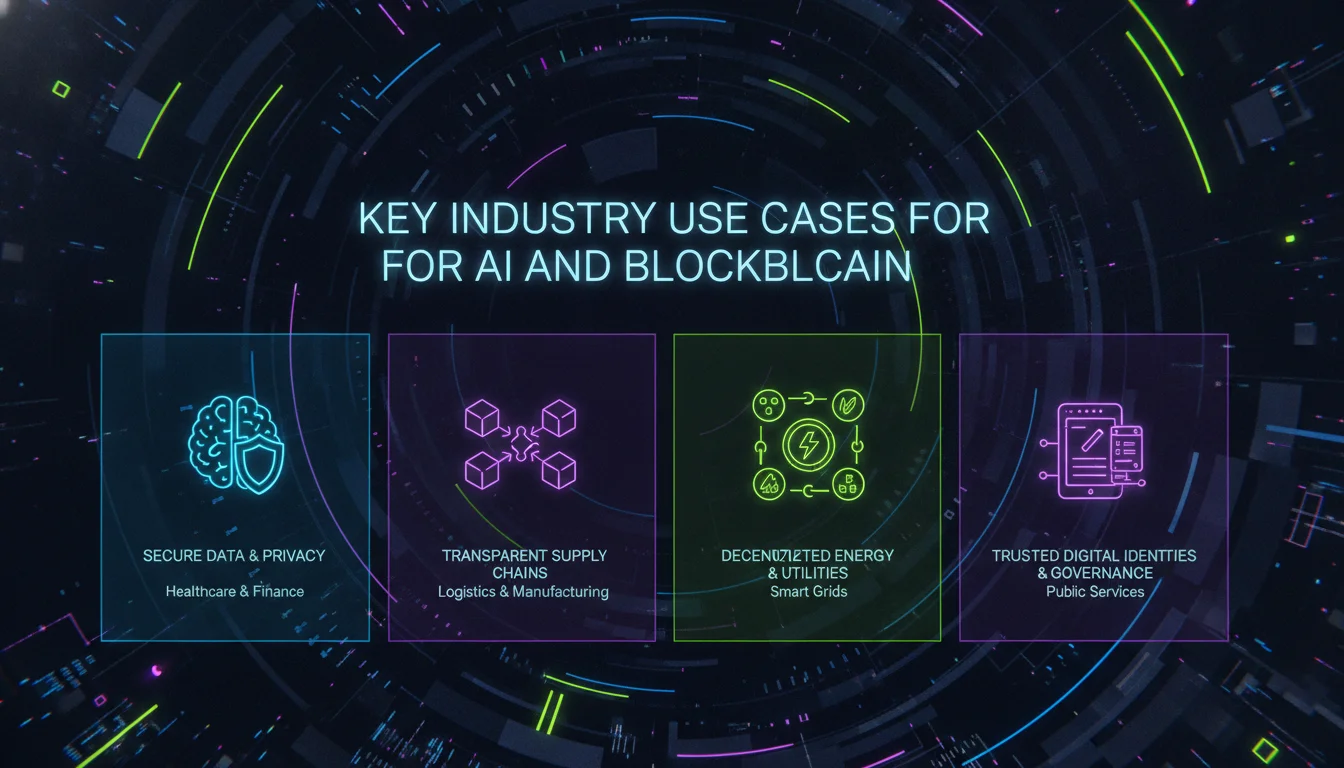
In banking, and blockchain are reshaping lending, trade finance, and fraud detection. Loan applicants can grant permission to access personal records stored on a blockchain, allowing AI algorithms to assess creditworthiness instantly without manual document verification. This accelerates decision-making and reduces bias through standardized, auditable data. Smart contracts can automate collateral management and settlement, with AI providing real-time risk assessments. According to IBM, this integration increases trust, removes friction, and accelerates transactions.
Healthcare: Secure Patient Data and Drug Traceability
The healthcare industry faces stringent privacy regulations and fragmented data systems, and the combination of this type of blockchain offers a direct solution. Patient data stored on a blockchain can be accessed only with consent, while AI analyzes anonymized records to identify treatment patterns or drug interactions. In pharmaceutical supply chains, blockchain provides traceability from manufacturer to patient, preventing counterfeit drugs. AI enhances this by predicting demand spikes or detecting anomalies in distribution. IBM notes that the combination can increase the success rate of clinical trials by ensuring data integrity and automating trial participant tracking.
Supply Chain: Transparent and Intelligent Logistics
Global supply chains have long suffered from a lack of transparency and chronic inefficiency. Blockchain digitizes the paper-based process, creating a single source of truth for all parties. When this kind of blockchain are combined, manufacturers can automatically recommend sustainable shipping methods, trigger reorders based on demand forecasts, or resolve disputes by analyzing sensor data from IoT devices recorded on-chain. As highlighted by Rutgers Business School, the combination enables smarter and more efficient systems that make up for each technology’s shortcomings.
Technical Deep Dive: AI-Blockchain Architecture in Action
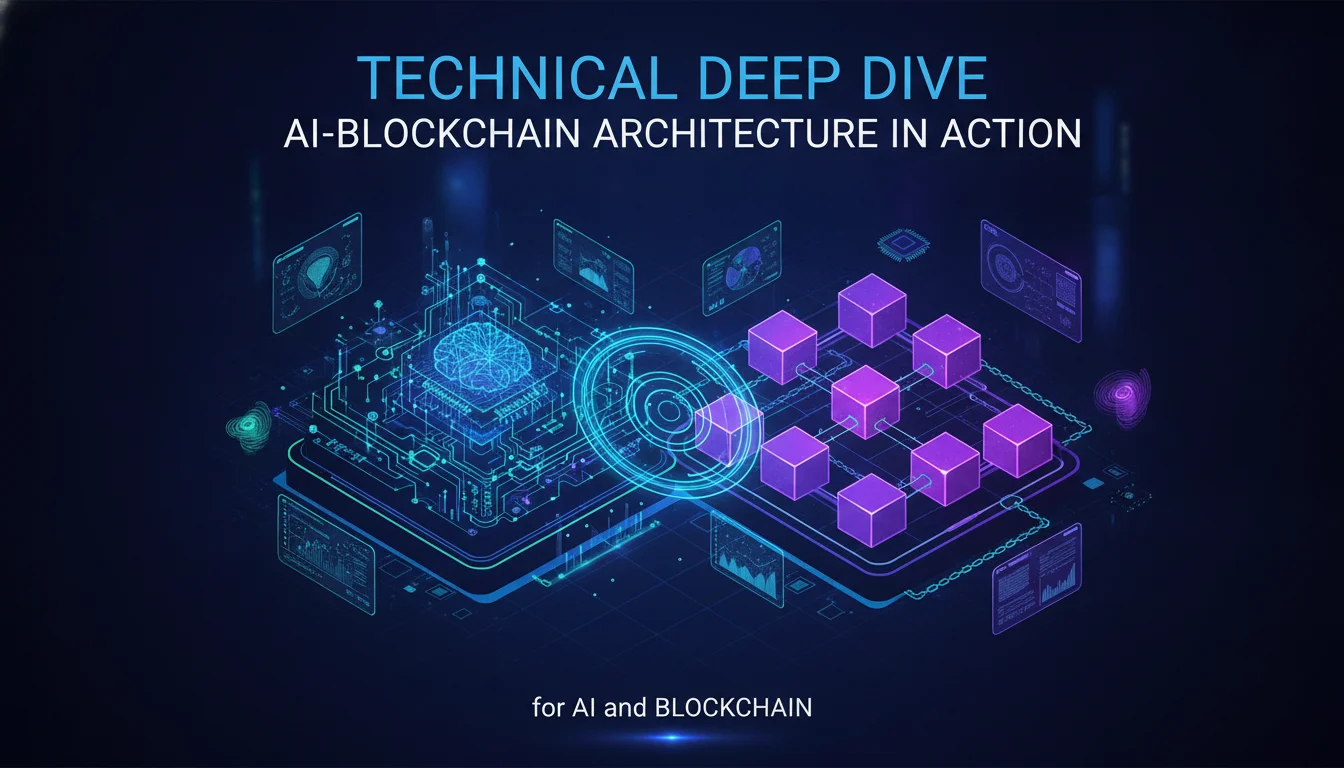
AI-Powered Smart Contracts: From Static to Cognitive
Traditional smart contracts execute predetermined logic based on simple if-then conditions. ai and integration allows these contracts to become cognitive, capable of interpreting unstructured data and making subjective judgments. An insurance smart contract, for example, could process a claim by analyzing images of damaged property through a computer vision module. The process typically works like this:
- Data ingestion: The AI model consumes external data from trusted oracles, such as weather data or IoT sensors.
- Inference: The model evaluates the data against predefined thresholds and returns a recommendation, approve claim or flag for review.
- Blockchain recording: The smart contract executes the recommended action, releasing funds or updating records, and logs the entire decision trail on-chain.
- Audit and feedback: The record provides an immutable history for future audits, and the AI model can be retrained using outcomes.
This loop not only automates processes but also provides a verifiable, transparent mechanism for high-stakes applications.
“Blockchain’s digital record offers insight into the framework behind AI and the provenance of the data it uses, addressing the challenge of explainable AI. This insight helps improve trust in data integrity and in the recommendations that AI provides.” – IBM Think, Blockchain and AI
Blockchain as a Governance Layer for AI Models
As AI models become pervasive, governing their development and deployment is critical. Blockchain can act as a decentralized certificate authority, maintaining a permanent record of model versions, training datasets, and governance approvals. Each time a model is updated, the change is timestamped and signed, creating a tamper-evident history. This is vital for regulatory compliance, for instance, demonstrating that a financial trading bot adhered to model risk management guidelines. According to GeeksforGeeks, blockchain can provide consumer trust logos that allow users to validate AI models against their on-chain history. The fusion of AI and blockchain thus establishes end-to-end model provenance.
Scalability Solutions Through AI-Driven Consensus
Consensus mechanisms like Proof of Work consume immense energy and limit throughput. AI can enhance blockchain scalability by optimizing consensus protocols. Machine learning algorithms can predict node reliability and dynamically adjust committee sizes in Proof of Stake systems, or identify potential validator collusion. AI can also facilitate sharding by intelligently partitioning network traffic to reduce latency. These innovations are making the AI and blockchain ecosystem more viable for enterprise-grade applications, as researchers continue to explore how AI integration addresses blockchain challenges in security, consensus, and scalability.
Overcoming Challenges in AI-Blockchain Integration
Performance and Scalability Bottlenecks
Combining AI and blockchain introduces real performance challenges that practitioners need to plan for. Running AI computations on-chain can be prohibitively expensive and slow due to consensus overhead. Most practical implementations rely on off-chain computation with on-chain verification. However, this creates trust dependencies on external oracles. Researchers are exploring zero-knowledge proofs and advanced cryptographic techniques to verify AI model execution without revealing sensitive data. Scalability remains an open problem, particularly for real-time AI applications that demand millisecond latency.
Regulatory Compliance and Data Privacy
Integrating AI and blockchain raises complex regulatory questions that organizations cannot ignore. The EU’s General Data Protection Regulation (GDPR) enshrines the right to erasure, which conflicts directly with blockchain’s immutability. Similarly, AI model explainability requirements may be hard to meet without revealing proprietary algorithms. Organizations must navigate these tensions by adopting privacy-preserving technologies like fully homomorphic encryption or trusted execution environments. KPMG emphasizes that blockchain can actually support compliance by providing an unchangeable audit trail, but careful design is required to balance transparency with confidentiality.
“The intersection of blockchain and artificial intelligence is becoming an increasingly important area of innovation as entrepreneurs begin building systems to combine the strengths of both technologies.” – Pantera Capital, The Convergence of AI and Blockchain (2026)
Pros and Cons
Pros
- Auditable AI decisions: Blockchain provides an immutable record of every step in an AI model’s decision process, making outputs explainable and verifiable.
- Enhanced security: AI detects anomalies and threats in real time while blockchain cryptographically secures the underlying data logs.
- Smarter automation: AI-augmented smart contracts can respond to real-world events, not just deterministic conditions, enabling far more sophisticated workflows.
- Regulatory readiness: On-chain audit trails simplify compliance reporting in regulated industries like finance and healthcare.
- Decentralized data markets: Blockchain enables fair, transparent monetization of the data that AI models depend on.
Cons
- Performance overhead: Running AI inference on-chain is expensive and slow; off-chain solutions introduce oracle trust dependencies.
- Regulatory conflicts: GDPR’s right to erasure clashes with blockchain’s immutability, creating legal complexity for data-heavy AI applications.
- Integration complexity: Building systems that bridge AI inference engines with on-chain execution requires deep expertise in both domains.
- Scalability limits: Current blockchain throughput is insufficient for real-time AI applications that require millisecond response times.
Leading Projects and Enterprise Implementation
Notable Blockchain-AI Protocols
A wave of projects is pioneering the AI and blockchain frontier. SingularityNET offers a decentralized marketplace for AI services, where algorithms are bought and sold using smart contracts. Fetch.ai builds autonomous agents that perform tasks like data delivery or energy trading on behalf of users, with blockchain ensuring trust. Ocean Protocol uses blockchain to share and monetize data while preserving privacy. According to Pantera Capital, the convergence is an increasingly important area of innovation, with a growing share of investment flowing into such projects.
Enterprise Perspectives: IBM, AWS, and KPMG
Large enterprises are also embracing this convergence. IBM’s blockchain platform integrates AI for supply chain automation and identity verification. As reported in the AWS Startups blog, AI agents already analyze smart contracts for vulnerabilities like reentrancy attacks and logic errors, and scrutinize transaction patterns to detect fraud or money laundering through wallet profiling. KPMG advises clients on using blockchain as a trust layer for AI, particularly in regulated industries like finance and healthcare. These real-world deployments confirm that AI and blockchain is a practical toolset, not a theoretical concept.
Which Blockchain Is Best for AI Integration?
The best blockchain for AI integration depends entirely on your use case. Ethereum offers the deepest developer ecosystem and the widest range of smart contract tooling, making it the default starting point for most AI-augmented contract logic. Solana’s high throughput and low transaction costs make it attractive for applications requiring frequent on-chain AI interactions. Purpose-built networks like Fetch.ai are designed from the ground up for autonomous agent deployment. Key selection criteria include throughput requirements, privacy features, oracle availability, and the maturity of the developer tooling. There is no universal answer, but evaluating these factors against your specific workload will narrow the field quickly. For a deeper look at how to evaluate protocol infrastructure, see our analysis of blockchain development frameworks on the Digital Blockchains blog.
The Road Ahead: Future Trends in AI and Blockchain
Decentralized AI Marketplaces and Tokenized Incentives
The next evolution of AI and blockchain will likely see the rise of decentralized AI marketplaces. These platforms allow developers to monetize their models and users to access them without intermediary fees. Tokenized incentives can reward data providers and model trainers, democratizing access to AI capabilities. Blockchain ensures transparent revenue sharing and intellectual property rights management. As Pantera Capital notes, periods of technological acceleration often occur when two powerful systems reinforce one another, and the convergence of AI and blockchain may unlock category-defining companies, much as smartphones unlocked Uber from the iPhone’s infrastructure.
Autonomous AI Agents on Blockchain Networks
AI agents are poised to become first-class citizens on blockchain networks. These agents can hold cryptocurrency, enter into smart contracts, and execute transactions autonomously. An agent could negotiate energy prices in a decentralized grid or participate in a prediction market on a protocol like Augur. The combination of AI and blockchain ensures that agent actions are transparent and irreversible, building trust in automated economies. AWS highlights that AI agents already monitor transactions for suspicious activity, and their roles will only expand as on-chain governance matures.
As of 2026: Where the Ecosystem Stands
As of 2026, the AI and blockchain ecosystem has moved well past proof-of-concept. Enterprise deployments are live in pharmaceutical supply chains, financial compliance, and decentralized data markets. Pantera Capital has publicly committed a growing share of its research time and investment capital to opportunities at this intersection, a signal that institutional conviction is building. The infrastructure layer, oracles, zero-knowledge proof systems, and agent frameworks, is maturing fast. The builders who understand both sides of this stack are the ones positioned to define what comes next. If you’re working at this intersection, the Digital Blockchains studio is where serious protocol work gets done.
Frequently Asked Questions
What is the main difference between AI and blockchain?
AI is a technology that simulates human intelligence to analyze data and make decisions, while blockchain is a distributed ledger that provides transparency, immutability, and trust in transactions. They serve different purposes but complement each other directly: blockchain audits what AI decides, and AI makes blockchain networks smarter and more efficient.
How does AI improve blockchain security?
AI enhances blockchain security by analyzing transaction patterns in real time to detect anomalies such as fraud or money laundering. According to the AWS Startups blog, AI agents can also audit smart contract code for vulnerabilities like reentrancy attacks and logic errors, reducing the risk of exploits before they occur.
Can blockchain solve the AI black box problem?
Yes, blockchain can provide a transparent and immutable record of AI model training data, versions, and decision trails, making it easier to audit and explain AI outputs. Full transparency may still be limited by privacy requirements, but on-chain provenance tracking is a significant step toward explainable AI.
Which blockchain is best for AI?
There is no single best blockchain for AI integration. Ethereum offers the richest smart contract ecosystem, Solana provides high throughput at low cost, and purpose-built networks like Fetch.ai are designed specifically for autonomous agent deployment. The right choice depends on your throughput requirements, privacy needs, and oracle availability.
Will AI agents use blockchain in the future?
AI agents are already using blockchain for autonomous operations today. They can hold digital assets, enter contracts, and execute transactions on behalf of users, with blockchain providing trust and auditability for their actions. As on-chain governance matures, the scope of what agents can do autonomously will expand significantly.
What are the benefits of combining AI and blockchain in healthcare?
In healthcare, this combination enables secure sharing of patient data for AI analysis while maintaining privacy, improves drug traceability across the pharmaceutical supply chain, and automates clinical trial management. IBM notes it can increase clinical trial success rates by ensuring data integrity and automating participant tracking and consent management.