Key Takeaways
- A blockchain project is any software initiative that uses distributed ledger technology to solve a problem, ranging from simple voting dApps to enterprise supply chain platforms.
- Blockchain projects span four network types, public, private, consortium, and hybrid, each suited for different trust and permission requirements.
- Real-world deployments by JPMorgan Chase, Block, and Cash App show that financial services, healthcare, and logistics are leading adoption.
- Open-source ecosystems like Ethereum/Solidity, Hyperledger Fabric, and Hardhat provide the foundation for most blockchain projects, with detailed documentation and active communities.
- Beginners can start with a voting system or patient data management dApp, while advanced builders tackle energy trading, IoT security, or zero-trust architectures.
A blockchain project is a software initiative built on distributed ledger technology to create decentralized, transparent, tamper-resistant records. These range from academic prototypes to multi-billion-dollar financial networks reshaping how data and value move online.
What Is a Blockchain Project?
Defining the Core Concept
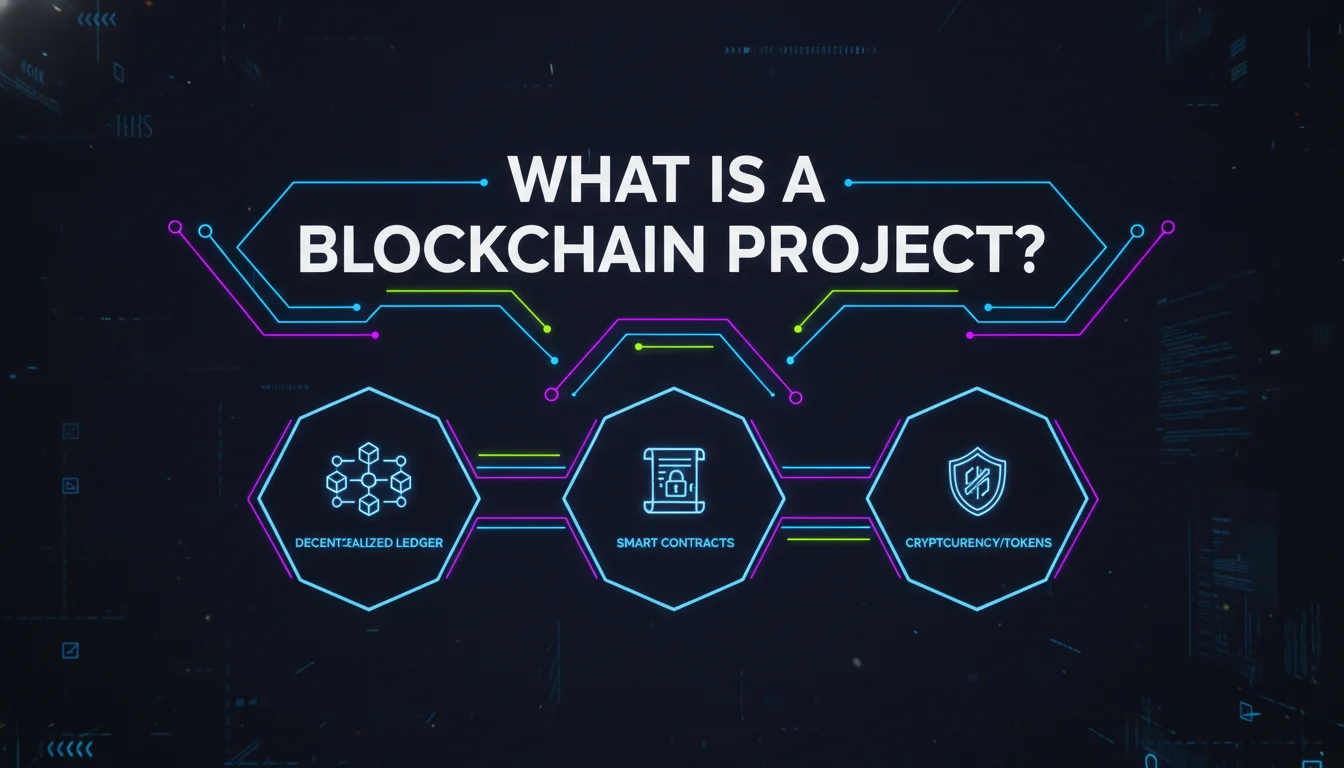
A blockchain project is any development effort that uses a distributed ledger as its foundational infrastructure. Unlike traditional centralized databases, a blockchain stores data in sequential, cryptographically linked blocks, creating an immutable record shared across many participants. This architecture eliminates single points of failure and reduces the need for intermediaries, whether the project is a cryptocurrency, a supply chain tracker, or a decentralized identity system. At its core, every blockchain project aims to solve a trust problem. In finance, it may replace clearinghouses. In healthcare, it can secure patient records. In government, it can make voting auditable.
How Blockchain Projects Work
All blockchain projects rely on three fundamental layers: the protocol (consensus rules and block validation), the network (peer-to-peer communication), and the application (smart contracts or client interfaces). When a user submits a transaction, it’s broadcast to nodes, which validate it according to a consensus mechanism like Proof of Work or Proof of Stake. Once validated, the transaction is grouped into a block, added to the chain, and replicated across every node. This process ensures no single entity can alter past records without collusion from the majority of the network. For developers, the application layer is where most blockchain projects differentiate. By writing smart contracts in Solidity, Rust, or Go, they define business logic that executes automatically when conditions are met.
// A minimal ERC-20 transfer function in Solidity
function transfer(address to, uint256 amount) public returns (bool) {
    require(balanceOf[msg.sender] >= amount, "Insufficient balance");
    balanceOf[msg.sender] -= amount;
    balanceOf[to] += amount;
    emit Transfer(msg.sender, to, amount);
    return true;
}
Key Benefits Across Industries
Because blockchain removes the central gatekeeper, projects built on it offer transparency (all participants see the same ledger), immutability (records can’t be changed retroactively), and disintermediation (peer-to-peer value transfer). According to Builtin, companies like JPMorgan Chase and Block are using these properties to speed up settlement and give users direct control over digital assets. In supply chains, a blockchain project can trace a product from raw material to shelf, reducing fraud and recall costs. In media, it enables royalties paid instantly via smart contracts. These benefits explain why thousands of blockchain projects are now in production across every sector.
“Trust used to require an intermediary. Now it requires a protocol.” This shift, more than any single application, is what separates blockchain projects from ordinary software builds.
The Four Types of Blockchain Networks
Public Blockchains
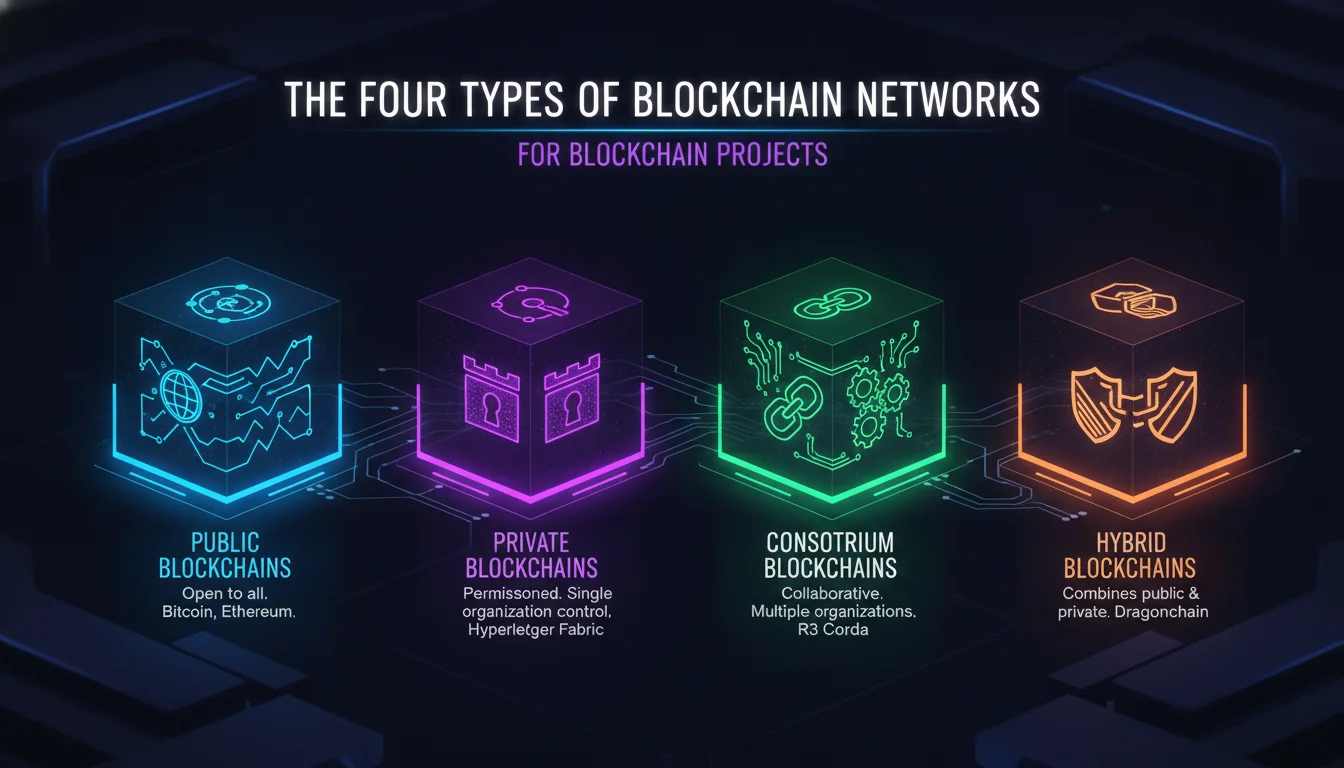
A public blockchain is a permissionless network where anyone can join, read, and write transactions. Bitcoin and Ethereum are the most famous examples. In these projects, consensus is achieved through economic incentives: miners or validators stake value to secure the network. Public blockchains offer maximum decentralization and censorship resistance, but they often face scalability bottlenecks. Many early blockchain projects chose public networks precisely because they need no central authority and can operate globally without gatekeepers.
Private Blockchains
A private blockchain, sometimes called a permissioned ledger, restricts participation to a single organization or a controlled group. Only approved nodes can validate transactions, and read access may be limited. These blockchain projects sacrifice some decentralization for higher throughput and tighter confidentiality, critical for internal auditing or sensitive corporate workflows. Hyperledger Fabric, a common choice for private networks, allows pluggable consensus and fine-grained permissions, making it the foundation for many enterprise deployments.
Consortium and Hybrid Blockchains
Consortium blockchains are governed by a group of organizations rather than a single entity. For example, a shipping consortium might run a blockchain project to digitize bills of lading, with each participant operating a node. Hybrid blockchains combine public verification with private data storage, useful for government services where citizens need to audit records but personal data must remain confidential. Understanding these four types helps architects pick the right trust model when designing new systems.
Real-World Blockchain Project Applications
Money Transfer and DeFi
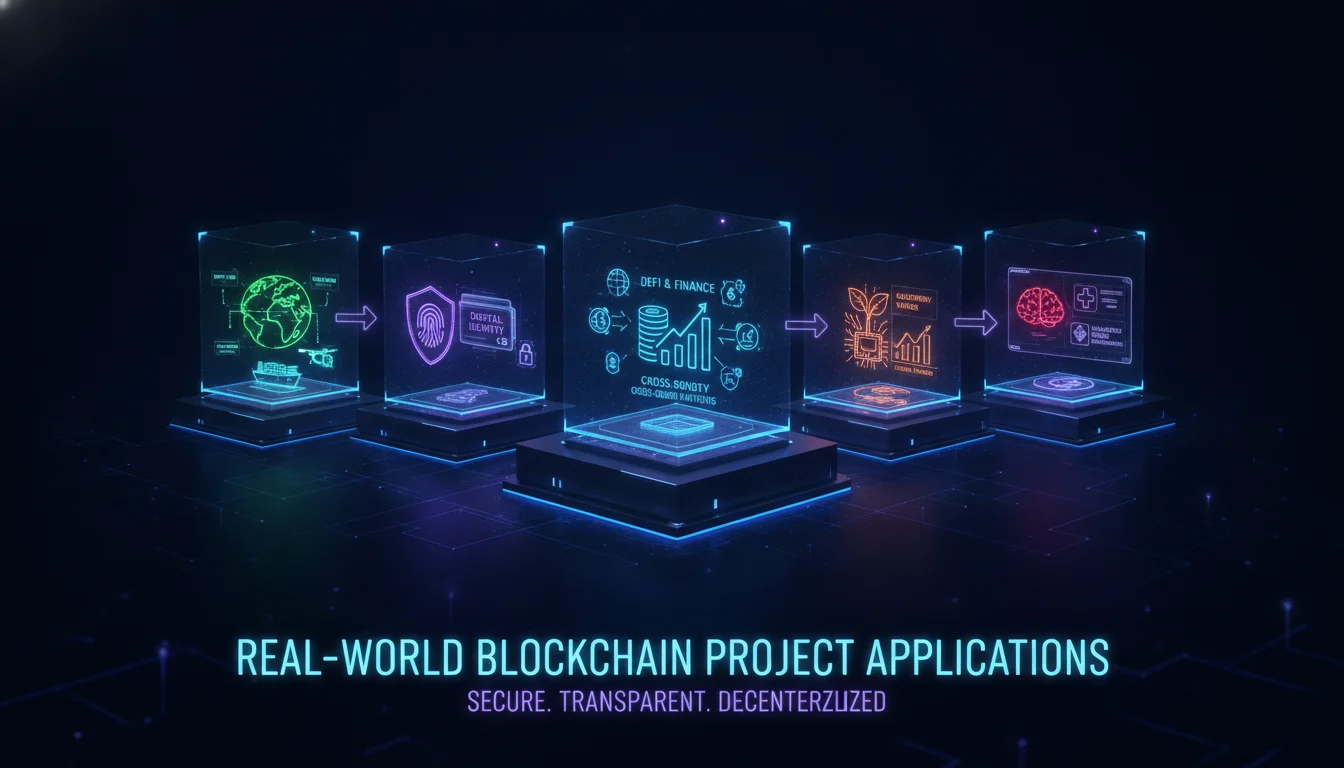
Pioneered by Bitcoin, financial blockchain projects have expanded well beyond simple peer-to-peer payments. Block (formerly Square) provides a self-custody hardware wallet called Bitkey and funds open-source Bitcoin development through its Spiral initiative. JPMorgan Chase’s Onyx platform uses distributed ledger technology to settle interbank U.S. dollar transactions in real time. In 2023, it launched a pilot with six banks in India, demonstrating how blockchain can replace legacy correspondent banking, according to Builtin’s reporting. Cash App rolled out stablecoin payment functionality in 2026, allowing users to send and receive stablecoins directly on the platform. DeFi protocols built on Ethereum further extend money transfer into lending, borrowing, and automated market making, all without traditional intermediaries.
Supply Chain and Logistics
Supply chain blockchain projects tackle counterfeiting, product recalls, and opaque provenance. By recording every handoff, from raw material to final sale, on an immutable ledger, participants gain a shared, real-time view of goods. Competitor research from Final Year Projects lists a “Blockchain-Based Traceability System for Product Recall” as an active IEEE project topic, reflecting industry demand. Logistics teams are piloting such systems to cut paperwork and automate payments via smart contracts triggered by IoT sensor data.
Healthcare and Identity Management
Healthcare is fertile ground for blockchain projects because fragmented records and privacy regulations create data silos. A blockchain-based patient data management system, one of the GeeksforGeeks project ideas, stores encrypted patient records on a private or consortium chain, giving hospitals controlled access without a central database. The U.S. Department of Homeland Security Science and Technology Directorate lists blockchain as part of its cybersecurity and critical infrastructure research portfolio, underscoring the strategic trust these systems can provide.
Top Open-Source Blockchain Projects in 2026
Ethereum/Solidity: The Smart Contract Standard
Ethereum remains the most popular platform for decentralized applications. Its smart contract language, Solidity, is an open-source project with 23,900 GitHub stars, according to Web3 Career. Developers use Solidity to write self-executing contracts that power everything from NFT marketplaces to DAOs. As the ecosystem matures, tooling like Hardhat and Foundry streamlines development, testing, and deployment, making Ethereum the entry point for most new builds.
Hyperledger Fabric: Enterprise Grade
Hyperledger Fabric, hosted by the Linux Foundation, is the dominant framework for private and consortium blockchains. Unlike Ethereum, Fabric supports pluggable consensus, channels for confidential transactions, and identity management through certificate authorities. It’s the backbone of countless supply chain, finance, and healthcare blockchain projects. Its modular architecture lets organizations swap out components, a key advantage for regulated industries evaluating consensus algorithms like PBFT variants for their specific throughput and fault-tolerance needs.
Emerging Tools: Lenster, Hardhat, Chainlink
Beyond the core ledgers, a wave of open-source tools accelerates blockchain projects. Lenster, with 21,200 GitHub stars per Web3 Career, is a decentralized social media app demonstrating how web3 can rival traditional platforms. Hardhat provides a complete development environment for Ethereum, with a built-in local network, debugging, and plugin system. Chainlink’s oracle network bridges on-chain smart contracts with off-chain data, a critical service used by most DeFi projects. Together, these tools lower the barrier to entry, letting a single developer move a dApp from concept to testnet in weeks.
Beginner-Friendly Blockchain Project Ideas
Electronic Voting System
A vote chain is one of the most recommended starter blockchain projects for students. The concept is straightforward: an ID verifier authorizes a voter, who then casts a ballot in a smart contract that records the vote immutably. Because each vote is a transaction, the system provides a transparent tally while preserving anonymity. The GitHub topic “blockchain-projects” showcases a popular repository by Vatshayan with 159 stars, complete with code, PPT, synopsis, and video explanation. Building a voting dApp teaches Solidity, front-end integration, and the fundamentals of transaction lifecycle, skills that transfer to any project.
Patient Data Management System
Healthcare projects are ideal for beginners because they illustrate the technology’s value in data security and permissioning. In a typical student build, patients’ encrypted records are stored off-chain while access permissions are managed by smart contracts. Only authorized providers can decrypt and view the data, and every access attempt is logged. GeeksforGeeks lists this as a top beginner idea, and final year project lists from Final Year Projects include similar titles like “A System for the Promotion of Traceability and Ownership of Health Data Using Blockchain.” Such a project introduces you to off-chain storage patterns, encryption, and privacy regulations like HIPAA.
Simple Cryptocurrency
Creating a basic token on Ethereum using the ERC-20 standard is a rite of passage for new blockchain developers. With just a few lines of Solidity, you can define a token’s name, symbol, total supply, and transfer functions. Tools like Remix IDE let you write, compile, and deploy without installing any software. This exercise demystifies gas fees, wallets, and the Ethereum Virtual Machine, forming the foundation for more ambitious builds down the line.
Advanced Blockchain Project Ideas for Students and Developers
Blockchain-Based Energy Trading
Renewable energy producers can use blockchain to trade excess electricity directly with consumers, bypassing utilities. Titles like “Blockchain Power Trading and Energy Management Platform” and “Blockchain-Based Distributed Renewable Energy Management Framework” appear on the Final Year Projects IEEE list, alongside a project exploring SCADA system integration with OpenADR for energy services. These advanced blockchain projects require integrating IoT smart meters with smart contracts that automatically execute transactions when generated power exceeds a household’s consumption. Challenges include handling real-time data ingestion, ensuring low-latency settlement, and managing volatile energy prices, making this a rich capstone project.
IoT Security with Blockchain
The explosion of IoT devices has created vast attack surfaces. A blockchain project that secures device identity and data integrity can form a zero-trust architecture. Final Year Projects lists “A Novel Blockchain-Based Secured and QoS-Aware IoT Vehicular Network in Edge Cloud Computing” as an IEEE topic, alongside a related title on blockchain-enabled intrusion detection within zero-trust architectures. In this scenario, vehicles authenticate themselves to roadside units via blockchain-anchored certificates, and sensor data is hashed on-chain for later forensic analysis. Such projects blend networking, cryptography, and consensus optimization, perfect for graduate research.
Decentralized Notarization System
Using a national electronic ID card to notarize documents on a blockchain is explored in “Blockchain-Based Autonomous Notarization System Using National eID Card,” another IEEE title from the Final Year Projects list. The system hashes a document, associates it with a citizen’s verified identity, and records the timestamp on a consortium chain. This creates a tamper-proof audit trail that courts and businesses can trust without relying on a notary’s physical seal. Building this requires understanding self-sovereign identity standards and multi-signature authorization, skills directly transferable to enterprise deployments.
Comparing Blockchain Project Types by Complexity
| Project Level | Description | Typical Use Cases | Example Tools & Platforms |
|---|---|---|---|
| Beginner | Single smart contract, basic UI, often deployed on a testnet | Voting system, simple token, basic record keeping | Remix IDE, Solidity, MetaMask, Ethereum testnets |
| Intermediate | Multi-contract dApp with off-chain storage and oracle integration | Supply chain tracker, NFT marketplace, patient data management | Hardhat, The Graph, IPFS, Chainlink Oracles |
| Advanced | High-throughput permissioned network with custom consensus and business rules | Energy trading, IoT security, cross-border settlement | Hyperledger Fabric, Cosmos SDK, custom consensus modules |
| Enterprise | Fully audited, multi-org consortium with governance and compliance | Interbank payments, government identity, healthcare consortia | Onyx (JPMorgan), enterprise Fabric deployments |
From a homework exercise to institutional settlement infrastructure, the table above shows that blockchain projects exist on a wide spectrum. Beginners should start with a public testnet and a single smart contract, while larger teams need to evaluate permissioned frameworks and formal verification tools.
How to Choose the Right Platform for Your Blockchain Project
Evaluating Scalability and Consensus
The first decision for any blockchain build is the consensus mechanism. Public networks like Ethereum rely on Proof of Stake, which offers strong decentralization but limited base-layer throughput, though L2 rollups are improving this. Private ledgers like Hyperledger Fabric can use pluggable consensus for much higher transaction volumes but require trusted operators. If your project must handle high-volume payment flows, consider a permissioned chain. If censorship resistance is paramount, stay public. Always model transaction load and latency requirements before choosing.
Development Tools and Community Support
Rich tooling accelerates blockchain projects dramatically. Ethereum leads with Hardhat, Truffle, Ethers.js, and a vibrant developer community. Hyperledger offers SDKs in Node.js, Java, and Go, plus detailed documentation. Newer platforms like Cosmos and Aptos have smaller communities but strong momentum among builders. When in doubt, pick the platform with the largest developer base: it will have more tutorials, libraries, and battle-tested code. The open-source rankings compiled by Web3 Career also indicate where recruitment and innovation are concentrated.
Cost and Deployment Considerations
Deploying on Ethereum mainnet incurs gas fees that can spike significantly for complex contract interactions. Layer-2 solutions like Optimism and Arbitrum reduce this, while sidechains like Polygon offer a middle ground. Private networks avoid gas fees entirely but require hosting and maintenance costs. For student projects, public testnets provide free sandboxes. For enterprise pilots, cloud providers offer managed blockchain services that lower the operational burden. Budget not just for development but also for ongoing node operation and smart contract auditing, which can range widely in cost depending on scope and complexity.
Pros and Cons of Building a Blockchain Project
Pros
- Removes single points of failure and reduces reliance on intermediaries
- Creates auditable, tamper-resistant records across all participants
- Enables automated execution of business logic through smart contracts
- Open-source ecosystems (Ethereum, Hyperledger) provide mature tooling and documentation
Cons
- Public networks can face scalability and gas fee volatility
- Smart contract bugs are often irreversible once deployed
- Permissioned chains sacrifice some decentralization for throughput
- Regulatory uncertainty still complicates some financial and identity use cases
The Future of Blockchain Projects
Enterprise Adoption and Government Initiatives
Institutional blockchain projects are progressing from pilots to production. JPMorgan’s Onyx is settling real transactions, not just running a proof of concept. The U.S. Department of Homeland Security continues to fund blockchain research for cybersecurity and critical infrastructure resilience, signaling that governments see strategic value beyond cryptocurrency. As regulations solidify, expect more public-private consortia to tackle problems like digital identity and secure data sharing. Industry trends observed by Builtin suggest financial services and healthcare will remain the most active sectors for enterprise-grade deployments.
AI Integration and Cross-Chain Interoperability
The intersection of artificial intelligence and blockchain is creating new project categories. Chainalysis already uses AI to detect fraudulent transactions and assess NFT risks, embedding machine learning models into its monitoring tools. Future blockchain projects may use AI for consensus optimization or anomaly detection. Cross-chain interoperability protocols like Cosmos IBC and Polkadot’s XCMP are also breaking down silos, letting assets and data flow between networks. This composability will accelerate innovation, as developers combine specialized chains into a single application.
As one Web3 Career analysis puts it, the open-source projects with the most GitHub activity tend to indicate “where recruitment and innovation are concentrated” across the industry, a useful signal for anyone choosing a platform to build on.
Regulatory Clarity and Mainstream Acceptance
As governments worldwide finalize crypto frameworks, blockchain builds will operate with clearer legal boundaries. The EU’s MiCA regulation and ongoing U.S. stablecoin legislation are early examples. Regulatory certainty is a green light for institutional capital, which will flow into compliant DeFi, tokenized securities, and central bank digital currencies. Meanwhile, user experience is catching up: wallets like Bitkey and Cash App’s stablecoin integration abstract away the complexity of private keys, making blockchain invisible to the end user. When blockchain fades into the background, adoption accelerates, and that’s the ultimate goal of every serious builder in this space.
Conclusion
Whether you’re a student exploring final year ideas or a technical lead evaluating enterprise solutions, the landscape of blockchain projects as of 2026 is richer than it’s ever been. By understanding the four network types, studying real-world applications from JPMorgan and Block, and using open-source tools like Solidity and Hyperledger, you can build systems that deliver genuine transparency and efficiency. Start small: a voting dApp or an ERC-20 token, then scale your skills toward harder problems in energy, IoT, and identity. The infrastructure is ready and the community is active. If you’re serious about building protocol-level infrastructure rather than another disposable dApp, apply to the Genesis Cohort at digitalblockchains.com and build with people who ship.
Frequently Asked Questions
What is a blockchain project?
A blockchain project is any software system built on a distributed ledger that records transactions immutably. It can range from a simple student voting app to a cross-border payment network used by banks.
What are some examples of blockchain projects?
Popular examples include Bitcoin, Ethereum, JPMorgan’s Onyx for interbank settlement, and Lenster, a decentralized social media platform. Many academic blockchain projects focus on electronic voting, patient data management, and energy trading.
What are the 4 types of blockchain?
The four types are public (permissionless, e.g., Ethereum), private (permissioned, e.g., Hyperledger Fabric), consortium (governed by multiple organizations), and hybrid (public verification with private data). Each suits a different trust model.
Is blockchain 100% safe?
No technology is 100% safe. While blockchain’s cryptography and decentralization make it highly tamper-resistant, vulnerabilities can arise from smart contract bugs, key mismanagement, or attacks on smaller networks. Audits and best practices reduce these risks significantly.
How do I start a blockchain project?
Begin by choosing a platform (Ethereum for public, Fabric for private), learning a smart contract language like Solidity, and building a minimal viable dApp on a testnet. Study open-source repositories like those on GitHub’s blockchain-projects topic for inspiration and code examples.
What are the best blockchain platforms for projects?
For public, censorship-resistant applications, Ethereum and its Layer-2s lead. For enterprise use, Hyperledger Fabric offers confidentiality and pluggable consensus. Polkadot and Cosmos excel at cross-chain interoperability. The best choice depends on your project’s scalability, permissioning, and ecosystem needs.