Key Takeaways
- Blockchain AI merges immutable ledgers with machine intelligence to create transparent, auditable, and automated systems.
- The combination improves data integrity, builds trust in AI outputs, and enables smart contracts that act on their own.
- Platforms like SingularityNET, Fetch.ai, and Ocean Protocol are building decentralized AI marketplaces and data economies.
- Scalability, regulation, and genuine decentralization remain unsolved problems, not marketing footnotes.
- Token utility varies widely across projects. No single AI token is a guaranteed winner, and due diligence matters more than narrative.
Blockchain AI is the combination of distributed ledger systems and machine intelligence into a single architecture for auditable, automated decision-making. It lets AI models prove their data provenance while smart contracts execute decisions without a middleman.
What Is Blockchain AI?
Defining Blockchain and Artificial Intelligence
Blockchain is a shared, immutable ledger that records transactions across a network of computers, and AI is the layer that gives those systems judgment. According to IBM, blockchain provides an immediate, transparent exchange of encrypted data among multiple parties, enabling trust without a central authority. Artificial intelligence uses computers and data to mimic human-like problem-solving. It covers machine learning and deep learning, letting systems learn from data and produce predictions or classifications.
The Convergence of Two Powerful Technologies
Blockchain AI emerges when these two fields intersect at the protocol level. Blockchain supplies a tamper-proof record of data and model provenance, while AI adds intelligence to blockchain-based processes that would otherwise require manual review. This pairing solves a real problem on both sides: AI gains an audit trail it never had, and blockchain networks get smarter about when and how to act. Per Pantera Capital, blockchain and AI reinforce each other the way steam power and railroads did in the 19th century or electricity and manufacturing did in the early 20th, creating new categories of automation and trust rather than just improving old ones.
“Blockchain’s digital record offers insight into the framework behind AI and the provenance of the data that it is using, addressing the challenge of explainable AI,” IBM notes in its research on the two technologies. That audit trail is the whole value proposition for regulated industries.
At its core, blockchain AI isn’t one product. It’s a design pattern. It can mean smart contracts that call AI models, a decentralized marketplace for AI services, or a chain that natively supports machine-learning workloads. The thread connecting all three: using blockchain’s verifiability to make AI more reliable, and using AI to make blockchain systems less rigid.
How Blockchain and AI Enhance Each Other
Data Integrity and Auditability
Blockchain AI improves data integrity by recording an AI model’s training data, inputs, and outputs on a ledger that nobody can quietly edit. Anyone with access can trace how a conclusion was reached, which directly addresses AI’s “black box” problem. That matters most in regulated sectors like healthcare and finance, where an unexplainable decision isn’t just inconvenient, it’s a compliance risk. IBM points out that storing and distributing AI models on blockchain provides a clear chain of custody, which strengthens trust in the underlying data.
Intelligent Automation Through Smart Contracts
Smart contracts become genuinely autonomous once you connect them to AI models instead of static rules. A blockchain AI system can automatically reorder supplies when inventory drops below a threshold, or trigger a payment once it verifies real-world sensor data. IBM describes how AI models embedded in smart contracts can recommend recalling expired products, resolve disputes, or select the most sustainable shipping method. That’s not automation for its own sake, it’s removing human friction from processes that involve multiple parties who don’t fully trust each other.
Decentralized AI Marketplaces
Blockchain lets AI developers monetize models and datasets without going through a centralized platform that takes a cut and controls access. Platforms like SingularityNET and Ocean Protocol let users buy and sell AI services or datasets in exchange for tokens. That opens access to advanced AI to smaller developers and creates a permissionless economy where contributors get paid directly. In this framing, blockchain AI functions as infrastructure for a distributed intelligence network rather than a single company’s product.
Real-World Applications Across Industries
Healthcare and Life Sciences
In healthcare, blockchain AI solves two problems at once: protecting patient privacy and improving data-driven care. Electronic health records stored on a blockchain can be queried by AI algorithms to surface treatment insights without exposing identifiable personal data. IBM notes that organizations can collaborate on care improvements while still protecting patient privacy. In clinical trials, pairing blockchain with AI adds transparency to consent, data collection, and trial management, which increases trust among participants and regulators alike.
Financial Services
Financial institutions are using blockchain AI to speed up loan origination and catch fraud earlier. Once an applicant grants consent to access blockchain-stored financial records, AI can assess creditworthiness almost instantly, and smart contracts can automate disbursement. That removes the manual document-verification bottleneck that slows down closings. AI-powered monitoring layered on a blockchain ledger can also flag suspicious transactions in real time, which strengthens anti-money laundering compliance without adding headcount.
Supply Chain Management
Supply chains are fragmented and still largely paper-based, and blockchain AI fixes that by digitizing records and adding automated decision-making on top. A manufacturer can track raw materials from source to finished product on an immutable ledger while AI predicts demand dips and triggers reorders before a shortage happens. IBM describes how this convergence opens up new options, from selecting the most sustainable shipping method to automatically executing payments once goods clear customs. The output is a supply network that’s harder to defraud and faster to adjust.
Top Blockchain AI Tools and Platforms
Overview of Leading Tools
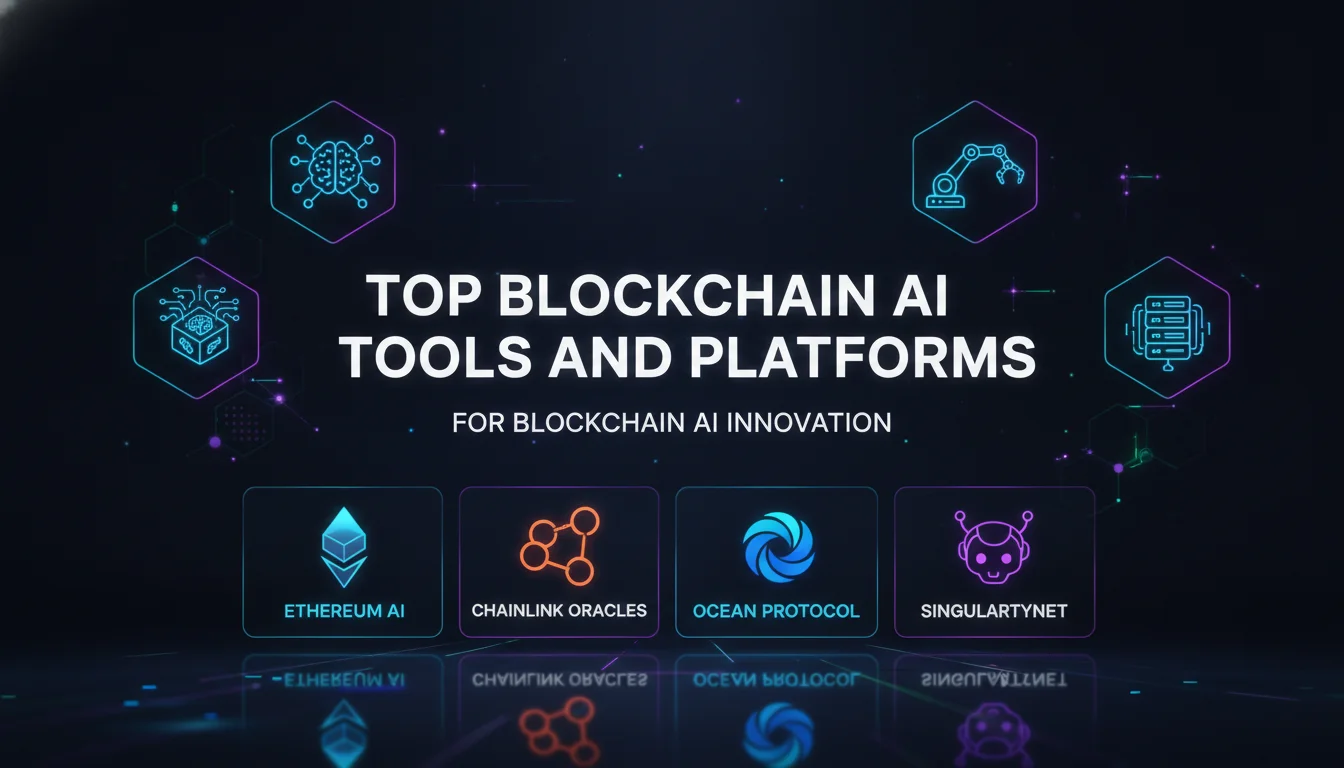
Several platforms embody the blockchain AI model in production today. The comparison below draws on data from QuickNode’s builder guide and each project’s official documentation.
| Platform | Primary Use Case | Blockchain | Token Utility |
|---|---|---|---|
| SingularityNET | Decentralized AI service marketplace | Ethereum, Cardano | AGIX for payments and governance |
| Fetch.ai | Autonomous economic agents | Cosmos SDK | FET for staking and agent deployment |
| Ocean Protocol | Data sharing and monetization | Ethereum, Polygon | OCEAN for data access and curation |
| ChainGPT | Crypto-native AI infrastructure | BNB Chain | CGPT for API access and model usage |
| Bittensor | Peer-to-peer machine intelligence | Subtensor (custom) | TAO for network incentives |
| Numerai | Crowdsourced hedge fund | Ethereum | NMR for staking on predictions |
| Cortex | On-chain AI inference | Cortex blockchain | CTXC for smart contract execution |
How to Choose a Blockchain AI Tool
Choosing the right tool depends entirely on what you’re trying to build. Developers building dApps that need direct on-chain model calls should look at ChainGPT or Cortex. Organizations trying to monetize proprietary data should evaluate Ocean Protocol’s marketplace model. If you’re building multi-agent systems that negotiate and transact autonomously, Fetch.ai offers a more mature framework than most alternatives. Investors researching exposure to the sector should dig into tokenomics, partnership networks, and whether the team has shipped anything beyond a whitepaper. Always check the maturity of the underlying chain, whether it’s had a security audit, and how active the developer community actually is before committing resources.
Security Threats AI Poses to Blockchain
AI poses a real security risk to blockchain systems by automating attacks that used to require manual effort, including smart contract exploit discovery and large-scale phishing campaigns. Bad actors can now use AI to scan contract code for vulnerabilities faster than human auditors, and to generate convincing social-engineering attacks at scale. The flip side is that the same AI techniques can be turned into defense. Anomaly-detection models trained on transaction patterns can flag wallet drains or unusual contract calls in real time, often faster than a human security team would catch them. This is a genuine arms race, not a one-sided threat, and any serious blockchain AI security strategy has to plan for both directions.
Investing in AI Blockchain
Understanding AI Crypto Tokens
Most blockchain AI projects issue native tokens that function as the medium of exchange inside their own ecosystem. AGIX on SingularityNET pays for AI services, while TAO on Bittensor rewards nodes that contribute machine-learning models to the network. These tokens can appreciate if platform adoption grows, but they also carry the volatility that comes standard with crypto assets. No coin is a guaranteed winner as of 2026. Treat every project on its individual fundamentals, not its category label.
Risks and Considerations
Investing in blockchain AI carries layered risk: technological (protocols that are still immature), regulatory (unclear legal status for AI-generated outputs and their associated tokens), and market (the volatility that defines crypto generally). Some platforms promise transformative results and simply don’t deliver on the roadmap. Diversification and a long time horizon are the standard advice for a reason. It’s also worth scrutinizing whether a project actually uses AI in its core architecture, or if it just added “AI” to its pitch deck to ride the trend. That distinction matters more than most token comparisons do.
Challenges and Limitations
Technical Hurdles
Merging AI and blockchain is genuinely hard, not just a branding exercise. Training large AI models needs massive compute and fast data access, while blockchains are inherently slower because of consensus overhead. Storing raw training data on-chain is expensive and impractical, so most blockchain AI systems store data off-chain and anchor a hash on-chain instead. Scalability is still a bottleneck. Layer-2 solutions and rollups are being explored for AI workloads, but none are mainstream yet. Interoperability between different blockchains and different AI frameworks adds another layer of friction on top of that.
The Decentralization Dilemma
True decentralization is hard to achieve because AI training still depends heavily on centralized compute clusters, the kind only a handful of companies can afford to run at scale. Projects like Bittensor try to distribute model training across a peer-to-peer network, but verifying correctness without central oversight remains an open research problem. Governance can also drift toward centralization around a handful of large token holders or the founding team, which undercuts the whole point of building on a blockchain in the first place. Balancing efficiency against actual decentralization is one of the central design questions for this entire category.
The Road Ahead
Trends to Watch in 2026
Several blockchain AI trends are gaining real traction this year, not just conference-talk attention. Zero-knowledge proofs are being used to verify AI computations privately, which allows on-chain inference without exposing sensitive inputs. The rise of autonomous AI agents that transact on a user’s behalf is driving demand for chains that support verifiable agentic workflows. Regulatory clarity in jurisdictions like the EU (via MiCA) and the US (via stablecoin legislation) could unlock institutional capital that’s been sitting on the sidelines for tokenized AI assets. And the convergence of IoT, blockchain, and AI is starting to produce machine-to-machine economies where connected devices trade data and services with no human in the loop.
Convergence as a Major Innovation Wave
Historically, exponential change shows up when two technologies start reinforcing each other rather than developing in isolation: steam and railways, electricity and manufacturing, the internet and smartphones. Pantera Capital argues blockchain and AI represent the next wave in that pattern. As blockchain matures into a trust layer for digital assets and AI pushes toward broader general capability, the combined effect could reshape industries from logistics to creative work.
“The intersection of blockchain and artificial intelligence is becoming an increasingly important area of innovation as entrepreneurs begin building systems to combine the strengths of both technologies,” according to Pantera Capital’s research team. That’s the thesis driving a growing share of venture capital into this specific intersection.
This convergence is still early. The infrastructure being built right now, clumsy as parts of it are, will define what decentralized intelligent systems look like a decade from now.
Pros and Cons
Pros
- Creates an auditable trail for AI decisions, directly addressing the “black box” trust problem.
- Enables autonomous, multi-party smart contracts that cut manual friction out of business processes.
- Opens permissionless marketplaces where developers monetize AI models and data directly.
- Improves fraud detection and compliance monitoring through real-time on-chain anomaly detection.
Cons
- Blockchain’s consensus overhead makes it slow and expensive for AI’s compute-heavy workloads.
- Genuine decentralization is difficult when AI training still depends on centralized compute clusters.
- Regulatory status of AI-generated outputs and their associated tokens remains unsettled in most jurisdictions.
- The “AI coin” label gets attached to projects with little real AI integration, making due diligence essential.
If you’re building at this intersection rather than just reading about it, the fastest way to stress-test an idea is to work alongside people who’ve shipped protocol-level infrastructure before. Apply to the Genesis Cohort at digitalblockchains.com if you’re a serious builder looking to develop tokenomics, smart contract architecture, or decentralized AI infrastructure with a studio that treats this as engineering, not hype.
Frequently Asked Questions
What is a blockchain AI?
Blockchain AI is the integration of blockchain technology with artificial intelligence to create systems that are secure, transparent, and capable of independent decision-making. It typically involves storing AI model data on a distributed ledger for auditability and using smart contracts to automate AI-driven actions.
Which AI coin will boom in 2026?
No single AI coin is guaranteed to boom, and anyone claiming certainty is selling something. Projects like SingularityNET (AGIX), Fetch.ai (FET), and Ocean Protocol (OCEAN) have established ecosystems, but crypto markets remain highly unpredictable. Focus on fundamentals, adoption metrics, and team track record instead of hype cycles.
How to invest in AI blockchain?
You can invest by buying tokens of AI-focused blockchain platforms on established crypto exchanges, participating in token sales, or buying equity in publicly traded companies developing this technology. Use reputable exchanges, store assets in secure wallets, and never risk more than you can afford to lose.
Is blockchain safe from AI?
Blockchain itself is cryptographically secure, but AI can be used to find vulnerabilities in smart contracts or automate phishing attacks at scale. AI also strengthens blockchain security by detecting anomalies in transaction patterns faster than manual review. The relationship cuts both ways: AI is simultaneously a threat vector and a defensive tool.
What are the benefits of blockchain AI?
Key benefits include stronger data integrity through immutable audit trails, more trustworthy AI outputs, automated multi-party processes through smart contracts, and decentralized marketplaces for AI services and data. Together, these reduce fraud, cut friction, and open new business models that weren’t practical before.
How do blockchain AI tools work?
These tools either run AI models directly on-chain, like Cortex, provide token-incentivized networks for off-chain AI computation, like Bittensor, or build marketplaces where users monetize AI assets, like Ocean Protocol. They use the blockchain layer for payments, governance, and provenance tracking while relying on off-chain resources for the heavy computation itself.