Blockchain cybersecurity is the combined practice of protecting blockchain networks from attack and applying blockchain’s core properties to strengthen broader security systems. It blends cryptography, decentralization, and consensus into one defense model.
Key Takeaways
- cybersecurity combines cryptographic techniques, decentralized architectures, and consensus models to secure data and transactions on distributed ledgers.
- While blockchains are tamper resistant by design, they face real threats: phishing, routing attacks, Sybil attacks, 51% attacks, and smart contract exploits.
- The same technology can strengthen broader cybersecurity practices. Decentralized identity, IoT security, software integrity verification, and DDoS mitigation are prime examples.
- Effective this type of cybersecurity requires a risk management framework, rigorous key management, continuous monitoring, and a real incident response plan.
- The future of the field includes quantum-safe cryptography, AI-powered threat detection, and tighter regulatory compliance.
What Is Blockchain Cybersecurity?
Defining Blockchain Security
Blockchain security is a comprehensive risk management system, according to IBM, that applies cybersecurity frameworks, assurance services, and best practices to reduce the risk of attacks and fraud on blockchain networks. At its foundation, blockchain technology produces a data structure with built-in security qualities: cryptography, decentralization, and consensus working together to establish trust in transactions. In most distributed ledger technologies (DLT), data is organized into blocks, each containing a validated transaction or bundle of transactions, and every new block is cryptographically chained to all previous ones. That chaining makes unauthorized tampering computationally impractical, not impossible.
The Cybersecurity Aspect of Blockchain Technology
this kind of cybersecurity is a two-sided discipline. On one side, it’s about safeguarding the blockchain itself: network nodes, consensus mechanisms, smart contracts, and user wallets. On the other, it’s about applying blockchain’s core properties, immutability, transparency, and decentralization, to solve long-standing security problems that predate crypto entirely. NIST describes a blockchain network as a “shared, tamper-evident, and tamper-resistant digital ledger” that resists alteration because every copy of the ledger is distributed across many nodes. Those same properties can secure digital identities, verify software updates, and build trust without a central authority.
Why Blockchain Cybersecurity Matters Now
Global cybersecurity spending exceeded $1 trillion between 2017 and 2021, according to an Infosys report citing industry research, and CB Insights calculated that roughly 6 billion confidential files were stolen in that same 2017-2018 window. Traditional perimeter defenses are routinely outmatched by sophisticated threats, and distributed work arrangements have only expanded the attack surface. In this environment, blockchain cybersecurity offers a different model entirely: distributed trust instead of central points of failure, cryptographically enforced integrity instead of reactive patching after the fact.
“A blockchain network provides a shared, tamper-evident, and tamper-resistant digital ledger.” – NIST, Blockchain Technology Overview
Core Security Principles of Blockchain Technology
Decentralization and Distributed Consensus
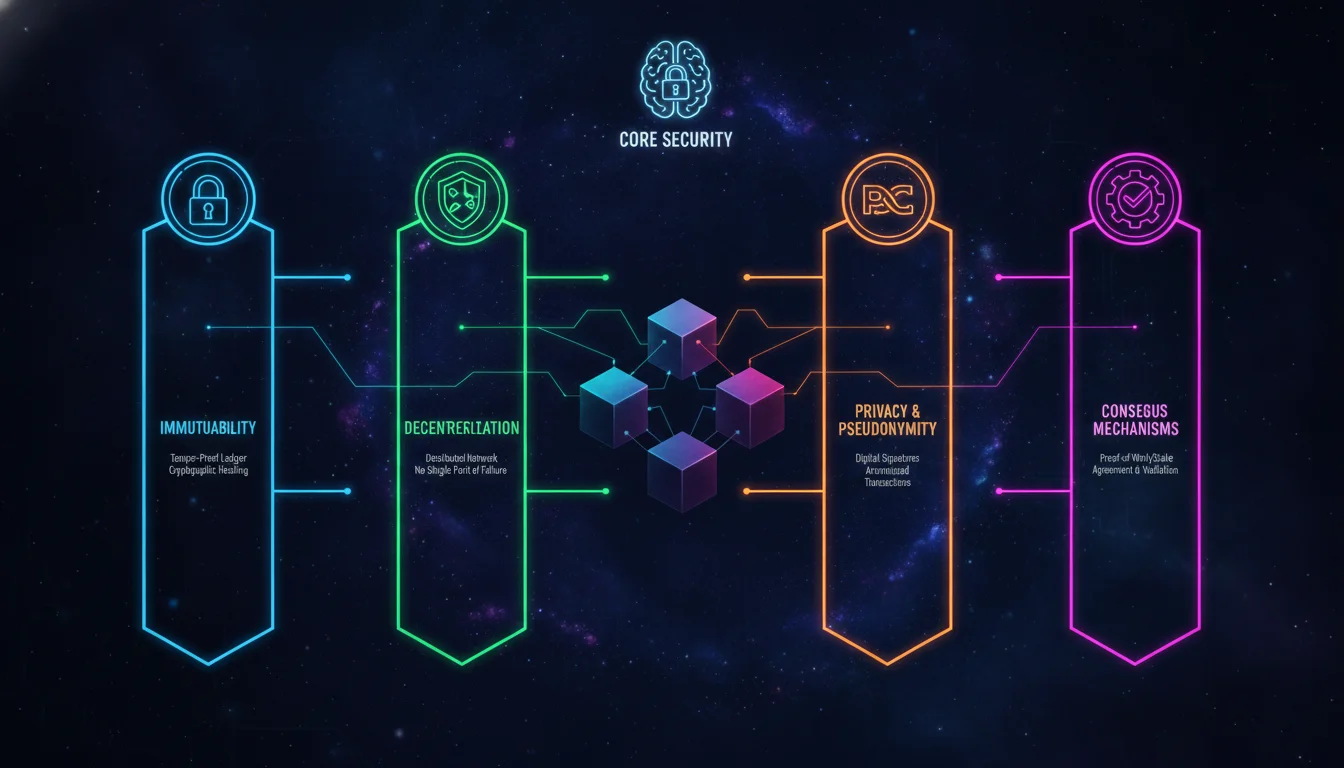
Decentralization removes the single point of failure that plagues conventional systems. Instead of relying on a central server, a blockchain is maintained by a peer-to-peer network of nodes, each holding a full copy of the ledger. New transactions must pass through a consensus mechanism, such as Proof of Work (used by Bitcoin) or Proof of Stake, before they’re accepted. An attacker would need to compromise a majority of the nodes simultaneously to rewrite the ledger, which gets more expensive and less practical as the network grows. This design directly supports the availability pillar of the CIA triad: confidentiality, integrity, and availability.
Immutability and Tamper-Resistant Records
Immutability in blockchain doesn’t mean records can never change. It means they’re mathematically resistant to change, as NIST clarifies. Each block contains a cryptographic hash of the previous block’s header. Alter a single bit in an earlier block and its hash changes, which breaks the chain. That’s a tamper-evident property on its own, and it becomes tamper-resistant as more blocks stack on top. Once a transaction is recorded, the only way to correct it is by issuing a new transaction. Both the original and the correction stay visible permanently, which is exactly why this feature matters for audit trails, supply chain tracking, and evidence management.
Cryptography and Key Management
Blockchains rely on public key infrastructure (PKI) to generate cryptographic key pairs: a public key (address) and a private key. The private key signs transactions; the public key lets anyone verify that signature. This asymmetric cryptography is the backbone of authentication, non-repudiation, and data integrity across the network. But it also shifts real responsibility onto users. Lose a private key or have it stolen, and everything that key controls is gone. Robust blockchain cybersecurity demands hardware security modules (HSMs), multi-signature schemes, and disciplined key derivation practices, a point GeeksforGeeks reinforces when discussing IETF and RFC-based key management standards.
How Blockchain Cybersecurity Differs by Network Type
Public vs. Private Blockchains
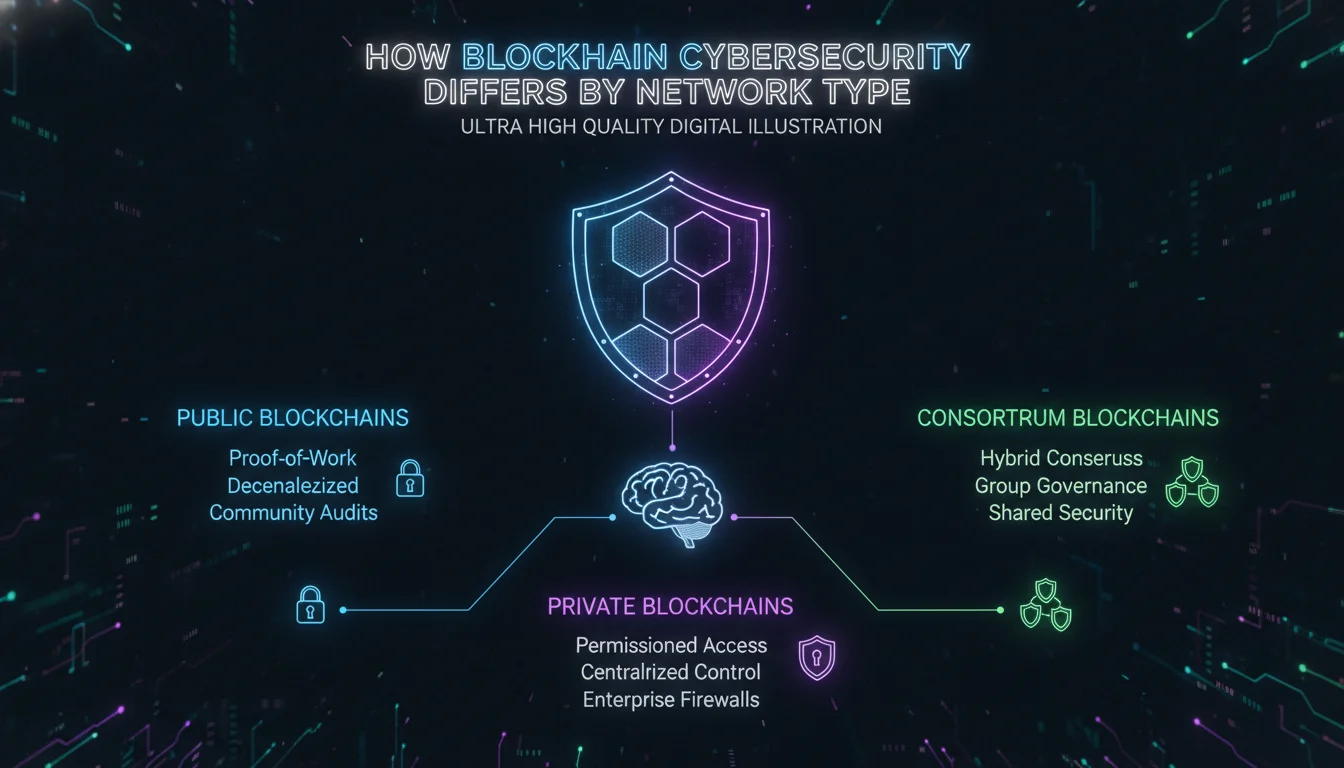
Public and private blockchains handle security through fundamentally different mechanisms. Public blockchains like Bitcoin and Ethereum are permissionless: anyone can join, validate, and remain pseudonymous. Security comes from economic incentives and a large, distributed set of miners or validators, which makes 51% attacks prohibitively costly at scale. Private blockchains restrict participation to known, vetted organizations and use identity-based consensus like selective endorsement. They trade some decentralization for better performance and privacy. A serious blockchain cybersecurity strategy weighs these trade-offs deliberately: public networks give you stronger tamper-resistance, private networks give you stricter access control and easier regulatory compliance.
Permissioned vs. Permissionless Networks
Permissioned blockchains, often used in enterprise consortia, assign roles and access rights through certificates. Only authorized nodes validate transactions, which simplifies governance but concentrates trust in a smaller validator set. Permissionless networks let any node participate, spreading trust wider but opening the door to Sybil attacks if incentive design is weak. Choosing between them isn’t a matter of which is objectively more secure. It’s a matter of matching the model to your actual threat model and trust assumptions.
Security Trade-offs at a Glance
| Feature | Public Blockchain | Private Blockchain |
|---|---|---|
| Access Control | Open to anyone | Restricted by identity |
| Consensus Mechanism | Proof of Work, Proof of Stake | Selective endorsement, PBFT |
| Immutability | Very high (miner collusion difficult) | High but controlled by consortium |
| Performance | Slower, less scalable | Faster, more scalable |
| Privacy | Pseudonymous; data on-chain is public | Confidential; data visible only to participants |
| Typical Use Cases | Cryptocurrencies, DeFi | Supply chain, enterprise systems |
These distinctions matter for any blockchain cybersecurity initiative because the same control can perform very differently depending on network architecture.
Common Threats to Blockchain Security
Phishing and Social Engineering
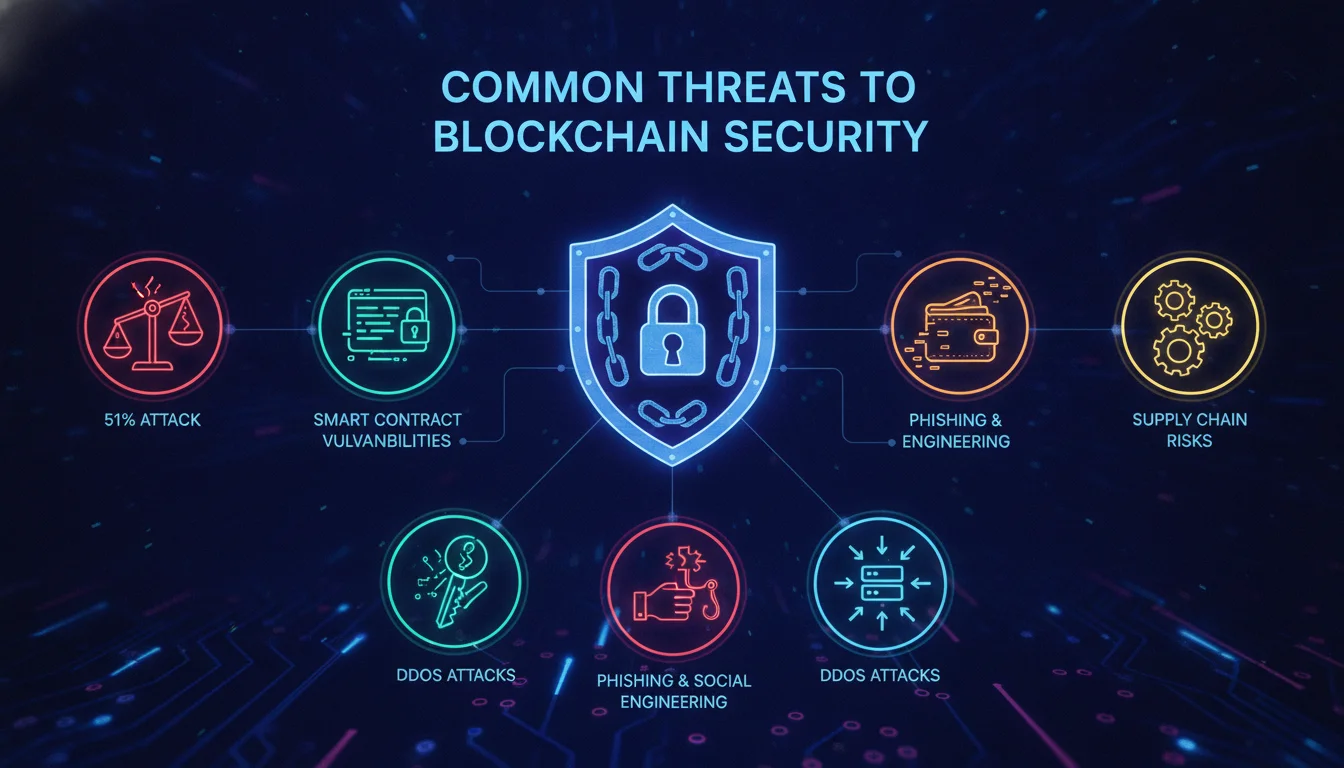
Phishing is still the top attack vector in blockchain cybersecurity, and it has nothing to do with cryptography. Attackers send fraudulent emails or messages that mimic legitimate wallet providers or exchanges, tricking users into revealing private keys or login credentials. The most cryptographically airtight ledger in the world is helpless once the human element gets compromised. As IBM notes, these scams can result in losses for both the individual user and the broader network.
Routing Attacks and Network Exploits
Blockchains depend on real-time data transmission between nodes, which creates an opening. In a routing attack, a hacker intercepts network traffic at the internet service provider level, potentially isolating nodes, delaying transactions, or executing a man-in-the-middle attack. Nodes often can’t detect the interception while it’s happening, which is exactly why end-to-end encryption and secure communication protocols need to be part of a layered blockchain cybersecurity defense, not an afterthought.
Sybil and 51% Attacks
A Sybil attack happens when one attacker creates many fake network identities to subvert the consensus process. A 51% attack happens when a malicious actor gains control of more than half the network’s mining or validation power, letting them rewrite the chain, double-spend coins, or block transactions outright. Public blockchains with large, distributed hashing power resist this well; smaller networks remain genuinely vulnerable. Mitigations include reputation systems, stake-weighted voting, and, in permissioned settings, identity verification.
Smart Contract Vulnerabilities
Smart contracts are self-executing code deployed on the blockchain, and that code introduces its own blockchain cybersecurity risk surface entirely separate from the ledger below it. Bugs like reentrancy, integer overflow, or access control flaws can be exploited to drain funds or corrupt state. Formal verification, thorough auditing, and reliance on established libraries (OpenZeppelin, for example) are non-negotiable. McAfee makes a sharp point here: the ledger might be secure, but the code sitting on top of it might not be at all.
How Blockchain Strengthens Traditional Cybersecurity
Decentralized Identity and Access Management
Blockchain enables self-sovereign identity, where users own and control their personal data instead of handing it to a central identity provider. Cryptographic attestations replace passwords, cutting down on credential stuffing and database breach exposure. Access gets granted or revoked dynamically through smart contracts, and attributes get verified without exposing the underlying secrets behind them. This model shifts blockchain cybersecurity away from “gatekeepers” and toward “holders of proofs,” which is a meaningfully different security posture.
Securing IoT and Edge Devices
The explosion of IoT devices has created a massive, frequently under-secured attack surface across every industry. Blockchain cybersecurity addresses this with device-to-device encryption, immutable ledger records for firmware updates, and decentralized key management. GeeksforGeeks points out that blockchain-based IoT security can prevent unauthorized access while giving each device a verifiable identity of its own. Infosys makes a similar case, referencing research on blockchain-protected smart devices in the field.
Mitigating DDoS Attacks and Protecting DNS
Distributed Denial-of-Service (DDoS) attacks overwhelm a target with a flood of traffic aimed at a central point. A blockchain-based Domain Name System (DNS) removes that central point entirely. By storing DNS records on a distributed ledger, tampering becomes nearly impossible, and the network’s structure makes it inherently harder to knock offline. Allianz Commercial lists defense against DDoS as one of six key ways blockchain reinforces security, privacy, and trust.
Ensuring Software Integrity and Supply Chain Security
Malicious software often slips in through fake updates or compromised installers, a problem blockchain addresses at the hash level. With blockchain cybersecurity, software publishers record cryptographic hashes of legitimate releases on-chain. Users then verify their download against that immutable hash before installation. Here’s the process:
- Publish Hash: The vendor generates a SHA-256 hash of the official software package and records it in a blockchain transaction.
- Download Verification: After downloading, the user computes the hash of the received file and queries the blockchain for the published hash.
- Smart Contract Validation: A smart contract compares the two hashes and returns a confirmation or rejection, no central server required.
- Immutable Audit Trail: Every verification attempt gets logged on-chain, creating a transparent history anyone can inspect.
This approach, described by GeeksforGeeks, uses blockchain’s immutability to guarantee that only legitimate software makes it to installation.
Blockchain Cybersecurity Best Practices
Step-by-Step Guide to Securing a Blockchain System
- Model Your Threats: Identify assets, attack vectors, and likely adversaries: node compromise, key theft, smart contract bugs.
- Select the Right Network: Choose public/private and permissioned/permissionless based on your actual trust and privacy requirements, not defaults.
- Implement Strong Key Management: Use hardware security modules (HSMs), multi-signature wallets, and secure key generation algorithms like Ed25519.
- Audit Every Smart Contract: Subject each contract to rigorous testing, formal verification, and third-party audits before deployment, no exceptions.
- Harden Consensus: Select a consensus mechanism resistant to your threat model, such as Proof of Stake with slashing conditions to deter misbehavior.
- Monitor Continuously: Deploy on-chain analytics and off-chain intrusion detection to catch anomalies like sudden hashrate drops or unusual transaction patterns.
- Plan Your Incident Response: Define procedures for key compromises, chain halts, or hard-fork scenarios before you need them, not after.
This framework, drawn from IBM and NIST guidance, forms the backbone of a serious blockchain cybersecurity posture. We walk builders through a version of this exact process during our development process.
Key Management and Access Controls
Theft or loss of private keys is one of the single most common failure points in blockchain cybersecurity, full stop. Best practices include never storing keys in plaintext, using air-gapped cold storage for high-value assets, and employing hierarchical deterministic (HD) wallets that generate new addresses per transaction. For enterprise deployments, role-based access controls on the blockchain itself can restrict which nodes submit transactions or access specific data. GeeksforGeeks notes that application-level encryption and access policies are critical even inside a private network, where trust assumptions can quietly get lax.
Continuous Monitoring and Incident Response
Real-time monitoring tools catch suspicious activity: a spike in rejected transactions, unusual node reconnection patterns, or odd smart contract calls that don’t match normal behavior. Collaborative consensus algorithms themselves can be leveraged to watch for malicious actions, according to Allianz. But no monitoring setup is perfect. An incident response plan tailored to your blockchain’s specific characteristics, including the possibility of an emergency hard fork, has to exist before an incident happens. Regular red-teaming exercises sharpen these blockchain cybersecurity defenses over time.
“Decentralization doesn’t mean invincibility. It introduces new attack surfaces, unique failure points, and security assumptions that many still don’t fully understand.” – industry security researchers, on the limits of blockchain’s threat model
Blockchain Security Certifications and Career Paths
Blockchain security certifications validate specialized skills in smart contract auditing, cryptography, and protocol-level defense. As demand grows for professionals who understand both traditional security fundamentals and blockchain-specific risk, certification programs from organizations focused on blockchain security and smart contract auditing have become a common credential path. If you’re evaluating blockchain cybersecurity as a career direction rather than just a technical concern, expect the strongest opportunities to sit at the intersection of smart contract auditing, protocol engineering, and traditional infosec experience. Roles in this space typically ask for hands-on Solidity or Rust experience plus a working knowledge of consensus design, not just a security background alone.
The Future of Blockchain Cybersecurity
Quantum Computing Risks and Post-Quantum Cryptography
Quantum computing threatens the elliptic curve cryptography (ECC) underlying most blockchains today, and this is not a distant, theoretical concern anymore. Shor’s algorithm could, in theory, derive a private key from a public key, which would render current wallet security models obsolete. Blockchain cybersecurity is already adapting: the NIST Post-Quantum Cryptography Standardization project has selected algorithms like CRYSTALS-Kyber and CRYSTALS-Dilithium, now being tested for integration into blockchain protocols. Some projects are building with post-quantum primitives from day one rather than retrofitting later. As of 2026, this transition is shaping up to be one of the largest protocol-level upgrades in the history of decentralized systems.
AI and Machine Learning in Blockchain Security
Artificial intelligence strengthens blockchain cybersecurity by analyzing on-chain data for patterns that indicate fraud, money laundering, or smart contract exploits in progress. Machine learning models trained on historical attack vectors can flag anomalies early, before funds move. The relationship runs both directions too: blockchain can provide a trustworthy data pipeline for AI models by guaranteeing the provenance and integrity of training data. This convergence of AI and blockchain is becoming a genuinely active area for both defensive and offensive security research this year.
Regulatory and Compliance Trends
Regulators and standards bodies are paying closer attention to blockchain cybersecurity as adoption spreads into regulated industries. The General Data Protection Regulation (GDPR) in Europe creates real friction for immutable ledgers holding personal data, since right-to-erasure requests directly conflict with immutability by design. NIST’s Blockchain Technology Overview (NISTIR 8202) provides foundational technical guidance, while industry groups continue working on frameworks for smart contract security and identity management. Compliance pressure will keep pushing adoption of privacy-preserving techniques like zero-knowledge proofs and off-chain data storage, reshaping how blockchain cybersecurity gets implemented in production systems.
Pros and Cons of Blockchain Cybersecurity
Pros
- Eliminates single points of failure through distributed consensus and node redundancy.
- Provides tamper-evident, auditable records that are extremely difficult to alter retroactively.
- Enables self-sovereign identity, reducing reliance on centralized password databases prone to breaches.
- Strengthens DDoS resistance and DNS security by removing central targets attackers can flood.
Cons
- Smart contract bugs and human error (phishing, key loss) remain outside the protection of the ledger itself.
- Quantum computing poses a long-term threat to current cryptographic assumptions.
- Smaller networks with limited validator sets remain genuinely exposed to 51% and Sybil attacks.
- Immutability can conflict with regulatory requirements like GDPR’s right to erasure.
Frequently Asked Questions
Will blockchain replace cybersecurity?
No. Blockchain is a powerful tool that strengthens specific aspects of cybersecurity, like data integrity, decentralized identity, and secure transactions, but it doesn’t replace the broader discipline of cybersecurity, which still includes endpoint protection, incident response, and human-centric threat defense.
Is blockchain 100% safe?
No. The underlying cryptographic mechanisms are extremely resilient, but blockchain cybersecurity isn’t absolute. Threats like phishing, smart contract bugs, 51% attacks, and key theft show that security depends on the entire ecosystem around the ledger, not the ledger alone.
Can you give me an example of blockchain security in action?
A real-world example is blockchain-based DNS: domain name records get stored on a distributed ledger, making them resistant to tampering and DDoS attacks because there’s no central server left to overwhelm.
What are the main blockchain cybersecurity threats?
The primary threats are phishing attacks targeting users, routing attacks that intercept node traffic, Sybil and 51% attacks that undermine consensus, and smart contract vulnerabilities that get exploited to drain funds or corrupt data.
How does encryption work in blockchain?
Blockchain uses asymmetric cryptography, where every user holds a public-private key pair. The private key signs transactions to prove ownership, and the public key lets others verify that signature, which together establish authentication and non-repudiation.
What is the role of consensus in blockchain cybersecurity?
Consensus ensures all nodes agree on the state of the ledger without a central authority making the call. It makes unauthorized changes extremely difficult because an attacker would need to control a majority of the network’s voting power, which is economically or practically infeasible on large, well-designed networks.
Blockchain cybersecurity isn’t a checkbox you tick once during deployment. It’s an ongoing discipline that spans protocol design, smart contract hygiene, key management, and monitoring, and it’s exactly the kind of infrastructure problem we work on at Digital Blockchains. If you’re building a protocol, token launch, or DAO structure and want security built in from the architecture stage rather than bolted on afterward, apply to the Genesis Cohort at digitalblockchains.com and let’s build it right from block one.