Blockchain in procurement and supply chain is a decentralized, tamper-proof digital ledger that tracks goods, automates contracts, and reduces fraud across sourcing and logistics operations. This technology is reshaping how organizations manage supplier relationships from origin to final delivery.
Key Takeaways
- supply chain provides end-to-end traceability, reducing counterfeit risks at every tier.
- Smart contracts automate purchase orders and payments, cutting processing time and administrative costs significantly.
- Decentralization eliminates intermediaries, building trust among suppliers, buyers, and regulators without a central authority.
- Implementation requires careful platform selection, stakeholder alignment, and phased rollouts to succeed.
- ESG tracking and climate resilience are emerging as major drivers for blockchain adoption in 2026.
- Despite challenges like scalability and regulation, adoption is accelerating across food, pharma, and automotive industries.
What Is Blockchain Technology?
The Fundamentals of Distributed Ledger Technology
Blockchain is a decentralized, immutable digital ledger that records transactions across a peer-to-peer network. Each block contains a batch of verified transactions, cryptographically linked to the previous one, forming a chain. This structure ensures that no single party controls the data, and once recorded, entries cannot be altered without consensus. According to Oracle, blockchain is “a technology that creates a decentralized record of all transactions in a network,” enabling participants to confirm transactions without intermediaries.
Key Characteristics: Decentralization, Immutability, and Consensus
Three pillars underpin blockchain’s value for procurement and supply chain:
- Decentralization: No central authority holds the ledger. All nodes maintain a copy, removing single points of failure.
- Immutability: Once added, data cannot be changed, ensuring audit trails remain tamper-proof across every transaction.
- Consensus mechanisms: Algorithms like Proof of Work and Proof of Stake validate transactions, ensuring agreement across parties that don’t inherently trust each other.
As Procurement Tactics notes, blockchain was initially developed in 2008 to support Bitcoin and has since expanded into decentralized finance, smart contracts, and enterprise supply chain applications.
How Blockchain Transforms Procurement and Supply Chain
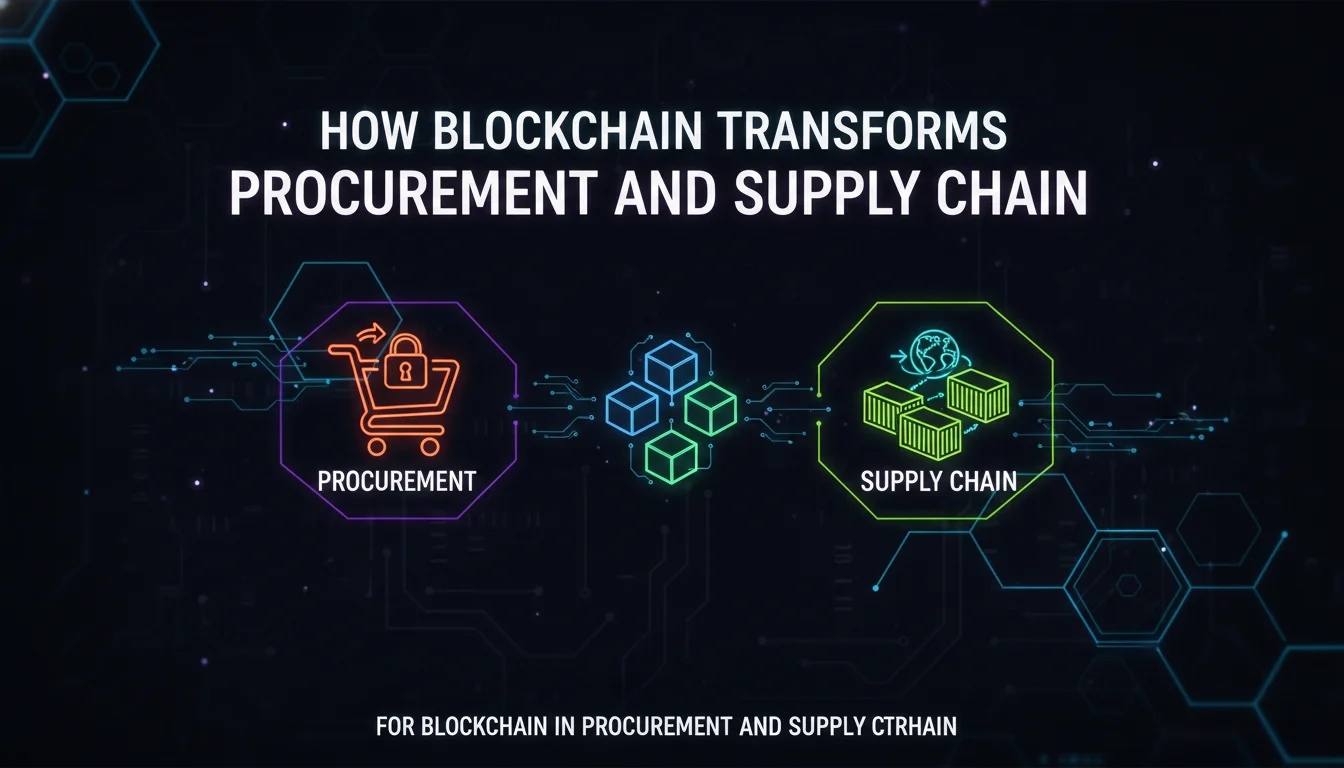
this type of chain brings a level of visibility that traditional ERP systems simply cannot match. Every movement of goods, from raw material extraction to final delivery, is recorded on a shared ledger accessible to all authorized participants. This end-to-end traceability helps identify bottlenecks, verify ethical sourcing, and quickly isolate defective batches during recalls.
“Using blockchain can improve both supply chain transparency and traceability as well as reduce administrative costs.” – Deloitte, Using Blockchain to Drive Supply Chain Transparency
Streamlining Source-to-Pay Processes
Traditional procure-to-pay cycles involve manual paperwork, invoice reconciliation, and time-consuming approvals. this kind of supply chain replaces these friction points with smart contracts: self-executing code that automatically triggers payments, order releases, or penalties when predefined conditions are met. This automation reduces cycle times, errors, and the need for intermediary banks or escrow services.
ESG and Sustainability Tracking
As of 2026, ESG compliance has moved from a reporting checkbox to a board-level priority. the in procurement and supply chain is uniquely positioned to support this shift. According to Deloitte’s supply chain research, enabling environmental, social, and governance tracking through supply chain traceability is one of the three key effectiveness drivers supply chain executives are investing in. An immutable ledger can record carbon emissions data, labor certifications, and material sourcing claims at each handoff, making ESG audits faster and harder to manipulate. This is particularly relevant for organizations subject to the EU Corporate Sustainability Reporting Directive and similar frameworks.
Geopolitical and Climate Disruption as Adoption Drivers
The COVID-19 pandemic exposed how fragile lean, just-in-time supply chains really are. Since then, geopolitical tensions, cyberattacks, inflation, and climate-driven shipping disruptions have kept supply chain resilience at the top of executive agendas. Blockchain’s shared, tamper-evident ledger gives organizations a reliable way to record, validate, and view transactions across complex multi-stakeholder environments, even when those stakeholders don’t inherently trust each other. That trust infrastructure is exactly what resilient supply chains need.
Pros and Cons of Blockchain in Procurement and Supply Chain
Pros
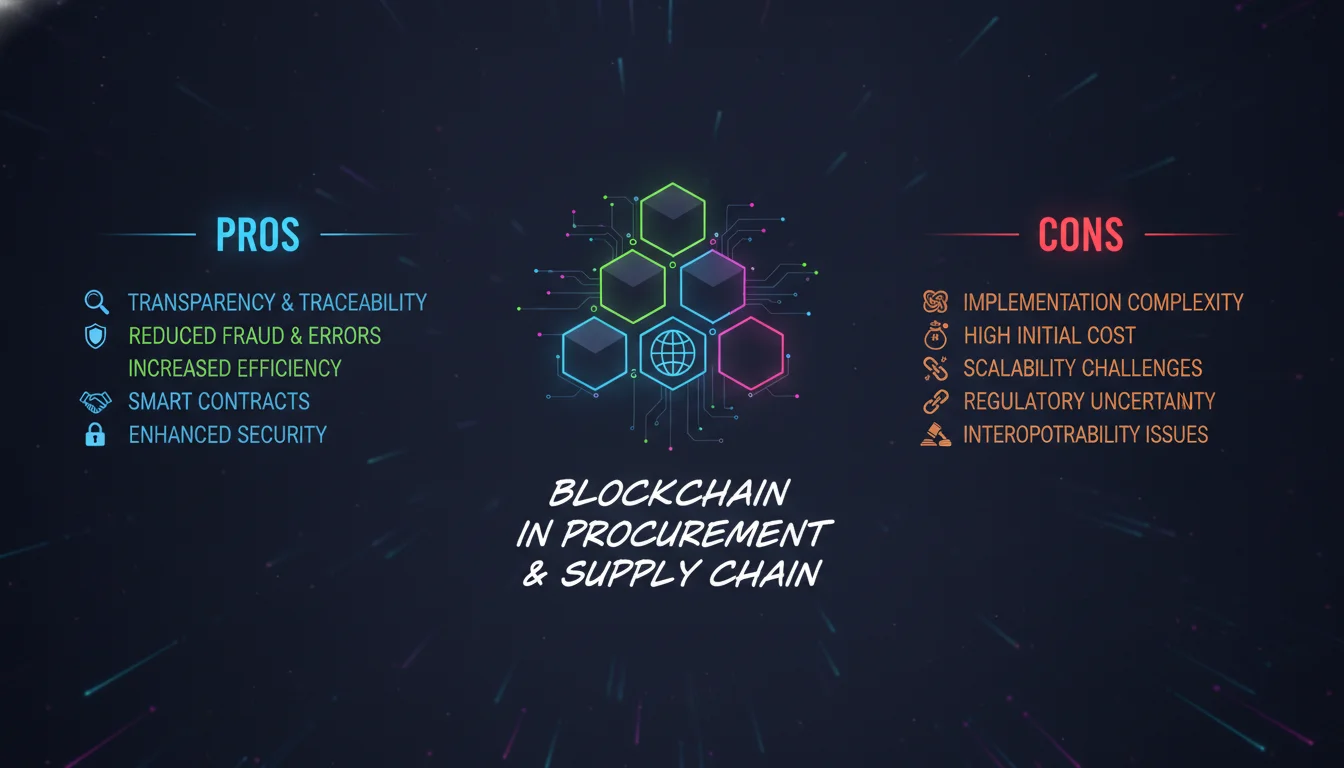
- End-to-end traceability: Every transaction and handoff is recorded on an immutable ledger, making recalls and audits dramatically faster.
- Fraud reduction: Tamper-proof records make counterfeit goods, double-invoicing, and unauthorized substitutions immediately detectable.
- Automated workflows: Smart contracts eliminate manual reconciliation and reduce order-to-cash cycle times from days to minutes.
- Stakeholder trust: A shared cryptographic ledger builds trust between buyers, suppliers, logistics providers, and regulators without requiring a central authority.
- ESG auditability: Immutable records of emissions data and labor certifications support credible sustainability reporting.
- Lower administrative costs: Removing intermediaries and manual processes directly reduces transaction overhead, as Deloitte’s research confirms.
Cons
- Legacy integration complexity: Existing ERP and procurement systems were not built for blockchain, requiring custom middleware and API development.
- High upfront investment: Infrastructure, training, and change management costs are substantial, particularly for mid-market organizations.
- Regulatory uncertainty: Cross-border supply chains must navigate GDPR, CCPA, and evolving smart contract legal frameworks simultaneously.
- Data standardization gaps: Supply chain partners often use incompatible data formats, slowing interoperability even when blockchain is in place.
- Scalability constraints: Public blockchains can face network congestion and elevated transaction fees during peak usage periods.
Top Benefits of Blockchain in Procurement and Supply Chain
Reduced Fraud and Risk Mitigation
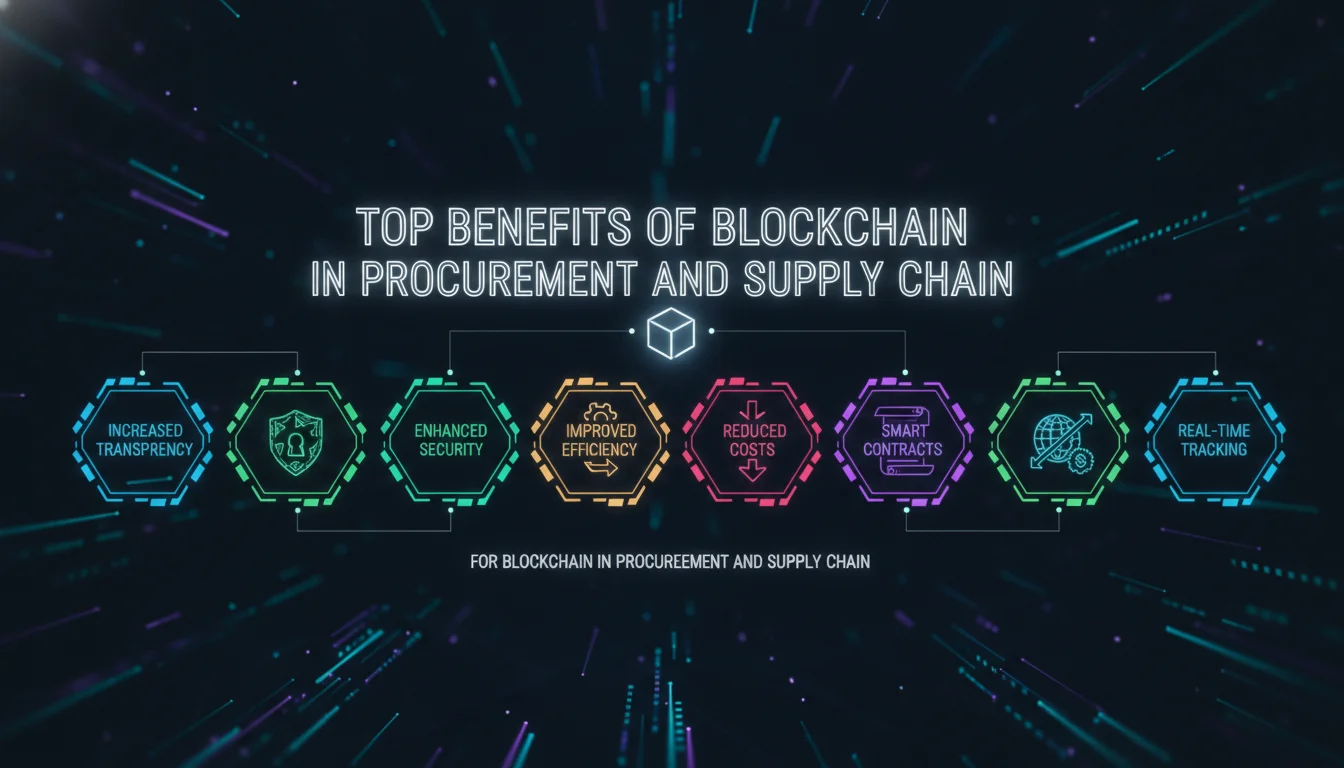
Because records are immutable and time-stamped, tampering becomes virtually impossible. Counterfeit goods, double-invoicing, and unauthorized substitutions are immediately detectable. This is especially critical in pharmaceuticals, where fake drugs endanger lives. chain acts as a single source of truth that all stakeholders can rely on, regardless of whether they have a prior relationship.
Operational Efficiency and Cost Savings
Eliminating manual reconciliation and intermediaries directly lowers transaction costs. Deloitte’s supply chain research highlights administrative cost reduction as a direct, measurable benefit of blockchain adoption. Faster settlement times improve cash flow, while real-time inventory tracking reduces safety stock requirements and storage expenses.
Building Trust Among Stakeholders
Supply chains often involve dozens of parties with conflicting interests. Blockchain’s decentralized architecture ensures that no single entity can manipulate the shared record. This cryptographically secured ledger builds trust between buyers, suppliers, logistics providers, and regulators, even across borders and without prior relationships.
Real-World Use Cases of Blockchain in Supply Chain
Food Safety and Provenance Tracking
Global retailers like Walmart have partnered with IBM Food Trust to trace leafy greens from farm to shelf. blockchain in enables them to pinpoint the origin of contamination within seconds rather than weeks. Consumers can scan QR codes to view a product’s full journey, reinforcing brand credibility and regulatory compliance simultaneously.
Pharmaceutical Supply Chain Integrity
Counterfeit medicines represent a serious threat to global public health. Blockchain-based track-and-trace systems, such as the MediLedger Project, authenticate drugs at every handoff by recording serial numbers and batch data on an immutable ledger. This approach supports compliance with regulations like the U.S. Drug Supply Chain Security Act (DSCSA) while protecting patients from fraudulent products.
Automotive and Electronics Counterfeit Prevention
Complex manufacturing supply chains are vulnerable to grey-market parts. VeChain assigns unique IDs to components, allowing automakers to verify authenticity throughout a vehicle’s lifecycle. This reduces warranty fraud and ensures safety standards are maintained across every tier of the supply chain.
Smart Contracts: Automating Procurement Workflows
How Smart Contracts Work
A smart contract is self-executing code stored on a blockchain. It automatically enforces agreed terms when conditions are met: for example, releasing payment once a sensor confirms goods have arrived at a temperature-controlled warehouse. Because execution is decentralized, neither party can unilaterally alter the terms after deployment.
Applications in Purchase Order Management and Payments
In procurement, smart contracts streamline purchase orders end to end. When a buyer issues a PO, the contract can:
- Validate the order against inventory levels and supplier credentials.
- Trigger a shipment request to the logistics provider automatically.
- Initiate payment upon delivery confirmation, potentially using stablecoins for near-instant settlement.
This automation compresses order-to-cash cycles from days to minutes and minimizes disputes between counterparties.
“Blockchain has the potential to transform all kinds of digital transactions, including in procurement and supply chain. A distributed database that holds tamper records of digital transactions could usher in a new era of source-to-pay process efficiency.” – GEP, supply chain
Comparing Blockchain Platforms for Supply Chain
Choosing the right blockchain platform is critical. The table below compares four prominent options used in procurement and supply chain applications.
| Platform | Type | Consensus Mechanism | Scalability | Key Features | Typical Use Case |
|---|---|---|---|---|---|
| Ethereum | Public | Proof of Stake (PoS) | Moderate (12-15 TPS, improving with L2) | Smart contracts, large developer community, ERC standards | Decentralized finance, tokenized assets, public traceability |
| Hyperledger Fabric | Permissioned | Pluggable (e.g., Raft) | High (configurable, up to 20,000 TPS) | Modular architecture, confidential channels, endorsed by Linux Foundation | Enterprise consortia, private supply chains, compliance-heavy industries |
| VeChain | Public (with authority Masternodes) | Proof of Authority (PoA) | High (10,000+ TPS) | Built-in IoT integration, ToolChain platform, two-token model | Product authentication, cold-chain logistics, luxury goods |
| Quorum | Permissioned (Ethereum fork) | Istanbul BFT / Raft | High (hundreds to thousands TPS) | Private transactions, zero-knowledge proofs, JPMorgan heritage | Financial settlements, inter-bank supply chain finance |
Overcoming Challenges in Blockchain Adoption
Technical and Integration Hurdles
Legacy ERP and procurement systems were not designed for blockchain. Integrating blockchain in procurement and supply chain requires middleware layers and often custom APIs. Data standardization is another obstacle: supply chain partners frequently use incompatible formats. Industry groups like GS1 and ISO/TC 307 are working on standards, but convergence takes time and organizational will.
Regulatory and Compliance Issues
Cross-border supply chains must navigate varying data privacy laws, including GDPR and CCPA. Blockchain’s immutability can conflict with the right to erasure. Regulators are still defining legal frameworks for smart contracts and digital assets, creating uncertainty for early adopters. Permissioned blockchains are a common response, giving organizations control over data visibility while preserving the core benefits of the technology.
Cost and Scalability Considerations
Implementing blockchain in procurement and supply chain requires upfront investment in infrastructure, training, and change management. Public blockchains can suffer from network congestion and elevated transaction fees during peak usage. Layer-2 solutions and alternative consensus mechanisms are rapidly improving both scalability and cost-effectiveness, making the economics more favorable for mid-market organizations in 2026.
Implementing Blockchain: A Step-by-Step Guide
Step 1: Assess Processes and Define Objectives
Start by identifying the pain points where blockchain’s transparency and automation add the most value. Map current workflows, data flows, and stakeholder interactions. Set clear KPIs: reducing counterfeits, cutting settlement times, or improving recall readiness. Without specific targets, pilots drift and ROI becomes impossible to measure.
Step 2: Choose the Right Platform and Partners
Select a blockchain that matches your privacy, scalability, and regulatory requirements. Refer to the comparison table above. Collaborate with a consortium of trusted partners: blockchain’s network effect multiplies when multiple tiers of the supply chain participate. Consider technology providers with proven supply chain expertise, such as IBM, SAP, or Oracle.
Step 3: Pilot, Test, and Scale
Run a controlled pilot with a limited product line or geographic region. Validation should include stress testing, security audits, and user acceptance testing. Once proven, gradually expand scope by integrating IoT sensors, AI analytics, and external data oracles. Measure results against baseline metrics to build a business case for full-scale deployment. Organizations that pilot blockchain in procurement and supply chain today are building a structural advantage in resilience and auditability that will compound over time.
For a deeper look at how smart contract architecture supports these workflows, see our article on smart contract development. If you’re evaluating tokenomics models for supply chain incentive layers, our tokenomics design guide covers the structural considerations in detail.
Frequently Asked Questions
How is blockchain used in procurement?
Blockchain is used in procurement to create transparent, tamper-proof records of supplier credentials, purchase orders, invoices, and payments. Smart contracts automate order approvals and payment releases, reducing manual processing time and fraud risk across the source-to-pay cycle.
How is blockchain used in supply chains?
In supply chains, blockchain tracks products from origin to consumer, ensuring authenticity and ethical sourcing at every handoff. It enables real-time visibility, faster product recalls, and compliance with regulatory standards like the U.S. Drug Supply Chain Security Act.
What does blockchain stand for?
Blockchain is a compound term describing a chain of data blocks. Each block contains transaction records and is cryptographically linked to the previous one, forming an immutable distributed ledger that no single party controls.
What are the top 5 blockchains for supply chain?
Leading enterprise blockchains for supply chain include Hyperledger Fabric, VeChain, Ethereum, Quorum, and Corda. The right choice depends on whether a public, permissioned, or hybrid network best fits your privacy and scalability requirements.
What are the benefits of blockchain in procurement and supply chain?
Key benefits include enhanced transparency, reduced fraud, lower administrative costs, faster settlement, and improved ESG compliance. The technology builds trust among disparate parties without requiring a central authority or pre-existing relationships.
Is blockchain expensive to implement in procurement?
Initial setup and integration with legacy systems carries real cost. Operational savings from automation, fraud reduction, and efficiency gains can deliver a positive return within a few years, particularly in high-value or high-risk supply chains where the cost of a single fraud event or recall dwarfs the implementation investment.