Key Takeaways
- Blockchain in IoT creates an immutable, distributed ledger for device data, ensuring data integrity and trust without central intermediaries.
- Integrating blockchain in IoT strengthens security through decentralization, cryptographic protection, and consensus mechanisms.
- Smart contracts enable autonomous transactions between devices, streamlining processes like supply chain tracking and device maintenance.
- Leading applications include supply chain, healthcare, and smart infrastructure, where tamper-proof records matter most.
- Scalability, interoperability, and energy efficiency remain the challenges that will decide how far this model scales.
- The convergence of blockchain with AI and edge computing is shaping the next wave of autonomous device networks.
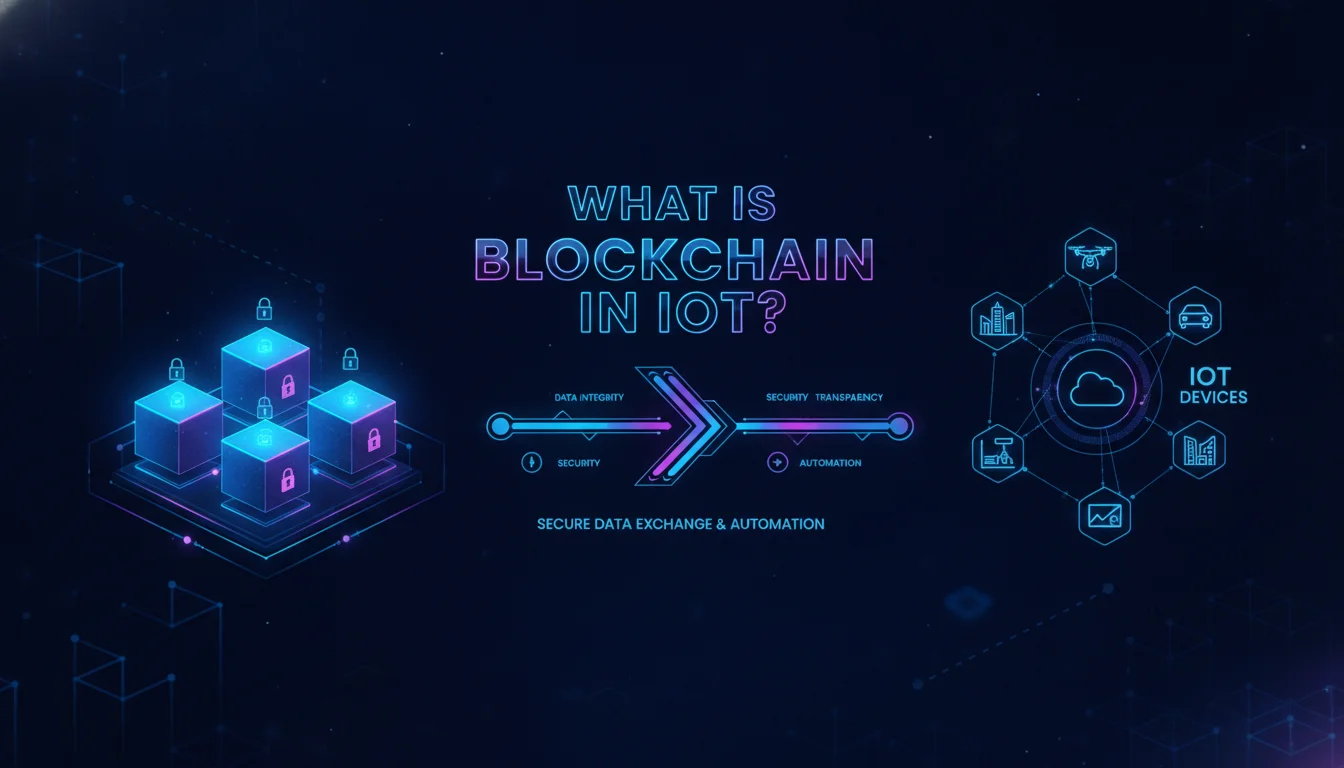
Blockchain in IoT is the combination of distributed ledger technology with connected devices to secure, verify, and automate data exchange without a central authority. It turns sensor readings and device events into tamper-resistant records that any permissioned party can trust.
“Each transaction is verified to prevent disputes and build trust among all permissioned network members.” – IBM Blockchain
What Is Blockchain in IoT?
Understanding the Underlying Blockchain Layer
Blockchain is a decentralized, distributed ledger that records transactions across a network of computers rather than one central server. Nodes reach agreement using consensus algorithms like Proof of Work (PoW) or Proof of Stake (PoS), and each transaction gets grouped into a block that’s cryptographically linked to the one before it. That chain structure is what gives blockchain its defining trait: immutability. Once data lands on the ledger, changing it requires consensus from the network, not just permission from an admin.
A blockchain’s core components are a shared ledger visible to all participants, cryptographic hashing that protects data integrity, and smart contracts that automate agreements without a human in the loop. For IoT, this combination lets devices record and share data in a trustless environment. A temperature sensor on a shipping container, for instance, can log readings directly to a blockchain, building an auditable trail from origin to destination, a use case IBM documents in its freight transportation writeup.
Why IoT and Blockchain Converge
in iot describes the meeting point of two technologies moving in opposite directions: IoT connects billions of physical devices to the internet, while blockchain decentralizes control over the data those devices produce. According to Wipro, installed IoT devices numbered 13.8 billion in 2021 and were projected to reach 30.9 billion by 2025, roughly a threefold increase in under half a decade. That kind of growth puts real pressure on data management and security, and it’s exactly the gap blockchain is built to fill.
In a blockchain-secured IoT network, every device can hold a unique, cryptographically verifiable identity. That identity lets devices interact directly through smart contracts, automating tasks like reordering inventory when stock drops or firing off a maintenance alert when a sensor detects abnormal wear. The practical effect is a move away from centralized, single-point-of-failure systems toward decentralized networks that support automation without a middleman validating every step.
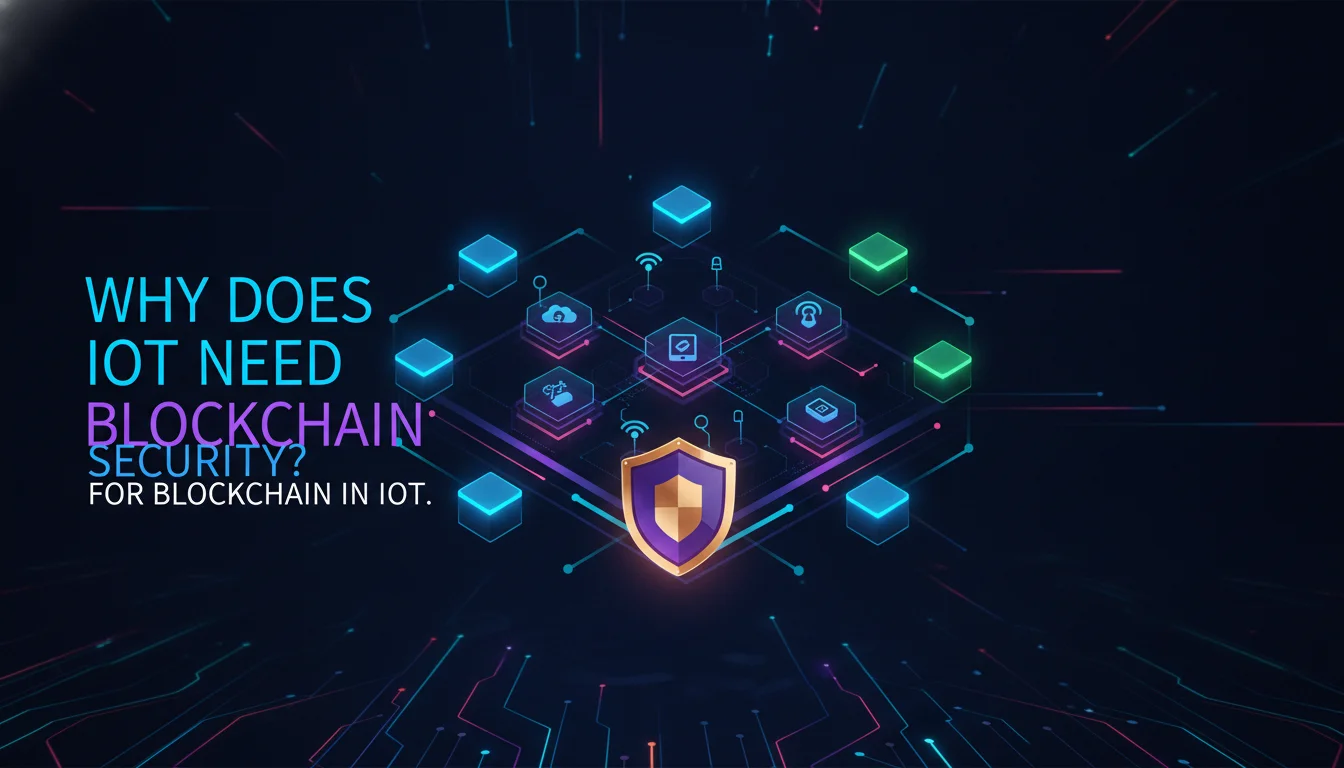
Why Does IoT Need Blockchain Security?
IoT Vulnerabilities and Centralized Risk
IoT needs blockchain because its default architecture concentrates risk in central servers that, once breached, expose the entire network. Most IoT devices run on limited computational power, which makes them easy targets and hard to patch at scale. Traditional IoT setups route everything through central servers for processing and storage, and a single breach there compromises everything downstream. As GeeksforGeeks notes, the foundational technologies foundation IoT still carry unresolved bugs that need attention before large-scale deployment makes sense.
These gaps matter because IoT data increasingly drives consequential decisions, from medical diagnostics to industrial automation. Without a tamper-proof record, you can’t fully vouch for that data’s integrity, and that creates real exposure on both reliability and regulatory fronts.
How Blockchain Closes the Gap
this type of iot directly counters these weaknesses. Spreading data across a network of nodes removes the single point of failure that plagues centralized architectures. Each data point gets encrypted and appended to an immutable ledger, so unauthorized changes become practically impossible to slip through. Consensus mechanisms require multiple parties to validate transactions before they’re recorded, and the ledger’s transparency means any participant can audit the trail, which builds accountability into the system by design.
A 2024 comprehensive review published in Sustainability (MDPI) found that blockchain technology meaningfully strengthens IoT security and trust through decentralized identity management, data integrity guarantees, and secured communication channels. The systematic literature review, which analyzed a large body of peer-reviewed research, pointed specifically to how this kind of iot mitigates data tampering, unauthorized access, and device spoofing.
How Does Blockchain Enhance IoT Ecosystems?
Decentralized Data Integrity and Immutability
Blockchain enhances IoT ecosystems by locking every recorded data point, a temperature reading, a location update, into a permanent, unchangeable history the moment it’s written. That matters in industries where audit trails aren’t optional, like pharmaceuticals or food safety. IBM’s component tracking approach, for example, uses blockchain to store provenance data so manufacturers and regulators can verify a part’s origin and journey without relying on paperwork that can be lost or altered.
Smart Contracts and Autonomous Device Interactions
Smart contracts are self-executing programs stored on the blockchain that enforce agreements automatically once predefined conditions are met. In an IoT setting, a smart contract could release payment the moment a shipment arrives at its destination, confirmed by GPS data from the truck. Tektelic uses autonomous vehicles as an illustration: cars can securely share speed, position, and road conditions over a blockchain network, with smart contracts triggering hazard warnings or insurance claims without a person approving each step.
This kind of automation cuts administrative overhead and reduces disputes, since every action gets recorded transparently and executed exactly as coded, no room for a middleman to interpret the terms differently after the fact.
Device Identity and Access Management
Every IoT device on a blockchain network can carry a unique, cryptographically generated identity managed through public and private key pairs, so only authorized devices can send data or execute commands. Wipro describes how device identity protocols give every device a public blockchain key, letting organizations track an immutable event history across that device’s full lifecycle. That’s essential infrastructure for smart factories or connected cities, where thousands of devices need continuous authentication without a human checking credentials one by one.
Blockchain vs. Traditional IoT: A Feature Comparison
| Feature | Traditional IoT | Blockchain-Enabled IoT |
|---|---|---|
| Data Integrity | Susceptible to tampering and single-point failure | Immutable ledger ensures data cannot be altered |
| Security Model | Central server-based, prone to DDoS and hacking | Decentralized, with cryptographic consensus |
| Trust | Relies on a central authority | Trustless; verification by network participants |
| Scalability | Limited by server capacity | Potentially unlimited with horizontal scaling |
| Cost | High infrastructure and maintenance costs | Reduced by eliminating intermediaries |
| Interoperability | Often siloed, vendor-specific | Open protocols enable cross-platform communication |
How Blockchain Validates IoT Data: A Step-by-Step Process
Validating IoT data on a blockchain follows a structured sequence designed to preserve authenticity at every step:
- Step 1: Generate the data. An IoT device, say a temperature sensor, collects a reading and signs it digitally using its private key.
- Step 2: Broadcast the transaction. The signed data gets broadcast to the blockchain network as a transaction.
- Step 3: Validate the source. Miners or validators check the digital signature and confirm the device is authorized. In permissioned blockchains like Hyperledger Fabric, this can involve specific endorsement policies.
- Step 4: Reach consensus. Nodes agree on the transaction’s validity through a consensus algorithm such as PoW, PoS, or PBFT.
- Step 5: Form the block. The transaction gets grouped with others into a block, cryptographically linked to the previous one.
- Step 6: Update the ledger. Every node updates its copy, making the data permanently recorded and tamper-evident.
What Are the Real-World Applications of Blockchain in IoT?
Supply Chain and Logistics
Supply chain tracking is one of the clearest use cases for blockchain in IoT. IBM describes how an IoT-enabled blockchain can monitor shipping containers in real time, recording temperature, position, and arrival status as the shipment moves. Because that data is immutable, manufacturers, carriers, and regulators can all trust it without routing everything through a central party. In food logistics specifically, that kind of traceability can turn contamination recalls from a days-long investigation into something closer to instant.
Healthcare and Remote Monitoring
Healthcare IoT devices, wearable monitors and in-hospital equipment alike, generate sensitive patient data that needs both confidentiality and integrity. IoT For All points out how blockchain protects patient records while still allowing authorized providers to share them without friction. Smart contracts can also automate insurance claims based on verifiable treatment data, cutting down on fraud and administrative overhead in the process.
Smart Infrastructure and Autonomous Vehicles
Smart cities run on a mesh of sensors and actuators, and blockchain adds resilience by removing single points of failure from that mesh. In the automotive sector, Tektelic notes that autonomous vehicles can exchange safety-critical data over blockchain rails, with smart contracts triggering immediate responses to potential collisions. Blockchain-based identity management for vehicles also helps secure over-the-air updates and block unauthorized access to onboard systems.
What Challenges Stand in the Way of Blockchain in IoT?
Scalability and Resource Constraints
Scalability is the biggest practical challenge, since many IoT devices are low-power with limited storage and processing capacity, which makes running a full blockchain node a non-starter. Hedera points out that the computational demands of consensus algorithms like PoW can be prohibitive for constrained devices. Lightweight protocols and tiered architectures, where edge gateways handle blockchain operations on behalf of the sensors, are emerging as workarounds. Even so, achieving high transaction throughput while keeping decentralization intact remains a real hurdle for blockchain in IoT deployments.
Interoperability and Standardization
IoT ecosystems are fragmented by design, with devices from different manufacturers running on proprietary protocols that don’t talk to each other natively. A blockchain layer sitting on top has to integrate all of that without forcing a single vendor’s standard on everyone. Standards work is ongoing, with organizations like the IEEE and ISO developing interoperability frameworks. Without shared standards, you risk ending up with isolated blockchain islands that undercut the connectivity IoT is supposed to deliver in the first place.
Energy Consumption and Sustainability
Public blockchains like Bitcoin carry a well-known energy cost, and while permissioned or PoS-based chains are far more efficient, the total footprint of a large-scale blockchain in IoT deployment still needs careful management. As the MDPI review notes, sustainability is a genuine concern, particularly since IoT devices themselves are usually engineered to run on minimal power. Progress on green consensus mechanisms and energy-harvesting IoT nodes will matter a lot here.
“Blockchain offers a promising solution to the growing security needs of both businesses and consumers. By providing a secure and transparent framework, blockchain can help to shore up many vulnerabilities in IoT systems.” – Hedera
Pros and Cons
Pros
- Removes single points of failure by distributing data validation across many nodes instead of one server.
- Creates tamper-evident audit trails that regulators, partners, and customers can verify independently.
- Automates device-to-device transactions through smart contracts, cutting manual reconciliation work.
- Gives every device a cryptographically verifiable identity, reducing spoofing and unauthorized access.
Cons
- Resource-constrained devices often can’t run full nodes, forcing reliance on edge gateways or lightweight protocols.
- Interoperability between competing blockchain platforms and legacy IoT systems is still immature.
- Energy-intensive consensus mechanisms like PoW can conflict with the low-power design goals of most IoT hardware.
- Regulatory frameworks around data sovereignty and smart contract liability are still catching up.
What Does the Future of Blockchain in IoT Look Like?
Convergence with AI and Edge Computing
The next stage for blockchain in IoT is deeper integration with artificial intelligence and edge computing. AI can analyze blockchain-verified data right at the edge, enabling real-time decisions without waiting on a round trip to the cloud. A factory robot, for example, could adjust its own operation based on quality data secured on a local blockchain instance. GeeksforGeeks describes a version of this future where AI models embedded in IoT devices use blockchain to audit and share what they’ve learned across a fleet of machines.
DAOs for IoT Networks
A DAO is an organization run by smart contracts and collective voting instead of a central authority, and applied to IoT, a DAO could govern an entire device network, think a community-owned smart grid where solar panels sell excess energy autonomously. Blockchain in IoT makes that kind of trustless coordination economically workable by removing the utility company as a required middleman. Early pilots in energy trading and shared autonomous vehicle fleets are already testing this model in limited form.
The Path to Mainstream Adoption
For blockchain in IoT to go mainstream, the industry still has to clear real technical hurdles. Layer-2 scaling solutions, interoperability bridges, and more energy-efficient consensus mechanisms will matter more than any single breakthrough. Regulatory clarity, especially around data sovereignty and who’s liable when a smart contract misfires, will also shape how fast enterprises move. As of 2026, adoption is still concentrated in supply chain, healthcare, and industrial pilots rather than blanket deployment, but the direction of travel is clear.
If you’re building in this space and want feedback from people who’ve shipped protocol infrastructure before, apply to the Genesis Cohort at digitalblockchains.com. We work with serious builders on tokenomics, smart contract architecture, and the kind of decentralized identity systems that IoT networks actually need to scale.
Frequently Asked Questions
What is blockchain in IoT?
Blockchain in IoT is the integration of decentralized ledger technology into Internet of Things networks to secure, validate, and automate data transactions between connected devices. It creates an immutable, transparent record of device interactions without needing a central intermediary.
How does blockchain improve IoT security?
Blockchain improves IoT security by distributing data across a peer-to-peer network, using cryptographic signatures for authentication, and requiring consensus to validate transactions. That combination prevents tampering, removes single points of failure, and makes unauthorized access far harder to pull off.
What are the four types of blockchain used in IoT?
The four main types are public (open to anyone, like Ethereum), private (controlled by one organization), consortium (governed by a defined group), and hybrid (mixing public and private elements). Each fits different IoT use cases depending on how much control versus openness the network needs.
Can blockchain IoT data be trusted?
Yes. Once data is recorded on a blockchain, it’s cryptographically sealed and can’t be altered without network consensus, and that immutability combined with a transparent audit trail makes blockchain IoT data reliable for applications like supply chain provenance or medical records.
What are some examples of blockchain in IoT?
Examples include supply chain tracking like IBM’s freight and component provenance work, healthcare data integrity for patient monitoring, and autonomous vehicle communication where smart contracts trigger safety responses without human input.
What are the challenges of integrating blockchain with IoT?
Key challenges include scalability limits from resource-constrained devices, interoperability gaps between different blockchains and legacy systems, energy consumption of some consensus protocols, and regulatory frameworks that haven’t fully caught up yet. Lightweight consensus models and edge computing architectures are the most active areas of work addressing these gaps.
Conclusion
Blockchain in IoT is a real shift in how connected systems establish trust, security, and efficiency, not a distant concept. By giving billions of devices an immutable, decentralized ledger for their data, blockchain directly addresses the structural vulnerabilities baked into traditional IoT architecture. Real deployments in supply chain, healthcare, and smart infrastructure already back that up. Challenges around scalability, interoperability, and energy use are real, but the direction toward AI and edge computing convergence points to more autonomous, resilient systems ahead, and builders who understand both the protocol layer and the device layer will be the ones who ship it.