Blockchain healthcare news is the ongoing coverage of distributed ledger technology deployments, market shifts, and research breakthroughs reshaping how patient data, drug supply chains, and clinical trials are managed. As of 2026, real-world implementations span national health systems, academic research labs, and biopharma supply chains.
Key Takeaways
- Blockchain technology is reshaping healthcare by strengthening data security, improving interoperability, and returning data control to patients.
- The global blockchain healthcare market was valued at $1.2 billion in 2021 and is projected to reach $126 billion by 2030, according to Elevance Health.
- Key applications include electronic health records (EHR) management, pharmaceutical supply chain tracking, and decentralized clinical trials.
- Major barriers to adoption include scalability, regulatory compliance with HIPAA and GDPR, and integration with legacy health IT systems.
- The peer-reviewed journal Blockchain in Healthcare Today and recent academic research continue to publish significant developments in the field.
Understanding Blockchain Technology in Healthcare

Definition and Core Features
Blockchain is a decentralized, immutable ledger that records transactions in a chain of cryptographically linked blocks. According to the National Institute of Standards and Technology (NIST), its core advantages include tamper resistance, decentralization, and the inability to alter recorded data without consensus (News-Medical.net). In healthcare, these features address critical needs for data integrity, security, and patient privacy.
How Blockchain Differs from Traditional Databases
Unlike centralized databases vulnerable to single points of failure, blockchain distributes data across a network of nodes. Each block contains a timestamp, transaction data, and a hash of the previous block, creating an auditable trail. This structure makes it exceptionally difficult for malicious actors to alter records without detection, a property especially valuable for protected health information (PHI).
“While blockchain is best known for its use in cryptocurrency, it is being used in healthcare to keep an incorruptible, decentralized, and transparent data log, all while keeping the patient’s identity private. This allows patients, providers, and payers to share information quickly and safely.” – Ashok Chennuru, Global Chief Data and Insights Officer, Carelon Digital Platforms (via Elevance Health)
Key Types of Blockchain Networks
Healthcare implementations typically use private or consortium blockchains where access is permissioned, ensuring compliance with regulations like HIPAA. Public blockchains, while more decentralized, are generally avoided for storing PHI due to transparency risks. The choice depends on the use case: private chains for internal hospital systems, consortium models for inter-organizational data sharing, and public chains for anchoring verifiable hashes of off-chain data.
| Blockchain Type | Access Control | Security Level | Typical Healthcare Use Cases |
|---|---|---|---|
| Private | Permissioned | High | Internal hospital data sharing, EHR management |
| Public | Permissionless | Lower (due to openness) | Not typically used for PHI directly; may anchor hashes |
| Consortium (Federated) | Semi-permissioned | Medium-High | Inter-organizational data exchange, supply chain |
Blockchain Healthcare News: Key Trends in 2026
Market Growth and Adoption
Recent blockchain healthcare news underscores significant market expansion. According to Elevance Health, the market was valued at $1.2 billion in 2021 and is projected to reach $126 billion by 2030, driven by demand for secure data exchange and interoperability. Separately, Elinext’s industry analysis projects the market reaching $750 billion by 2033 at a 69.2% CAGR from its $3.9 billion base in 2023. These two projections use different base years and methodologies, so treat them as directional signals rather than a single consensus figure.
Regulatory Developments
Regulators are increasingly addressing blockchain’s role in health data governance. In the U.S., the Trusted Exchange Framework and Common Agreement (TEFCA) and FDA guidance on decentralized clinical trials align well with blockchain’s capabilities. The EU’s General Data Protection Regulation (GDPR) poses unique challenges: immutability conflicts directly with the “right to be forgotten,” spurring innovations in off-chain storage and zero-knowledge proofs.
Emerging Use Cases Beyond Finance
Much of the blockchain healthcare news cycle still gets pulled toward cryptocurrency. The more interesting story is non-financial applications. Per Elinext’s analysis, pharmaceutical supply chain tracking accounted for 26.2% of the market in 2023, and decentralized clinical trials are gaining ground as smart contracts automate patient recruitment and consent management.
Major Applications of Blockchain in Healthcare
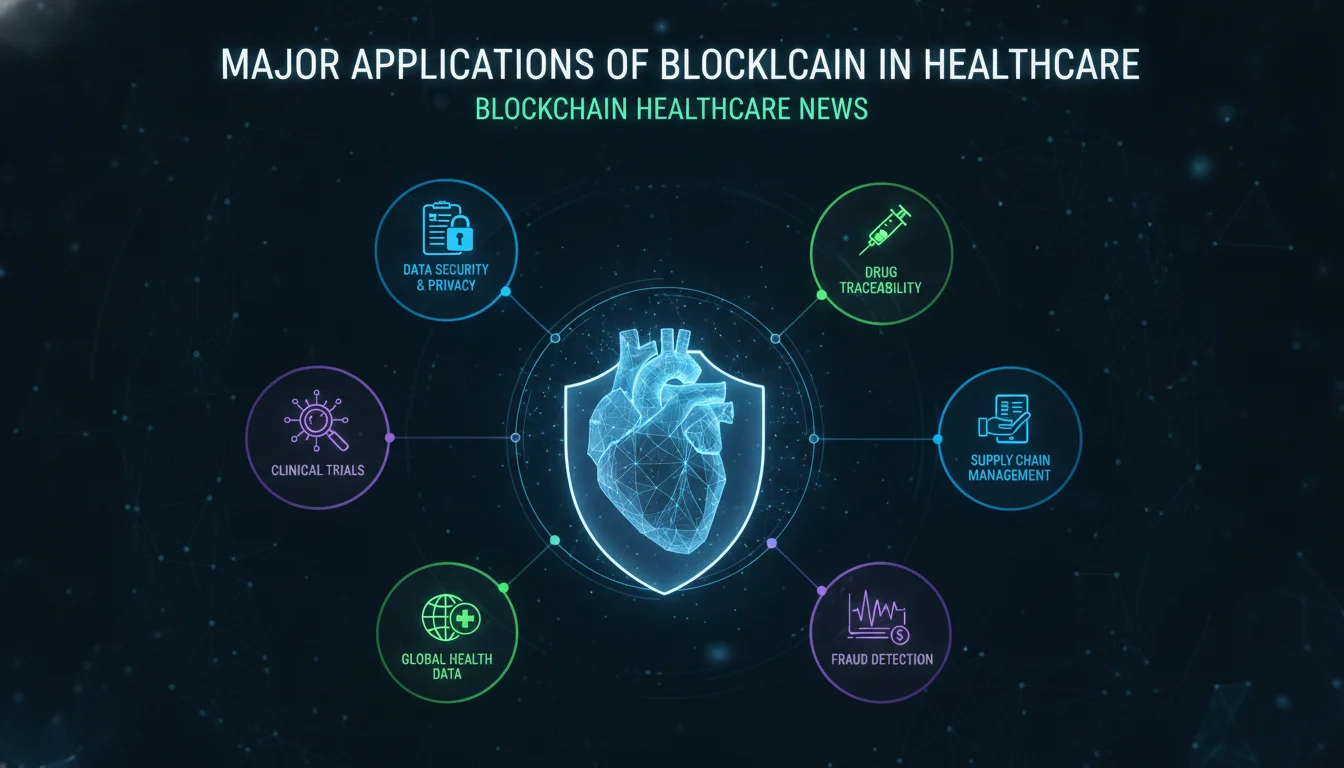
Electronic Health Records (EHR) Management
Blockchain can unify fragmented EHR systems. Boston alone runs 26 different EMR systems, creating interoperability problems that cost money and, at times, patient outcomes (MIT Technology Review). By storing pointers to health data on a ledger rather than the data itself, blockchain enables cross-system access without centralizing sensitive information. Patients control a private key, granting or revoking provider access instantly.
Supply Chain and Drug Traceability
The Drug Supply Chain Security Act (DSCSA) requires an interoperable track-and-trace system for prescription drugs. Blockchain provides an immutable audit trail from manufacturer to pharmacy, reducing counterfeit medications. According to Elinext’s market data, biopharma and medical device companies represent around 41.4% of blockchain healthcare end-users, relying on it for provenance tracking and batch recall efficiency.
Clinical Trials and Research Recruitment
Researchers at Indiana University’s Luddy School of Informatics are building blockchain-based platforms for clinical trial management (IU News). Smart contracts can execute participant consent, verify data integrity, and enable patients to share anonymized data on their own terms. This approach reduces recruitment costs and improves transparency, directly addressing the reality that many patients remain unaware of trial opportunities.
“If we bring these features into health care – whether for managing health data or clinical trial process – it becomes incredibly useful. Everyone on the blockchain doesn’t need to know a patient’s identity or see their data; they only need to be assured that the data has been authorized by its owner and that it flows from the original source without tampering.” – Yan Zhuang, Assistant Professor of Health Informatics, IU Luddy School (via IU News)
Real-World Blockchain Healthcare Implementations
Estonia’s National Blockchain Health System
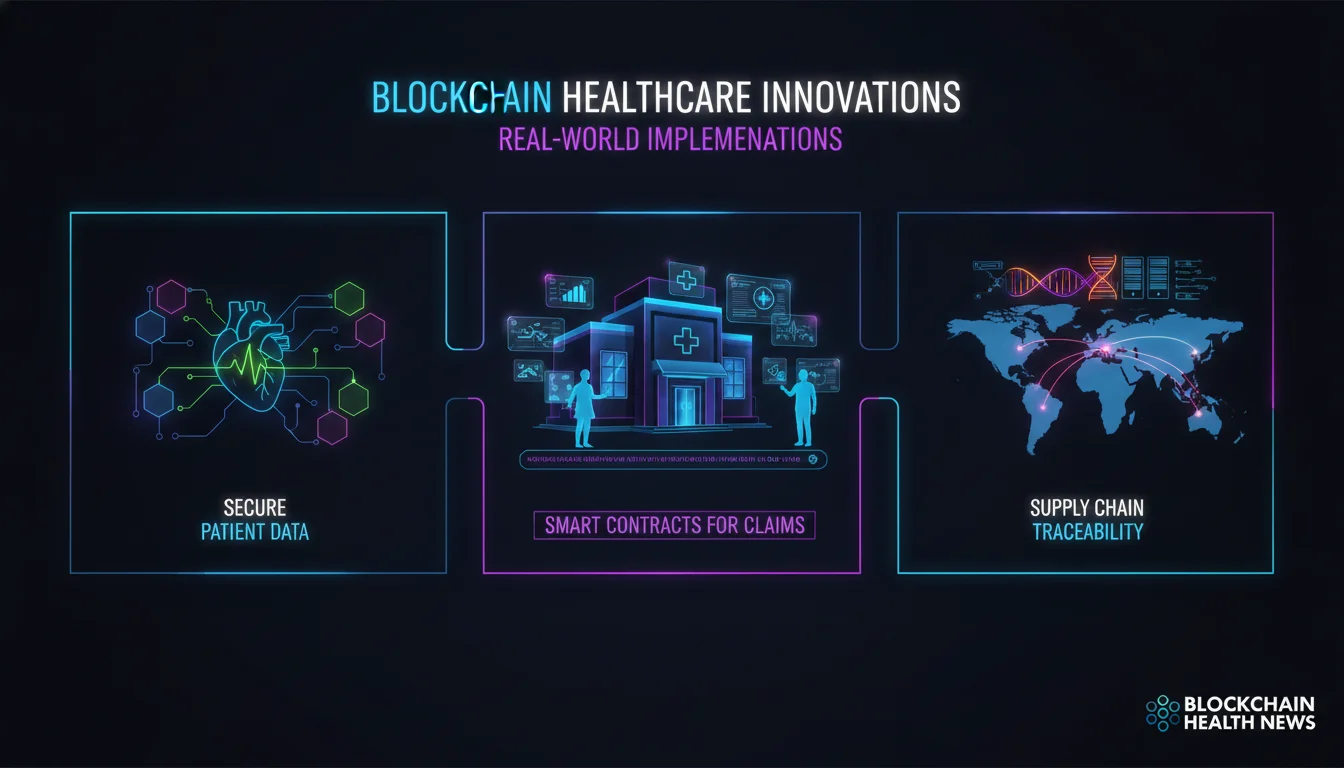
Estonia is the clearest proof point in any blockchain healthcare news discussion. The country began integrating blockchain in healthcare in 2012. Today, 95% of health data, 99% of prescriptions, and all healthcare billing are managed on a blockchain-based system (News-Medical). This nationwide infrastructure gives citizens direct access to and control over their medical records, and it remains the most cited production deployment in the field.
Chinese Hospital Pilots and Billing Platforms
Several Chinese hospitals are piloting blockchain-based medical billing platforms. A study reported in Nature Scientific Reports describes using blockchain to securely manage health data, as referenced by IU News in its coverage of Professor Yan Zhuang’s research. These platforms record every billing transaction on an immutable ledger accessible to patients, insurers, and regulators, reducing fraud without requiring a central authority.
Indiana University’s Decentralized Data Management Research
At the Luddy School of Informatics, Professor Yan Zhuang’s team is building patient-centric systems where individuals carry their encrypted health data on personal devices. The blockchain acts as an audit layer for authorization and data flow. This architecture aligns with FDA decentralized trial guidelines and the TEFCA framework, making it directly relevant to U.S. regulatory priorities.
Blockchain Platform Architecture: A Technical Comparison
Hyperledger Fabric for Healthcare
Hyperledger Fabric is the most widely referenced permissioned blockchain framework in healthcare contexts. Its modular architecture supports pluggable consensus mechanisms and fine-grained access control, making it well-suited for consortium deployments where multiple hospitals or payers share a network. Channels allow different participant groups to maintain private data streams on the same infrastructure, a critical feature for HIPAA compliance.
Ethereum and Smart Contract Logic
Ethereum’s programmable smart contracts are relevant for clinical trial consent management and patient data monetization models. Public Ethereum is generally unsuitable for storing PHI directly, but the EVM execution model can run on private or consortium chains. Projects anchoring verifiable hashes of off-chain health data to Ethereum’s public chain benefit from its security guarantees without exposing sensitive records.
Platform Selection Criteria
Choosing between Hyperledger Fabric, Ethereum-based private chains, or purpose-built health chains depends on three factors: the number of participating organizations, the required transaction throughput, and the regulatory jurisdiction. A single-hospital EHR system has different requirements than a multi-payer insurance claims network. Getting this architecture decision right early avoids costly migrations later.
IoMT Integration: Blockchain as the Trust Layer for Medical Devices
The Internet of Medical Things (IoMT) generates continuous streams of patient data from wearables, implants, and remote monitoring devices. Blockchain healthcare news increasingly covers how distributed ledgers serve as the integrity layer for this data. Without a tamper-proof record of what a device reported and when, AI diagnostic models trained on IoMT data inherit whatever errors or manipulations occurred upstream.
The integration pattern is straightforward in principle: IoMT devices write signed data hashes to a permissioned chain, creating an auditable provenance record. Clinicians and AI systems then query verified data rather than raw device outputs. According to the Sumo and Jong study published in Blockchain in Healthcare Today (2025), this combination of blockchain with IoMT is one of the key application areas identified in the literature review of digital health transformation programs (PMC).
Latency remains the practical constraint. Real-time clinical monitoring cannot tolerate the confirmation delays of most distributed consensus mechanisms. Layer-2 approaches and off-chain state channels are the active research direction for closing this gap.
Tokenomics and Patient Data Incentives
Why Incentive Design Matters
Blockchain healthcare news rarely covers the economic layer, but it’s where adoption actually stalls or accelerates. Patients have little reason to share health data with researchers unless there’s a clear benefit. Token-based incentive models address this directly: patients receive compensation, access to premium services, or governance rights in exchange for granting temporary, auditable research access to their anonymized records.
Smart Contract-Based Consent and Compensation
A well-designed tokenomics model for health data sharing uses smart contracts to enforce consent terms automatically. When a researcher queries a patient’s data, the contract verifies current consent status, logs the access event on-chain, and triggers a token transfer. The patient can revoke consent at any time, and the on-chain audit trail provides regulators with a complete access history. This flips the current model where institutions profit from patient data without explicit compensation.
Challenges in Health Data Token Models
Regulatory classification of health data tokens is unresolved in most jurisdictions. Whether a token representing data access rights constitutes a security, a utility token, or something else entirely affects how these systems can be structured and marketed. Projects building in this space need legal architecture as carefully designed as their technical architecture.
Challenges and Limitations of Blockchain in Healthcare
Technical Barriers: Scalability and Speed
Healthcare data volumes are substantial and growing. Sermo reports that healthcare data was expected to grow by 36% in 2025 (Sermo). Public blockchains struggle with transaction throughput and latency, making them unsuitable for real-time clinical data exchange. Private and consortium chains offer better performance but sacrifice some decentralization. Layer-2 scaling and sidechains are under active investigation as solutions.
Regulatory and Privacy Hurdles
Immutable ledgers conflict with regulations like GDPR that mandate data erasure upon request. To comply, architects must store PHI off-chain and keep only cryptographic proofs on-chain. Identity verification and uniform authorization standards remain unresolved across jurisdictions, as noted in Sumo and Jong’s 2025 study published in Blockchain in Healthcare Today (PMC).
Adoption and Interoperability with Legacy Systems
Healthcare IT ecosystems are deeply entrenched, with most systems built around HL7 or FHIR standards. Integrating blockchain requires significant investment and specialized expertise. Organizational resistance and the need for stakeholder consensus across providers, payers, and regulators slow deployment, despite the technology’s clear promise for data integrity.
Pros and Cons of Blockchain in Healthcare
Pros
- Data integrity: Immutable records make tampering with patient data or clinical trial results detectable and auditable.
- Patient control: Private key-based access lets patients grant or revoke provider permissions without involving a central authority.
- Supply chain transparency: An end-to-end audit trail from drug manufacturer to pharmacy reduces counterfeit medications and simplifies recalls.
- Interoperability potential: Blockchain-based pointers can bridge fragmented EHR systems without requiring a single centralized database.
- Regulatory alignment: Permissioned chains can be architected to satisfy HIPAA requirements while enabling cross-organizational data sharing.
Cons
- Scalability constraints: Most distributed consensus mechanisms cannot match the throughput required for real-time clinical data exchange.
- GDPR conflict: Immutability directly contradicts the right to erasure, requiring complex off-chain storage architectures.
- Legacy integration cost: Connecting blockchain layers to existing HL7/FHIR systems demands significant engineering investment and organizational buy-in.
- Specialized expertise gap: Healthcare organizations rarely have in-house blockchain architects, creating dependency on external vendors.
- Regulatory uncertainty: Token-based incentive models and cross-border data flows lack clear legal frameworks in most jurisdictions.
The Future of Blockchain Healthcare News
Decentralized Science (DeSci) and Clinical Research
One of the more interesting threads in current blockchain healthcare news is Decentralized Science (DeSci), which uses tokens and DAOs to fund and govern research. Projects like MedRec from MIT demonstrate how blockchain can create a research data commons while preserving patient privacy, enabling large-scale studies across traditionally siloed datasets.
Integration with AI and IoMT
The convergence of blockchain with AI and the Internet of Medical Things (IoMT) is a defining 2026 trend in blockchain healthcare news. Blockchain ensures data integrity from wearables and sensors, while AI algorithms access verifiable, tamper-proof datasets for diagnostics and predictive analytics. Recent publications from Blockchain in Healthcare Today cover this convergence in detail.
Patient-Centric Data Monetization
Future models will likely allow patients to control and monetize their health data. Using blockchain-based smart contracts, individuals could grant temporary research access in exchange for tokens or premium services. This inverts the current model where institutions profit from patient data without explicit compensation to the people who generated it.
How to Stay Updated with Blockchain Healthcare News
Key Journals and Academic Publications
For peer-reviewed blockchain healthcare news, Blockchain in Healthcare Today (BHTY) is the leading open-access journal. Its Vol. 9 No. 1 (2026) issue features studies on animal health tracking with blockchain, zero-knowledge process verification, and EHR models for managing patient vital data. PMC (PubMed Central) also hosts a growing body of research on the topic.
Industry Conferences and Events
Events like HIMSS Global Health Conference and ConVerge2Xcelerate (ConV2X) regularly feature blockchain tracks. These gatherings provide updates on real-world deployments, standards development, and direct access to technologists and healthcare executives working on production systems.
Online Resources and Researchers to Follow
Platforms such as News-Medical.net and Sermo’s blog offer accessible summaries of blockchain healthcare news. For deeper analysis, the Elinext blog publishes market trend reports. Following researchers like John Halamka at Beth Israel Deaconess Medical Center and Yan Zhuang at IU Luddy provides direct access to thought leadership as it develops.
The Path Forward
Blockchain healthcare news in 2026 reflects a field moving from pilot projects to production systems. Market projections, nationwide implementations like Estonia’s, and academic breakthroughs in clinical trial management all point in the same direction. The technology isn’t replacing existing health IT infrastructure. It’s adding an immutable trust layer on top of it.
The persistent challenges are real: scalability, GDPR conflicts, legacy integration costs, and the expertise gap. None of them are unsolvable. The organizations that will lead this space are the ones building now, before the standards fully crystallize, not waiting for a perfect regulatory environment that may never arrive.
If you’re building at the intersection of blockchain and healthcare, or exploring protocol infrastructure for health data systems, apply to the Genesis Cohort at digitalblockchains.com.
Frequently Asked Questions
What is the future of blockchain in healthcare?
The future involves widespread integration with AI and IoMT, patient-owned data marketplaces, and decentralized clinical trials. Blockchain is expected to serve as a secure trust layer for health data exchange, complementing existing systems rather than replacing them outright.
Is blockchain dead today?
No. Blockchain healthcare news in 2026 shows active deployments in Estonia, China, and the U.S., alongside strong market growth projections from multiple independent analysts. The technology is maturing beyond cryptocurrency into practical, regulated health applications.
What is replacing blockchain?
Nothing directly replaces blockchain’s combination of immutability, decentralization, and transparency. Complementary technologies like self-sovereign identity (SSI), zero-knowledge proofs, and confidential computing address specific limitations without replacing the underlying architecture.
Does blockchain really have a future in healthcare?
Yes. Real-world deployments like Estonia’s national system and ongoing research from institutions like Indiana University demonstrate that blockchain delivers measurable value in health data management. The regulatory alignment with TEFCA and FDA decentralized trial guidance further strengthens its position.
How is blockchain being used in healthcare today?
Current uses include securing electronic health records, tracking pharmaceuticals across supply chains, managing clinical trial consent via smart contracts, and enabling patients to control provider access to their data through private keys.
What are the biggest blockchain healthcare news stories in 2026?
Key developments include the publication of novel zero-knowledge proof applications in BHTY’s 2026 issue, Indiana University’s patient-centric health data management research, and continued expansion of Estonia’s blockchain health infrastructure as a global reference model.