A blockchain hash function is a cryptographic algorithm that converts input data of any length into a fixed-size hexadecimal string, acting as a tamper-evident digital fingerprint for every transaction and block in a distributed ledger.
Key Takeaways
- A hash function transforms arbitrary input into a fixed-size output that cannot be reversed.
- SHA-256 secures Bitcoin, Keccak-256 powers Ethereum, and BLAKE3 is gaining ground in newer protocols.
- Core security properties: determinism, preimage resistance, and collision resistance make ledgers immutable.
- Merkle trees use chained hashes to let light nodes verify transactions without downloading full blocks.
- Quantum computing and length-extension attacks are real long-term threats that protocol designers must plan for now.
1. What Is a Blockchain Hash Function?
Definition and Core Concepts
A this type of function is a cryptographic algorithm purpose-built for distributed ledger systems. It takes any amount of data and produces a unique, fixed-length output called a hash, digest, or checksum. According to Investopedia, “a hash is a mathematical function that converts an input of arbitrary length into an encrypted output of a fixed length.” The process is deterministic: the same input always generates the same hash. Even capitalizing a single letter produces a completely different output, a phenomenon called the avalanche effect.
In blockchain technology, a this kind of function is not merely a utility tool. It enables immutability by chaining blocks together, creates transaction IDs, and powers consensus mechanisms like Bitcoin’s proof-of-work. Without secure hash functions, the entire trust model of decentralized networks collapses.
Hash Functions vs. Encryption
Hashing and encryption are fundamentally different operations. Encryption is a two-way process: data is scrambled with a key and can be decrypted back to its original form. Hashing is one-way: you can hash data, but you cannot reverse the operation to retrieve the input. As Splunk explains, “Encryption is a two-way process. You can hide the data by encrypting it. Later, you can decrypt it using a special key. Hashing, on the other hand, is a one-way process.” This irreversibility is critical for blockchain security, where sensitive information like private keys must never be derivable from public data.
Brief History and Evolution
The concept of hash functions predates blockchain. Early algorithms like MD5 (1991) and SHA-1 (1995) were designed for digital signatures but are now deprecated due to vulnerabilities. The SHA-2 family, introduced in 2001 by the National Security Agency (NSA), includes SHA-256, which became the foundation of Bitcoin. Newer entrants like BLAKE2 (announced December 21, 2012) and BLAKE3 (announced January 9, 2020) focus on speed and security, while Keccak-256, chosen as the SHA-3 standard in 2012, powers Ethereum. Each iteration has adapted to the increasing demands of decentralized systems.
2. Core Properties of a Blockchain Hash Function

Determinism and Fixed-Length Output
A blockchain hash must always return the same result for the same input. This determinism allows any participant to independently verify data. Regardless of input size, whether a 1 KB transaction or a 1 GB block, the output length stays constant. As noted by GeeksforGeeks, SHA-256 always produces a 256-bit (32-byte) digest. That consistency is what makes independent verification possible across thousands of nodes.
Preimage, Second Preimage, and Collision Resistance
Three security properties define a robust hash function:
- Preimage resistance (one-wayness): Given a hash h, it must be computationally infeasible to find any input x such that hash(x) = h. This ensures transaction data cannot be reverse-engineered from its hash.
- Second preimage resistance: Given an input x1, it must be difficult to find another input x2 (where x2 ≠ x1) with the same hash. This prevents attackers from substituting a legitimate transaction with a fraudulent one.
- Collision resistance: It must be infeasible to find any two distinct inputs that produce the same hash. While collisions are theoretically inevitable due to the pigeonhole principle, strong hash functions make them astronomically unlikely. GeeksforGeeks notes that “the only way to find a hash collision is via a brute force search, which requires checking as many inputs as the hash function has possible outputs.”
Avalanche Effect and Puzzle Friendliness
The avalanche effect means that altering even a single bit of the input changes roughly half of the output bits. This makes it impossible to predict how a message modification will affect its hash. Halborn confirms that “changing 1 bit of the input results in a change in about half of the output bits.” Additionally, puzzle friendliness is a requirement for proof-of-work systems: knowing part of the input should not let anyone deduce the rest, which is exactly what makes mining computationally hard.
Pros and Cons

Pros
- Tamper evidence at scale: Any modification to a transaction or block is immediately detectable across the entire network without a central authority.
- Efficient verification: Merkle trees built from hash outputs let light nodes verify transactions without downloading full block data.
- Deterministic trust: Every node independently recomputes the same hash from the same data, eliminating the need for trusted intermediaries.
- Algorithm flexibility: Protocol designers can choose from SHA-256, Keccak-256, BLAKE2, or BLAKE3 depending on their performance and security requirements.
- One-way security: Preimage resistance ensures that even if a hash is exposed, the underlying data remains protected.
Cons
- Computational cost: Proof-of-work systems built on SHA-256 consume significant energy, driving demand for specialized ASIC hardware.
- No native error correction: A this type of function detects tampering but cannot repair corrupted data on its own.
- Quantum vulnerability (long-term): Grover’s algorithm could theoretically reduce the effective security of current hash functions, requiring future migration to longer outputs or post-quantum schemes.
- Length-extension risk: SHA-256 in naive implementations is vulnerable to length-extension attacks, requiring double-hashing or algorithm substitution as a mitigation.
3. How a Blockchain Hash Function Works
A Step-by-Step Look at SHA-256
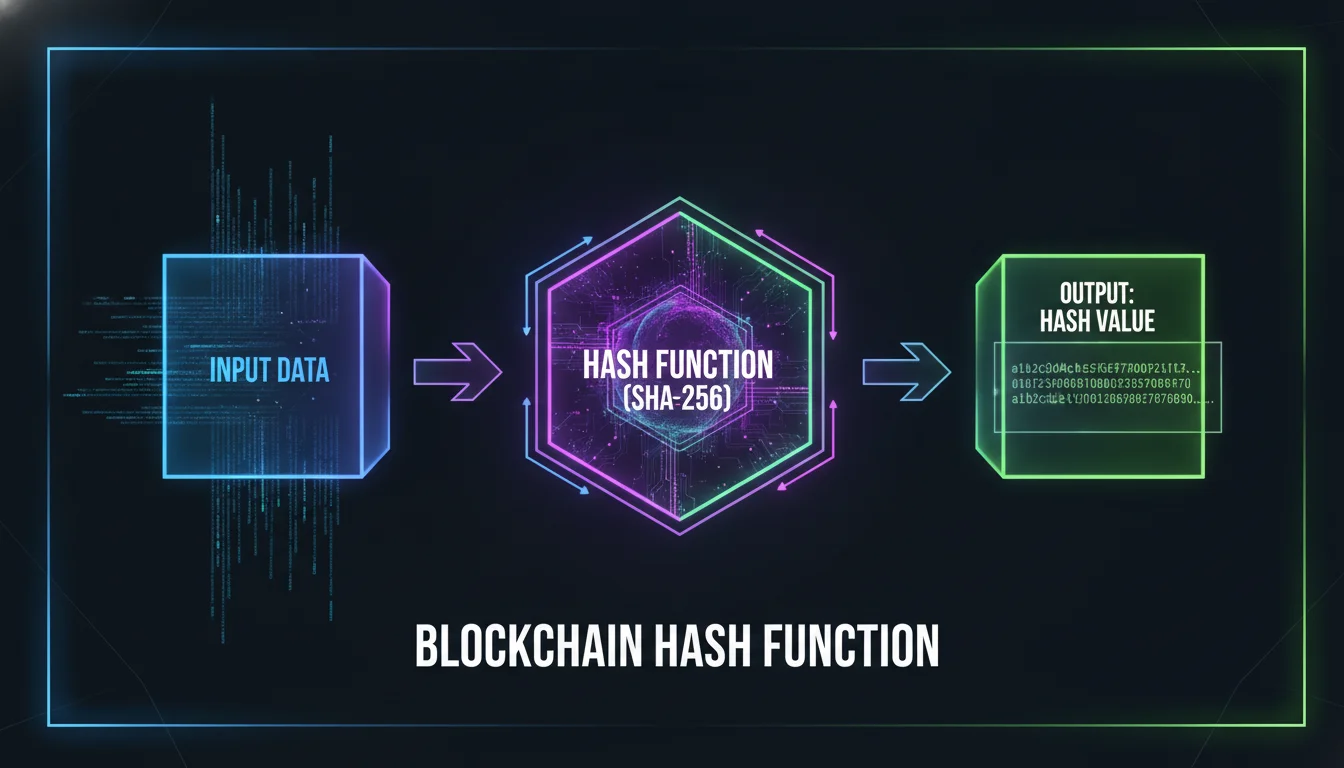
SHA-256, the most widely deployed this kind of function, processes data through a defined sequence of steps. According to Investopedia, the SHA-256 process includes converting input to binary, creating hash values, initializing constants, chunking data into bits, creating a message schedule, running a compression loop, and modifying the final values.
- Input Conversion: The message (e.g., transaction data) is converted into binary.
- Padding: The binary message is padded so its length is a multiple of 512 bits.
- Chunking: The padded data is split into 512-bit blocks.
- Initialization: Eight 32-bit hash values are set to predefined constants.
- Message Schedule: For each block, a 64-entry array of 32-bit words is created using bit-shifting and modular addition.
- Compression Loop: Hash values are updated over 64 rounds by combining message schedule words with logical functions and constants.
- Finalization: After processing all blocks, the eight hash values are concatenated to form the final 256-bit output.
To illustrate determinism in practice, Investopedia shows that SHA-256 hashing “Hello” produces 185f8db32271fe25f561a6fc938b2e264306ec304eda518007d1764826381969, while “Hello world” produces 64ec88ca00b268e5ba1a35678a1b5316d212f4f366b2477232534a8aeca37f3c. Same length output, completely different hash. That’s the avalanche effect in action.
From Transactions to Block Hashes
In a blockchain, individual transactions are first hashed to create unique transaction IDs. These IDs are then paired and hashed together in a Merkle tree structure. The root of the Merkle tree is a single hash representing all transactions in the block. The block header, containing the Merkle root, timestamp, previous block hash, and nonce, is then run through the blockchain hash function to produce the block hash. That block hash is included in the next block’s header, forming the chain.
Merkle Trees: Efficient Verification
A Merkle tree is a binary tree where each leaf node is the hash of a transaction and each internal node is the hash of its two child nodes. According to GeeksforGeeks, Merkle trees “make it infeasible to find two Merkle trees with the same root hash, protecting the integrity of the block header.” This structure allows light nodes to verify a transaction’s inclusion without downloading the entire block, a process called Simplified Payment Verification (SPV).
4. Comparative Analysis of Hashing Algorithms
SHA-256 (Secure Hash Algorithm 256-bit)
Bitcoin’s blockchain relies on SHA-256 for mining and block hashing. Its 256-bit output provides a hash space of 2^256 possibilities, more than the number of atoms in the observable universe, making brute-force attacks impractical. SHA-256 is computationally intensive, which is why application-specific integrated circuits (ASICs) dominate Bitcoin mining. The NSA developed SHA-256 in 2001 as part of the SHA-2 family.
Keccak-256 (SHA-3)
Ethereum uses Keccak-256, the algorithm chosen as the SHA-3 standard in 2012. It differs structurally from SHA-2, using a “sponge construction” that absorbs data and squeezes out the hash. This design offers resistance to length-extension attacks and performs well on general-purpose hardware, which aligned with Ethereum’s original goal of commodity-friendly mining before its transition to proof-of-stake.
BLAKE2, BLAKE3, and RIPEMD-160
BLAKE2 was designed to replace MD5 and SHA-1 in high-performance applications. It provides better security than SHA-2, immunity to length-extension attacks, and reduces the number of rounds from 16 to 12 compared to its predecessor. Its successor BLAKE3, announced in January 2020, is several times faster than BLAKE2 and supports parallelism, XOF, and KDF modes. RIPEMD-160 is notable for Bitcoin address generation: a 160-bit hash applied after SHA-256 to create public key hashes, adding security through algorithm layering.
Below is a comparison of the most prominent algorithms used with a blockchain hash function:
| Algorithm | Output Size (bits) | Used By | Key Features | Security Level |
|---|---|---|---|---|
| SHA-256 | 256 | Bitcoin, Bitcoin Cash, many others | Battle-tested; extensive cryptanalysis; ASIC-optimized | Very high; no known collisions |
| Keccak-256 | 256 | Ethereum, other EVM chains | Sponge construction; resistant to length extension; efficient on CPUs | Very high; SHA-3 standard |
| BLAKE2 | 256/512 | Zcash, Siacoin, some proof-of-work coins | Faster than SHA-2; immune to length extension; highly configurable | High; analyzed by NIST |
| BLAKE3 | Any output size | Emerging in modern protocols | Extremely fast; parallelizable; XOF support | High; newer, based on BLAKE2 |
| RIPEMD-160 | 160 | Bitcoin (address generation) | Used with SHA-256; creates shorter addresses | Moderate; 160-bit output limits collision resistance to 2^80 |
5. The Role of the Blockchain Hash Function in Consensus
Proof-of-Work and the Hash Puzzle
In Bitcoin’s proof-of-work system, miners compete to find a nonce that, when combined with the block’s data and run through the blockchain hash function, yields a hash below a certain target. The target adjusts to maintain roughly a 10-minute block time. As Lightspark notes, “miners race to find a specific hash value to validate a new block and earn bitcoin rewards.” The immense computational power expended secures the network: altering a past block requires redoing all subsequent work.
Block Linking and Chain Integrity
Each block contains the hash of the previous block’s header. This creates a chronological chain where modifying any block forces a change in every subsequent block’s hash. The avalanche effect and the one-way nature of the blockchain hash function ensure that even a tiny alteration to a transaction invalidates the entire chain from that point forward.
“The hash function is the bedrock of blockchain security. Altering a single transaction would change that block’s hash, which would then invalidate every subsequent block in the chain.” – Lightspark
This cryptographic linkage is what makes the blockchain tamper-evident. Any attempt to rewrite history is immediately detectable by any node recomputing the chain.
Transaction Verification and Immutability
Every transaction is independently hashed to produce a transaction ID. Nodes verify transactions by recomputing their hashes and comparing them with the IDs stored in the Merkle tree. If a transaction’s hash does not match, it’s rejected. This ensures that only valid, unaltered transactions are included in blocks, maintaining ledger integrity without a central authority. According to Investopedia, hash functions in blockchain “prevent fraud and double-spending” precisely through this mechanism.
6. Security Considerations and Attack Vectors
Collision Attacks and Birthday Attacks
A collision attack seeks two different inputs with the same hash. The birthday paradox implies that finding a collision in an n-bit blockchain hash function requires roughly 2^(n/2) operations, not 2^n. For SHA-256, that’s still 2^128, which is computationally infeasible with current hardware. Older algorithms like MD5, however, have suffered practical collisions. Halborn emphasizes that “collision resistance is a critical property for blockchain security.” Even a theoretical vulnerability in a widely deployed algorithm could undermine network trust.
Length Extension Attacks and Salting
Some hash functions based on the Merkle-Damgård construction, including SHA-256, are vulnerable to length-extension attacks: given hash(M), an attacker can compute hash(M + padding + extension) without knowing M. This doesn’t directly break preimage resistance, but it can be exploited in poorly designed systems. Mitigations include using double SHA-256 (as Bitcoin does) or switching to algorithms like BLAKE2 or Keccak-256 that are immune by design. In password storage, salting, adding a random value to the input before hashing, defeats precomputed rainbow tables.
Quantum Computing Threats
Quantum computers running Grover’s algorithm can theoretically reduce the security of a blockchain hash function by a square root: finding a preimage in SHA-256 would require 2^128 operations instead of 2^256. While still enormous, this has prompted research into post-quantum hash functions. Blockchain systems planning for long-term security may need to migrate to longer outputs or adopt quantum-resistant algorithms in the coming decades. As of 2026, large-scale quantum computers capable of threatening SHA-256 do not exist, but the design window for protocol upgrades is now.
7. Practical Applications Beyond Mining
Digital Signatures and Wallet Addresses
Cryptographic hash functions are central to public-key cryptography. In Bitcoin, a user’s public key is hashed with SHA-256 and then RIPEMD-160 to produce a shorter, more manageable address. This two-step process adds a layer of security: breaking both algorithms sequentially is far harder than breaking either alone. Digital signatures also involve hashing the message before signing, ensuring efficiency and preventing signature malleability.
Data Verification and File Integrity
The blockchain hash function concept extends well beyond on-chain activity. As Splunk demonstrates, users can verify downloaded files by computing their hash and comparing it with an official checksum, a common practice for software distributions like Linux ISOs. The InterPlanetary File System (IPFS) uses content-addressed hashing to identify files by their cryptographic hash, enabling decentralized, tamper-resistant storage. These applications mirror blockchain’s reliance on hash functions for trustless validation.
Hash Time-Locked Contracts (HTLCs) in Layer 2
Layer-2 scaling solutions like the Lightning Network use hash time-locked contracts (HTLCs) to enable conditional payments. A payment is locked to the hash of a secret; revealing the secret preimage claims the funds. This showcases the blockchain hash function’s versatility beyond simple transfers, enabling atomic swaps and multi-hop payments while preserving the trustless character of the base layer.
8. Best Practices for Implementing Hash Functions
Choosing the Right Algorithm
Selecting a blockchain hash function involves real trade-offs between security, performance, and ecosystem compatibility. SHA-256 offers battle-tested security but slower throughput. BLAKE3 provides high speed for volume-intensive applications. For smart contract platforms, Keccak-256 is the natural fit due to EVM compatibility. Developers should assess whether they need collision resistance for addresses, preimage resistance for commitments, or puzzle-friendliness for mining before committing to an algorithm.
Avoiding Deprecated Algorithms
MD5 and SHA-1 are cryptographically broken and must not be used for security purposes. As GeeksforGeeks warns, “MD5 is no longer considered cryptographically secure and should not be used for cryptographic authentication.” SHA-1 collisions have been demonstrated in practice, and major browsers and protocols have deprecated it. Any production blockchain system should use SHA-256, SHA-3/Keccak-256, or BLAKE2 at minimum.
Future-Proofing with Post-Quantum Cryptography
Large-scale quantum computers are not yet a reality, but blockchain systems planning for long-term security should explore quantum-resistant options now. The NIST Post-Quantum Cryptography Standardization effort has selected several hash-based signature schemes, including SPHINCS+, which relies solely on the security of underlying hash functions. Integrating these schemes can prepare a blockchain for a post-quantum environment without altering the core hashing mechanism. For a deeper look at how protocol-level security decisions get made, see our analysis of smart contract security and our overview of blockchain consensus mechanisms.
“Modern hash algorithms like SHA-256 and SHA-3 are essential for safely storing passwords, verifying file integrity, and securing blockchain technology. To maintain security, always use up-to-date hash functions, implement salting for passwords, and avoid outdated methods like MD5 and SHA-1.” – Splunk
9. The Indispensable Role of the Blockchain Hash Function
A blockchain hash function is far more than a technical detail. It’s the cryptographic foundation that holds decentralized networks together. From ensuring transaction immutability to enabling secure mining and efficient data verification, these algorithms embody the principle of trustless systems. As the industry evolves with faster consensus mechanisms and quantum-resistant designs, the importance of choosing and implementing a robust blockchain hash function will only grow. Updated for 2026, the guidance here reflects both current best practices and the threat vectors that protocol designers need to account for today.
Ready to build on a protocol that takes cryptographic security seriously? Apply to the Genesis Cohort at Digital Blockchains and work alongside engineers who read the whitepapers before writing the code.
Frequently Asked Questions
Can you give me an example of a hash function?
SHA-256 is the most widely recognized blockchain hash function example. Running the string “Hello” through SHA-256 produces 185f8db32271fe25f561a6fc938b2e264306ec304eda518007d1764826381969, while “Hello world” produces a completely different 64-character output. The fixed output length and total output change from a minor input change illustrate both determinism and the avalanche effect.
Does Bitcoin still use SHA-256?
Yes. Bitcoin continues to use SHA-256 for both mining and block hashing as of 2026. Its 256-bit output has no known collisions, and the extensive cryptanalysis it has undergone over two decades gives the protocol high confidence in its continued security. ASIC hardware is purpose-built around SHA-256’s computational structure.
What type of hash is used in blockchains?
Different blockchains use different algorithms. Bitcoin uses SHA-256, Ethereum uses Keccak-256 (a SHA-3 variant), and some proof-of-work coins use BLAKE2 or Scrypt. The choice depends on the protocol’s security requirements, hardware targets, and resistance to specific attack vectors like length-extension or ASIC centralization.
How does hashing prevent double-spending in blockchain?
Each transaction is run through the blockchain hash function to produce a unique transaction ID. These IDs are organized into a Merkle tree, and any attempt to alter a transaction changes the block hash, breaking the chain and alerting every node to the fraud. The computational cost of recalculating all subsequent block hashes makes double-spending economically infeasible on a well-secured network.
What hash function does Ethereum use?
Ethereum uses Keccak-256, a variant of SHA-3, for consensus, addressing, and transaction verification. Its sponge construction offers resistance to length-extension attacks and performs well on consumer hardware. Keccak-256 is natively supported in the Ethereum Virtual Machine, making it the standard choice for EVM-compatible smart contract platforms.
Are blockchain hash functions safe against quantum computers?
Current hash functions like SHA-256 resist quantum attacks better than public-key cryptography does. Grover’s algorithm would reduce SHA-256’s effective security from 2^256 to 2^128 operations, which remains computationally infeasible with foreseeable quantum hardware. Long-term safety may still require migration to longer hash outputs or post-quantum schemes like SPHINCS+, and protocol designers should begin that planning now.