Securing blockchain is the practice of applying cryptographic techniques, consensus mechanisms, and network safeguards to protect decentralized ledgers from attacks and fraud. Done right, it combines encryption, access controls, and continuous monitoring to ensure data integrity across every layer of the stack.
Key Takeaways
- Blockchain security is a multi-layered approach combining cryptography, decentralization, and economic incentives.
- Over $482 million was lost to 44 blockchain security incidents in Q1 2026 alone, according to Hacken.
- Leading platforms like Blockchain.com keep 95% of funds in offline cold storage and use AES-256 encryption.
- Consensus mechanism choice directly impacts network resilience against 51% and Sybil attacks.
- Securing blockchain extends beyond code: it requires sound key management, regular audits, and regulatory compliance.
- Post-quantum cryptography migration is a multi-year process that serious networks must start planning now.
Core Principles of Securing Blockchain Networks

Securing blockchain begins with a firm grasp of the principles that make distributed ledger technology trustworthy. These are not abstract concepts. They are implemented through concrete protocol rules and cryptographic proofs. IBM defines blockchain security as a comprehensive risk management system that uses cybersecurity frameworks and best practices to reduce fraud and attacks.
Decentralization and Distributed Trust
Decentralization distributes control and data across many nodes rather than relying on a single authority. In a decentralized network, no single entity can unilaterally alter the ledger, which raises the cost of manipulation exponentially. Decentralization does not automatically guarantee security, though. According to Kudelski Security, a poorly designed governance model or a small number of full nodes can create new attack surfaces despite a distributed topology.
Immutability and Tamper Resistance
Immutability means that once data is recorded on the blockchain and confirmed by the network, it cannot be altered retroactively without consensus. Each block contains a cryptographic hash of the previous block, creating a chain where any attempted change breaks the link and alerts the network. NIST, in NISTIR 8202 (Blockchain Technology Overview), describes this as tamper-evident and tamper-resistant, noting that as more blocks are added, the difficulty of modifying earlier data grows exponentially.
Transparency and Auditability
Transparency allows all network participants to view and verify the complete history of transactions. On public blockchains like Bitcoin and Ethereum, anyone can run a node to independently audit the ledger. This openness deters fraud, but it must be balanced with privacy. Permissioned blockchains often restrict visibility to authorized entities while still maintaining a shared, auditable record for compliance purposes.
Common Myths About Blockchain Security
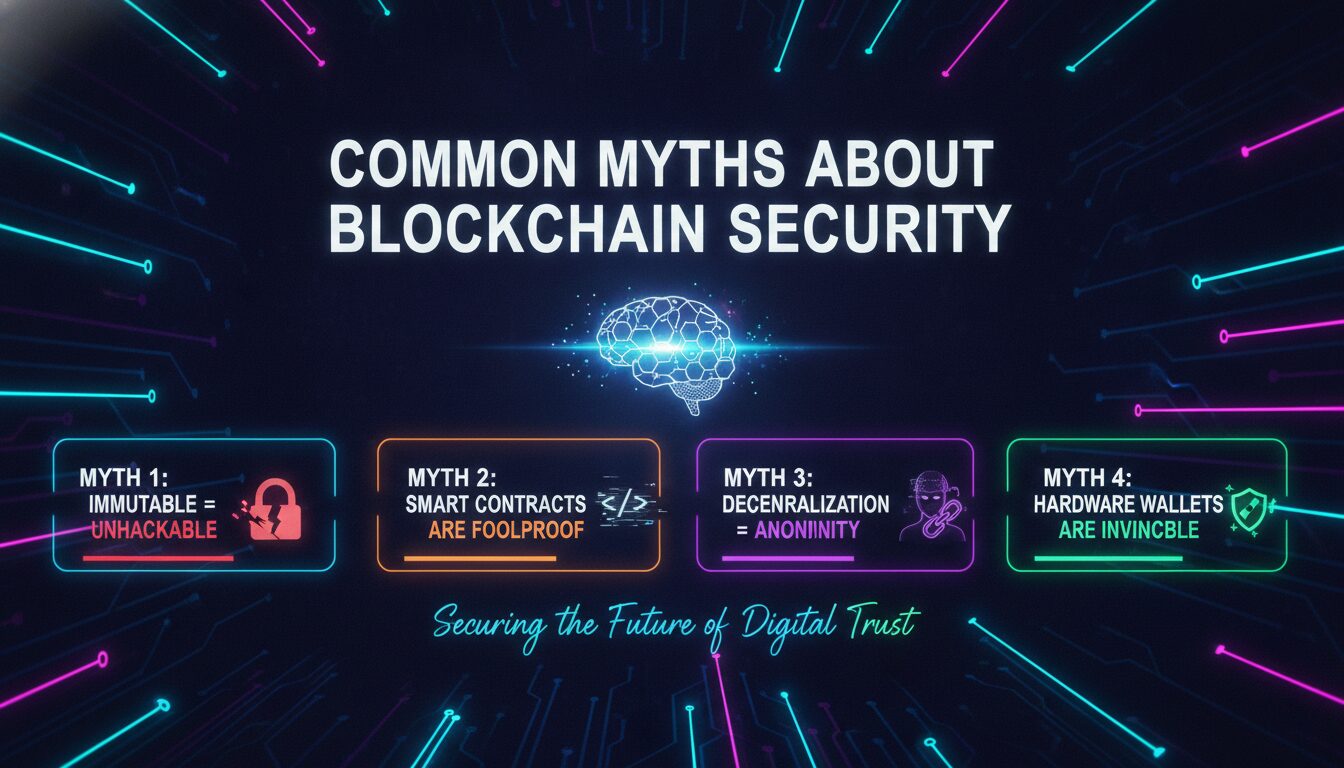
Securing blockchain effectively requires separating fact from fiction. Several persistent myths lead developers and operators to underinvest in protection, assuming the protocol handles everything automatically.
Myth 1: Blockchain Is Inherently Secure
The protocol layer may be cryptographically robust, but the full stack is not. Kudelski Security documents this directly: weak key generation, flawed smart contract logic, and vulnerable user interfaces can all be exploited regardless of how strong the underlying consensus mechanism is. The protocol does not protect you from your own code.
Myth 2: Decentralization Equals Security
A network can be technically decentralized across hundreds of nodes yet still be vulnerable if those nodes are concentrated among a small number of operators or cloud providers. Geographic and organizational diversity matters as much as node count. A network where 60% of validators run on a single cloud platform has a meaningful single point of failure, even if the ledger itself is distributed.
Myth 3: Immutability Prevents All Fraud
Immutability means you cannot rewrite confirmed history without enormous cost. It does not prevent fraudulent transactions from being confirmed in the first place. If an attacker steals a private key and signs a valid transaction, the network confirms it. The ledger records the theft permanently and correctly. Securing blockchain wallets and access controls is just as important as securing the protocol itself.
Myth 4: Smart Contracts Are Trustless and Safe
Smart contracts remove human intermediaries, not human error. The code is the contract, which means bugs become binding. Reentrancy vulnerabilities, integer overflows, and access control gaps have collectively cost the industry hundreds of millions of dollars. Trustless execution only helps when the logic is correct to begin with.
Blockchain Architecture Layers and Security Risks
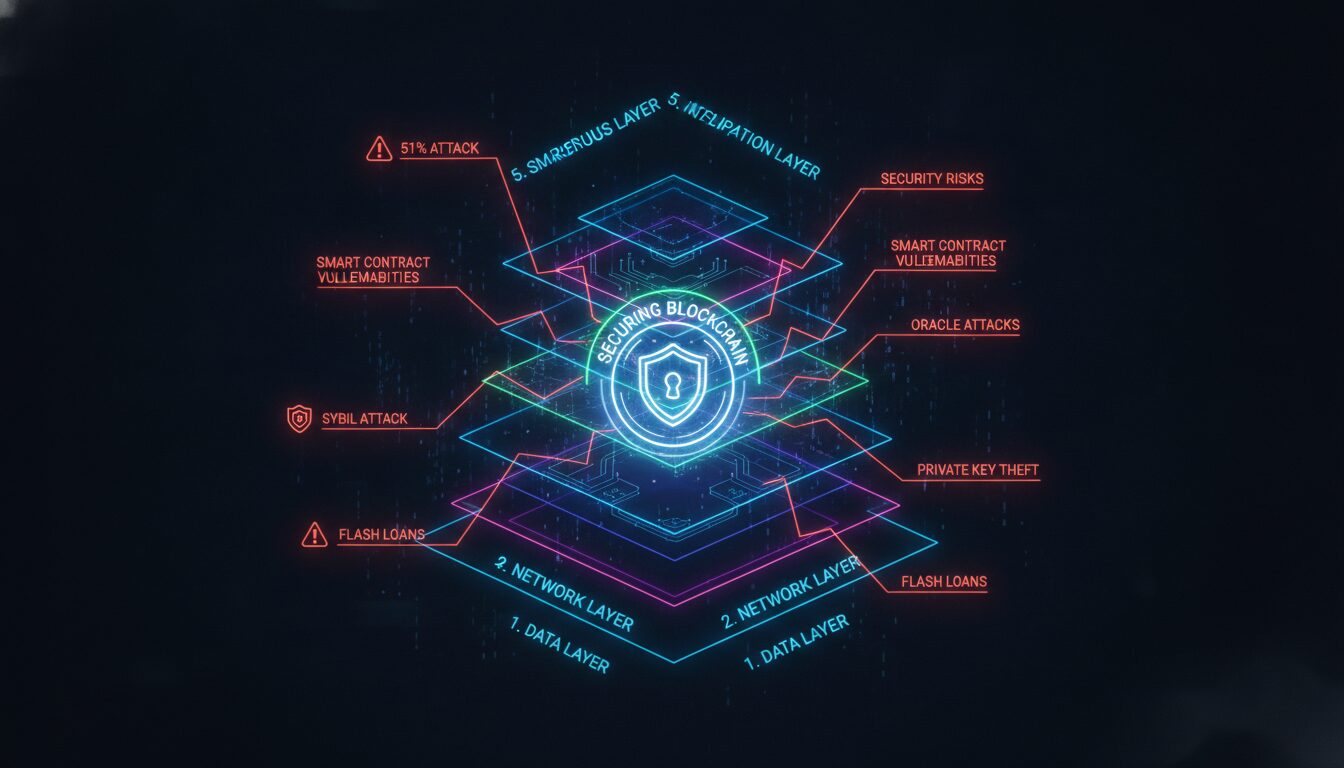
A blockchain system is best understood as a stack of distinct layers, each with its own security concerns. The layered model, often compared to the OSI model, helps isolate vulnerabilities and apply targeted protections. Hacken’s Q1 2026 report, which collected insights from 11 industry leaders, confirms that attackers exploit weaknesses at every level, making a complete approach to securing blockchain essential.
Infrastructure Layer: Nodes and Network Topology
The infrastructure layer includes the physical hardware, virtual machines, and networking components that run blockchain nodes. Nodes validate transactions and maintain copies of the ledger. A decentralized network requires a healthy distribution of nodes to avoid central points of failure. In a Sybil attack, a malicious actor creates many fake identities to flood the network and influence consensus. Routing attacks intercept data as it travels to internet service providers, potentially enabling eclipse attacks that isolate honest nodes.
Data Layer: Encryption and Storage
The data layer handles how transactions are formatted, encrypted, and stored. Most blockchains use asymmetric encryption, where a private key signs transactions and a public key verifies them. Proper key generation is critical. Kudelski Security warns that weak randomness in key generation can allow attackers to guess private keys, bypassing every other security control. On-chain data can be complemented by off-chain storage solutions like IPFS, but these introduce their own trade-offs that must be assessed when securing blockchain applications.
Consensus Layer: Validating Transactions Securely
The consensus layer is the set of rules that nodes follow to agree on the state of the ledger. It ensures that only valid transactions are added to the blockchain. A robust consensus mechanism prevents double-spending and resists attacks like the 51% attack, where an entity controlling the majority of hashing power or staked coins can rewrite recent history. Selecting the right consensus protocol is a foundational decision in securing blockchain networks.
Common Attack Vectors and How to Defend Against Them
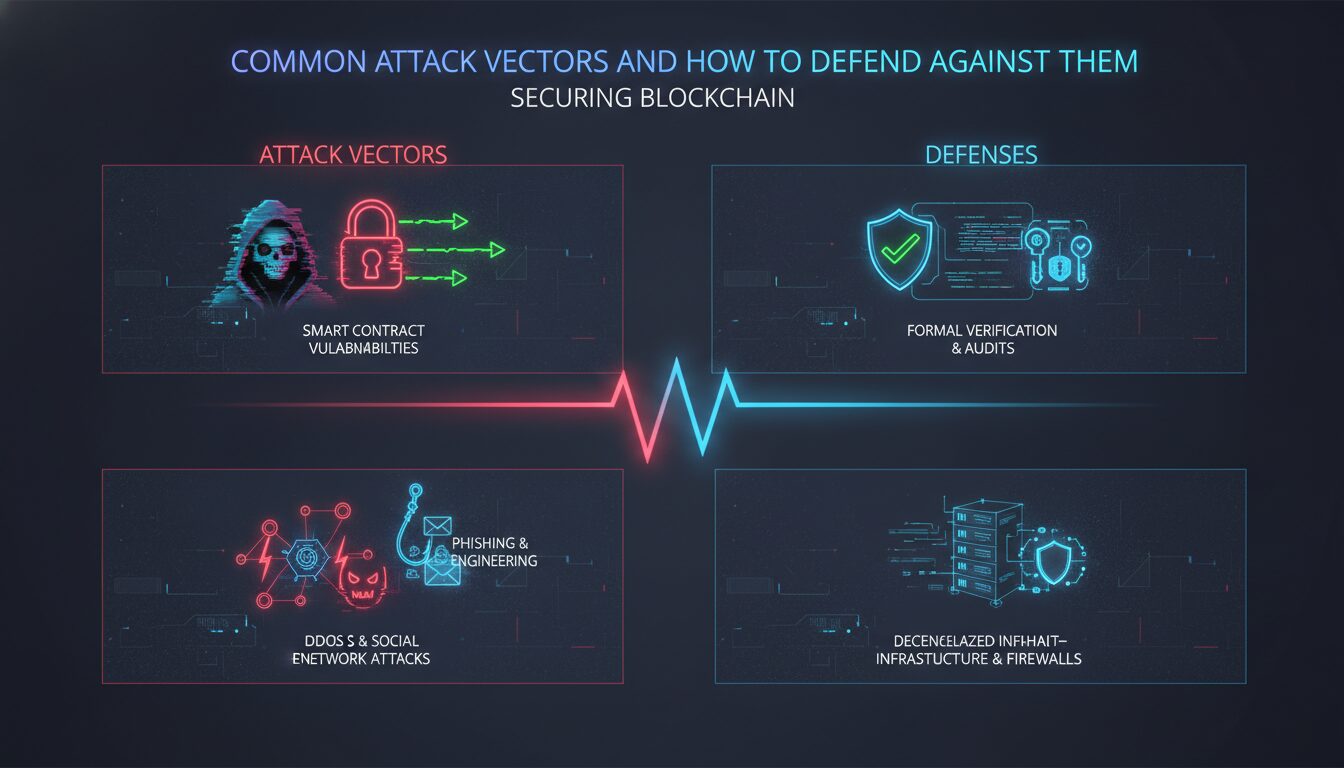
Understanding how adversaries target blockchain systems is essential for defense. The threat landscape ranges from network-level disruptions to social engineering. Below are the most prevalent attack types documented by IBM and corroborated by Hacken’s incident data.
51% and Sybil Attacks
A 51% attack occurs when a single miner or group controls more than half of the network’s mining hash rate (in Proof of Work) or staked tokens (in Proof of Stake). This majority control enables the attacker to reverse transactions and double-spend coins. Bitcoin, with its enormous hash rate, has never suffered a successful 51% attack, but smaller altcoins with lower security budgets have been repeatedly targeted. Sybil attacks, where an adversary creates numerous pseudonymous identities to undermine the peer-to-peer network, can pave the way for 51% attacks by isolating honest nodes from the rest of the network.
Phishing and Social Engineering
Phishing remains one of the most effective tactics for stealing private keys and credentials. Fraudsters send emails or messages that appear to come from legitimate services, tricking users into entering their wallet details on fake websites. This human vulnerability often bypasses all technical safeguards. Defenses include user education, multi-factor authentication (MFA), and hardware wallets that keep keys isolated from internet-connected devices.
Smart Contract Exploits and Code Vulnerabilities
Smart contracts are self-executing programs that run on the blockchain. While they remove intermediaries, their code is publicly visible and any bug can be exploited. Reentrancy attacks, integer overflows, and access control flaws have led to hundreds of millions in losses across DeFi protocols. Formal verification and thorough third-party audits are vital practices for securing blockchain applications that rely on smart contracts. If you are building on-chain logic, our smart contract security audit guide covers the full pre-deployment checklist.
“The biggest misconception is that deploying on a public blockchain automatically makes your application secure. The protocol is sound. Your code may not be.” – Common finding across leading blockchain security audit firms, including Trail of Bits and Hacken.
The Role of Consensus in Network Security
Consensus mechanisms are the backbone of blockchain security. They determine how nodes agree on the valid chain and provide economic incentives for honest behavior. The choice between Proof of Work, Proof of Stake, or other models directly impacts a network’s resilience, energy profile, and attack cost.
Proof of Work (PoW) Security Model
Proof of Work requires miners to solve computationally intensive puzzles to propose a new block. The first miner to find a solution receives a block reward and transaction fees. This expends real-world resources, making attacks extremely costly. Bitcoin’s PoW has secured the network for over 15 years without a single compromise of the ledger’s integrity. The trade-off is significant energy consumption and a tendency toward mining pool centralization, where a handful of pools control a disproportionate share of hash rate.
Proof of Stake (PoS) and Slashing Mechanisms
Proof of Stake selects validators based on the amount of cryptocurrency they hold and are willing to stake as collateral. If a validator acts maliciously, a portion of their stake is destroyed through a process called slashing. This aligns economic incentives with network security. Ethereum’s transition to PoS in September 2022 reduced its energy use by over 99% and introduced strong financial disincentives for attacks, making it economically irrational to attempt a takeover given the capital required.
Comparing Consensus Security: A Table
| Consensus Mechanism | Typical Blockchain | Key Security Strength | Main Vulnerability |
|---|---|---|---|
| Proof of Work (PoW) | Bitcoin, Litecoin | Capital-intensive hardware attack resistance | 51% attack by mining pools; high energy use |
| Proof of Stake (PoS) | Ethereum 2.0, Cardano | Economic penalties (slashing) deter misbehavior | Nothing-at-stake problem; validator centralization |
| Delegated Proof of Stake (DPoS) | EOS, TRON | High throughput and fast finality | Collusion among few elected delegates |
| Byzantine Fault Tolerance (BFT) | Hyperledger Fabric, Cosmos | Immediate finality; suited for permissioned networks | Requires known validator set; less decentralized |
Cryptographic Foundations: Beyond Basic Encryption
Cryptography is the mathematical engine of blockchain security. It provides confidentiality, integrity, authentication, and non-repudiation. Its strength, however, depends entirely on correct implementation and disciplined key management. Securing blockchain networks requires cryptographic agility: the ability to swap algorithms as threats evolve, without breaking existing state.
Hash Functions and Digital Signatures
Hash functions like SHA-256 (used in Bitcoin) create a unique, fixed-size fingerprint for any input. Any change in input completely alters the hash, enabling tamper detection at the data layer. Digital signatures, based on elliptic curve cryptography (ECC), prove that the owner of a private key authorized a transaction without revealing the key itself. Together, these tools ensure that transaction history is verifiable and unalterable by any party that does not control the relevant private keys.
Zero-Knowledge Proofs and Privacy
Zero-knowledge proofs (ZKPs) allow one party to prove to another that a statement is true without revealing the underlying data. In blockchain, ZKPs enable private transactions and scalable verification. Protocols like Zcash use zk-SNARKs to shield transaction details, while Ethereum layer-2 solutions like zk-rollups use ZKPs to batch transactions securely. This approach reduces on-chain computation costs significantly while preserving cryptographic integrity, a key technique in securing blockchain scalability without sacrificing privacy.
Cryptographic Agility and Future Threats
No cipher remains secure forever. Shor’s algorithm, run on a sufficiently powerful quantum computer, could break ECC and RSA, jeopardizing most public-key cryptography in blockchain. Securing blockchain for the long term means monitoring advances in post-quantum cryptography and preparing to deploy hybrid schemes well before a cryptographically relevant quantum computer appears. NIST is actively standardizing quantum-resistant algorithms, with CRYSTALS-Kyber, CRYSTALS-Dilithium, and FALCON already announced as primary selections.
Securing Blockchain at the Application Layer
The application layer includes wallets, dApps, smart contracts, and the interfaces users interact with. This is where most high-profile breaches actually occur. Strong infrastructure means little if a user hands over their private key to a phishing site or a smart contract has an unchecked external call that drains funds in a single transaction.
Wallet Security: Key Management and Cold Storage
Private keys are the absolute proof of ownership on a blockchain. Losing a private key means losing access to assets permanently and irrevocably. Best practices for securing blockchain wallets include:
- Step 1: Choose a Hardware Wallet – Devices like Ledger or Trezor keep private keys in a secure element, isolated from the internet.
- Step 2: Enable Multi-Factor Authentication (MFA) – For exchange accounts, use app-based MFA rather than SMS to prevent SIM-swap attacks.
- Step 3: Write Down and Store Recovery Phrases Offline – The seed phrase must be kept on paper or metal in a physically secure location, never stored digitally.
- Step 4: Use Multi-Signature Schemes – For institutional funds, require multiple keys to authorize a transaction. Blockchain.com uses multi-signature validation so that no single person can unilaterally access cold-stored funds.
- Step 5: Regularly Update Wallet Software – Firmware updates patch known vulnerabilities before attackers can exploit them.
Blockchain.com keeps 95 percent of all custodied funds in offline cold wallets distributed across globally secure facilities, with private keys stored in FIPS 140-2 certified Hardware Security Modules and protected by AES-256 encryption. The platform also enforces TLS 1.2 for all data in transit and holds ISO 27001 certification, setting a practical benchmark for institutional-grade custody.
Smart Contract Auditing and Formal Verification
Auditing is the systematic review of smart contract code to identify vulnerabilities, logic errors, and potential exploits. Leading audit firms like Trail of Bits, Quantstamp, and Hacken conduct thorough analyses before a contract goes live. Formal verification goes a step further, using mathematical proofs to ensure the contract behaves exactly as specified under all possible inputs. Securing blockchain applications that handle high-value assets should always incorporate multiple independent audits and, where budget allows, formal verification of critical execution paths.
“Formal verification is not a luxury for high-value contracts – it is the minimum bar. An audit finds what auditors look for. Formal verification finds what the math cannot allow.” – Perspective shared across the Trail of Bits and Certora research communities.
Decentralized Identity and Access Control
Decentralized identity (DID) solutions let users control their own credentials without relying on a central authority. By storing identity claims on a blockchain, individuals can prove attributes such as age or professional certification without revealing unnecessary personal data. These systems reduce the risk of large-scale data breaches common with centralized identity providers. Blockchain-based identity also allows users to revoke access instantly and manage their digital footprint more precisely, a meaningful improvement over traditional OAuth-based systems.
Real-World Applications: NFTs and Supply Chain
Securing blockchain is not purely a financial concern. NFT platforms must protect against metadata manipulation, where off-chain assets linked to on-chain tokens can be altered if storage is not pinned correctly on IPFS or Arweave. Supply chain applications face different risks: oracle manipulation, where external data feeds are compromised to inject false provenance records. Both use cases require application-layer security controls that go well beyond what the base protocol provides. For a deeper look at how tokenized assets interact with security models, see our piece on tokenomics design and incentive structures.
Economic Models and Incentive Alignment for Security
Beyond code, blockchain security is deeply rooted in economic design. A well-constructed token economy can make attacks unprofitable, while poor incentive structures leave a network exposed regardless of its cryptographic strength. Securing blockchain networks requires both technical and economic foresight from day one of protocol design.
Tokenomics and Stake-Based Security
Tokenomics governs token supply, distribution, and utility. In PoS networks, validators earn rewards for honest behavior and lose stake for misbehavior. This creates a direct financial motivation to act in the network’s interest. Projects like Ethereum and Polkadot have refined these models to align validator incentives with long-term network health, making 51 percent attacks economically irrational given the capital an attacker would need to acquire and then destroy.
Game Theory in Blockchain Defense
Game theory models the behavior of miners, validators, and attackers as rational actors making strategic decisions. A successful 51 percent attack on Bitcoin would cost billions in hardware and electricity, yet the attacker’s illicit gains would likely be smaller than the legitimate mining rewards they could earn by simply playing by the rules. This asymmetry is a deliberate design feature. It strengthens security through negative incentives rather than relying solely on technical barriers.
Insurance and Security Bonds
Some protocols require validators to post a security bond that can be slashed for misbehavior. Additionally, crypto insurance markets, offered by firms like Nexus Mutual and Evertas, cover losses from smart contract failures and exchange hacks. These financial instruments create an extra layer of protection, spreading risk across the ecosystem and reinforcing the economic case for securing blockchain systems thoroughly rather than cutting corners on audits.
Post-Quantum Security Preparedness for Blockchains
Quantum computing poses a unique long-term threat to blockchain cryptography. While practical, large-scale quantum computers may still be a decade or more away, the migration to quantum-resistant algorithms is a multi-year process that must start now. Securing blockchain for the quantum era is a planning problem as much as a technical one.
The Quantum Threat to Cryptography
Current blockchain systems rely on elliptic curve cryptography for digital signatures and SHA-256 for hashing. SHA-256 is considered quantum-resistant due to Grover’s algorithm providing only a quadratic speedup. ECC, however, is vulnerable to Shor’s algorithm. A quantum computer with roughly 4,000 logical qubits could theoretically derive a Bitcoin private key from its public key, potentially enabling theft from any address that has previously broadcast a public key. Long-dormant addresses with unextracted public keys carry lower immediate risk, but the threat trajectory is real and documented.
Quantum-Resistant Algorithms and Standards
Post-quantum cryptography (PQC) algorithms are designed to withstand attacks from both classical and quantum computers. NIST has led a multi-year standardization process and announced CRYSTALS-Kyber for key encapsulation, plus CRYSTALS-Dilithium and FALCON for digital signatures. These lattice-based and hash-based schemes are now being evaluated for blockchain integration. Projects like the Quantum Resistant Ledger (QRL) already implement a broad suite of PQC algorithms as their primary signature scheme, not as a future upgrade.
Migration Strategies for Existing Networks
Migrating a live blockchain to new cryptography is genuinely complex. Viable approaches include: (1) a hard fork to replace the signature scheme, as several Bitcoin Improvement Proposals have explored; (2) hybrid schemes that support both classical and PQC keys during a transition period, allowing gradual migration without breaking existing wallets; and (3) layer-2 solutions that offload PQC signatures to a sidechain while the base layer transitions. The Ethereum community has begun research on future upgrades to accommodate quantum-safe measures, though no firm timeline exists as of 2026.
Blockchain Security Certifications and Professional Standards
Securing blockchain at an organizational level increasingly requires credentialed expertise. As the field matures, professional certifications are becoming a baseline expectation for teams building or auditing on-chain systems.
The Certified Blockchain Security Professional (CBSP) credential, offered by the Blockchain Training Alliance, covers threat modeling, cryptographic fundamentals, smart contract vulnerabilities, and incident response specific to distributed ledger environments. For developers, the EC-Council’s Certified Blockchain Developer program includes a dedicated security track. On the enterprise side, organizations pursuing ISO 27001 certification, as Blockchain.com has done, establish a documented information security management system that regulators increasingly treat as a minimum standard.
Beyond individual credentials, audit firms like Trail of Bits, Hacken, and Certora publish their methodologies publicly. Reviewing these frameworks, even without formal certification, gives development teams a structured vocabulary for identifying and classifying vulnerabilities before they reach production.
The Future of Securing Blockchain
As blockchain adoption accelerates across finance, supply chain, and identity, the threat landscape will evolve in parallel. Governance, artificial intelligence, and cross-chain interoperability will define the next frontier of blockchain security. Regulation is also playing an increasingly central role in setting minimum standards that were previously left to individual projects.
Regulatory Developments and Compliance
Global regulators are creating frameworks that directly impact how blockchain networks secure user assets and data. The EU’s Markets in Crypto-Assets (MiCA) regulation, phasing in through 2025, imposes strict cybersecurity requirements on crypto-asset service providers operating in European markets. In the US, Executive Order 14067 calls for a coordinated approach to digital asset security across federal agencies. Meeting standards like ISO 27001 and SOC 2, as Blockchain.com has done, is becoming a baseline expectation rather than a competitive differentiator.
AI-Driven Security Monitoring
Artificial intelligence is increasingly used to detect anomalies and potential attacks on blockchain networks in real time. Machine learning models can analyze transaction patterns, flag phishing addresses, and surface smart contract vulnerabilities before exploitation. Firms like Chainalysis and CipherTrace incorporate AI to identify suspicious wallet activity, reducing mean time to detection from weeks to hours in documented incident responses. As of 2026, AI-assisted monitoring is shifting from a premium feature to a standard component of serious security infrastructure.
Cross-Chain Security and Interoperability
Interoperability protocols that allow assets and data to move between blockchains introduce new attack surfaces that single-chain security models do not address. Bridge exploits, including the 2022 Ronin bridge hack that resulted in losses exceeding $600 million, highlight the risks of cross-chain infrastructure built without rigorous security review. Future solutions will likely require shared security models, where multiple chains pool their validation power, combined with formal verification of bridge smart contracts before any significant value is locked in them.
Pros and Cons of Current Blockchain Security Approaches
Securing blockchain involves real trade-offs. Understanding both sides helps teams make informed architectural decisions rather than defaulting to whatever is most popular.
Pros
- Cryptographic immutability makes confirmed transaction history extremely difficult to alter without controlling a majority of network resources.
- Economic incentive alignment in PoS and PoW systems makes large-scale attacks financially irrational for well-capitalized networks.
- Transparency and auditability allow independent verification of the ledger state by any participant, reducing reliance on trusted third parties.
- Mature tooling for auditing, formal verification, and key management has improved substantially, with firms like Trail of Bits and Hacken publishing detailed methodologies.
- Decentralized identity solutions reduce single points of failure in access control and credential management.
Cons
- Application-layer vulnerabilities are not addressed by protocol security. Smart contract bugs and phishing attacks remain the primary loss vectors, as Hacken’s Q1 2026 data confirms.
- Key management complexity places significant responsibility on end users. Lost private keys mean permanently lost assets, with no recovery mechanism.
- Cross-chain bridges introduce concentrated risk. A single bridge contract can hold billions in locked assets, making it a high-value target with limited defense depth.
- Quantum vulnerability of ECC-based signatures is a long-term risk that most production networks have not yet addressed in their roadmaps.
- Audit costs for thorough smart contract review can range from tens of thousands to several hundred thousand dollars, creating a barrier for smaller projects.
Securing blockchain networks is a continuous process that integrates technology, economics, and human factors. From consensus mechanisms and cryptography to key management and regulatory compliance, every layer demands attention. As quantum computing and cross-chain architectures mature, proactive defense strategies will separate resilient networks from those that fail. The $482 million in Q1 2026 losses, documented by Hacken, underscore the high stakes and the value of robust, multi-layered security across every component of the stack.
Frequently Asked Questions
How is blockchain secured?
Blockchain is secured through a combination of cryptographic hashing, digital signatures, and a decentralized consensus mechanism that requires network participants to agree on the validity of transactions. This structure makes altering recorded data extremely difficult and expensive, since an attacker would need to redo the computational or economic work for every subsequent block.
Is blockchain 100% secure?
No technology is 100 percent secure. While the underlying blockchain protocol may be mathematically robust, weaknesses exist in smart contract code, user key management, and the applications built on top of it. A Hacken report documented 44 incidents leading to $482 million in losses in Q1 2026 alone, confirming that vulnerabilities are actively exploited in practice.
Which is the most secure blockchain?
Bitcoin is widely considered the most secure blockchain due to its high hash rate, 15-year track record, and simple scripting language that limits attack surface. “Most secure” depends on the use case, though. Ethereum’s broad smart contract platform has strong economic security but a larger application-layer attack surface that requires more rigorous auditing practices.
What is an example of a blockchain security incident?
The 2022 Ronin bridge hack, which resulted in losses exceeding $600 million, is one of the most prominent examples. Attackers exploited a vulnerability in the validator scheme of the cross-chain bridge, gaining control of enough validator keys to authorize fraudulent withdrawals. It underscores the importance of securing cross-chain infrastructure and conducting regular security audits of bridge contracts.
How does Proof of Stake improve security compared to Proof of Work?
Proof of Stake replaces energy-intensive mining with economic penalties. Validators who attempt to attack the network can lose their staked coins through slashing, making attacks economically irrational. Ethereum’s transition to PoS in September 2022 reduced its energy consumption by over 99 percent while maintaining strong security guarantees backed by billions in staked capital.
What are the best practices for securing a crypto wallet?
Use a hardware wallet for long-term holdings, enable app-based multi-factor authentication on all exchange accounts, store recovery phrases offline on paper or metal, and consider multi-signature setups for high-value wallets. Regularly updating wallet firmware and avoiding suspicious links are equally critical steps for preventing phishing and malware attacks from bypassing technical controls.