An enterprise blockchain development company is a specialized technology partner that designs, builds, and maintains permissioned distributed ledger networks for organizations. These firms handle everything from architecture and smart contracts to legacy system integration, security audits, and compliance.
Key Takeaways
- Enterprise blockchain development companies build permissioned, scalable networks focused on data privacy, compliance, and integration with existing enterprise systems.
- Core services span consulting, smart contract development, private and public blockchain deployment, system integration, and ongoing optimization.
- The global blockchain market was valued at approximately $20.16 billion in 2024 and is projected to reach $393.42 billion by 2032, exhibiting a CAGR of 43.65%, according to MarketsandMarkets.
- Selecting the right development company requires evaluating technical expertise, compliance track record, industry experience, and verifiable case studies.
- Leading platforms include Hyperledger Fabric, Ethereum/Quorum, and Corda. Each suits different use cases, from supply chain traceability to financial settlement.
- A structured four-phase implementation process, from discovery through ongoing optimization, significantly reduces deployment risk.
What Is an Enterprise Blockchain Development Company?
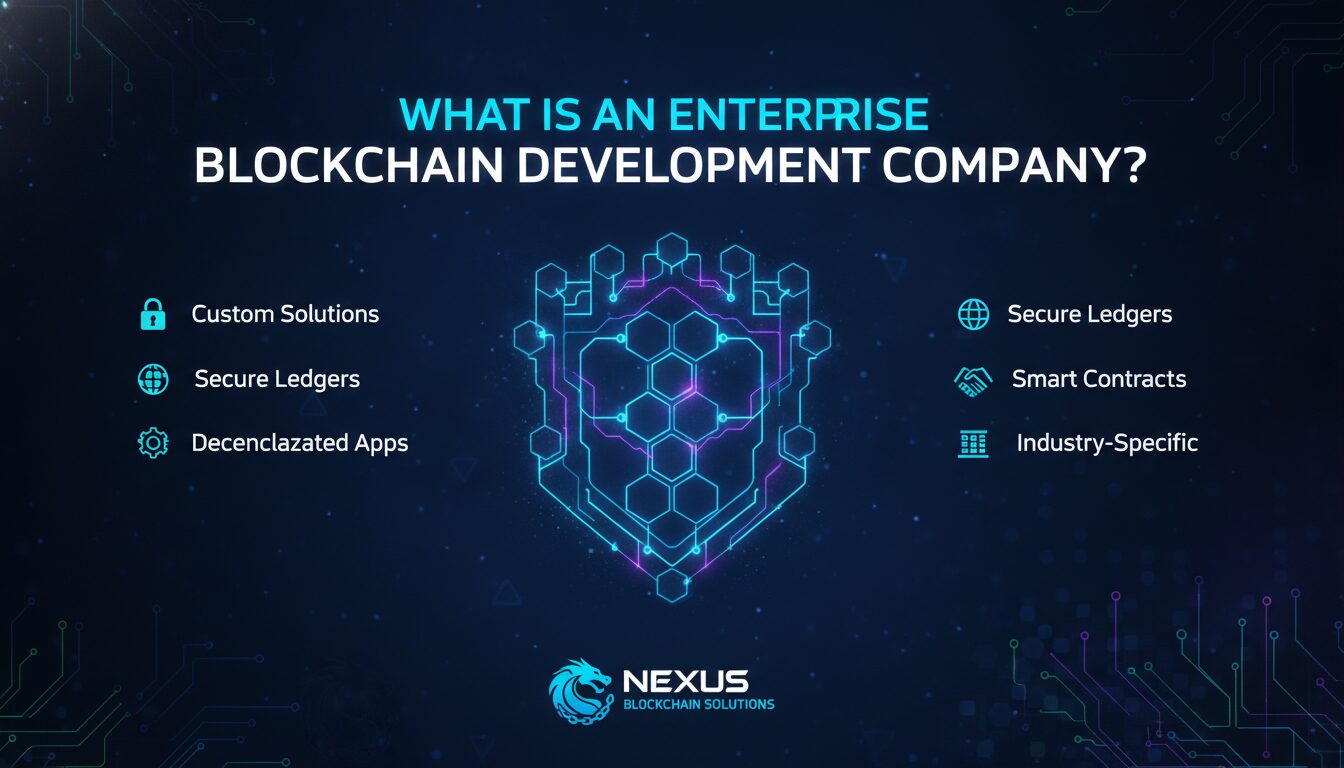
An this type of company is a technology partner that helps businesses adopt distributed ledger technology in a controlled, business-friendly manner. Unlike public blockchains, enterprise solutions are permissioned: only verified participants can access the network. This structure ensures data privacy, regulatory compliance, and the high transaction throughput required for real-world logistics, trade finance, and digital identity management.
Core Characteristics of Enterprise Blockchain Solutions
- Permissioned Access: Only authorized nodes join the network, giving operators granular control over data visibility and transaction validation.
- High Throughput and Low Latency: Enterprise chains are optimized for thousands of transactions per second, making them viable for real-world logistics or financial settlement systems.
- Interoperability: Top development companies connect new blockchain layers to existing ERP, CRM, and legacy systems through APIs and middleware.
- Regulatory Readiness: Identity management (KYC/AML), audit trails, and data sovereignty controls are built in from day one.
Public vs. Enterprise Blockchains
Public networks like Ethereum offer openness and censorship resistance. Enterprise blockchains prioritize confidentiality and performance. A skilled this kind of development company will often recommend a hybrid approach: public chains for certain functions, a private or consortium ledger for sensitive data. This combination balances transparency with controlled access.
Key Services Offered by Enterprise Blockchain Developers
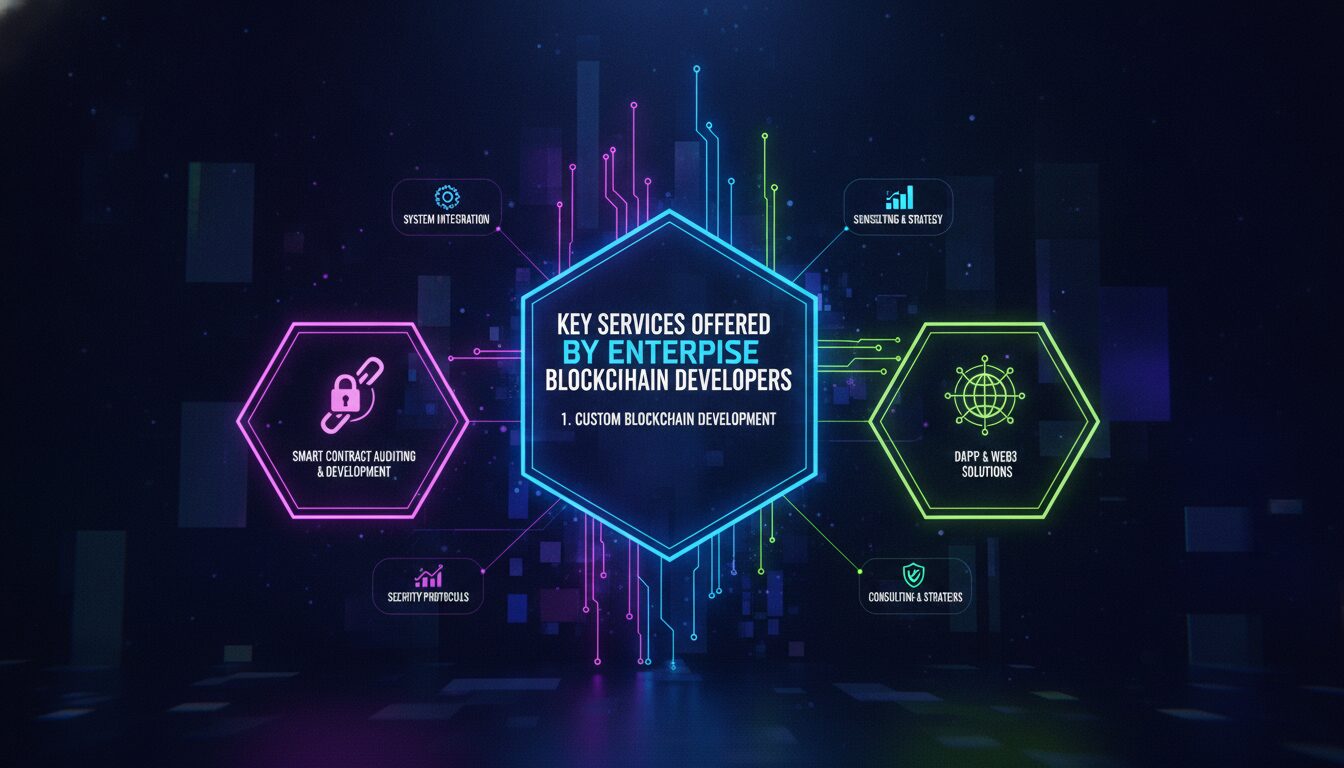
Most enterprise blockchain development companies offer a full suite of services covering the entire project lifecycle. This lets organizations move from strategy to production without switching vendors mid-build.
Blockchain Consulting and Feasibility Analysis
Consulting is the first step, where experts map business processes to distributed ledger benefits. According to Deloitte’s Tech Trends, blockchain-powered ecosystems are becoming key to building digital trust, with organizations increasingly recognizing stakeholder trust as one of blockchain’s primary benefits. A solid consulting phase includes cost-benefit analysis, network type recommendation (public, private, or consortium), and a phased adoption roadmap.
Custom Blockchain Network Development
This involves designing and deploying a purpose-built chain. Development companies configure nodes, consensus mechanisms (Raft, IBFT, or Proof of Authority), and governance models. Per competitor data, PixelPlex reports an 8-week go-live for private blockchain deployments, backed by a 99.99% uptime SLA and role-based access control. Smart contracts are then coded and audited to eliminate vulnerabilities before production launch.
Blockchain Integration and Optimization
Integration services connect the new blockchain layer with existing enterprise applications like SAP, Oracle, or Microsoft Dynamics. Optimization focuses on boosting throughput and reducing latency, which is critical for real-time inventory tracking or high-frequency payment settlement. Post-launch diagnostics can reconfigure nodes and consensus parameters for sustained peak performance.
Benefits of Partnering with an Enterprise Blockchain Development Company
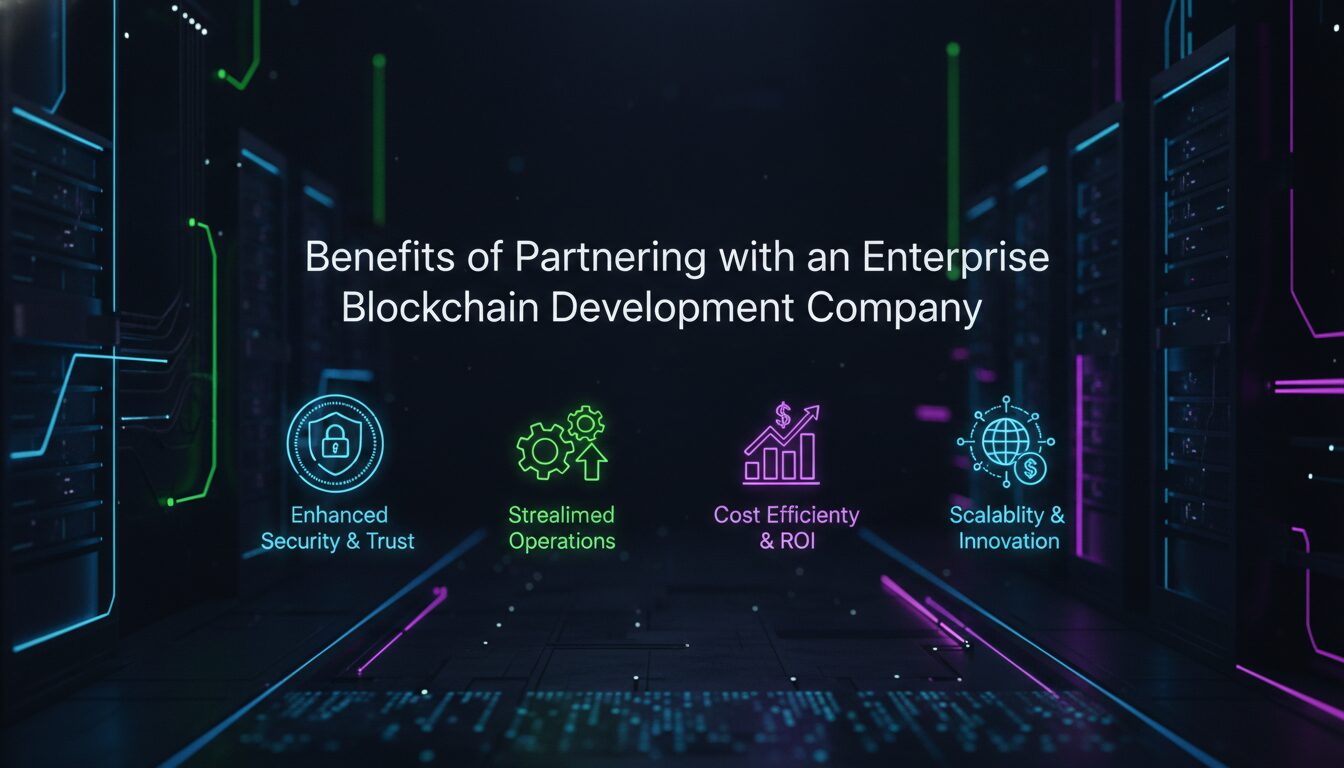
The decision to engage an enterprise blockchain development company is driven by both strategic and operational gains. These benefits are documented across multiple industries and verified by third-party research.
Enhanced Transparency and Trust
Because all transactions are recorded on a shared, immutable ledger, every participant sees the same data. This eliminates reconciliation errors and builds trust among counterparties. The World Economic Forum highlights blockchain’s ability to secure sensitive data, particularly in healthcare, reducing cybersecurity risks. A single source of truth also speeds up audits and dispute resolution significantly.
Cost Reduction Through Disintermediation
By automating processes with smart contracts and removing middlemen, companies cut operational expenses. A special report by the US Faster Payments Council and Ripple estimates that financial institutions could save $10 billion by 2030 through blockchain-based cross-border payments. Decentralized finance models are expanding at a CAGR of 46% from 2023 to 2030, opening new revenue streams that were structurally impossible under traditional intermediary models.
Future-Proofing and Innovation
Working with an experienced enterprise blockchain development company ensures the solution is built on a modern tech stack (Hyperledger Fabric, Quorum, Corda) that can evolve with standards and regulations. Many enterprises use blockchain to tokenize real-world assets, launch digital currencies, or build decentralized autonomous organizations (DAOs). A specialized development partner brings both the technical depth and strategic context to execute these initiatives without costly restarts.
Pros and Cons of Hiring an Enterprise Blockchain Development Company
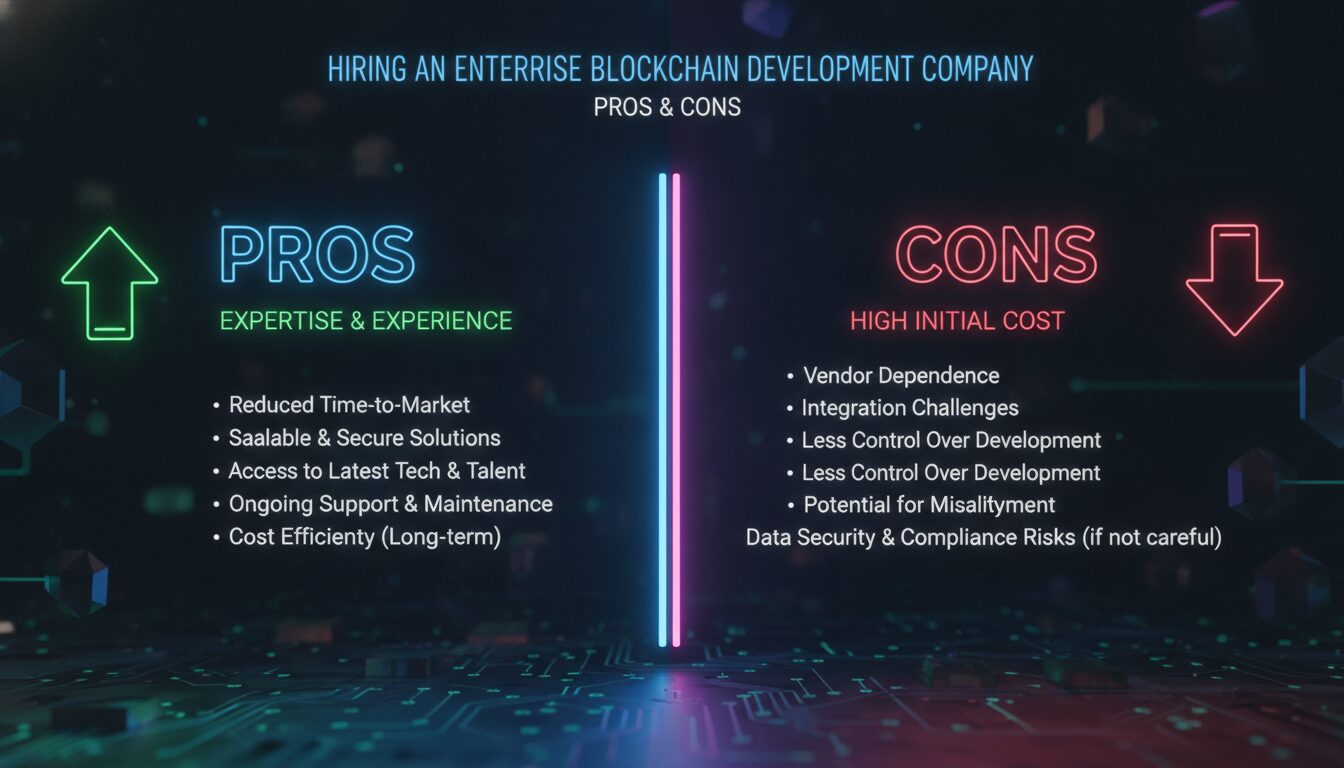
Every strategic technology decision has trade-offs. Here is an honest assessment before you commit budget.
Pros
- Faster time to market: Pre-built frameworks and experienced teams compress delivery timelines compared to building internal capability from scratch.
- Deep, diversified expertise: Top firms maintain specialists across Hyperledger, Ethereum, Corda, and Rust-based chains simultaneously.
- Predictable cost structure: Project-based or retainer pricing makes budgeting more reliable than open-ended internal hiring.
- Built-in compliance knowledge: Firms with regulated-industry experience embed KYC/AML, GDPR controls, and audit trails by default.
- Ongoing SLA coverage: Maintenance and security patching are typically included, reducing the burden on internal IT teams.
Cons
- Vendor dependency: Deep integration with an external partner creates switching costs if the relationship deteriorates.
- Knowledge transfer gaps: Internal teams may not fully understand the deployed architecture, creating long-term maintenance risk.
- Variable quality: The market includes firms with vastly different capability levels. Vetting is time-intensive and requires technical due diligence.
- Cost at scale: For large, multi-year programs, total outsourcing costs can exceed the investment in a well-structured internal team.
How to Choose the Right Enterprise Blockchain Development Partner
With hundreds of firms claiming blockchain expertise, a structured evaluation process is essential. Focus on factors that align with your organization’s risk tolerance and long-term goals.
Technical Expertise and Certifications
Look for companies with proven experience across multiple platforms (Hyperledger, Ethereum, Corda) and a strong portfolio of successful enterprise deployments. Security certifications like ISO/IEC 27001 and SOC 2 Type II indicate mature practices. For reference, TechAhead Corp holds ISO 27001:2022, SOC 2 Type II, and AWS Advanced Tier certifications, which signals a baseline of operational discipline worth benchmarking against any shortlisted partner.
Industry Experience and Case Studies
A partner that has delivered projects in your vertical will better understand regulatory nuances and integration challenges. Ask for detailed case studies with measurable outcomes: cost savings, throughput improvements, or user adoption rates. Aetsoft, for instance, reports an average smart contract audit score of 9.9/10 and a 70% client retention rate over three or more years, signaling consistent delivery quality. Those are the kinds of verifiable metrics worth requesting from any candidate firm.
Development Methodology and Communication
Agile, Kanban, and DevOps practices are critical for iterative delivery and stakeholder transparency. The partner should provide clear timelines, dedicated project managers, and structured tracking tools. PixelPlex, for example, reports 100% JIRA adoption for scope and timeline tracking across all engagements. Cultural fit and time-zone alignment also affect collaboration quality on long-running projects.
Comparison of Development Models: In-House vs. Outsourced vs. Hybrid
Different organizations approach blockchain adoption in different ways. The table below summarizes the trade-offs of building an internal team versus engaging an enterprise blockchain development company.
| Model | Cost Structure | Time to Market | Expertise Level | Ongoing Maintenance |
|---|---|---|---|---|
| In-House Team | High fixed costs (salaries, training, infrastructure) | Slow: recruit and ramp-up required | Limited by hiring difficulty; may lack niche skills | Managed internally; requires 24/7 support capability |
| Outsourced to Specialist Company | Project-based or retainer; predictable budgeting | Faster: pre-built frameworks and skilled team ready | Deep, diversified across platforms | Typically included in SLA; reduced burden on internal IT |
| Hybrid (Internal Core + External Augmentation) | Balanced: core staff plus contract specialists | Moderate: leverage external speed for build phase | Combines institutional knowledge with specialized skills | Shared responsibility; requires clear governance |
Enterprise Blockchain Implementation Process
A methodical approach mitigates risk and aligns stakeholders. Most enterprise blockchain development companies follow a structured four-phase lifecycle that moves from discovery through sustained optimization.
Step 1: Discovery and Feasibility Study
Begin with a two-to-four-week assessment of business requirements, existing systems, and regulatory constraints. This phase produces a feasibility report, a recommended blockchain type (public, private, or hybrid), and a high-level architecture. PixelPlex structures this as a two-week Discovery Sprint, with 98% of scopes moving directly to the build phase.
Step 2: Proof of Concept (PoC) and Pilot
Develop a lightweight prototype to validate the idea with real data. The PoC demonstrates core functionality, such as asset tracking or transaction settlement, and helps secure internal buy-in from stakeholders who need to see the system work before committing full budget.
Step 3: Full-Scale Development and Deployment
Once the PoC succeeds, the development team builds the production network. This involves node deployment, smart contract engineering, rigorous security audits, and integration with existing IT infrastructure. Testing covers functionality, performance, and security under realistic production loads.
Step 4: Ongoing Optimization and Support
After launch, the development partner provides maintenance, monitoring, and enhancements. As transaction volumes grow, optimization may include reconfiguring nodes, upgrading consensus mechanisms, or implementing layer-2 scaling solutions. Regular security patches and compliance updates are not optional: they are contractual obligations in any serious SLA.
Leading Enterprise Blockchain Platforms and Technologies
An enterprise blockchain development company’s platform expertise defines its real capability. The following frameworks dominate enterprise adoption as of 2026.
Hyperledger Fabric
An open-source framework maintained by the Linux Foundation, Fabric is known for its modular architecture and pluggable consensus. It is widely used in supply chain (IBM Food Trust), trade finance, and healthcare because it supports private data collections and requires no native cryptocurrency. Its channel architecture allows multiple parties to transact privately within a shared network.
Ethereum (Enterprise) and Quorum
While the public Ethereum network is permissionless, Quorum, an enterprise fork maintained by ConsenSys, adds privacy features and higher performance. It is often chosen for financial applications and tokenization projects, benefiting from Ethereum’s large developer community and mature tooling ecosystem.
Corda by R3
Purpose-built for financial services, Corda enables direct, point-to-point transactions with fine-grained access control. It excels in syndicated loans, trade finance, and central bank digital currency (CBDC) pilots. Its data model ensures that only the parties involved in a transaction ever see its details, which is a hard requirement in many regulated environments.
“The line between public and private blockchains is blurring as enterprises demand both permissioning and interoperability. The best enterprise blockchain development companies are those that can stitch together multiple networks using bridges and sidechains. They think in ecosystems, not silos.” Synthesized insight from multiple industry reports
“According to Deloitte’s Tech Trends research, blockchain-powered ecosystems are becoming key to building digital trust, with organizations increasingly recognizing stakeholder trust as one of blockchain’s primary strategic benefits.” Deloitte Tech Trends
What to Look for in Smart Contract Development
Smart contracts are the operational core of any enterprise blockchain deployment. A weak contract is a permanent vulnerability: once deployed on-chain, bugs cannot be patched without a full redeployment. Any enterprise blockchain development company worth engaging will treat smart contract security as non-negotiable.
Key practices to demand from your development partner:
- Formal verification: Mathematical proof that the contract behaves as specified under all possible inputs.
- Third-party audits: Independent security firms reviewing the codebase before mainnet deployment.
- Gas optimization: Efficient code reduces transaction costs at scale, which matters enormously in high-volume enterprise environments.
- Upgrade patterns: Proxy contracts or modular designs that allow logic updates without losing on-chain state.
A basic Solidity pattern for an upgradeable proxy looks like this:
// SPDX-License-Identifier: MIT
pragma solidity ^0.8.20;

import "@openzeppelin/contracts/proxy/transparent/TransparentUpgradeableProxy.sol";

// Deploy logic contract separately, then point proxy at it.
// Admin can upgrade logic without touching stored state.
contract EnterpriseProxy is TransparentUpgradeableProxy {
 constructor(
 address _logic,
 address _admin,
 bytes memory _data
 ) TransparentUpgradeableProxy(_logic, _admin, _data) {}
}
This pattern, standardized through OpenZeppelin’s proxy libraries, is the baseline for any enterprise contract that needs to evolve post-deployment.
Frequently Asked Questions
What is the difference between a public blockchain and an enterprise blockchain?
Public blockchains are open and permissionless, while enterprise blockchains are permissioned, with access limited to verified participants. Enterprise versions prioritize data privacy, regulatory compliance, and higher transaction throughput over open participation.
How long does it take to develop an enterprise blockchain solution?
Timelines vary by complexity. A minimum viable product for a private blockchain can be delivered in 8 to 10 weeks, while full-scale integration with legacy systems may take 6 to 12 months. Discovery phases typically run 2 to 4 weeks, per standard industry practice.
What are the typical costs of hiring an enterprise blockchain development company?
Costs depend on scope and team composition. Small consulting engagements start around $25,000 to $50,000, while full-scale projects range from $100,000 to over $1 million. Hourly rates for senior developers vary significantly by geography and firm tier.
Which industries benefit most from enterprise blockchain?
Supply chain management, financial services, healthcare, and government see the most adoption. Use cases include product traceability, cross-border payments, medical records sharing, and public registries. According to the World Economic Forum, blockchain can significantly reduce cybersecurity risks in healthcare data management.
How do I ensure my blockchain project remains compliant with regulations?
Choose a development company with direct experience in your industry and jurisdiction. They should embed identity management (KYC/AML), data privacy controls (GDPR), and audit trails from the architecture phase. Regular legal reviews and proactive engagement with regulators are essential, not optional.
Can an existing system be integrated with blockchain?
Yes. A skilled enterprise blockchain development company will design APIs or configure middleware to connect blockchain networks with ERP, CRM, and legacy databases. Middleware platforms like Chainlink can also provide verified external data feeds to smart contracts, bridging on-chain logic with off-chain business systems.
Ready to move from evaluation to execution? Apply to the Genesis Cohort at Digital Blockchains and work directly with a team that reads whitepapers before breakfast and ships production contracts before lunch.