How to create a blockchain is the process of designing a decentralized ledger, selecting a consensus protocol, and coding cryptographically linked blocks into an immutable chain. This guide walks from prototype to production.
Key Takeaways
- Blockchain creation involves building a chain of cryptographically hashed blocks that form an immutable ledger shared across a peer-to-peer network.
- The choice between building a custom blockchain and deploying on an existing platform like Ethereum or Hyperledger depends on control requirements, scalability goals, and budget.
- A minimum viable blockchain can be coded in hours using Go, Python, or Rust, but a production-ready system requires extensive testing, security audits, and ongoing maintenance.
- Cost estimates range from near zero for a local test chain to over $500,000 for a fully audited mainnet with custom features and infrastructure.
- The four core steps to creating a blockchain are: create a block, add data, hash the block, and chain the blocks together, according to the Builtin tutorial.
- Consensus protocol choice directly shapes the security, energy profile, and throughput of your chain.
What Is a Blockchain and How Does It Work?
The Anatomy of a Block
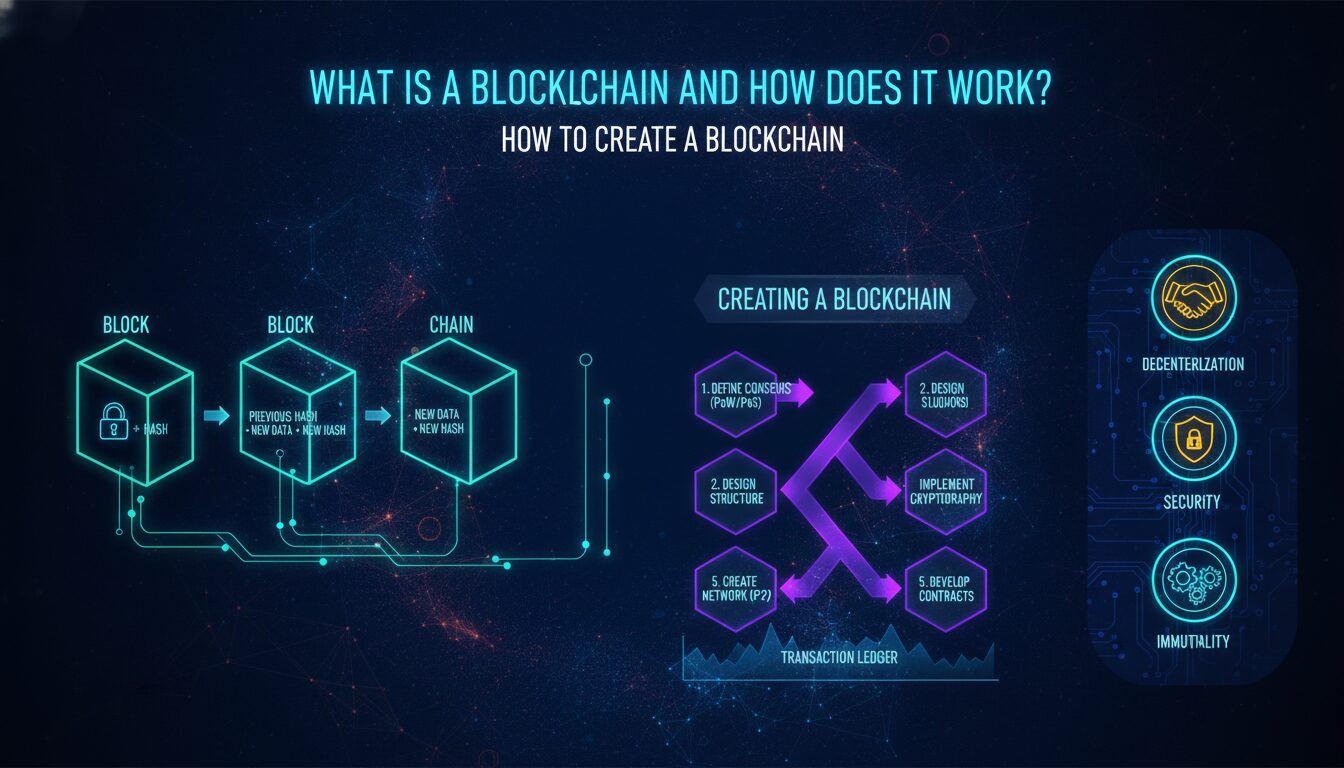
A blockchain is a distributed digital ledger that records transactions across many computers so that no record can be altered retroactively. Each block contains a batch of validated transactions, a timestamp, and a cryptographic hash linking it to the previous block. According to the Builtin blockchain tutorial, a block typically stores transaction details, a nonce, target difficulty, the previous block’s hash, and its own hash (Builtin). Any attempt to change a past block would require recalculating all subsequent hashes, which is computationally impractical at scale.
Decentralization and Immutability
Unlike traditional databases that rely on a central authority, a blockchain operates on a peer-to-peer network where each node holds a copy of the entire ledger. This eliminates single points of failure and makes the system resilient against targeted attacks. Once data is appended to the chain, it becomes immutable. That property is particularly valuable for audit trails, regulatory compliance, and cross-party trust.
Consensus Mechanisms Explained
For a blockchain to function without a central coordinator, nodes must agree on the ledger’s state through a consensus algorithm. Proof of Work, used by Bitcoin, requires miners to solve computationally intensive puzzles to add new blocks. Many modern chains adopt Proof of Stake or alternatives like Practical Byzantine Fault Tolerance, which offer better energy efficiency and faster finality. The choice of consensus directly shapes the security, scalability, and decentralization profile of your chain, a tension often called the blockchain trilemma.
Why Create Your Own Blockchain?
When to Build vs. Use an Existing Chain
Before deciding how to create a blockchain, assess whether you need a custom chain at all. Existing platforms like Ethereum, Solana, or Hyperledger Fabric already provide robust ecosystems with established security and developer tooling. Building from scratch makes sense when you require full protocol control, want to implement a novel consensus mechanism, or need a permissioned network for enterprise use. As MongoDB’s blockchain implementation guide notes, public blockchains like Bitcoin and Ethereum are open and decentralized, while private architectures restrict access to authorized members (MongoDB).
Advantages of a Custom Blockchain
A custom blockchain lets you tailor network rules, transaction throughput, and governance to your specific use case. A supply chain consortium, for example, might opt for a permissioned chain with fast finality and zero transaction fees, something public networks cannot offer natively. You also avoid reliance on third-party token economics and can design a native asset that aligns with your business incentives.
Real-World Use Cases
Organizations across industries are exploring custom blockchains: from DeFi protocols needing specialized smart contract capabilities to governments digitizing land registries. ScienceSoft’s blockchain development guide highlights applications in payments, insurance, supply chain traceability, and personal health records (ScienceSoft). Clarifying your use case before writing a single line of code is the most underrated step in the entire process of how to create a blockchain.
Pros and Cons of Building a Custom Blockchain
Pros
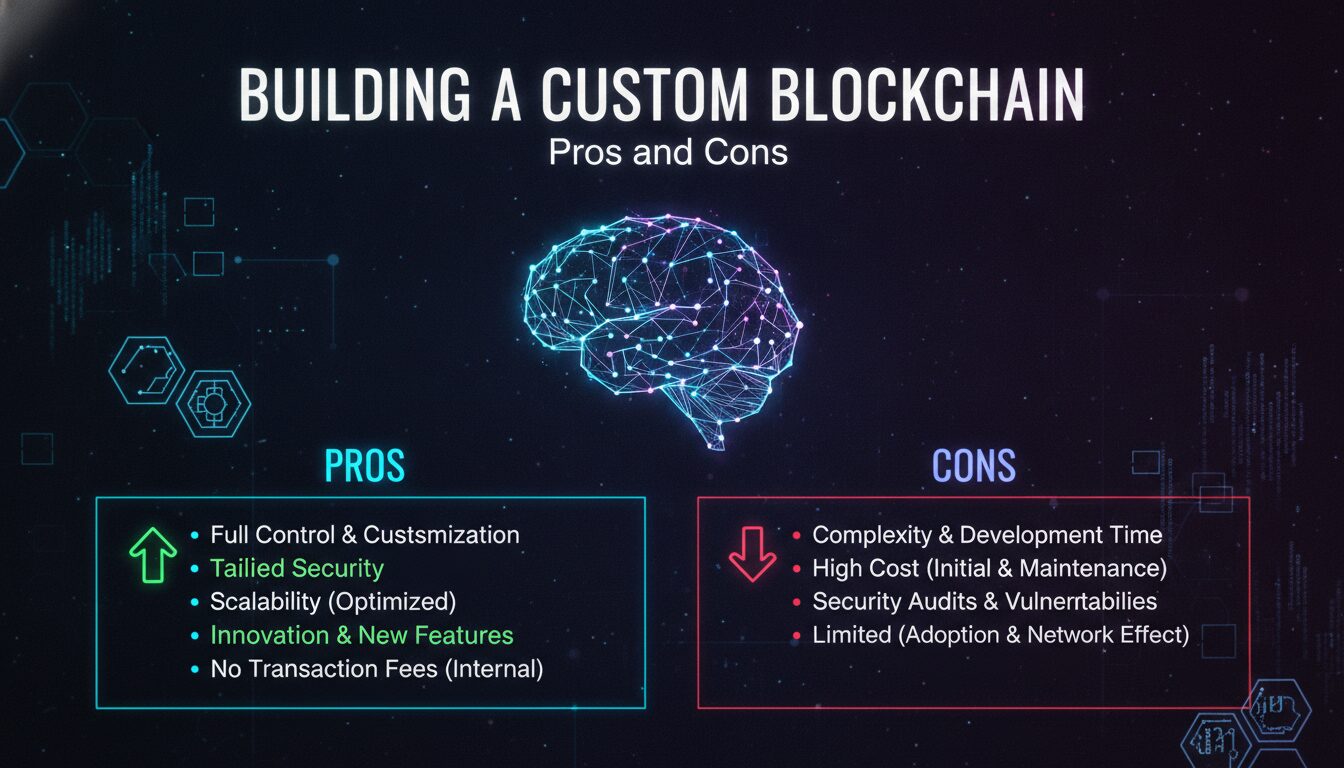
- Full protocol control: You set the consensus rules, block size, transaction format, and governance model without negotiating with an existing community.
- Custom tokenomics: Design a native asset and incentive structure that fits your business model precisely.
- Permissioned access: Enterprise consortiums can restrict participation, enabling compliance with data residency and privacy regulations.
- No shared congestion: Your chain’s throughput is not competing with unrelated dApps or NFT mints.
- Novel consensus options: You can implement mechanisms not available on existing platforms, such as hybrid PoW/PoS or application-specific finality rules.
Cons
- High cost and time: A production-ready custom chain can cost $300,000 to over $1,000,000 and take 6 to 18 months to launch.
- Security burden: You inherit full responsibility for auditing, patching, and defending against 51% attacks, Sybil attacks, and smart contract exploits.
- Ecosystem from zero: Wallets, block explorers, developer tooling, and liquidity must all be built or attracted from scratch.
- Talent scarcity: Blockchain developers with distributed systems and cryptography depth are expensive and hard to hire.
- Regulatory exposure: A native token may trigger securities regulations depending on jurisdiction, adding legal overhead before launch.
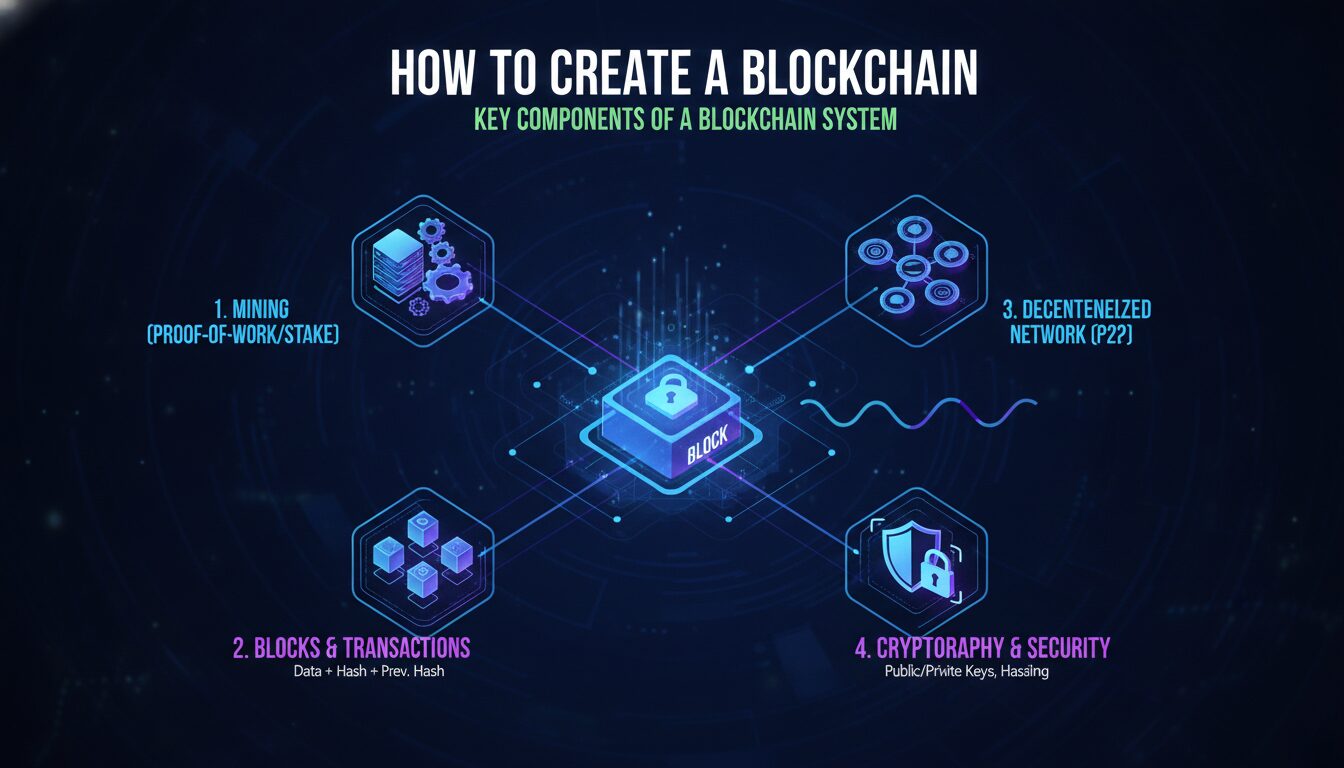
Key Components of a Blockchain System
Cryptographic Hashing
At the heart of every blockchain is a cryptographic hash function, typically SHA-256 or Keccak-256, that transforms input data of any size into a fixed-length string. Change even a single bit of input and the output hash changes completely, making the chain tamper-evident. In practice, each block’s hash is computed by combining its contents with the previous block’s hash. Digital signatures using ECDSA authenticate transactions and prove ownership without revealing private keys.
Peer-to-Peer Networking
Blockchains rely on P2P networks to propagate transactions and blocks among nodes. The Gossip Protocol, referenced in MongoDB’s implementation guide, is commonly used to flood data across the network efficiently. Each node maintains connections to a subset of peers, keeping the ledger consistent without a central server. Libraries like libp2p handle peer discovery and messaging in many modern implementations.
The Ledger and Data Structures
The blockchain ledger is typically implemented as a linked list of blocks, but Merkle trees are used to verify large data sets efficiently. A Merkle tree hashes transactions in pairs, letting a lightweight node verify a transaction’s inclusion without downloading the entire chain. According to MongoDB’s guide, nodes can be full nodes that store the entire blockchain state or lightweight nodes that store only block headers, saving significant time and memory. This distinction matters for mobile wallets and IoT devices with limited storage.
How to Create a Blockchain: Step-by-Step Tutorial
Building a simple blockchain from scratch is the fastest way to internalize the core concepts. The following steps are adapted from the Builtin tutorial, which demonstrates a minimal implementation in Go (Builtin). The four foundational steps are: create a block, add data, hash the block, and chain the blocks together.
Step 1: Set Up the Development Environment
Install a programming language suited to your goals. Go, Python, and Rust are the most common choices for learning how to create a blockchain. You’ll also need a text editor or IDE such as Visual Studio Code and a version control system like Git. For Go, define a module and install any required packages. The Go standard library includes a built-in SHA-256 implementation, which keeps dependencies minimal for a first prototype.
“For speed, endurance and security, most blockchain core engines are built in C/C++ (Bitcoin, EOS), Go (Hyperledger Fabric, Ethereum), Java (Ethereum), Rust, Haskell (Cardano) and Ruby (Ethereum), then provide bindings to other easy-to-use programming languages.” – Builtin blockchain tutorial
Step 2: Define the Block Structure
Create a struct or class to represent a block. Include fields for Index, Timestamp, Data, PreviousHash, and Hash. The PreviousHash field is what links blocks into a chain. In Go, the struct looks like this:
type Block struct {
Index int
Timestamp string
Data string
PrevHash string
Hash string
}
Step 3: Implement Hashing and Chain Logic
Write a function that calculates a block’s hash by concatenating its fields and passing them through SHA-256: hash = SHA256(Index + Timestamp + Data + PrevHash). Then create a genesis block and a function to append new blocks. Each new block must reference the previous block’s hash. Validate the chain by iterating through it and confirming that stored hashes match recalculated values. A mismatch anywhere in the chain signals tampering.
Step 4: Test and Run Locally
Run your blockchain in a terminal. Create multiple blocks, intentionally modify one block’s data, and observe how validation fails. This prototype gives you a working mental model of how to create a blockchain at its core, but it lacks consensus, networking, and security. Those layers are what separate a toy from a production system.
Choosing the Right Consensus Protocol
Proof of Work vs. Proof of Stake
Proof of Work, pioneered by Bitcoin, requires miners to solve computationally intensive puzzles. This consumes significant electricity but provides battle-tested security. Proof of Stake, used by Ethereum and many newer chains, selects validators based on staked tokens, reducing energy consumption and enabling higher transaction throughput. The right choice depends on your network’s threat model and scalability requirements.
Alternative Consensus Models
For enterprise or permissioned blockchains, alternatives like Practical Byzantine Fault Tolerance, Delegated Proof of Stake, and Raft are common. PBFT can finalize transactions in sub-second times and suits networks with a known validator set. Hyperledger Fabric supports pluggable consensus, letting organizations swap mechanisms as requirements evolve.
How to Select the Best Fit for Your Project
Consider these factors when choosing a consensus algorithm for how to create a blockchain that meets your objectives:
- Decentralization vs. performance: More decentralized networks often sacrifice raw speed.
- Energy efficiency: PoS and its derivatives are far greener than PoW.
- Finality requirements: Probabilistic finality (PoW) vs. instant finality (PBFT).
- Validator governance: Permissionless vs. permissioned participation.
Selecting a Programming Language and Tech Stack
Popular Languages: Go, Rust, C++, and Python
The core engine of most blockchains is written in systems languages. C++ powers Bitcoin and EOS; Go drives Hyperledger Fabric and Ethereum’s geth client; Rust underpins Solana and Polkadot; Haskell is used by Cardano. Python is common for prototyping, while JavaScript and TypeScript power frontend dApps. According to the Builtin tutorial, many blockchains combine multiple languages to leverage each one’s strengths (Builtin). C++ gives fine-grained memory control at the cost of complexity; Rust provides memory safety without garbage collection; Go balances simplicity and performance.
Development Frameworks and Libraries
If you’re building a dApp rather than a core chain, frameworks like Hardhat (Ethereum), Anchor (Solana), or the Blockchain Development Kit for Visual Studio Code can accelerate development. Microsoft Reactor demonstrated using the Blockchain Development Kit to scaffold and test smart contracts on a local network. For building a blockchain from scratch, libraries like libp2p for networking, RocksDB or LevelDB for storage, and cryptographic libraries such as OpenSSL are standard choices.
Smart Contract Development Considerations
If your chain will support programmable logic, smart contract design deserves its own architecture pass. Solidity is the dominant language for EVM-compatible chains; Rust is used for Solana programs via the Anchor framework; Hyperledger Fabric uses Chaincode written in Go or JavaScript. The Dapp University ecosystem covers Hardhat for local testing, and the community has increasingly debated Truffle vs. Hardhat vs. Foundry for contract development workflows. Foundry has gained traction for its speed and native Solidity testing, while Hardhat remains the most widely documented option for Ethereum developers.
Database and Storage Considerations
Blockchains typically store state in embedded key-value stores. Bitcoin uses LevelDB; Ethereum uses a Merkle Patricia trie backed by LevelDB. Your database choice directly affects performance and sync speed. MongoDB’s implementation guide emphasizes that the architecture must support efficient data retrieval without compromising the immutable log.
From Prototype to Production: Scaling and Testing
Security Audits and Smart Contract Risks
Once your basic chain is functional, rigorous security auditing is non-negotiable. Test for common vulnerabilities: 51% attacks, Sybil attacks, and, if smart contracts are involved, reentrancy, integer overflows, and front-running. Engage third-party audit firms like CertiK or Trail of Bits before mainnet launch. Even a minor oversight can lead to catastrophic losses, as demonstrated repeatedly across DeFi history.
Node Deployment and Network Configuration
Deploying nodes across geographically distributed servers increases resilience. Configure network parameters including bootnodes, port mappings, and firewall rules. Containerization with Docker and orchestration with Kubernetes simplify scaling. Google Cloud’s Blockchain Node Engine offers fully managed Ethereum nodes for teams connecting to existing networks, but for a custom chain you’ll need to configure everything manually (Google Cloud).
Performance Optimization
Blockchain performance is typically measured in transactions per second and block time. To improve throughput, you might increase block size, reduce block interval, or implement layer-2 solutions like state channels or rollups. These optimizations can affect decentralization, so benchmark under realistic network conditions. Hyperledger’s Caliper tool is designed specifically for this kind of performance testing.
How to Create a Blockchain for Enterprise
Feasibility Study and Use Case Identification
Before writing a single line of code, enterprises must conduct a feasibility study to determine whether blockchain is the right solution. This means analyzing existing processes, identifying pain points such as lack of trust between parties or manual reconciliation, and estimating ROI. ScienceSoft’s four-step plan begins with a feasibility study and conceptual design, ensuring alignment with business goals before any development begins (ScienceSoft).
Proof of Concept Development
Build a minimal working product that demonstrates the core value of your blockchain solution. The PoC should focus on a narrow scope, such as tracking a single asset type across a supply chain, to validate technical assumptions and gather stakeholder feedback. MongoDB’s guide identifies this step as critical before committing to full-scale implementation.
Choosing the Right Platform and Architecture
If building from scratch seems too resource-intensive, enterprise blockchain platforms like Hyperledger Fabric, R3 Corda, or Quorum provide permissioned networks with modular components. These platforms still require significant configuration but include built-in consensus, identity management, and smart contract engines. The decision of how to create a blockchain for enterprise often comes down to this make-or-buy analysis.
Using Cloud Services to Create a Blockchain Node
Blockchain Node Engine on Google Cloud
Google Cloud’s Blockchain Node Engine is a fully managed service for deploying and operating blockchain nodes with minimal operational overhead. According to its official documentation, creating a node takes approximately 30 minutes, though full sync can take up to roughly one day (Google Cloud). It currently supports Ethereum and is available in us-central1, europe-west1, and asia-east1.
Advantages of Managed Blockchain Services
Managed services abstract away infrastructure complexity, including provisioning, patching, and monitoring. They suit organizations that want to participate in existing networks without running a node in-house. That said, they are not designed for building a brand-new blockchain from scratch. They connect you to established networks, not help you create new ones.
Deployment Considerations
When deploying via cloud providers, factor in data residency requirements, network latency to adjacent services, and integration with existing identity and access management systems. Nodes are typically accessed via JSON-RPC or WebSocket endpoints, enabling applications to read on-chain data and submit transactions programmatically.
Cost and Time Estimates for Building a Blockchain
Development Costs by Approach
The cost of how to create a blockchain varies dramatically by scope. A solo developer building a Go prototype spends only time. A startup developing a custom L1 with a novel consensus mechanism can expect to budget $300,000 to over $1,000,000 for a team of engineers, security audits, and initial node infrastructure. ScienceSoft notes that blockchain development costs depend on solution type, tech stack, and project complexity, and offers a free calculator for estimation (ScienceSoft).
Timeline from Idea to Launch
A minimal prototype can be coded in days. A production-ready testnet typically takes 3 to 6 months. A full mainnet launch with ecosystem tooling can take over a year. The timeline expands further if you need to hire specialized talent or navigate regulatory approvals.
Ongoing Maintenance and Upgrades
Blockchains require continuous maintenance: security patches, consensus rule upgrades via hard forks, and scaling node infrastructure. Budget for DevOps engineers and community management if your chain is permissionless. Enterprise networks carry lower public-facing overhead but still need around-the-clock node monitoring.
| Aspect | Custom Blockchain (Built from Scratch) | Existing Blockchain Platform (Ethereum, Hyperledger) |
|---|---|---|
| Control | Full control over protocol, consensus, and governance | Governed by network rules; limited customization |
| Development Time | 6 to 18+ months for a production-ready chain | Days to weeks for a dApp; nodes deploy in minutes |
| Cost | $100,000 to $1,000,000+ (team, audits, infrastructure) | Variable; development cost depends on dApp complexity |
| Scalability | Can be optimized for throughput; no resource competition | Shared network congestion; layer-2 solutions may be needed |
| Security Model | Depends on node distribution and consensus; requires battle-testing | Relies on existing network hash power or stake; proven security |
| Ecosystem Support | Must build tooling, wallets, and explorers from scratch | Rich ecosystem of wallets, explorers, and developer tools |
| Best For | Unique consensus needs, permissioned enterprise consortiums, high control | General dApps, tokenization, NFTs, rapid go-to-market |
Common Challenges and How to Overcome Them
The Scalability Trilemma
The blockchain trilemma holds that achieving decentralization, security, and scalability simultaneously is extremely difficult. Most projects sacrifice one dimension for the others. Solutions like sharding, sidechains, and layer-2 rollups aim to break this trade-off. Ethereum’s transition to Proof of Stake and its ongoing shard chain roadmap represent the most closely watched attempt to resolve it at scale.
Regulatory and Compliance Hurdles
Depending on your token model, you may face securities regulations from the SEC in the US or ESMA in Europe. Privacy regulations like GDPR complicate the immutable storage of personal data. Consider zero-knowledge proofs or off-chain storage to reconcile compliance requirements with on-chain transparency.
Talent and Knowledge Gaps
Blockchain development requires a niche skill set combining distributed systems, cryptography, and economic design. Hiring experienced developers is challenging and expensive. Engaging a specialized firm or using structured learning resources can bridge the gap for teams new to how to create a blockchain at a production level.
Future Trends in Blockchain Development
AI-Assisted Blockchain Creation
AI tools are beginning to streamline dApp development. The 2025 Dapp University tutorial showed AI coding assistants like Bolt helping scaffold smart contracts, and the community has noted tools like Replit accelerating full-stack Web3 prototyping. AI cannot yet design novel consensus protocols, but it can accelerate boilerplate code and test generation, lowering the barrier for developers learning how to create a blockchain for the first time.
“According to the Builtin blockchain tutorial, the five key concepts every builder must understand are: cryptographic hash and digital signature, immutable ledger, P2P network, consensus algorithm, and block validation. Master these and the rest of the implementation follows logically.”
Interoperability and Cross-Chain Solutions
The rise of cross-chain bridges and protocols like Polkadot and Cosmos lets blockchains communicate, reducing the need for one monolithic chain. If you’re building a new blockchain, designing for interoperability from day one can attract users and liquidity from adjacent ecosystems without requiring them to migrate entirely.
Eco-Friendly Consensus Evolution
Environmental concerns are accelerating adoption of Proof of Stake and other low-energy consensus models. Future blockchain projects will face market pressure to demonstrate sustainability credentials, and that pressure will influence consensus choices for anyone working through how to create a blockchain in 2026 and beyond.
Is Learning How to Create a Blockchain Right for You?
For developers, building a simple chain is an invaluable exercise that makes every subsequent blockchain interaction more legible. For businesses, the decision is more complex. Unless you require features unavailable on existing platforms, forking an established codebase or deploying on an enterprise framework is often the smarter path. Weigh your use case, budget, and technical resources carefully before committing to a full custom build. If you’re ready to go deeper, the Digital Blockchains studio works with serious builders on protocol infrastructure and tokenomics from day one.
Want to build with a team that has read the whitepapers and deployed the contracts? Apply to the Genesis Cohort at digitalblockchains.com.
Frequently Asked Questions
Is it possible to create your own blockchain?
Yes, anyone with programming knowledge can create a blockchain. A basic implementation in Go or Python takes only a few hours, but a secure, production-ready system requires extensive design, testing, and security auditing before it can handle real value.
What are the 4 types of blockchain?
Blockchain networks are generally classified as public (permissionless), private (permissioned), consortium, and hybrid. Public chains like Bitcoin are open to all; private chains restrict access to authorized members; consortium chains are governed by a defined group; hybrids combine public and private features for specific use cases.
How much does it cost to create your own blockchain?
Costs range from near zero for a test blockchain on a local machine to over $500,000 for a custom mainnet with security audits, a development team, and cloud infrastructure. Key cost drivers include consensus complexity, smart contract scope, and regulatory requirements.
Can someone own a blockchain?
No single entity can own a public, permissionless blockchain. However, a private or consortium blockchain can be owned and managed by an organization or group that controls access, consensus rules, and the ledger’s governance structure.
What programming language is used for blockchain?
Core blockchain engines are typically written in C++, Go, Rust, or Java. For smart contracts, Solidity is standard on Ethereum, Rust is used for Solana programs, and Chaincode written in Go or JavaScript is used in Hyperledger Fabric. Python and JavaScript are common for prototyping and frontend development.
How long does it take to create a blockchain?
A simple prototype can be built in a day. A testnet with basic consensus and networking may take 3 to 6 months. A full mainnet launch with security audits, tokenomics design, and ecosystem tooling typically takes over a year.