Key Takeaways
- Blockchain is a decentralized digital ledger technology that records transactions across a network of computers.
- How to invest in blockchain can involve buying cryptocurrencies, blockchain stocks, ETFs, or gaining exposure through mining and staking.
- Indirect methods like purchasing shares in companies using blockchain offer a familiar path for traditional investors.
- Understanding the risks, including high volatility and regulatory uncertainty, is essential before committing capital.
- Starting small, diversifying, and focusing on long-term potential are prudent strategies for beginners.
How to invest in blockchain is choosing between direct ownership of crypto assets and indirect exposure through stocks or funds. This guide covers every major method, from buying Bitcoin and Ethereum to picking blockchain ETFs and vetting the companies building decentralized infrastructure.
Understanding Blockchain Technology

Blockchain is a shared, tamper-resistant ledger that groups data into blocks and links them together in chronological order. This structure underpins cryptocurrencies like Bitcoin, but it also supports use cases in healthcare, supply chain tracking, and finance. According to Fidelity Investments, a blockchain tracks data in small increments that are then linked, which is what makes the record tamper-resistant and transparent.
How a Blockchain Works
Each block contains a batch of transactions, a timestamp, and a unique cryptographic hash. The hash of the previous block gets included to form the chain. On the Bitcoin network, blocks are produced approximately every 10 minutes; on Ethereum, roughly every 12 seconds, according to Fidelity’s explainer. This design means altering a single block would require recalculating every subsequent hash, a task that’s computationally impractical at scale. The math backs this up: the odds of guessing a Bitcoin hash sit at 1 in over 115 quattuorvigintillion, a 76-digit number larger than the estimated number of atoms in the universe.
Public vs. Private Blockchains
Public blockchains are decentralized and permissionless, meaning anyone can view and verify the data. Private blockchains are controlled by a single entity, similar to a database with restricted access, and are used in sectors like insurance and food supply tracking where a company needs control over who sees what. For investors, public networks like Bitcoin and Ethereum are the ones that matter most, since they’re the networks you can actually participate in through Proof of Work mining or Proof of Stake validation.
Direct vs. Indirect Methods for How to Invest in Blockchain
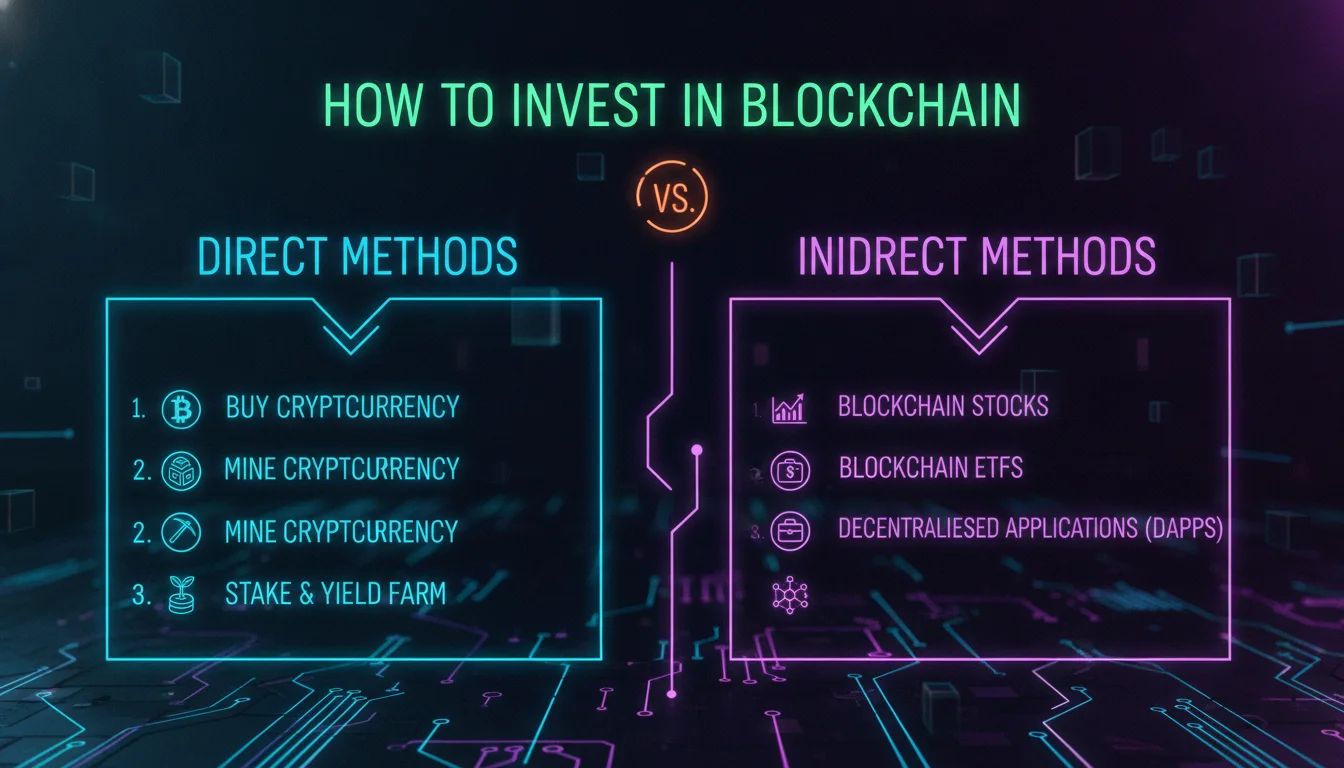
There are two broad paths for how to invest in blockchain: direct exposure through cryptocurrencies and tokens, or indirect exposure through equities and funds. Each carries a different risk-return profile, and plenty of portfolios blend both. Getting this split clear in your head is the first practical step toward building a position you’re comfortable holding.
| Method | Description | Pros | Cons |
|---|---|---|---|
| Buying Cryptocurrencies | Directly purchasing Bitcoin, Ethereum, or other tokens on exchanges or via wallets. | High upside potential, direct ownership of the underlying asset, staking yields. | High volatility, security risks (lost keys), evolving regulation. |
| Blockchain Stocks | Buying shares of publicly traded companies that develop or use blockchain technology. | Familiar structure, potential dividends, regulated markets. | Indirect exposure, company-specific risks, correlation with broader stock market. |
| Blockchain ETFs | Exchange-traded funds that hold a basket of blockchain-related stocks or crypto assets. | Instant diversification, low investment minimums, high liquidity. | Management fees, may not perfectly track the underlying theme, potential overlap. |
| Crypto Mining / Staking | Earning rewards by validating transactions on proof-of-work or proof-of-stake networks. | Generates passive income, supports network security. | High entry cost (mining hardware), technical complexity, energy concerns. |
| Venture Capital / Startups | Investing in early-stage blockchain companies through funds or direct equity. | Potentially very high returns, early access to innovation. | High risk, illiquidity, long lock-up periods. |
This table makes one thing clear: there’s no single right answer for how to invest in blockchain. Direct crypto ownership gives you the purest exposure but demands real security discipline. Stocks and ETFs offer a more familiar on-ramp for anyone already comfortable with a brokerage account.
Blockchain Stocks and Equity Investments
Buying shares of blockchain-involved companies is a common way to gain exposure without touching cryptocurrency directly. Plenty of publicly traded firms sit deep in this ecosystem, from exchanges and mining operations to enterprise software and payment processing.
Types of Blockchain Stocks
- Crypto-native companies: Firms like Coinbase, a major exchange, generate revenue directly from trading and custody fees.
- Mining operators: Companies such as Marathon Digital Holdings and Riot Platforms run large-scale Bitcoin mining facilities.
- Enterprise blockchain providers: IBM offers blockchain tooling for supply chain tracking, while Digital Asset Holdings focuses on financial infrastructure.
- Holders of crypto on balance sheets: MicroStrategy, now operating as Strategy, holds a large Bitcoin treasury position, making its stock behave largely as a Bitcoin price proxy.
Evaluating Blockchain Companies
Before buying a blockchain stock, dig into the company’s financial health, management team, and how deep the blockchain integration actually goes. Not every company that mentions blockchain in a press release genuinely benefits from it. Revenue growth tied to blockchain business lines, transparency about holdings, and regulatory compliance are the indicators that matter. According to Encyclopædia Britannica, investors can buy shares in companies that hold significant crypto on their balance sheet and get indirect market exposure without ever touching a crypto wallet.
“Cryptocurrency stocks vary as much as the companies underlying them, meaning investors have plenty of investment choices, but they should thoroughly vet every opportunity before committing capital.” – Encyclopædia Britannica Money
Blockchain ETFs and Funds
Blockchain ETFs simplify things by packaging multiple assets into one tradable product. These funds either hold crypto futures or a basket of blockchain equities, giving you diversification and easy trading through a standard brokerage account.
Top Blockchain ETFs
- Amplify Transformational Data Sharing ETF (BLOK): An actively managed fund investing in companies developing and using blockchain technology.
- Global X Blockchain ETF (BKCH): Tracks companies involved in digital asset mining, exchanges, and infrastructure.
- Bitwise Crypto Industry Innovators ETF (BITQ): Focuses on pure-play crypto companies, including exchanges and mining firms.
- ProShares Bitcoin Strategy ETF (BITO): Offers exposure to Bitcoin via futures contracts rather than direct holdings.
- Siren Nasdaq NexGen Economy ETF (BLCN): Invests in companies across various sectors that are developing or utilizing blockchain technology.
How to Choose a Blockchain ETF
Check the fund’s expense ratio, actual holdings, and index methodology before buying. Some ETFs hold spot cryptocurrency directly (spot Bitcoin ETFs launched in the U.S. in January 2024), while others hold equity in blockchain-related businesses. The right pick depends on whether you want crypto price exposure or exposure to the companies building the infrastructure around it. One thing worth checking: how much a fund overlaps with standard tech indices. High overlap can dilute the blockchain thesis you thought you were buying.
Investing in Cryptocurrencies as a Gateway to Blockchain
Buying digital assets like Bitcoin and Ethereum is the most direct route into this space. When you hold a cryptocurrency, you’re effectively holding a claim on its underlying network’s activity. Early adopters have historically been rewarded for patience, but the path still demands real due diligence.
Buying and Storing Crypto
To buy crypto, open an account with a reputable exchange such as Coinbase, Kraken, or Binance. After purchasing, you can leave assets on the exchange or move them to a personal wallet for stronger security. Hardware wallets like Ledger or Trezor provide cold storage that keeps your private keys off the internet entirely. Blockchain.com, a global platform that has created over 95 million wallets and moved more than $1.1 trillion in transaction volume, gives a sense of just how much retail participation this market has already absorbed.
Staking and Earning Rewards
Proof-of-stake networks like Ethereum let investors earn rewards by staking, meaning you lock up coins to help validate transactions. Yields vary by asset and platform. Blockchain.com, for example, advertises rates up to 9.5% APY on select assets. Staking adds a passive income layer to a blockchain portfolio, rewarding long-term holding while contributing directly to network security.
Alternative Ways to Gain Blockchain Exposure
Beyond stocks, ETFs, and direct crypto purchases, there are a handful of less common routes that suit different risk appetites and technical comfort levels.
Crypto Mining
Mining means running specialized hardware to solve computational puzzles that secure the network, earning block rewards in return. Bitcoin mining itself is brutally competitive and capital-intensive, but mining smaller networks or joining mining pools lowers the barrier to entry. Electricity costs and hardware depreciation need to be modeled carefully before committing, since they can quietly erase any expected return. Institutional appetite for this infrastructure keeps growing too: on-chain adoption data from State Street Global Advisors shows global crypto owners reached nearly 660 million by the end of 2024, with 86% of institutions now holding some exposure to digital assets, a trend that pushes demand for mining and custody infrastructure alike.
Venture Capital and Startups
Investing in early-stage blockchain companies through venture funds or equity crowdfunding gives you exposure to the technology’s frontier. These startups typically build in decentralized finance, NFTs, or tokenization of real-world assets. This route is illiquid and high-risk, but it can produce outsized returns if a venture succeeds. It’s best suited to accredited investors who can sit through long lock-up periods without needing the capital back.
Tokenized Assets and DeFi
DeFi has introduced instruments like lending pools, liquidity provision, and tokenized real estate that didn’t exist a decade ago. By supplying liquidity to a decentralized exchange or lending stablecoins, investors can earn yield directly from protocol activity rather than a company’s balance sheet. Understanding these mechanics takes more effort, but this is genuinely the frontier of blockchain investing, combining technology adoption with direct financial utility.
Risks and Challenges of Investing in Blockchain
Investing in blockchain carries real risk: extreme price volatility, security vulnerabilities at the wallet and exchange layer, and a regulatory environment that’s still being written in real time. No honest guide skips this part.
Volatility and Regulatory Risks
Cryptocurrency prices can swing sharply within a single day, sometimes by double-digit percentages. Regulatory actions, like China’s mining crackdown or the SEC’s classification of certain tokens as securities, can trigger sharp sell-offs across the market. The lack of consistent global regulation keeps this uncertainty alive. Investors need to be mentally prepared for meaningful drawdowns and should never invest money they can’t afford to lose.
Security and Technological Risks
Blockchain networks themselves are secure by design, but the interfaces around them, exchanges, wallets, smart contracts, are where things go wrong. Lost private keys are gone for good; there’s no SIPC insurance covering crypto held outside a regulated custodian. Smart contract bugs get exploited regularly, sometimes leading to permanent loss of funds. Stick to hardware wallets, turn on two-factor authentication, and only interact with audited protocols. Charles Schwab advises starting small and focusing on long-term goals instead of hype, a sentiment shared by most financial advisors covering this space.
“The key is to start small, gain an understanding of the basics, choose the right platform, and focus on long-term goals rather than hype.” – Charles Schwab, beginner’s guide to cryptocurrency investing
Step-by-Step: How to Invest in Blockchain for Beginners
The steps below turn all of this into an actionable plan for anyone starting from zero. Moving methodically here helps you dodge the most common beginner mistakes and build a position that actually fits your goals.
Step 1: Define Your Investment Goals
Are you after short-term gains or long-term exposure to blockchain’s growth curve? Nail down your time horizon, risk tolerance, and how much capital you can realistically commit. If retirement savings is the goal, a diversified ETF probably beats swing-trading small-cap tokens. Write your goals down; it keeps you honest later when prices move fast.
Step 2: Choose Your Investment Method
Based on those goals, pick from the methods covered above. For most beginners, a combination of a few spot crypto purchases (Bitcoin and Ethereum, typically) plus a blockchain ETF gives a balanced starting point. If you’d rather never hold crypto directly, blockchain stocks and ETFs alone can get you there.
Step 3: Select a Platform or Broker
For direct crypto purchases, use a regulated exchange like Coinbase, which is publicly traded and audited. For stocks and ETFs, a traditional brokerage such as Fidelity, Schwab, or Robinhood works fine. Confirm the platform has solid security practices, insurance where it applies, and an interface you can actually navigate under pressure.
Step 4: Start Small and Diversify
Begin with an amount you’re genuinely fine losing, maybe 1 to 5% of your total portfolio. Spread it across a few assets: some Bitcoin, some Ethereum, and a blockchain equity ETF. That spread cuts down single-asset risk. Setting up automatic recurring purchases lets you dollar-cost average instead of trying to time entries.
Step 5: Monitor and Rebalance
Blockchain markets move fast, sometimes faster than any traditional asset class. Set a quarterly reminder to review your holdings. Rebalance back toward your target allocation when crypto prices spike, taking some profit or buying weakness as needed. Stay informed through credible sources, but resist the pull to overtrade off every headline.
“Learning how to invest in blockchain is not about timing the market perfectly. It’s about time in the market, understanding the technology, and managing risk. Start with education, then commit only what you can afford to lose.” – Common wisdom among experienced blockchain investors
The Future of Blockchain Investment
Blockchain’s investment landscape keeps shifting as the underlying technology matures. The launch of spot Bitcoin ETFs in the United States in January 2024 was a real turning point, bridging traditional finance and crypto markets in a way that hadn’t existed before. Tokenization of real-world assets, from real estate to fine art, could unlock enormous value over time. Central bank digital currencies may further push adoption forward. As institutional interest grows, new products keep emerging, and they keep reshaping what it actually means to invest in blockchain today.
Institutional Adoption Trends
According to State Street Global Advisors, 86% of institutions already have exposure to digital assets, and more than three-quarters expect to increase their allocations. That shift suggests blockchain is becoming a standard portfolio component rather than a speculative side bet. ETFs and improved custody solutions are making it easier for pension funds and endowments to participate, which could reduce volatility over the long run as more patient capital enters the market.
Emerging Sectors to Watch
DeFi, Web3 gaming, and tokenized securities remain among the most active areas in the space. Protocols like Uniswap and Aave already facilitate large daily trading volume without a traditional intermediary in the loop. Investors can now consider yield farming, providing liquidity, or participating in governance through DAOs. These remain high-risk plays, but they represent the active edge of blockchain investing, for those who want to participate rather than just hold.
Pros and Cons
Pros
- Multiple entry points exist, from direct crypto to regulated ETFs, fitting a wide range of risk tolerances.
- Staking and mining offer passive income opportunities beyond simple price appreciation.
- Growing institutional adoption and improved custody options are gradually reducing structural risk.
- Tokenization and DeFi open genuinely new financial mechanics not available in traditional markets.
Cons
- Volatility remains extreme compared to traditional equities and bonds.
- Regulatory frameworks are still evolving and vary widely by jurisdiction.
- Security failures, from lost keys to smart contract exploits, can mean permanent loss of funds.
- Indirect exposure through stocks carries company-specific risk that isn’t always correlated with blockchain fundamentals.
Missing the Bigger Picture: Building, Not Just Buying
Investing in blockchain doesn’t have to stop at buying an asset. At Digital Blockchains, we work with founders and operators who want to build the infrastructure itself, not just hold a position in someone else’s protocol. If you’re a builder thinking about token launches, DAO structures, or tokenomics design rather than a passive allocation strategy, that’s a different conversation entirely, and one worth having early.
Frequently Asked Questions
What is the simplest way how to invest in blockchain?
For most people, the simplest approach is buying a blockchain ETF through a standard brokerage account. This gives diversified exposure without the need to manage private keys or research individual cryptocurrencies yourself.
Can I invest in blockchain with little money?
Yes. Many platforms support fractional shares of crypto, and ETFs can be purchased for the price of a single share. Starting with a small amount lets you learn the mechanics before committing larger sums.
How to invest in blockchain without buying Bitcoin?
You can buy shares in companies like Coinbase, MicroStrategy, or blockchain-focused ETFs such as BLOK or BKCH. These give you exposure to the blockchain industry without ever holding cryptocurrency directly.
Is investing in blockchain risky?
Yes, it can be quite risky due to price volatility, security threats, and shifting regulation. A diversified, long-term approach can soften some of that risk, but you should never invest more than you’re prepared to lose.
What are the best blockchain stocks for beginners?
Exchange operators like Coinbase (COIN) and enterprise tech firms such as IBM offer relatively straightforward exposure. Always research the company’s balance sheet and growth prospects rather than buying on name recognition alone.
Conclusion
How to invest in blockchain depends entirely on your risk appetite, technical comfort, and time horizon. From buying crypto directly to holding shares in forward-looking companies, the paths are genuinely varied. As of 2026, institutional interest keeps accelerating and tokenization is gaining real traction, meaning this technology is still early in its adoption curve. Start small, stay diversified, keep learning, and you’ll be well positioned to invest with real conviction. If you’re building in this space rather than just investing in it, apply to the Genesis Cohort at digitalblockchains.com and let’s talk about what you’re building.