Blockchain employment is the professional engagement of individuals in roles that support blockchain networks, applications, and ecosystems. Salaries regularly exceed six figures, remote work is standard, and platforms like Web3.career list over 40,563 active positions across 7,292 projects.
Key Takeaways
- employment spans technical roles (Solidity, Rust) and non-technical ones (marketing, compliance), with remote work dominating hiring across all categories.
- Specialized job boards like CryptocurrencyJobs.co and Web3.career aggregate thousands of positions, while company career pages at Blockchain.com and Ripple offer direct listings.
- Salaries range from $50K for entry-level specialists to $365K+ for senior security directors, with many roles adding equity and crypto bonuses on top.
- In-demand skills include smart contract development, DeFi protocol knowledge, and regulatory compliance under frameworks like MiCA and FATF.
- Certifications, hackathon participation, and hands-on portfolio projects significantly improve hiring odds, even for candidates without a traditional CS background.
Understanding Blockchain Employment: More Than Just Coding
Defining the Scope of Blockchain Employment
this type of employment covers every professional role that directly or indirectly supports decentralized networks, from building protocols to auditing smart contracts to managing regulatory compliance. Unlike traditional tech jobs, these positions typically require familiarity with distributed ledger technology, tokenomics, and a globally distributed, remote-first work culture. The scope is genuinely wide: a compliance officer at a crypto exchange and a Solidity engineer at a DeFi protocol are both part of the same labor market.
Why Blockchain Employment Is Surging
Demand for blockchain talent has grown steadily as enterprises, startups, and governments adopt Web3 solutions. According to data from leading job aggregators, listings have risen year-over-year across every major category. Web3.career now lists over 40,563 jobs across 7,292 projects, while CryptocurrencyJobs.co curates roles at more than 2,000 startups. This growth is fueled by the maturation of decentralized finance, the proliferation of layer-2 networks, and the urgent need for robust security and compliance infrastructure as regulators worldwide sharpen their focus.
Key Sectors Within Blockchain Employment
this kind of employment is not monolithic. Major sectors include decentralized finance, where liquidity protocols and yield aggregators require constant engineering iteration; infrastructure, focused on layer-1 and layer-2 scaling; and enterprise blockchain, where institutions like JPMorgan Chase build platforms such as Kinexys Digital Assets. Other active niches include gaming, digital identity, supply chain, and regulatory technology, each demanding a unique blend of blockchain expertise and domain knowledge.
Types of Blockchain Employment Opportunities
Technical Roles: Developers and Architects
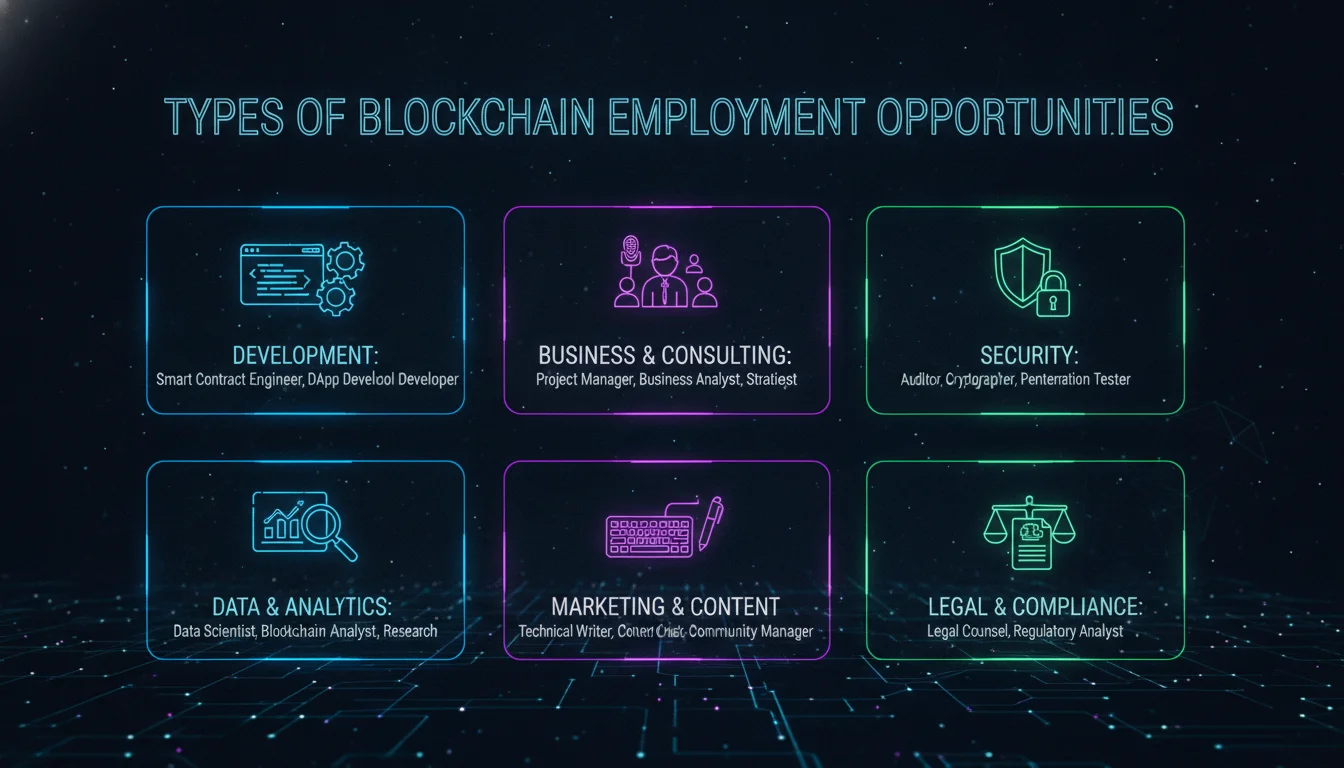
Technical blockchain forms the backbone of the industry. Common titles include Blockchain Developer, Smart Contract Engineer, and Protocol Engineer. These positions require proficiency in Solidity for Ethereum and EVM-compatible chains, or Rust for Solana, Polkadot, and Cosmos SDK chains. Senior Blockchain Engineer roles at firms like Blockchain Game Alliance are listed at $160K to $180K on Works-Hub. Senior Web3 Developer positions reach $180K to $200K. Infrastructure and security roles, such as the Chief Information Security Officer at Blockchain.com, command top-tier packages, often well above $200K.
Non-Technical Roles: Business, Marketing, and Compliance
employment is rich with non-coding opportunities. Compliance roles such as Deputy BSA and Sanctions Officer and MLRO are critical for companies like Blockchain.com, which maintains offices in London, New York, Malta, Buenos Aires, Dallas, Paris, and Singapore. Marketing and growth professionals are in high demand: Performance Marketing Specialist and Social Media and Growth Lead positions appear across every major platform. According to CryptocurrencyJobs.co, sales, operations, and human resources roles are frequently posted, many offering remote work and crypto bonuses.
Hybrid Roles: The New Breed
Many this type of employment opportunities blur the line between technical and business functions. Product Managers with DeFi knowledge, Technical Recruiters, and Developer Advocates are all essential hires. A Manager of Product Development for Digital Assets and Stablecoin Products at Mastercard, listed on Web3.career at $150K to $254K, is a clear example of this hybrid nature. Similarly, a16z’s Partner 18 Events Associate role, listed at $150K to $165K plus equity per the Blockchain Association job board, requires both crypto market understanding and event management skills.
Navigating Blockchain Employment Platforms: Where to Look
Specialized Crypto Job Boards
Niche platforms have become the primary destination for this kind of employment. Web3.career aggregates over 40,563 jobs and offers salary filters, internship listings, and a profile builder that lets hiring agents discover you. CryptocurrencyJobs.co curates roles at startups across Engineering, Marketing, Sales, and Operations categories. CryptoJobsList bills itself as the largest list of crypto, Web3, and blockchain jobs, with dedicated filters for non-technical and remote positions. These platforms generally provide salary transparency, a key advantage over generalist boards.
Traditional Job Aggregators
Generalist sites remain relevant for blockchain, particularly for corporate roles. LinkedIn surfaces positions from companies like Ripple, Coinbase, and JPMorgan Chase. Indeed lists blockchain positions with remote and hybrid options. While these platforms require more manual filtering, they surface opportunities at large enterprises that rarely post on niche boards.
Company Career Pages and Direct Applications
Directly visiting company websites is an underrated method for finding employment. Blockchain.com’s careers page on Greenhouse lists dozens of openings across engineering, compliance, and business strategy in London, New York, Malta, Buenos Aires, Dallas, Paris, and Singapore. Ripple, Fireblocks, and Aave all maintain dedicated job portals. This approach bypasses aggregators and often yields faster application processing, since you’re not competing with candidates who applied through a high-traffic board.
How to Land a Job in Blockchain: A Step-by-Step Process
Step 1: Identify Your Niche
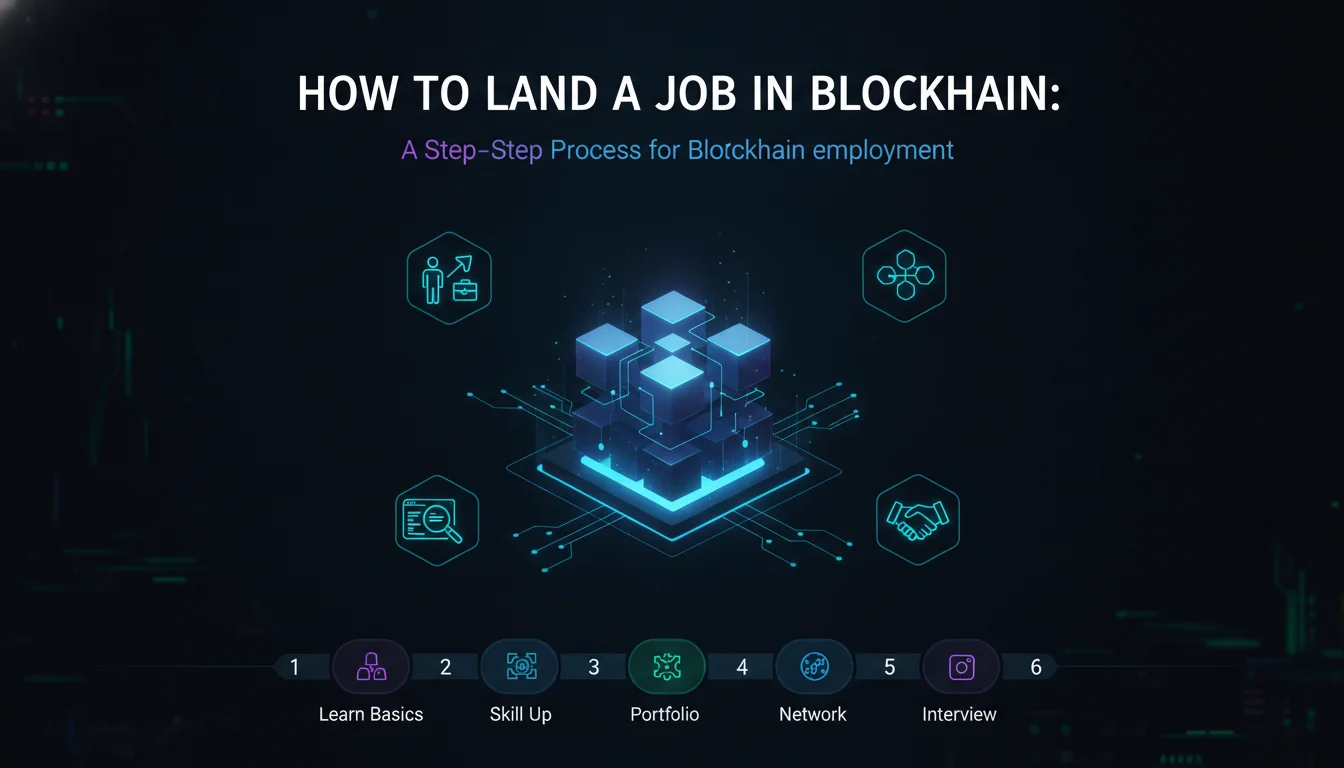
this type of employment is broad, so start by deciding between technical, business, creative, or operational paths. Research current job descriptions to understand required skills. Platforms like Web3.career allow filtering by “non-tech” or “entry-level,” helping newcomers find accessible starting points without wading through senior engineering listings.
Step 2: Build Relevant Skills
For technical this kind of employment, learn Solidity through resources like CryptoZombies or complete a structured bootcamp. Metana offers an ISO 9001-certified Solidity and Rust program with a job guarantee, aimed at candidates who want structured accountability. Non-tech candidates should study tokenomics, AML and KYC regulations, and community management. Contributing to open-source projects or running a testnet validator demonstrates hands-on capability that no certificate alone can replicate.
Step 3: Create a Portfolio
A strong portfolio consistently outperforms a polished résumé in blockchain. Developers should publish audited smart contracts on GitHub with clear documentation. Marketers can showcase campaigns with on-chain performance metrics. For governance roles, documented participation in DAOs, including delegate votes and forum proposals, signals genuine engagement. Host your portfolio on a personal site or a Web3 social profile like Lens or Farcaster.
Step 4: Network Strategically
Attend Ethereum community events, join Discord servers for protocols like Lido and Aave, and engage actively on X. Many positions are filled through referrals before they ever reach a job board. Web3.career and CryptoJobsList both offer profile features that let hiring agents find you, which inverts the traditional application dynamic in your favor.
Step 5: Apply with Precision
Tailor each application to the specific employment role. Reference relevant protocols, EIPs, or governance proposals you’ve engaged with. Follow up through LinkedIn or project community channels. Companies like Ethena Labs and Ripple explicitly list passion for the technology as a hiring signal, so surface that authentically rather than as a boilerplate closing line.
Interview Preparation for Blockchain Roles
Technical interviews at Web3 companies often include live smart contract reviews, gas optimization challenges, or architecture discussions about consensus mechanisms. Non-technical candidates should expect questions on regulatory frameworks (MiCA, FATF Travel Rule), tokenomics modeling, and protocol-specific mechanics. Reading project whitepapers and reviewing recent governance proposals before an interview is a reliable differentiator. Practicing on public testnets and contributing to audit contests on platforms like Code4rena builds both skill and a verifiable track record.
Salaries and Compensation in Blockchain Employment
Salary Ranges by Role
Compensation in blockchain employment varies widely but consistently runs above comparable traditional tech roles. Entry-level specialists can earn $50K to $70K, as seen in the Crypto Market Specialist listing on Web3.career. Mid-level engineers command $105K to $180K: a Full Stack Engineer at Flint Labs is listed at $105K to $120K, while Senior Blockchain Engineers at Blockchain Game Alliance reach $160K to $180K. Senior and leadership roles climb significantly higher, with Ripple’s Senior Staff Security Engineer listed at $224K to $300K plus equity and the Senior Director of Security Engineering at $292K to $365K plus equity, per the Blockchain Association job board. A Chief Compliance Officer at Lightspark is offered $300K to $350K on CryptocurrencyJobs.co.
| Role | Company | Salary Range (USD) | Source |
|---|---|---|---|
| Entry-Level Crypto Market Specialist | APEX TRADE | $50K – $70K | Web3.career |
| Full Stack Engineer | Flint Labs | $105K – $120K | Web3.career |
| Senior Blockchain Engineer | Blockchain Game Alliance | $160K – $180K | Works-Hub |
| Senior Web3 Developer | Mobalytics | $180K – $200K | Works-Hub |
| Senior Staff Security Engineer | Ripple | $224K – $300K + Equity | Blockchain Association Jobs |
| Chief Compliance Officer | Lightspark | $300K – $350K | CryptocurrencyJobs.co |
| Senior Director, Security Engineering | Ripple | $292K – $365K + Equity | Blockchain Association Jobs |
Geographic Salary Differences
Blockchain employment salaries skew highest in the United States, particularly in New York and San Francisco. European roles, including those at Blockchain.com’s London office and Matter Labs’ remote-Europe positions, tend to offer competitive but somewhat lower base salaries, often offset by equity and token allocations. Asia-Pacific roles, such as those listed on LaborX for Hong Kong and Singapore, vary significantly by local cost of living. The remote-first nature of most blockchain employment partially equalizes this: a developer in Eastern Europe or Latin America can earn a US-benchmarked salary while benefiting from a lower cost of living.
Tokenomics Compensation Structures
Beyond base pay and equity, many blockchain employment packages include token allocations tied to the project’s native asset. These grants typically vest over two to four years with a one-year cliff, mirroring traditional equity structures. The key difference is liquidity: tokens can become tradeable before a traditional IPO, but they also carry price volatility that stock options don’t. When evaluating an offer with a token component, scrutinize the vesting schedule, any lockup periods post-TGE, and whether the allocation is priced at a discount to the public sale. Ask explicitly about acceleration clauses if the project is acquired or undergoes a governance restructure.
Additional Benefits
Beyond base pay, blockchain employment often includes meaningful equity, crypto bonuses, unlimited vacation, and paid family leave. Blockchain.com’s benefits package explicitly highlights competitive salary, meaningful equity, crypto bonuses, healthcare, paid family leave, equipment stipends, unlimited vacation, and hybrid working. Many startups add token allocations on top of this, while remote-first policies reduce geographic constraints and expand the effective talent pool globally.
Negotiating Compensation
Use salary transparency data from boards like Web3.career and CryptoJobsList as your baseline. Emphasize protocol-specific skills: Rust experience for Solana roles or CAMS certification for compliance positions carries measurable premium. For senior roles, equity or token grants can represent a substantial share of total compensation. Always ask for vesting acceleration clauses and clarify lockup terms on any token component before signing.
“The best blockchain engineers I’ve hired weren’t found through job boards. They were the ones shipping code in public, contributing to governance forums, and showing up at hackathons. The portfolio is the interview.” – Perspective shared across multiple Web3 hiring communities
Skills and Qualifications for Blockchain Employment
Technical Hard Skills
Core technical skills for blockchain employment include Solidity for EVM chains, Rust for Solana, Near, and Cosmos SDK environments, and backend languages like Go, Python, and TypeScript. Understanding of smart contract security, gas optimization, and consensus algorithm design is essential for senior roles. Relevant certifications from ConsenSys Academy or similar programs, combined with open-source contributions, signal expertise more credibly than a degree alone. On-chain data from platforms like Dune Analytics and Etherscan is increasingly used in technical interviews to assess a candidate’s ability to read and interpret protocol activity.
Non-Technical and Soft Skills
Non-technical blockchain employment values analytical thinking, adaptability, and genuine conviction about decentralization. Compliance roles demand deep knowledge of AML and KYC regulations, the FATF Travel Rule, and emerging frameworks like the EU’s MiCA regulation. Marketing and community leads must combine storytelling with data-driven growth tactics. Remote work across multiple time zones requires strong asynchronous communication and disciplined self-management, skills that are genuinely tested in distributed teams.
Building Credibility Without a CS Degree
Many blockchain employers prioritize demonstrable skills over formal education. Participate in hackathons like ETHGlobal, earn on-chain credentials, or become an active delegate in a DAO. Completing a structured program, such as Metana’s ISO 9001-certified Solidity bootcamp with its job guarantee, can accelerate a career transition. Even for non-developers, knowing how to use wallets, interact with DeFi protocols, and participate in governance forums is increasingly treated as a baseline expectation rather than a bonus.
Pros and Cons of Blockchain Employment
Pros
- Compensation premium: Salaries consistently exceed comparable traditional tech roles, with senior positions regularly reaching $200K to $365K plus equity and token grants.
- Remote-first culture: The majority of blockchain employment is location-independent, enabling global talent to earn competitive salaries regardless of geography.
- Rapid career growth: The industry is young enough that skilled contributors can advance to senior or lead roles faster than in mature tech sectors.
- Mission alignment: Many practitioners find genuine intellectual satisfaction in building infrastructure that challenges legacy financial and governance systems.
- Token upside: Compensation packages at early-stage projects often include token allocations that can appreciate significantly if the protocol gains adoption.
Cons
- Market cycle volatility: Hiring in blockchain employment contracts sharply during bear markets, and token-heavy compensation packages can lose value quickly when sentiment shifts.
- Regulatory uncertainty: The legal landscape is still evolving, and compliance requirements can change rapidly, creating instability for both employers and employees.
- Steep learning curve: The technical depth required, from cryptographic primitives to protocol economics, is genuinely demanding and requires continuous self-education.
- Startup risk: A significant share of blockchain employment is at early-stage companies with real failure rates, meaning job security is lower than at established tech firms.
The Impact of Crypto Market Cycles on Employment Stability
Blockchain employment is more sensitive to market cycles than most tech sectors. During bull markets, hiring accelerates sharply: new protocols launch, existing teams expand, and compensation packages grow more aggressive. Bear markets produce the opposite effect, with layoffs concentrated at consumer-facing products and speculative projects while infrastructure and compliance roles tend to hold more stable. The practical implication for job seekers is to build skills that remain valuable across cycles: smart contract security, protocol engineering, and regulatory compliance are consistently in demand regardless of token prices. Chasing roles at hype-driven projects during a bull run without evaluating the underlying fundamentals is a reliable path to a layoff notice twelve months later.
“Compliance and security hiring in crypto doesn’t follow the same cycle as product hiring. Regulators don’t pause during bear markets, and neither does the need for engineers who can keep protocols from getting exploited.” – Observation consistent with hiring patterns tracked by the Blockchain Association job board
The Future of Blockchain Employment: Trends and Outlook
Growth of DeFi and Layer-2 Solutions
Decentralized finance continues to drive blockchain employment, with roles like DeFi Growth Lead and Smart Contract Auditor proliferating across every major job board. Layer-2 networks including Arbitrum, Optimism, and zkSync are actively hiring engineers to scale Ethereum throughput. As traditional finance integrates on-chain services, the overlap between TradFi and DeFi skill sets is creating a new category of hybrid roles that command premium compensation from both sides of the market.
Remote-First Culture and Global Talent
Blockchain employment is inherently global. Companies like Institute of Free Technology and Ethena Labs hire talent irrespective of geography, as confirmed by their listings on CryptocurrencyJobs.co. This opens real opportunities for individuals in regions with lower living costs who can earn globally competitive salaries. The infrastructure of DAOs further blurs the line between contributor and employee, enabling micro-employment through bounties and grants that don’t require a formal hiring process at all.
Regulatory and Compliance Roles Will Multiply
As governments implement clearer frameworks, particularly the EU’s MiCA regulation, demand for compliance officers, policy experts, and legal counsel is accelerating. Blockchain.com alone carries five compliance openings across multiple offices, per its Greenhouse careers page. Chief Compliance Officer positions are now standard at major Web3 firms, often commanding salaries above $300K, and that trend is not reversing as regulatory scrutiny increases globally.
Seizing Your Place in Blockchain Employment
Blockchain employment offers a genuine combination of high compensation, technical depth, and global flexibility that few other sectors can match right now. Whether you’re engineering the next DeFi protocol, shaping regulatory policy, or building a Web3 brand, the opportunities are real and the job boards are active. Start by identifying your niche, acquiring the right skills, and engaging with the community. The builders who move now, while the infrastructure is still being laid, are the ones who will define what this industry looks like in a decade.
Apply to the Genesis Cohort at digitalblockchains.com and build alongside practitioners who are shipping protocol infrastructure today.
Frequently Asked Questions
What qualifications do I need for blockchain employment?
Qualifications vary significantly by role. Developers need proficiency in Solidity, Rust, or smart contract auditing, while non-technical roles require industry knowledge, compliance certifications like CAMS, or marketing expertise. Hands-on experience and portfolio projects frequently substitute for formal education at most Web3 employers.
Is blockchain employment mostly remote?
Yes, the majority of blockchain jobs are remote-friendly by design. Many protocols are distributed organizations, and platforms like Web3.career and CryptocurrencyJobs.co list remote as the default filter for most categories. Even roles at companies with physical offices, like Blockchain.com, often offer hybrid arrangements.
How much do blockchain jobs pay?
Salaries range from $50K for entry-level positions to over $365K for senior security and engineering directors, with many roles adding equity, crypto bonuses, and token allocations on top of base pay. Compensation data from the Blockchain Association job board and Web3.career confirms this range across verified listings.
What is the best platform for blockchain employment?
Specialized boards like Web3.career, with over 40,000 active listings, and CryptocurrencyJobs.co are the most targeted options. LinkedIn and Indeed surface additional corporate listings, while company career pages at firms like Blockchain.com and Ripple offer direct access without aggregator competition.
Can I get a blockchain job with no experience?
Entry-level and internship opportunities exist, particularly in community management, customer support, and junior development. Building a verifiable portfolio through hackathons, open-source contributions, or DAO participation significantly improves your chances, and structured bootcamps like Metana’s ISO 9001-certified program offer a job guarantee for those who complete the curriculum.
What are the most in-demand blockchain employment skills in 2026?
Solidity and Rust remain the top programming languages across active job listings. Proficiency in DeFi protocol mechanics, zero-knowledge proof systems, and regulatory compliance frameworks including AML, KYC, and MiCA is increasingly treated as a baseline expectation rather than a differentiator at senior levels.