Learn blockchain is the starting point for anyone entering Web3, DeFi, or smart contract development. Blockchain is a tamper-proof distributed ledger that records transactions across a network of nodes, where each block links to the previous one through a cryptographic hash.
Key Takeaways
- Blockchain is a tamper-proof distributed ledger that powers cryptocurrencies, smart contracts, and decentralized applications.
- Self-study is viable, but structured courses from Microsoft Learn and Cyfrin Updraft reduce the guesswork of curating outdated material.
- Hands-on practice beats passive watching: send testnet transactions, deploy a smart contract, and explore Layer 2 tools before moving on.
- Compare platforms before paying; free resources like GitHub roadmaps and edX audits can take you surprisingly far.
- Pick one ecosystem and go deep: Ethereum is the most documented starting point for developers in 2026.
What Does It Mean to Learn Blockchain in 2026?
Learning blockchain today means acquiring a general-purpose infrastructure skill, not just understanding how to buy cryptocurrency. According to edX, a blockchain is a digital ledger that records transactions across multiple information systems, where each block connects to the previous one through a cryptographic hash. That framing matters: blockchain is a data integrity technology first, and a token system second.
The Core Concepts Every Beginner Must Know
Before you can meaningfully learn blockchain, five definitional building blocks need to be solid. A block is a tamper-proof record of transactions. A cryptographic hash is a fixed-length string that links blocks together. A consensus mechanism is a protocol that lets distributed nodes agree on the blockchain state. A wallet is a tool for managing cryptographic keys and signing transactions. Gas is a unit that measures the computational effort required to execute operations on Ethereum. These concepts appear in every credible course, including Microsoft Learn’s Beginner’s Series and Cyfrin Updraft’s Blockchain Basics.
How Blockchain Fundamentals Have Evolved
As of 2026, the curriculum has expanded well beyond Bitcoin and Ethereum basics. Cyfrin Updraft’s Blockchain Basics course now covers account abstraction and EIP-4337, the oracle problem, and attack vectors like MEV, 51% attacks, Sybil attacks, and blockchain reorganisations. It also introduces Layer 2 rollups, specifically naming ZKsync as a significant L2. This shift reflects how much of modern blockchain development is about scaling, security, and user experience rather than minting tokens.
Why Learn Blockchain Now Means More Than Crypto
The same Cyfrin Updraft syllabus highlights real-world use cases such as decentralized exchanges (DEXs), real-world assets (RWAs), stablecoins, and NFTs. edX similarly frames blockchain skills as relevant to software development, financial technology, cybersecurity, and supply chain management. When you learn blockchain today, you are building a transferable infrastructure skill, not a narrow trading skill.
Can You Learn Blockchain on Your Own?
Yes, and many people have done exactly that. The GitHub repository nqcm/learning-blockchain is a curated path to becoming a blockchain developer through self-education, currently showing 354 stars, 19 watching, and 55 forks. The repository organizes resources into introductory courses, advanced courses, tutorials, articles, books, frameworks, communities, and podcasts.
Self-Directed Learning Works for Motivated Beginners
If you want to learn blockchain without enrolling in a paid program, you can assemble a solid curriculum from free videos, documentation, and GitHub repos. The Microsoft Learn series is entirely free and includes 20 short episodes. According to roadmap.sh, its Blockchain Developer roadmap has 10,742+ people tracking their progress. These resources are enough to build a conceptual foundation and deploy a first smart contract.
What Self-Study Gets Right and Where It Fails
The main advantage of self-study is flexibility and cost. The main failure mode is fragmentation. Quora contributor Brian Schuster, who taught himself development through MOOCs, advises beginners to start with a gentle introduction via YouTube and podcasts, then find tutorials produced or written in the last 12 months because the industry changes too fast for older material. That curation burden is real, and it is why structured courses remain popular even among developers who could figure it out alone.
Building a Personal Curriculum from Free Resources
A practical self-study stack might include the Microsoft Learn video series for fundamentals, the nqcm/learning-blockchain list for reading material, and the Simplilearn Blockchain Full Course 2026 video for a longer guided session. That video runs nearly 6 hours, and the Simplilearn channel has 6.72 million subscribers. You do not need every resource. You need one coherent path and the discipline to finish it.
Step-by-Step Process to Learn Blockchain from Scratch
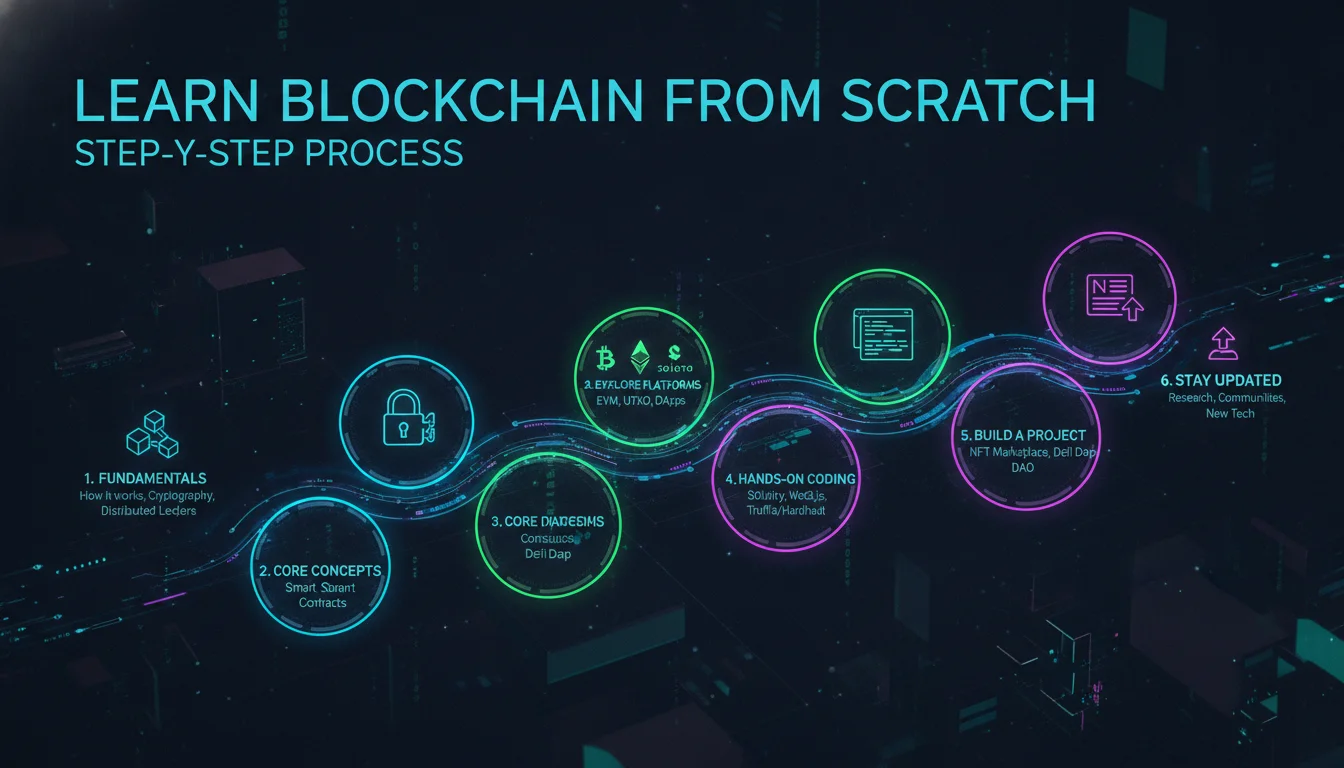
The most effective way to learn blockchain from scratch is to follow a deliberate sequence that builds conceptual understanding before touching code. This process appears, in different forms, across Microsoft Learn, Cyfrin Updraft, and roadmap.sh.
Your First 30 Days: Fundamental Knowledge
- Learn what a blockchain is. Study distributed ledgers, blocks, hashes, and immutability.
- Understand Bitcoin and Ethereum. Compare Bitcoin’s UTXO model with Ethereum’s account model.
- Set up a wallet. Use a testnet and record your seed phrase safely.
- Study consensus mechanisms. Contrast Proof of Work with Proof of Stake.
- Learn a smart contract language. Solidity is the most common starting point.
- Use developer tools. Try Remix, Hardhat, Truffle, and OpenZeppelin.
- Send transactions and deploy a contract on a testnet. This is the single most important beginner milestone.
- Explore scaling and security. Learn what Layer 2 rollups, MEV, and Sybil attacks are.
Common Pitfalls to Avoid
Beginners often try to learn every chain at once, skip wallet security, or treat blockchain as purely financial speculation. Another common mistake is watching hours of content without ever opening Remix or a testnet. Quora contributor Ivan Murphy, a software engineer and crypto enthusiast, recommends focusing on one area, such as Ethereum or Hyperledger, then learning Solidity and creating smart contracts rather than jumping between ecosystems.
How Long Does It Take?
No single timeline fits everyone. Cyfrin Updraft’s Blockchain Basics course is 6 hours long and contains 58 lessons, but that is only a foundation. Developer-level proficiency requires months of building, reading documentation, and understanding security tradeoffs. Treat the first structured course as a map, not the destination.
“Get a gentle introduction to the subject. YouTube videos and podcasts are a great way to do this. Don’t push yourself to ‘be a developer’, just go in to understand what it is. Find tutorials produced or written in the last 12 months and commit to finishing that one thing.” – Brian Schuster, self-taught developer, via Quora
Best Structured Courses to Learn Blockchain
When you learn blockchain through a structured course, you trade some flexibility for a curated sequence and hands-on labs. Three platforms stand out in the current landscape, each with a different focus.
Microsoft Learn Beginner’s Series to Blockchain
According to Microsoft Learn, this free series includes 20 episodes presented by Meaghan Lewis. It covers the history of blockchain, types of blockchain, the Byzantine Generals Problem, Bitcoin, Ethereum, cryptography, mining, consensus algorithms, transactions, nodes, double spending, Solidity, smart contracts, Truffle Suite, OpenZeppelin, and Azure Blockchain Solutions. Each episode is short and focused, making it an excellent first pass for absolute beginners.
Cyfrin Updraft Blockchain Basics
According to Cyfrin Updraft, Blockchain Basics is a beginner-friendly yet rigorous course with 6 hours of content, 58 lessons, and subtitles in 20+ languages. The platform reports that over 200,000 students have used Updraft to start or grow their blockchain careers. The syllabus includes wallet setup, testnet usage, gas mechanics, L2 rollups, and real-world use cases like DeFi, NFTs, RWAs, and stablecoins. Critically, it also covers attack vectors: MEV, 51% attacks, Sybil attacks, and blockchain reorganisations.
edX and University-Backed Blockchain Courses
edX offers multiple university-led options: Fintech: Blockchain for Business and Finance from The University of Texas at Austin, Blockchain and FinTech: Basics, Applications, and Limitations from The University of Hong Kong, Introduction to Blockchain and Web3 from the Web3 Foundation, and Blockchain Fundamentals from SDA Bocconi School of Management. These are useful if you want a certificate from a recognized institution or a business-focused perspective rather than a purely technical one.
| Platform | Format | Key Focus | Ideal For |
|---|---|---|---|
| Microsoft Learn | 20-episode free video series | Fundamentals, Ethereum, smart contracts | Absolute beginners |
| Cyfrin Updraft | 6-hour interactive course | Transactions, wallets, L2s, attack vectors | Developers and non-technical learners |
| edX | University-backed courses | Fintech, Web3, decentralized systems | Career changers seeking certificates |
| roadmap.sh | Visual developer roadmap | Full-stack blockchain development | Aspiring developers |
Pros and Cons of Learning Blockchain in 2026
Pros
- High demand across industries: edX identifies opportunities in software development, financial technology, cybersecurity, and supply chain management.
- Free entry points exist: Microsoft Learn’s 20-episode series and roadmap.sh’s developer roadmap cost nothing to access.
- Transferable skills: Cryptography, distributed systems thinking, and smart contract security apply across multiple chains and protocols.
- Active developer communities: Cyfrin Updraft’s Discord, Ethereum’s Gitter channels, and GitHub repos provide real support networks.
- Portfolio-driven hiring: On-chain work is verifiable, which means a strong GitHub and testnet history can outweigh a traditional degree.
Cons
- Rapid curriculum decay: Material older than 12-18 months can be misleading; the ecosystem moves faster than most course providers update.
- Wide surface area: Cryptography, game theory, distributed systems, and Solidity security are all required for professional-level work.
- Fragmented self-study: Without a structured path, beginners often bounce between resources and never build depth in any one area.
- Security stakes are high: A single vulnerability in a deployed contract can be exploited. Learning security is not optional.
Self-Directed Resources and Developer Roadmaps
GitHub Curated Learning Paths
The nqcm/learning-blockchain repository remains one of the cleanest starting points for self-directed learners. It links to Blockchain Fundamentals by Berkeley, the official Ethereum tutorial, Mastering Bitcoin, Solidity Programming Essentials, and frameworks like Truffle and OpenZeppelin. Because it is openly maintained, it functions as a living document rather than a static course.
roadmap.sh Blockchain Developer Roadmap
The roadmap.sh Blockchain Developer roadmap is a step-by-step guide to becoming a blockchain developer in 2026, with 10,742+ others tracking their progress. It covers Solana, EVM-based chains, Ethereum, Polygon, BNB Chain, Arbitrum, Optimism, smart contracts, oracles, security practices, and client libraries like ethers.js and web3.js. For developers, this is the closest thing to a self-paced technical curriculum that stays current.
YouTube and Community Content
YouTube remains a major entry point for anyone who wants to learn blockchain without committing to a platform. Simplilearn’s Blockchain Full Course 2026 is a nearly 6-hour tutorial on a channel with 6.72 million subscribers. Cyfrin Updraft also maintains a Blockchain Basics full course video on YouTube, and freeCodeCamp offers a 16-hour Solidity, Blockchain, and Smart Contract course. The quality gap between these long-form videos and short explainer clips is significant. Choose full courses if you are serious.
“Focus on one area, for example Ethereum or Hyperledger. If you want to focus on Ethereum, start with learning Solidity and try to create smart contracts. Depth in one stack beats superficial familiarity with ten.” – Ivan Murphy, software engineer and crypto enthusiast, via Quora
How Hard Is It to Learn Blockchain?
Learning blockchain as a developer is moderately difficult, but the conceptual layer is accessible to almost anyone willing to put in a few focused hours. The challenge is that blockchain combines cryptography, distributed systems, game theory, and software engineering. Non-technical learners can understand the fundamentals quickly, but writing and securing smart contracts takes months of focused practice.
The Learning Curve Depends on Your Background
If you already know JavaScript, Python, or Go, you will recognize many patterns in Solidity and wallet integrations. If you do not program, start with a conceptual course before touching code. Brian Schuster’s advice captures this well: get a gentle introduction first, then commit to finishing one tutorial rather than chasing novelty. That sequencing reduces the perceived difficulty more than any single resource.
Technical Skills You’ll Need to Master
You will need to understand cryptographic hashing, digital signatures, public and private keys, consensus mechanisms, wallet security, gas, nodes, and smart contract deployment. You will also need to recognize attack vectors like MEV, 51% attacks, and Sybil attacks. Cyfrin Updraft explicitly teaches these threats because they are part of professional competence, not optional theory. Tools like Slither for static analysis and Echidna for fuzz testing appear on the roadmap.sh curriculum as well.
Why It Feels Overwhelming and How to Manage It
Blockchain is a wide area, and the number of chains, tools, and protocols can paralyze beginners. Ivan Murphy’s advice is to pick one ecosystem and go deep. Learn Ethereum or Hyperledger first, write simple contracts, and avoid the temptation to follow every new L2 or token standard. Depth in one stack beats superficial familiarity with ten.
Blockchain Careers and Why It’s Worth Learning in 2026
Blockchain knowledge opens doors to multiple career paths, not just developer roles. Cyfrin Updraft states that many of its 200,000+ students have gone on to become engineers, auditors, product managers, or founders in the web3 space.
Job Roles That Blockchain Knowledge Unlocks
edX points to opportunities in software development, financial technology, cybersecurity, and supply chain management. Blockchain expertise is not limited to writing contracts. Auditors, researchers, and product managers with on-chain literacy are increasingly valuable as protocols mature and institutional adoption grows.
Real-World Applications Driving Demand
The same sources emphasize applications such as DeFi, NFTs, RWAs, DEXs, and stablecoins. These are not hypothetical. When a platform like Cyfrin Updraft devotes an entire module to real-world use cases, it is signaling that employers expect practitioners to understand how protocols generate value. Supply chain verification, data integrity, and decentralized identity are also mentioned by edX as broader adoption drivers.
Certification vs Portfolio: What Employers Look For
A certificate from edX or Cyfrin Updraft proves you completed a structured curriculum, but employers in web3 often look for on-chain evidence. Deploy a testnet contract, contribute to a GitHub repository, or document a smart contract audit. The nqcm/learning-blockchain repo and roadmap.sh both emphasize building projects because that is how blockchain competence is actually demonstrated. For a deeper look at how smart contract skills translate to production systems, see our guide on smart contract development and our overview of tokenomics design.
To learn blockchain successfully in 2026, pair structured instruction with hands-on projects. Microsoft Learn, Cyfrin Updraft, edX, and roadmap.sh offer different but complementary paths. Start with the fundamentals, focus on one chain, and build a portfolio that demonstrates real understanding. If you’re ready to go further, apply to the Genesis Cohort at Digital Blockchains and build alongside protocol engineers who ship production-grade Web3 infrastructure.
Frequently Asked Questions
Can I learn blockchain on my own?
Yes. Self-study using GitHub resources, free video series, and developer roadmaps is a proven path, but structured courses reduce the time you spend filtering outdated material. The nqcm/learning-blockchain repository and roadmap.sh are solid starting points for self-directed learners.
Is blockchain still a thing in 2026?
Absolutely. Platforms continue to update their courses, and current material covers Layer 2 rollups, account abstraction via EIP-4337, real-world assets, and DeFi protocols. The developer tooling ecosystem has also matured significantly, with frameworks like Foundry and Hardhat now standard.
How hard is it to learn blockchain?
It depends on your background. Beginners can grasp core concepts in a few hours, but developer-level skill requires months of practice with Solidity, wallets, and security concepts. The combination of cryptography, distributed systems, and game theory makes it broader than most single-discipline engineering fields.
Do I need to know programming to learn blockchain?
Not for the fundamentals. Many beginner courses, including Microsoft Learn’s series and Cyfrin Updraft’s Blockchain Basics, are designed for non-technical learners. However, blockchain development requires at least one language such as Solidity, Python, or JavaScript.
Which blockchain course is best for beginners?
Microsoft Learn’s Beginner’s Series and Cyfrin Updraft’s Blockchain Basics are both strong starting points. Cyfrin adds hands-on testnet activities, L2 topics, and security attack vectors, making it the better choice for anyone who wants to move toward development rather than just conceptual understanding.