IPFS blockchain is the combined use of the InterPlanetary File System for decentralized file storage and a blockchain ledger for immutable transaction and metadata verification. IPFS itself is not a blockchain. It is a peer-to-peer, content-addressed file system built for storing and sharing data across distributed nodes.
Key Takeaways
- IPFS is not a blockchain: it is a peer-to-peer content-addressed file system; blockchain is a decentralized immutable ledger.
- Content Identifiers (CIDs) are cryptographic hashes that address data by what it is, not where it lives.
- IPFS blockchain integration enables off-chain storage for Ethereum smart contracts, dApps, and enterprise systems, keeping on-chain costs low.
- IPFS gateways bridge HTTP access, while trustless gateways let browsers verify content against CIDs locally.
- Filecoin adds an incentivized storage layer to IPFS, creating a cooperative storage cloud from Protocol Labs.
- The ipfs blockchain stack supports use cases from NFT metadata and DAO governance to vehicular network footage and research data.
What Is IPFS?
Definition and Core Components
IPFS is a protocol, hypermedia, and peer-to-peer file sharing network for storing and sharing data using a distributed hash table (DHT) to store provider information. Juan Benet and Protocol Labs created it, with an alpha version launched in February 2015. According to Wikipedia, the stable release 0.41.0 shipped on 23 April 2026, and the project is licensed under the MIT license and Apache license 2.0.
Unlike traditional location-based protocols such as HTTP and HTTPS, IPFS uses content-based addressing. Every file added to the network receives a unique Content Identifier (CID) derived from a hash of the file’s content. That CID points to the content, not to a specific server location, which makes data portable and verifiable across open networks. According to the IPFS documentation, the ecosystem now includes 17.1K GitHub stars, more than 1 billion published CIDs, and over 400,000 public nodes.
The Role of Content Addressing
Content addressing identifies data by its cryptographic hash rather than by its network location. In IPFS, a CID is a self-describing cryptographic fingerprint of the content. It includes the hash algorithm identifier and the hash value, so any party can generate a CID for a file and any other party can independently verify that the received bytes match the CID. If a file changes, its CID changes, making tampering immediately detectable.
The IPFS constellation includes tools such as UnixFS, DASL, and BDASL for addressing everything from a single byte to multi-gigabyte datasets. Content addressing is used by AT Protocol for social records, by Anytype for offline knowledge graphs, and by Snapshot Labs for auditable governance systems. The same model runs on public, private, or hybrid networks, with the same CIDs and different routing rules.
“IPFS is the standard for storing data in a verifiable and fully transparent way, thereby allowing us to build openly auditable governance systems.” – Fabien, Founder and CEO, Snapshot Labs
IPFS Blockchain vs Traditional Blockchain: Key Differences
Storage vs Ledger: Two Different Decentralized Models
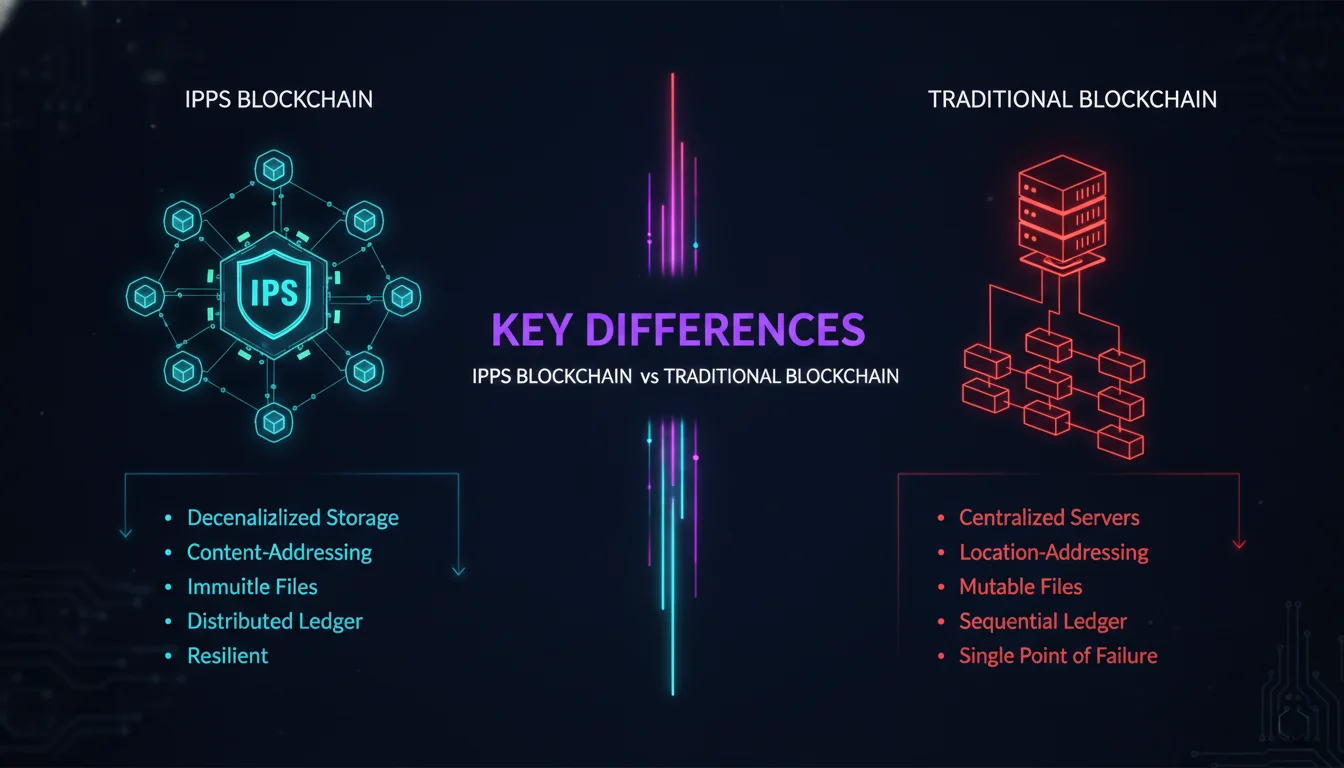
IPFS and blockchain are both decentralized technologies, but they serve fundamentally different purposes. A blockchain is a decentralized ledger that records transactions or data in a transparent, tamper-proof order using consensus mechanisms and cryptographic hashes. IPFS is a distributed file system designed for storing, accessing, and sharing files, websites, applications, and data across peer-to-peer nodes. According to Coinbase, IPFS focuses on creating a global network for storing and sharing files without a central authority, while blockchain serves primarily as a decentralized ledger for transactions and smart contracts.
This distinction is central to understanding the phrase ipfs blockchain: it is not a single chain called IPFS, but an integration pattern where blockchain records pointers or proofs and IPFS stores the bulk data. Blockchains are inefficient for storing large files because every full node must replicate the entire ledger. IPFS splits files into chunks, hashes each chunk, and distributes them across many nodes, reducing redundancy and improving retrieval speed.
Comparison Table: IPFS and Blockchain Side by Side
| Feature | IPFS | Blockchain |
|---|---|---|
| Primary function | Content-addressed file storage and retrieval | Decentralized, append-only transaction ledger |
| Data model | Files, chunks, and directories identified by CIDs | Blocks of transactions linked by cryptographic hashes |
| Consensus | Not required; data verified by content hash | Required (e.g., Proof of Work or Proof of Stake) |
| Immutability | Immutable content; new version = new CID | Immutable transaction history |
| Native token | None; Filecoin is a separate incentivized layer | Usually a native cryptocurrency |
| Typical use case | Store large files, websites, media, and datasets | Record transactions, run smart contracts, coordinate state |
Why the Terms Often Appear Together
The combination of ipfs blockchain technologies is common in Web3 applications because blockchains provide trust and ordering while IPFS provides scalable, redundant storage. A smart contract cannot efficiently store a large image, video, or document on-chain due to gas costs and block size limits. Developers store the file on IPFS, obtain a CID, and record that CID in the smart contract. The contract acts as an immutable pointer, while IPFS serves the content peer-to-peer. This pattern preserves the blockchain’s tamper resistance while keeping storage costs low.
Research published at the 2024 International Conference on Integration of Emerging Technologies for the Digital World (IEEE) found that integrating blockchain with IPFS significantly improves security and resilience over traditional systems. The paper states that IPFS ensures high availability and redundancy, while blockchain offers a tamper-proof record of transactions, matching centralized systems in data retrieval speed and throughput.
Pros and Cons of IPFS Blockchain Integration
Pros
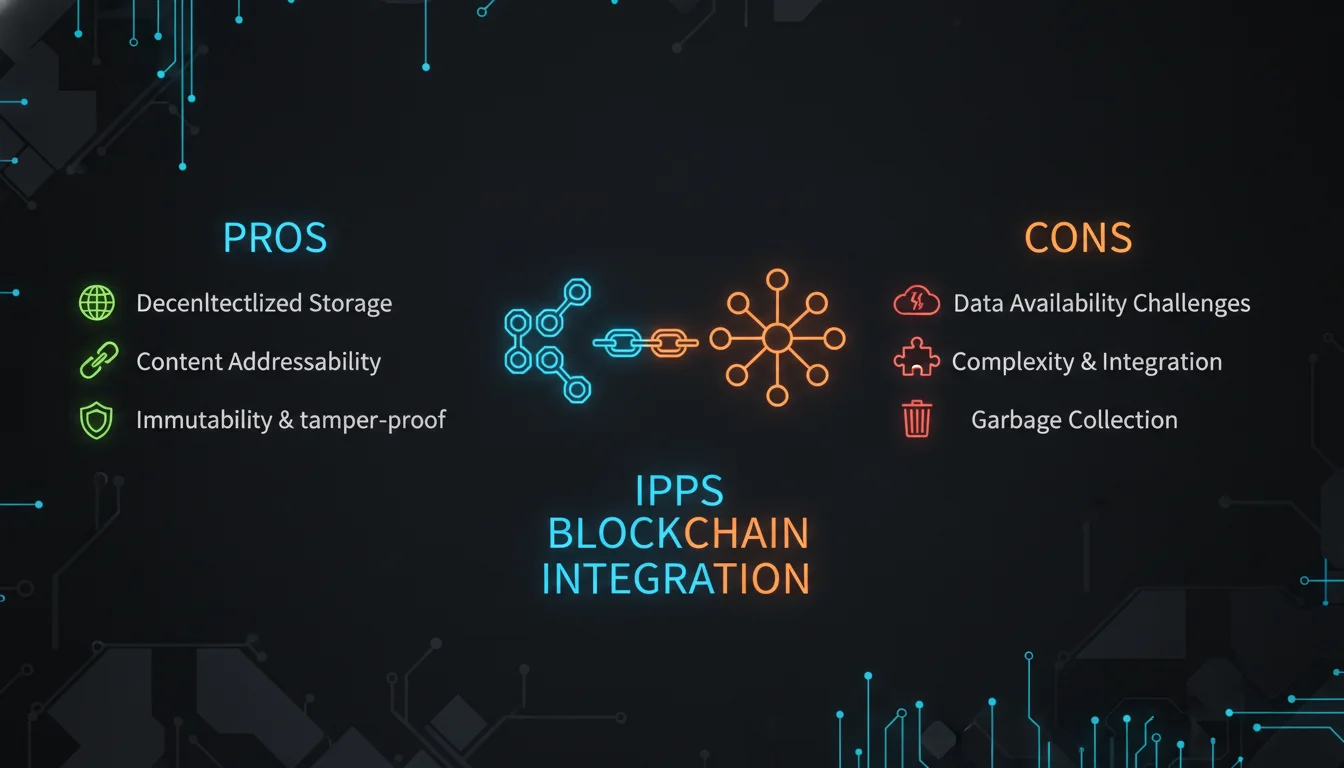
- Cost efficiency: Storing large files off-chain on IPFS and recording only a CID on-chain dramatically reduces gas costs and on-chain storage overhead.
- Tamper resistance: Any modification to a file changes its CID, making data manipulation immediately detectable by any party holding the original CID.
- Resilience and redundancy: Files distributed across many IPFS nodes remain available even if individual nodes go offline, eliminating single points of failure.
- Transport agnostic: The same CID can travel over HTTP, libp2p with Bitswap, iroh-blobs over QUIC, and RASL, giving developers flexibility in how they serve content.
- Verifiable governance: Projects like Snapshot Labs use the ipfs blockchain stack to create openly auditable governance records that anyone can independently verify.
- Enterprise flexibility: The same content-addressing model works on public, private, and hybrid networks, letting organizations choose trust boundaries that fit their use case.
Cons
- No built-in persistence guarantee: IPFS does not guarantee that data stays available. If no node pins a file, it can disappear from the network entirely.
- Complexity overhead: Developers must manage CID storage on-chain, pinning strategies off-chain, and optional Filecoin deals, adding architectural complexity compared to centralized storage.
- Gateway trust assumptions: Standard HTTP gateways require trusting the gateway operator unless trustless gateways with local CID verification are used.
- Retrieval latency variability: Performance depends on how many nodes are hosting a given CID. Rarely accessed content may have slow retrieval if few peers are serving it.
How IPFS Works: CIDs, DHT, and Data Distribution
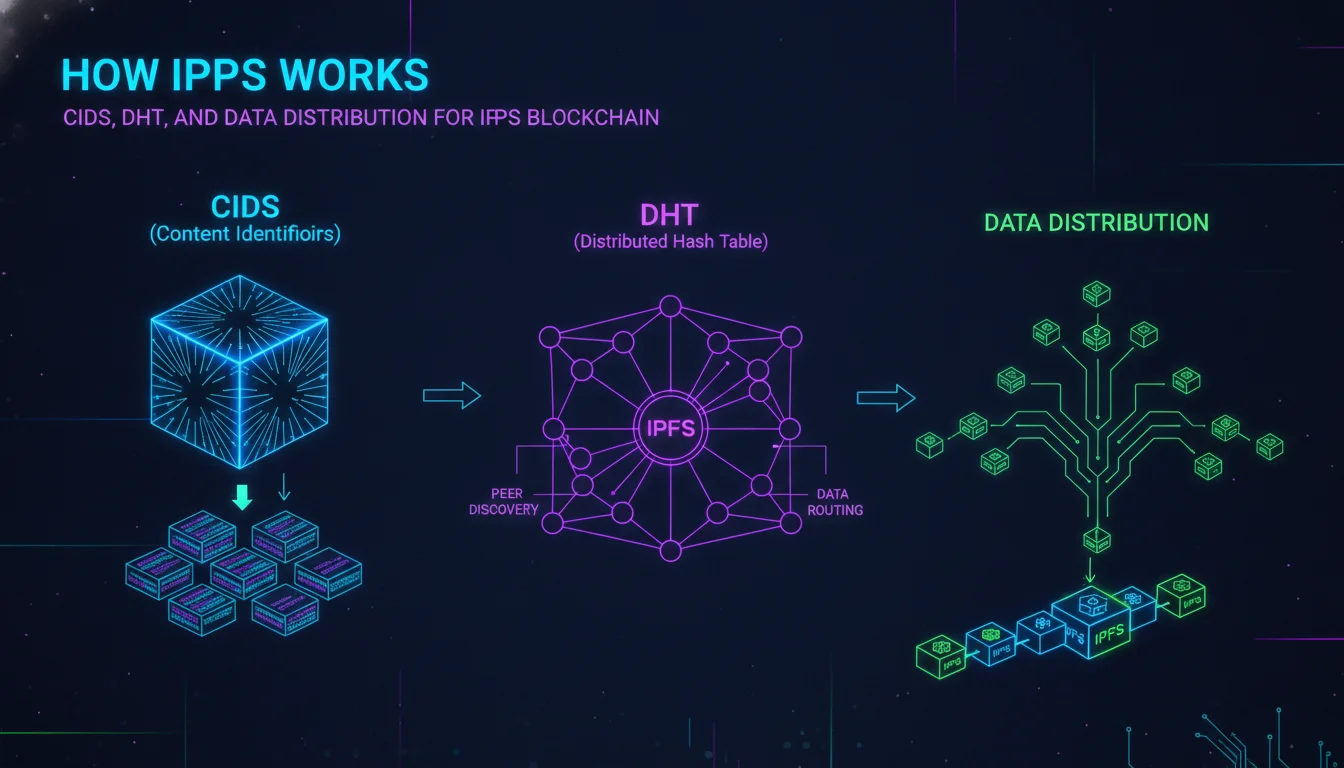
Content Identifiers (CIDs) Explained
A Content Identifier (CID) is the unique address assigned to every file added to IPFS. It contains two pieces of information: the hash of the file and an identifier for the hash algorithm used, combined into a single string. By default, IPFS uses SHA-256 and encodes the result with Base58, an encoding scheme that omits visually ambiguous characters such as zero and the capital letter O. A typical CID looks like QmXoypizjW3WknFiJnKLwHCnL72vedxjQkDDP1mXWo6uco. IPFS also supports other encodings such as Base32 and other hash algorithms including SHA-3 and BLAKE2.
Because the CID is derived from the content itself, two identical files always produce the same CID, and any change to a file produces a different CID. This is what makes IPFS content-addressed: you look up files by what they contain, not by where they are stored. The Cloudflare Web3 documentation explains that this property also applies to directories: the CID of a directory changes any time any file inside changes, or if files are added or removed.
Distributed Hash Table (DHT) and Peer Discovery
A Distributed Hash Table (DHT) is a lookup system that maps CIDs to the network addresses of computers hosting that content. No single computer holds the entire lookup table; each node stores a portion and knows where to find the rest. When someone adds a file to IPFS, the node announces that it has the content by adding an entry to the DHT that maps the file’s CID to its network address.
When another peer wants to download that file, it looks up the CID in the DHT, finds the address of one or more hosts, and downloads the data directly from them. Because multiple computers can host the same file, downloads are spread across all of them. If any one host goes offline, the others continue serving the content. This redundancy is what gives IPFS its speed and reliability advantages over single-server hosting.
Uploading and Retrieving Files in IPFS
Uploading content to IPFS does not mean sending a file to a central server. It means announcing to the network that you have the content by adding an entry to the DHT that maps the file’s CID to your network address. Once announced, other peers can discover and retrieve the file from you. IPFS can also handle directories: a folder uploaded with the command ipfs add -r ./example receives its own CID, and each file inside also receives its own CID. This makes it possible to address an entire static website with a single CID and access different pages by requesting different files in the directory.
The same CID can travel over multiple transport protocols, including HTTP, libp2p with Bitswap, iroh-blobs over QUIC, and RASL. Verification always happens at the endpoints: hosts come and go, routes change, but the bytes either arrive intact or the client knows they did not. This transport-agnostic design is a key reason the ipfs blockchain stack works across public, private, and hybrid network configurations.
IPFS Blockchain Integration: Storage for Smart Contracts and dApps
Why Blockchains Need Off-Chain Storage
Blockchains excel at recording and ordering transactions, but they are poorly suited for storing large files. Every full node in a blockchain network must replicate the full ledger, so adding a multi-megabyte image or video to a smart contract would be prohibitively expensive and slow. The ipfs blockchain pattern solves this by storing bulky data off-chain while the blockchain stores a compact CID that references the data. According to Coinbase, by integrating with Ethereum’s smart contracts, IPFS can provide secure and cost-effective storage capabilities within the crypto ecosystem, aiming to enhance Ethereum’s overall performance.
This pattern is widely used in decentralized applications (dApps), where a smart contract stores metadata, ownership records, or a CID, and the IPFS network serves the actual media or documents. This ensures that the file remains available even if the dApp’s frontend or a centralized server goes offline. For builders working on NFT platforms, DAO tooling, or decentralized publishing, the ipfs blockchain architecture is the standard approach.
Smart Contract Authentication and Authorization
Blockchain-based smart contracts can also manage access and authorization to IPFS-stored content. An IEEE paper presented at the 2024 International Conference on Integration of Emerging Technologies for the Digital World describes a decentralized file sharing system where access is managed through blockchain-based smart contracts, handling authentication and authorization. IPFS provides decentralized file storage by splitting files into chunks, hashing them, and distributing them across nodes, while blockchain logs transactions immutably.
That research found that the integrated system matches centralized systems in data retrieval speed and throughput, with added security and reliability. The authors’ key contribution was the implementation of a multi-formatting technique that increases the flexibility and efficiency of data storage and retrieval. This shows that the ipfs blockchain combination is not just theoretical; it can be implemented with measurable performance outcomes.
Here is a simplified Solidity snippet showing how a smart contract stores an IPFS CID on-chain:
// SPDX-License-Identifier: MIT
pragma solidity ^0.8.20;

contract IPFSRegistry {
 mapping(address => string) public userCID;

 event CIDStored(address indexed user, string cid);

 function storeCID(string calldata cid) external {
 userCID[msg.sender] = cid;
 emit CIDStored(msg.sender, cid);
 }

 function getCID(address user) external view returns (string memory) {
 return userCID[user];
 }
}
The contract stores nothing about the file itself. It stores only the CID string. The actual content lives on IPFS. Any client can retrieve the file by CID and verify the bytes match, without trusting the contract deployer or any gateway.
Enterprise and Permissioned Blockchain Use Cases
Enterprise platforms also combine IPFS with permissioned or private blockchains. Kaleido describes IPFS as a decentralized, peer-to-peer network for storing and sharing data in a more secure, efficient way. By integrating IPFS with Kaleido’s platform, enterprises can manage, store, and retrieve large volumes of data while maintaining blockchain-level security. The platform supports both private and public blockchains, offering scalable, cost-effective storage that reduces reliance on costly centralized servers.
Kaleido’s materials explain that data is split into pieces and stored across many nodes globally, with each piece having a unique identifier. This makes the system highly accessible: data can be retrieved from any node, ensuring high availability and redundancy. In a permissioned enterprise context, the same content-addressing model ensures that only authorized peers with the correct swarm key can route and transfer data within the closed network.
IPFS Gateways and Web Access
What Is an IPFS Gateway?
An IPFS gateway is a service that pulls content from the IPFS network and serves it over HTTP for browsers and tools that lack native IPFS support. Users may choose not to install an IPFS client and instead use a public gateway. According to Wikipedia, a list of these gateways is maintained on the IPFS GitHub page. Cloudflare started using IPFS in 2018 and launched its own IPFS gateway in 2022, making IPFS content accessible through standard web URLs.
Public, Private, and Hybrid IPFS Networks
The same content-addressing model runs on public, private, and hybrid IPFS deployments. In a public network, nodes discover peers via the Amino DHT and IPNI; any compliant node can join and find content with no coordination required. In a hybrid setup, public peers route content but the data itself is encrypted; CIDs route over the DHT while ciphertext stays opaque to every transit node. In a private network, all peers share a swarm key, and routing and transfer stay within the closed network.
This flexibility means organizations can choose the trust boundaries that fit their use case. A private IPFS network can be used inside a company to share large datasets without exposing them to the public internet, while a public deployment supports open, censorship-resistant publishing. The same CIDs work across these configurations because content addressing is independent of the routing mechanism.
Trustless Gateways and Browser Verification
Trustless gateways eliminate the need to trust the gateway operator. A trustless gateway pulls content from the IPFS network and serves it over HTTP, but the browser verifies the data against the CID locally. Trust is rooted in the CID, not in the gateway. This allows browsers to confirm that the bytes they receive exactly match the requested content, even if the gateway is compromised or malicious.
Cloudflare’s IPFS gateway documentation notes that IPFS gateways enable access to IPFS content for users who have not installed IPFS software. The gateway handles the translation between HTTP and the IPFS network, while the underlying content remains addressed by CIDs. In combination with DNSLink, a domain name can be mapped to an IPFS CID, making decentralized websites accessible through ordinary HTTPS URLs.
Real-World Applications of IPFS Blockchain
Open Social and Self-Verifying Records
AT Protocol, the protocol behind the Bluesky social network, uses CIDs so anyone on the network can verify what they receive without trusting the server that delivered it. Every post, repo, and event is identified by CID, creating self-verifying records for open social platforms. Seed Hypermedia builds collaborative documents where every version, comment, and link is addressed by CID, durable across servers, editors, and time.
Snapshot Labs uses IPFS to store data in a verifiable and fully transparent way, enabling openly auditable governance systems for decentralized organizations. These applications show that the ipfs blockchain stack is not just a storage backend. It is a foundation for verifiable data across social, collaborative, and governance contexts.
“It’s crucially important to have a distributed file system in our open hypertext system. IPFS is the missing piece that allows for a truly decentralized and open web.” – Gabo H Beaumont, Co-Founder, Seed Hypermedia
Anti-Censorship and Resilient Publishing
One of the most significant properties of the ipfs blockchain architecture is resistance to censorship. Because content is addressed by CID rather than by server location, no single authority can take down a file by blocking a URL or shutting down a server. As long as at least one node on the network holds the content, it remains retrievable by CID. This makes IPFS particularly useful for publishing content in jurisdictions with restrictive internet policies or for archiving records that must survive institutional pressure.
Artists and publishers rely on IPFS for resilient content storage. Nancy Baker Cahill, an artist, cited the importance of storing videos with their own IPFS URL and CID, so the work remains backed up and available for a long time. SimplePage uses IPFS as a content-addressed foundation for publishing websites that stay online without depending on any single server. These use cases highlight IPFS suitability for media, publishing, and archival applications.
Research Data and Scientific Collaboration
Research institutions use IPFS to improve data sharing and collaboration. A case study from the Max Planck Institute for Meteorology describes how scientists set up IPFS on notebooks and a Raspberry Pi when local data infrastructure was stuck in customs. All scientists could sync, share, and collaborate, with automatic uploads back to Hamburg whenever the connection returned. This demonstrates IPFS resilience in constrained network environments where centralized infrastructure simply fails.
Vehicular Networks and Secure Footage Storage
A 2023 study published in Electronics (MDPI) proposed a blockchain and IPFS-based data storage system for vehicular networks with keyword search capability. The paper addresses the security and data integrity concerns of CCTV and black box footage, which is usually saved to microSD cards, cloud storage, or local hard drives. By combining blockchain for access logs and IPFS for decentralized file storage, the system provides a tamper-resistant storage solution for road safety and accident management.
This application illustrates the broader potential of the ipfs blockchain stack in critical infrastructure. The blockchain records who accessed which footage and when, while IPFS replicates the encrypted video chunks across nodes, reducing the risk of data loss and unauthorized modification.
IPFS and Filecoin: Incentivized Storage
Filecoin as a Cooperative Storage Cloud
Filecoin is a cryptocurrency used to implement an IPFS-based cooperative storage cloud, also authored by Protocol Labs. While IPFS itself has no built-in incentive for nodes to store data long-term, Filecoin adds an economic layer: storage providers earn Filecoin tokens for storing and serving files, and clients pay for storage. This turns IPFS’s voluntary peer-to-peer network into a market-driven storage service with guarantees of replication and retrieval.
The relationship between IPFS and Filecoin is complementary. IPFS provides the content-addressed protocol and data model, while Filecoin provides the incentive and enforcement mechanisms for long-term data persistence. Developers can use IPFS for verifiable, portable data today, and add Filecoin when they need contractual guarantees of storage duration and replication.
Using IPFS with Ethereum and Other Blockchains
IPFS integrates with Ethereum and other blockchains as an off-chain storage layer. A smart contract can store a CID as a pointer to a file on IPFS, while the Filecoin network ensures that the file remains available over time. This reduces on-chain storage costs and enables dApps to handle large media, NFT assets, legal documents, and research datasets.
The combination of IPFS, Filecoin, and smart contracts is often described as the decentralized web stack: Ethereum or another blockchain for logic and state, IPFS for content-addressed storage, and Filecoin for persistence incentives. This stack supports applications ranging from NFT marketplaces to decentralized social networks and open science platforms. The ipfs blockchain model is central to this architecture, and as of 2026, it remains the dominant off-chain storage pattern for serious Web3 builders.
Security, Reliability, and Performance Considerations
Security Properties of Content Addressing
Content addressing provides several inherent security benefits. Because a CID is a cryptographic hash of the content, any modification to the data changes the CID. A client can therefore verify that the data it receives matches the requested CID, without trusting the node that served it. This is especially important when content passes through multiple intermediaries or untrusted gateways. The IPFS documentation emphasizes that verification always happens at the endpoints.
In a private or hybrid IPFS network, data can be encrypted before it is stored. CIDs route over the DHT while ciphertext stays opaque to every transit node. Even nodes participating in routing cannot read the underlying data. Only the intended recipients with decryption keys can access the content.
Reliability and Redundancy
IPFS improves reliability by distributing file chunks across multiple computers. Because multiple computers can host the same file, downloads are spread across all of them. If any one host goes offline, the others continue to serve the content. The IPFS official website reports over 400,000 public nodes, and the network is designed to tolerate node churn without losing access to content, provided at least one node still serves the data.
IPFS does not guarantee permanence by itself. Nodes can stop hosting data, and if no node retains a copy, the file becomes unavailable. Filecoin addresses this by creating economic incentives for storage providers to maintain copies over agreed periods. For critical data, organizations often pin files on multiple reliable nodes or use paid pinning services to ensure long-term availability.
Performance and Throughput
Research indicates that IPFS can match or approach the performance of centralized systems in retrieval speed and throughput when integrated with a blockchain for access management. The 2024 IEEE paper found that the integrated system matched centralized systems in data retrieval speed and throughput, while adding security and reliability. The multi-formatting technique proposed by the authors further improved flexibility and efficiency of data storage and retrieval.
Performance in the real world depends on factors such as network size, chunk size, node bandwidth, and routing efficiency. IPFS supports multiple transports, including HTTP, libp2p with Bitswap, iroh-blobs over QUIC, and RASL, allowing implementations to choose the method best suited for their latency and bandwidth requirements. For large files or directories, parallel downloads from multiple peers can improve throughput significantly.
How to Use IPFS: A Step-by-Step Guide
Step 1: Install an IPFS Client
Choose an IPFS implementation and install it on your computer or server. The reference implementation is written in Go (often called Kubo), but JavaScript, Python, and other language clients are available. The IPFS Desktop application provides a graphical interface, while command-line tools like Kubo are suitable for servers and automated workflows.
Step 2: Initialize and Start a Node
After installation, initialize your IPFS node with the command ipfs init. This creates a local repository and generates a peer identity. Then start the node with ipfs daemon. Once running, your node can connect to the public IPFS network, discover peers through the DHT, and begin serving content.
Step 3: Add Files and Get a CID
Add a file or directory to IPFS using the command ipfs add filename or ipfs add -r ./folder. The command returns a CID for the content. That CID is the permanent address you will use to retrieve the file. You can also use IPFS Desktop to drag and drop files and copy their CIDs.
Step 4: Retrieve Content
Retrieve a file by its CID using ipfs cat [CID] or by requesting it through a gateway URL such as https://cloudflare-ipfs.com/ipfs/[CID]. If the file is a directory, you can access individual files by appending the file path to the directory CID. The DHT resolves the CID to the network address of one or more hosts serving the content.
Step 5: Pin Content and Ensure Availability
To keep content available long-term, pin it on your node with ipfs pin add [CID]. Pinning prevents your node’s garbage collector from deleting the data. For important files, consider using a pinning service or Filecoin storage deals to guarantee replication across multiple providers.
- Install an IPFS client such as Kubo, IPFS Desktop, or the JavaScript implementation.
- Initialize your node with
ipfs initand start it withipfs daemon. - Add a file with
ipfs add filenameto obtain its CID. - Retrieve the file using
ipfs cat [CID]or an HTTP gateway URL. - Pin the CID with
ipfs pin add [CID]or arrange Filecoin storage for persistence.
The ipfs blockchain stack is a practical response to the limitations of centralized storage and monolithic blockchain designs. By combining content-addressed file sharing with immutable ledgers, developers gain verifiable, resilient, and cost-efficient infrastructure for dApps, enterprises, and open networks. IPFS alone does not replace a blockchain, and a blockchain alone cannot efficiently store large files. Together, they form a foundation for the next generation of decentralized applications.
If you’re building on this stack, or designing tokenomics and protocol architecture for a Web3 project, apply to the Genesis Cohort at Digital Blockchains. We work with serious builders who want infrastructure that lasts.
Frequently Asked Questions
Is IPFS a blockchain?
No. IPFS is a peer-to-peer content-addressed file system, while a blockchain is a decentralized immutable ledger. They are often used together in the ipfs blockchain pattern, but they serve fundamentally different functions.
What is an IPFS CID?
A CID (Content Identifier) is a self-describing cryptographic hash that uniquely identifies a file or directory in IPFS. It includes the hash algorithm identifier and the hash value, so content can be verified independently by any party.
How does IPFS blockchain integration work?
IPFS blockchain integration stores large files off-chain on IPFS and records the file’s CID or metadata hash on a blockchain. This keeps blockchain storage efficient while ensuring data integrity through the on-chain pointer, and it is the standard architecture for NFT metadata, DAO governance records, and decentralized publishing.
Can I access IPFS content without installing software?
Yes. IPFS gateways, such as public gateways or Cloudflare’s IPFS gateway, allow browsers and tools without native IPFS support to access content over HTTP using CIDs. Trustless gateways go further by letting the browser verify content against the CID locally.
What is the difference between IPFS and Filecoin?
IPFS is a protocol and network for content-addressed file sharing with no built-in storage incentives. Filecoin is a cryptocurrency and incentive layer, also from Protocol Labs, that rewards storage providers for persisting IPFS content over agreed time periods.
Does IPFS guarantee permanent storage?
No. IPFS provides redundancy and availability if at least one node still hosts the content, but it does not guarantee permanence. Pinning services and Filecoin storage deals provide long-term persistence guarantees for critical data.