Blockchain architecture is the structural design of a distributed ledger system that defines how data is created, validated, stored, and shared across a decentralized network without central control.
Key Takeaways
- Blockchain architecture defines how a decentralized network validates, stores, and shares data without a central authority.
- Core components include nodes, blocks, Merkle trees, transactions, smart contracts, and consensus mechanisms.
- The five-layer functional model separates hardware, data, network, consensus, and application concerns.
- Layer 0 through Layer 3 topologies address scalability, interoperability, and application-specific needs.
- Public, private, hybrid, and consortium architectures suit different governance and privacy requirements.
- Blockchain architects earn a total median pay of $189,000, according to Glassdoor.
According to Codebridge, the digital assets market, which includes cryptocurrencies, NFTs, and DeFi, will generate about €91.3 billion in revenue worldwide, and global spending on blockchain solutions is projected to reach $19 billion. The global blockchain technology market was estimated at USD 31.28 billion in 2024 and is projected to reach USD 1,431.54 billion by 2030, growing at a CAGR of 90.1%. These figures make robust blockchain architecture a critical engineering discipline.
This guide breaks down the components, layers, topologies, consensus trade-offs, and career pathways that define blockchain architecture in 2026. Each section draws on leading developer resources and peer-reviewed research to give you a complete technical picture.
What Is Blockchain Architecture?
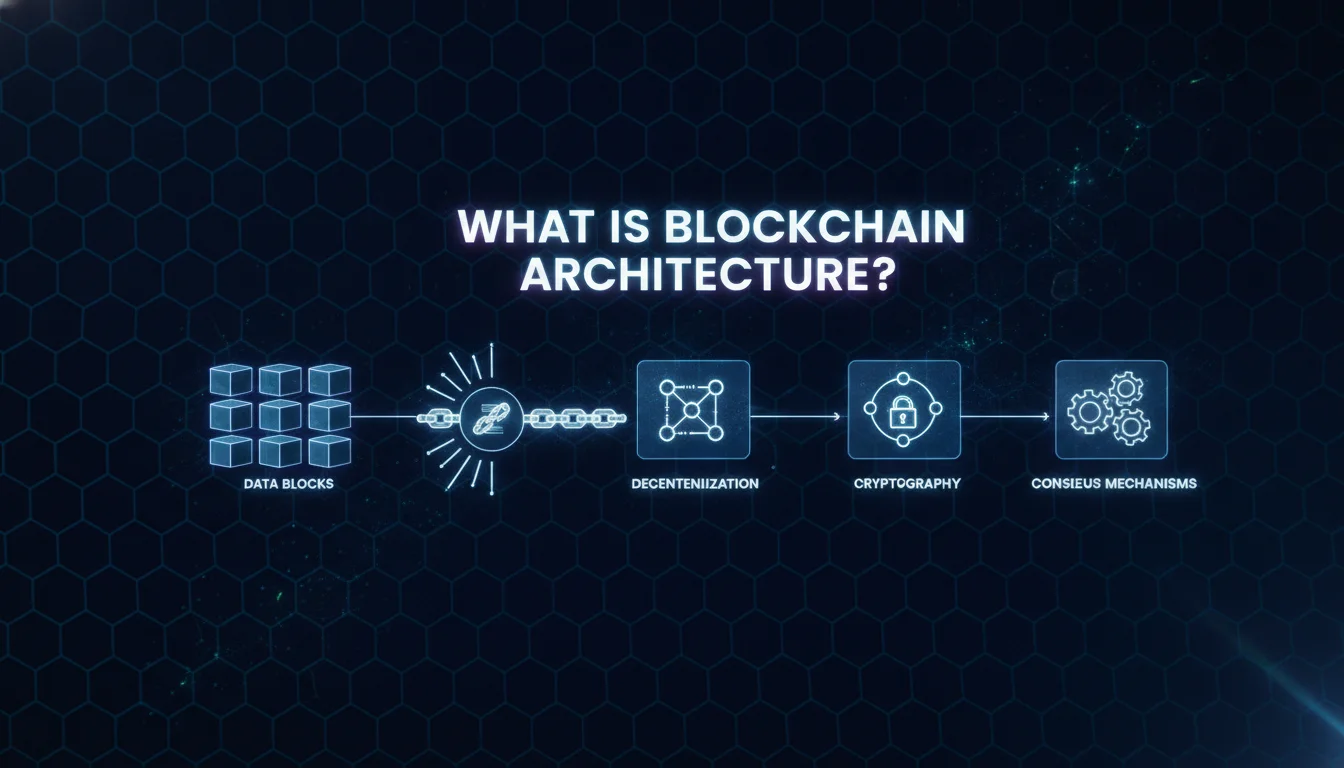
Blockchain architecture is the blueprint that specifies how a distributed ledger system operates. It determines how transactions are grouped into blocks, how nodes reach agreement, and how data remains tamper-evident. A well-designed architecture balances decentralization, security, and performance for a specific use case.
Definition and Core Purpose
According to IntechOpen, blockchain comprises validated transaction blocks, and its decentralized structure, free from a single point of failure, enhances safety. This architectural principle underpins cryptocurrencies, supply chain tracking, and enterprise data sharing alike.
The distributed ledger sits at the center of everything. Every node holds a copy of the chain. Every change requires consensus. No single administrator can rewrite history unilaterally, which is the property that makes blockchain architecture fundamentally different from any database you have used before.
How It Differs from Traditional Databases
A traditional database uses a central server or cluster controlled by one organization. Blockchain architecture distributes the ledger across many independent nodes, each holding a full or partial copy. Changes require consensus, not a single administrator. This trade-off sacrifices some write speed but delivers censorship resistance and auditability.
Data in a traditional database can be updated or deleted. In a blockchain, records are append-only. Once a block is confirmed, altering it would require recalculating every subsequent block’s hash and controlling a majority of network consensus – an economically infeasible task for mature networks.
Why Architecture Determines Performance
The choice of consensus mechanism, block size, and network topology directly affects transactions per second (TPS), latency, and cost. A public proof-of-work chain like Bitcoin processes only 4 to 7 TPS, while a centralized payment network like Visa handles more than 65,000 TPS, according to Cyfrin. Architects must optimize for the intended workload rather than assuming one design fits all.
Core Components of a Blockchain System

Every blockchain architecture is built from the same fundamental primitives, regardless of whether you are looking at Bitcoin, Ethereum, or a private enterprise chain. Understanding these building blocks is the prerequisite for every design decision that follows.
Blocks, Chains, and Cryptographic Links
A block is a data structure that bundles validated transactions. Each block contains a header with the previous block hash, a Merkle root, a timestamp, and a nonce for proof-of-work. The previous block hash creates a cryptographic chain. The Merkle tree enables efficient verification of transaction integrity without downloading the entire ledger.
The append-only sequence of blocks forms an immutable ledger. Any attempt to alter a historical transaction changes its hash and breaks the chain, alerting all full nodes to tampering. This property is fundamental to blockchain architecture and is what makes it useful for auditability-sensitive applications.
Transactions and Smart Contracts
Transactions represent state transitions. According to Pluralsight’s blockchain architecture guide, a Bitcoin transaction generally consists of a sender address, a recipient address, and a value, and it references previous unspent transaction outputs (UTXOs). Smart contracts are self-executing code deployed on-chain to automate workflows and enforce rules without intermediaries.
Ethereum developers write smart contracts in Solidity. Here is a minimal storage contract that illustrates the pattern:
// SPDX-License-Identifier: MIT
pragma solidity ^0.8.0;

contract SimpleBlockchainStorage {
 string public storedData;
 address public owner;

 event DataUpdated(string newData, address updatedBy);

 constructor(string memory _initialData) {
 storedData = _initialData;
 owner = msg.sender;
 }

 modifier onlyOwner() {
 require(msg.sender == owner, "Not authorized");
 _;
 }

 function updateData(string memory _newData) public onlyOwner {
 storedData = _newData;
 emit DataUpdated(_newData, msg.sender);
 }

 function getData() public view returns (string memory) {
 return storedData;
 }
}
Aptos and Sui support Move instead of Solidity. The language differs, but the architectural guarantee is the same: deterministic execution so every node reaches an identical result. These contracts define logic for token transfers, lending, governance, and more.
Nodes, Miners, and Validators
Nodes are the distributed computing infrastructure that maintains the ledger. Full nodes store the entire blockchain, validate transactions, and enforce consensus rules. Light clients rely on full nodes for verification, reducing storage and bandwidth. Validators in proof-of-stake systems propose and attest new blocks, earning rewards for honest behavior and facing penalties for malicious actions.
Miners in proof-of-work systems compete to solve cryptographic puzzles. Both miners and validators serve the same architectural purpose: producing new blocks and securing the network against double-spending and tampering.
The Five-Layer Functional Model
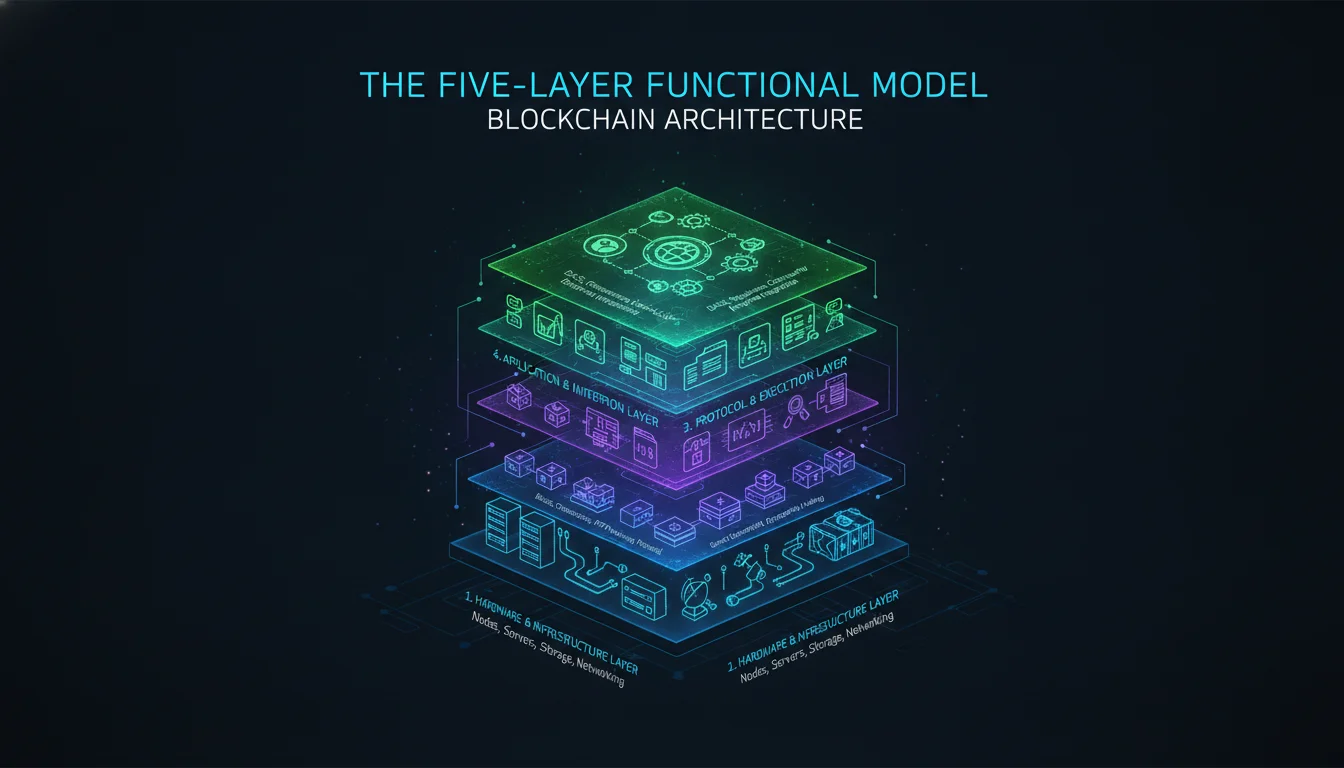
The five-layer functional model organizes blockchain architecture into distinct concerns so that changes in one layer do not cascade unpredictably into others. Think of it as separation of concerns applied to distributed systems design.
Hardware, Data, and Network Layers
The hardware layer includes the physical infrastructure: servers, nodes, and storage devices that host the network. The data layer defines the structure of blocks, transactions, and cryptographic hashes. The network layer manages peer-to-peer communication, transaction propagation, and block synchronization across nodes.
These three layers work together to ensure that every node receives the same data in the same order. The architecture must handle bandwidth constraints, latency, and node churn without compromising consistency.
Consensus Layer
The consensus layer is the heart of blockchain architecture. It is a fault-tolerant mechanism that allows distributed nodes to agree on the state of the ledger. Common algorithms include proof of work, proof of stake, delegated proof of stake, and practical Byzantine fault tolerance (PBFT).
This layer determines security guarantees, energy consumption, and finality time. A blockchain architect must choose a consensus model that aligns with the network’s trust assumptions: permissionless, permissioned, or hybrid.
Application Layer
The application layer hosts decentralized applications (DApps), smart contracts, and user-facing interfaces. It sits on top of the consensus and data layers, interacting with them through APIs and SDKs. This layer defines the business logic and user experience, from DeFi protocols to NFT marketplaces.
Separation of concerns across these layers allows developers to upgrade application logic without altering the underlying ledger. It also enables interoperability through standardized interfaces such as Ethereum’s JSON-RPC or Substrate’s runtime modules.
Developer Tooling and Frameworks
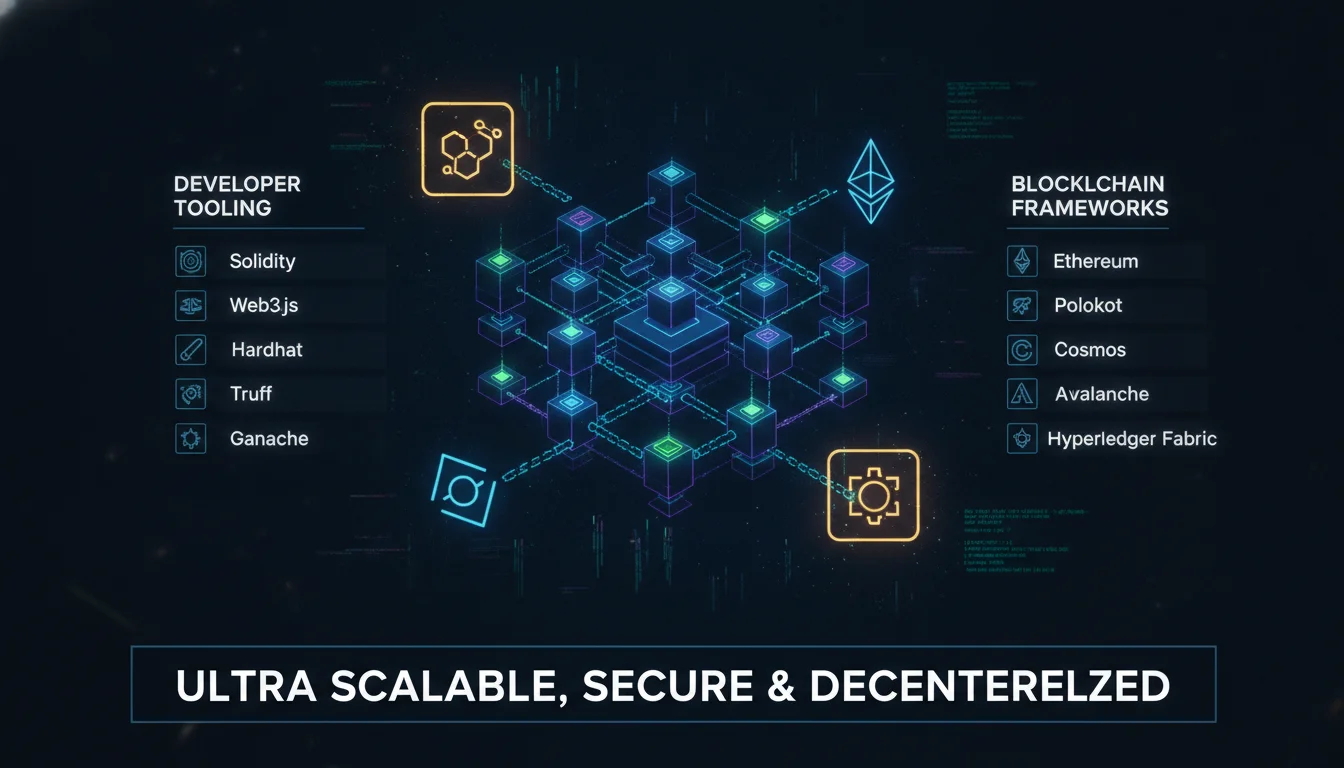
Choosing the right development framework shapes how quickly a team can iterate on blockchain architecture decisions. The tooling ecosystem has matured considerably, and the choice often comes down to testing philosophy and deployment target.
Ethereum Development Frameworks
Hardhat is the most widely adopted Ethereum development environment as of 2026. It offers a local network, console logging inside Solidity, and a rich plugin ecosystem. Foundry has gained significant traction among security-focused teams because it allows tests to be written in Solidity itself rather than JavaScript, which reduces context switching and catches more edge cases. Truffle, the original framework, remains in use for legacy projects but sees less new adoption.
For teams building on Substrate (the framework behind Polkadot parachains), the tooling is Rust-native. A minimal Substrate pallet looks like this:
#[pallet::call]
impl<T: Config> Pallet<T> {
 #[pallet::weight(10_000)]
 pub fn store_value(
 origin: OriginFor<T>,
 value: u32,
 ) -> DispatchResult {
 let who = ensure_signed(origin)?;
 <StoredValue<T>>::put(value);
 Self::deposit_event(Event::ValueStored(value, who));
 Ok(())
 }
}
Cosmos SDK uses Go and a module-based architecture. Each module encapsulates state, messages, and handlers, making it straightforward to compose application-specific chains without rebuilding consensus from scratch.
Blockchain Layer Topology: L0, L1, L2, L3
Blockchain layer topology describes how different networks stack on top of each other to solve distinct parts of the scalability problem. Each layer inherits security from the one below while adding its own capabilities above.
Layer 0 and Layer 1 Foundations
Layer 0 refers to the underlying infrastructure that multiple blockchains can share: networking protocols, cross-chain communication, and node software. Polkadot’s relay chain and Cosmos’s Inter-Blockchain Communication (IBC) protocol are the clearest examples. Layer 1 blockchains are the base networks that provide security, consensus, and data availability, such as Bitcoin and Ethereum.
The distinction matters because Layer 1 changes are expensive and risky. Upgrading consensus or block structure requires network-wide coordination, which is why many teams prefer to build on Layer 2 instead. Bitcoin implemented the first large-scale blockchain at Layer 1, according to Pluralsight’s blockchain architecture documentation.
Layer 2 Scaling Solutions
Layer 2 protocols are built on top of Layer 1 to enhance performance without changing the base layer’s security model. zkSync (zero-knowledge rollup) and the Lightning Network (payment channel) are two well-documented examples. These architectures batch transactions off-chain or compress them before settling on Layer 1, increasing TPS and reducing fees.
The scalability trilemma, coined by Vitalik Buterin, states that a blockchain can achieve at most two of three properties simultaneously: decentralization, security, and scalability. Layer 2 solutions let Layer 1 focus on decentralization and security while Layer 2 handles scale.
“Vitalik Buterin first coined this term to describe the three properties that a high-performing blockchain must have: decentralization, security, and scalability. The thesis of this trilemma is that a blockchain can only achieve two of these three goals simultaneously.” – Cyfrin, Blockchain Architecture Layers Guide
Layer 3 Application-Specific Chains
Layer 3 networks are application-specific chains or protocols built on Layer 2 or Layer 1. They optimize for a particular use case, such as gaming, social media, or enterprise settlement. By abstracting infrastructure complexities, Layer 3 enables developers to deploy custom consensus rules, fee models, and privacy features without rebuilding the security stack.
This layered topology allows blockchain architecture to scale horizontally. Each layer solves a distinct problem while inheriting security guarantees from the layers below.
Cross-Chain and Interoperable Frameworks
Cross-chain interoperability is no longer optional in 2026. Applications that cannot communicate across chains are isolated islands in an increasingly connected ecosystem.
Polkadot and the Relay Chain Model
Polkadot’s relay chain provides shared security to connected parachains. Each parachain runs its own application logic and consensus, but relies on the relay chain for finality. This model lets teams build specialized chains without bootstrapping their own validator set from zero. The trade-off is that parachain slot capacity is finite, which creates competition for relay chain resources.
Cosmos and IBC
Cosmos takes a different approach. Chains in the Cosmos ecosystem are sovereign and connect through the Inter-Blockchain Communication protocol. IBC defines a standard for passing packets of data between chains that have compatible light clients. Any chain built with Cosmos SDK can, in principle, communicate with any other IBC-enabled chain. This gives teams full sovereignty over their consensus and governance while still participating in a broader network of chains.
Both models represent mature answers to the cross-chain problem, and the choice between them depends on whether a team prioritizes shared security (Polkadot) or chain sovereignty (Cosmos).
Types of Blockchain Architectures
The right blockchain architecture type depends on who needs access, how much trust exists between participants, and what regulatory constraints apply. There is no universal answer.
Public Blockchains
Public blockchains are open, permissionless networks where anyone can join as a node, validator, or user. Bitcoin, Ethereum, and Solana are prominent examples. They offer maximum decentralization and censorship resistance but often trade off speed and privacy. Consensus mechanisms must be economically secure to deter Sybil attacks.
Private Blockchains
Private blockchains restrict participation to approved entities. A single organization or consortium controls who can read, write, and validate transactions. These architectures suit enterprise use cases that require data privacy, regulatory compliance, and high throughput. Because trust is partially centralized, consensus can be lighter, such as PBFT or Raft variants.
Hybrid and Consortium Blockchains
Hybrid architectures combine public and private elements. Some data is visible to everyone, while sensitive records remain private. Consortium blockchains are governed by a group of organizations, such as Hyperledger Fabric networks. These models balance transparency with confidentiality and are popular in supply chain, finance, and healthcare.
| Architecture Type | Access Control | Consensus Efficiency | Typical Use Cases |
|---|---|---|---|
| Public | Permissionless, anyone can join | Lower throughput, higher energy cost | Cryptocurrencies, DeFi, NFTs |
| Private | Permissioned, approved nodes only | High throughput, lower cost | Enterprise data sharing, internal ledgers |
| Hybrid/Consortium | Selective access, group governance | Moderate to high throughput | Supply chain, banking consortia, healthcare |
Pros and Cons of Blockchain Architecture
Pros
- Immutability: Once data is written and confirmed, altering it requires recalculating every subsequent block’s hash and controlling a majority of consensus, which is economically prohibitive on mature networks.
- Censorship resistance: No single administrator can block or reverse transactions on a permissionless network.
- Auditability: The UTXO model and append-only ledger make every transaction traceable from origin to present state.
- Trustless execution: Smart contracts enforce rules automatically without relying on a counterparty to honor an agreement.
- Modular scalability: The layered topology (L0 through L3) lets teams add throughput at Layer 2 without touching the security guarantees of Layer 1.
Cons
- Throughput limits at base layer: Public Layer 1 chains like Bitcoin process only 4 to 7 TPS, far below what high-volume applications require without additional layers.
- Complexity and cost: Designing, auditing, and maintaining a production blockchain system requires specialized skills across cryptography, distributed systems, and tokenomics.
- Finality latency: Proof-of-work chains can take minutes to reach probabilistic finality, which is unsuitable for latency-sensitive applications.
- Upgrade difficulty: Changing consensus rules or block structure on a live Layer 1 requires network-wide coordination and carries significant risk.
- Privacy trade-offs: Public chains are transparent by default. Adding privacy requires additional cryptographic layers such as zero-knowledge proofs, which add complexity and cost.
Consensus Mechanisms and the Scalability Trilemma
Consensus mechanisms are where blockchain architecture trade-offs become most visible. The algorithm you choose determines your security model, energy footprint, and the practical throughput ceiling of the entire network.
Proof of Work and Proof of Stake
Proof of work (PoW) requires miners to solve cryptographic puzzles, consuming significant energy but providing strong security through economic cost. Bitcoin’s PoW architecture achieves only 4 to 7 TPS. Proof of stake (PoS) replaces miners with validators who lock collateral, reducing energy use and enabling higher throughput. Ethereum transitioned to PoS in 2022.
Other consensus algorithms include delegated proof of stake (DPoS), practical Byzantine fault tolerance (PBFT), and proof of authority (PoA). Each offers different trade-offs among finality, decentralization, and performance. The consensus layer is where blockchain architecture most visibly affects real-world usability.
The Scalability Trilemma Explained
According to Cyfrin, making a blockchain highly scalable and secure might require some degree of centralization. If a network is highly decentralized and secure, it may struggle with scalability because every node must validate every transaction. Layer 2 and sharding are the primary architectural responses to this constraint.
Real-World TPS Comparisons
Visa handles more than 65,000 TPS in traditional payment rails. Bitcoin processes 4 to 7 TPS. These numbers highlight why pure Layer 1 scaling is difficult. Modern blockchain architecture uses rollups, sidechains, and state channels to push TPS higher while preserving security. zkSync and the Lightning Network offload transactions from the base chain and settle only final proofs or channel states on Layer 1.
The Role of a Blockchain Architect in 2026
A blockchain architect designs high-level structure, governance, and technical decisions for blockchain-based products. This is not a sub-specialization of general software architecture. The decisions involved touch security, regulation, and financial risk in ways that standard software roles rarely encounter.
Core Responsibilities
According to Fireblocks, a blockchain architect is responsible for high-level design, strategic planning, and tech decisions for blockchain-based products, including decisions involving security, regulation, and financial considerations that go beyond standard software architecture concerns. The architect defines the network topology, consensus mechanism, data model, and integration points.
Typical systems include digital asset platforms, custody solutions, crypto trading infrastructure, and Web3 loyalty programs. The architect must align technical choices with business goals, regulatory requirements, and risk tolerance.
“The blockchain architect is not just a sub-type of the software architect. The blockchain system architecture requires the blockchain architect to make decisions involving security, regulation, and financial considerations, in addition to standard software architecture concerns that do not exist in other domains in the same way.” – Arik Galansky, VP Technology, Fireblocks
Skills and Certifications
A blockchain architect needs deep knowledge of cryptography, distributed systems, smart contract development, and tokenomics. Familiarity with Solidity, Rust, Go, and Substrate is common. Certifications such as Certified Blockchain Solutions Architect (CBSA) or Certified Information Systems Security Professional (CISSP) demonstrate expertise. According to Coursera, earning a certification is an effective way to develop and demonstrate skills in areas such as cryptography and smart contracts.
Salary and Career Outlook
Blockchain architect salary data reveals a total median pay of $189,000, according to Glassdoor. Demand is rising as financial institutions, logistics firms, and governments adopt distributed ledger technology. The architect role sits at the intersection of software engineering, security, and product strategy, making it one of the highest-paying technical positions in Web3.
How to Build a Blockchain Architecture Step by Step
Building a production blockchain system is a structured engineering process. Skipping steps creates security gaps that are expensive to fix after deployment.
Step 1: Define Requirements and Governance
Start by identifying the use case, participants, trust model, and regulatory constraints. Decide whether the network should be public, private, or hybrid. Document data privacy requirements, throughput targets, and acceptable latency. This step determines the entire architectural direction, so it deserves more time than most teams give it.
Step 2: Select Consensus and Network Model
Choose a consensus mechanism that matches the trust assumptions. Permissionless networks need economically secure proof of stake or proof of work. Permissioned networks can use PBFT, Raft, or practical variants. Define the node topology: how many validators, what geographic distribution, and what hardware requirements. The consensus layer will dictate finality time and energy costs.
Steps 3 through 5: Design, Test, and Deploy
- Design the data model and smart contracts. Define block structure, Merkle trees, transaction formats, and contract logic. Use formal verification for high-value contracts. Audit with tools like Slither or Mythril before any testnet deployment.
- Implement and test on a testnet. Simulate network conditions, load test TPS, and run adversarial scenarios. A bug found on testnet costs nothing. The same bug on mainnet can be catastrophic.
- Deploy and monitor. Launch the mainnet, configure monitoring, and establish upgrade paths. For Layer 2 or app-chains, integrate with existing Layer 1 bridges and indexers. Plan for governance from day one, not as an afterthought.
Following these steps gives you a systematic approach to blockchain architecture that reduces the risk of consensus failures and security breaches.
The Future of Blockchain Architecture
Blockchain architecture has matured from a single monolithic chain design to a modular stack of layers, rollups, and app-specific networks. The trajectory is clear: more specialization, more interoperability, and more privacy tooling baked into the base design.
Interoperability and Cross-Chain Trends
Cross-chain protocols and bridges are becoming core to blockchain architecture. Layer 0 networks like Cosmos and Polkadot enable independent chains to share security and transfer assets. As of 2026, interoperability is no longer a niche feature. It is a baseline requirement for enterprise and DeFi applications that need to reach users across multiple ecosystems.
Privacy, Regulation, and Enterprise Adoption
Privacy-preserving technologies such as zero-knowledge proofs and confidential transactions are reshaping how architects approach data visibility. Regulatory pressure is pushing architects to design systems with selective disclosure and auditability baked in from the start. Enterprise adoption of consortium blockchains continues to grow, driven by supply chain transparency and financial settlement use cases.
Final Outlook for 2026
The scalability trilemma still shapes trade-offs, but innovations like zero-knowledge rollups and shared security models are pushing the boundaries of what is achievable at each layer. For developers and architects, mastering these patterns is essential to building the next generation of decentralized systems. If you are serious about building in this space, the time to go deep on blockchain architecture is now.
Ready to build? Apply to the Genesis Cohort at Digital Blockchains and work alongside a team that reads whitepapers for breakfast and ships production systems before lunch.
Frequently Asked Questions
What are the four types of blockchain technology?
The four main types are public, private, hybrid, and consortium blockchains. Public blockchains are permissionless and open to anyone, private blockchains restrict access to approved participants, hybrid architectures combine both approaches, and consortium blockchains are governed collectively by a group of organizations.
What are the seven layers of a blockchain?
The five functional layers are hardware, data, network, consensus, and application. When you add the topology layers, Layer 0 (cross-chain infrastructure) and Layer 1 (base chain) bring the total to seven distinct layers. Together they separate infrastructure, data propagation, agreement, and user-facing applications into manageable concerns.
How do you build a blockchain?
Building a blockchain requires defining governance and trust assumptions, selecting a consensus mechanism, designing block and transaction structures, writing and auditing smart contracts, testing on a testnet, and deploying with monitoring in place. Many teams use frameworks like Substrate or Cosmos SDK to accelerate development rather than building consensus from scratch.
What are the 6 main characteristics of blockchain?
The six main characteristics are decentralization, persistency, anonymity, auditability, transparency, and cryptography. These properties ensure data integrity, censorship resistance, and verifiable transactions across the network, as documented in blockchain structure research from GeeksforGeeks and peer-reviewed sources.
What does a blockchain architect do?
A blockchain architect designs the high-level structure, governance, and technical decisions for blockchain-based products. According to Fireblocks, the role involves decisions around security, regulation, and financial considerations that go beyond standard software architecture, including selecting consensus models, defining data models, and integrating with existing systems.
How much does a blockchain architect earn?
According to Glassdoor data cited by Coursera, the total median pay for a blockchain architect is $189,000 per year. Salaries vary based on experience, location, and industry, with senior roles at financial institutions and infrastructure companies typically earning more.