Blockchain beyond cryptocurrency is a distributed, immutable ledger technology that secures supply chains, patient records, financial settlements, and voting systems without relying on central intermediaries.
Key Takeaways
- beyond cryptocurrency is a shared, distributed ledger with decentralized control, not limited to digital currencies.
- Core properties: encryption, provenance, immutability, and decentralization enable trust across industries without a central authority.
- Real-world deployments include supply chain traceability, healthcare data management, cross-border payments, and voting integrity.
- According to TCI Technologies, 81% of the world’s largest companies recognize blockchain uses beyond Bitcoin alone.
- Market projections differ by source but all point to rapid expansion: TCI Technologies cites growth from $20 billion in 2024 to over $248 billion by 2029; Mad Devs projects $27.85 billion in 2024 rising to $746.41 billion by 2032.
- Challenges remain around interoperability, energy consumption, and regulatory frameworks.
What Is Blockchain Beyond Cryptocurrency?
Defining Distributed Ledger Technology
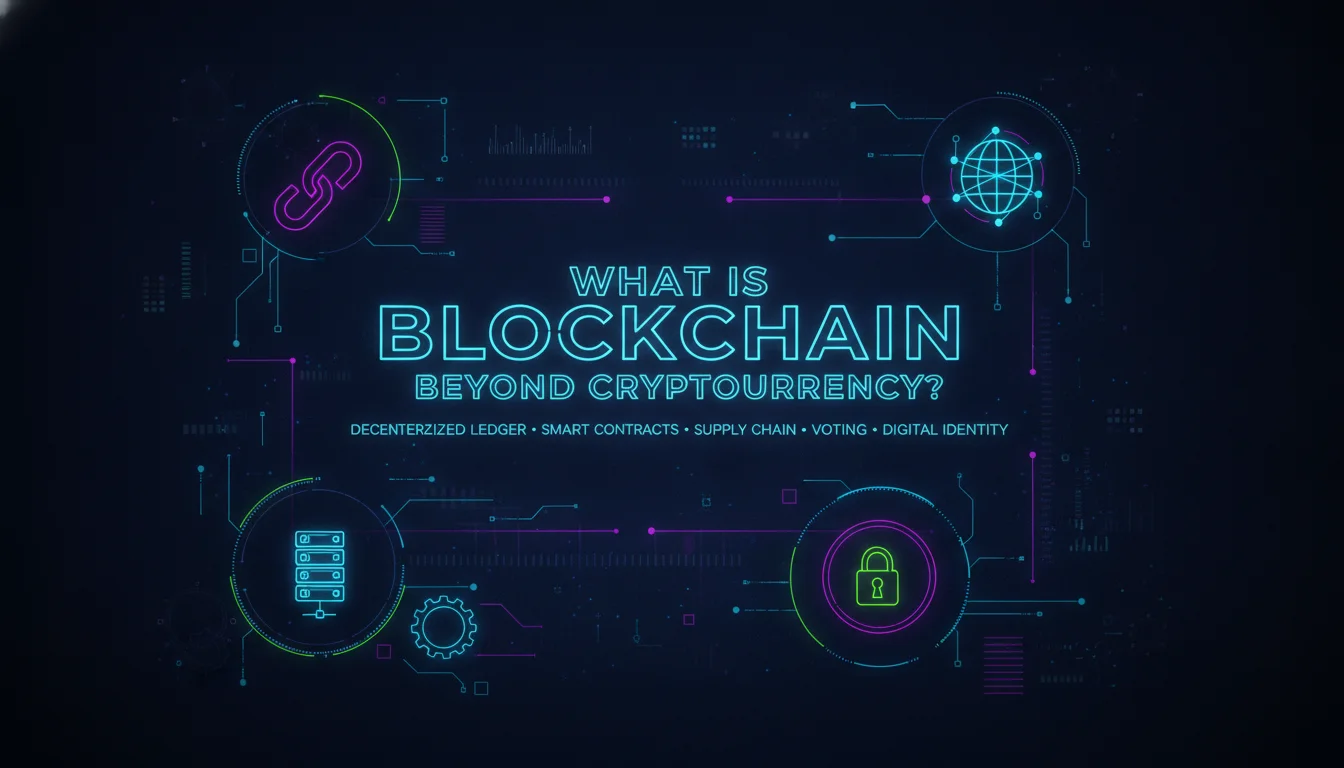
this type of cryptocurrency is the application of distributed ledger technology to non-monetary domains, using the same cryptographic architecture that powers Bitcoin to solve trust problems in logistics, healthcare, and governance. As IBM defines it, blockchain is a shared, distributed ledger with decentralized control where each block contains encrypted data and a reference to the previous block, forming an immutable chain. Understanding this distinction is the first step for any organization evaluating adoption.
According to GeeksforGeeks, blockchain is a distributed, peer-to-peer database that documents operations simultaneously on multiple nodes. That decentralized architecture removes the need for a central authority, reducing susceptibility to censorship, fraud, and single-point failures.
How Blockchain Differs from Bitcoin and Other Cryptocurrencies
IBM puts it cleanly: cryptocurrencies are to blockchain what the combustion engine is to automobiles. One application, not the whole technology. Bitcoin launched as the first large-scale implementation, but the conceptual foundation predates it. Stuart Haber and Scott Stornetta introduced cryptographic timestamping in 1991, according to a Barclays analysis published in October 2025.
Most cryptocurrency deployments use public blockchains where anyone can participate. Corporate deployments typically use private ledgers with restricted access. American Express, for example, joined Ripple’s global payment network and launched a blockchain for membership rewards in 2017 and 2018, demonstrating financial services adoption that has nothing to do with currency speculation.
Core Properties That Enable Enterprise Adoption
- Encryption makes data unreadable without a key, protecting sensitive transaction details.
- Provenance provides a data trail that ensures validity and integrity of the data history.
- Immutability means data cannot change once a block is validated, preventing tampering after the fact.
- Decentralization distributes copies across nodes, removing single points of failure.
- Smart contracts are digital, self-managed contracts that execute logic automatically when conditions are met, as described by GeeksforGeeks.
The Evolution of Blockchain Beyond Digital Currency
From 1991 Timestamping to 2009 Bitcoin
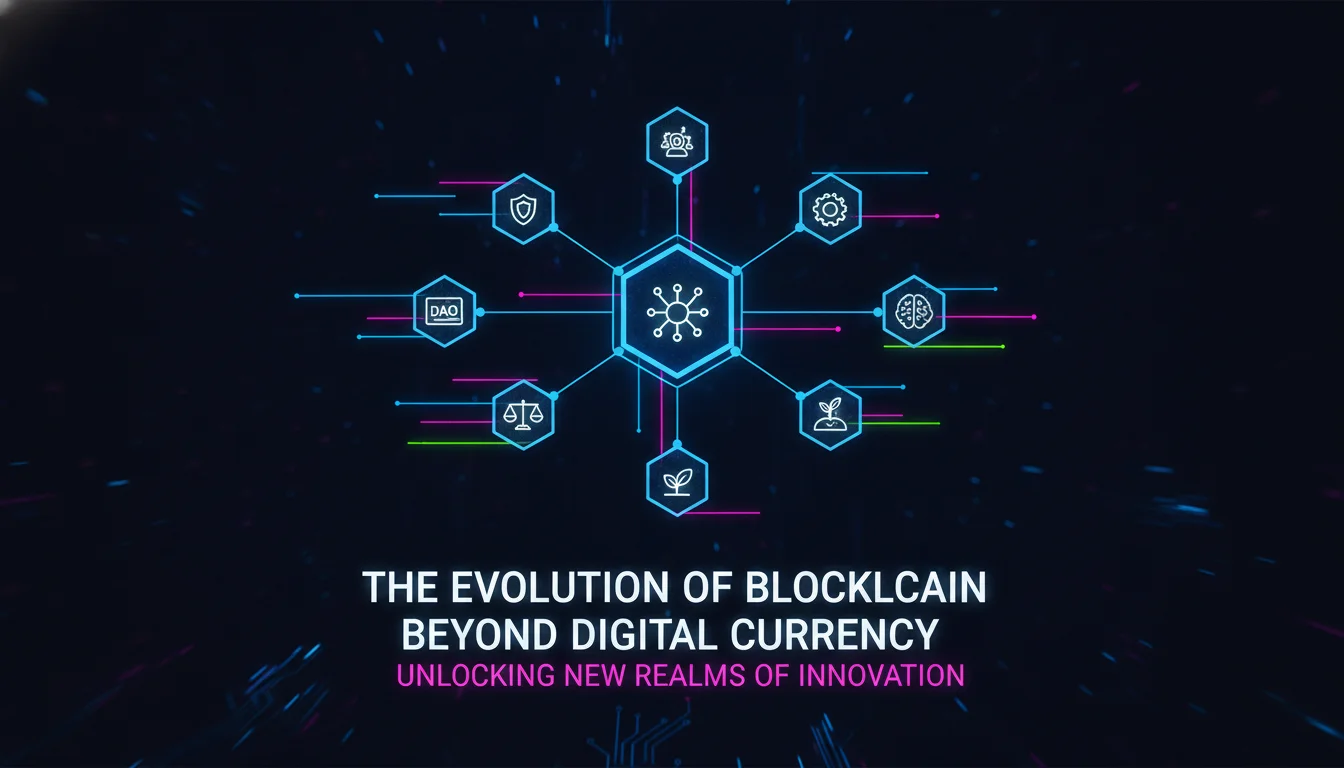
The history of this kind of cryptocurrency starts earlier than most people realize. Computer scientists Stuart Haber and Scott Stornetta introduced cryptographically secured timestamping for digital documents in 1991. The breakthrough moment came in 2009 when Satoshi Nakamoto released the Bitcoin whitepaper, giving rise to the first cryptocurrency running on a blockchain, according to Barclays.
While Bitcoin popularized the technology, academic researchers were already mapping broader territory. Mahdi H. Miraz and Maaruf Ali published their 2018 paper “Applications of Blockchain Technology beyond Cryptocurrency” on arXiv, surveying non-monetary systems including distributed storage, proof-of-location, healthcare, and decentralized voting. That academic foundation broadened the scope considerably.
Early Corporate Pilots and Live Implementations
Large companies including IBM, Walmart, Maersk, and DeBeers invested substantial money in blockchain to improve and secure business operations worldwide, as IBM notes. These early adopters recognized that a shared, immutable ledger could streamline multi-party processes, reduce disputes, and create auditable trails that no single party could manipulate.
American Express was among the first financial services firms to move from pilot to production, joining RippleNet and launching a blockchain-based membership rewards program. Both deployments were live by 2018, with expectations for further growth documented at the time.
Market Growth Indicators and Investment Trends
Blockchain technology has moved from pilot tests to live, revenue-generating systems. TCI Technologies reports that 81% of the world’s largest companies recognize blockchain uses beyond Bitcoin alone, and that the global blockchain market is projected to grow from $20 billion in 2024 to over $248 billion by 2029.
Mad Devs cites a different valuation: $27.85 billion in 2024, rising to $44.29 billion in 2025 and $746.41 billion by 2032, implying a compound annual growth rate of about 49.7 percent. The exact figures differ by methodology, but both projections point to the same conclusion: blockchain beyond is expanding fast.
Key Applications of Blockchain Beyond Cryptocurrency
Supply Chain Traceability and Counterfeit Prevention
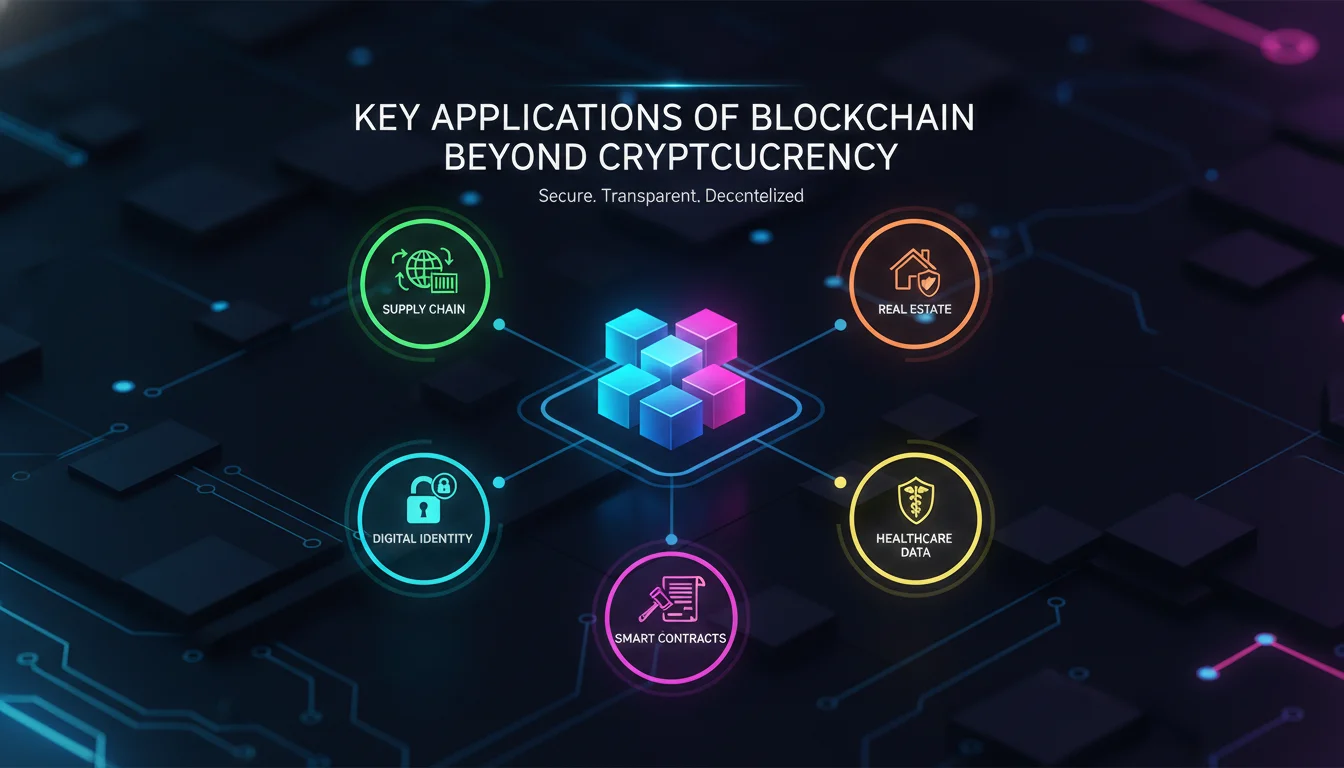
Supply chain management is one of the most mature use cases for beyond cryptocurrency. GeeksforGeeks explains that recording every product movement on a blockchain increases access and accountability, helping companies avoid counterfeit goods, address quality issues faster, and maintain subject-matter specificity across complex logistics networks. IBM highlights Walmart and Maersk as companies using it for supply chain visibility.
The immutable ledger lets companies trace an item from raw material to consumer, reducing counterfeit risk and enabling more efficient recalls. For retail implementations, blockchain data can include the item purchased, serial number, date purchased, and manufactured location, as IBM describes.
Healthcare Data Management and Patient Control
In healthcare, blockchain allows patient records to be maintained and transmitted electronically with security features that ensure data privacy and immutability. According to AIU course material, blockchain holds the promise of securely managing patient data, ensuring interoperability among different providers, and streamlining insurance claims and medical record management.
Patients gain greater control over their data while maintaining privacy. Because records are encrypted and immutable, unauthorized alterations are virtually impossible, and caregivers can access a trustworthy history across large healthcare organizations without relying on a central database that becomes a breach target.
Financial Services and Cross-Border Settlements
Financial services have one of the strongest cases for blockchain adoption because inherent security and immutability tie directly into banking and insurance requirements. IBM notes that American Express joined Ripple’s global payment network and launched a blockchain for membership rewards, with near real-time updates informing everyone in the value chain of activities performed.
Beyond traditional banking, blockchain enables direct, protected, and independent transactions, making cross-border payments faster and cheaper than legacy systems. Smart contracts can execute business agreements without gatekeepers, cutting fees and delays that currently make international settlement slow and expensive.
Real Estate and Asset Tokenization
Real estate is an emerging application area where blockchain beyond cryptocurrency delivers concrete efficiency gains. GeeksforGeeks identifies real estate as a use case where blockchain can record property ownership, transfer history, and title documentation on an immutable ledger, reducing fraud and streamlining the closing process.
Asset tokenization extends this further: representing fractional ownership of physical assets as on-chain tokens makes previously illiquid assets tradeable without traditional intermediaries. This is one of the more technically demanding applications, requiring careful integration of legal frameworks with smart contract logic.
Nonprofit and Philanthropy Transparency
Charitable organizations face a persistent trust problem: donors want to know their contributions reach intended recipients. TCI Technologies identifies nonprofit and philanthropy as a sector where blockchain enhances transparency by clearly recording how donations are received and distributed, creating an auditable trail that any stakeholder can verify.
This application requires no cryptocurrency. The blockchain simply acts as a shared, tamper-evident ledger that replaces the need to trust a single organization’s internal accounting.
How Blockchain Secures Voting Systems and Digital Identity
Tamper-Evident Ballot Recording
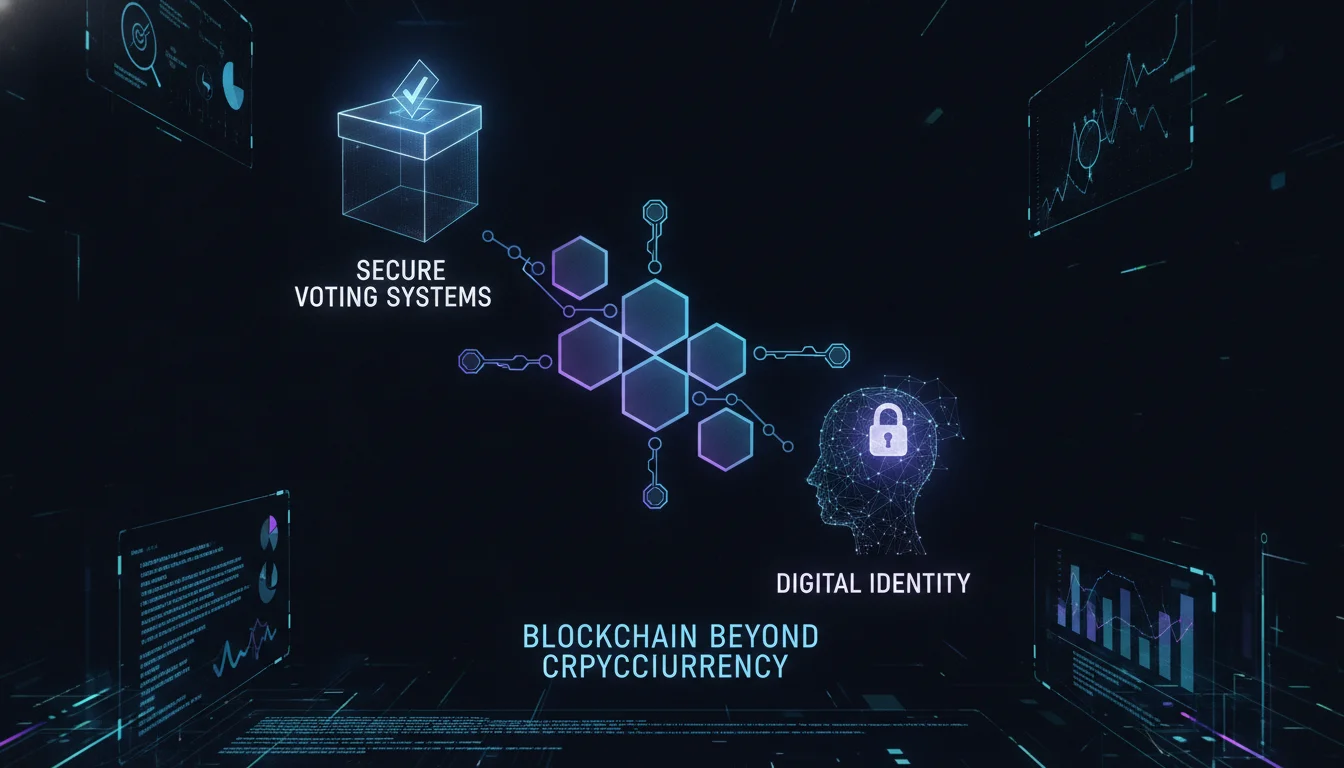
Blockchain-based voting systems have the potential to eliminate voter fraud, tampering, and logistical challenges associated with traditional voting methods. The AIU material notes that by providing a secure and transparent way to record and verify votes, blockchain could enhance the integrity and accessibility of democratic processes worldwide.
Each vote is protected cryptographically. Once recorded, it cannot be manipulated. That same immutability ensures no one can alter results after the fact, providing a verifiable audit trail for election officials and independent observers.
Remote and Online Voting Considerations
Blockchain enables remote and online voting by allowing voters to submit ballots from anywhere while maintaining a tamper-evident record. GeeksforGeeks emphasizes that every vote is protected and no one can manipulate the results, which is a meaningful advantage for democratic participation at scale.
Implementing blockchain-based voting still requires careful attention to voter authentication, privacy, and accessibility. The technology solves integrity problems but must be paired with robust identity verification to prevent coercion or vote buying. The cryptographic layer is necessary but not sufficient on its own.
Digital Identity and Public Key Infrastructure
Blockchain uses a changeable Public Key to record users’ identity, providing an extra layer of privacy, as described in the 2018 arXiv paper by Miraz and Ali. This feature supports digital identity management well beyond voting, including secure access to services and verifiable credentials.
Ethereum-based implementations also use smart contracts for digital identity management, as IBM notes. By decentralizing identity verification, blockchain reduces reliance on centralized databases that are attractive targets for breaches.
Smart Contracts and Decentralized Finance as a Bridge
Self-Executing Agreements in Business Processes
Smart contracts are digital, self-managed contracts that contain logic in code to execute as per agreement. GeeksforGeeks defines them as self-triggering and self-implementing when set conditions are met. TCI Technologies notes that blockchain automation through smart contracts can streamline operations, reduce administrative costs, and speed up transactions.
In industries where blockchain beyond cryptocurrency is being deployed, smart contracts can automate insurance claims, royalty distributions, and supply chain payments. A shipment reaching a warehouse can automatically trigger payment release, cutting reconciliation time from days to minutes.
DeFi Lending, Borrowing, and Trading Without Intermediaries
Decentralized finance applications use blockchain to offer traditional financial services such as lending, borrowing, and trading without intermediaries like banks. The AIU course notes that DeFi has the potential to democratize access to financial services, reduce transaction costs, and increase financial inclusion, particularly in underserved regions.
Although DeFi is related to cryptocurrency, it represents a distinct use case where blockchain serves as the infrastructure for open financial systems rather than as a speculative asset class. That shift is exactly what makes blockchain beyond cryptocurrency a serious enterprise topic, not just a trading narrative.
Balancing Innovation with Regulatory Requirements
Regulators face the challenge of developing frameworks that balance innovation with consumer protection and compliance. According to AIU, issues such as anti-money laundering (AML) and know your customer (KYC) requirements, taxation, and jurisdictional challenges pose significant regulatory hurdles.
For blockchain beyond cryptocurrency to scale in finance and other regulated sectors, legal clarity is essential. Organizations must design systems that comply with existing laws while preserving the decentralization that makes the technology valuable in the first place.
Step-by-Step: Implementing Blockchain Beyond Cryptocurrency in an Organization
Step 1: Identify Transaction-Specific Information
Start by mapping what data actually needs to live on-chain. IBM advises that in banking, a block may include name, account number, transaction type, and amount; in retail, it may include item purchased, serial number, date purchased, and manufactured location.
- Map the workflow: Determine which participants need to read or write data and what triggers a valid transaction.
- Select data fields: Choose the minimum necessary information to ensure efficiency and privacy.
- Define validation rules: Establish consensus criteria for when a block is accepted by the network.
Step 2: Choose Public vs. Private Ledger Architecture
Most cryptocurrency deployments involve public blockchains allowing anyone to participate, while most corporate blockchain deployments use a private ledger limiting access and authorization, according to IBM. The choice depends on trust assumptions, regulatory requirements, and performance needs.
For consortium use cases like supply chain or interbank settlement, a permissioned private ledger typically offers better privacy and throughput. For public verification, a public chain provides transparency but may raise data protection concerns in regulated industries.
Step 3: Pilot, Integrate, and Scale
Begin with a controlled pilot to test integration with existing systems. After validating value, scale gradually by adding more participants and data types. Barclays observes that as blockchain firms matured and share price volatility declined, they delivered better risk-adjusted returns, indicating that sustainable growth comes from real-world usage, not speculation.
The pilot phase is also where interoperability gaps become visible. Build with standards in mind from day one, because retrofitting cross-chain compatibility after deployment is significantly more expensive than designing for it upfront.
Industry Comparison of Blockchain Beyond Cryptocurrency
The table below summarizes key industries applying blockchain beyond cryptocurrency, the specific features they use, and representative examples from the sources reviewed.
| Industry | Core Blockchain Features Used | Real-World Example or Application | Key Benefit |
|---|---|---|---|
| Supply Chain | Immutability, transparency, traceability | Walmart and Maersk deployments; product serial number tracking | Counterfeit prevention, efficient recalls, consumer trust |
| Healthcare | Encryption, provenance, interoperability | Secure patient record sharing across providers | Data privacy, patient control, streamlined claims |
| Finance | Smart contracts, decentralization, immutability | American Express on RippleNet; cross-border settlements | Faster, cheaper payments; reduced gatekeepers |
| Voting | Tamper-evidence, transparency, PK-based identity | Remote and online voting pilots | Election integrity, verifiable results |
| Real Estate | Immutability, timestamping, tokenization | Property title recording and fractional ownership tokens | Fraud reduction, liquidity for illiquid assets |
| Intellectual Property | Timestamping, immutability | Recording ownership and transfer of patents, copyrights | Proof of rightful possession, reduced plagiarism |
| DeFi | Smart contracts, decentralization | Lending, borrowing, and trading without intermediary banks | Financial inclusion, lower transaction costs |
| Nonprofit | Transparency, immutability | Donation tracking and fund distribution auditing | Donor trust, accountability without intermediaries |
These examples are drawn from IBM, GeeksforGeeks, AIU, TCI Technologies, Barclays, and the arXiv paper by Miraz and Ali. They illustrate that blockchain beyond cryptocurrency is not a single use case but a family of trust-enhancing applications across fundamentally different industries.
Pros and Cons
Pros
- Immutable audit trails make data tampering detectable and practically impossible after block validation.
- Reduced intermediary costs through smart contracts that automate multi-party agreements without gatekeepers.
- Cross-industry applicability: the same core architecture serves supply chains, healthcare, voting, and finance.
- Decentralization removes single points of failure and reduces censorship risk across all deployments.
- Transparency and provenance build verifiable trust between parties who have no prior relationship.
Cons
- Interoperability gaps mean different blockchain networks often cannot share data without custom bridge infrastructure.
- Energy consumption from proof-of-work consensus mechanisms raises environmental concerns, particularly for public chains.
- Regulatory uncertainty around AML, KYC, GDPR compliance, and right-to-erasure conflicts with immutability by design.
- Implementation complexity requires significant technical expertise and organizational change management.
- Immutability as a liability: once incorrect data is written on-chain, correcting it requires workarounds rather than simple edits.
Challenges and Limitations of Blockchain Beyond Cryptocurrency
Interoperability and Standards Gaps
Interoperability remains one of the most stubborn challenges in the blockchain ecosystem, with numerous platforms and protocols competing for dominance. The AIU course material emphasizes that establishing interoperability standards and protocols is crucial to ensure smooth communication and data exchange between different blockchain networks, facilitating widespread adoption and scalability.
Without standards, organizations risk building isolated systems that cannot share data with partners on other chains. This fragmentation slows the realization of blockchain beyond cryptocurrency across multi-party ecosystems where the value comes precisely from shared visibility.
Energy Consumption and Consensus Mechanisms
The energy-intensive process of validating transactions, known as mining, has raised concerns about the environmental impact of blockchain technology. AIU specifically flags proof-of-work (PoW) consensus algorithms used by cryptocurrencies like Bitcoin. The arXiv research by Miraz and Ali also identifies PoW as a cryptographic puzzle vital for security but computationally heavy.
Enterprise blockchains often avoid PoW by using permissioned consensus mechanisms that require far less energy. But the overall perception of blockchain as energy-hungry can still hinder adoption in sustainability-focused sectors, even when the specific implementation has a minimal footprint.
Regulatory and Privacy Concerns
Regulatory challenges include developing frameworks for AML and KYC requirements, taxation, and jurisdictional issues. AIU notes that challenges remain regarding the privacy implications of public blockchains, especially in sensitive industries like healthcare.
For blockchain beyond cryptocurrency to gain regulatory acceptance, organizations must demonstrate compliance with data protection laws such as GDPR and provide mechanisms for data minimization and right-to-erasure where possible, despite the immutability that makes the technology valuable in the first place. This tension is real and has no clean technical solution yet.
The Future of Blockchain Beyond Cryptocurrency
From Hype to Mature Infrastructure
Blockchain is a long-term investment theme that is maturing after an initial stage of hype, according to Barclays. As of 2026, the technology has moved beyond speculation into practical infrastructure for healthcare, manufacturing, and artificial intelligence data pipelines. As blockchain firms matured and share price volatility declined, they delivered better risk-adjusted returns, per the Barclays analysis.
“Blockchain is a long-term investment theme that is maturing after an initial stage of hype. As the technology expanded into new sectors such as healthcare, manufacturing and artificial intelligence, blockchain companies now deliver more than just crypto exposure.” – Barclays Private Bank, October 2025
This maturation means blockchain beyond cryptocurrency will increasingly be evaluated on operational ROI rather than token price movements. Enterprises are shifting from pilot projects to production systems that solve real coordination problems at scale.
AI Integration and Emerging Convergence
Barclays identifies artificial intelligence as one of the new sectors where blockchain is expanding, noting that blockchain companies now deliver more than just crypto exposure as the technology moves into AI data pipelines. The combination is logical: AI systems require trustworthy, auditable training data, and blockchain provides exactly that kind of provenance trail.
This convergence is early-stage but directionally significant. Organizations building AI infrastructure today should consider whether blockchain-based data provenance belongs in their architecture, particularly in regulated industries where model auditability will become a compliance requirement.
Blockchain as a Long-Term Investment Theme
Barclays notes that blockchain companies offer indirect exposure to crypto markets, but as the technology expanded into new sectors, they now deliver more than just crypto exposure. The sector’s high beta makes it suitable only for investors with a high risk appetite, yet the diversifying use cases provide a broader investment narrative.
For institutional and retail investors, the question is no longer “Is blockchain just Bitcoin?” but “Which blockchain applications will capture durable value?” The answer increasingly points to supply chain traceability, identity management, and automated compliance: areas where blockchain beyond cryptocurrency delivers measurable efficiency gains that justify the infrastructure cost.
How Organizations Can Prepare
Organizations preparing for blockchain beyond cryptocurrency should start by auditing processes that involve multiple parties, shared data, and trust gaps. Evaluate permissioned versus public ledgers, pilot with a narrow scope, and invest in interoperability standards from the beginning. TCI Technologies reports that 81% of the world’s largest companies already recognize the broader utility, making it a competitive imperative to understand the technology before your industry’s coordination layer gets built without you.
“Not only in cryptocurrency has the successful adoption of blockchain been implemented, but also in complex non-monetary systems such as distributed storage systems, proof-of-location, healthcare, and decentralized voting.” – Miraz and Ali, arXiv:1801.03528, Annals of Emerging Technologies in Computing, 2018
Blockchain beyond cryptocurrency is not a future promise. It is a present reality in supply chains, healthcare, finance, and voting systems. By separating the technology from its first application, decision-makers can access decentralized trust, transparency, and efficiency across their operations.
Frequently Asked Questions
What is blockchain beyond cryptocurrency?
Blockchain beyond cryptocurrency is the application of distributed, immutable ledger technology to non-monetary use cases such as supply chains, healthcare, and voting. It uses the same core properties: encryption, provenance, and immutability to create trust without intermediaries.
How does blockchain improve supply chain management?
Blockchain records every transaction and movement of goods on an immutable ledger, enhancing traceability, reducing counterfeit products, and enabling more efficient recalls. Walmart and Maersk are among the companies using it for supply chain visibility, as IBM documents.
Can blockchain be used for secure voting?
Yes. Blockchain-based voting systems provide a tamper-evident record of votes, reducing fraud and enabling remote or online voting. Each vote is cryptographically protected and verifiable by all participants, though robust identity verification must accompany the technical layer.
What are smart contracts in blockchain beyond cryptocurrency?
Smart contracts are self-executing digital contracts with terms written in code. They automatically trigger actions when conditions are met, streamlining processes such as insurance claims and supply chain payments without intermediaries or manual reconciliation.
Is blockchain secure enough for healthcare data?
Blockchain’s encryption and immutability make it well-suited for securing patient records and ensuring data integrity. It also gives patients control over their data while supporting interoperability among providers, as AIU course material describes.
What are the main challenges of blockchain adoption beyond crypto?
Key challenges include lack of interoperability standards between competing networks, energy consumption from proof-of-work systems, and regulatory uncertainty around AML, KYC, and privacy laws like GDPR. Addressing these is essential for widespread adoption in regulated industries.