The HSBC blockchain trade finance case study is a documented record of how distributed ledger technology compressed letter of credit settlement from days to hours. The most cited transaction: HSBC’s May 2018 Cargill soybean LC on R3 Corda, completed in 24 hours versus five to ten days on paper.
Key Takeaways
- HSBC executed the world’s first commercially viable blockchain trade finance transaction with Cargill in May 2018 on R3 Corda, cutting LC settlement to 24 hours from five to ten days.
- The HSBC Vietnam domestic LC pilot on Contour completed in 27 minutes compared with the usual three to five working days for a paper-based domestic letter of credit.
- The Darden case study estimates the annual trade finance market at USD 18 trillion with HSBC holding a 12% share, making document digitisation strategically material.
- HSBC’s blockchain journey spans Voltron, Contour, and a Swift/HSBC 2025 shared ledger initiative with more than 40 financial institutions.
- Governance, interoperability, and pricing remain unresolved decision questions across trade finance consortia.
- In April 2021, HSBC executed a paperless trade transaction with Tata Steel and Universal Tube & Plastic Industries on the Contour platform, extending the case beyond agricultural commodities into industrial supply chains.
The Evidence Base Behind the HSBC Blockchain Trade Finance Case Study
Why This Case Still Matters
The case study is not a single document. It is a body of evidence spanning academic publishers, bank disclosures, and trade finance platforms. The Darden Business Publishing case explains that HSBC Holdings Plc is part of various trade finance consortia aiming to digitise the traditional paper-based trade finance process. According to the Darden product overview, the trade finance market was estimated at USD 18 trillion on an annual basis and HSBC had a 12% share in trade finance transactions worldwide.
That scale is the reason this case remains strategically relevant. A bank with a 12% share of an USD 18 trillion market faces enormous documentary costs, settlement delays, and fraud exposure. The this type of study shows how consortia-based ledger infrastructure can attack those costs, but it also exposes governance questions that are easy to ignore in proof-of-concept announcements.
What the Primary Sources Report
Primary sources split the HSBC story into three distinct layers. CNBC reported that HSBC claimed the world’s first commercially viable trade finance transaction using blockchain in May 2018. HSBC Vietnam later documented its first live pilot domestic letter-of-credit transaction on the Contour platform, implemented jointly with Vietcombank. In 2025, Swift announced a blockchain-based shared ledger initiative with HSBC, extending the case from documentary credit into 24/7 cross-border payments and tokenised deposits.
These sources are not mutually exclusive. The Cargill soybean transaction validated blockchain for a cross-border letter of credit. The HSBC Vietnam pilot validated domestic letters of credit. The Swift/HSBC initiative tests whether the same infrastructure can support continuous payment flows rather than discrete documentary credits. Together they form the most complete version of the this kind of case study available in public reporting.
“The need for paper reconciliation is removed because all parties are linked on the platform and updates are instantaneous. The quick turnaround could mean unlocking liquidity for businesses.” – Vivek Ramachandran, Head of Growth and Innovation, HSBC (via CNBC, May 2018)
The Paper-Based Problem HSBC Tried to Solve
Letters of Credit as a Documentary Chokepoint
A letter of credit is a bank-issued guarantee that a seller will receive payment once specified documentary conditions are met. In a traditional trade finance transaction, one bank issues the LC to another, and the seller must present documents such as invoices, bills of lading, and certificates of origin. That process involves multiple parties, extensive documentation, courier transfers, and manual reconciliation. The EY CAFTA 2025 case study abstract notes that HSBC’s April 2021 blockchain-enabled, paperless trade transaction marked a significant advancement in digitising trade finance, specifically because letters of credit typically involve multiple parties and extensive documentation.
The result is a chokepoint. A documentary credit that takes five to ten days to settle ties up working capital, creates error-prone manual steps, and increases fraud risk. HSBC Vietnam’s case page states that the usual paper-driven process involves sending physical documents via couriers, which adds many manual steps and costs. That description aligns with the broader trade finance industry’s long-standing complaint that paper reconciliation prevents real-time visibility into transaction status.
Why Distributed Ledger Technology Fits Trade Finance
Blockchain is a decentralised, secure, and transparent ledger technology that eliminates the need for intermediaries. In trade finance, it enables real-time tracking, automated settlement, and fraud reduction. Because every party on a distributed ledger sees the same shared record, the need for paper reconciliation is removed. CNBC quoted Vivek Ramachandran, HSBC’s head of growth and innovation at the time, confirming that all parties are linked on the platform and updates are instantaneous. That is the core operational promise of the the blockchain trade finance case study.
The second promise is liquidity. A faster letter of credit cycle converts documentary evidence into payment faster, freeing up cash for buyers and sellers. For corporates such as Cargill, a 24-hour settlement versus a five-to-ten-day cycle is not merely an efficiency gain. It alters short-term working capital planning in a material way.
Platforms Behind the Case: Corda, Voltron, and Contour

R3 Corda as the Underlying Ledger
Corda is a distributed ledger platform developed by the enterprise blockchain firm R3. Unlike public cryptocurrency networks, Corda uses a permissioned architecture, meaning known parties can transact privately while still sharing a common record. CNBC confirmed that HSBC used a platform developed by blockchain start-up R3 called Corda for the Cargill transaction. HSBC Vietnam’s case page likewise states that the Contour platform is powered by R3’s blockchain software Corda.
This matters for the study because it shows HSBC did not build a proprietary chain from scratch. It adopted a shared infrastructure model, joining consortia that use a common protocol. The Darden case product overview confirms that HSBC successfully executed multiple trade finance pilots using a blockchain-based platform called Voltron and was launching its Contour platform as a service to clients. The shift from Voltron pilots to a commercial Contour offering is one of the clearest examples of a bank moving from experimentation to operational deployment.
From Voltron to Contour
Voltron is a blockchain-based trade finance platform used by HSBC for documentary credit pilots. Contour is a blockchain trade finance platform that enables the end-to-end digitisation of trade finance, including letter of credit issuance, document presentation, and payment. The distinction is important: Voltron proved the concept, while Contour became the commercial vehicle. The Darden case focuses on HSBC’s challenge of porting the traditional trade finance process to a blockchain-based system, including how banks form consortia, implement blockchain, and facilitate trading globally.
HSBC Vietnam also used Contour for its domestic letter-of-credit transaction. According to HSBC Vietnam’s case page, Contour enabled all four parties – buyer, seller, issuing bank, and advising bank – to have simultaneous and instant access to transaction information through a simple web interface connected to their own dedicated node. This node architecture is characteristic of Corda’s design, where data is shared only with parties that need to see it, preserving confidentiality while still reducing manual reconciliation.
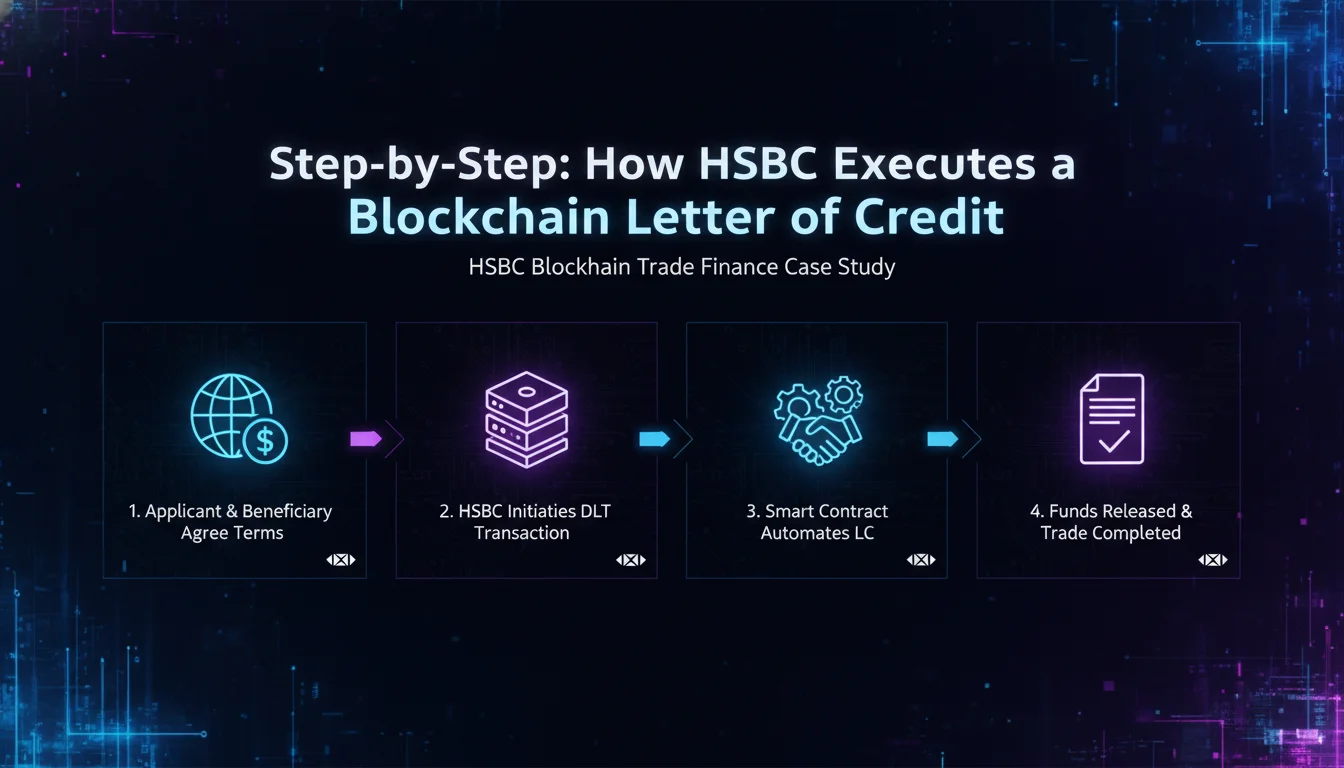
Step-by-Step: How HSBC Executes a Blockchain Letter of Credit
Document Creation and Counterparty Onboarding
A blockchain letter of credit follows a structured workflow that removes paper handoffs while preserving the legal roles of issuing and advising banks. Based on HSBC Vietnam’s description of the Contour pilot and CNBC’s reporting on Cargill, the steps are:
- Step 1: Buyer and seller agree on trade terms and the buyer requests a letter of credit from its bank.
- Step 2: The issuing bank creates a digital LC on the blockchain platform and invites the advising bank, buyer, and seller to connect.
- Step 3: Each party accesses a dedicated node through a simple web interface, establishing simultaneous and instant visibility into the transaction.
- Step 4: The seller uploads digital trade documents to the platform instead of sending physical documents by courier.
- Step 5: The advising bank validates the documents and the ledger records the verified information, reducing the risk of human error or fraud.
- Step 6: Payment is triggered when documentary conditions are met, and the transaction status updates in real time for all parties.
This six-step model synthesises the HSBC Vietnam and Cargill reports. Both emphasise that a single platform replaces the back-and-forth of couriers, manual checks, and separate bank systems. The term “node” matters: each party retains its own data environment while sharing only the transaction record necessary for the LC to progress.
Settlement, Liquidity, and Working Capital Effects
The settlement effect is concrete. In the Cargill transaction, HSBC and ING said the exchange was performed in 24 hours, compared with five to ten days for a paper-based system. In the HSBC Vietnam domestic pilot, a transaction that usually takes three to five working days was completed in 27 minutes, and document presentation took half a day instead of the conventional lead time of ten working days. Those are not directional improvements. They are order-of-magnitude reductions in cycle time.
For a corporate treasurer, that reduction can unlock working capital. HSBC Vietnam lists three key benefits: fast, simple, and streamlined workflows; a digital warehouse for records that eliminates manual storage; and real-time data sharing that reduces time from presentation to acceptance to pay. These benefits translate directly into working capital efficiencies because cash is no longer tied up in a courier-dependent document cycle.
The Cargill Soybean Transaction: Core Facts
Transaction Facts and Counterparties
The most frequently cited data point in the hsbc blockchain is the Cargill soybean transaction. On May 14, 2018, HSBC issued a letter of credit for U.S. food and agriculture firm Cargill using blockchain. The trade finance transaction involved a bulk shipment of soybeans from Argentina to Malaysia. The letter of credit was issued from HSBC to Dutch lender ING. The platform was R3’s Corda, which the start-up developed with a consortium of banks.
That transaction is significant because HSBC and ING described it as the world’s first commercially viable trade finance transaction using blockchain. Prior deals had been proof-of-concept exercises, but the Cargill shipment had commercial application. A commercial transaction carries real payment obligations, real cargo, and real regulatory exposure, which is a stronger test than a sandbox simulation.
Why It Was Commercially Viable, Not Just a Pilot
Commercial viability in this context means the transaction could have occurred without blockchain, but blockchain made it faster and more transparent while remaining legally enforceable. CNBC reported that HSBC claimed the exchange was performed in 24 hours, compared with five to ten days for paper-based systems. The removal of paper reconciliation was not a theoretical benefit. It was the reason the deal could close in a single day.
The Cargill case also demonstrated cross-bank interoperability. HSBC and ING are separate institutions with separate systems, yet the Corda network let them share a single source of truth for the letter of credit. That is the same interoperability problem the Darden case highlights: banks need consortia because no single bank’s proprietary ledger can serve a global trade finance value chain. The Cargill deal showed interoperability in a live trade, not just in a pilot.
The April 2021 Tata Steel Transaction: Industrial Supply Chains
Extending the Case Beyond Agriculture
The case study extends beyond the Cargill soybean deal. In April 2021, HSBC executed a blockchain-enabled, paperless trade transaction in collaboration with Tata Steel and Universal Tube & Plastic Industries on the Contour platform. According to the EY CAFTA 2025 case study abstract, this initiative marked a significant advancement in digitising trade finance within the steel industry, enhancing efficiency, transparency, and risk management.
The steel transaction matters because it shows the Contour platform is not commodity-specific. Agricultural bulk cargo and industrial steel both generate the same documentary burden: invoices, bills of lading, certificates of origin, and inspection reports. If blockchain LC workflows function across both categories, the addressable market for digitisation is far broader than any single sector pilot suggests.
Comparing HSBC Blockchain Trade Finance Cases Across Markets
Cargill 2018 vs HSBC Vietnam Domestic LC vs Swift 2025
The table below compares the three most concrete this type of study milestones. Figures are used exactly as reported by the underlying sources.
| Case | Platform | Parties | Speed vs Paper | Geographic Scope |
|---|---|---|---|---|
| Cargill soybean LC (May 2018) | R3 Corda | HSBC to ING for Cargill | 24 hours vs 5-10 days | Cross-border, Argentina to Malaysia |
| Tata Steel paperless trade (April 2021) | Contour powered by R3 Corda | HSBC, Tata Steel, Universal Tube & Plastic Industries | Paperless vs paper-intensive process | Industrial supply chain |
| HSBC Vietnam domestic LC | Contour powered by R3 Corda | HSBC Vietnam and Vietcombank for Kirby South East Asia and Ton Dong A | 27 minutes vs 3-5 working days; document presentation half a day vs ten working days | Domestic Vietnam |
| Swift/HSBC shared ledger initiative (2025) | Swift blockchain-based shared ledger | Swift, HSBC, and more than 40 financial institutions | 24/7 cross-border payments, not discrete LC timing | Global, with HSBC tokenised deposits in Hong Kong, Singapore, Luxembourg, and the UK |
The Cargill case proved a cross-border letter of credit could settle in one day. The HSBC Vietnam case proved a domestic letter of credit could settle in under half an hour. The Swift/HSBC initiative shifts the unit of analysis from a single credit instrument to an always-on payment rail. All three use blockchain, but they answer different questions: cross-border interoperability, domestic efficiency, and infrastructure scalability.
Domestic, Cross-Border, and Infrastructure Layers
The HSBC blockchain trade finance case study is not one transaction. It is a progression across three layers. The cross-border layer is represented by Cargill. The domestic layer is represented by HSBC Vietnam’s pilot with Vietcombank, which completed Vietnam’s first live pilot blockchain domestic letter-of-credit transaction. The infrastructure layer is represented by Swift’s 2025 announcement of a blockchain-based shared ledger, with HSBC confirming that tokenised deposits have already launched across Hong Kong, Singapore, Luxembourg, and the UK.
This layering matters for corporate treasurers and trade finance teams. A domestic LC workflow may not need the same interoperability as a cross-border LC, but both rely on the same underlying property: a single, shared, verifiable record. The Swift initiative suggests banks are now trying to connect those layers, not just optimise individual transactions.
Pros and Cons of HSBC’s Blockchain Trade Finance Approach
Pros
- Dramatic cycle time reduction: Settlement compressed from five to ten days to 24 hours for cross-border LCs, and from three to five working days to 27 minutes for domestic LCs, based on reported transactions.
- Working capital release: Faster documentary cycles convert trade evidence into payment sooner, reducing cash tied up in courier-dependent processes.
- Fraud and error reduction: Data is continuously recorded and verified in digital format on Contour, reducing the risk of human error or document fraud, per HSBC Vietnam’s case page.
- Multi-party visibility: All four parties – buyer, seller, issuing bank, advising bank – access the same transaction record simultaneously through dedicated nodes, eliminating reconciliation disputes.
- Platform extensibility: The same Corda-based infrastructure has handled agricultural commodities (Cargill), industrial goods (Tata Steel), and domestic trade (Vietnam), showing broad applicability.
Cons
- Consortium governance complexity: The Darden case explicitly identifies formation, governance, and management of the consortium as unresolved decision questions. Getting all stakeholders onto one platform is harder than the technology itself.
- Interoperability gaps: As Swift notes, proprietary solutions don’t move easily across banks. A fragmented multi-consortium landscape recreates silos in digital form.
- Pricing uncertainty: The Darden case asks how HSBC should price blockchain trade finance services to customers. That question remains publicly unanswered, creating commercial risk for platform investment.
- Adoption dependency: The network effect only works if counterparty banks, exporters, importers, and logistics providers all join. A single non-participant breaks the paperless chain.
- Regulatory variation: Manish Kohli of HSBC noted at Sibos 2025 that the right legislative framework now exists in many markets, implying it does not yet exist in all markets where HSBC operates.
Governance, Interoperability, and Pricing Lessons
Consortium Formation and Decision Questions
The Darden case study frames the HSBC blockchain trade finance case study as a set of decision questions, not a technology demonstration. According to the Darden product overview, HSBC is facing questions on the formation, governance, and management of the consortium; on interoperability between consortia; and on how to price its services to customers. Each of those questions is harder than the technical integration itself.
Consortium governance is difficult because trade finance involves issuing banks, advising banks, exporters, importers, insurers, and logistics providers. A blockchain platform that excludes one category simply recreates the paper problem digitally. Interoperability between consortia is the second-order challenge: if one bank group uses Contour and another uses a different ledger, a cross-consortium transaction still needs bridges. HSBC’s participation in multiple consortia, including Voltron and Contour, shows the bank is hedging that interoperability risk rather than betting on a single platform.
Pricing Trade Finance on a Shared Ledger
Pricing is the least discussed but most commercially important lesson in the HSBC blockchain trade finance case study. A shared ledger reduces cost for the network, but banks still need to recover investment and manage risk. The Darden case explicitly asks how HSBC should price its blockchain trade finance services to customers. That question is not answered publicly in the source material, but the Swift/HSBC session at Sibos 2025 offers a clue.
“The time now is right because now we have the right legislative framework in many markets, we have the right intensity, we have the right focus from our customers who are keen and there’s a willingness to adopt new technology.” – Manish Kohli, Global Head of Payments Solutions, HSBC (Sibos 2025, via Swift)
Customer willingness is a precondition for a pricing model that moves beyond pilot subsidies. Swift’s page also notes that proprietary solutions don’t move easily across banks. That observation underscores why pricing cannot be set by a single bank acting alone. If a bank prices its blockchain LC as a premium product, clients may stay on paper or choose a competitor. If it prices too low, it cannot fund the shared infrastructure. The HSBC blockchain trade finance case study does not resolve this tension. It exposes it.
Tokenised Deposits and the Road Ahead
The Swift/HSBC initiative extends the case beyond documentary credit into tokenised deposits and always-on payments. Swift announced it will add a blockchain-based shared ledger to its infrastructure stack, connecting more than 11,500 institutions globally. More than 40 financial institutions are working together to make 24/7 cross-border payments a reality, according to Swift’s Sibos 2025 announcement. HSBC has already launched tokenised deposits across Hong Kong, Singapore, Luxembourg, and the UK, connecting markets and currencies on a 24/7 basis.
That scale is important. A Cargill soybean LC settles one shipment. A domestic Vietnam LC settles one purchase order. Tokenised deposits could settle thousands of payments continuously. The governance and interoperability questions raised by Darden become more urgent at that scale, because a fragmented tokenised deposit market would produce exactly the kind of proprietary silos that blockchain was meant to eliminate.
What Corporates and Banks Can Take From This
Practical Lessons for Trade Finance Teams
The HSBC blockchain trade finance case study is most useful not as a technology showcase but as an implementation roadmap. Three practical lessons emerge from the evidence base.
First, start with a high-volume, document-heavy instrument. Letters of credit are the right entry point because the paper burden is measurable and the settlement delay is directly tied to working capital cost. The Cargill and Vietnam cases both chose LC as the instrument, and both produced quantifiable time savings.
Second, join an existing consortium rather than building proprietary infrastructure. HSBC did not build its own chain. It joined R3’s Corda ecosystem, participated in Voltron, and moved to Contour as the commercial platform matured. As Swift notes, proprietary solutions don’t move easily across banks. A bank that builds alone cannot achieve the network effects that make blockchain trade finance valuable.
Third, treat governance as the primary risk, not technology. The Darden case is explicit: the crux is how banks form consortia, implement blockchain, and facilitate trading globally given that it is a new technology requiring all stakeholders in the trade finance value chain to join the blockchain-based platform. Technology risk is solvable. Consortium governance risk is political and commercial.
Conclusion: What the HSBC Blockchain Trade Finance Case Study Demonstrates
What the Cases Collectively Show
The HSBC blockchain trade finance case study demonstrates that distributed ledger technology can reduce letter of credit settlement from days to hours without losing legal enforceability or bank roles. The Cargill transaction cut a cross-border LC from five to ten days to 24 hours. The HSBC Vietnam pilot cut a domestic LC from three to five working days to 27 minutes and reduced document presentation from ten working days to half a day. These are completed transactions with named counterparties, real goods, and real banks, not hypothetical simulations.
Why Corporates and Banks Keep Investing
Banks and corporates keep investing because the trade finance market is enormous and still heavily paper-dependent. The Darden case estimates the annual trade finance market at USD 18 trillion, with HSBC holding a 12% share. Even marginal reductions in document handling time create meaningful working capital effects. The Swift/HSBC shared ledger initiative suggests the next phase is not another standalone pilot but a coordinated infrastructure play connecting more than 11,500 institutions. That is the lasting insight of the HSBC blockchain trade finance case study: the technology was never the hardest part. Organising consortia, pricing services, and connecting networks is the real work.
If you’re building protocol infrastructure or tokenised finance systems, the Digital Blockchains Genesis Cohort is where serious builders work through exactly these problems. Apply to the Genesis Cohort at digitalblockchains.com.
Frequently Asked Questions
What is the HSBC blockchain trade finance case study?
The HSBC blockchain trade finance case study refers to publicly reported transactions in which HSBC used distributed ledger technology to execute letters of credit, most notably the May 2018 Cargill soybean LC on R3 Corda. It also includes HSBC Vietnam’s Contour domestic LC pilot, the April 2021 Tata Steel paperless trade transaction, and the Swift/HSBC 2025 shared ledger initiative.
How fast was HSBC’s Cargill blockchain transaction?
HSBC and ING said the Cargill soybean letter of credit was performed in 24 hours, compared with five to ten days for a paper-based system. That speed was achieved on the R3 Corda platform because all parties were linked and updates were instantaneous, per CNBC’s reporting.
What platform did HSBC use for blockchain trade finance?
HSBC used R3’s Corda for the Cargill transaction and later used Contour, a trade finance platform powered by Corda, for domestic and cross-border pilots. Earlier pilots used a blockchain platform called Voltron, according to the Darden case study published by the Indian Institute of Management Ahmedabad.
Did HSBC complete a domestic blockchain letter of credit?
Yes. HSBC Vietnam completed Vietnam’s first live pilot blockchain domestic letter-of-credit transaction with Vietcombank. The Contour-based transaction was completed in 27 minutes, compared with three to five working days for a paper-based domestic LC, and document presentation took half a day versus ten working days.
What challenges remain for HSBC’s blockchain trade finance efforts?
According to the Darden case study, HSBC still faces questions about consortium formation, governance, interoperability between consortia, and pricing blockchain trade finance services. Swift and HSBC also note at Sibos 2025 that proprietary solutions do not move easily across banks, making shared infrastructure essential for the technology to scale.
What is the Contour platform?
Contour is a blockchain trade finance platform that enables the end-to-end digitisation of trade finance, including letter of credit issuance and document presentation. It is powered by R3’s Corda software and lets buyers, sellers, and banks access shared transaction data through dedicated nodes, as described on HSBC Vietnam’s case page.