Visa blockchain is Visa’s use of public blockchain networks to settle stablecoins, issue crypto-linked cards, and give banks enterprise-grade onchain payment infrastructure. As of 2026, the visa blockchain settlement pilot spans nine chains and has reached a $7 billion annualized run rate.
Key Takeaways
- Visa blockchain strategy centers on stablecoin settlement across nine public chains, not a proprietary Layer-1.
- The settlement pilot hit a $7 billion annualized run rate, up 50% quarter over quarter as of April 2026.
- The Visa Onchain Analytics Dashboard, built with Allium Labs, tracks fiat-backed stablecoin activity across 10 major blockchains.
- The Visa Stablecoin Platform (VSP) gives banks and fintechs onchain wallet infrastructure, fiat ramps, and Visa payment flow integration.
- Visa supports 130+ stablecoin-linked card programs across more than 50 countries, backed by partnerships with over 70 crypto platforms.
- Visa CLI extends the visa blockchain ecosystem to agentic payments, letting AI agents execute card-based transactions programmatically.
What Is Visa’s Blockchain Strategy?

Visa blockchain strategy is, at its core, a stablecoin infrastructure play. Visa does not operate its own public Layer-1 chain. Instead, it uses existing public blockchains alongside its global payment network to help banks, fintechs, and crypto platforms move stablecoin value at scale. According to Visa’s corporate stablecoin insights, stablecoins add incremental payment infrastructure that has the potential to modernize digital payments across many consumer and commercial use cases.
Stablecoins as the Core Use Case
A stablecoin is a token issued on a blockchain network designed to maintain a stable value, typically backed by fiat reserves held off-chain. Visa’s public material defines fiat-backed stablecoins as tokens issued on blockchain networks designed to maintain a stable value with fiat reserves held off-chain. Programmable stablecoins enable fast, stable, borderless payments, and Visa positions them as the primary bridge between traditional finance and onchain finance. The company’s stablecoin solutions include stablecoin-linked cards, cross-border money movement, issuer tools, and consulting.
Why Visa Does Not Operate Its Own Layer-1
Visa’s approach is explicitly multi-chain. According to Visa Investor Relations, partners are building in a multi-chain world and expect their options to reflect that reality. Rather than competing with Ethereum, Solana, or other Layer-1 networks, the visa blockchain approach provides a common settlement layer across all supported chains. This lets issuers and acquirers choose the networks that best fit their needs while relying on Visa for interoperability, security, and scale.
From Crypto Cards to Institutional Settlement
Visa’s blockchain journey started with crypto-linked cards issued alongside more than 70 crypto platforms. It then expanded into USDC settlement pilots, and now supports 130+ stablecoin-linked card programs in more than 50 countries. The shift from consumer card products to institutional settlement is central to Visa’s current positioning, as stablecoins move from speculative assets to practical payment rails.
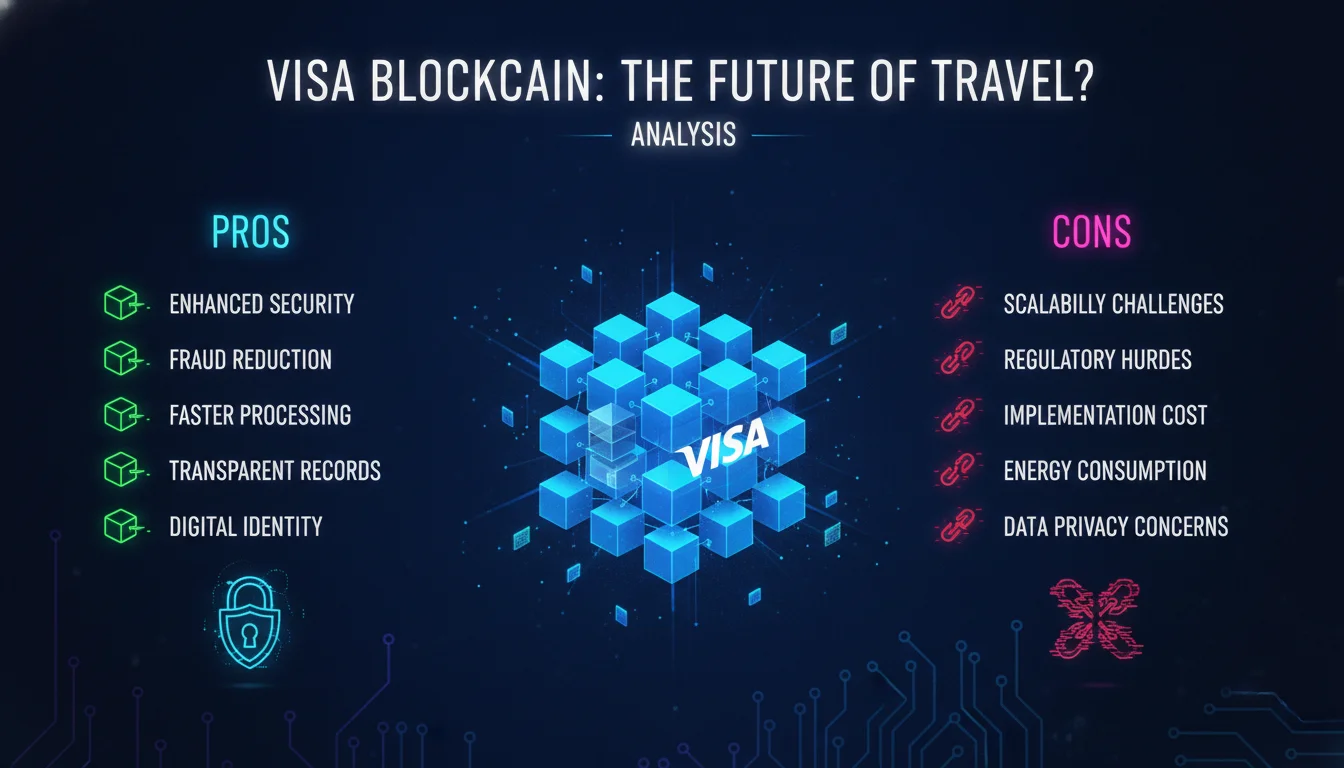
Pros and Cons
Pros
- Multi-chain flexibility: Partners choose from nine supported blockchains without being locked into a single infrastructure.
- Trusted brand and compliance posture: Visa’s regulatory experience and global network reduce institutional adoption friction.
- Real-time, 24/7 settlement: Stablecoin rails operate continuously, including weekends, unlike batch-based traditional settlement.
- Transparent onchain data: The Onchain Analytics Dashboard gives regulators and institutions verifiable, adjusted transaction metrics.
- Agentic payment support: Visa CLI enables AI agents to execute payments programmatically, positioning the visa blockchain ecosystem for autonomous commerce.
Cons
- No proprietary chain control: Visa depends on third-party blockchain infrastructure, introducing external protocol risk.
- Stablecoin concentration risk: Over 97% of supply is minted by just two issuers, creating systemic dependency on Tether and Circle.
- Data complexity: Cross-chain differences and bot activity require sophisticated filtering, adding analytical overhead for institutions.
- Regulatory uncertainty persists: Despite recent clarity, stablecoin regulation varies by jurisdiction and can shift quickly.
Visa Blockchain Stablecoin Settlement and Multi-Chain Expansion

On April 29, 2026, Visa announced it was adding five blockchains to its global stablecoin settlement pilot. According to Visa Investor Relations, the pilot now supports nine blockchains and has reached a $7 billion annualized stablecoin settlement run rate, up 50% since the previous quarter. The newly supported chains are Arc, Base, Canton, Polygon, and Tempo, joining existing support for Avalanche, Ethereum, Solana, and Stellar.
“Our partners are building in a multi-chain world, and they expect their options to reflect that reality. Expanding our stablecoin settlement pilot program to more blockchains means our partners can choose the networks that best fit their needs, while relying on Visa to provide a common settlement layer across all of them.” – Rubail Birwadker, Global Head of Growth Products and Strategic Partnerships, Visa
The Nine Supported Blockchains
| Blockchain | Created or Backed By | Primary Purpose in Visa Settlement |
|---|---|---|
| Avalanche | Ava Labs | Existing high-throughput settlement network |
| Ethereum | Ethereum Foundation | Foundational smart contract settlement |
| Solana | Solana Labs | High-speed, low-cost settlement |
| Stellar | Stellar Development Foundation | Cross-border and remittance settlement |
| Arc | Circle | Programmable money and onchain innovation |
| Base | Coinbase | Fast, low-cost stablecoin and agentic commerce |
| Canton | Digital Asset | Configurable privacy for regulated capital markets |
| Polygon | Polygon Labs | High-throughput global payments and digital commerce |
| Tempo | Tempo | Private, efficient stablecoin liquidity movement |
Growth Metrics: $7 Billion Run Rate and 50% QoQ
The $7 billion annualized stablecoin settlement run rate represents record growth of 50% quarter over quarter. This figure signals increasing confidence in blockchain infrastructure from financial institutions, fintechs, and payment providers. Visa explicitly frames stablecoin settlement over blockchain infrastructure as a viable complement to traditional settlement rails, not a replacement for them.
Partner Perspectives on Multi-Chain Settlement
Circle’s Chief Product and Technology Officer, Nikhil Chandhok, described Arc as designed to provide performance, predictability, and reliable access to liquidity for real-time settlement at global scale. Jesse Pollak, Founder of Base, called Visa’s expansion a step in making stablecoin payments a daily reality for billions of people. These partner statements reflect a broader industry consensus that multi-chain settlement is becoming necessary as liquidity spreads across ecosystems.
“Arc is designed to provide the performance, predictability, and reliable access to liquidity needed to support real-time settlement at a global scale. Our work with Visa reflects growing demand for stablecoins like USDC and blockchain infrastructure that can settle today’s payment flows instantly while enabling the next era of programmable commerce and agent-driven economic activity.” – Nikhil Chandhok, Chief Product and Technology Officer, Circle
Visa Onchain Analytics Dashboard and Stablecoin Data

The Visa Onchain Analytics Dashboard is a free tool developed with Allium Labs that tracks how fiat-backed stablecoins move across public blockchains globally. It covers stablecoin movements across 10 major blockchains and highlights trends in supply, transaction volume, and address activity. Anyone interested in the stablecoin ecosystem can access it without a login.
How the Dashboard Works
Public blockchains are decentralized networks designed to allow anyone to participate and verify transactions, with transaction history transparent and accessible to everyone. The dashboard ingests this public data and displays it visually. Users can view total transaction volume, transaction count, retail-sized transaction volume, active unique sending and receiving addresses, and average stablecoin supply across multiple time ranges.
Adjusted vs. Unadjusted Transaction Metrics
Visa’s dashboard separates signal from noise using adjusted and unadjusted methodologies. Adjusted transaction criteria aim to remove potential distortions from high-frequency trading and bots. According to the dashboard’s published methodology, Allium Labs has sourced over 3 million labeled addresses, including organic categories such as lending, investment funds, minting and burning, on and off ramps, decentralized exchanges, and centralized exchange activities. For unlabeled addresses, the dashboard applies heuristic filters, including a single directional volume filter and a 30-day transaction volume and count threshold.
Key Stablecoin Market Figures
According to Visa’s corporate stablecoin insights, there is over $272 billion in global circulating stablecoin supply. More than 99% is U.S. dollar denominated, and 97% is minted by two issuers: Tether at 67% and Circle at 27%. Visa estimates that in 2024, Circle and Tether collectively made over $7 billion in interest revenue from their reserves. The dashboard also shows $10.2 trillion in adjusted global transaction volume over the last 12 months.
Stablecoin Supply Breakdown by Issuer
The stablecoin market is highly concentrated. USDT (Tether) and USDC (Circle) together account for 97% of all circulating supply, per Visa’s onchain data. Beyond these two, newer entrants are gaining ground: RLUSD from Ripple, PYUSD from the PayPal and Paxos partnership, and USDG from Paxos represent an emerging tier of issuers. Visa’s corporate analysis notes that despite Tether and Circle’s dominance, new stablecoin issuers and models are emerging, with some sharing interest revenue across ecosystem participants rather than retaining it entirely.
Visa Stablecoin Platform and Enterprise Tools
The Visa Stablecoin Platform (VSP) is an enterprise-grade platform for banks and fintechs to access and manage stablecoins. According to Yahoo Finance, the platform supports onchain wallet infrastructure, fiat on and off ramping, and integration into existing Visa payment flows. VSP aims to make stablecoins easier to use for treasury, settlement, and new product development.
What the Visa Stablecoin Platform Offers
VSP allows users to store and access stablecoins, or issue their own. The platform combines Visa’s trusted brand, global network, and regulatory experience with enterprise-grade performance. For financial institutions and fintechs, VSP enables new products and brings existing business onchain by integrating stablecoin solutions into existing systems.
Visa CLI and Agentic Payments
Visa CLI gives AI agents real payment capability as developers code. With Visa CLI, developers can complete card-based transactions programmatically, enabling agentic commerce and autonomous payment workflows. A joint report from Visa and Artemis examines how AI agents are starting to pay for things, drawing on live onchain data. This connects the visa blockchain ecosystem directly to the emerging agentic payments economy.
Consulting and Analytics Services
Visa Consulting and Analytics offers curated data as a service and actionable insights on stablecoin trends. For banks that need additional support, Visa can tailor analytics from the Onchain Analytics Dashboard to specific client needs. Consulting services span strategy, research, design, and pilot implementation.
Stablecoin-Linked Cards and Crypto Partnerships
Visa’s crypto solutions page highlights that the company works with more than 70 leading crypto platforms to issue crypto-linked cards. These cards make it straightforward to convert and spend crypto at millions of merchants worldwide. The visa blockchain card ecosystem also supports easy on-ramps into crypto for cardholders and connects to non-fungible token (NFT) use cases.
Crypto-Linked Card Programs
Stablecoin-linked cards connect crypto and stablecoin wallets to the global Visa network, allowing users to spend digital assets at merchants that accept Visa. Visa’s stablecoin-linked card programs now number 130+ across more than 50 countries. These programs are a key bridge between the onchain world and everyday commerce.
Open USD (OUSD) as Open Stablecoin Infrastructure
Visa is part of the Open Standard ecosystem and is bringing to market Open USD (OUSD), described as the first stablecoin designed as open infrastructure. OUSD gives businesses the economics, governance, and reliability needed to move money. This initiative positions Visa not just as a network provider but as an active participant in stablecoin infrastructure design.
Cross-Border Money Movement with Visa Direct
Visa Direct enables faster and more cost-effective money movement across fiat and stablecoin rails. Visa believes stablecoins have strong potential for driving financial inclusion and global commerce, including helping global marketplaces pay seller partners in USDC. This cross-border use case was one of Visa’s earliest blockchain pilots and remains central to its strategy.
NFTs and CBDC Engagement
The visa blockchain strategy extends beyond stablecoins into adjacent areas. On NFTs, Visa views non-fungible tokens as an evolution of eCommerce and aims to connect consumers who want to own and display digital assets to its global network. On central bank digital currencies, Visa engages with central banks and policymakers to identify compelling CBDC use cases and explore how to bring them to market. These initiatives are earlier-stage than the stablecoin settlement work but reflect Visa’s intent to cover the full spectrum of onchain value transfer.
Visa Blockchain vs Traditional Payment Rails: A Comparison
Visa blockchain settlement infrastructure differs from traditional card and wire settlement in several key ways. Traditional rails often batch transactions and operate on business-day schedules, while stablecoins settle 24/7, 365 days a year. The table below compares the two approaches based on public information from Visa’s materials.
Settlement Finality and Operating Hours
Stablecoins facilitate near-continuous payment settlements, designed to operate 24/7, 365 days a year. Visa’s analysis based on Coordinated Universal Time (UTC) shows that weekend transaction volumes are substantial, averaging billions of dollars per day. Traditional card and wire settlement, by contrast, typically follows banking hours and batch processing schedules.
Cost and Speed Trade-offs
Stablecoin settlement can reduce friction and move money faster, but it introduces new complexity: cross-chain differences, bot activity, and data noise. Visa’s Onchain Analytics Dashboard addresses this by adjusting for inorganic activity, making stablecoin data more comparable to traditional payment metrics. Visa’s consulting services further help institutions evaluate cost and speed trade-offs specific to their use case.
Regulatory and Institutional Adoption
Recent regulatory clarity enables more banks to use stablecoins for cross-border money movement and onchain financial solutions. The visa blockchain settlement pilot now supports regulated institutional use cases, including Canton’s configurable privacy for capital markets. This compliance posture differentiates Visa’s approach from purely decentralized settlement alternatives.
| Feature | Traditional Card/Settlement Rails | Visa Blockchain Stablecoin Settlement |
|---|---|---|
| Settlement cycle | Batch, typically business days | Near-instant, 24/7/365 |
| Operating hours | Banking hours, cutoffs | Continuous, including weekends |
| Currency type | Fiat currencies | Fiat-backed stablecoins |
| Transparency | Private ledgers | Public blockchains, visible data trail |
| Programmatic access | Limited APIs, batch files | Onchain smart contracts, Visa CLI |
| Primary users | Banks, merchants, consumers | Banks, fintechs, crypto platforms, developers |
Step-by-Step: Launching a Stablecoin Settlement Program with Visa
Launching a stablecoin settlement program with Visa involves several structured steps. The process below synthesizes Visa’s public guidance for banks, fintechs, and crypto platforms looking to use the visa blockchain infrastructure.
Step-by-Step Process Overview
- Step 1: Define your use case. Decide whether you need settlement, card programs, cross-border money movement, or developer tools. Visa’s stablecoin solutions page directs users to choose among these options before engaging the team.
- Step 2: Choose a supported blockchain. Select from the nine blockchains currently in Visa’s settlement pilot: Avalanche, Ethereum, Solana, Stellar, Arc, Base, Canton, Polygon, or Tempo. Consider privacy requirements, throughput needs, and ecosystem fit.
- Step 3: Integrate with Visa APIs and VSP. Use the Visa Stablecoin Platform to access onchain wallets, fiat ramps, and existing Visa payment flows. For developer-focused programs, use Visa CLI to give AI agents payment capability.
- Step 4: Monitor with Onchain Analytics. Use the Visa Onchain Analytics Dashboard to track stablecoin supply, transactions, and addresses. For deeper insights, engage Visa Consulting and Analytics to curate data for your business.
- Step 5: Launch a pilot and iterate. Visa’s history shows that live pilots across LAC, Europe, AP, and CEMEA preceded broader rollouts. Start with a controlled pilot, measure results, and expand based on performance data.
Choosing a Settlement Blockchain
Each supported blockchain serves a different purpose. For regulated capital markets, Canton’s configurable privacy may be the right fit. For high-throughput global payments, Polygon or Base are strong candidates. For programmable money and USDC-native flows, Arc is purpose-built by Circle. The visa blockchain multi-chain approach lets partners choose without being locked into a single infrastructure provider.
Monitoring and Compliance
The Onchain Analytics Dashboard provides adjusted transaction metrics that filter out bot noise, making it easier to demonstrate real economic activity to regulators and internal stakeholders. Visa’s methodology includes labeled addresses from Allium Labs and heuristic filters for unlabeled addresses, ensuring data quality for compliance reporting.
For teams building onchain payment infrastructure, our analysis of smart contract architecture and tokenomics design covers the protocol-level decisions that matter most when selecting settlement chains. If you’re evaluating stablecoin integration patterns, the Digital Blockchains studio works directly with teams on protocol infrastructure and onchain treasury design.
Frequently Asked Questions
What is Visa blockchain?
Visa blockchain refers to Visa’s initiatives that use public blockchain networks for stablecoin settlement, analytics, and card-linked digital asset payments. Visa does not operate its own chain but provides a common settlement layer across multiple blockchains, currently supporting nine networks as of April 2026.
Which blockchains does Visa support for stablecoin settlement?
Visa supports nine blockchains: Avalanche, Ethereum, Solana, Stellar, Arc, Base, Canton, Polygon, and Tempo. The list expanded in April 2026 with the addition of Arc, Base, Canton, Polygon, and Tempo to the existing four.
What is the Visa Onchain Analytics Dashboard?
The Visa Onchain Analytics Dashboard is a free tool developed with Allium Labs that tracks fiat-backed stablecoin movement across 10 major blockchains. It provides adjusted and unadjusted transaction metrics to separate real economic activity from bot noise, and is accessible to anyone without a login.
What is the Visa Stablecoin Platform?
The Visa Stablecoin Platform (VSP) is an enterprise platform for banks and fintechs to store, access, and issue stablecoins. It includes onchain wallet infrastructure, fiat on/off ramps, and integration into Visa payment flows, making stablecoins practical for treasury and settlement use cases.
Does Visa issue its own cryptocurrency?
Visa does not issue a general-purpose cryptocurrency. It participates in Open USD (OUSD), a stablecoin designed as open infrastructure, but its primary visa blockchain strategy focuses on enabling existing stablecoins like USDC across its network rather than launching a proprietary token.
How can a business start using Visa stablecoin solutions?
A business can start by contacting Visa’s stablecoin solutions team to define a use case. From there, it selects a supported blockchain, integrates with the Visa Stablecoin Platform or Visa CLI, and monitors activity using the Onchain Analytics Dashboard.
Visa Blockchain as Settlement Infrastructure: The Bottom Line
Visa blockchain initiatives have matured from crypto card experiments into a multi-chain stablecoin settlement network. The combination of nine supported blockchains, a $7 billion annualized settlement run rate, and a public analytics dashboard built on over 3 million labeled addresses demonstrates that Visa is building practical infrastructure rather than speculative token offerings. For banks, fintechs, and developers, the approach offers a trusted path to use stablecoins for real-world payments, cross-border movement, and programmatic commerce. As stablecoins continue to grow beyond $272 billion in circulating supply, visa blockchain settlement is positioned to become an increasingly important complement to traditional payment rails.
If you’re building onchain payment infrastructure or evaluating stablecoin settlement architecture, apply to the Genesis Cohort at digitalblockchains.com. We work with serious builders on protocol infrastructure, tokenomics, and onchain treasury design.