Blockchain protocols are the foundational rule sets that govern how data is recorded, shared, and secured across a distributed network. They define transaction validation, consensus, node communication, and economic incentives, enabling decentralized systems to operate without any central authority.
Key Takeaways
- protocols define the rules every node must follow: how transactions are validated, how consensus is reached, and how data is stored.
- Major categories include public, private, consortium, layer 1, and layer 2 protocols, each with distinct trust assumptions and performance tradeoffs.
- Consensus mechanisms like Proof of Work and Proof of Stake determine network security, energy use, and finality speed.
- 51% attacks are economically impractical on large networks like Bitcoin and Ethereum but remain a real risk on smaller chains.
- Enterprise this type of protocols such as Hyperledger Fabric, Corda, and Quorum prioritize privacy and regulatory compliance over open participation.
- Choosing the right protocol requires matching security, scalability, privacy, and ecosystem maturity to the specific use case.
Blockchain technology provides a way for a community of participants to maintain a shared, tamper-evident, and tamper-resistant digital ledger. – National Institute of Standards and Technology (NIST)
What Are Blockchain Protocols?

Definition and Core Purpose
A blockchain protocol is a set of rules that defines the network interface, interactions between computers, incentives, and data formats for a blockchain network. According to GeeksforGeeks, this kind of protocols are the foundational rules that govern how data is recorded, shared, and secured on a blockchain network. They dictate how transactions are validated, how consensus is achieved, and how nodes communicate.
IBM describes blockchain as a shared, immutable digital ledger, and the protocol layer supplies the operating rules for that ledger. The protocol is separate from the blockchain itself: the blockchain is the data structure, while the protocol is the set of instructions that all participants follow. This distinction matters because a blockchain can exist under one protocol and migrate to another, though such changes require broad network consensus.
The term protocol comes from computer networking, where protocols like HTTP define how systems communicate. blockchain apply the same principle to decentralized ledgers, but instead of a server-client model, they coordinate peer-to-peer nodes. As Chetu puts it, protocols are shared instructions every node agrees to follow. When those rules are clear and enforced, data moves securely. When they are not, things break.
The Four Foundational Principles
GeeksforGeeks identifies four principles that protocols aim to address: security, decentralization, consistency, and scalability. Security means protocols define data structure and protect data from malicious actors, especially critical when financial transfers are involved. Decentralization means no central authority controls the network; the protocol itself authorizes the entire network. Consistency means every transaction updates the whole database so each participant has a current view. Scalability means the protocol can handle an increasing number of transactions and nodes without degrading performance.
How Protocols Differ from Blockchains
A blockchain is a distributed ledger with growing lists of records, or blocks, securely linked via cryptographic hashes. Wikipedia notes that each block contains a cryptographic hash of the previous block, a timestamp, and transaction data. The protocol is the higher-level set of rules that determines how those blocks are created, validated, and shared. NIST reinforces this: a blockchain network is the network in which a blockchain is used, with copies of the ledger maintained across nodes and new blocks added according to established validation and consensus rules. The protocol is the rulebook. The blockchain is the ledger.
Why Blockchain Protocols Matter

Standardization and Interoperability
this type of protocols establish standards so all participants can interact consistently. According to GeeksforGeeks, standardization ensures reliable operation in decentralized systems. Interoperability is another direct benefit: this kind of protocols can facilitate communication between different networks, enabling information and asset exchange across platforms. Without shared rules, isolated ledgers cannot coordinate.
Interoperability is not automatic, though. Different blockchain use different data formats, consensus rules, and cryptographic primitives. Cross-chain bridges and interoperability layers attempt to translate between these rules, but they introduce additional security assumptions. A well-designed protocol includes clear interfaces that make such connections easier to reason about and audit.
Security and Trust in Decentralized Systems
Blockchain protocols outline how data is encrypted, transmitted, and stored, protecting against unauthorized access and tampering. As NIST explains, blockchain technology provides a way for a community of participants to maintain a shared, tamper-evident, and tamper-resistant digital ledger. The cryptographic linking of blocks makes changes to earlier records detectable, and distributed consensus makes later modification increasingly difficult.
Security in blockchain protocols is not a single feature but a combination of cryptographic hashing, consensus rules, and economic incentives. Each layer reinforces the others. According to Chetu, protocols also contain defenses to block malicious attempts to interfere or scrape valuable data. Without those defenses, decentralized systems simply would not work.
Efficiency and Scalability
Well-designed blockchain protocols optimize network performance by improving transaction speeds and reducing costs. According to Chetu, protocols decide how data moves, who can see it, and how trust is enforced when there is no central authority. Early blockchain systems struggled with scalability, but many modern protocols handle growing transaction volumes and expanding node counts. The shift toward layer 2 solutions and optimized consensus models is a direct response to those efficiency demands.
Scalability is not just about throughput. It also involves the ability to add nodes without proportional degradation in performance. GeeksforGeeks notes that earlier scalability was an issue in blockchain, but most protocols now handle increasing transaction numbers and node additions. This is critical for enterprise adoption and mainstream applications.
Core Components of Blockchain Protocols

Nodes, Transactions, and Blocks
A node is an individual computer or device that participates in the blockchain network. Nodes validate transactions, store data, and maintain a full copy of the ledger. A transaction is the basic unit of data representing asset or information transfer, grouped into blocks after validation. A block is a container holding a set of transactions; each block links to the previous one and includes a timestamp and a cryptographic hash of the previous block.
These components form the backbone of every blockchain protocol. Without nodes, there is no distributed validation. Without transactions, there is no economic activity. Without blocks, there is no immutable history. The protocol defines how these pieces interact: who can create blocks, how transactions are broadcast, and how nodes reach agreement.
Consensus Mechanisms and Cryptography
A consensus mechanism is the protocol used to achieve agreement among nodes on transaction validity. It ensures all nodes maintain the same version of the blockchain. Common mechanisms include Proof of Work and Proof of Stake. Cryptography secures data and transactions, providing integrity, confidentiality, and authentication. Public and private keys are essential for transaction validation and user identification.
Cryptography in blockchain protocols typically uses hash functions like SHA-256 and digital signatures based on elliptic curve cryptography. These primitives ensure that only the rightful owner can spend assets and that any modification to a block invalidates all subsequent blocks. The consensus mechanism then decides which candidate block becomes part of the canonical chain.
Smart Contracts and Distributed Ledgers
A smart contract is a self-executing contract with terms written directly in code. It automates and enforces agreements without intermediaries. A distributed ledger is a shared record of transactions stored across multiple nodes, with no single owner or point of failure. Chetu notes that in public systems the ledger may be visible to anyone, while enterprise environments restrict access. Immutability is a defining feature: once data is recorded and confirmed, it cannot be quietly changed.
Smart contracts extend blockchain protocols from simple value transfer to complex programmable logic. They power everything from supply chain automation to financial settlements. The idea started with Bitcoin scripts and evolved rapidly on platforms like Ethereum. Today, smart contracts are a core component of every major programmable blockchain protocol.
Coins vs. Tokens: A Critical Distinction
Coins and tokens are not the same thing, and the distinction matters when evaluating blockchain protocols. Coins typically exist on their own blockchain, such as BTC on Bitcoin or ETH on Ethereum. Tokens are built on top of existing protocols, using standards like ERC-20 or ERC-721 on Ethereum. Many blockchain services rely on tokens because they simplify transfers and user experience without requiring a new base-layer network. The tradeoff involves custodial control and dependency on the underlying protocol’s security model.
Types of Blockchain Protocols
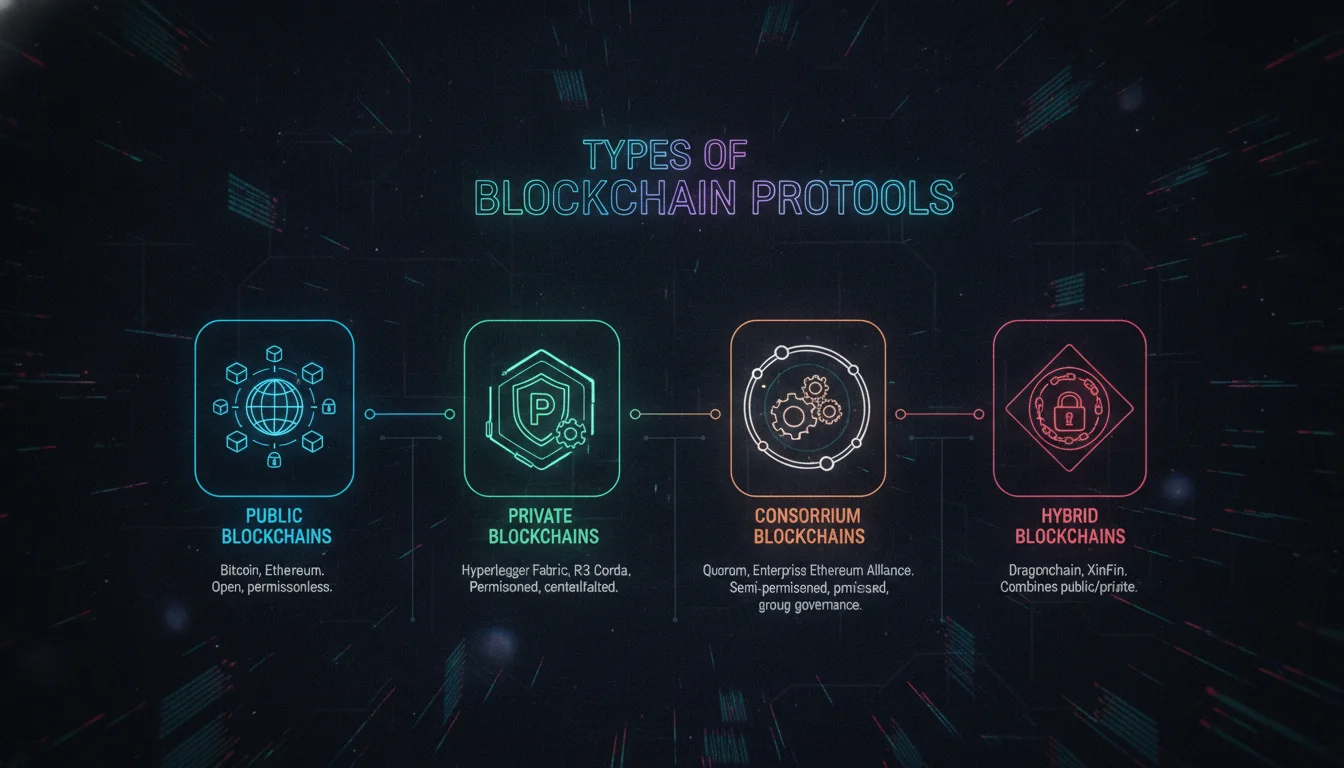
Public, Private, and Consortium Protocols
Public blockchain protocols are open and permissionless: anyone can join, read, and validate. Private blockchain protocols restrict access to authorized participants and are often used for business. Consortium protocols sit between the two, where a group of organizations shares control. Wikipedia observes that private blockchains have been proposed for business use, though Computerworld criticized marketing of privatized blockchains without a proper security model as snake oil. Others argue that carefully designed permissioned blockchains may be more decentralized and secure in practice than permissionless ones.
The distinction matters because it changes trust assumptions. Public protocols rely on economic incentives and open participation to secure the network. Private protocols rely on legal agreements and known identities. Consortium protocols attempt to combine the benefits of both by limiting participation to a controlled group while retaining distributed validation.
Layer 1 vs. Layer 2 Protocols
Layer 1 blockchain protocols are base networks like Ethereum or Solana that handle settlement and security directly. Layer 2 protocols are built on top of a layer 1 to increase throughput and reduce costs. Alchemy lists 162 blockchains across categories including layer 1 blockchains, layer 2 blockchains, data availability blockchains, and testnets. Base is described as Coinbase’s Ethereum layer-2 for low-cost onchain apps and payments, while Arbitrum is a low-cost layer 2 solution for building secure Ethereum apps.
Layer 2 protocols inherit security from their underlying layer 1 while moving computation off-chain or aggregating transactions. This allows them to offer lower fees and faster settlement without sacrificing the decentralization of the base layer. The rise of layer 2 chains is one of the most significant trends in blockchain protocol design today.
Application-Specific Protocols
Some blockchain protocols target enterprise use cases rather than public cryptocurrencies. Chetu names Hyperledger, Corda, Quorum, and Enterprise Ethereum as enterprise-focused protocols designed for scalability, privacy, and regulatory compliance. These protocols often use permissioned networks and modular architectures to meet business requirements that public chains cannot fulfill.
Application-specific protocols may also optimize for a particular industry, such as supply chain traceability, healthcare records, or financial settlement. By narrowing the use case, developers can tune consensus, privacy, and data models to achieve better performance and compliance than a general-purpose public chain would provide.
Pros and Cons of Blockchain Protocols
Pros
- Trustless security: Cryptographic hashing and distributed consensus make tampering detectable and economically costly to attempt.
- Transparency and auditability: Public blockchain protocols give any participant a verifiable, immutable record of all transactions.
- Programmability: Smart contract support on platforms like Ethereum enables complex financial logic without intermediaries.
- Interoperability potential: Well-specified blockchain protocols create clear interfaces for cross-chain bridges and multi-chain applications.
- Diverse fit: The range from public permissionless to private permissioned protocols means there is a viable option for most use cases.
Cons
- Scalability tradeoffs: Achieving high throughput often requires sacrificing some degree of decentralization or security.
- Energy consumption: Proof of Work protocols require substantial computational power, raising operating costs and regulatory exposure.
- Smart contract risk: Bugs in contract code can be exploited; the protocol itself may be sound while the application layer is not.
- 51% attack surface: Smaller networks remain vulnerable to majority-control attacks, making protocol selection a genuine business risk.
- Governance complexity: Protocol upgrades require broad consensus, which can slow adaptation to new security threats or performance demands.
Major Blockchain Protocols Compared
The following table compares leading blockchain protocols based on publicly available information from Alchemy, Wikipedia, IBM, and Chetu. It is not exhaustive, but it illustrates the diversity of protocol designs.
| Protocol | Type / Launch | Consensus | Key Features | Example Use Cases |
|---|---|---|---|---|
| Bitcoin | Public Layer 1 (2008) | Proof of Work | First decentralized cryptocurrency; secure, immutable ledger | Digital currency, store of value |
| Ethereum | Public Layer 1 (2015) | Proof of Stake (post-Merge) | Smart contracts, DeFi, NFTs | dApps, tokenization, DAOs |
| Solana | Public Layer 1 | Proof of History + PoS | Highly scalable, fast transaction speeds | High-throughput DeFi, gaming |
| Polygon | Layer 2 / sidechain on Ethereum | Proof of Stake | $0.002 average transaction costs, fast settlement | Global payments, Ethereum scaling |
| BNB Smart Chain | EVM-compatible Layer 1 | Proof of Staked Authority | High-throughput, low gas fees, sub-second finality | DeFi, payments, BNB ecosystem |
| Hyperledger Fabric | Permissioned enterprise | Pluggable consensus | Privacy, modular architecture | Supply chain, finance, healthcare |
Bitcoin and the Proof-of-Work Standard
Bitcoin was created in 2008 by Satoshi Nakamoto as a public distributed ledger for bitcoin cryptocurrency transactions. According to Wikipedia, it was based on previous work by Stuart Haber, W. Scott Stornetta, and Dave Bayer, and it solved the double-spending problem without a trusted authority. Bitcoin’s protocol uses Proof of Work, where miners solve cryptographic puzzles to validate transactions and add blocks. Its design prioritizes security and decentralization over transaction throughput.
Ethereum and Smart Contract Platforms
Ethereum launched in 2015 and expanded blockchain use beyond currency by supporting smart contracts. IBM notes that Ethereum’s development broadened blockchain applications into real estate, finance, supply chain, healthcare, and voting. Ethereum is now the foundation for decentralized finance (DeFi) and non-fungible tokens (NFTs), and many layer 2 blockchain protocols build on it to address scalability. If you want to understand how Ethereum’s token standards work in practice, our breakdown of smart contract architecture goes deeper on the ERC standard ecosystem.
Hyperledger, Corda, and Enterprise Options
Enterprise blockchain protocols like Hyperledger, Corda, Quorum, and Enterprise Ethereum are designed for privacy, scalability, and regulatory compliance. Chetu emphasizes that these protocols differ from public cryptocurrencies because they restrict access and tailor consensus for business workflows. A supply chain consortium might use Hyperledger Fabric to share data among known participants without exposing sensitive information to the public. The permissioned model trades censorship resistance for auditability and access control.
Consensus Mechanisms: Proof of Work, Proof of Stake, and Beyond
Proof of Work Explained
Proof of Work is a consensus mechanism where a computer must solve complex puzzles to create new blocks. Chetu explains that the work is easy to check but hard to create, which keeps networks honest. In Bitcoin, Proof of Work secures the network and validates transactions, making attacks expensive. However, it consumes significant energy and is not always ideal for enterprise systems.
The asymmetry in Proof of Work is the core insight. It ensures that anyone can verify the chain’s validity without trusting the miner, but creating a fraudulent block requires enormous computational power. This makes rewriting history prohibitively expensive on large networks.
Proof of Stake and Alternative Models
Proof of Stake is an alternative where validators are chosen based on the assets they stake. GeeksforGeeks lists Proof of Stake alongside Proof of Work as common consensus mechanisms. Modern blockchain protocols use variations such as delegated proof of stake, proof of authority, and proof of history to improve speed and reduce energy use. The specific model affects finality, decentralization, and security.
Alternative models often trade some decentralization for faster finality or lower energy consumption. Delegated proof of stake allows token holders to elect a smaller set of validators, increasing throughput but concentrating power. Proof of authority relies on known, trusted entities, which suits enterprise networks but reduces censorship resistance.
The Energy and Security Tradeoff
Proof of Work prioritizes security but requires substantial computational power. Chetu notes that as of 2026, many enterprise systems are exploring alternatives to Proof of Work. The tradeoff is not simple: some newer consensus models sacrifice a degree of decentralization for higher throughput. Selecting a protocol means evaluating which tradeoffs align with the use case.
Energy consumption is not just an environmental concern. It also affects operating costs and regulatory exposure. Public networks with high energy use may face scrutiny, while permissioned networks with efficient consensus may be easier to deploy in regulated industries. The right choice depends on whether the application needs open, censorship-resistant validation or controlled, efficient settlement.
Security Threats and 51% Attacks in Blockchain Protocols
How 51% Attacks Work
A 51% attack occurs when one entity controls more than half of a network’s validating power. Chetu explains that this allows the entity to manipulate outcomes. For large networks like Ethereum or Bitcoin, such an attack is economically unrealistic, but smaller networks have experienced it. This makes protocol selection a business risk, not just a technical detail.
Attackers with majority hash power or stake can reverse transactions, double-spend coins, or prevent new transactions from being confirmed. The cost of such an attack is directly tied to the protocol’s security model and network size. This is why decentralization, spreading validating power across many independent parties, is so important in any well-designed blockchain protocol.
Smart Contract Risks and Protocol Vulnerabilities
Smart contracts automate trust but are not perfect. Chetu advises that when designed carefully they reduce friction, but vulnerabilities can be exploited. Protocol-level risks also include cryptographic weaknesses, consensus bugs, and governance attacks. NIST’s tamper-evident design helps detect changes, but it does not eliminate all risks.
Smart contract exploits often stem from coding errors or flawed logic rather than weaknesses in the underlying blockchain protocol. However, some protocol-level vulnerabilities, such as flaws in cross-chain bridges or consensus implementations, have led to significant losses. Continuous auditing and formal verification are becoming standard practices for high-value protocols.
Mitigations and Best Practices
Best practices include choosing blockchain protocols with strong decentralization, hardened cryptography, and active security audits. For enterprises, permissioned models can reduce attack surfaces, but they also concentrate trust. Ongoing monitoring and protocol upgrades are essential, as the protocol landscape evolves rapidly.
Developers should also consider the maturity of a protocol’s security tooling, the availability of bug bounties, and the responsiveness of its core maintainers. No protocol is immune to all threats, but those with transparent governance and rapid patch cycles are better positioned to respond when issues arise.
“The right blockchain protocol is not the fastest or the cheapest. It’s the one whose security model, consensus design, and governance structure match what your application actually needs.” – Amin Ferdowsi, Digital Blockchains
How to Choose Among Blockchain Protocols
Matching Protocols to Use Cases
There is no single best blockchain protocol. Public protocols like Bitcoin and Ethereum offer openness and censorship resistance. Enterprise protocols like Hyperledger prioritize privacy and compliance. Chetu recommends building on established blockchain protocols to save time, lower costs, and reduce risk compared with building foundational infrastructure from scratch.
The choice depends on what the application must deliver. A global payments network may prioritize sub-second finality and low fees. A supply chain consortium may prioritize privacy and regulatory compliance. A DeFi protocol may prioritize composability with existing Ethereum tooling. Understanding these tradeoffs is the foundation of sound protocol selection. For a deeper look at how tokenomics interacts with protocol choice, see our tokenomics design resources on the Digital Blockchains blog.
Evaluation Criteria for Developers
Follow these steps to evaluate blockchain protocols systematically:
- Step 1: Define transaction volume, latency, privacy, and regulatory requirements.
- Step 2: Compare consensus mechanisms and security models, including network size and attack resistance.
- Step 3: Assess ecosystem maturity, developer tooling, and interoperability with existing systems.
- Step 4: Evaluate governance, upgradeability, and long-term viability.
This structured approach prevents teams from being swayed by hype or vendor marketing. A protocol that excels in one dimension may be weak in another, and the best choice is always use-case dependent.
The Evolution Ahead
Blockchain protocols continue to evolve. According to a Statista report cited by IBM, blockchain technology is forecast to grow by nearly $1 trillion by 2032, with a compound annual growth rate of 56.1% since 2021. Chainstack supports over 70 blockchain protocols, and Alchemy lists 162 blockchains as of 2026, reflecting rapid expansion. Integration with artificial intelligence and the Internet of Things is expected to drive further protocol innovation.
As the number of blockchain protocols grows, so does the need for clear evaluation frameworks. The winners will not necessarily be the fastest or cheapest chains, but those that balance security, decentralization, and developer experience in ways that match real-world demand.
Frequently Asked Questions
What is a blockchain protocol?
A blockchain protocol is a set of rules that governs how data is recorded, shared, and secured on a blockchain network. It defines transaction validation, consensus, node communication, and incentives, enabling decentralized systems to operate without a central authority.
What are the main types of blockchain protocols?
Main types include public permissionless, private permissioned, consortium, layer 1, and layer 2 protocols. Each balances transparency, privacy, and scalability differently depending on the trust model and use case.
How do Proof of Work and Proof of Stake differ?
Proof of Work requires solving computational puzzles to validate blocks, while Proof of Stake selects validators based on staked assets. Proof of Stake reduces energy consumption and is used by many modern blockchain protocols, including Ethereum after its Merge upgrade.
What are some examples of blockchain protocols?
Examples include Bitcoin, Ethereum, Solana, Polygon, BNB Smart Chain, Hyperledger Fabric, and Corda. Chainstack supports over 70 blockchain protocols, and Alchemy lists 162 blockchains across layer 1, layer 2, and data availability categories.
How do blockchain protocols ensure security?
They combine consensus mechanisms, cryptographic hashing, and distributed nodes to prevent tampering. NIST notes that records are tamper-evident and tamper-resistant, and the economic cost of attacking large networks makes most exploits impractical.
What should I consider when choosing a blockchain protocol?
Consider transaction throughput, finality speed, cost, privacy requirements, regulatory compliance, and developer ecosystem maturity. Enterprise protocols often prioritize privacy and compliance over openness, while public protocols prioritize censorship resistance and composability.
Ready to build on the right protocol from day one? Apply to the Genesis Cohort at digitalblockchains.com and work with a team that reads whitepapers before selecting a stack.