Blockchain in banking is the application of distributed ledger technology to record, verify, and settle financial transactions without a central intermediary. It reduces costs, strengthens security, and enables near-instant settlement across a shared, tamper-resistant ledger.
Key Takeaways
- in banking uses distributed ledger technology to record, verify, and settle financial transactions without a central intermediary.
- Core benefits include lower transaction costs, stronger fraud prevention, improved transparency, and near-instant settlement.
- Primary use cases include Know Your Customer (KYC), cross-border payments, trade finance, clearing and settlement, syndicated loans, and smart contracts.
- Adoption faces real hurdles: scalability constraints, energy consumption, regulatory uncertainty, and legacy system integration.
- Banks typically favor private or consortium ledgers over public blockchains due to compliance and privacy requirements.
What Is Blockchain in Banking?
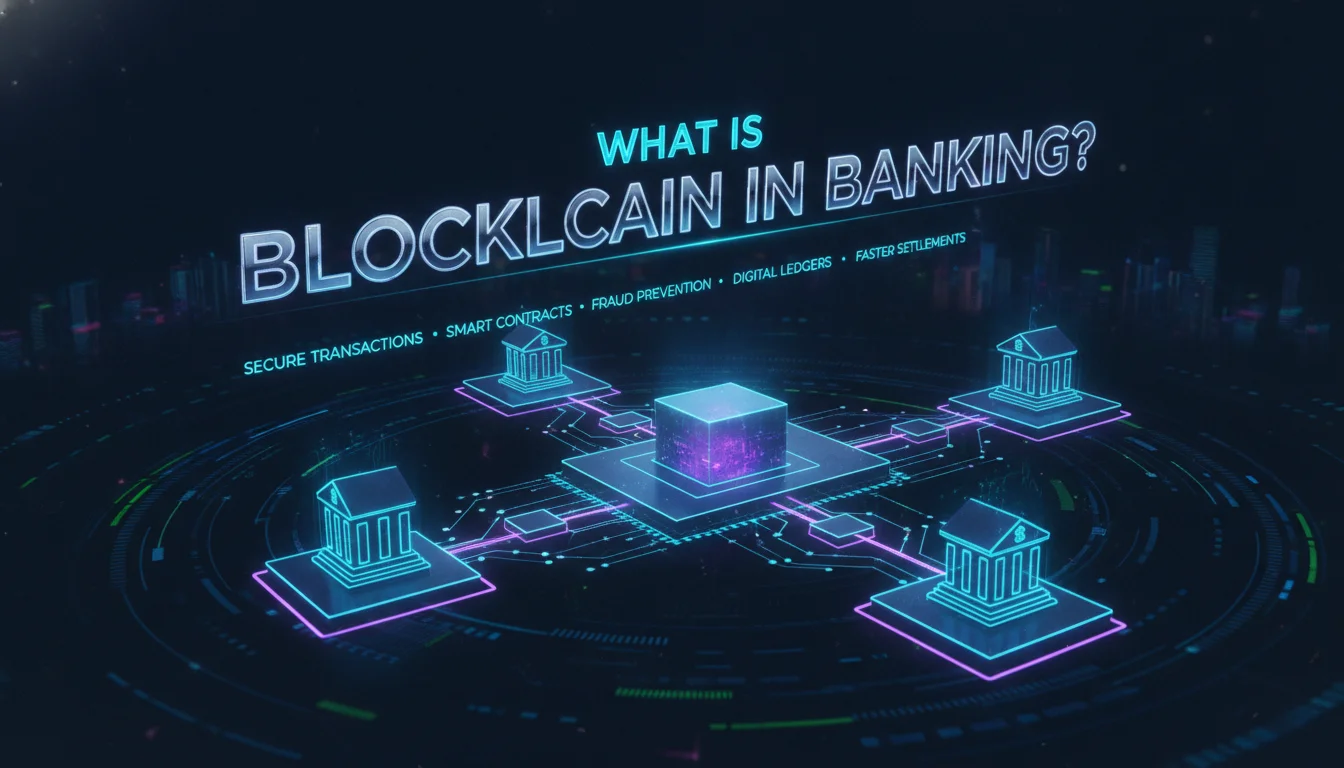
Defining Blockchain in Banking
this type of banking is the use of a decentralized, immutable ledger system to record transactions across a network of computers. According to Investopedia, a blockchain is a decentralized digital database or ledger that securely stores records across a network of computers in a way that is transparent, immutable, and resistant to tampering. Each block contains data, and blocks are linked in a chronological chain. In a banking context, this technology allows banks to maintain a shared, tamper-resistant record of transactions rather than each institution keeping its own private ledger and reconciling differences later.
The term this kind of banking covers both the technology itself and the operational changes banks undergo when they adopt distributed ledger systems. It is not a single product or platform. It is an architectural shift in how financial data is stored, shared, and verified. Banks can use public blockchains, private permissioned ledgers, or consortium networks depending on their regulatory and operational needs.
From Centralized Ledgers to Distributed Trust
Traditional banking relies on centralized databases maintained by individual institutions. Every payment, settlement, and trade requires a web of institutions – banks, clearinghouses, and custodians – to agree on who owns what, and when. According to Chainlink, each of these institutions maintains its own private ledger of the same events. This constant comparison of records is known as reconciliation: the process of matching internal records across multiple parties to identify and resolve discrepancies.
blockchain in replaces this model with a single shared ledger state. When Bank A and Bank B both reference the same distributed ledger, they no longer need to exchange messages and compare separate databases. A blockchain-based workflow allows both institutions to reference one shared, tamper-resistant record. This shared recordkeeping reduces duplicative reporting and reconciliation, which in turn reduces operational risk and processing time. Per Chainlink, back-office reconciliation complexity costs the industry billions each year – a problem a shared ledger directly addresses.
How Blockchain in Banking Works
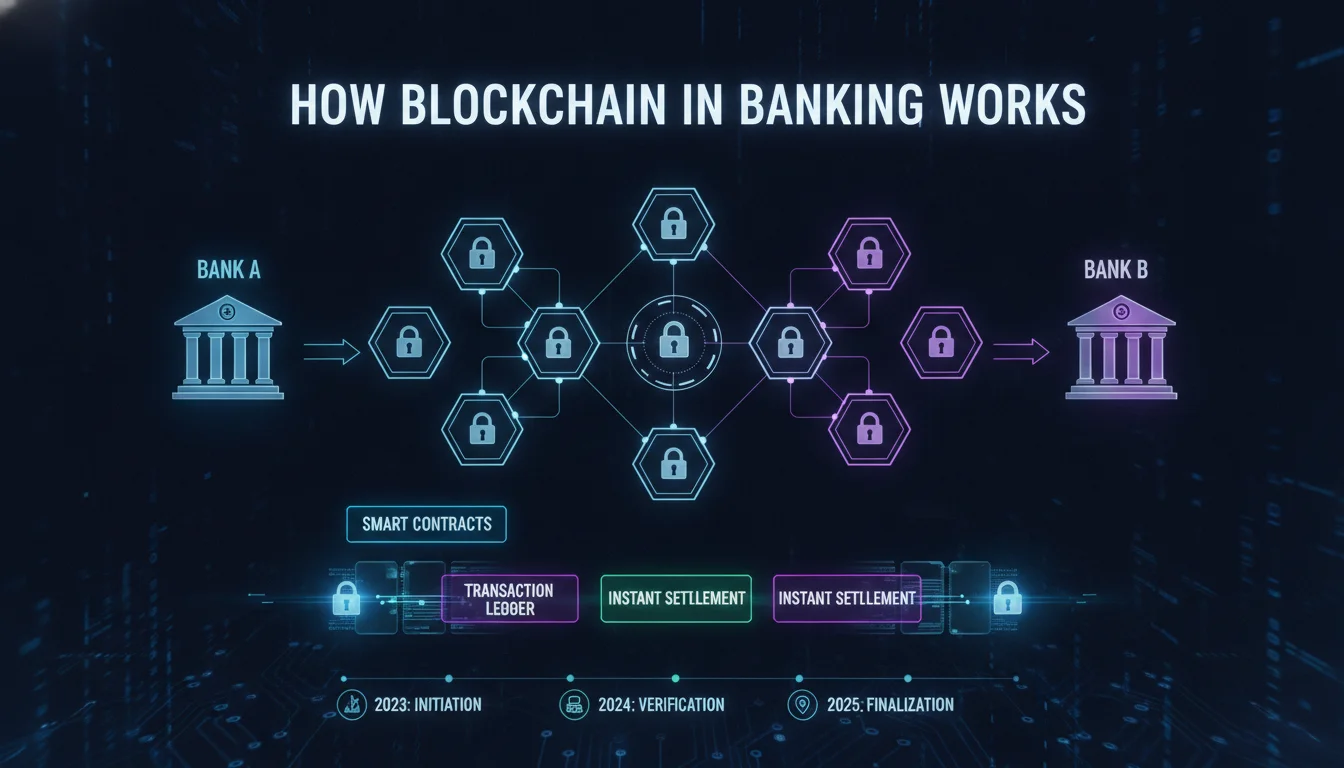
Shared Ledger and Consensus Mechanisms
A blockchain is a digital ledger technology where transactions are recorded across a decentralized network of computers. Unlike traditional systems, blockchain entries are immutable: once a transaction is verified and added to the chain, it cannot be altered or deleted. This creates a secure and transparent record that is resistant to tampering or fraud. In banking, every participant in a network can view the same transaction history, but no single party can unilaterally change it.
Consensus mechanisms are the rules by which network participants agree on the validity of transactions. Public permissionless blockchains use open consensus such as proof of work or proof of stake, while private and consortium blockchains use controlled consensus among known participants. The choice of consensus directly affects scalability, security, and energy consumption – trade-offs often described as the blockchain trilemma.
A Step-by-Step Transaction Flow
A typical blockchain-based transaction in banking follows these steps:
- Transaction initiation: A bank or customer submits a payment, trade, or loan instruction to the blockchain network.
- Validation: Network participants verify the transaction against agreed rules, such as available balances or contract terms.
- Block formation: Valid transactions are grouped into a cryptographically secured block.
- Consensus: Participants reach agreement that the block is valid and should be added to the chain.
- Immutability: The block is appended to the chain, and the transaction becomes a permanent, tamper-resistant record. Settlement is near-instantaneous rather than taking days.
This flow removes the need for sequential messaging and manual reconciliation. A wire transfer that can take days to settle in traditional systems can settle in minutes or seconds on a blockchain network.
Programmability and Smart Contracts
A smart contract is a self-executing contract with terms directly written into code. Once predefined conditions are met, the contract automatically executes the agreed action – such as releasing funds when a digital asset is delivered. According to Consensys, smart contracts are tamper-proof, deterministic software that automates business logic. In blockchain in banking, smart contracts enable programmable loans, automated compliance checks, and conditional settlement without manual intervention.
Key Benefits of Blockchain in Banking
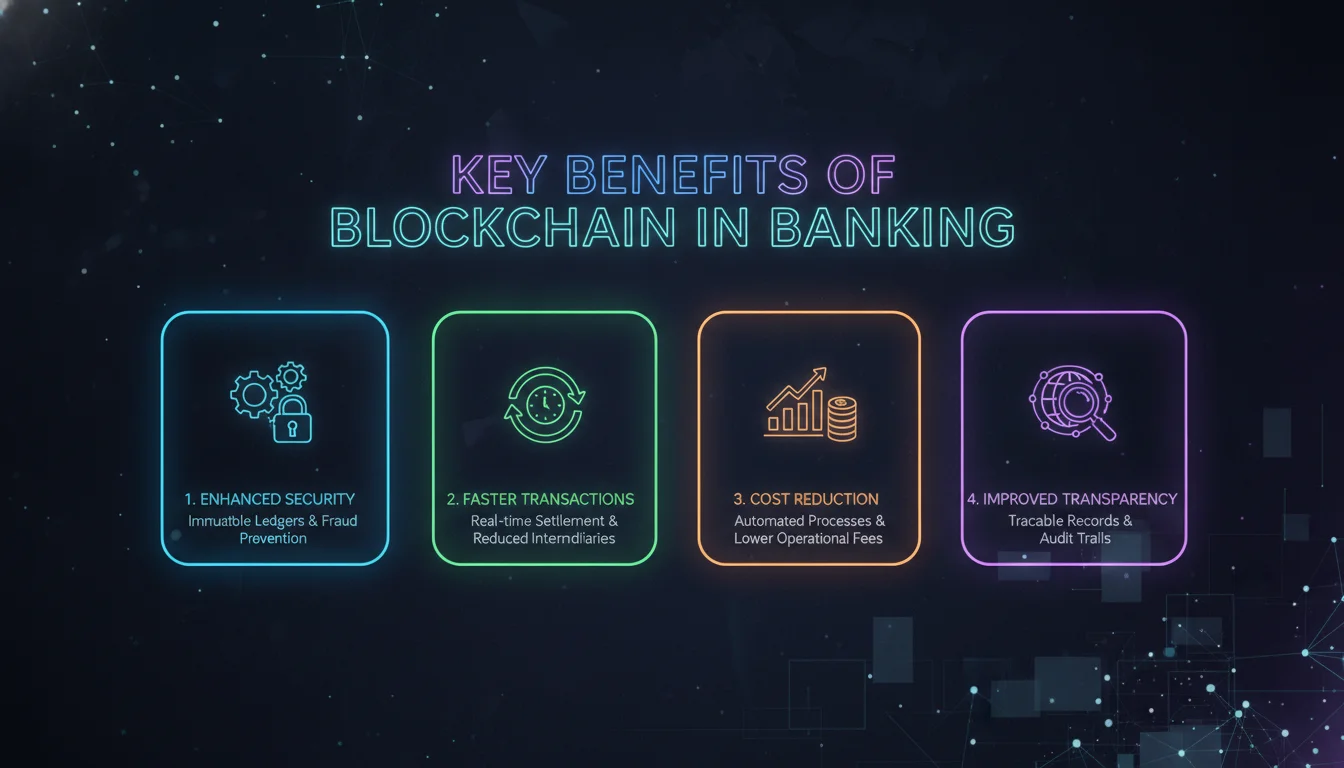
Cost Reduction and Operational Efficiency
Blockchain can automate many processes, from transaction verification to compliance, significantly reducing manual errors and administrative tasks. This efficiency cuts costs for banks and enables faster transaction settlements. By eliminating intermediaries, blockchain lowers the costs of cross-border payments, clearing and settlement, and trade finance. According to the Harvard Law School Forum on Corporate Governance, standardized blockchain solutions can eliminate friction in transactions, reduce back-end costs and labor hours, and dramatically increase transaction speed and security.
These savings can be passed on to consumers through lower fees. For banks, reduced reconciliation work translates directly into lower operational costs. The shift from batch processing and multi-day settlement to near-real-time finality also reduces the capital banks must hold against settlement risk.
Security, Fraud Prevention, and Immutability
The tamper-proof nature of blockchain ensures transaction authenticity, making it nearly impossible for bad actors to manipulate data. Once a transaction is recorded, it cannot be altered or deleted without detection. This heightened security reduces fraud risk in payments, lending, and identity verification. According to Consensys, distributed consensus architecture eliminates single points of failure and reduces the need for data intermediaries such as transfer agents and messaging system operators.
Immutability strengthens traceability and audit controls across blockchain in banking implementations. Banks can prove exactly when and how a transaction was executed, which is valuable for regulatory reporting and dispute resolution.
Transparency, Auditability, and Trust
A shared ledger provides a single source of truth for all network participants. Transparency is not just about seeing transactions – it is about mutualized standards, protocols, and shared processes. When banks reference the same tamper-resistant ledger state, they can collaborate more easily, manage data consistently, and reach agreement without manual reconciliation. This transparency may boost trust while reducing the risk of fraud and errors in the banking sector.
Auditability is enhanced because blockchain records every state change in a chronological chain. Regulators and internal auditors can inspect the full history without relying on fragmented reports from multiple systems. The result is a more resilient and trustworthy financial infrastructure.
Pros and Cons of Blockchain in Banking
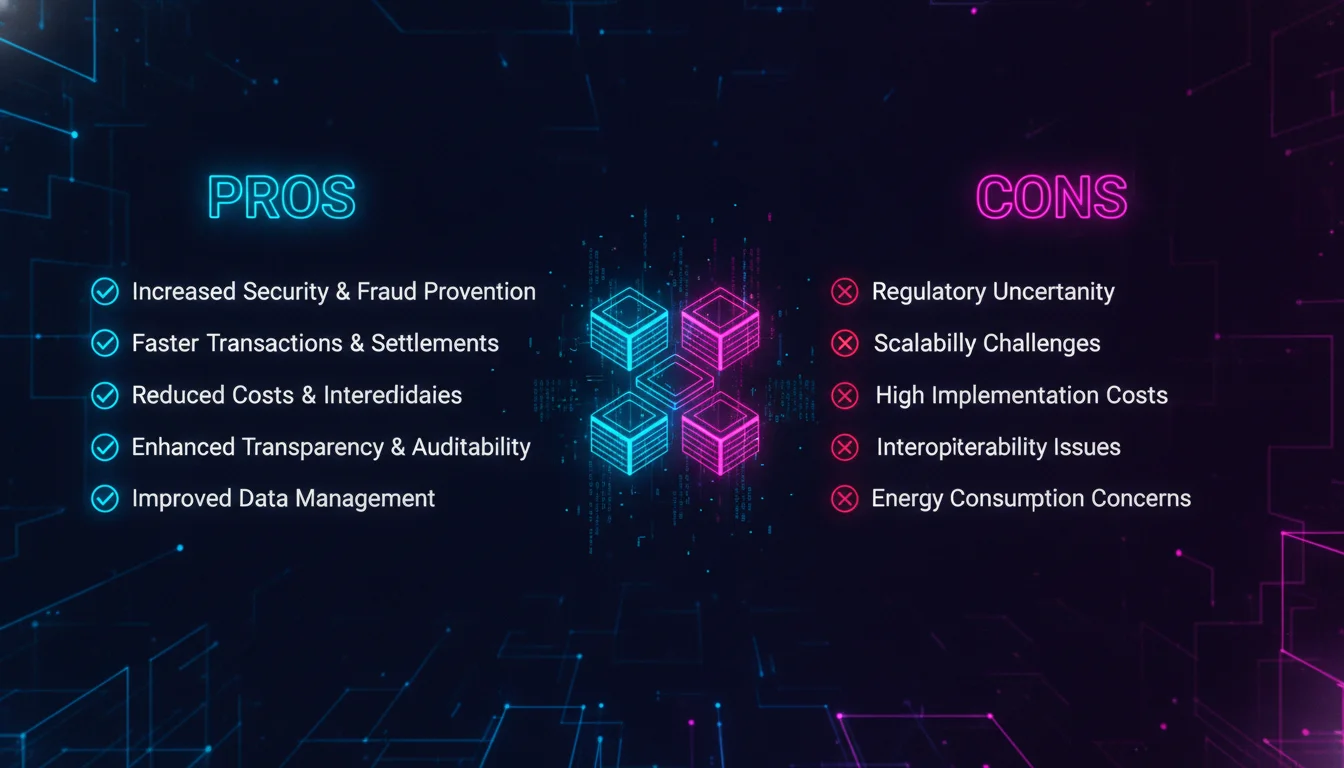
Pros
- Lower transaction costs: Eliminating intermediaries and automating reconciliation reduces fees across cross-border payments, trade finance, and clearing.
- Near-instant settlement: Transactions that take days in traditional systems can settle in minutes or seconds on a distributed ledger.
- Stronger fraud prevention: Immutable records and distributed consensus make data manipulation extremely difficult to execute without detection.
- Programmable compliance: Smart contracts automate covenant checks, KYC verification, and conditional fund release, reducing manual overhead.
- Improved auditability: Every state change is recorded chronologically, giving regulators and auditors a complete, tamper-resistant history.
Cons
- Scalability constraints: Public blockchains struggle to process the transaction volumes that large banks handle daily, and the blockchain trilemma makes this difficult to resolve without trade-offs.
- Regulatory uncertainty: Key legal questions around data privacy, financial reporting, and distributed ledger governance remain unresolved in most jurisdictions.
- Legacy integration complexity: Connecting distributed ledgers to decades-old mainframe infrastructure is costly and technically demanding.
- Energy consumption: Proof-of-work consensus mechanisms carry significant environmental costs, though enterprise blockchains increasingly use more efficient alternatives.
- Slower-than-expected adoption: Many blockchain experiments in banking have stalled at the proof-of-concept stage, and production deployments remain limited.
Primary Use Cases of Blockchain in Banking
Know Your Customer (KYC) and Identity Verification
KYC is the regulatory process banks use to verify the identity of their customers, and blockchain in banking can make it dramatically more efficient. Today, each bank performs its own KYC checks, which leads to duplicated effort and inconsistent data. Blockchain allows multiple institutions to reference the same verified customer identity on a shared ledger. According to the IEEE, KYC is one of the most prominent use cases for blockchain in banking. A shared, permissioned identity record reduces duplication, speeds onboarding, and improves compliance with anti-money laundering rules.
Cross-Border Payments and Remittances
Cross-border payments traditionally require multiple correspondent banks, each adding fees, time, and operational risk. Blockchain enables near-instant global access to funds and reduces counterparty risk. According to Investopedia, major financial institutions have been developing blockchain services particularly in cross-border payments. The shared ledger eliminates the need for intermediaries to pass messages and reconcile balances, which lowers cost and increases speed.
Trade Finance, Clearing, and Settlement
Trade finance involves multiple parties – importers, exporters, banks, insurers, and customs authorities – all of whom must share documents and agree on the same facts. A blockchain-based workflow allows all parties to reference a single, shared ledger state, reducing document fraud and processing delays. Clearing and settlement, which traditionally take two to three business days for securities trades, can be compressed to near-real-time finality. According to Chainlink, blockchain is increasingly explored as a way to address these coordination challenges by introducing a shared, tamper-resistant layer that enables institutions to synchronize records and automate execution.
Lending and Syndicated Loans
Blockchain-based lending can provide a secure way of offering loans to a broader pool of consumers while lowering costs for all parties. In syndicated loans, multiple banks jointly fund a single borrower. Coordination among lenders is complex and document-heavy. Smart contracts can automate interest payments, covenant checks, and distribution of funds, reducing administrative burden. According to the IEEE, syndicated loans are another key use case for blockchain in banking. Programmable loan terms encoded in smart contracts could allow for new financial services that respond to real-time conditions.
Types of Blockchains Used in Banking
Public, Private, and Consortium Ledgers
According to the IEEE, there are three types of blockchain used in banking: public, private, and consortium or federated. A public blockchain is permissionless – anyone can join, read, and participate in consensus. Bitcoin and Ethereum are examples. A private blockchain is permissioned and controlled by a single organization, which grants access to known participants. A consortium blockchain is a hybrid in which a group of institutions jointly governs the network.
The Harvard Law School Forum on Corporate Governance makes a similar distinction between public, permissionless blockchains and private, permissioned blockchains controlled by one or more entities. Banks often prefer permissioned or consortium models because they offer greater control over privacy, compliance, and governance.
Comparison Table
| Type | Control | Access | Typical Banking Application |
|---|---|---|---|
| Public permissionless | Decentralized, no single owner | Open to anyone | Cryptocurrency settlement, open DeFi lending |
| Private permissioned | Single organization or bank | Restricted to approved participants | Internal KYC, interbank transfers |
| Consortium / federated | Group of banks or institutions | Restricted to consortium members | Trade finance, syndicated loans, clearing and settlement |
Selecting the Right Architecture
The choice of blockchain architecture depends on the use case, regulatory environment, and the level of trust among participants. Public blockchains offer maximum transparency and censorship resistance but raise privacy and compliance concerns for regulated banks. Private and consortium blockchains provide controlled access and faster consensus but may reintroduce some centralization. According to the Harvard Law School Forum, both public and private blockchains can be implemented across a variety of use cases in the financial world, opening up new sectors of banking services that benefit both banks and customers by allowing faster, cheaper, more secure, and more inclusive transactions.
Challenges and Limitations of Blockchain in Banking
Scalability and the Blockchain Trilemma
Scalability is one of the most persistent technical barriers to broader blockchain in banking adoption. Blockchain 3.0, the generation related to expansive banking use, requires more network capacity. The blockchain trilemma is the inherent trade-off among decentralization, security, and scalability. Improving one often degrades another. Public blockchains in particular struggle to process the transaction volumes that large banks handle daily. According to Investopedia, technical challenges around scalability remain barriers to widespread adoption in banking.
Regulatory Uncertainty and Privacy
Regulatory uncertainty is one of the biggest obstacles to blockchain in banking. Banks operate under strict rules on data privacy, financial reporting, and anti-money laundering. Public blockchains make all transaction data visible, which conflicts with privacy and data protection laws. Permissioned networks can restrict visibility, but regulators still need clarity on how distributed ledgers fit into existing legal frameworks. According to the Harvard Law School Forum, this new landscape lacks clarity in key legal areas, and legal questions need to be resolved before wider adoption can occur.
Legacy Integration and Energy Consumption
Traditional banking systems are built on decades-old mainframe infrastructure. Integrating blockchain with these legacy systems is complex and costly. Banks must maintain interoperability between existing payment rails, core banking platforms, and new distributed ledgers. High energy consumption is another concern, particularly for proof-of-work public blockchains. Although many enterprise and banking blockchains use more efficient consensus mechanisms, the environmental impact of the broader industry remains a point of criticism. These operational challenges mean that adoption has been slower than initially anticipated.
Real-World Bank Adoption and Initiatives
Pilot Programs at Major Financial Institutions
Several major banks have moved beyond theory to pilot blockchain services. According to Investopedia, JPMorgan Chase and Goldman Sachs have been developing blockchain services, particularly in areas like cross-border payments, KYC verification, and trade finance. These initiatives focus on private and consortium networks rather than public blockchains, reflecting the need for regulatory compliance and data privacy.
“This is revolutionary technology. What we do with the revolution, the industry is still coming to terms with. Hopefully, organisations will be able to harness the power of this technology for the advancement of the society and community, especially banks to make global trade and financial services much stronger to help connect communities and help our societies grow.”
CBDCs and National Digital Currency Projects
A central bank digital currency (CBDC) is a digital form of a country’s fiat currency issued and backed by its central bank. CBDCs can use blockchain or distributed ledger technology to improve payment efficiency and financial inclusion. According to the Harvard Law School Forum, China has been pushing forward its digital yuan, and the need for policy action to secure the United States’ lead in cryptoasset innovation is critical as international competition intensifies. CBDC development will affect the relationship between commercial banks and central banks, potentially reshaping the traditional two-tier banking system.
“Blockchains, both public and private, can be implemented across a variety of use cases in the financial world, opening up new sectors of banking services that benefit both banks and customers by allowing faster, cheaper, more secure and more inclusive transactions.”
Standardization and Industry Collaboration
For blockchain in banking to scale, institutions must agree on common standards. Standardization of industry solutions through the use of both public and private blockchains can eliminate friction in transactions and reduce back-end costs. According to the Harvard Law School Forum, collaboration between financial services companies and regulators is essential to reap the rewards of this next-generation technology. The financial services industry will then be able to expand its offerings, create new profit centers, and provide new levels of service for customers both existing and previously unreached.
Blockchain in Capital Markets and Adjacent Sectors
Capital Markets and Asset Management
Beyond retail and commercial banking, blockchain in banking extends into capital markets infrastructure. According to Consensys, the Ethereum blockchain enables digital securities to be issued within shorter periods of time, at lower unit costs, and with greater levels of customization. Digital financial instruments can be tailored to investor demands, expanding the market for investors, decreasing costs for issuers, and reducing counterparty risk. Asset management operations – fund administration, transfer agency, and custody – are all candidates for distributed ledger efficiency gains.
The same properties that make blockchain useful for payments apply directly to securities settlement. A shared, tamper-resistant record of ownership eliminates the reconciliation burden between custodians, brokers, and clearinghouses. As of 2026, capital markets remain one of the most active areas of blockchain experimentation among institutional financial firms.
Insurance and Trade Finance Extensions
Blockchain’s utility is not confined to banking alone. Insurance is another sector where shared ledger technology can reduce fraud, automate claims processing through smart contracts, and improve data consistency across underwriters and reinsurers. Trade finance, which sits at the intersection of banking and commerce, benefits from the same document-sharing and verification properties that make blockchain attractive for KYC and syndicated lending. These adjacent applications reinforce why financial institutions are investing in consortium infrastructure rather than isolated, bank-specific deployments.
The Future of Blockchain in Banking
From Proof of Concept to Production Systems
Many blockchain experiments in banking have remained in the proof-of-concept stage. According to the BBC, the application of the technology is still in the proof of concept stage, but it could play a positive role in a diverse range of industries. For banking, real-time settlement capability, reduced counterparty risk, and enhanced automation are among the most important advances. The shift from pilot to production depends on resolving scalability, regulatory, and integration challenges.
Strategic Considerations for Banks
Banks that adopt blockchain early may gain a competitive advantage in cost, speed, and product innovation. Adoption requires careful planning, though. Institutions must decide whether to build on public networks, deploy private ledgers, or join consortia. They must also invest in talent, compliance frameworks, and interoperability with existing systems. The future of blockchain in banking is not about replacing banks. It is about giving them a shared, tamper-resistant execution and coordination layer that works alongside existing financial infrastructure. According to Chainlink, blockchain’s role in banking is evolving into an execution and coordination layer rather than a wholesale replacement of legacy systems.
If you are building protocol infrastructure, tokenomics models, or distributed ledger solutions for financial services, explore how Digital Blockchains approaches this space at our studio or review our build process.
Frequently Asked Questions
What is blockchain in banking?
Blockchain in banking is the use of distributed ledger technology to record, verify, and settle financial transactions across a decentralized network of computers. It reduces the need for intermediaries, lowers costs, and improves transaction security and auditability.
What are the four types of blockchain?
While some sources describe four types – public, private, consortium, and hybrid – the IEEE specifically identifies three types used in banking: public, private, and consortium or federated. A hybrid blockchain combines features of public and private networks and is sometimes listed as a fourth category.
Can I withdraw money from blockchain to my bank account?
Yes. If you hold cryptocurrency on a public blockchain, you can transfer it to an exchange that supports fiat withdrawals to a bank account. The transaction requires an exchange or off-ramp service that links your blockchain wallet to traditional banking rails.
Are any banks using blockchain?
Yes. According to Investopedia, JPMorgan Chase and Goldman Sachs have been developing blockchain services for cross-border payments, KYC, and trade finance. Standard Chartered Bank has also explored blockchain for global trade and transaction efficiency, as noted by BBC StoryWorks.
What are the main benefits of blockchain in banking?
The main benefits include lower transaction costs, stronger fraud prevention, improved transparency, faster settlement, and reduced counterparty risk. Blockchain also enables programmable smart contracts that automate compliance and settlement without manual intervention.
What challenges does blockchain face in banking?
Challenges include scalability limitations, high energy consumption for proof-of-work systems, regulatory uncertainty, privacy concerns, and the complexity of integrating distributed ledgers with legacy banking infrastructure. These factors have slowed adoption despite the technology’s clear potential.