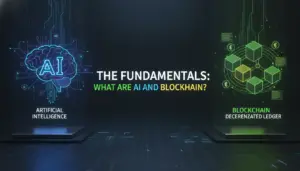
AI in blockchain is the combination of machine learning systems with distributed ledger technology to build networks that are more secure, more auditable, and more automated. Blockchain gives AI a tamper-proof record. AI gives blockchain pattern recognition and speed.
Key Takeaways
- in blockchain combines machine learning with distributed ledger technology to improve security, auditability, and automation.
- Blockchain gives AI a tamper-proof audit trail for data and models, addressing explainability and trust gaps that have slowed enterprise AI adoption.
- AI strengthens blockchain scalability, consensus efficiency, and fraud detection through pattern recognition and real-time monitoring.
- Practical implementations of ai in blockchain span healthcare, life sciences, financial services, and supply chain management.
- The convergence is still maturing. Scalability, interoperability, and governance remain open problems, but one technology replacing the other looks unlikely.
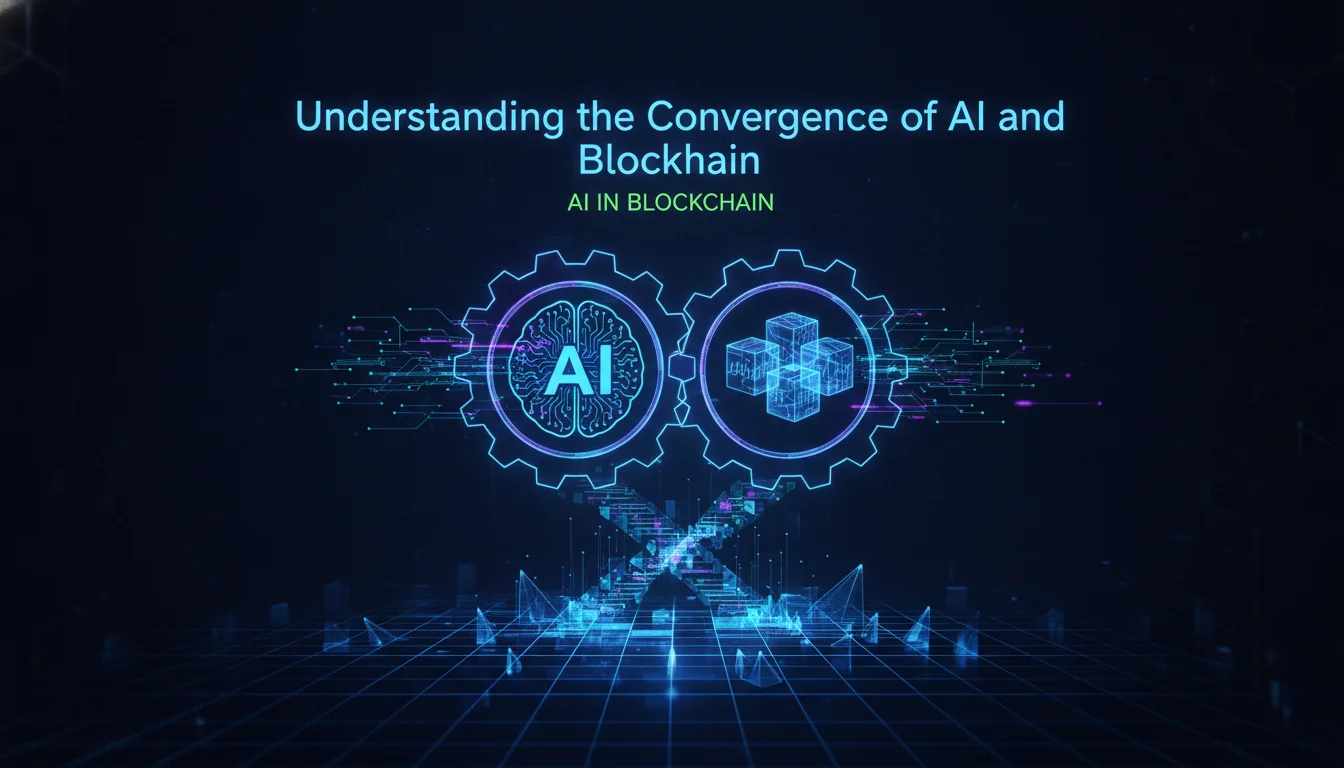
Understanding the Convergence of AI and Blockchain
Defining AI and Blockchain
Blockchain is a shared, immutable ledger that provides an immediate, transparent exchange of encrypted data to multiple parties as they initiate and complete transactions. According to IBM’s Think blog, a blockchain network can track orders, payments, accounts, production, and more, letting permissioned members share a single view of the truth. That shared view builds confidence in transactions between businesses and opens up new efficiencies.
Artificial intelligence uses computers, data, and sometimes machines to mimic the problem-solving and decision-making capabilities of the human mind. AI covers sub-fields like machine learning and deep learning, where algorithms trained on data make predictions or classifications. The core benefits are automation of repetitive tasks, better decision-making, and a smoother customer experience.
Why These Technologies Reinforce Each Other
The convergence of ai in blockchain isn’t a forced pairing. It’s a complementary relationship rooted in each technology’s core strengths. Pantera Capital points out that AI and blockchain share a high degree of talent overlap because both fields grew out of branches of math: cryptography for blockchain, statistics for AI. Many founders in Pantera’s blockchain portfolio have AI backgrounds, and plenty of AI leaders have blockchain experience.
Philosophically, blockchain and AI pull in opposite but complementary directions. Pantera quotes OpenAI’s Sam Altman: “AI is indefinite abundance and crypto is definite scarcity.” AI collapses the cost of producing information, enabling infinite content generation, agents, and digital identities. Blockchain uses cryptography and distributed consensus to verify authenticity and enforce ownership, minimizing trust assumptions. Put abundance and scarcity together and you get balance.
“Every major innovation wave has been a convergence: steam and railroads, electricity and manufacturing, automobiles and highways, the internet and smartphones. We believe AI plus blockchain is the next such wave.” – Pantera Capital, The Convergence of AI and Blockchain
A 2024 review published in ScienceDirect highlights that integrating AI into blockchain applications shows promise in addressing key challenges such as security, consensus, and scalability. That research momentum underscores the practical value of combining the two rather than treating them as competing approaches.
IBM’s framework breaks the combined value into three pillars: authenticity, augmentation, and automation. Authenticity comes from blockchain’s digital record, which shows the provenance of data and models. Augmentation comes from AI reading and correlating data at speed. Automation comes from AI models embedded in smart contracts that execute transactions, resolve disputes, or select sustainable shipping methods. These three pillars form the practical foundation for enterprise adoption of ai in blockchain.
How AI Strengthens Blockchain Networks
Security and Fraud Detection
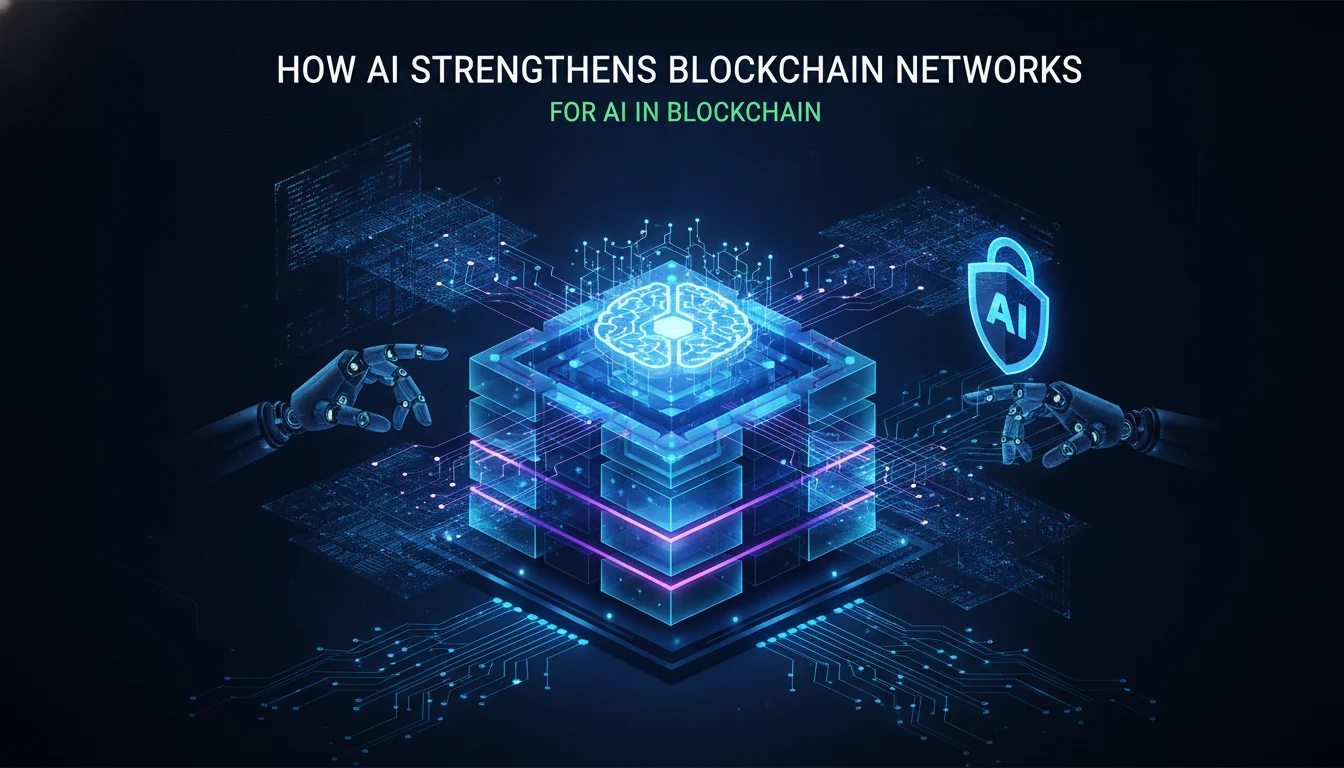
AI strengthens blockchain security by mining large datasets and surfacing patterns in transaction behavior. According to GeeksforGeeks, AI and blockchain together offer a double shield against cyber-attacks. AI can mine a huge dataset, build newer scenarios, and detect anomalies based on data behavior, while blockchain helps remove bugs and fraudulent data sets.
In practice, AI agents scrutinize transaction patterns on blockchain networks to flag suspicious activity such as fraud or money laundering. By profiling wallet behaviors, these agents can detect anomalies suggesting compromised accounts or malicious actors. This real-time monitoring matters most in decentralized applications where trust is spread across many participants with no central authority. New classifiers and patterns created by AI can be verified on decentralized blockchain infrastructure before they’re used in consumer-facing products.
Scalability and Consensus Optimization
AI improves blockchain scalability by predicting network load and helping networks adjust dynamically instead of hitting hard bottlenecks. Every node validating every transaction is expensive, and AI can optimize consensus mechanisms by forecasting demand, adjusting block sizes, or selecting efficient validators. AI-driven models analyze historical transaction data to recommend sharding strategies or off-chain processing paths, cutting latency and improving throughput without sacrificing decentralization.
Specific throughput or latency benchmarks aren’t available in the public research we reviewed, so we won’t manufacture numbers here. What’s consistent across sources is the qualitative case: AI brings a new level of intelligence to blockchain-based business networks by reading, understanding, and correlating data at speed, which is what IBM’s research points to. This capability helps a blockchain network scale toward more actionable insights. The practical result is a network that handles more transaction volume and more complex smart contract logic without falling over.
Smart Contract Analysis and Automation
Smart contracts are self-executing code on a blockchain, but they can carry vulnerabilities that sit undetected for months. AI agents continuously analyze smart contracts for logic errors and reentrancy attacks, alerting developers in real time. AWS notes that AI agents can monitor contracts and transactions to detect vulnerabilities and suspicious patterns, supporting a rapid response.
Beyond security, AI models embedded in smart contracts automate multi-party business processes. IBM describes AI models that recommend expired products for recall, execute transactions like reorders or payments based on set thresholds, resolve disputes, and select the most sustainable shipping method. This is the augmentation and automation value of ai in blockchain: removing friction and adding speed across organizational boundaries that used to require manual reconciliation.
How Blockchain Strengthens AI Systems
Data Integrity and Audit Trails
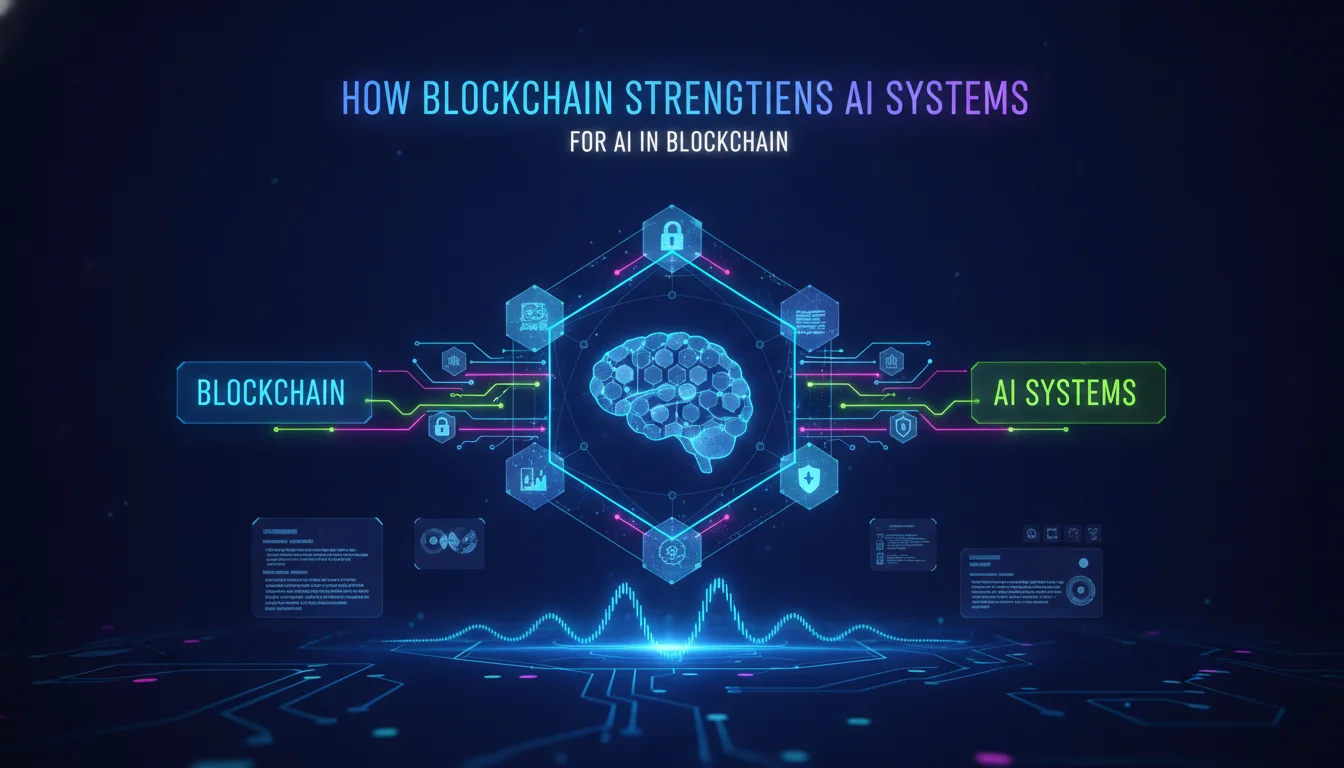
Blockchain strengthens AI by giving it a permanent, tamper-proof record of the data and decisions behind every model output. This directly addresses the explainable AI problem. Storing and distributing AI models on blockchain creates an audit trail, and according to IBM, this pairing improves trust in both data integrity and the recommendations AI produces.
For AI engineers, blockchain can record every change to a model, including stakeholder identity, original intent, governance reviews, and experiment logs. GeeksforGeeks describes blockchain as acting like a permanent memory bank that travels with an AI model, providing a single source of truth for training data and algorithms. That matters most in regulated industries that need to demonstrate model accountability and data lineage on demand.
Model Governance and IP Protection
Generative AI raises real concerns around intellectual property, cyber risk, and regulatory compliance. KPMG calls blockchain the “bouncer” that generative AI needs: guarding IP, mitigating cyber and regulatory risks, and opening new revenue streams. A tamper-evident audit trail ensures every model version, data input, and governance decision gets permanently recorded.
“Blockchain can be the bouncer that generative AI needs, guarding IP, mitigating cyber and regulatory risks, and opening new revenue streams.” – KPMG, Artificial Intelligence and Blockchain: The New Power Couple
Blockchain can also govern multi-user AI workflows. It establishes traceable identity for all stakeholders by acting as a certificate authority, logs ongoing governance and reviews, and provides trust markers so models can be validated against their own blockchain history. That’s a foundational piece of building public trust in AI outputs and preventing unauthorized model tampering.
Decentralized Resource Aggregation
Pantera Capital points to resource aggregation as one of the ways blockchain accelerates AI innovation. Blockchain networks can coordinate distributed computing power, data marketplaces, and model sharing on a permissionless basis. Instead of depending on a single centralized cloud provider, AI developers can tap a global pool of resources secured by cryptographic incentives.
This open, permissionless collaboration mirrors the culture of both fields. AI and blockchain have both been driven by global open-source communities, rapid experimentation, and permissionless collaboration. The result is a deep pool of talent and infrastructure operating at the intersection, which keeps fueling ai in blockchain development. Pantera also flags open systems and identity as additional ways blockchain can accelerate AI, though its published analysis focuses mainly on resource aggregation.
Practical Use Cases of AI in Blockchain Across Industries
Healthcare and Life Sciences
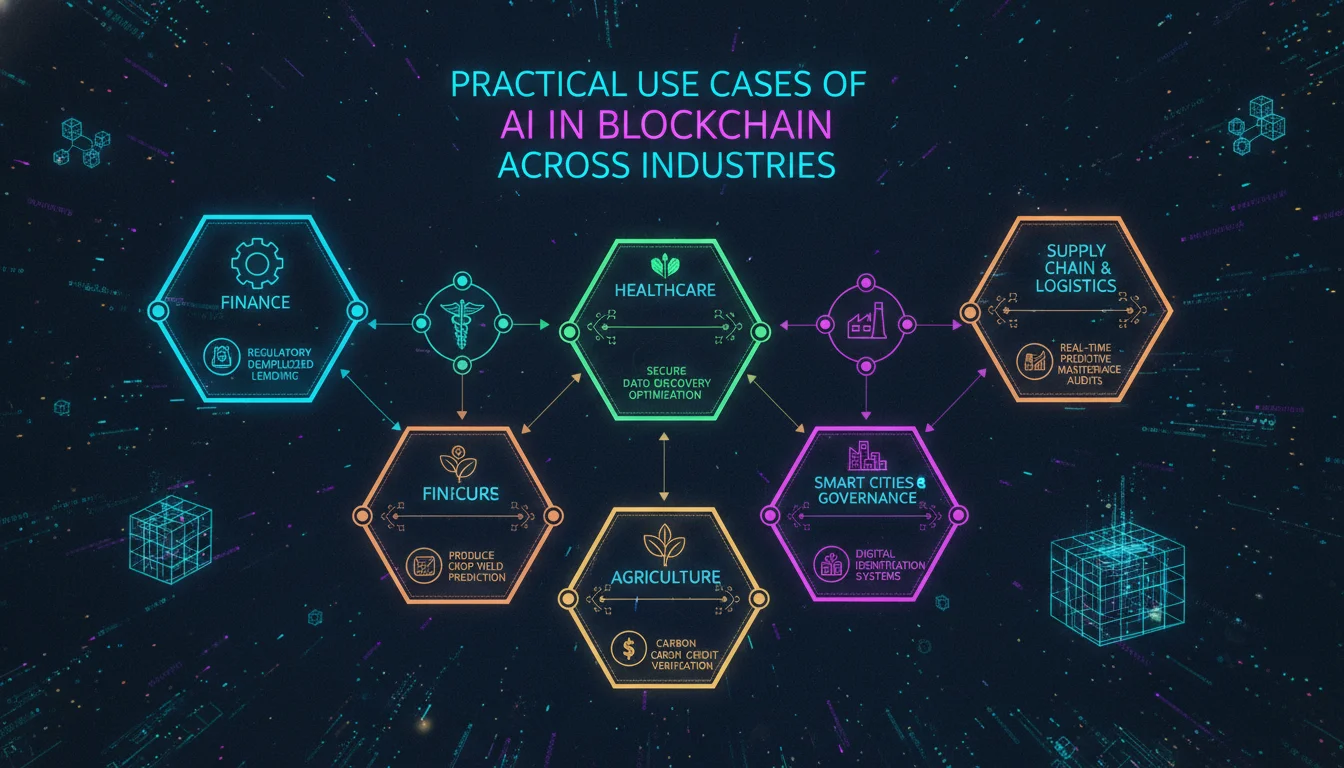
AI in blockchain shows up in healthcare through shared, privacy-protected patient records that multiple institutions can act on without exposing raw data. AI helps surface treatment insights and identify patterns in patient data, while blockchain lets organizations collaborate on care without compromising patient privacy. IBM notes that blockchain and AI in the pharmaceutical industry add visibility and traceability to the drug supply chain while increasing the success rate of clinical trials.
Combining advanced data analysis with a decentralized framework for clinical trials enables data integrity, transparency, patient tracking, consent management, and automated trial participation. That’s a concrete example of ai in blockchain creating value neither technology could produce alone. GeeksforGeeks similarly notes that blockchain can create trackable, traceable AI using the same methods that protect food and healthcare logistics, so every data point stays verifiable.
Financial Services
Blockchain and AI are reshaping financial services by building trust, removing friction from multiparty transactions, and speeding up execution. In lending, applicants grant consent for access to personal records stored on the blockchain. Trust in that data, combined with automated evaluation, drives faster closings and better customer satisfaction.
AI algorithms increasingly decide whether financial transactions look fraudulent and should be blocked or investigated. When those decisions get recorded on a blockchain, financial institutions gain an auditable trail of every action, which satisfies regulatory requirements and builds customer trust. GeeksforGeeks lists smarter finance and transparent governance among the core benefits of integrating AI with blockchain, reinforcing why financial services is a leading use case.
Supply Chain and Manufacturing
By digitizing a mostly paper-based process, making data shareable and trustworthy, and adding intelligence to execute transactions automatically, AI and blockchain are reshaping supply chains. A manufacturer can track components from source to finished product, while AI models embedded in smart contracts automatically reorder inventory when thresholds are met or select the most sustainable shipping method.
GeeksforGeeks notes that blockchain can create trackable, traceable AI using the same methods that protect food and healthcare logistics. That traceability extends to media royalties and financial security, showing how broad the applications of ai in blockchain really are. Rutgers Business School adds that blockchain’s trust and authenticity combined with AI’s decision-making speed create smarter, more efficient supply chain systems.
How to Integrate AI in Blockchain: A Step-by-Step Framework
Step 1: Define the Business Problem and Data Requirements
Integrating ai in blockchain starts with identifying a specific friction point that multi-party coordination or trustlessness can actually solve. A pharmaceutical consortium might need immutable clinical trial data. A financial institution might need real-time fraud detection with a built-in audit trail. Define your data sources, decide between a permissioned or public network, and set expected outcomes up front. Skip this step and the integration risks becoming a technology showcase instead of a value driver.
Step 2: Select the Blockchain Architecture and AI Model
Choose a blockchain platform that fits your governance needs: permissioned for enterprise consortia, public for open innovation. Then select or train an AI model suited to the task, whether that’s anomaly detection for fraud, natural language processing for contract analysis, or predictive models for supply chain demand. AWS notes that generative AI agents are particularly effective for monitoring smart contracts and transaction patterns. IBM recommends starting with a use case where authenticity, augmentation, or automation can actually be measured.
Step 3: Integrate AI With Smart Contracts and Monitor Continuously
Embed the AI model’s outputs into smart contracts to automate decisions, but keep human review in the loop for high-risk actions. Use blockchain to record every model update, training data hash, and governance decision. Continuously monitor model performance and smart contract behavior with AI agents, similar to how AWS describes reentrancy attack detection. This layered approach keeps the system transparent and adaptable as conditions change.
Here’s the ordered workflow, condensed:
- Step 1: Identify the business problem requiring multi-party trust or automation.
- Step 2: Select the blockchain architecture and relevant AI model.
- Step 3: Train the AI model on verified data from the blockchain.
- Step 4: Integrate model outputs into smart contracts.
- Step 5: Deploy AI agents for continuous monitoring and audit logging.
Comparing AI and Blockchain Contributions: A Feature Matrix
Key Dimensions of collaboration
The table below summarizes how each technology contributes to a combined ai in blockchain system. It’s based on qualitative evidence from IBM, Pantera, AWS, KPMG, and GeeksforGeeks, and should be used as a decision aid rather than a performance benchmark.
| Dimension | AI Contribution | Blockchain Contribution | Combined Outcome |
|---|---|---|---|
| Data | Mines large datasets and identifies patterns | Provides a tamper-proof, shared record | Trustworthy data for model training |
| Security | Detects anomalies, fraud, and logic errors | Uses cryptographic immutability | Double shield against cyber-attacks |
| Trust | Explains recommendations and predictions | Maintains audit trail for decisions | Explainable and accountable AI |
| Automation | Executes decisions in smart contracts | Coordinates multi-party processes | Autonomous business workflows |
| Scalability | Optimizes consensus and sharding | Provides decentralized infrastructure | Higher throughput with less friction |
| Governance | Assesses model risk and performance | Records governance, reviews, and intent | Transparent model lifecycle management |
How to Interpret the Matrix
Each row represents a dimension where ai in blockchain delivers value beyond a standalone system. AI alone can detect fraud, but without a blockchain audit trail, regulators may question the integrity of the detection process. Blockchain alone can store transactions, but without AI’s pattern recognition, suspicious activity can go unnoticed until it’s too late. The combined outcome column captures that added value. Decision makers should evaluate which dimension matters most for their use case and prioritize from there.
Pros and Cons of AI in Blockchain
Pros
- Creates a tamper-proof audit trail for AI model training data, versions, and governance decisions.
- Improves fraud detection and anomaly monitoring through real-time pattern recognition across transaction data.
- Automates multi-party business processes through AI logic embedded in smart contracts.
- Opens access to decentralized compute and data resources instead of relying on one cloud provider.
- Supports explainable AI by linking every model decision back to a verifiable on-chain record.
Cons
- Scalability remains a real constraint since both AI training and blockchain validation are computationally heavy.
- Interoperability between blockchain networks and AI frameworks isn’t standardized yet.
- Liability is unresolved when an AI model embedded in a smart contract makes a faulty or harmful decision.
- Regulatory frameworks for combined AI-blockchain systems are still catching up to the technology.
- On-chain storage and compute costs can make some AI workloads impractical without off-chain workarounds.
Real-World Implementations, Challenges, and Future Outlook of AI in Blockchain
AWS and the Onchain Economy
AWS describes the onchain economy as cryptocurrency transactions and activity on the blockchain, a new way to create, own, and exchange digital assets and data. Generative AI is unlocking new possibilities for this onchain economy by analyzing smart contracts for vulnerabilities and monitoring transaction patterns. Real-world examples AWS names include Coinbase, which is championing AI-driven innovation; Prove AI, which powers a new standard for AI governance; and Allium and ZettaBlock (KiteAI), which are laying the foundations for a new data era. These examples show both established platforms and startups investing at this intersection.
IBM, Pantera, and Enterprise Perspectives
IBM’s framework of authenticity, augmentation, and automation gives enterprises a practical lens for adoption. Authenticity comes from blockchain’s audit trail; augmentation from AI reading and correlating data at speed; automation from AI models embedded in smart contracts. Pantera Capital adds that every major innovation wave has been a convergence: steam and railroads, electricity and manufacturing, automobiles and highways, internet and smartphones, and argues AI plus blockchain is the next one. Their historical read suggests the largest enduring companies may be the ones building on top of this new infrastructure, not necessarily the ones who invented it.
Rutgers Business School notes that blockchain facilitates trust, authenticity, and security in transactions, while AI analyzes massive amounts of data and makes intelligent decisions quickly. Their combination helps create smarter, more efficient systems, with each technology covering the other’s weak spots. Appinventiv makes a similar argument: the fusion of AI and blockchain can reshape supply chain logistics, healthcare, and cybersecurity, among other areas. KPMG’s bouncer metaphor reinforces the idea that blockchain is the missing governance layer for generative AI, turning potential risk into a controlled opportunity.
Challenges, Limitations, and Future Outlook
Despite the promise, ai in blockchain still faces real hurdles. Scalability is a genuine concern because both AI training and blockchain validation are computationally intensive. Interoperability between different blockchain networks and AI frameworks isn’t standardized. Governance is also unresolved: who’s liable when an AI model embedded in a smart contract makes a faulty decision? KPMG points out that blockchain can mitigate cyber and regulatory risks, but it doesn’t eliminate them entirely.
As of 2026, the co-evolution of ai in blockchain is producing early movement toward new standards for data provenance, model auditability, and decentralized AI marketplaces. The open-source culture shared by both fields should keep accelerating experimentation this year and beyond. As Pantera frames it, AI provides indefinite abundance while blockchain provides definite scarcity, and the balance between the two will shape the next phase of the digital economy. Blockchain isn’t likely to get replaced by AI. Instead, expect the two to keep intertwining, building a more trustworthy and intelligent digital infrastructure over time.
If you’re building at this intersection, whether that’s an AI-audited DeFi protocol, a verifiable data marketplace, or tokenomics for an agentic AI network, this is exactly the kind of infrastructure problem worth solving early. Our studio works with teams tackling protocol-level challenges like this, and our build process is structured around exactly these kinds of technical bets. Apply to the Genesis Cohort at digitalblockchains.com if you’re ready to build with us.
Frequently Asked Questions
What is the 30% rule in AI?
The 30% rule in AI isn’t a standard industry definition found in the sources we reviewed on ai in blockchain. Some practitioners use it informally as a heuristic for allocating compute, data, or evaluation resources, but there’s no authoritative definition backing it up.
Which AI is best for blockchain?
No single AI model or vendor is universally best for blockchain. The right choice depends on the use case: AWS highlights AI agents for smart contract monitoring, IBM emphasizes machine learning for automation, and KPMG points to generative AI for IP and risk management.
What is the top 5 AI crypto?
There’s no verified ranked list of AI cryptocurrencies in the sources we reviewed for this piece. Instead, the available research focuses on the underlying convergence: Pantera Capital discusses the investment thesis, AWS names Coinbase, Prove AI, Allium, and ZettaBlock (KiteAI) as real-world examples, and IBM and KPMG describe enterprise use cases rather than token rankings.
Will blockchain be replaced by AI?
No. Based on Pantera’s framework of abundance and scarcity, AI and blockchain are complementary rather than substitutive technologies. Blockchain provides verifiable scarcity and trust, AI provides abundant intelligence, and the combination is more valuable than either alone.
How does blockchain improve AI model auditability?
Blockchain creates a tamper-evident record of every training data hash, model version, governance review, and stakeholder identity. This audit trail addresses explainable AI challenges and supports regulatory compliance, as both IBM and KPMG note in their research.
What industries benefit most from AI in blockchain?
Healthcare, life sciences, financial services, and supply chain management are the most frequently cited beneficiaries of ai in blockchain. These industries need multi-party data sharing, tamper-proof records, and automated decision-making, which makes them a natural fit for this convergence.