Key Takeaways
- AI blockchain is the integration of artificial intelligence with distributed ledger technology to produce intelligent, auditable systems.
- IBM identifies three combined values: authenticity, augmentation, and automation.
- BlackRock’s BUIDL fund has grown past 2 billion dollars in tokenized treasury assets, signaling production adoption in 2026.
- QuickNode’s builder guide lists ChainGPT, Fetch.ai, SingularityNET, Bittensor, Ocean Protocol, and others among top AI-powered blockchain tools.
- The EU AI Act’s transparency rules apply from August 2026, making AI governance an operating requirement.
AI blockchain is the pairing of artificial intelligence with distributed ledger technology to build systems that are both intelligent and auditable. Together they enable authenticity, augmentation, and automation across regulated industries.
Artificial intelligence and blockchain get discussed as two separate infrastructure shifts, and that framing misses the point. For regulated institutions, the strongest combination is operational. AI helps teams interpret, monitor, and orchestrate complex workflows, while blockchain records the state changes, permissions, and audit evidence those workflows depend on. This article breaks down what AI blockchain actually is, why the two technologies reinforce each other, which tools lead in 2026, and how to evaluate a real implementation. If you’re weighing a build, our venture studio process covers exactly this kind of architecture decision.
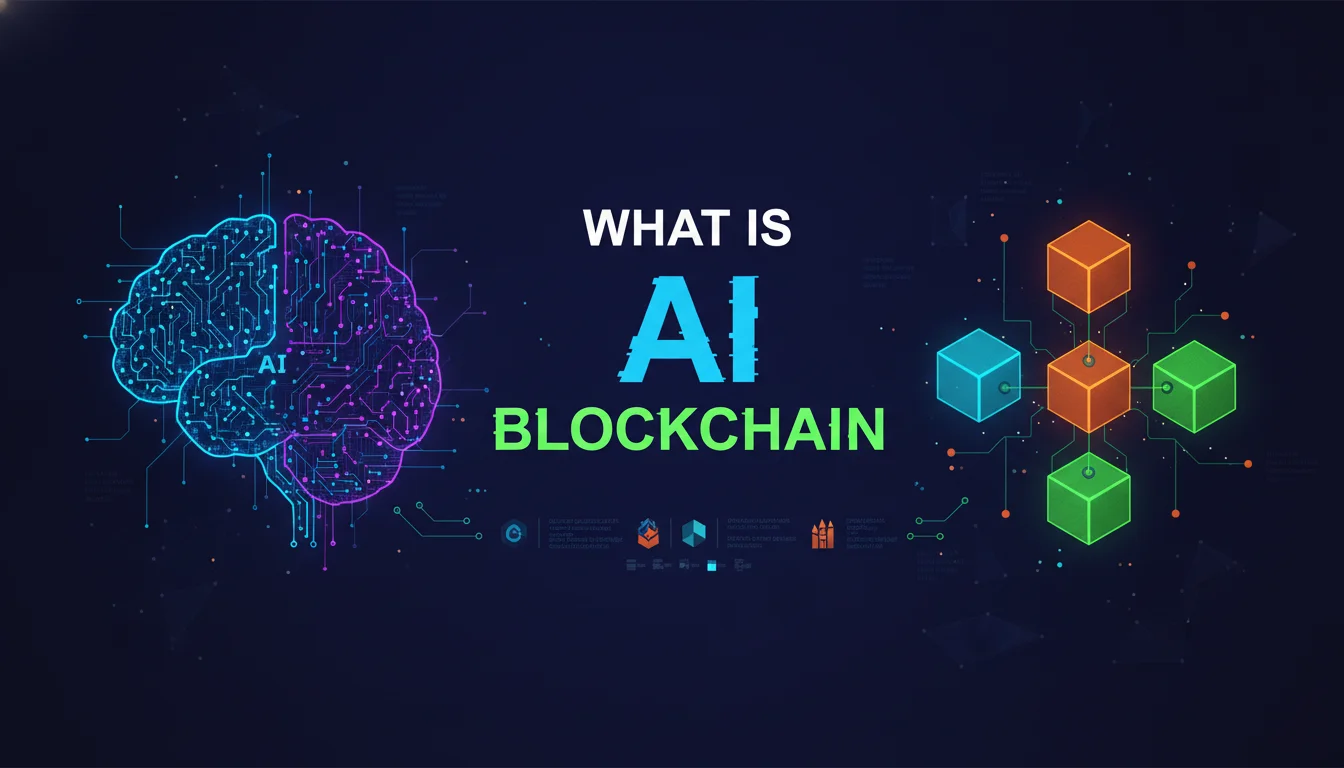
What Is AI Blockchain?
Defining Blockchain and Artificial Intelligence
Blockchain is a shared, immutable ledger that provides immediate, shared, and transparent exchange of encrypted data simultaneously to multiple parties as they initiate and complete transactions. According to IBM, a blockchain network can track orders, payments, accounts, production and much more. As permissioned members share a single view of the truth, they gain confidence in their transactions with other businesses, along with new efficiencies.
Artificial intelligence uses computers, data, and sometimes machines to mimic the problem-solving and decision-making capabilities of the human mind. IBM notes that AI encompasses the sub-fields of machine learning and deep learning, which use algorithms trained on data to make predictions or classifications. The benefits include automation of repetitive tasks, better decision making, and an improved customer experience.
The Definition of AI Blockchain
AI blockchain is an architectural pattern that pairs AI’s pattern recognition, prediction, and automation with blockchain’s tamper-evident, decentralized record-keeping. It’s not a single protocol or product. It’s a way to combine a probabilistic intelligence layer with a deterministic audit layer. According to SettleMint, AI is probabilistic: it can be useful, but it can also be wrong, while blockchain is deterministic. It records what happened and, when the right rules are encoded, prevents certain actions from happening at all.
This distinction matters because financial institutions need both qualities at once. They need intelligence for scale, and controls for trust. The AI layer can read documents, identify exceptions, classify events, summarize risk, and prepare decisions. The blockchain layer can enforce transfer rules, maintain ownership records, trigger lifecycle actions, and preserve a shared record that auditors and counterparties can inspect.
“AI and blockchain are usually discussed as separate infrastructure shifts. That misses the useful part. For regulated institutions, the strongest combination is operational.” – SettleMint, AI and Blockchain in Digital Asset Operations
Why the Term Matters in 2026
The market conversation shifted in 2026. According to SettleMint, tokenized funds, tokenized collateral, tokenized deposits, and regulated digital securities now sit inside real institutional workflows. At the same time, regulation is becoming explicit about AI governance. The practical question is no longer whether AI and blockchain can work together; it’s how to deploy them with explainability, oversight, and data governance. For developers and enterprises, the term ai blockchain now describes a stack that combines intelligent interpretation with auditable state changes, not a vague merger of two fashionable technologies.
Why AI and Blockchain Reinforce Each Other
Complementary Strengths
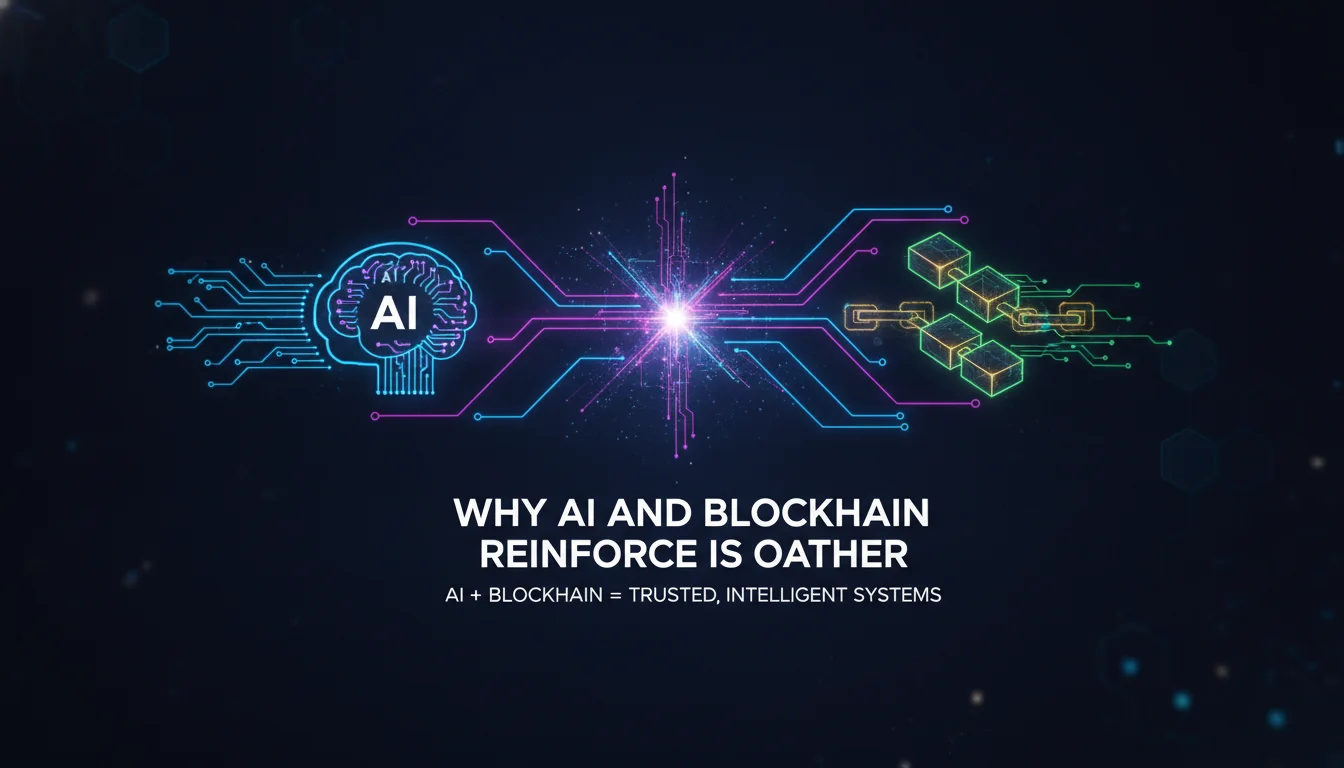
AI and blockchain reinforce each other because one excels at pattern recognition and prediction while the other guarantees a secure, transparent, decentralized ledger. According to QuickNode, integrating these technologies lets businesses apply AI’s analytical power within the secure framework of blockchain networks, producing more accurate and reliable outcomes. One compelling angle is consensus mechanism optimization, but the broader value sits in data integrity and automated execution.
QuickNode also points out that AI-powered tools meaningfully enhance data security in blockchain networks by proactively detecting and preventing fraudulent activity through anomaly detection. That’s a concrete example of AI adding a layer of intelligence on top of blockchain’s existing trust guarantees.
From Parallel Tracks to Shared Infrastructure
Pantera Capital‘s Cosmo Jiang argues that AI is only half the story. Blockchain has matured beyond cryptocurrencies into infrastructure for coordinating trust, ownership, and incentives across decentralized systems. As blockchain-focused investors, Pantera believes blockchain will be central to AI’s growth. Jiang writes that the limited attention paid to how these two technologies reinforce one another is a clear oversight.
This convergence has become one of Pantera’s major research focuses, and the firm is dedicating a growing share of incremental research time and investment dollars to opportunities emerging at this intersection. The takeaway for builders: AI blockchain isn’t a side project. It’s a core investment thesis for at least one major crypto venture firm in 2026.
The Convergence Thesis at Pantera Capital
In a Blockchain Letter dated May 28, 2026, Dan Morehead and Cosmo Jiang connect the AI-blockchain convergence to historical innovation waves. Steam power and railroads enabled national industrial economies in the 19th century, including businesses like Union Pacific Railroad, Standard Oil, and Carnegie Steel. Electricity and modern manufacturing drove the second wave of industrialization, enabling the rise of General Electric and the acceleration of urbanization along with the NY Subway system. Mass automobiles necessitated highway infrastructure, which led to national chains like Walmart and McDonald’s. More recently, the internet accelerated with smartphones, producing the global enterprise tech companies that define today’s landscape.
Pantera’s point is that periods of technological acceleration often happen when two powerful systems begin reinforcing one another. The current pairing of AI and blockchain follows this pattern, with real economic activity emerging at the intersection rather than in isolated silos.
Core Value Drivers: Authenticity, Augmentation, and Automation
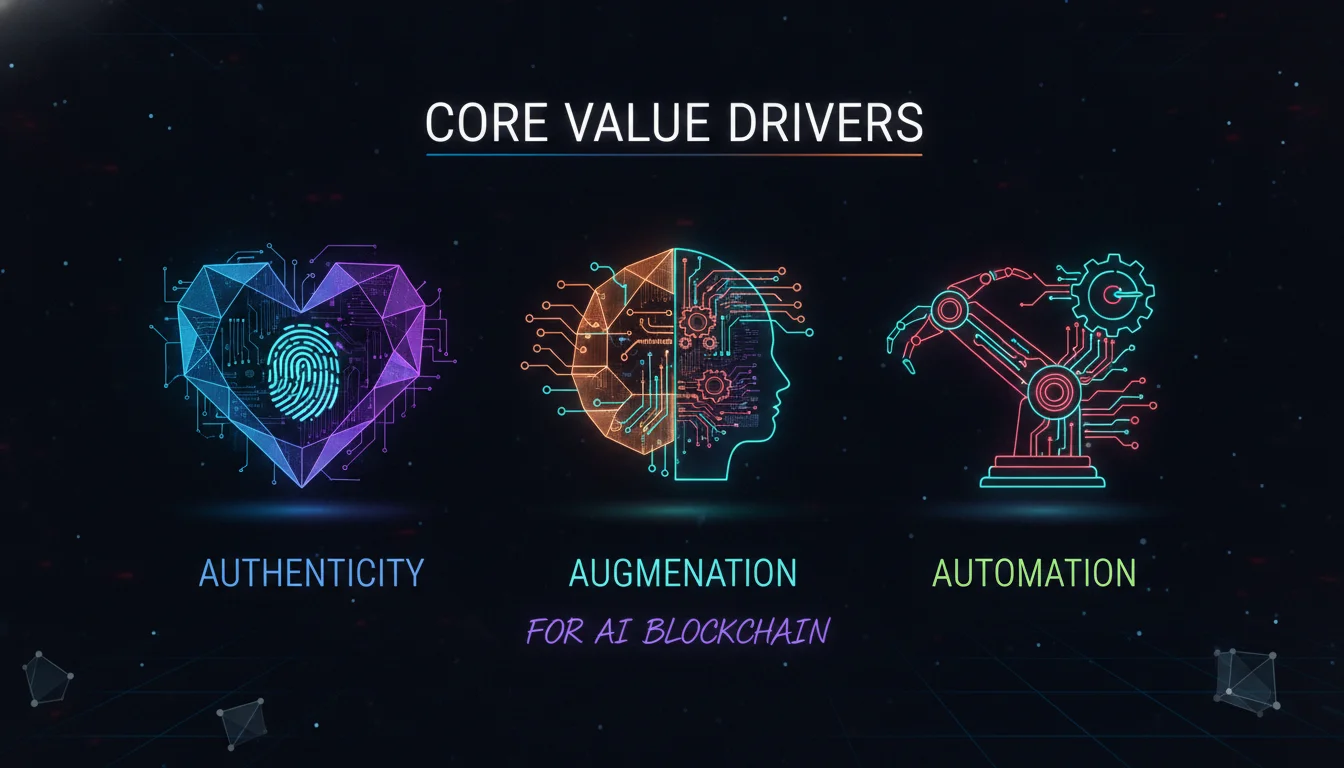
IBM identifies three combined values of blockchain and AI: authenticity, augmentation, and automation. These categories give a practical framework for evaluating any ai blockchain initiative.
| Value Driver | AI Contribution | Blockchain Contribution | Combined Outcome |
|---|---|---|---|
| Authenticity | Generates recommendations that need provenance | Stores model and data audit trails | Improved trust in AI outputs |
| Augmentation | Reads and correlates data at speed | Provides shared access to large datasets | Actionable insights across parties |
| Automation | Embedded in smart contracts to trigger decisions | Executes rules with deterministic finality | Frictionless multiparty processes |
Authenticity Through Audit Trails
Authenticity in an ai blockchain system is the capacity to verify that an AI model, its training data, and its outputs haven’t been altered without leaving a trail. Blockchain’s digital record offers insight into the framework behind AI and the provenance of the data it’s using, addressing the challenge of explainable AI. According to IBM, this insight helps improve trust in data integrity and in the recommendations AI provides. Storing and distributing AI models on blockchain provides an audit trail, and pairing the two can enhance data security.
Augmentation Through Data Scale
Augmentation is how AI adds speed and analytical depth to blockchain-based business networks, while blockchain gives AI access to larger, more trustworthy data sets. AI reads, understands, and correlates data at speed, bringing a new level of intelligence to blockchain-based networks. IBM states that by providing access to large volumes of data from within and outside the organization, blockchain helps AI scale to deliver more actionable insights. It also facilitates data usage and model sharing while supporting a trustworthy and transparent data economy.
Automation Through Smart Contracts
Automation in the ai blockchain context is the execution of conditional logic by smart contracts enhanced or triggered by AI models. IBM gives concrete examples: AI models embedded in smart contracts executed on a blockchain can recommend expired products to recall, execute transactions such as reorders, payments, or stock purchases based on set thresholds and events, resolve disputes, and select the most sustainable shipping method. Automation here isn’t just about removing human approval. It’s about encoding conditional intelligence into deterministic execution so multiparty processes run without friction.
Top AI Blockchain Tools and Platforms
QuickNode’s 2026 Tool Landscape
The leading AI blockchain tools in 2026 include a mix of decentralized AI marketplaces, autonomous agent frameworks, and data-sharing protocols. QuickNode’s builder’s guide, “Top 10 AI-Powered Blockchain Tools,” lists platforms that integrate AI with blockchain to automate processes, improve scalability, and drive Web3 innovation. The listed tools include Quicknode, SingularityNET, Fetch.ai, Ocean Protocol, Cortex, Numerai, ChainGPT, Bittensor, BlockAI, and Composio Crypto-Kit.
QuickNode’s key takeaways emphasize that leading blockchain platforms such as Ethereum, Hyperledger Fabric, and Corda are facilitating the integration of AI technologies to optimize applications and improve business processes. The guide also notes that AI-powered tools significantly enhance data security in blockchain networks by proactively detecting and preventing fraudulent activities through anomaly detection.
Platform Categories and Specializations
Developers building ai blockchain applications typically choose between public networks like Ethereum for open composability, permissioned ledgers like Hyperledger Fabric and Corda for enterprise privacy, and application-specific tooling from the QuickNode list. Each category prioritizes different trade-offs among decentralization, throughput, and compliance. A public chain offers global liquidity and open access, while a permissioned ledger offers identity controls and stronger transaction privacy for regulated workflows.
Enterprise and Regulated Options
For regulated institutions, SettleMint emphasizes an operational rather than purely technological view. AI supports interpretation and monitoring, while blockchain provides deterministic rules, ownership records, and audit evidence for digital asset operations. This distinction helps enterprises pick tools that separate the probabilistic AI layer from the deterministic blockchain layer. Instead of hunting for a single all-in-one product, institutions should ask whether a tool makes the AI interpretable, the blockchain auditable, and the combined workflow explainable to regulators.
How AI Blockchain Works in Production
The Operational Model for Digital Assets
AI blockchain works in production by splitting responsibilities: AI handles interpretation and exception-handling, while blockchain enforces rules and preserves the record. SettleMint’s March 24, 2026 insight describes this as the strongest combination available for regulated institutions. The AI layer reads documents, identifies exceptions, classifies events, and prepares decisions. The blockchain layer enforces transfer rules, maintains ownership records, triggers lifecycle actions, and preserves a shared record auditors and counterparties can inspect. Financial institutions need both layers because intelligence without controls creates compliance risk, and controls without intelligence create processing bottlenecks.
Tokenized Funds and Real-World Assets
The production shift is visible in tokenized assets. According to SettleMint, BlackRock’s BUIDL fund, tracked by RWA.xyz, has grown past 2 billion dollars in tokenized treasury assets. J.P. Morgan’s Kinexys Tokenized Collateral Network focuses on moving collateral ownership without moving the underlying asset record, reducing manual processing and settlement delays. These aren’t pilot projects. They’re live institutional workflows where ai blockchain tooling gets applied for monitoring, classification, and compliance. The presence of named institutions like BlackRock and J.P. Morgan shows the convergence has moved past speculative narratives.
AI Governance and the EU AI Act
The EU AI Act introduces risk-based obligations for AI systems, with transparency rules applying from August 2026 and additional high-risk obligations following in later phases. SettleMint argues that for financial institutions, this makes logging, explainability, oversight, and data governance operating requirements rather than abstract ethics language. In an ai blockchain context, blockchain can provide the logging and audit evidence needed to demonstrate compliance with these transparency obligations. That’s a concrete reason the deterministic layer matters in production, not just in theory.
Use Cases Across Industries
Healthcare and Life Sciences
IBM highlights that AI can advance almost every field in healthcare, from surfacing treatment insights to identifying patterns in patient data. With patient data on blockchain, including electronic health records, organizations can collaborate to improve care while protecting patient privacy. In life sciences, blockchain and AI in the pharmaceutical industry can add visibility and traceability to the drug supply chain while improving the success rate of clinical trials. Combining advanced data analysis with a decentralized framework for clinical trials enables data integrity, transparency, patient tracking, consent management, and automation of trial participation and data collection.
Financial Services and Supply Chain
In financial services, blockchain and AI are transforming the industry by building trust, removing friction from multiparty transactions, and speeding up settlement. IBM gives the loan process as an example: applicants grant consent for access to personal records stored on the blockchain, and trust in the data plus automated evaluation drives faster closings and better customer satisfaction. In supply chain, digitizing a largely paper-based process, making the data shareable and trustworthy, and adding intelligence and automation to execute transactions are reshaping supply chains across industries.
Web3, Agents, and Decentralized Governance
Coursera‘s “Generative AI and Blockchain” course, instructed by Don Tapscott and others, explores how blockchain can make generative AI more transparent, secure, and reliable, and how generative AI can enhance blockchains, from automating smart contracts to optimizing networks and creating personalized experiences. The course also covers Agentic AI, decentralized governance, and AI-driven tokenomics. This points to a broader use case: autonomous agents that need identity, payments, and coordination mechanisms. Blockchain provides those coordination rails, while AI supplies the agent behavior. That combination is foundational for the Web3 era, and it’s a theme we track closely in our own development process.
Risks, Limitations, and Governance Challenges
AI Is Probabilistic, Blockchain Is Deterministic
The core limitation of ai blockchain is that its two components have different failure modes. AI can be wrong, and its outputs may reflect bias or hallucination. Blockchain enforces rules deterministically, but it can’t verify whether the AI’s input was correct in the first place. SettleMint’s distinction is critical here: intelligence for scale, controls for trust. Without careful design, a system can inherit the costs of both layers without capturing the benefits of either. Teams must decide which layer is authoritative for each decision and document that boundary explicitly.
“AI is probabilistic. It can be useful, but it can also be wrong. Blockchain is deterministic. It records what happened and, when the right rules are encoded, prevents certain actions from happening at all.” – SettleMint
Explainability and Data Provenance
Explainable AI remains a genuine challenge. IBM notes that blockchain’s digital record offers insight into the framework behind AI and the provenance of the data it’s using, which helps address that problem. But recording data provenance doesn’t automatically make a neural network interpretable. Teams still need to invest in model documentation, monitoring, and governance. The EU AI Act’s transparency rules make this a legal requirement, not just a best practice, and blockchain logs can become part of the evidence package.
Regulatory and Compliance Gaps
Regulation is becoming more explicit, but it’s still fragmented across jurisdictions. The EU AI Act applies from August 2026 for transparency rules, while tokenized asset frameworks vary by region. SettleMint points out that financial institutions need logging, explainability, oversight, and data governance as operating requirements, not optional extras. For now, many ai blockchain projects operate in a gray zone, and teams should design for auditability from day one. A system that can’t produce a clear audit trail will struggle under emerging AI governance rules.
Pros and Cons
Pros
- Combines AI’s speed and pattern recognition with blockchain’s tamper-evident record-keeping.
- Improves auditability and explainability for regulated workflows like lending and tokenized assets.
- Reduces manual reconciliation work through automated, rule-based smart contract execution.
- Enhances fraud detection through AI-driven anomaly detection layered on-chain.
Cons
- AI outputs remain probabilistic and can be wrong, biased, or hallucinated, even when logged on-chain.
- Regulatory frameworks are fragmented, and compliance requirements vary by jurisdiction.
- Blockchain can’t verify whether the underlying AI input was correct, only that it was recorded.
- Integration complexity increases when teams try to combine probabilistic and deterministic systems without a clear architecture.
How to Evaluate and Start with AI Blockchain
Step 1: Identify the Trust Boundary
Start by determining which decisions require auditable record-keeping and which require probabilistic intelligence. This prevents over-blockchaining a simple ML model and keeps the architecture lean.
Step 2: Map Data Provenance Requirements
Locate where AI models need training data, model weights, or output explanations recorded on-chain. This step is essential for authenticity and compliance under frameworks like the EU AI Act.
Step 3: Select an Integration Architecture
Choose between a public network like Ethereum, a permissioned ledger like Hyperledger Fabric or Corda, or specialized AI blockchain platforms from a builder’s guide. The right choice depends on your compliance needs and desired decentralization.
Step 4: Prototype With an Existing Tool
Test a tool from QuickNode’s guide, such as Fetch.ai, ChainGPT, or SingularityNET, against a narrow workflow. Measure whether it reduces manual effort and improves auditability before scaling further.
Step 5: Define Governance and Audit Rules
Align with regulations such as the EU AI Act transparency obligations that apply from August 2026. Document who can update the AI model and how disputes get resolved.
Skill Building and Courses
For professionals entering the field, structured learning paths exist. Coursera’s “Generative AI and Blockchain” course includes 4 modules, holds a 4.8 rating from 32 reviews, and reports 3,544 already enrolled. The course covers the Web3-AI stack, blockchain-based AI security, Agentic AI, decentralized governance, and AI-driven tokenomics. A one-week completion at 10 hours per week makes it a practical entry point for developers, product managers, and compliance leads. Skills listed include agentic systems, AI security, blockchain, ESG, data ethics, responsible AI, emerging technologies, AI integrations, digital assets, and AI personalization.
From Pilot to Production
After selecting a stack and building the right skills, the path from pilot to production requires a staged rollout. As of 2026, successful ai blockchain implementations start with a narrow workflow where trust and intelligence overlap, such as a loan evaluation, a supply chain exception, or a tokenized asset monitoring task. Teams then expand to adjacent workflows only after audit trails and governance controls are proven. SettleMint’s operational framing and IBM’s three value drivers give you a checklist for each stage. Avoid broad “AI plus blockchain” initiatives; attach both technologies to a specific business process with a clear owner, a measurable outcome, and a regulatory requirement.
Conclusion: AI Blockchain as an Operating Model
AI blockchain has moved from speculative convergence to practical infrastructure this year. The combination of AI’s probabilistic intelligence and blockchain’s deterministic audit trail creates value through authenticity, augmentation, and automation. With production examples like BlackRock’s BUIDL fund surpassing 2 billion dollars in tokenized treasury assets, and with EU AI Act transparency rules applying from August 2026, the operational question is no longer “if” but “how.” Teams that treat AI blockchain as an architecture for trust, rather than a buzzword bundle, will be positioned to build the next wave of digital infrastructure. If you’re building in this space and want technical partners who think the same way, apply to the Genesis Cohort at digitalblockchains.com.
Frequently Asked Questions
What is AI blockchain?
AI blockchain is the integration of artificial intelligence with distributed ledger technology to create systems that are both intelligent and auditable. It combines AI’s pattern recognition with blockchain’s immutable record-keeping for authenticity, augmentation, and automation.
How does AI improve blockchain?
AI improves blockchain by adding pattern recognition, anomaly detection, and automated decision-making to on-chain data. According to QuickNode, AI-powered tools enhance data security by proactively detecting and preventing fraudulent activities through anomaly detection.
How does blockchain improve AI?
Blockchain improves AI by providing an audit trail for data, model weights, and outputs, which addresses the explainability challenge. IBM notes that blockchain’s digital record offers insight into the framework behind AI and the provenance of the data it uses.
What are the top AI blockchain tools?
QuickNode’s builder guide lists Quicknode, SingularityNET, Fetch.ai, Ocean Protocol, Cortex, Numerai, ChainGPT, Bittensor, BlockAI, and Composio Crypto-Kit among top AI-powered blockchain tools. Leading underlying platforms include Ethereum, Hyperledger Fabric, and Corda.
Is AI blockchain regulated?
Regulation is increasing. The EU AI Act introduces transparency rules from August 2026, with high-risk obligations following later. Blockchain can help meet logging and explainability requirements under these rules.
What are real-world use cases for AI blockchain?
Real-world use cases include healthcare record sharing, pharmaceutical supply chain traceability, financial loan processing, supply chain automation, and tokenized asset monitoring. BlackRock’s BUIDL fund and J.P. Morgan’s Kinexys network show production adoption in digital assets.