US bank blockchain trade finance is the use of the WaveBL platform by U.S. Bank to digitize trade documents like electronic bills of lading. It replaced a days-long courier process with an encrypted transfer completed in minutes.
Key Takeaways
- U.S. Bank is the first American lender to execute a fully digital trade finance transaction on the WaveBL blockchain platform.
- The trade finance transaction cut document transfer from several days to minutes using an electronic bill of lading issued by MSC Mediterranean Shipping Company.
- The Digital Container Shipping Association (DCSA) has set a target of 100% electronic bills of lading by 2030.
- U.S. Bank pairs blockchain trade finance with supply chain finance, global trade services, and institutional digital asset custody.
- Lloyds Bank ran a comparable WaveBL transaction in April 2024, cutting processing from 15 days to just over 24 hours.
Understanding US Bank Blockchain Trade Finance
What Is Trade Finance?
Trade finance is the set of financial instruments and services that support cross-border transactions between exporters and importers. It includes letters of credit, documentary collections, bankers’ acceptances, and supply chain finance tools. These instruments help companies manage payment risk, working capital, and cash flow across borders. Before the WaveBL transaction, U.S. Bank already ran a full suite of import and export solutions through its global trade financing services. According to the U.S. Bank Global Trade Financing Services page, the bank works through a network of partner banks spanning six continents to help clients maximize trade terms, mitigate risk, and manage balance sheet efficiency.
What Is WaveBL?
WaveBL is a blockchain-based platform that enables encrypted document transfers between trading partners and their financial institutions. It digitizes the management of bills of lading, documents that function as both a receipt and a title for goods in transit. Blockchain itself is a form of distributed ledger technology that uses consensus among participants to validate transactions without relying on a central authority. WaveBL applies that model to trade documentation, letting banks and carriers exchange electronic bills of lading securely instead of shipping paper across time zones.
Why This Transaction Matters
The this type of finance milestone matters because it pushes a major U.S. financial institution past pilots and proofs of concept into a live production transaction. Cross-border trade has run on high volumes of paper documentation for decades, which slows deals and adds cost. According to a Deutsche Bank flow case study, digitization in trade finance has been difficult because cross-border transactions involve many variables and generate large documentation volumes. This transaction shows a practical path around that problem.
“Digitisation has been difficult as cross-border trade involves a large number of variables when communicating information such as country of origin or product details, and transactions generate high volumes of documentation, making some deals uneconomical.” – Clarissa Dann, Deutsche Bank flow
Inside the First Fully Digital Transaction
Transaction Parties and Roles
U.S. Bank served as the presenting bank, or intermediary bank, for a large publicly traded American exporter. The container shipping company MSC Mediterranean Shipping Company issued the electronic bill of lading. Using an eBL removed the need to physically courier paper documents across continents. Trade Finance Global reported that U.S. Bank is the first American lender to execute a transaction using WaveBL, a distinction American Banker also confirmed in its coverage of the bank’s blockchain testing. The bank’s Minneapolis headquarters anchors what’s now a concrete case study for blockchain-based trade finance in the United States.
Document Transfer Time Reduction
According to U.S. Bank, the process reduced what would typically take several days for physical document courier services down to minutes. Swapping paper for encrypted digital documents removed delays caused by courier transit, weather, and geopolitical disruption. For a large publicly traded exporter, faster document transfer meant quicker access to trade documentation and more predictable working capital timing.
Bank and Platform Statements
“Our clients are looking for smarter, more efficient ways to manage their import and export activities,” said Christine Bravo, senior vice president at U.S. Bank. “This fully digital process is a step toward delivering the speed, transparency and reliability businesses need in today’s trade environment.”
Ofer Ein Bar, vice president of financial institutions at WaveBL, said established institutions adopting the platform brings the industry closer to streamlining trade finance transactions. Those statements underscore that this this kind of trade finance move is driven by client demand for digital-first processes, not a marketing exercise.
How US Bank Blockchain Trade Finance Reduces Paper Dependence
Electronic Bills of Lading Explained
An electronic bill of lading, or eBL, is a digital version of the bill of lading, a document that serves as a receipt for goods and a title document. In traditional trade, the bill of lading has to physically move from the carrier to the exporter, banks, and importer in sequence. Electronic bills of lading replace that physical chain with encrypted digital transmissions, which is the core mechanic behind the the bank blockchain trade finance approach.
Security and Compliance Benefits
U.S. Bank noted that the digital process increases security and compliance while avoiding disruptions from weather or geopolitical events. Because transfer happens through WaveBL’s encrypted platform, the risk of document loss, forgery, and courier failure drops sharply. For corporate treasurers evaluating finance as an option, these benefits address operational pain points that have existed in cross-border trade for decades.
From Days to Minutes: Operational Impact
The shift from days to minutes has immediate implications for working capital. When documents move faster, exporters can present them sooner, banks can process payments earlier, and importers can take possession of goods without waiting on couriers. This acceleration shortens the cash conversion cycle and reduces financing costs. It also cuts the administrative burden tied to reconciling purchase orders, invoices, and trade documents.
How the WaveBL Transaction Works Step by Step
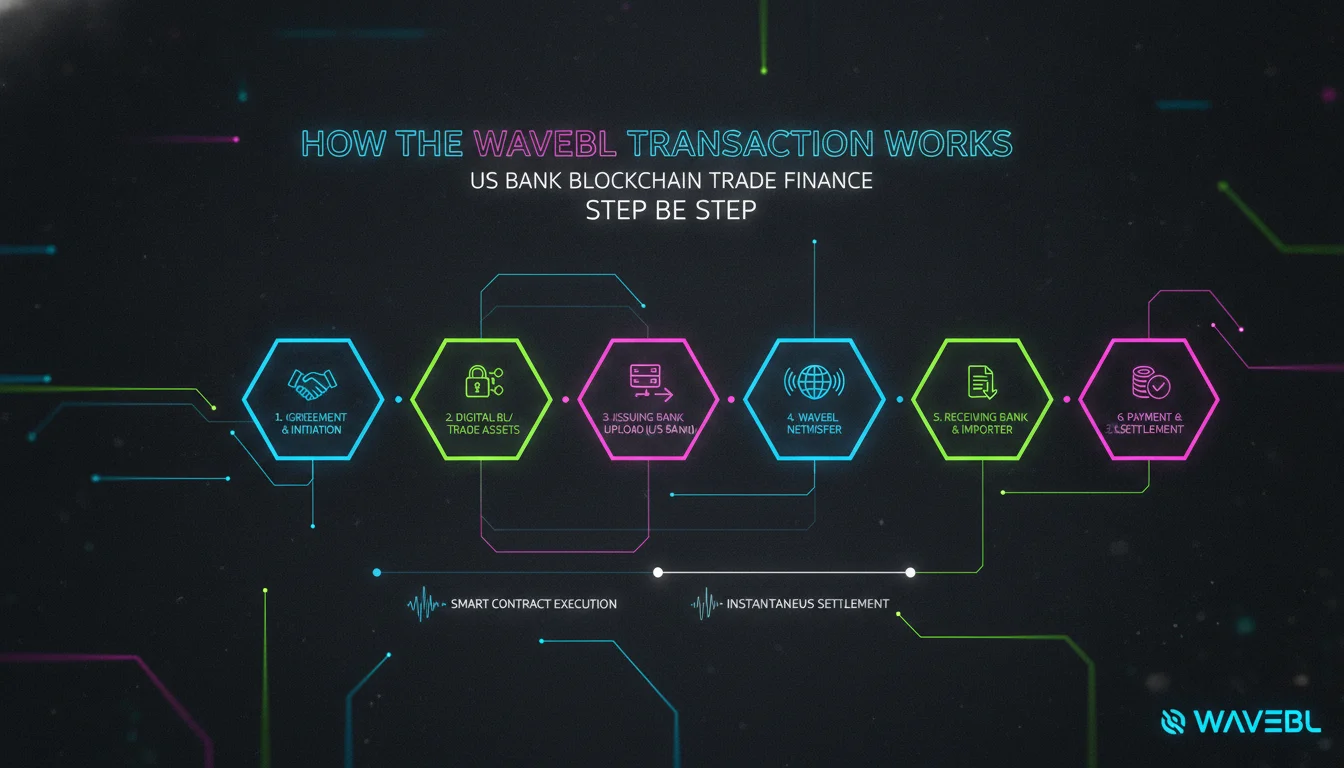
Follow the Document From Issuance to Settlement
- Step 1: Agree on the platform. The exporter, importer, banks, and carrier agree to use WaveBL for the transaction.
- Step 2: Carrier issues the eBL. The shipping line, such as MSC Mediterranean Shipping Company, issues an electronic bill of lading on WaveBL.
- Step 3: Transfer the document in encrypted form. The presenting bank receives and transfers the eBL in encrypted form to the next party.
- Step 4: Confirm title and receipt. The eBL functions as receipt and title for goods in transit, enabling legal transfer of ownership.
- Step 5: Settle and finance. The exporter presents digital documents to the bank, which accelerates payment or financing.
Why Bills of Lading Are Central
The bill of lading is one of the most important documents in international shipping. It acts as a receipt for shipped goods, evidence of the contract of carriage, and a document of title all at once. Physical bills of lading are vulnerable to courier delays, document losses, and storage costs. WaveBL digitizes the bill of lading, removing those vulnerabilities and making the trade document workflow fit for modern digital banking.
US Bank’s Broader Trade Finance and Digital Asset Strategy
Global Trade Financing Services
U.S. Bank offers commercial letters of credit, trade confirmations, bankers’ acceptances, and documentary collections through its international trade financing services. The bank also runs a secure online trade platform with unlimited use at no added cost, full visibility into trade transactions, and real-time activity notifications. This platform eliminates manual reports and cuts down reconciliation work across purchase orders, invoices, and trade documents. These capabilities complement the blockchain trade finance transaction by giving clients a genuinely digital suite for imports and exports, not just a single flashy pilot.
Supply Chain Finance Programs
Supply chain finance covers payables and receivables solutions that improve liquidity across a supply chain. U.S. Bank offers a Receivables Purchase Program to monetize receivables and reduce days sales outstanding, plus an Approved Payables Financing Program that helps suppliers access working capital while buyers get more competitive payment terms. These programs extend the efficiency gains of digital trade documents into the broader corporate cash conversion cycle.
Cryptocurrency Custody and Digital Assets
Beyond trade finance, U.S. Bank has expanded into institutional cryptocurrency custody. The bank launched custody services letting institutional investors manage cryptocurrency and non-cryptocurrency assets in one place. According to the U.S. Bank Cryptocurrency Custody FAQs, regulatory clarity from the SEC’s SAB 122, which rescinded the more restrictive SAB 121, along with the signing of the GENIUS Act, has accelerated bank participation in digital assets. This broader strategy positions us bank blockchain trade finance as one piece of a multi-asset digital transformation rather than an isolated experiment. Additional legislative efforts, including the CLARITY Act and Anti-CBDC measures, are still moving through Congress and could further shape how banks handle digital assets going forward.
Comparing Blockchain Trade Finance Platforms
Traditional Paper vs. WaveBL vs. Other DLT Initiatives
The table below compares the traditional paper-based process, the U.S. Bank WaveBL transaction, and other blockchain trade finance initiatives. It shows how the US Bank blockchain trade finance use case fits into a wider ecosystem of digital trade experiments.
| Feature | Traditional paper trade finance | US Bank WaveBL transaction | Other blockchain trade initiatives |
|---|---|---|---|
| Document type | Physical paper bill of lading | Electronic bill of lading (eBL) | eBLs and letters of credit on DLT |
| Transfer time | Several days via courier | Minutes | Lloyds Bank: 15 days to just over 24 hours |
| Primary parties | Exporter, importer, banks, carrier | U.S. Bank, large American exporter, MSC | Ornua, Barclays, Seychelles Trading Company; Maersk/IBM |
| Security model | Physical custody and courier risk | Encrypted transfers on WaveBL | Consensus-based distributed ledger |
| Production status | Legacy standard | First American bank production transaction | Pilots and early production cases |
Lloyds Bank Comparison
FStech reported that in April 2024, Lloyds Bank completed the first cross-border transaction using WaveBL, becoming the first UK bank to join the platform. Lloyds reduced processing time from 15 days to just over 24 hours and eliminated physical documentation entirely. That earlier European benchmark makes the U.S. Bank move part of a transatlantic shift toward digital trade documents, not a one-off American event.
Industry Pressures and the 2030 eBL Target
DCSA and the Push for 100% eBL Adoption
The Digital Container Shipping Association, or DCSA, is an independent organization representing nine of the world’s ten largest container lines. DCSA has set a target of issuing 100% electronic bills of lading by 2030. That target creates pressure on banks, exporters, importers, and carriers to digitize trade documents on a fixed timeline. The U.S. Bank WaveBL transaction is an early production example of the direction DCSA is pushing the entire shipping and banking industry toward.
“We’re excited to see such established institutions adopting WaveBL’s digital platform. Having such partners brings us closer to achieving our mission to provide practical solutions that streamline trade finance transactions.” – Ofer Ein Bar, VP of Financial Institutions, WaveBL
Regulatory and Market Momentum
Trade finance has stayed heavily paper-dependent despite technology advances across other parts of banking. But recent regulatory developments and successful production transactions are shifting that. U.S. Bank’s move follows broader industry efforts to modernize trade and working capital by cutting reliance on paper documents and manual workflows. A major U.S. bank completing this transaction signals that compliance and legal teams now treat electronic bills of lading as legitimate instruments in cross-border trade, not experimental workarounds. It’s worth noting that the underlying legal framework for eBLs still varies by jurisdiction, and questions about which law governs an electronic trade document’s enforceability remain an active area for trade lawyers and legislators.
What to Watch Next
For corporate banking clients, the next phase of us bank blockchain trade finance will likely involve scaling eBL usage across more shipping lines, expanding into letters of credit and other trade instruments, and integrating digital trade documents with supply chain finance platforms. This transaction is a foundational step, not an endpoint. As more banks adopt WaveBL and competing digital trade networks, standardization and interoperability between platforms will become the harder problem to solve.
The Future of US Bank Blockchain Trade Finance
Scaling Beyond a Single Transaction
The first fully digital trade finance transaction is a proof point, but the bigger prize is network adoption. U.S. Bank, as a major U.S. trade bank, can help bring more exporters, importers, carriers, and correspondent banks onto digital document workflows. As of 2026, the us bank blockchain trade finance initiative is expected to expand into additional trade instruments and geographies, particularly as DCSA’s 2030 deadline gets closer.
From Paper to Digital Trade
Paper-based trade finance has long been vulnerable to courier delays, document losses, and storage costs. Production transactions on WaveBL show that digital alternatives are viable at scale, not just in pilot programs. As DCSA’s 2030 target approaches, more banks will need to build blockchain-based document transfer into their core trade operations. U.S. Bank’s early move gives it a competitive benchmark in digital trade finance and reinforces a simple conclusion: trade finance is getting less paper-dependent every year.
Pros and Cons
Pros
- Document transfer drops from days to minutes, directly shortening the cash conversion cycle.
- Encrypted digital transfer reduces exposure to courier loss, forgery, and weather or geopolitical disruption.
- Aligns U.S. Bank with the DCSA’s 2030 industry target ahead of most domestic competitors.
- Integrates with existing letters of credit, documentary collections, and supply chain finance programs rather than replacing them.
Cons
- Adoption still depends on counterparties, carriers, and banks all agreeing to use the same platform.
- Legal recognition of electronic trade documents varies by jurisdiction, which can complicate cross-border enforceability.
- Only a single named production transaction has been publicly disclosed so far, so the model is still early stage relative to full industry rollout.
- Smaller exporters and importers may lack the technical relationships to plug into WaveBL as quickly as large publicly traded companies.
Frequently Asked Questions
What is us bank blockchain trade finance?
US bank blockchain trade finance refers to U.S. Bank using the WaveBL blockchain platform to digitize trade finance documents, such as electronic bills of lading, in international trade transactions.
Was U.S. Bank the first U.S. bank to complete a blockchain trade finance transaction?
Yes, U.S. Bank is the first American lender to execute a fully digital trade finance transaction using WaveBL, according to Trade Finance Global and American Banker.
What is an electronic bill of lading?
An electronic bill of lading is a digital version of a bill of lading that serves as a receipt and title document for goods in transit, replacing physical paper transfer with encrypted digital exchange.
Which parties were involved in the U.S. Bank WaveBL transaction?
U.S. Bank acted as presenting bank for a large publicly traded American exporter, while MSC Mediterranean Shipping Company issued the electronic bill of lading.
How much faster is WaveBL compared with paper courier?
U.S. Bank said the process reduced document transfer from several days to minutes. Lloyds Bank, using the same platform, cut processing from 15 days to just over 24 hours back in 2024.
What is the DCSA target for electronic bills of lading?
The Digital Container Shipping Association, representing nine of the world’s ten largest container lines, has set a target of 100% eBLs by 2030.
If you’re building infrastructure for the next phase of digital trade, whether that’s tokenized trade instruments, custody rails, or DAO-governed treasury tools, we’re building alongside serious operators. Apply to the Genesis Cohort at digitalblockchains.com.