Hashgraph vs blockchain is a comparison of two distributed ledger architectures: hashgraph uses a directed acyclic graph with gossip-based consensus, while blockchain chains sequential blocks via proof-of-work or proof-of-stake. Hashgraph wins on raw throughput and cost; blockchain wins on maturity and decentralization.
Key Takeaways
- Hashgraph uses a directed acyclic graph (DAG) and a gossip protocol, delivering faster finality and lower fees than most blockchains.
- Blockchain remains the more battle-tested technology with a larger developer ecosystem and broader institutional adoption.
- The hashgraph vs blockchain decision hinges on your priorities: throughput, cost predictability, decentralization, and regulatory comfort.
- Hedera Hashgraph, the leading implementation, is governed by a council of 39 organizations and is transitioning to open-source under Apache 2.0.
- No single DLT is objectively superior. Each excels in different enterprise and public network scenarios.
What is Blockchain?
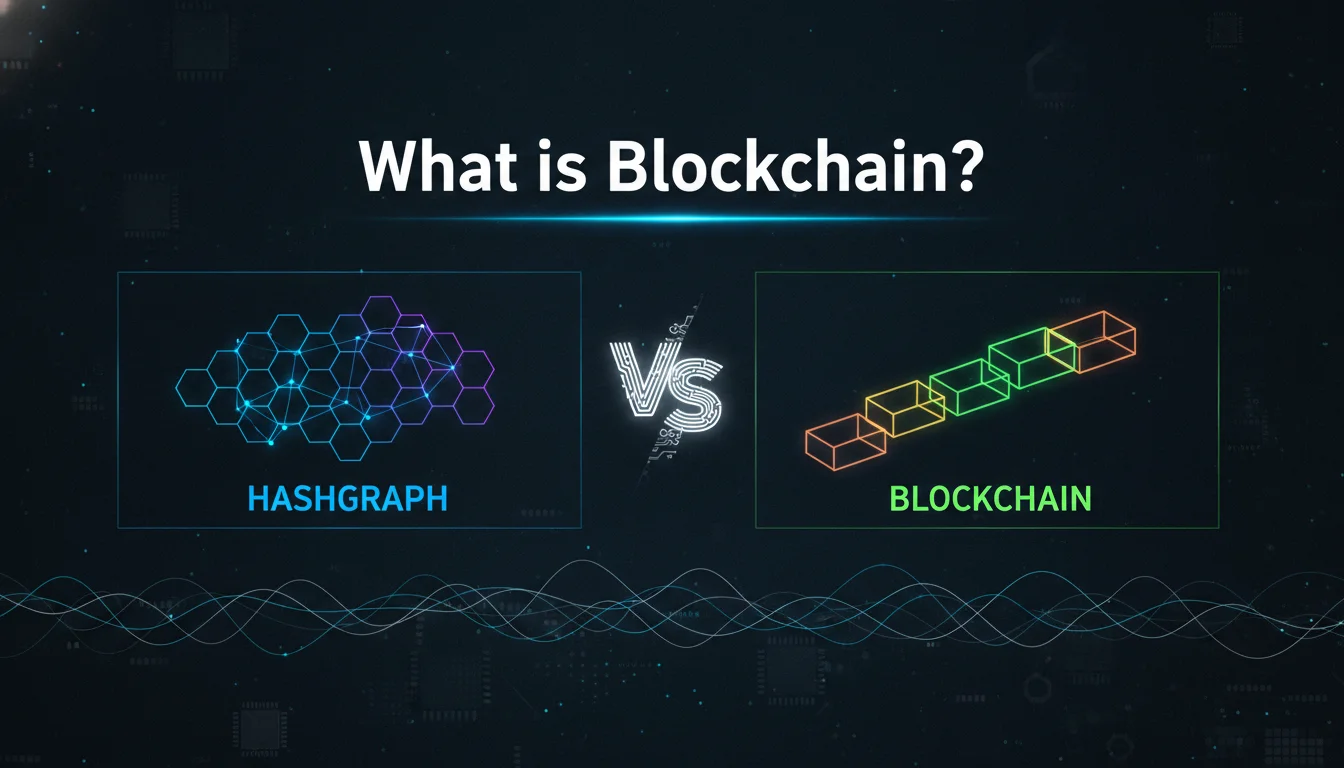
A blockchain is a shared distributed database that stores information in sequentially linked blocks, each containing validated transactions, a timestamp, and a cryptographic hash of the previous block, forming an immutable record. That chain structure is what makes blockchain tamper-resistant by design.
Blockchain networks use consensus mechanisms like proof-of-work (PoW) or proof-of-stake (PoS) to agree on the ledger state. Bitcoin, the first blockchain, uses PoW, where miners solve complex cryptographic puzzles to earn the right to add a new block. Ethereum made a final shift to PoS on September 15, 2022, dramatically reducing its energy footprint. These structural trade-offs sit at the center of any serious hashgraph vs blockchain analysis.
Strengths of Blockchain
- Decentralization: Data is distributed across many nodes, eliminating single points of failure.
- Security: Cryptographic hashing and consensus make records tamper-proof.
- Transparency: Public blockchains let anyone audit the full transaction history.
- Maturity: Blockchain has been stress-tested for over a decade with a large developer community and deep institutional support.
Limitations of Blockchain
- Scalability challenges: PoW blockchains like Bitcoin have a 10-minute block time and low throughput, causing congestion and high fees during peak demand.
- Energy consumption: PoW mining consumes massive electricity. According to Hacken, Bitcoin is 885,000 times less energy efficient than Hedera Hashgraph.
- Transaction fees: Bitcoin fees ranged between $10 and $30 as of 2021, and confirmation can take up to 10 minutes, per GeeksforGeeks data.
- Complexity: Integrating blockchain with legacy systems requires significant technical expertise.
Despite these drawbacks, blockchain remains the dominant DLT for cryptocurrencies, DeFi, and tokenization because of its first-mover advantage and proven resilience across multiple market cycles.
What is Hashgraph?
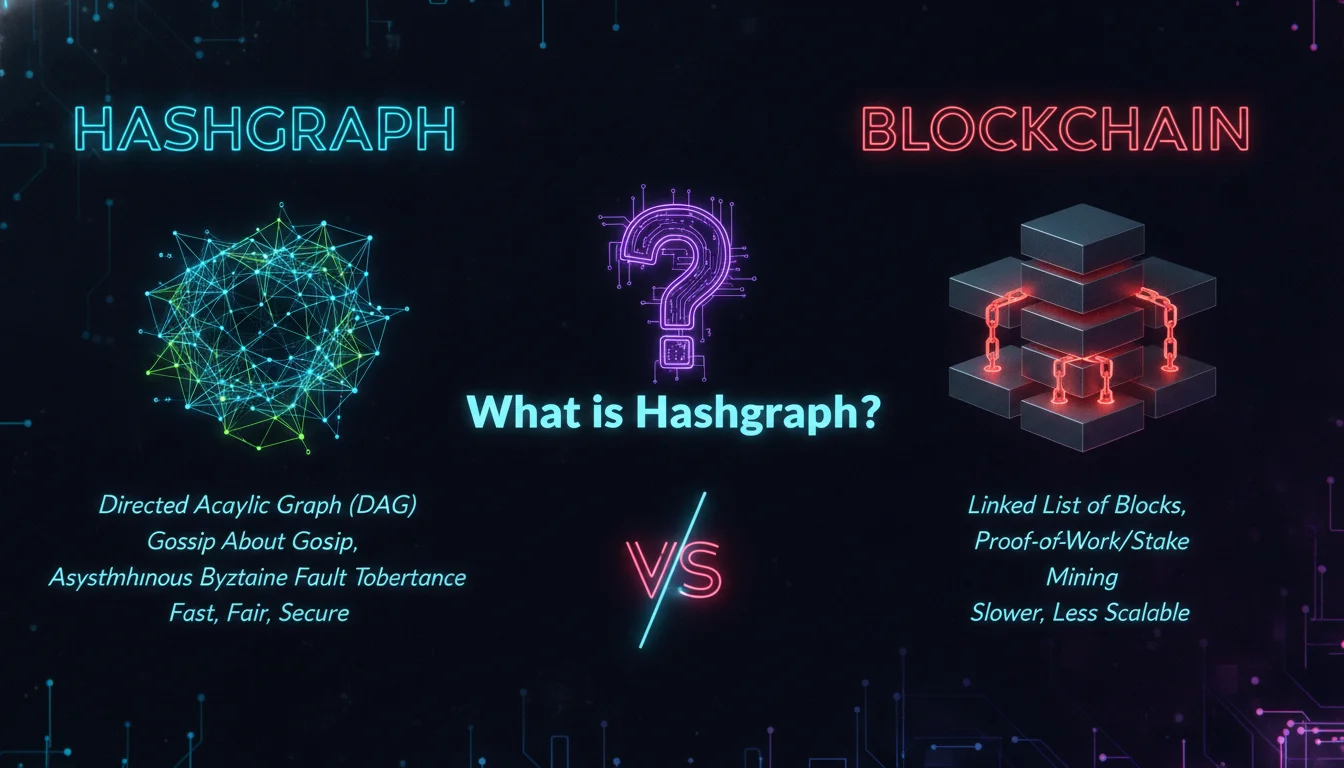
Hashgraph is a distributed ledger technology that uses a directed acyclic graph (DAG) structure instead of a linear chain of blocks, combining a “gossip about gossip” protocol with virtual voting to achieve fast, fair, and energy-efficient consensus. That architectural choice is what separates it from every major blockchain in production today.
According to GeeksforGeeks, hashgraph can process up to 500,000 transactions per second in theory. In practice, Hedera Hashgraph currently handles over 10,000 TPS, as reported by Hacken. That gap between theoretical ceiling and practical throughput is worth understanding before you architect anything on top of it.
How Hashgraph Consensus Works (Step-by-Step)
- Step 1: A node receives new transaction data and creates an “event” with a timestamp.
- Step 2: The node randomly selects another node on the network and shares that event via the gossip protocol.
- Step 3: Each receiving node adds the event to its local DAG, then gossips it to another random node.
- Step 4: This process repeats until all nodes know about the event. Virtual voting then determines the order and validity of transactions without energy-intensive mining.
Strengths of Hashgraph
- High throughput: Theoretical 500,000 TPS; practical 10,000+ TPS, far exceeding most blockchains.
- Fast finality: Typical transaction validation takes 3 to 5 seconds, according to Hacken.
- Low fees: Transaction cost stays under 1 cent, making micropayments and high-frequency use economically viable.
- Fairness: The consensus algorithm prevents any single party from dominating transaction ordering.
- Energy efficiency: No mining required. Hashgraph uses PoS and gossip, drastically cutting energy consumption.
Limitations of Hashgraph
- Younger ecosystem: Fewer developers, dApps, and integrations compared to Ethereum or other major blockchains.
- Decentralization concerns: Hedera is governed by a council of 39 organizations, and 10% of profits go to Swirlds, the company that patented hashgraph. That structure has drawn legitimate criticism from decentralization purists.
- Permissioned history: Until recently, running a dApp on Hedera required approval from the governing council. The network is transitioning to open-source under Apache 2.0 after the next mainnet upgrade.
Hashgraph vs Blockchain: Core Architectural Differences
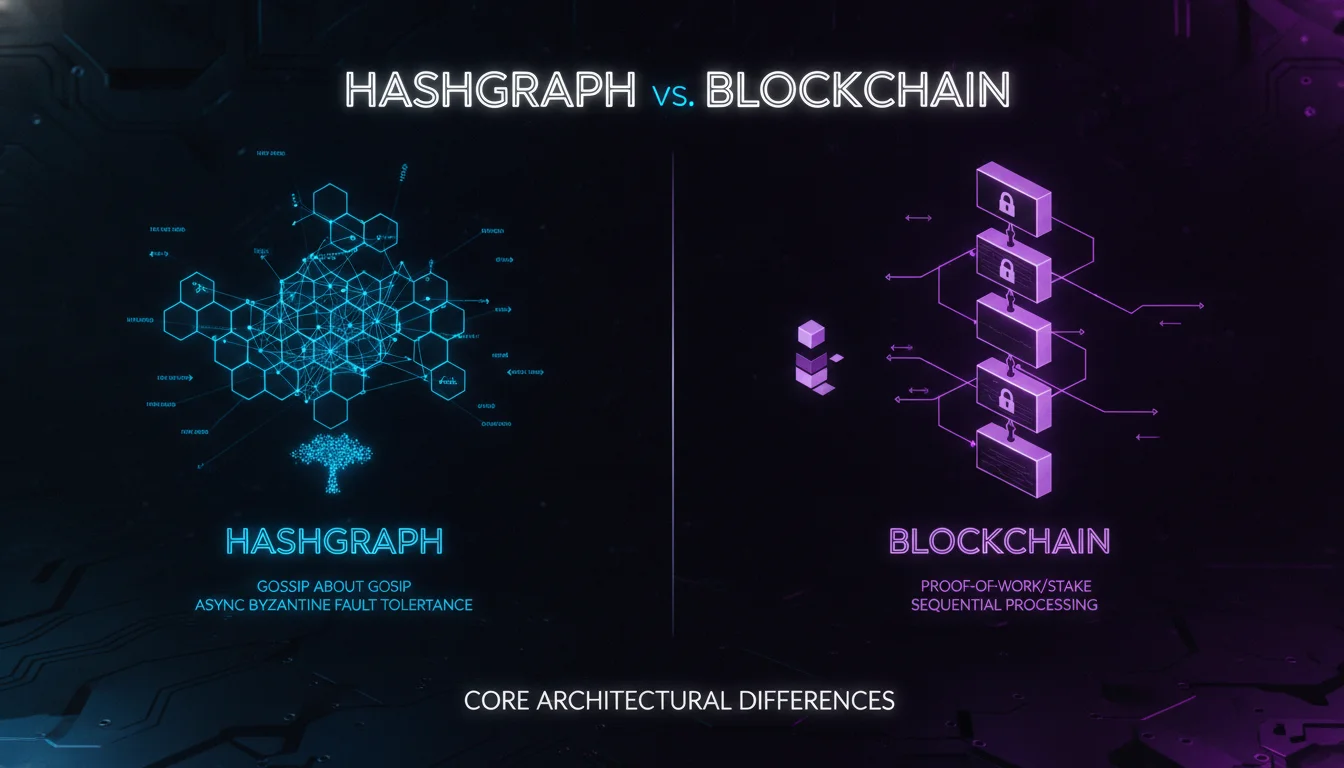
The fundamental difference in the hashgraph vs blockchain comparison lies in how transactions are recorded and agreed upon. Blockchain organizes data into sequentially linked blocks; hashgraph uses a web-like DAG where transactions can be processed simultaneously rather than one block at a time.
Data Structure: Chain of Blocks vs Directed Acyclic Graph
Blockchain maintains a single chronological chain of blocks, which creates a processing bottleneck because only one block can be appended at a time. Hashgraph’s DAG allows multiple branches to exist and merge, enabling parallel processing. According to GeeksforGeeks, this web-like structure allows transactions to be processed simultaneously, making hashgraph faster and more scalable at the base layer.
Consensus Mechanism: PoW/PoS vs Gossip About Gossip
Blockchain networks rely on PoW or PoS, where miners or validators compete or are selected to propose blocks. Hashgraph uses the gossip protocol combined with virtual voting, which requires no block proposals or leader elections. As described by Hacken, once a node receives new data, it randomly shares it with another node; this continues until all nodes have the information, and virtual voting achieves Byzantine Fault Tolerance without heavy computation.
Transaction Speed and Scalability
Speed is the most cited metric in the hashgraph vs blockchain comparison. Bitcoin’s PoW has a 10-minute block time and low throughput. Ethereum post-merge still faces scalability constraints on its base layer. Hedera Hashgraph reports a theoretical 500,000 TPS ceiling and actual 10,000+ TPS with 3 to 5 second finality, per the sources cited above. That is not a marginal improvement; it is a structural difference in how consensus is reached.
Fees and Energy Efficiency
Blockchain fees spike during network congestion. Bitcoin fees were $10 to $30 in 2021, and Ethereum gas fees have exceeded $50 during peak periods. Hashgraph’s fee structure is designed to stay under 1 cent regardless of network load. On energy, Hacken reports that Bitcoin is 885,000 times less energy efficient than Hedera Hashgraph. PoS blockchains like Ethereum are significantly greener than PoW, but hashgraph’s gossip protocol avoids block proposal overhead entirely, making it arguably the most efficient of the three approaches.
Security and Fairness
Both technologies use cryptographic techniques to secure data, but they differ in their guarantees. Hashgraph claims asynchronous Byzantine Fault Tolerance (ABFT), the highest security grade for DLTs, ensuring finality even if some nodes behave maliciously. Blockchain’s PoW provides probabilistic finality (Bitcoin requires multiple confirmations before a transaction is considered settled), while PoS provides deterministic finality. Hashgraph also enforces fair ordering: transactions are processed in the sequence they are received, reducing front-running and manipulation at the protocol level.
“Hashgraph solves the same problems that blockchain does but tends to do it faster so that a typical transaction gets validated within 3-5 seconds. The processing capacity on the Hashgraph network is over 10,000 transactions per second, which is virtually unattainable on the blockchain.” – Hacken Security Research
Smart Contract Compatibility
Smart contract support is a practical consideration that often gets buried in the hashgraph vs blockchain debate. Hedera Hashgraph supports smart contracts through the Hedera Smart Contract Service, which is compatible with the Ethereum Virtual Machine (EVM). That means developers can port existing Solidity dApps to Hedera with minimal changes. The trade-off is ecosystem depth: Ethereum has years of audited contract libraries, established tooling like Hardhat and Foundry, and a much larger pool of Solidity developers. Hedera’s EVM compatibility lowers the migration barrier, but the surrounding infrastructure is still maturing.
Side-by-Side Comparison
| Criteria | Blockchain | Hashgraph |
|---|---|---|
| Data Structure | Linear chain of blocks | Directed Acyclic Graph (DAG) |
| Consensus | Proof-of-Work, Proof-of-Stake | Gossip about Gossip + Virtual Voting |
| Transaction Speed | Bitcoin: 10-min block time; Ethereum: moderate | 10,000+ TPS (actual); 500,000 TPS theoretical |
| Finality | Probabilistic (Bitcoin) or deterministic (PoS Ethereum) | Deterministic, 3 to 5 seconds |
| Fees | $10 to $30 (Bitcoin, 2021); variable gas fees | Under 1 cent |
| Energy Efficiency | PoW high; PoS moderate | Very high, no mining |
| Decentralization | Varies: Bitcoin highly decentralized; PoS moderate | Currently governed by 39-org council; transitioning |
| Maturity/Ecosystem | Large, mature, thousands of dApps | Smaller but growing, enterprise-focused |
| Smart Contracts | Native (Ethereum, Solana, etc.) | EVM-compatible via Hedera Smart Contract Service |
Pros and Cons
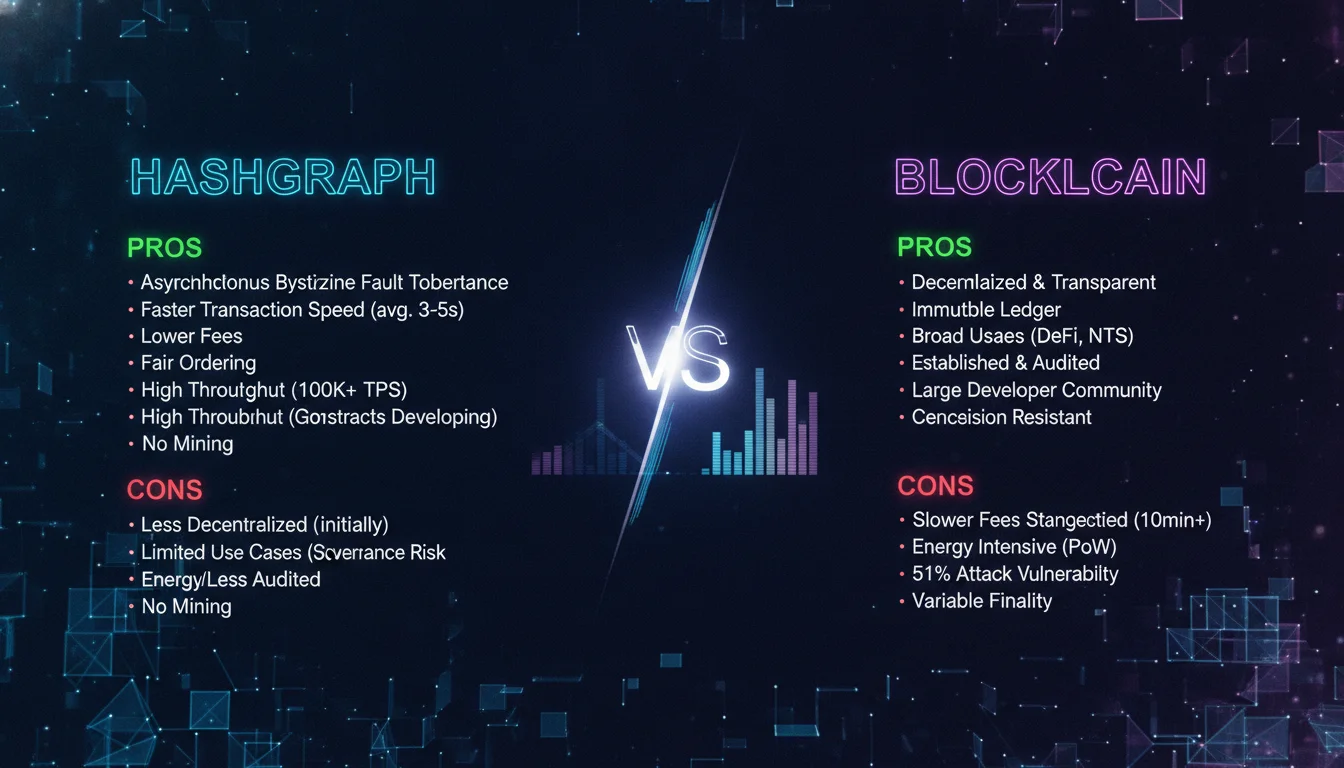
Pros of Hashgraph
- Deterministic finality in 3 to 5 seconds, suitable for real-time settlement use cases.
- Transaction fees under 1 cent, enabling micropayments and high-frequency data logging.
- No mining means dramatically lower energy consumption than PoW blockchains.
- ABFT security model provides strong guarantees even under adversarial conditions.
- EVM compatibility lets Solidity developers migrate existing contracts with minimal rework.
Cons of Hashgraph
- Governance is centralized around a 39-organization council, with 10% of profits flowing to Swirlds.
- Smaller developer ecosystem means fewer audited libraries, tools, and community resources.
- Permissioned history creates regulatory and philosophical friction for teams building truly open protocols.
- The open-source transition is still in progress; full permissionless operation is not yet live.
Pros of Blockchain
- Over a decade of battle-tested security across Bitcoin, Ethereum, and dozens of other networks.
- Massive developer ecosystem with mature tooling, audited libraries, and deep liquidity.
- Maximum decentralization on networks like Bitcoin, with no single governing body.
- Regulatory clarity is advancing faster for blockchain-based assets (Bitcoin and Ethereum ETFs, MiCA in Europe).
Cons of Blockchain
- PoW blockchains are energy-intensive and slow, with Bitcoin’s 10-minute block time creating settlement delays.
- Fee volatility on congested networks can make certain use cases economically unviable.
- Base-layer scalability still requires Layer 2 solutions for high-throughput applications.
- Integrating with legacy enterprise systems remains technically complex and expensive.
When to Choose Blockchain vs Hashgraph
Your decision in the hashgraph vs blockchain evaluation should be driven by specific project requirements, not hype. Both technologies solve distributed trust, but their trade-offs make them suited to different scenarios.
Choose Blockchain When…
- You need maximum decentralization and censorship resistance, such as public DeFi protocols or permissionless token economies.
- You want access to a massive developer talent pool, existing tooling, and a rich ecosystem of dApps and oracles.
- You are building an application that benefits from the Lindy effect: blockchain has survived over a decade of market cycles and attacks.
- Regulatory clarity around your use case already exists for blockchain-based assets, such as Bitcoin or Ethereum ETFs.
Choose Hashgraph When…
- Your application requires high throughput and low, predictable fees, such as micropayments, supply chain tracking, or IoT data streams.
- You need fast, deterministic finality for real-time settlements or gaming applications.
- Energy efficiency is a core requirement for your organization’s ESG commitments.
- You are comfortable with a more centralized governance model now and believe the open-source transition will broaden decentralization over time.
Hedera Hashgraph has attracted enterprise interest for use cases like coupon fraud prevention, vaccine cold chain tracking, and tokenization of real-world assets. Blockchain, particularly Ethereum, dominates DeFi lending, NFTs, and decentralized autonomous organizations (DAOs). These are not competing for the same ground in most cases.
“According to Statista, the global distributed ledger technology market will exceed $127 billion by 2030, with supply chain audits alone projected to reach $103 billion by end of decade. Both hashgraph and blockchain will capture portions of that growth in different verticals.” – SCAND Technology Research, 2025
Hedera Hashgraph: The Leading Hashgraph Implementation
Hedera is the public network built on the Swirlds hashgraph algorithm, and it is not technically a blockchain. It uses the hashgraph consensus without blocks in the traditional sense. That distinction matters when you are evaluating the hashgraph vs blockchain question for a real project, because the governance model, fee structure, and consensus guarantees are fundamentally different from anything in the blockchain stack.
Governance and Decentralization Considerations
Hedera is governed by the Hedera Global Governing Council, which consists of 39 representatives from large organizations including Google, IBM, Boeing, and Deutsche Telekom. This council makes decisions about network parameters, software upgrades, and treasury management. According to Hacken, 10% of all profits generated by Hedera go to Swirlds, the company that patented the hashgraph technology.
Critics argue this model is not sufficiently decentralized compared to Bitcoin or Ethereum. Supporters counter that the council model provides stability and prevents hard forks. Hedera has announced plans to make the hashgraph consensus open source under an Apache 2.0 license after the next mainnet upgrade, which would remove the patent dependency and allow broader community participation. Whether that transition delivers meaningful decentralization remains to be seen.
Adoption and Ecosystem Maturity
Hedera’s developer ecosystem is smaller than Ethereum’s, but it has attracted significant enterprise interest. Use cases include coupon fraud tracking, asset tokenization, and secure data logging. The network’s native token, HBAR, is used for transaction fees, staking, and governance voting. For teams evaluating the hashgraph vs blockchain question from an enterprise angle, Hedera’s predictable fee model and deterministic finality are often the deciding factors.
Hashgraph vs Blockchain: Final Verdict
The hashgraph vs blockchain comparison is not about which technology is universally superior. It is about which tool fits your project’s specific requirements. Blockchain remains the default for decentralized finance, public infrastructure, and applications that prioritize battle-tested security and maximal decentralization. Hashgraph, especially via Hedera, offers superior speed, cost predictability, and energy efficiency, making it attractive for enterprise-grade applications where throughput matters more than radical decentralization.
If you are building a public DeFi platform or a permissionless token economy, choose a blockchain like Ethereum or a Layer 2 solution. If you are an enterprise needing a high-throughput, low-fee DLT for supply chain, identity, or asset tracking, hashgraph is a strong contender. Both technologies will likely coexist, serving different niches in the expanding DLT market, which Statista projects to exceed $127 billion by 2030. The builders who understand both will be the ones making the right architectural calls.
If you are working through this decision for a real protocol or enterprise deployment, the Digital Blockchains studio works through exactly these trade-offs. You can also explore our breakdown of tokenomics design and smart contract architecture for deeper context on how consensus choice affects your entire system design.
Ready to build on the right foundation? Apply to the Genesis Cohort at digitalblockchains.com and work with a team that has read the whitepapers and knows which trade-offs actually matter in production.
Frequently Asked Questions
What is replacing blockchain?
No single technology is replacing blockchain outright. Hashgraph and other DAG-based DLTs offer faster and cheaper alternatives for specific use cases, but blockchain’s maturity and network effects keep it dominant for most public applications. The more accurate framing is that different DLTs are capturing different market segments rather than one replacing the other.
Is XRP considered a blockchain?
XRP runs on the XRP Ledger (XRPL), which is a blockchain that uses a unique consensus protocol instead of proof-of-work. So yes, XRP is a blockchain-based cryptocurrency, but its consensus mechanism differs significantly from Bitcoin or Ethereum. The XRPL uses a federated consensus model with a trusted validator list rather than open mining or staking.
Is HBAR its own blockchain?
HBAR is the native cryptocurrency of the Hedera network. Hedera is not a blockchain in the traditional sense; it uses the hashgraph DAG data structure for consensus. Therefore, HBAR runs on a hashgraph-based DLT, not a blockchain, which is a meaningful technical distinction when evaluating the hashgraph vs blockchain question for development purposes.
What are the top 5 blockchains?
Rankings vary by metric, but the most widely adopted blockchains as of 2026 are Ethereum, Bitcoin, Solana, BNB Chain, and Arbitrum or Polygon depending on whether you measure by DeFi TVL, developer activity, or market capitalization. Each serves a different primary use case within the broader ecosystem.
Is hashgraph more secure than blockchain?
Hashgraph claims asynchronous Byzantine Fault Tolerance (ABFT), a strong security property that provides deterministic finality even if some nodes behave maliciously. Many blockchains achieve BFT through PoS or other mechanisms, but hashgraph’s gossip protocol reaches consensus without energy-intensive mining or leader elections. Whether that makes it “more secure” depends on your threat model: ABFT is a stronger formal guarantee, but Bitcoin’s decade-plus track record carries its own weight.
Can hashgraph handle smart contracts?
Yes. Hedera Hashgraph supports smart contracts through the Hedera Smart Contract Service, which is compatible with the Ethereum Virtual Machine (EVM). This allows developers to port existing Solidity dApps to Hedera with minimal changes, though the surrounding tooling and audited library ecosystem is less mature than Ethereum’s.