Blockchain investing is the practice of allocating capital to assets or companies that build, use, or benefit from blockchain technology, including crypto, ETFs, and equities. Every vehicle carries distinct risks you must evaluate before buying.
Key Takeaways
- Blockchain investing spans direct crypto, spot ETPs, blockchain ETFs, and crypto-related equities.
- Public blockchains are decentralized ledgers with no single owner; private blockchains are centralized.
- Spot crypto ETFs and ETPs provide wallet-free exposure with lower operational friction.
- Volatility and regulatory risk remain central concerns. Crypto lost $2 trillion in 2022, according to the World Economic Forum.
- Demographic data show uneven participation and risk perception across investor groups.
- A step-by-step plan helps match investment vehicles to risk tolerance.
What Is Blockchain Investing?
Blockchain investing is the practice of allocating capital to digital assets, companies, or funds that build on, use, or derive value from distributed ledger technology. This includes buying cryptocurrencies directly, purchasing exchange-traded products that hold digital assets, buying shares of companies developing blockchain applications, or investing in thematic ETFs. Investors choose among these vehicles based on risk tolerance, regulatory access, and their long-term view of blockchain adoption.
Blockchain Technology Defined
A blockchain is a decentralized, incorruptible digital ledger that records transactions across a network. According to Fidelity Investments, blockchain technology works like an online database that records data across a network. Data is grouped into blocks, each with a unique code called a hash generated automatically. To start the next block, the previous block’s hash must be incorporated, creating an unbroken chain. Once a block is added, it cannot be altered. On the Bitcoin network, data is grouped approximately every 10 minutes. On the Ethereum network, that interval drops to approximately every 12 seconds.
Public vs. Private Blockchains
A public blockchain is a decentralized network with no single owner. It works like a publicly shared spreadsheet where everyone can view data but no one can edit it. A private blockchain is a centralized ledger maintained by one entity, group, or company. This distinction matters for blockchain investing because most cryptocurrency networks such as Bitcoin and Ethereum are public, while many enterprise solutions use private or permissioned networks. The governance and trust assumptions differ significantly.
Why Blockchain Investing Matters
Blockchain investing matters because the technology has applications far beyond cryptocurrency. Fidelity notes potential use cases in healthcare, insurance, and the food industry. ETF Database explains that blockchain solved the age-old problem of efficiently exchanging assets without intermediaries, distributing records across a network of computers accessible to anyone with internet. Investors can participate in this infrastructure through thematic funds, equities, and direct digital asset ownership, not just by holding coins.
How Blockchain Investing Works

Blockchain investing works by selecting an exposure vehicle that matches your goals. You can own the underlying digital asset, buy shares of companies that build blockchain infrastructure, or hold a diversified fund. Each route has different mechanics, custody, fees, and risk profiles, so understanding how each vehicle operates is essential before committing capital.
Direct Crypto Ownership
Direct ownership means buying cryptocurrencies like Bitcoin or Ethereum and holding them in a wallet. Fidelity warns that users identify with a private key, like a randomized password, and losing that key may result in total loss of access. No organization like the Securities Investor Protection Corporation (SIPC) insures or protects your crypto. Direct ownership offers full control but demands strong security practices. Charles Schwab is preparing to launch Schwab Crypto, allowing clients to buy and sell Bitcoin and Ethereum at a fee of 0.75% of trade value with zero spread, according to its website.
Blockchain Stocks and Equities
Investors can also buy shares of companies that operate in the cryptocurrency and blockchain sectors. Schwab offers access to crypto-related stocks and exchange-traded products, and its Schwab Investing Themes includes a Blockchain theme with a starting minimum investment of $250. The Motley Fool notes that an exchange-traded fund may be a better way to invest in blockchain technology than a single stock, because ETFs spread risk across multiple companies.
ETFs and Thematic Funds
A blockchain ETF is a fund that meets at least one of two criteria, according to ETF Database: it invests in companies involved with the transformation of business applications through development and use of blockchain technology, or it invests in companies directly or indirectly involved in the blockchain ecosystem. These funds provide diversified exposure and trade through standard brokerage accounts. VanEck, for example, launched its actively managed Onchain Economy ETF in May 2025, a spot Solana ETP with staking rewards in November 2025, and an Avalanche ETF in January 2026.
Blockchain Investment Vehicles Compared
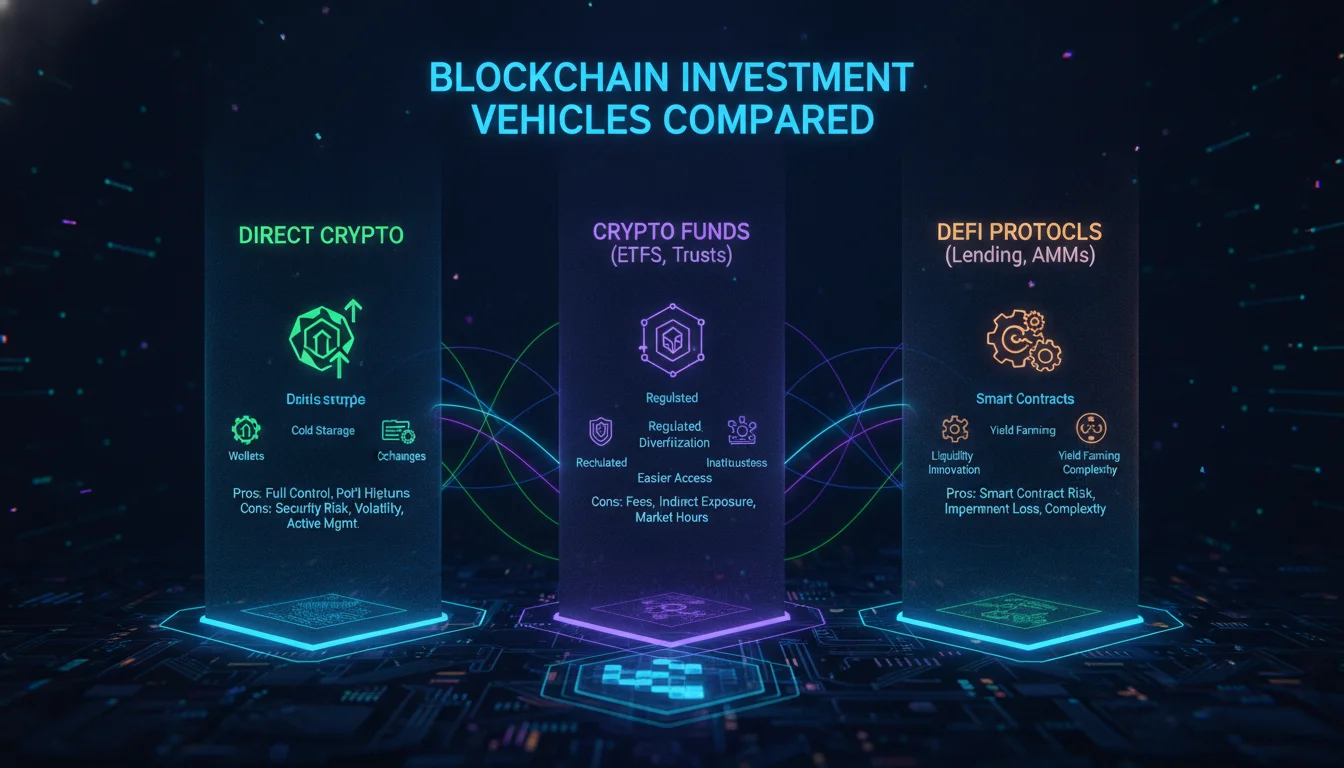
The table below compares the primary vehicles for blockchain investing. Each option trades off control, convenience, diversification, and risk in different ways.
| Vehicle | Description | Pros | Cons | Example or Notes |
|---|---|---|---|---|
| Spot crypto ETPs | Exchange-traded products that invest directly in Bitcoin, Ethereum, or other cryptocurrencies | No wallet required; exchange access; direct price exposure | High volatility; management fees; possible tracking error | Schwab lists ETPs in Fund Finder; VanEck launched spot Solana ETP Nov 2025 and Avalanche ETF Jan 2026 |
| Blockchain ETFs | Funds investing in companies developing or using blockchain technology | Diversified; thematic exposure; lower single-asset risk | Indirect exposure; may include non-pure-play companies | Schwab Blockchain theme with $250 minimum; ETF Database defines two criteria |
| Blockchain stocks | Equities of companies operating in crypto and blockchain sectors | Familiar brokerage account; potential dividends; company-specific growth | Corporate risk; still correlated to crypto cycles | Motley Fool suggests ETFs over single stocks; Schwab offers crypto-related stocks |
| Direct cryptocurrency | Buying and holding digital assets like Bitcoin or Ethereum | Full ownership; no intermediary; highest upside potential | Private key loss risk; no SIPC insurance; extreme volatility | Fidelity warns losing private key may lose access; Schwab Crypto fee 0.75% with zero spread |
Spot Crypto ETPs
Spot crypto exchange-traded products invest directly in cryptocurrencies, providing exposure to price movements without requiring a crypto wallet. Schwab lists a range of crypto-invested ETPs in its Fund Finder under the digital assets category. VanEck’s product launches illustrate the breadth of what’s now available: the firm was the first ETF issuer to file for a Bitcoin futures ETF in August 2017, filed for a spot Bitcoin ETF in June 2018, and more recently launched a Solana ETP with staking rewards in November 2025 and an Avalanche ETF in January 2026. These products trade on regulated exchanges but still carry the underlying asset’s volatility.
Blockchain ETFs and Thematic Funds
Thematic blockchain ETFs hold baskets of stocks rather than digital assets directly. They can include companies developing enterprise blockchain solutions, crypto exchanges, miners, or financial firms adopting the technology. Because they are diversified, they may be less volatile than single cryptocurrencies, but they still carry sector concentration risk. Schwab’s Blockchain theme is one example of a low-minimum approach, with a starting investment of $250. ETF Database’s definition helps investors distinguish genuine blockchain ETFs from funds that only incidentally hold crypto-adjacent companies.
Stocks and Direct Crypto
Individual blockchain stocks offer company-specific exposure, but picking winners is difficult. The Motley Fool points out that an ETF may be a better starting point than a single stock. Direct crypto ownership provides the purest exposure to blockchain networks but requires managing private keys and accepting the risk of total loss if keys are lost. Both options carry higher risk compared with broad market funds, and neither carries the same protections as traditional securities.
Pros and Cons of Blockchain Investing
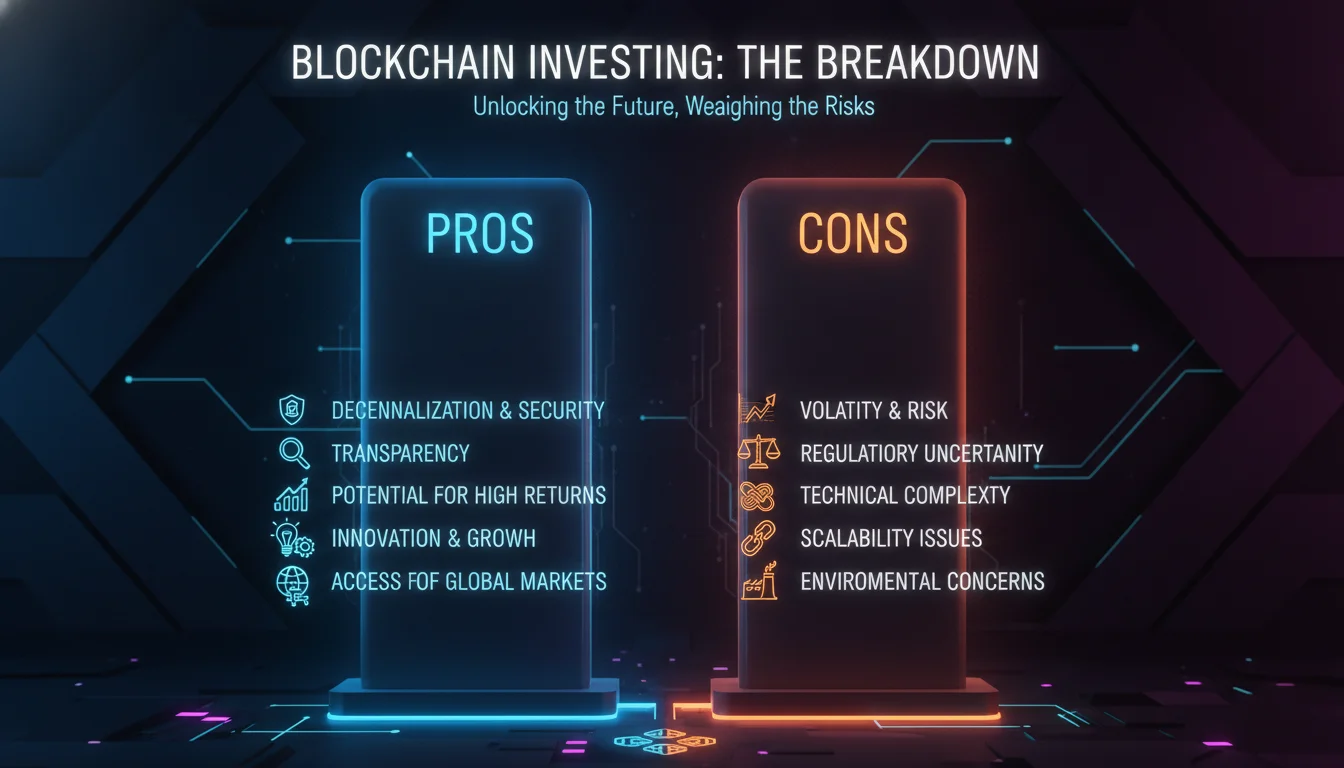
Blockchain investing offers genuine opportunity alongside real structural risks. Understanding both sides clearly is the only honest way to approach capital allocation in this sector.
Pros
- Multiple entry points: Direct crypto, spot ETPs, thematic ETFs, and equities let investors calibrate exposure to their exact risk tolerance.
- Regulated product access: Spot Bitcoin and Ethereum ETPs now trade on major exchanges, removing the need for self-custody.
- Broad technology upside: Blockchain applications extend into healthcare, insurance, supply chain, and finance, not just digital currencies.
- Low minimum entry: Products like Schwab’s Blockchain theme start at $250, making the sector accessible without large capital commitments.
- Diversification potential: Thematic ETFs spread risk across dozens of companies rather than concentrating it in a single token.
Cons
- Extreme volatility: Crypto lost $2 trillion in 2022 alone, according to the World Economic Forum. Drawdowns of that scale can happen quickly.
- No SIPC protection: Unlike traditional brokerage accounts, direct crypto holdings carry no government insurance backstop.
- Private key risk: Losing your private key means losing your assets permanently. No recovery mechanism exists.
- Regulatory fragmentation: Rules vary by jurisdiction and continue to shift, creating compliance uncertainty for both issuers and investors.
- Fraud exposure: Minority investors are disproportionately targeted by crypto scammers, per the D.C. Department of Insurance, Securities and Banking.
Step-by-Step Guide to Start Blockchain Investing
Use this numbered process to begin blockchain investing methodically. Each step builds on the previous one to reduce emotional decision-making.
- Determine your risk tolerance: Decide how much volatility you can accept and whether you can afford to lose the invested capital.
- Choose an investment vehicle: Select among direct crypto, spot ETPs, blockchain ETFs, or stocks based on your goals.
- Open and fund a brokerage or crypto account: Use a regulated platform. For thematic exposure, Schwab’s Blockchain theme requires a $250 minimum.
- Execute the trade: Place orders during market hours for ETFs and stocks. Crypto trades can occur 24/7.
- Monitor and rebalance: Review performance, fees, and allocation regularly. Adjust as needed.
Step 1: Determine Your Risk Tolerance
Blockchain investing involves substantial price swings. Before buying anything, assess how much loss you can tolerate without altering your long-term plan. The D.C. Department of Insurance, Securities and Banking warns that crypto is volatile and a substantial risk, advising investors to put in only what they can afford to lose. This guidance applies to many blockchain-linked equities and funds as well.
Step 2: Select an Investment Vehicle
Match your vehicle to your risk profile and access preferences. Direct crypto offers maximum exposure but requires self-custody discipline. Spot ETPs and blockchain ETFs provide brokerage convenience and diversification. If you prefer not to hold digital assets directly, thematic funds or crypto-related stocks may be more suitable. Schwab’s crypto-related investment options allow exposure without a crypto wallet, according to its cryptocurrency page.
Step 3: Open, Fund, and Execute
Open a brokerage account if you choose ETFs, ETPs, or stocks. Schwab’s Blockchain theme has a $250 minimum investment, making it accessible for many beginners. For direct crypto, use a reputable exchange or wait for Schwab Crypto’s launch, which will offer Bitcoin and Ethereum trading at 0.75% of trade value with zero spread. Execute trades only after verifying fees and settlement mechanics.
Step 4: Monitor and Rebalance
Blockchain markets move quickly. Review your allocation periodically and rebalance if one position grows to dominate your portfolio. Keep records of fees, tax implications, and any changes in product structure. Rebalancing does not guarantee profits, but it helps maintain your intended risk level as market conditions shift.
Understanding Blockchain Investment Risks
Blockchain investing carries unique risks not present in traditional securities. The same properties that make blockchain innovative, including decentralization, immutability, and the absence of intermediaries, also create distinct failure modes.
Volatility and Loss Potential
Cryptocurrency and blockchain-linked assets can lose value rapidly. The D.C. Department of Insurance, Securities and Banking reports that crypto wiped out $2 trillion in 2022, citing the World Economic Forum. This illustrates the scale of drawdowns possible in digital asset markets. Even diversified blockchain ETFs can decline sharply during risk-off periods, although they may be less volatile than single coins.
Regulatory and Security Risks
Regulation of crypto and blockchain products remains fragmented. Fidelity notes that crypto holdings are not insured by the SIPC, unlike traditional brokerage accounts. If you lose your private key, there is no entity to recover your assets. Securities regulators also warn that crypto is not regulated like stocks or insured like bank deposits. This gap in protection is a structural feature of the technology, not a temporary oversight.
Scams and Misleading Promotions
Fraud is a persistent risk in blockchain investing. The D.C. Department of Insurance, Securities and Banking warns that minority investors are often targeted by crypto scammers. A Pew Research Center survey found that 24% of Asian adults and 21% of Black or Hispanic adults say they have invested in or used a cryptocurrency, compared with 14 percent of White adults. Overall, 17% of U.S. adults fall into one of these categories. The Ariel-Schwab Black Investor Survey found that Black investors are more likely than White investors to believe crypto investments are safe (33% vs. 18%) and regulated by the government (30% vs. 14%). Be wary of unsolicited offers and finfluencers who get paid regardless of your losses.
“Crypto is volatile and a substantial risk. Invest only what you can afford to lose.” – D.C. Department of Insurance, Securities and Banking
Blockchain Investing in 2026: Trends and Regulatory Landscape
The blockchain investing landscape in 2026 reflects a maturing product set and shifting demographics. Spot ETFs, staking-enabled ETPs, and thematic funds have expanded access beyond early adopters. Understanding these trends helps investors evaluate where the market is headed.
Spot ETF Milestones and Product Launches
VanEck’s timeline illustrates how quickly crypto investment products have evolved. The firm became the first ETF issuer to file for a Bitcoin futures ETF in August 2017 and followed with a spot Bitcoin ETF filing in June 2018. After the SEC’s spot bitcoin ETF approval, VanEck CEO Jan van Eck wrote on January 10, 2024: “We Celebrate Bitcoin Builders – Not Tourists.” The firm then launched an actively managed Onchain Economy ETF in May 2025, a spot Solana ETP with staking rewards in November 2025, and an Avalanche ETF in January 2026. These products give investors regulated ways to gain exposure without directly holding coins.
“We Celebrate Bitcoin Builders – Not Tourists.” – Jan van Eck, VanEck CEO, January 10, 2024, following the SEC’s spot Bitcoin ETF approval.
Institutional Adoption and Demographic Shifts
Adoption is uneven across demographic groups. According to Pew Research Center data cited by the D.C. Department of Insurance, Securities and Banking, 24 percent of Asian adults and 21 percent of Black or Hispanic adults have invested in or used cryptocurrency, compared with 14 percent of White adults. Overall, 17 percent of U.S. adults report such involvement. The Ariel-Schwab Black Investor Survey found that Black investors are more likely than White investors to believe crypto investments are safe and regulated. These gaps highlight the importance of education and caution in blockchain investing.
The Role of Blockchain Beyond Crypto
Blockchain’s value proposition extends beyond digital currencies. Fidelity highlights potential use cases in healthcare, insurance, and the food industry. ETF Database notes that blockchain solved the age-old problem of exchanging assets without intermediaries, with records distributed across a network and accessible to anyone with internet. This broader utility supports the case for thematic blockchain investing through equities and funds, not solely through crypto tokens.
Tax Considerations for Blockchain Investors
Tax treatment is a material factor in blockchain investing that many first-time investors underestimate. In most jurisdictions, selling or exchanging cryptocurrency triggers a taxable event, and the gain or loss is calculated against your cost basis. Holding a spot crypto ETP inside a standard brokerage account does not eliminate this treatment. Blockchain ETFs holding equities follow standard stock tax rules, which differ from direct crypto treatment. Before executing any blockchain investing strategy, consult a tax professional familiar with digital asset reporting requirements, as rules continue to evolve and vary by country.
How to Choose the Right Blockchain Investment for Your Portfolio
Choosing the right blockchain investing vehicle requires matching your goals, timeline, and risk capacity. There is no single best option for everyone. The right choice balances exposure, cost, and your willingness to manage custody or accept volatility.
Match Goals with Vehicle Profiles
If you seek maximum direct exposure and are comfortable with security responsibilities, direct crypto ownership may fit. If you prefer familiar brokerage mechanics and diversification, blockchain ETFs or thematic funds may be better. The Motley Fool’s observation that an ETF may beat a single stock applies to many beginners. Define what you want: broad ecosystem exposure, pure crypto price movement, or company-specific growth.
Evaluate Fees, Liquidity, and Access
Fees vary widely across blockchain investing vehicles. Schwab’s upcoming crypto trading charges 0.75 percent of trade value with zero spread, while some crypto exchanges charge higher or lower. Blockchain ETFs carry expense ratios and bid-ask spreads. Schwab’s Blockchain theme requires a $250 minimum, which lowers the entry barrier compared with buying entire shares of larger companies. Check whether products trade during standard market hours or around the clock, as this affects rebalancing and risk management.
Diversify Across Blockchain Exposure
Diversification does not eliminate risk, but it can reduce single-point failures. Combining a core blockchain ETF with a smaller allocation to spot crypto ETPs or stocks can balance growth potential and volatility. Avoid concentrating your entire portfolio in blockchain investing. The $2 trillion drawdown in 2022 shows how quickly the sector can reverse. Revisit your allocation as product offerings and regulations evolve.
Frequently Asked Questions
What is blockchain investing?
Blockchain investing is the practice of allocating capital to digital assets, companies, or funds that build on, use, or benefit from blockchain technology. It includes direct crypto, ETFs, stocks, and thematic products.
How can I invest in blockchain without buying Bitcoin?
You can buy blockchain ETFs, crypto-related stocks, or spot ETPs that hold digital assets without needing a crypto wallet. Schwab offers crypto-related stocks and a Blockchain theme with a $250 minimum investment.
Are blockchain ETFs safer than direct crypto?
Blockchain ETFs are diversified and trade through regulated brokerage accounts, but they still carry sector risk and can decline sharply. They are generally less volatile than holding a single cryptocurrency, but not risk-free.
What are the main risks of blockchain investing?
Main risks include extreme volatility, regulatory uncertainty, private key loss if holding crypto directly, and fraud. Crypto lost $2 trillion in 2022, according to the World Economic Forum, highlighting the scale of potential losses.
How much should I allocate to blockchain investing?
Only allocate money you can afford to lose, given the sector’s volatility. Most financial guidance suggests keeping speculative investments like blockchain to a small percentage of a diversified portfolio, though no universal rule exists.
What is the difference between public and private blockchains?
A public blockchain is a decentralized network with no single owner, where anyone can view data in read-only mode. A private blockchain is a centralized ledger maintained by one entity, group, or company.
Ready to build on blockchain infrastructure rather than just invest in it? Apply to the Genesis Cohort at Digital Blockchains and work with a team that reads whitepapers for breakfast and ships protocol-level code before lunch.